Exposing the Big Game

Forget Hunters' Feeble Rationalizations and Trust Your Gut Feelings: Making Sport of Killing Is Not Healthy Human Behavior

Exposing the Big Game

Montana Decides Not to Hunt Grizzly Bears this Year

Montana Fish, Wildlife & Parks (FWP) has decided not to hold a Yellowstone-area grizzly bear hunting season this year. This is welcome news and makes a lot of sense. We applaud the agency’s decision and want to do everything we can to work together to avoid any need (or excuse) for a grizzly hunting season in the future.

Last year, the U.S. Fish and Wildlife Service (FWS) “delisted” grizzlies in the Greater Yellowstone Ecosystem—an area that includes portions of southwestern Montana, northwestern Wyoming, and northeastern Idaho. This means that in those areas, Endangered Species Act protections for grizzly bears have been removed and the states could now hold limited hunting seasons.

Map showing the Greater Yellowstone Area grizzly bear “Distinct Population Segment” (blue exterior line). Grizzlies within this boundary have been delisted and could now be hunted (outside Yellowstone and Grand Teton National Parks).Credit FWS

Wyoming plans to move forward with a grizzly hunting season this year. Idaho will likely discuss the issue during its Fish and Game Commission meeting next month. We are encouraged that, in the meantime, Montana has shown restraint and decided not to hold a hunt in 2018.

In her comments recommending against a hunt this year, FWP Director Martha Williams emphasized focusing on managing grizzly bears for long-term recovery and conflict prevention. She explained that FWP will be “continuing to work hard at responding proactively to bear conflicts and educating people and communities in grizzly country how to be bear aware.”

Indeed, FWP’s wildlife specialists have long worked with communities like Missoula to prevent human-bear conflicts. And the agency’s website has a veritable library of practical advice about living with bears, such as how to recreate safely in bear country, avoid bear attractants, and use bear spray.

Example of electric wire installed by the Blackfoot Challenge to secure garbage in a solid waste transfer station from grizzly bears in Montana’s Blackfoot Valley.Photo NRDC

This is critically important work for bears and humans alike. Emphasizing conflict prevention is the exact direction that grizzly bear management in Montana should continue to take, whether grizzlies are protected under the Endangered Species Act or not. In recent years, NRDC has collaborated with ranchers, conservation colleagues, and state and federal wildlife managers—including FWP—to reduce conflicts with large carnivores like grizzlies. We look forward to supporting and partnering with FWP in the coming years to do even more.

In the meantime, FWP’s decision not to hunt grizzlies makes sense for multiple reasons. After more than 40 years on the list of threatened and endangered species, Yellowstone-area grizzlies were removed less than a year ago. The population remains completely isolated from any other grizzly bear population. It also remains too small to ensure long-term genetic health. Rather than killing these bears as soon as we can, we should stay focused on helping them further recover.

In addition, litigation over FWS’s grizzly delisting rule is ongoing. Shortly after the final rule was published, a federal appellate court rejected an identical approach taken by FWS to delist Western Great Lakes wolves. As we’ve told the agency, this means FWS—as the Court required it to do with Great Lakes wolves—should rescind its grizzly delisting rule, start over with any proposal to delist Yellowstone grizzlies, and re-list the bears in the meantime. Until these legal challenges and shortcomings are resolved, it makes little sense to even consider a hunt.

Grizzly bears are Montana’s state animal. They are the emblem of our wildlife management agency. They are one of the reasons I feel so proud and fortunate to have grown up in this state—and so humble when I head into its mountains. We don’t need to hunt these magnificent creatures. Instead, by working together and being proactive, we can figure out how to protect property and keep livestock, and ourselves, safe in grizzly country. We can figure out how to reconnect Yellowstone-area bears with their nearest neighbors to the northwest. It will take work. But as Director Williams herself has reflected, “the honor of living in one of the few remaining states with healthy grizzly populations makes that effort more than worthwhile.”

Photo USGS

This blog provides general information, not legal advice. If you need legal help, please consult a lawyer in your state.

3 men plead guilty to illegal hunting of bull bison

http://nbcmontana.com/news/local/3-men-plead-guilty-to-illegal-hunting-of-bull-bison

Yellowstone bison

AA

Three men have pleaded guilty to the illegal hunting and wasting of bull bison north of Yellowstone Park.

The Bozeman Daily Chronicle reports that Jesse Darr, Ryley Heidt and Peyton Simmons, all of Park County, were sentenced in justice court Tuesday for unlawful possession.

Each was ordered to pay fines and charges totaling $2,605 and each will lose hunting and fishing privileges for four and a half years.

Montana Fish, Wildlife and Parks wardens found three dead bison on March 2 in Beattie Gulch, a strip of Forest Service land near the Yellowstone border.

The heads of the three bison were each removed and usable meat was left to waste. The skulls were skinned and hidden nearby.

The men were linked to the kills with help from a dog.

MT trapping season finally closed for the year…

Image may contain: outdoor
Trap Free Montana Public Lands

The trapping season on wolves in Montana closed Feb 28.
88 wolves have been reported trapped for recreational and commercial purposes this season.

Anti-predators say killing wolves saves elk.
FWP reports the 2017 Montana elk population estimates at 176,117. Almost double the management objectives of 92,000! FWP’s response: hunting seasons have been added, lengthened, cow tags, more tags….

And consistent with nature’s response to overpopulation, we now have chronic wasting disease in Montana.
White tail deer are estimated at 235,316.
And the ones reported to be most likely affected by this lethal disease:
Mule deer at 386,075 up 20,000 since 2016. Increased 70,000 in just 5 years!

In Montana, we have 2,650,000 cattle and 230,000 sheep.
Basically, 2.6 cows for every one Montanan.
Less than 1% of all livestock mortality in the northern Rockies is attributed to wolves.

The number of wolves estimated in Montana “minimum count 477”. This is before the 245 reported killed by hunters and trappers this season. Hunting wolves closes March 15.

We have no quota for wolves in Montana except in three areas adjacent to national parks. Promotions to SSS, i.e. shoot, shovel, shut up, kill them all, poison, gut shoot, and run them over, are publicly prolific. Even when large rewards are offered, the plague persists and poachers go uncaught.

Wolves are a major economic lift to our state. Yellowstone National Park continues to break records with the main draw for visitors being wolves. These same wolves grown accustomed to people are targeted and easily destroyed once they leave the park crossing an imaginary line.

TFMPL supporters and many others recent requests to change or instill quotas or close areas for killing wolves in Montana were denied and for the next 2 years will remain status quo.

Science shows wolves operate as social family units, help keep prey species strong, and are our allies against disease such as chronic wasting disease.

But science isn’t what this is about anyhow.

Photo: Under fair use for educational purposes.

Montana outfitter to plead guilty in illegal mountain lion hunt case

https://uw-media.greatfallstribune.com/video/embed/99711074?sitelabel=reimagine&continuousplay=true&placement=uw-smallarticleattophtml5&pagetype=story

In the most recent case of poaching in the Great Falls area, three deer were shot and killed and left northwest of town. Montana Fish, Wildlife and Parks turns to the public for help in cases like this.Wochit

A big game outfitter reached a plea deal with federal prosecutors regarding illegal mountain lion hunting practices uncovered by authorities in 2013. He will be the fourth of five men charged in the matter to accept a plea agreement.

Ernest Jablonsky, a Plains outfitter with Montana Big Game Pursuits, is scheduled to plead guilty next week to federal charges related to an illegal mountain lion hunt in 2013 near Prickly Pear Creek on U.S. Forest Service lands, prosecutors said in court documents filed Friday.

In exchange, prosecutors said in court documents they will dismiss charges stemming from a February 2013 mountain lion hunt near White Sulphur Springs, when authorities alleged Jablonsky also committed illegal practices like guiding without a permit and telling hunters to lie to state hunting officials about his involvement.

More: Outfitter, clients accused of illegal Montana mountain lion hunt

Jablonsky, 51-year-old outfitter at Montana Big Game Pursuits, is one of five men indicted in 2017 on federal charges relating to the two hunts. After his change of plea hearing, scheduled for Feb. 26, he will join three of those men who have taken plea deals in their respective cases; one man continues to fight charges, according to court records.

According to court documents, Jablonsky summoned two Wisconsin men, including co-defendant Jeffrey Perlewitz, to Montana in December 2013, when he reportedly had an open schedule for new outfitting clients. Jablonsky, court records say, did not have the required special use permit issued by the U.S. Forest Service to legally guide or outfit mountain lion hunts on federal land, where he and the Wisconsin hunters drove his pickup around the remote roads looking for cat tracks on Dec. 13 that year.

James Day, according to court records, worked the hunt as a hound dog handler, and successfully treed a lion, which Perlewitz shot and killed with his bow. That day he paid Jablonsky $1,500 for the hunt, but when he checked his lion in with Montana Fish Wildlife and Parks the next day, Perlewitz reportedly said he had only used the services of the dog handler, and that his hunt was not outfitted.

In his required report to the Montana Board of Outfitters, Jablonsky never listed Perlewitz as a client, according to charging documents.

More: From bighorn sheep to bears to birds, cameras capture wildlife using underpasses

The plea agreement in Jablonsky’s case has been sealed, but federal prosecutors in court documents wrote that Jablonsky is willing to plead guilty to unspecified charges in the case following the hunt with Perlewitz in exchange for their dismissal of a February 2013 hunt near White Sulphur Springs.

Join for as low as
$999 for a year

Perlewitz is the only defendant in the case who has not taken a plea deal offered by federal prosecutors. In January, a judge granted a time extension requested by both parties to continue preparing for trial.

Perlewitz was indicted on Oct. 23 on charges including conspiracy to illegally hunt and kill mountain lions, illegal sale of outfitted mountain lion hunts and false labeling; in total, he could face a possible 15 years in prison and more than $250,000 in fines.

Day, the dog handler, pleaded guilty on Dec. 19 to the illegal sale of mountain lion hunts, which carries a possible five-year prison sentence and a maximum $250,000 fine. His sentencing has been set for April 3.

Mitch Theule, a guide with Montana Big Game Pursuits, pleaded guilty on Feb. 12 to aiding and abetting the interstate transport and possession of an illegally killed mountain lion, which carries a possible one-year prison term and maximum $10,000 fine. His sentencing has been set for June 13.

Theule’s case stems from the February 2013 near White Sulphur Springs, when Jablonsky, Day and Theule reportedly brought Richard Ceynar, of North Dakota, mountain lion hunting on national forest land where Jablonsky did not have the permits to outfit or guide.

According to court documents, the four men, and an unnamed associate of Ceynar, went hunting on Feb. 7 and late that afternoon treed a lion near the top of a steep mountain. Day and Theule reportedly went up the mountain by snowmobile, while Jablonsky and Ceynar got stuck on a different route. As Jablonsky and Ceynar traveled to the tree on foot, they communicated with the others with two-way radios, charging documents state.

When Ceynar shot the treed lion, it was past legal shooting hours, according to court documents. Additionally, authorities say Theule had illuminated the lion with a headlamp while Ceynar shot.

Like the case with Perlewitz’s hunt, Ceynar reported to FWP that his hunt was not outfitted, according to court documents. And when the North Dakota hunters paid Jablonsky for the hunt, the memo on the check read “two elk hunts.” Prosecutors allege they did so at Jablonsky’s direction.

Ceynar pleaded guilty on Dec. 22 to conspiracy to interstate transportation and possession of an illegally killed mountain lion. His sentencing is set for April 6.

Montana won’t recommend Yellowstone grizzly hunting this year

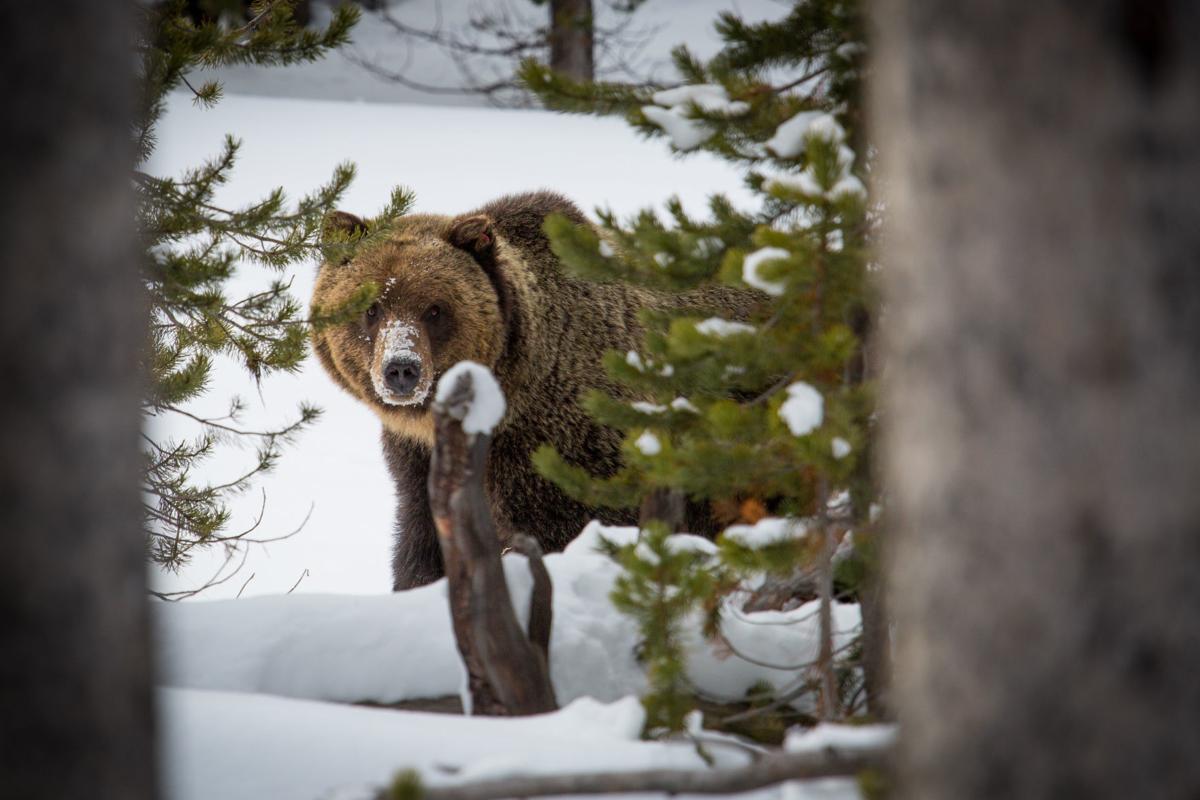
Grizzly bear (copy)

Grizzly bears were protected from hunting for mover 40 years while listed as threatened under the Endangered Species Act.

Public Domain/Neal Herbert via NPS

Not this year.

Montana Fish, Wildlife and Parks announced Thursday that it won’t ask the Montana Fish and Wildlife Commission to approve a hunting season for the recently delisted Yellowstone grizzly bears this year.

The bears were protected from hunting for more than 40 years while they were listed as threatened under the Endangered Species Act. Those protections were lifted in 2017, which opened the door for a potential hunting season. 

In a news release, FWP director Martha Williams said the decision is meant to reinforce the state’s commitment to the grizzly bear’s long-term survival.

“Holding off on hunting for now, I believe, will help demonstrate our commitment to long-term recovery and at the same time allow us the science-based management flexibility we need,” Williams said.

FWP will make the recommendation to its governing board at its next meeting Feb. 15.

The announcement comes weeks after Wyoming Game and Fish gained permission from its governing board to draw up grizzly bear hunting regulations, the first time since the 1970s that either state has had the legal authority to do so.

Removing Endangered Species Act protections for the bears gave more management responsibility to the states of Idaho, Wyoming and Montana. Prior to the delisting, each state had to create a framework for a potential hunting season, which was included in the final conservation strategy.

Part of the strategy is meant to limit the number of bears that are killed by humans. It created a level of “discretionary mortality” based on a population estimate. An agreement lined out before delisting split the allowable bear deaths between the three states.

The official government estimate puts the Yellowstone grizzly population at about 700 bears. Greg Lemon, a spokesman for FWP, said the allowable deaths for the three states was calculated to be 17.

Wyoming gets most of the allowable deaths, with the numbers this year being 10 males and 1 female. Idaho’s allowance is one female. Montana’s allowable mortality is 0.9 females and 5.8 males.

Montana will still retain its portion of allowable deaths, meaning the numbers for the other two states would remain the same whether the state decides to hunt bears or not.

FWP cited the ongoing legal challenge to the delisting as another reason it didn’t want to propose a hunting season.

At least five separate lawsuits over the delisting were filed by environmental groups and Native American tribes. They argue the bears shouldn’t have been removed from the list because the animals still face threats from climate change and shifts in their diets that result in more human-bear conflict.

FWP, some commissioners at odds over Montana’s extended elk season

[How quickly they forget they have wolves to help regulate elk and deer, as nature intended…]

http://missoulian.com/lifestyles/recreation/fwp-some-commissioners-at-odds-over-montana-s-extended-elk/article_80c3b99f-f452-54a0-9dc3-c4230385eec3.html

  • BRETT FRENCH french@billingsgazette.com
  • Updated 
Elk
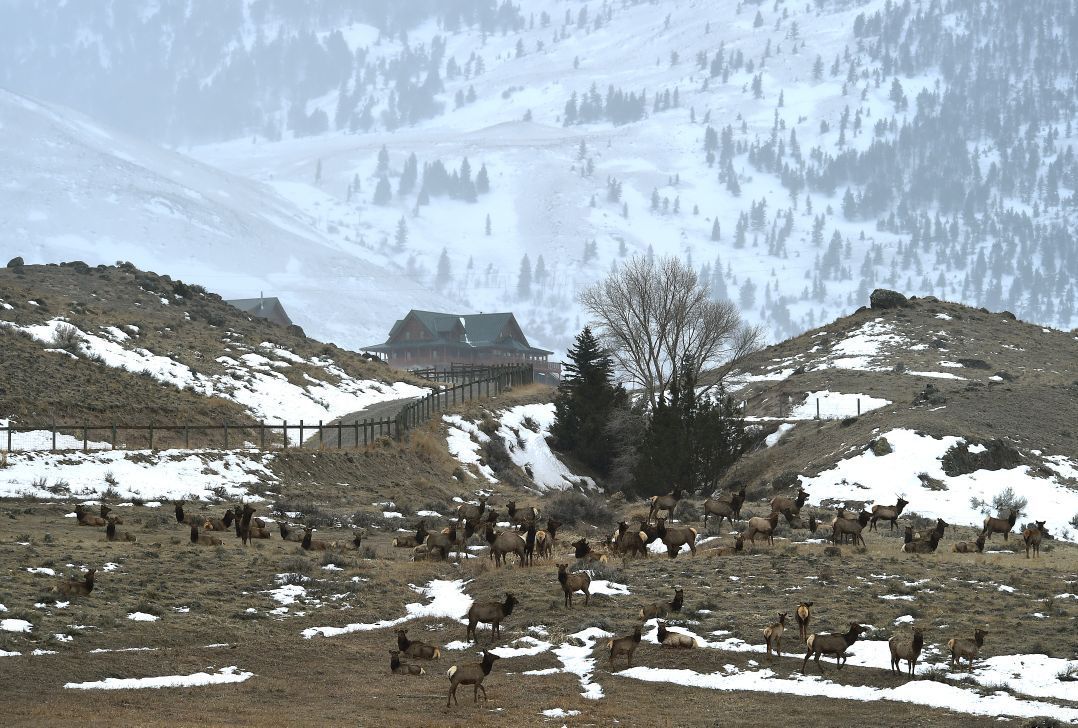
Some members of the Montana Fish and Wildlife Commission are concerned that extended elk hunting seasons are not having the desired effect and are pressuring some elk seven months of the year.

LARRY MAYER/Gazette Staff

“We think it’s time for cow-only elk hunting in the general season … in districts significantly over objective,” said Nick Gevock, conservation director for the Montana Wildlife Federation, at the commission’s meeting on Dec. 7.

“I totally agree,” said Dan Vermillion, of Livingston, who is the chairman of the Fish and Wildlife Commission.

Case in point

Vermillion pointed to Hunting District 580, on the east side of the Crazy Mountains, as an example of why Montana Fish, Wildlife and Parks should go to a cow-only elk hunt in specific areas. He said elk populations for the district are 200 percent over objective. The objectives are based on landowner tolerance.

The problem is that public access to hunt elk along the east side of the Crazy Mountains is limited because there’s only one public access to Custer Gallatin National Forest lands in that area. Some of the private land is leased to outfitters for hunts, or outfitted by landowners. Most outfitters are selling bull elk hunts, usually to out-of-state hunters, for about $5,000. There’s less interest in cow elk hunting by outfitted clients.

So going to a cow-only hunt in the area would essentially be a poke in the eye to outfitters, as well as a blow to their bottom line. It would also be a shot across the bow to landowners, demanding that public access to the elk be allowed or there will be consequences.

“At what point are we as a department going to either change the elk objective numbers or get serious about how to bring these numbers into objective?” Vermillion questioned.

+2  

Cow elk
Reducing the number of cow elk in certain hunting districts, often mainly on private land, is the objective of shoulder season hunts.

Gazette Staff

It’s working

John Vore, FWP’s Game Management Bureau chief, said the department has been serious, using the shoulder seasons to reduce elk populations. Now in its second season, shoulder seasons allow elk hunting mostly on private land as early as August and continuing through February in some hunting districts.

Last year, Vore said the 10 hunting districts with shoulder seasons that lasted to Feb. 15 reached 95 to 96 percent of their total harvest objective, a figure that includes the harvest during the general and extended seasons. But hunting districts like 580, along with a few others, halt the season by Jan. 1, essentially cutting the late hunt in half, he said.

“Sixty percent of those hunting districts with long shoulder seasons met those criteria and met 96 percent of the harvest criteria” despite weather that wasn’t always conducive to hunting, Vore said.

“In order to harvest elk, and harvest a lot of elk, you need to have a season that runs later than the general season,” he added.

The suggestion of a cow elk-only season in some hunting districts didn’t sit well with commissioner Richard Stuker, of Chinook. He said bulls can cause a lot of damage, even on property where landowners allow public hunter access. He also said that raising the population objectives for the number of elk allowed in a hunting district isn’t the answer, either.

“Otherwise, in about five to 10 years we’ll be in the same boat” as elk numbers continue to climb, he said.

According to FWP’s mathematical calculations based on 80 percent of elk being counted, elk numbers have climbed from about 163,000 a year ago to an estimated 176,000 across the state, a nearly 8 percent increase. The actual number of counted elk — not every area is counted — last year was about 141,400 elk, up from almost 130,700. The objective the FWP wants to reach is around 92,000 elk, which would be a 47 percent reduction in the current elk population.

Relying on hunters to reduce elk populations isn’t easy. Last season, more than 113,500 elk hunters spent more than 1 million days afield to harvest 24,500 elk. Only about 12 percent of all hunters were successful, though, because some hunters took two elk.

+2  

Elk hunting
Only about 12 percent of Montana elk hunters filled their tags last season.

BRETT FRENCH, Gazette Staff

Legislative stick

Vermillion said the extended elk hunting season isn’t only defined by FWP, hunters and landowners. The Montana Legislature also swings a very large stick, one that is often aimed squarely at Fish, Wildilfe & Parks’ forehead.

“The department — unfairly in my opinion — gets beat up by the Legislature for not reaching those numbers,” Vermillion said.

That was one of the objectives of the shoulder seasons, to give landowners a way to thin elk herds outside of the general season. If landowners do not help out by allowing hunter access, and elk populations don’t decline after three years, then FWP would be able to say they tried but were blocked in their efforts by uncooperative landowners.

No matter the reason, Vermillion said not reaching the objectives means the Legislature will be holding FWP accountable.

Hunter harvest

Last season, hunts in the state’s 43 districts with expanded seasons increased the harvest of cow elk by 33 percent, Vore said.

“So it is a tool that does work,” Vore said. “But of course, it’s not going to work if we don’t use it.”

Commissioner Shane Colton, of Billings, said he thinks the population objectives for elk are set too low in some hunting districts.

“If we were to manage down to those numbers we would be shot in the streets by hunters, outfitters and landowners,” he said.

Colton called the numbers antiquated and said a “lot of subjectivity” went into establishing the figures.

“I’m still stymied by the idea that we’re hunting elk seven months of the year,” he said. “Who would’ve thought that would happen in Montana?”

He also chided FWP for pushing shoulder seasons as the answer, noting that one week an elk may be worth thousands of dollars to an outfitter and the next it’s “treated like a rodent” to be exterminated.

“I really struggle with the idea that this is where we’re at,” he said.

Backing off

Vermillion said he would have pushed FWP for an antlerless-only elk season in HD 580, east of the Crazy Mountains, if it weren’t for the creation of a group attempting to solve the public access issue in the area.

“It probably would have been suicide to do it,” he said, but Vermillion has disagreed with legislators and landowners on the topic before, putting himself in the hot seat when his commission appointment came up for renewal before the 2015 Legislature.

Even with the shoulder season hunts, Vermillion doesn’t see how some of the hunting districts can reach the objectives.

“The department will have to prove to me in August 2018 we should continue” shoulder season hunts, he said. August is when the department will finalize the seasons for 2019, which is also a year that the Legislature meets and will closely follow the third season of the extended elk hunts.

The dilemma

Vore told Vermillion and the other commissioners that FWP wants to use the shoulder seasons to “full effect” next hunting season, expanding the late season hunts out to Feb. 15 in hunting districts like 580.

Martha Williams, who is still in her first year as FWP director, said she has heard a lot of the same complaints as the commissioners, but she wants to learn more from the current course the department is on before recommending any changes.

“It’s not whether we revisit the objectives, but when,” she said. “I am paying attention,” but didn’t think it was prudent to make any changes now.

“We need to do something and figure something out or the Legislature will be telling us what to do,” Stuker said.

“I’m not naïve,” Colton said. “I understand why we have (shoulder seasons).

“But I don’t want the Legislature setting our seasons and quotas,” he added. “My preference would not be to expand (the shoulder seasons) all out to Feb. 15. But if we don’t, then the Legislature will say we were on track and you shot us down. It’s just an unfortunate situation for us to be in because there are other tools and other methods than a seven-month elk season that we now have.”

‘Dead bears don’t learn anything’ — Biologists balk at notion hunting makes bears wary

Grizzly bear

It’s hard for a grizzly bear to learn anything when it’s dead.

That’s the take of two grizzly bear biologists in northwest Montana on the notion that grizzly bears will learn to fear man if the states of Montana, Idaho and Wyoming allow a limited trophy hunt now that the species’ threatened status in the region around Yellowstone National Park has been revoked by the U.S. Fish and Wildlife Service.

Last week, the National Rifle Association and Safari Club International asked to intervene in a lawsuit that seeks to restore protections for grizzly bears in the Yellowstone ecosystem.

In affidavits, several members of the two organizations said allowing a grizzly bear hunt would improve public safety as well as help the region’s economy and allow states to better manage the animals.

Safari Club International Idaho Chapter President Anthony Hafla of Idaho Falls said that hunting grizzly bears would limit the human-bear conflicts that now occur, especially during bow season.

“Grizzlies are smart animals and as soon as they figure out that man is dangerous, they will avoid such conflict,” Hafla said. “The overall outcome for the bears will be positive as fewer bears will be killed out of self-defense or from culling bears that have been involved in altercations with humans.”

Edwin Johnson, a 70-year-old outfitter from Gardiner, said he would welcome the opportunity both to offer guided grizzly bear hunts to his clients as well as hunt one personally.

“To me, this is a public safety issue,” Johnson said. “In 1996 and 2007, clients of mine were mauled by grizzly bears. More bears are becoming more aggressive. They need to be hunted so that they fear the scent of humans, rather than following as they do now.”

Montana Fish, Wildlife and Parks Libby area grizzly bear management specialist Kim Annis has heard that argument before.

“If the argument is that hunting bears will teach them to be afraid of humans, I don’t understand how that would play out,” Annis said. “Bears are solitary animals. If someone kills one, it’s dead. It would have to stay alive to actually learn something.”

Annis said people have been hunting black bears forever and they still come around people. Alaska has allowed hunting of brown bears — which are called grizzlies in the Lower 48 — and there are still conflicts between bears and humans there.

“I don’t see where there is any evidence that bears learn to fear humans because of hunting,” she said. “If people want to be able to hunt grizzly bears as a trophy, that’s what they should say.”

Confederated Salish and Kootenai Tribes grizzly bear specialist Stacy Courville said he couldn’t say for sure how bears would react to being hunted, but there is one thing he knows for certain.

“Dead bears don’t learn anything,” he said. “Unless there is a bear right there standing next to the one that got shot, I’m not sure how bears would learn anything about being hunted. … Intuitively, that doesn’t make any sense to me.”

Courville’s experience does tell him that grizzly bears are capable of learning to avoid unpleasant situations.

A cornfield surrounded by an electric fence near St. Ignatius has shown him that numerous times.

“We had bears that were patrolling the outside perimeter almost every night in hopes of finding a way in,” he said. “We had bears inside the fence that couldn’t get out. When they finally did decide to leave and the fence was turned off, they still hesitated before going through it.”

The female bear stuck inside the fence had two cubs with her. As the corn patch was harvested and it grew smaller and smaller, Courville occasionally saw her stand up and look around.

When the three finally decided to make a break for it, Courville happened to be there to watch.

“While mom barreled right through the fence, the two cubs hesitated when they got to the fence,” he said. “She was already across the county road before they even attempted to get through the fence. That was learned behavior.”

Proud Montana hunters show their “trophies” of 2017

 Sent  by a friend there wth these words:

“PROUD” MONTANA HUNTERS SHOW THEIR TROPHIES
….Warning!..graphic pictures of dead animals

I’m at a loss for words here…smiling faces showing off a dead animal?…what is wrong with these people? Were they abused as children..WTF?
This is on the front page of the Missoulian newspaper


Hunting season 2017 was a big success for many Montana hunters. Readers submitted their photos of this year’s trophies.

Grizzly roadmap: Studies show grizzlies finding their way around people

http://missoulian.com/news/local/grizzly-roadmap-studies-show-grizzlies-finding-their-way-around-people/article_265135ca-15b5-5e28-bc2a-bde1e15935c4.html#tracking-source=home-top-story-1

Grizzly bear management has evolved from growing populations to moving them around. And a couple of new reports give mixed signals about how the keystone predators travel.

In the United States, evidence has grown that grizzlies have almost bridged the gap between the Northern Continental Divide Ecosystem north of Missoula and the Greater Yellowstone Ecosystem south of Bozeman. But a British Columbia study released this month raises doubts about the condition of its much larger bear population.

Grizzly movement matters because the rare and federally protected animals must avoid inbreeding for their populations to remain healthy.

Critics of taking Greater Yellowstone grizzlies off the endangered species list say that the recovery area lacks connectivity to other bears, and so risks genetic decay.

The U.S. Interior Department proposed turning Greater Yellowstone grizzlies over to state management in July, and is developing rules for similar delisting of the Northern Continental Divide Ecosystem population within a year.

Montana researchers Cecily Costello of Fish, Wildlife and Parks and Frank van Manen of the U.S. Geological Survey published a report on possible grizzly pathways out of the Greater Yellowstone Ecosystem in the journal Ecosphere. Their work lends hope that the genetically isolated population around Yellowstone National Park may soon get a breeding boost as northern bears shake their family tree.

“There were routes that were not obvious before we started, and a lot more alternatives than we thought initially,” van Manen said.

Some bears leave the Bob Marshall Wilderness Complex via the short but precarious path around Helena through the Big Belt Mountains toward Bozeman and relative security north of Yellowstone. Others loop around Butte to approach Yellowstone from the west.

One counter-intuitive result van Manen observed was that the heavily used routes weren’t necessarily the best ones.

“The concentration isn’t because that’s the great habitat,” van Manen said. “It’s because there’s not a lot of great places to go. Those are pinch-points.”

Knowing that allows land managers and bear advocates to do two things. One is to make sure those pinch-points don’t become too hazardous for grizzlies, such as providing wildlife crossings at freeways.

The other is to protect the qualities of the more dispersed routes.

“Those (dispersed routes) have really good, secure habitat like the Beaverhead and Bitterroot mountains that are already well-protected with little human influence,” van Manen said. “That might make those routes more effective in the long run. We shouldn’t just focus on the ones with highest concentration.”

At least 21 grizzly bears have been tracked moving between the two recovery areas. Almost all have been males. Female bears are much less likely to cross highways or human settlements, the authors noted.

“Our analyses placed much greater emphasis on potential paths following the Rattlesnake, Garnet, John Long, Flint Creek, Anaconda, Pioneer and Highland Mountains,” the authors wrote. “The Tobacco Root Mountains may be a particularly pivotal stepping stone, as many different paths converged on this mountain range.”

***

Three smaller recovery areas in the Cabinet-Yaak, Selkirk and North Cascades mountains of Montana, Idaho and Washington also depend on the movement of grizzly bears. Pathways there cross the international border between the United States and Canada, where British Columbia has a much larger grizzly population.

Last week British Columbia Auditor General Carol Bellringer warned that supply of grizzlies may be at risk as well.

The southeast corner of the province bordering Waterton-Glacier International Peace Park holds B.C.’s greatest concentration of grizzlies. That zone is also the only portion of the B.C.-U.S. border open to grizzly hunting. But three of the four zones just to the west, bordering the small Cabinet-Yaak, Selkirk and North Cascade U.S. recovery zones, were considered threatened populations by the Canadians.

+2 

British Columbia grizzly bear population units
British Columbia Auditor General

British Columbia has slightly more than twice Montana’s area and more than four times its population, although about 2.6 million of the province’s 4.6 million people live in the greater Vancouver area north of Seattle.

It also has more than 10 times the grizzly bears: an estimated 15,000 compared to the 1,500 to 1,800 estimated in Montana and the Greater Yellowstone Ecosystem, which includes Idaho and Wyoming. Alberta had about 580 grizzlies, including about 140 in the region between Waterton Lakes National Park and Banff.

Grizzlies can be hunted in British Columbia, but Bellringer said that was less a threat to their management than loss of habitat.

“The expansion of development in oil and gas, forestry and human settlement makes it more difficult for grizzly bears to mate, and results in food source loss, as well as more human-bear conflict,” Bellringer wrote. “An increase in resource roads — 600,000 kilometers (100,000 miles) existing and more added every year — also leads to more human-bear conflict, and ultimately, grizzly bear deaths.”

British Columbia charges residents $80 for a license to hunt during its grizzly season, while nonresidents pay $1,030. Grizzly hunting brings about $6 million to $7.6 million to the provincial economy. Commercial bear viewing in just one part of the province, the Great Bear Rainforest, was worth $15 million in 2012, according to the auditor’s report.

While sales of resident hunting licenses have stayed steady at around 300 a year, nonresident sales have spiked. They grew from about 800 in 2000 to 1,700 in 2016. The audit did not separate Canadian and foreign purchases in the nonresident category.

The possibility of U.S. states offering grizzly hunting seasons has been a major controversy in the delisting debate. But van Manen noted that the Canadians were borrowing many of the same steps Americans have used in the Endangered Species Act recovery process to maintain their bear populations.

“We’ve certainly been fortunate we have a strong piece of legislation like the ESA,” van Manen said. “Roads are key. Keeping road density below certain thresholds is key to effective grizzly bear conservation.

“In the Yellowstone, that’s accomplished by setting standards for secure habitat that are at the same levels as 1998 or below. The same thing is happening with the NCDE (Northern Continental Divide Ecosystem) conservation strategy. That guarantees that in the core of the ecosystem, the road densities and motorized access will really not change.”

70-year-old wanted to ‘wear a coonskin cap, hunt bears, be a real woodsman’ — so he did

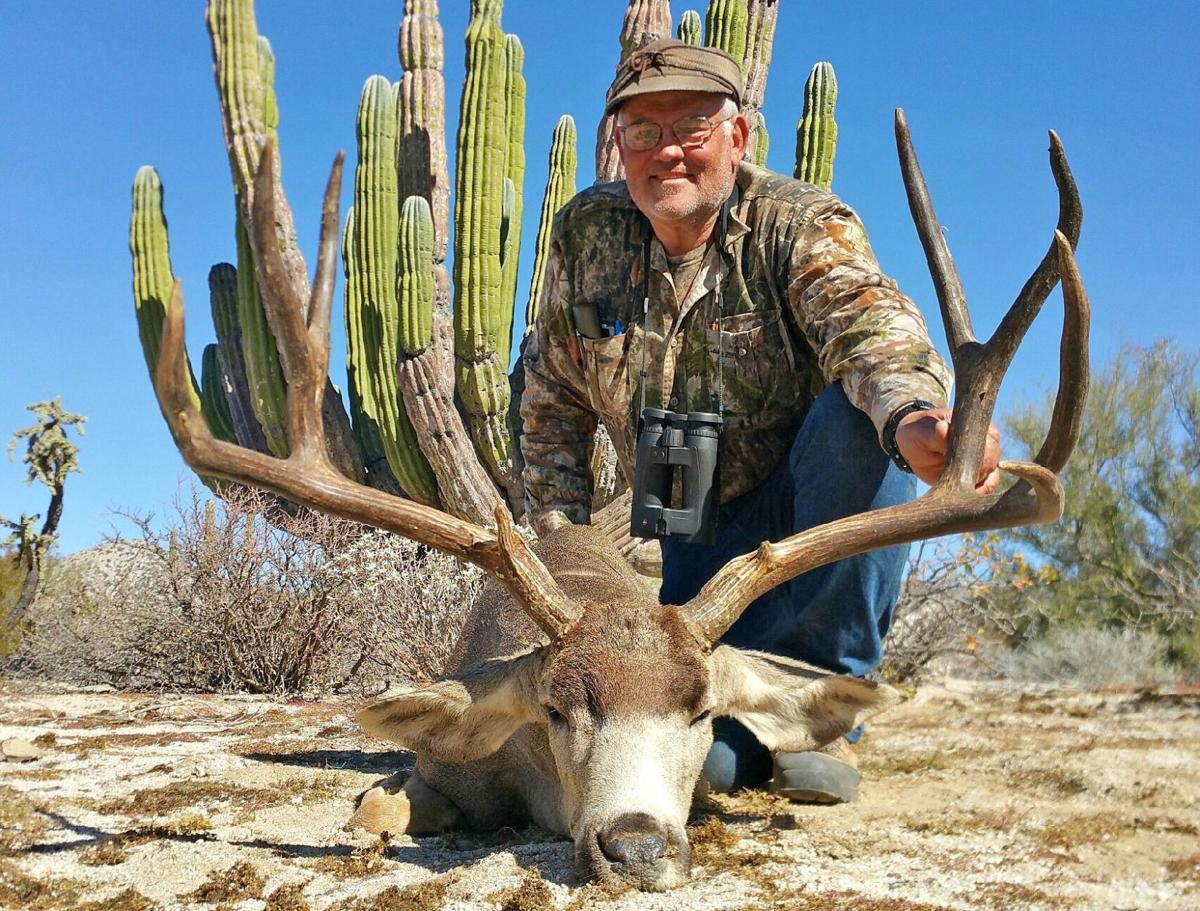
Biggest muley
Bill Butler shot this mule deer northwest of Hermosillo, Mexico, about 750 miles south of his Wyoming home. The buck’s antlers measured 36 inches wide and had a gross score of more than 195. He collected the trophy animal just days shy of his 70th birthday.

Courtesy photo

Five days short of his 70th birthday last year, Bill Butler shot the biggest mule deer of his long hunting life.

That’s saying something for a guy who literally wrote the book on “The Versatile Trophy Hunter.”

“I’m getting old, but I’m still poking around,” he said.

His love for hunting started when he was just a boy. That was when he developed an “intense instinct and desire.”

“I’ve slacked off a bit as I’ve gotten older, but I still like to get a good animal,” he said.

As if to prove the fact, on Sept. 5 he shot the largest bull elk of his life, which green scored 352 gross and had a 54-inch main beam. He shot the 8×6 elk from a ground blind at 325 yards. He would have preferred to stalk the bull, but with so many other elk in the area, he had little choice.

Montana boy

Bill grew up in Silesia, Montana, hunting with his father, Jim Butler, as soon as he passed Hunter Education at age 12. A photo in his book shows him looking a little unhappy at that age. His father balances a rifle and his right foot on the bumper of a car while draping an arm around his son. An antelope’s leg can be seen sticking out of the trunk. Bill wears a Davy Crockett shirt in the photo, a figure idolized by the youngster in 1958.

“I wanted to wear a coonskin cap, hunt bears, be a real woodsman, and wander throughout the wilderness when I grew up,” Bill wrote in the photo caption.

And he did.

“Growing up through high school, my brothers and I hunted as intensely as young wolves, taking many deer and antelope,” Bill wrote. “Soon we were shooting the legal limit of two deer each. We had more than enough meat to eat at home and supplied several neighbors, also.”

+2  

Bill's big whitetail
While hunting in Saskatchewan, Butler found this big whitetail on Dec. 1, 2016. The buck gross scored 169.

Courtesy photo

Outfitting

After high school Bill started guiding hunters, including difficult backpacking trips for bighorn sheep in remote and lofty portions of the Beartooth Mountains. Just hiking to the locations would be a 15- to 20-mile trip, he said. The outings paid off in five bighorn sheep for him, in addition to those he guided clients to.

“I carried 120 pounds for two days one time when I guided for a hunter,” Bill said, packing out their camping gear and the hunter’s sheep. “Now I don’t have any cartilage between my discs in my lower back.”

After 20 years of guiding in Montana, he hung up his license in 1986. He was 40 years old, had a pickup he still owed $6,000 on and no money in the bank. Yet he quickly transitioned to a new adventure, marrying Diana Wolff. Together they bought 86 acres in Wyoming and opened a guest ranch and started raising bucking bulls for the rodeo circuit.

Diana, 12 years his junior, said it’s a family joke that a month after getting married Bill took off on his honeymoon — without her — to hunt in Alaska for four weeks.

“Hunting is in Bill’s blood,” she said. “I knew who he was when I married him.”

Instead of children, they’ve raised a lot of livestock and dogs. That’s now dwindled down to three horses, three longhorn steers and six dogs.

Hard knocks

Bill even rode bulls for a while, but over a lifetime of active living, the injuries have added up. He’s torn the meniscus in both knees, has a 4-inch titanium rod and shoulder ball because he had dislocated it so much. He still carries around part of a .22 bullet in his shin after he dropped his Ruger Bearcat pistol which discharged and shot him. Then in 2013 he suffered a massive stroke.

“I was given the ‘wonder drug’ tPA (tissue plasminogen activator) which saved my life and left me with no ill effects of a stroke,” he wrote in a text.

But Diana said the doctor warned her before prescribing the medicine that there was also a chance Bill could bleed to death when given the drug. Although he was paralyzed on his left side and couldn’t talk in a way that Diana and the doctor could understand him, he agreed to risk trying the drug.

“That’s no life, not for a guy like Bill,” Diana said of the possibility that he might be permanently paralyzed. “Afterward, he got to thinking about it and said it was like riding a bucking bull. You nod your head and you might die before the ride is over.”

While being treated for the stroke, his doctor told him there was evidence of a previous stroke and that he “could die any day of another one.”

“I would say he’s more reflective on his life now,” Diana said. “He’s probably paying a little bit more attention to the things he wants to do.”

+2  

Biggest elk
Butler had been scouting elk prior to the season but this big bull showed up much later. The bull is the largest Butler has ever shot.

Courtesy photo

Back in the saddle

Such a blunt confrontation with his mortality prompted Bill to lose weight, take dietary supplements and begin a daily regimen of walking.

“I’ve been walking all my life,” he said. And he competed in track when in high school.

It was Bill’s youthful brush with track that prompted him to enter the Big Sky State Games. In the last four years he’s won 29 medals, five gold medals in 2017 and in July set the pole vault record for his 70 to 74 age class — 4-feet-9 inches.

Bill and Diana both took instruction from Cody high school track coach Scott Shaffer in June to get tuned up for this year’s event. The pole vaulters were the oldest he’d ever taught, yet they easily mixed with their teenage counterparts.

“When I first found out about it I was kind of expecting a little wiry guy,” Shaffer said. “But then I saw him and thought, ‘Oh my god, I hope it’s not him cause he’s a huge dude!’”

Bill is 6-foot-3 and weighs in at 241 pounds.

New goals

Just like his verve for hunting, Bill took to pole vaulting with the same determination.

“I’m fairly competitive too,” Diana said. “If Bill wants to do something, he does it to the Nth degree.”

“He wanted to do 50 jumps, I wanted him to do five,” Shaffer said. “He wanted to come back the next day, I wanted him to wait a week.”

But waiting or taking things easy just isn’t in Bill’s DNA, whether he’s raising bulls or hunting, everything is full tilt and all in.

“He’s not one of those guys sitting on the couch getting old and watching TV,” Shaffer said. “He’s going toe to toe with Father Time every day.”

Diana agreed. Even though she was hesitant about letting Bill drive 750 miles to Mexico for last year’s mule deer hunt, and also to drive north about the same distance to hunt whitetails, she said it wouldn’t have been fair to ask him not to go.

“I was very worried, but I don’t want him sitting here in the rocking chair and dying,” she said. “I know he’d be a lot happier dying out in nature.”

Bill doesn’t envision himself kicking the bucket anytime soon. Instead, he’s set his eyes on the prize of setting records in the Big Sky State Games track and field events when he’s 90.

“The more intense you hunt the better you do,” Bill said. “It’s the same with anything.”