Natural resource body readies bobcat, otter trapping rules

Public comment now being accepted

By: Leslie Bonilla Muñiz – September 18, 2024 7:00 am


 Natural Resources Commission member Patrick Early (left), department Director Dan Bortner and commission Chair Bryan Poynter at a commission meeting on Tuesday, Sept. 17, 2024. (Leslie Bonilla Muñiz/Indiana Capital Chronicle)

Indiana’s Natural Resources Commission on Tuesday approved preliminary rules for a new, lawmaker-mandated bobcat trapping season, and finalized statewide river otter trapping regulations.

Commission leader Bryan Poynter called the bobcat work a “heavy lift,” speaking from the ballroom at the Fort Harrison State Park Inn in Marion County.

The Department of Natural Resource’s proposed changes would include establishing a bobcat trapping season in 40 southern Indiana counties, with a bag limit of one bobcat per trapper and a season quota of 250 bobcats. It would run November to January.

Public comments can be submitted here by clicking on “Comment on this rule.”

Biologist Geriann Albers said the department based the limits on a data model created in collaboration with Purdue University.

 Department of Natural Resources Biologist Geriann Albers speaks at a commission meeting on Tuesday, Sept. 17, 2024. (Leslie Bonilla Muñiz/Indiana Capital Chronicle)

The model’s assumptions were “very conservative,” she said.

“We’re very confident that that number is sustainable and is not going to negatively impact our bobcat population,” Albers told the commission.

The season is limited to “established” populations in the south, for example, because bobcat populations further north are still considered “emerging.”

The department also recommended other amendments: letting legally acquired bobcats and parts to be sold, letting bobcats found dead to be kept for personal use with a permit, and more.

Traps would be limited to cage, foothold and cable device traps.

“We know those three types have been tested on bobcats, and they’re humane, efficient and selective for bobcats,” Albers said.

She told the Capital Chronicle that the department’s efforts related to bobcat trapping go back at least four years. Rulemaking for a brand-new season is complex, she said, because it involves plenty of data and other moving parts.

In 2019, the department weighed a bobcat season but dropped the idea after public backlash. Lawmakers stepped in earlier this year to require a season.

The department’s Fish and Wildlife Division aimed for balance.

“People like to participate in hunting and trapping, but we also want to strike that balance of (bobcats) still being available for people to view or photograph and things like that,” Albers said. “So we’re trying to maximize the outdoor activity that’s available, but in a sustainable way.”

 Fort Benjamin Harrison State Park’s inn on Tuesday, Sept. 17, 2024. (Leslie Bonilla Muñiz/Indiana Capital Chronicle)

The commission approved preliminary adoption of the amendments by voice vote. Public comment comes before a final vote.

Animal rights activists decried the move.

Samantha Chapman, Indiana state director for the U.S. Humane Society, said the group was “deeply disappointed” in the initial approval.

“While the Commission was given no choice on proposing such an unpopular season, we urge them to recognize Hoosier’s overwhelming opposition to this inhumane and scientifically unjustifiable treatment of Indiana’s only remaining native wildcat, whose population is still recovering,” Chapman said in a Wednesday statement.

She pushed the commission to set a quota of zero bobcats, noting it has the discretion to do so.

Swimming out of extinction

Commission members separately O.K.’d final rules for an expanded river otter trapping season, a development that Poynter dubbed “one of the biggest success stories that we’ve had in Indiana in a long time.”

Hoosier river otters were few and far between by the 1900s, and were even classified as extinct in Indiana in 1942, according to Purdue University.

The department began a reintroduction program in 1995, releasing 303 river otters into the state before the new millennium, according to its website. Most came from Louisiana, per Albers.

By 2005, the population had recovered so much that river otters were removed from the state-endangered list. The department opened its first limited season for the creatures in 2015.

Now, the department estimates there are upwards of 8,000 river otters in Indiana.

“As … otters have kept expanding, we’ve upped that quota once, and we started adding more and more counties, and we were kind of at a tipping point where most of the state was already open and there was only some counties that weren’t,” Albers said.

And, Hoosiers having “otter issues” can take them during the season instead of having to get other permits. River otters commonly get into small ponds stocked with fish, she said.

“Otters see those kind of as buffets,” she remarked.

The changes establish a statewide trapping quota of 750 river otters with an individual bag limit of two. The season extends from mid-November to mid-March.

Note: This article has been updated with comments from Indiana’s chapter of the Humane Society.

Dodo could be revived by 2028 after humans ATE them into extinction – and more long-extinct birds could follow

But anyone wanting to replace their turkey with a dodo for future Christmas’ will be sorely disappointed.

  • Published: 12:30 ET, Oct 5 2024

THE long-extinct dodo could be brought back from the dead by 2028, nearly 350 years after humans hunted them into extinction.

Either that, or the long-lost Tasmanian tiger, the CEO of a landmark gene-editing company told The Sun.

Sign up for The US Sun newsletterSign up

Your info will be used in accordance with our Privacy Policy

In an interview, CEO Ben Lamm said the woolly mammoth wouldn't be the first extinct species to be born by 2028
In an interview, CEO Ben Lamm said the woolly mammoth wouldn’t be the first extinct species to be born by 2028Credit: Colossal Biosciences
Dodos only lay one egg per year, which became food for new incoming species, and significantly accelerated their extinction
Dodos only lay one egg per year, which became food for new incoming species, and significantly accelerated their extinctionCredit: SWNS
Scientists hope to merge the genes of the woolly mammoth with its closest living relative, the Asian elephant
Scientists hope to merge the genes of the woolly mammoth with its closest living relative, the Asian elephantCredit: Getty
While these animals are expected to visually resemble the extinct species they're modelled on, they will be genetically engineered versions
While these animals are expected to visually resemble the extinct species they’re modelled on, they will be genetically engineered versionsCredit: Getty Images

Colossal Biosciences, understood to be the world’s first de-extinction company, is trying to bring the woolly mammoth, tasmanian tiger (thylacine) and dodo back from the dead.

Some 4,000 years after extinction, the woolly mammoth species is on track to have its first baby born via an artificial womb by 2028, thanks to a recent breakthrough.

But in an interview, CEO Ben Lamm said the woolly mammoth wouldn’t be the first extinct species to be born by that year.

“I don’t believe the mammoth will be the first species,” he said. “You know, it’s 22 months of gestation (incubation).”

READ MORE ON ANIMALS

SEA LEGS 

Incredible moment rarely seen bigfin squid with 13ft tentacles is caught on camera

Lamm, instead, reckons the dodo or the Tasmanian tiger might be born first, due to their shorter development times.

How is it done?

While these animals are expected to visually resemble the extinct species they’re modelled on, they will be genetically engineered versions.

For example, scientists hope to edit gene cells taken from a well-preserved woolly mammoth that was found frozen.

They will then combine those genes with the genes of an Asian elephant, the woolly mammoth’s closest living relative.

Scientists will also isolate the cold-resistant traits of a woolly mammoth, such as its thick hair, to insert into the Asian elephants genome.

Essentially, Colossal will create a cold-resistant version of the Asian elephant to exist in the Arctic Tundra.

Similar techniques will be used for the Tasmanian tiger and the dodo.

While there is some dispute over how exactly the dodo went extinct, the species thrived on the island of Mauritius until the arrival of settlers in the late 1500s.

The dodos were easy to catch because they had not yet learned to be afraid of humans, and lived together in small wooded areas of the island.

While accounts say they did not taste very nice, they were often caught and stewed by arriving sailors.

Most read in Science

TRAGIC END

Madonna’s younger brother dies aged 63 as tributes pour in for ‘talented’ artist

‘MURDER’ PROBE

Influencer, 36, found ‘murdered after she didn’t pick up son from nursery’

MEG, MYSELF & I

Meg makes surprise appearance without Harry – as they ‘live separate lives’

EXTREME PROTEST

Pro-Palestine protester sets himself on FIRE outside the White House

It wasn’t just humans that feasted on the dodo, but the rats, goats, pigs, deer and macaque that emerged there too.

Dodos only lay one egg per year, which became food for new incoming species, and significantly accelerated their extinction.

https://imasdk.googleapis.com/js/core/bridge3.670.0_en.html#goog_1224267667Play Video

Gruesome way humans killed 12-ton woolly mammoths in Ice Age finally revealed as scientists squash spear-hunting ‘myth’

But anyone wanting to replace their turkey with a dodo for future Christmas’ will be sorely disappointed.

Trophy hunting woolly mammoths in the Arctic Tundra, or Tasmanian tigers in Australia and the US will also be strictly prohibited.

“We aren’t bringing animals back to hunt them and we aren’t bringing animals back to eat them,” Lamm explained.

“It would be sad [if they were hunted], but we’d hope that the governments and partners that we’re collaborating with would help us in the enforcement of those protections.”

While just one dodo, tasmian tiger or woolly mammoth born in the 21st Century would be considered a triumph to any layman – Lamm’s vision goes further.

“I don’t define that as a success,” he said, adding “I think that you have to engineer in enough genetic diversity so you have small populations.”

Lamm doesn’t just want one or two of each species resurrected, but fully, self-sustainable populations across various different regions.

“Our conservation partners have found success in rewilding, or rebounding populations from as many as five to ten individuals (animals),” he said.

“I think that we will probably engineer small herds of mammoths, thylacine and dodos and others to help spur that.

Read More on The US Sun

DEADLY ATTACK 

Man, 55, mauled to death by bear as he picked mushrooms in horror attack

TAINTED LOVE 

I let my husband sleep with other women – then he moved his girlfriend in

“But then we probably have multiple different breeding populations would be the goal.

“So, you know, our goal isn’t to make one. I’ll tell you, the second one’s a lot cheaper than the first one. So, I think we’ll probably make as many as possible.”

Could recent ‘self-defense’ killing of mountain lion sway public on proposed hunting ban?

Mountain Lion Jumping in Natural Autumn Setting Captive Photo Credit: GarysFRP (iStock).
Photo Credit: GarysFRP (iStock).

Instagram user Patrick Montgomery recently shared additional details related to the killing of a mountain lion in Colorado, with some of this information said to address what took place from the side of the person who killed the animal. Montgomery’s post about the situation is accompanied by numerous photos of the big cat (warning: graphic in nature), along with the shovel presumably used to kill the animal.

In case you missed initial reporting on the situation, Colorado Parks and Wildlife detailed how a man was at a campground west of Cañon City on September 26 when a mountain lion was being abnormally aggressive toward the man and his dog. As the mountain lion approached the pair and shortened the distance to about 10 feet, wildlife officials say the man’s dog engaged the animal, with the man then striking the lion with a shovel and killing it. Officials noted that the preliminary investigation pointed to justified self-defense.

The post from Montgomery claims to provide additional detail on the matter, noting that the man involved was a friend of a friend who is a raft guide living in a camper near the Royal Gorge. The post explains that the incident took place around midnight, with the lion said to have targeted the man’s husky. The guide reportedly grabbed the shovel and whacked the big cat to get it to leave, but when it returned, he struck it again, ultimately killing the animal in order to protect himself and his dog.

While officials aren’t considering this to be a mountain lion ‘attack’ on a human because the man involved wasn’t injured and didn’t come in direct contact with the mountain lion, the additional information related to the encounter is enough to send chills down any outdoor recreator’s spine. Mountain lions are rarely seen and aggressive behavior toward humans is even more rare, but this situation goes to show that dangerous encounters are still a very real possibility.

This incident took place weeks before Coloradans are set to vote on whether or not the hunting of mountain lions (and other wild cats) should be allowed in Colorado, with hunting often considered to be a key method of population management.

The ballot item that will be voted on is Initiative 127, with proponents for the ban claiming that hunting causes animals unjust pain and trauma, also positing that mountain lion (and bobcat) populations are able to naturally self-regulate without a need for involvement in Colorado’s hunting program. It’s also worth noting that those who support this ban would still be agreeing that self-defense killings are justified.

Meanwhile, those who oppose the initiative argue that the measure would restrict the abilities of Colorado Parks and Wildlife to use their expertise to make science-based decisions related to the management of the local mountain lion population, also noting that the current approach toward management of the species seems to be working as the state’s mountain lion population is quite healthy. Additionally, those against proposition 127 have noted that increased mountain lion numbers could mean more frequent damages sustained by ranchers due to depredation of livestock, with these ranchers also losing the ability to seek reimbursement for damages should the initiative pass.

This ballot initiative comes a few years after wolf reintroduction was narrowly approved by Colorado voters via a similar method. That approval has since been questioned countless times by those who opposed the measure with the term ‘ballot box biology’ often linked to the program – this term being a reference to voters making decisions related to the management of the state’s wildlife instead of allowing those decisions to be made by wildlife experts hired by the state.

As it relates to this recent Cañon City encounter, some of those leaving comments about the situation online have expressed concern that this type of encounter could happen more frequently if the local mountain lion population is left unchecked. Additionally, concern has been expressed related to what an increased mountain lion population could mean for Colorado’s prey animals, such as deer.

Those wondering whether or not hunting may have an impact on Colorado’s mountain lion numbers may want to consider the impact of a mountain lion hunting ban that was put in place in California, where lions haven’t been hunted since 1972, with cougars later classified as a ‘non-game’ species in 1990 (it’s a different state with different factors, but perhaps the most comparable example of a similar situation in the US). In a study related to the population of California’s mountain lions that spanned years of 1906 to 2018, the population was estimated to be at its highest around the start of the 1900s, dipping to a low around the time that the mountain lion hunting ban was enacted. Since the ban, the population has continued to grow, approaching levels much closer to those seen 100 years ago by 2018 (chart seen on page 75 of this document). This presumably points to a ban on hunting having the potential to mean a larger mountain lion population.

And then there’s the question of what a larger mountain lion population might mean for local ungulates. 

As it currently stands, around 500 mountain lions are killed via hunting each year in Colorado. With adult mountain lions killing approximately one deer per week for consumption, the absence of 500 cats means that roughly 26,000 additional deer have a chance to escape death (napkin math, I know). It’s estimated that there are around 400,000 to 450,000 deer statewide, with this 26,000 number representing about five to seven percent of that population. It’s also worth noting that the average lifespan of a mountain lion in the wild is about eight to 13 years, thus multiple years of survival in the absence of death via hunting would need to be taken into account if the 500 mountain lions killed by Colorado hunters each year were to keep predating on ungulates for years to come. There’s debate over whether or not this additional predation would impact the stability of the deer population or help qualm concerns related to chronic wasting disease, which plagues local cervids and thrives when high population density is present.

While Initiative 127 is heavily tied to hunting, a large part of the proposal also seems to boil down to whether or not one believes that wildlife experts should have a hand in the population management of big cat species.

Full details related to this initiative can be found here. Scroll down to page 39.

Raptor Center sees increase in entanglement injuries with birds and soccer nets

By Ubah Ali

October 3, 2024 / 10:29 PM CDT / CBS Minnesota

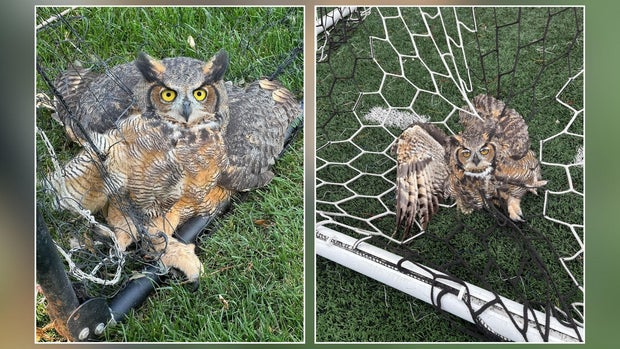
ST. PAUL, Minn. — We’re “owl” all in this together — that’s the message experts at the Raptor Center are pushing after five raptors got caught in soccer nets while on the hunt.

One red-tailed hawk and four great horned owls got themselves into a tight situation after getting caught in nets.

“Five in the month of September is a lot in one short period of time,” said Dr. Dana Franzen-Klein of the Raptor Center.

Franzen-Klein said entanglement admissions are higher than usual this year and a major problem for younger birds.

“This time of year, young great horned owls are separating from parents and learning how to hunt on their own,” Franzen-Klein said. “(They are) less experienced and so focused on hunting that they don’t see the soccer net at night.”

owls-trapped-in-soccer-net-mn-raptor-center.jpg
Raptor Center

Experts say entanglement injuries can be the most difficult to treat even leading to death.

“It restricts blood flow to their wings can cause them to get really swollen and get muscle strains that are really painful, and they may fly away but they are uncomfortable and can’t fly well enough to survive,” Franzen-Klein said.

She believes the best way people can help our feathered friends is to remove the nets or tip down the net.

“That’s a real easy thing you can do so it’s flat against the ground so birds will not get tangled in it,” Franzen-Klein said.

She also recommends regularly checking soccer nets and any landscape netting around your home.

Of the five raptors admitted to the hospital, one did not survive, one was released, one is relearning to fly and two are still receiving care.

Click here to learn what to do if you come across an injured bird.

Crows are even smarter than we thought

New evidence suggests the corvid family has surprising mental abilities.

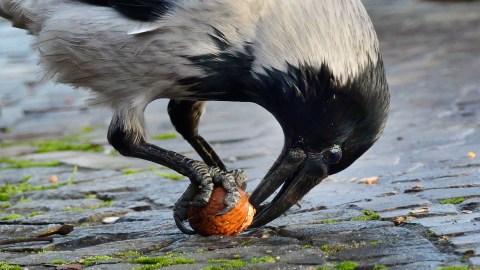
A hooded crow, exemplifying the intelligence of smart crows, pecks at a nut it holds with its claws on a mossy stone ground.
Crow uses pavement for leverage to crack a nut.Wolfram Steinberg / picture alliance / Getty Images

Kenna Hughes-CastleberryCopy a link to the article entitled http://Crows%20are%20even%20smarter%20than%20we%20thought

Share Crows are even smarter than we thought on FacebookShare Crows are even smarter than we thought on Twitter (X)Share Crows are even smarter than we thought on LinkedIn

Story by

Sign up for the Smarter Faster newsletter

A weekly newsletter featuring the biggest ideas from the smartest people

Fields marked with an * are required

Crows and ravens, which belong to the corvid family, are known for their high intelligence, playful natures, and strong personalities. They hold grudges against each other, do basic statistics, perform acrobatics, and even host funerals for deceased family members. But we keep learning new things about the savvy of these birds, and how widespread that savvy is among the corvid family.

Featured VideosThe video player is currently playing an ad. You can skip the ad in 5 sec with a mouse or keyboard

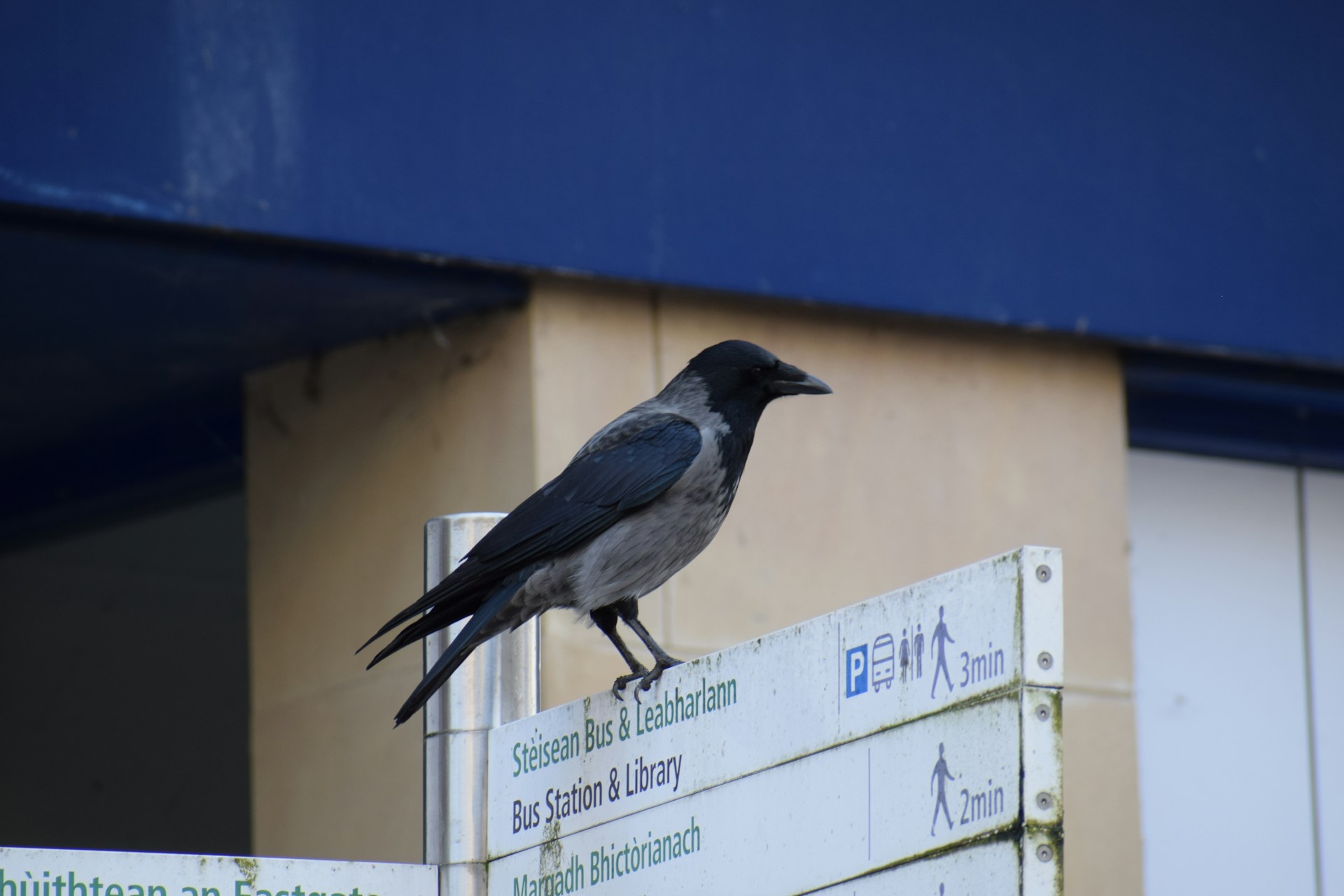
Earlier this year, a team of researchers from Lomonosov Moscow State University in Russia and the University of Bristol found that a species of crow called the hooded crow—which has a gray bust and black tail and head feathers, making it look like it is wearing a “hood”—is able to manage a mental feat we once thought was unique to humans: to memorize the shape and size of an object after it is taken away—in this case a small piece of colored paper—and to reproduce one like it.

This kind of feat, according to animal behavior researchers, requires the ability to form “mental templates.”Essentially, a mental template is an image in the mind of what a particular object looks like, even when that object is not present. Mental templates allow animals to create tools, which can be used to get food or make a stronger nest, both ultimately leading to a better chance of survival. They might also make it possible for individuals to learn about tool making from other members of their species—and to pass along improvements in tool making over time, often called “cumulative culture,” which so far seems rare among non-human animals.

We have been looking for evidence that different corvid and other bird species can create mental templates since at least 2002. That year, researchers published findings showing that Betty, a captive New Caledonian crow, was able to spontaneously bend a piece of wire to create a hook that she could use to grab a hard-to-reach treat. Betty had successfully used a pre-made hook to obtain the treat in earlier trials but in follow-up tasks didn’t seem to fully understand how hooks work.  The researchers decided she must have formed a mental template of the hook, which she then reproduced. So far, researchers have found that Goffin cockatoos, a kind of parrot, can also create tools spontaneously, which could indicate similar mental agility.

But the new hooded crow findings suggest that the ability to learn this way could be more widespread than we thought, says Sarah Jelbert, a comparative psychologist who studies animal behavior at the University of Bristol and is one of the authors of the study. Creating and using mental templates might be a skill that evolved in the ancestor of all corvids, the “Corvida” branch of songbirds, or perhaps it is even shared more broadly across the animal kingdom, she says.

For their study, Jelbert and her colleagues first trained three hooded crows—Glaz (15 years old), Rodya (4 years old), and Joe (3 years old)—to recognize pieces of paper of different sizes and colors. To do this, they exposed the birds to “template” pieces of paper in different colors and sizes for several minutes before removing them—and then rewarded the birds for dropping scraps that matched these templates into a small slit.

Top Stories

symbol

00:24

02:40

Read More

The crows were next given the opportunity to manufacture versions of these objects in exchange for a reward. The researchers found that all three crows manufactured objects that matched the original template object they had been rewarded for in both color and size—even though the treats in this second stage of the experiment were awarded at random. The researchers also observed that Glaz, the oldest of the three hooded crows, seemed to be the most proficient at making scraps that looked like the ones the bird was trained on. This finding suggested to them that mental templates may be linked to experience garnered with age.

“Unlike humans, who regularly copy each other’s behavior … we don’t have much evidence that crows will watch each other and deliberately copy what another crow is doing,” Jelbert says. However, they will steal each other’s tools—in particular, juvenile crows often steal their parents’ tools when they are young. So it’s possible that young crows learn how to make different types of tools from experience stealing their parent’s tools, using them, remembering what these tools look like, and then trying to create something similar, Jelbert says.

What qualifies as a mental template, and how flexible these templates are, seems to be up for some debate. Research suggests birdsong and mating practices may rely on certain kinds of mental templates, which can backfire if a bird memorizes behavior from the wrong species. “For example, if a song sparrow gets imprinted on the song of a swamp sparrow and sings a song from a different species rather than its own, it will have difficulty finding mating partners,” explains Andreas Nieder, a professor of animal psychology at the University of Tübingen and a lead researcher on corvid neuroscience, who was not involved in this study. “Similarly, if one finch species gets sexually imprinted on another, it may show courtship displays to the wrong species in adulthood.”

Nieder says this kind of imprinting can become fixed in the bird’s brain, and is not changeable even in new environments. “In this case, templates may no longer represent intelligence but rather the opposite,” he adds. Researchers have not yet determined whether mental templates related to tool making remain flexible, though there is some evidence in New Caledonian crows that they may evolve.

For biologists and comparative psychologists, understanding the ways corvids use mental templates can help to illuminate not just the nature of bird intelligence, but of intelligence across the animal kingdom and evolutionary time.

This article originally appeared on Nautilus, a science and culture magazine for curious readers. Sign up for the Nautilus newsletter.

California enacts unprecedented restrictions on rat poisons in bid to protect wildlife

A mountain lion with mange.

The famed and late mountain lion known as P-22 likely developed mange as a result of rat poisoning. A new California law bans the use of anticoagulant rat poisons, with some limited exceptions.

(National Park Service)

By Lila Seidman

Staff WriterFollow

Oct. 1, 2024 3 AM PT

  • A 2023 California Department of Fish and Wildlife report found that roughly 88% of raptors and 90% of pumas tested were exposed to the poisons.
  • The law allows the poisons to be used in agricultural settings and public health emergencies.

California has become the first state in the nation to restrict use of all blood-thinning rat poisons due to their unintended effect on mountain lions, birds of prey and other animals.

Gov. Gavin Newsom recently signed a bill that expands an existing moratorium to all anticoagulant rodenticides, with only limited exceptions. The poisons prevent an animal’s blood from clotting and cause it to die from internal bleeding. When an unsuspecting mountain lion or owl gobbles a dead or sick rat — or another animal that ate a tainted rat — the toxic substance can be passed on.

Wildlife advocates hailed the new law — set to go into effect Jan. 1 — as an important step toward protecting non-target animals. However, agricultural and pest-control groups derided the measure as a potential public health issue that sidestepped the state’s regulatory process.

Climate & Environment

Newsom signs bill to ban octopus farming in California

Sept. 29, 2024

“I’m so proud that California is leading the way in protecting wildlife from these harmful and unnecessary poisons,” said J.P. Rose, urban wildlands policy director at the Center for Biological Diversity, which sponsored AB 2552. “I think we can all agree that unintentionally poisoning native wildlife is wrong.”

Advertisement

A 2023 California Department of Fish and Wildlife report found that roughly 88% of raptors and 90% of pumas tested had been exposed to the poisons. Birds of prey — and American kestrels in particular — have been significantly harmed by chlorophacinone, one of two poisons targeted in the law, according to Lisa Owens Viani, director of Raptors Are the Solution, a co-sponsor of the bill.

Megan J. Provost, president of Responsible Industry for a Sound Environment, a trade association for the specialty pesticide and fertilizer industry, which opposed the bill, pointed to its potential harm to humans.

“Effective rodenticide products are necessary for protecting the health and safety of people, structures and businesses — including those responsible for food safety — from the diseases and property damage caused by rats and other harmful rodents,” Provost said in a statement. The new law “unfortunately removes products from the pest control toolbox that are important for managing rodent infestations, leaving fewer products for effective immediate and long-term control and for managing resistance in rodents.”

She said California’s Department of Pesticide Regulation has wide latitude to evaluate pesticides for safety “so pesticide-specific legislation … that supersedes this process was unnecessary.”

The law allows the poisons to be used in agricultural settings and public health emergencies.

Owens Viani said legislation and other efforts were necessary because state pesticide regulators were unwilling to act on their own.

Advertisement

“We’re ahead of the rest of the country with these regulations, but it hasn’t been because DPR has been a willing partner,” Owens Viani said. “We’ve had to force them every step of the way.”

A spokesperson for the agency said it “has been actively evaluating risks” related to the rodenticides since 2014.

“Evaluation has included both monitoring for impacts through a partnership with the California Department of Fish and Wildlife and initiating formal reevaluation to inform future actions to mitigate risks to wildlife,” the spokesperson said in a statement.

Owens Viani said her organization has worked for about a decade on passing legislation, including two previous laws that banned other blood-thinning rat poisons. A suit her nonprofit filed against the state agency is ongoing.

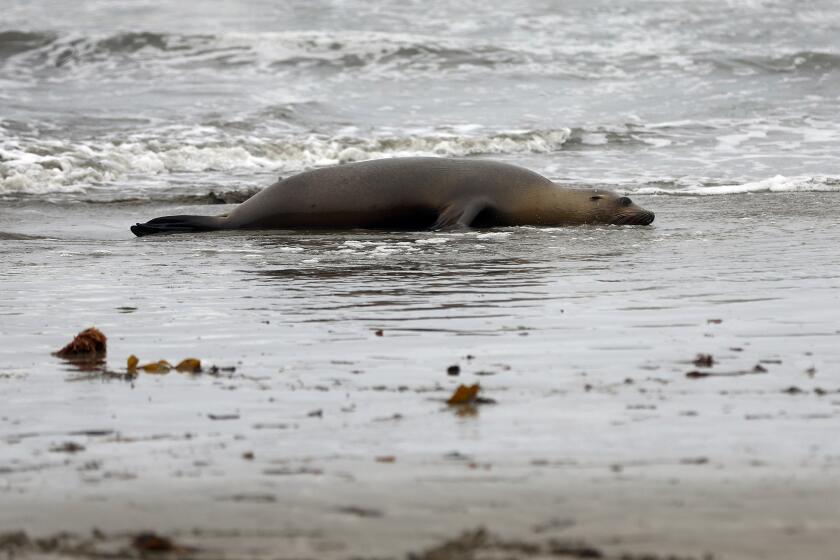
CAYUCOS, CALIFORNIA - AUGUST 05: A sick California sea lion lays on the water at Cayucos State Beach on August 05, 2024 in Cayucos, California. The Marine Mammal Center is seeing a surge of sick California sea lions washing up on Central California beaches in the past month exhibiting symptoms consistent with domoic acid poisoning, which leaves the mammals lethargic and suffering from seizures. The Marine Mammal Center, the world’s largest marine mammal hospital, typically respond to 60-80 sea lions per year impacted by the neurotoxin. Since July, 19th, they have responded to 70 calls for seal lions in distress. (Photo by Justin Sullivan/Getty Images)

Climate & Environment

Outbreak of neurotoxin killing unprecedented number of sea lions along California coast

Aug. 11, 2024

The early seeds of Owens Viani’s work on the issue began around 2011, when a neighbor ran over to tell her that Cooper’s hawk fledglings had drowned in his kiddie pool. At the time, she was studying raptors at the Golden Gate Raptor Observatory and had a hunch rat poison was involved. Tests confirmed it.

“It kept happening in my neighborhood, like people kept finding more dead hawks,” she said. They weren’t eating the bait; they were eating rats. “I knew that if people were using poison in my eco-friendly neighborhood in Berkeley, it was probably a problem everywhere. And so that’s when I decided to found my nonprofit and try to educate more people about the problem.”

Advertisement

The latest legislation, authored by Assemblymember Laura Friedman (D-Glendale), tightly restricts the use of chlorophacinone and warfarin, which are known as first-generation anticoagulant rodenticides. A law signed in 2020 put a moratorium on second-generation anticoagulant rodenticides. And last year the only other first-generation poison was added through a separate law.

The older first-generation version is slower-acting, requiring the rat to feed on the poison several times before it dies. The second-generation version is more potent, earning the moniker “one-feeding kills.”

Other states are working on similar efforts, but Owens Viani said only California has enacted a moratorium. British Columbia has placed a permanent moratorium on second-generation poisons, and the U.S. Environmental Protection Agency removed those types of poison from consumer shelves, she said.

The ban will remain in place until the state Department of Pesticide Regulation reevaluates the poisons and comes up with restrictions that meet certain criteria to protect wildlife.

The law also creates civil penalties. Anyone who sells or uses the poisons in violation of the law is subject to a fine of up to $25,000 per day for each violation.

Any money collected from violations will go to the Department of Pesticide Regulation to cover its costs in administering and enforcing the rules, and potentially other activities.

Advertisement

The department estimated the law would create a one-time cost of $258,000 and an ongoing annual cost of $193,000 to support a position “to handle anticipated increases in follow-ups and complaints associated with investigating sales and restricted materials,” according to a government analysis of the bill.

Approximately 170 Endangered southern mountain yellow-legged frogs (Rana muscosa) were released into their native habitat in the San Gabriel Mountains on Aug. 29 and 30, 2023. Animal care staff from the Los Angeles Zoo joined conservationists from the U.S. Geological Survey (USGS) to an undisclosed site to conduct the release.

Climate & Environment

Endangered frogs threatened by California wildfires once again. A rescue could be in order

Sept. 15, 2024

The analysis anticipates revenue loss of an unknown amount to the department, as well as to the California Department of Food and Agriculture’s Vertebrate Pest Control Research Advisory Committee.

The agency said it is committed to “a timely completion of its reevaluations.” Another bill signed into law this year requires that the agency share a timeline and status of all reevaluation and mitigation by the end of the year.

“The reevaluations underway include an assessment of cumulative impacts of anticoagulant rodenticides,” including first-generation varieties, the agency said in a statement, adding that it “will continue its ongoing work to address unintended wildlife exposure from first-generation and second-generation rodenticides while still retaining tools to protect public health, agriculture, critical infrastructure and the environment.”

Wildlife advocates said they compromised on certain elements of the bill as it wound through the Legislature and encountered opposition.

For example, a previous version of the bill allowed members of the public to sue bad actors for breaching the law.

Advertisement

An L.A. Times editorial from earlier this year pitched this as a powerful element of the legislation, which “could help curb the use of banned rodenticides by empowering all Californians to become enforcers.”

However, the California Chamber of Commerce called it “an expansive new private right of action that threatened businesses and created incentives for frivolous lawsuits,” and removed its opposition once the provision went away.

Owens Viani said proponents had also hoped to create buffer zones around agricultural areas, where birds of prey forage and which are part of habitat ranges for mountain lions, coyotes and other animals.

But there were other wins. Rose pointed out what he described as “exciting language … around the sentience of animals.”

The law text notes that animals “are able to subjectively feel and perceive the world around them” and that the “Legislature has an interest in ensuring that human activities are conducted in a manner that minimizes pain, stress, fear and suffering for animals and reflects their intrinsic value.”

Five Arrested for Illegal Wild Boar Hunting and Meat Transport in Talegaon

The team also seized a substantial quantity of wild boar meat along with the vehicle.

Illegal Wild Boar Hunting

Illegal Wild Boar HuntingThe Bridge Chronicle

Neelam Karale

Published on: 

30 Sep 2024, 10:47 am IST

Pune: The Forest Department arrested five individuals involved in the illegal hunting and transport of wild boar meat near Talegaon Dabhade, on the old Pune-Mumbai highway.

The incident unfolded when the Vadgaon Maval Forest Department received a tip-off about a group transporting wild boar meat in a car. Acting swiftly, the department conducted a raid and apprehended the suspects.

The team also seized a substantial quantity of wild boar meat along with the vehicle, with the total value of the confiscated items amounting to approximately six lakh rupees.

The arrested individuals have been identified as Maruti Shitole and Satyawan Bhoir, both hailing from Kasarsai in Mulshi, and Datta Waghmare, Sanjay Waghmare, and Sitaram Jadhav, all residents of Kade Maval.

Illegal Wild Boar Hunting

Female Leopard Tries to Free Captured Cub; Forest Department Warns Residents

The group was allegedly involved in hunting wild boar, which is a protected species under the Indian Wildlife (Protection) Act of 1972.

https://syndicatedsearch.goog/afs/ads?psid=5134551505&channel=AutoRsVariant&cx=r-10443d5c1ede938a1&fexp=95342163%2C21404%2C17301431%2C17301432%2C17301436%2C17301511%2C17301516%2C17301266%2C72717108&client=pub-0327893541412000&r=m&hl=en&rpbu=http%3A%2F%2Fgoogle.com&rpqp=q&type=3&rs_tt=c&oe=UTF-8&ie=UTF-8&format=r5&nocache=9741727718237790&num=0&output=afd_ads&domain_name=www.thebridgechronicle.com&v=3&bsl=10&pac=0&u_his=1&u_tz=-420&dt=1727718237792&u_w=1536&u_h=864&biw=1521&bih=710&psw=1521&psh=710&frm=0&uio=-&cont=autors-container-0&drt=0&jsid=csa&nfp=1&jsv=678245571&rurl=https%3A%2F%2Fwww.thebridgechronicle.com%2Fnews%2Ffive-arrested-for-illegal-wild-boar-hunting-and-meat-transport-in-talegaon&referer=https%3A%2F%2Fwww.google.com%2F

According to the Forest Department, the accused were caught near New English School on the old Pune-Mumbai highway, where they were attempting to transport the illegally obtained meat.

The Vadgaon Maval Forest Department quickly acted on the intelligence and set up a raid that led to the successful capture of the suspects. The operation was led by Range Forest Officer S.D. Vark, with additional support from Circle Forest Officer Mallinath Hiremth and a team of forest guards.

Illegal Wild Boar Hunting

Pune forest department bans photography of this migratory bird in Lonavala

The raid team included Forest Guards Devle, Daya Dome, Parmeshwar Kasule, Yogesh Kokate, SK More, Krishna Dethe, and Deepak Ubale, along with Forest Attendant Jambhulkar. 

Under the supervision of Chief Conservator of Forests N.R. Praveen, Deputy Conservator of Forests Mahadev Mohite, and Assistant Conservator of Forests Atul Jain, the team managed to prevent further transportation of the meat.

$12,000 fine for illegally hunting moose

Junor returned to a hunting camp on Annie Lake where an agreement was made with a member of a local Indigenous community to attend the kill site and claim the moose was shot under Indigenous harvesting rights

BayToday Staffabout 24 hours ago

bull moose adobestock_93928765 2017
Bull moose. File

Listen to this article

00:01:27

Timothy Junor of Echo Bay, east of the Soo, pleaded guilty to unlawfully hunting a bull moose without a licence and was fined $12,000.

On November 3, 2021, conservation officers initiated an investigation after locating a suspicious moose kill site near the Batchawana River in Norberg Township.

The court heard that on October 18, 2021, Junor was hunting for moose in an old forestry cut block. Junor was part of a larger hunting party that was only licenced to hunt calf moose.

Upon entering the cut block, Junor observed two bull moose running along the hillside and fired a round from his rifle at one of the bull moose, killing it.

Junor returned to a hunting camp on Annie Lake where an agreement was made with a member of a local Indigenous community to attend the kill site and claim the moose was shot under Indigenous harvesting rights, thereby covering up the illegal killing of the moose.

Junor returned to the kill site with the Indigenous person, processed the moose, and transported it back to the hunt camp at Annie Lake. The following day, the Indigenous community member transported the moose to a butcher shop in Thessalon where they again claimed that they shot the bull moose under their Indigenous harvesting rights.

Justice of the Peace Sarah Keesmaat heard the case in the Ontario Court of Justice, Sault Ste. Marie, on June 17, 2024.

Public hearing planned for Indiana bobcat trapping proposal

play audio
Play
Bobcats were protected in Indiana until 2005, when they were removed from the state's endangered species list. (Adobe stock)
Bobcats were protected in Indiana until 2005, when they were removed from the state’s endangered species list. (Adobe stock)

Previous StoryNext Story

 Joe Ulery, Producer

 Contact

  Why you can trust Public News Service

Thursday, September 26, 2024   

Indiana is considering a limited bobcat trapping season and the Department of Natural Resources is seeking public input on the proposal.

The plan would allow trapping in about 40 southern Indiana counties starting in November 2025, with a statewide quota of 250 bobcats. Trappers would have a one-bobcat bag limit and be required to purchase a special bobcat license.

Geriann Albers, furbearer and turkey program leader for the Indiana Department of Natural Resources, said the proposal includes strict monitoring, and requires trappers to report their catches within 24 hours.

“We do have a population model for bobcats,” Albers explained. “We’re very confident with that 250 quota that it will not negatively impact bobcat populations. What that 250 was set on was the population model we have that shows that’s a sustainable level of harvest.”

Opponents argued even a limited season could threaten bobcat populations. Environmental groups, including the Humane Society, said the DNR’s population model may not fully account for the bobcat’s slow reproductive rate and threats from habitat loss. They contended reintroducing trapping could undermine years of conservation work that helped the species recover in Indiana.

Albers noted the DNR invited public feedback on the proposal.

“On that rule-making docket page the comment button is available for people to submit comments now,” Albers pointed out. “That went up pretty quickly after the meeting but the first round of comments, we haven’t scheduled yet because that usually coincides with when we do a public hearing.”

A public hearing, tentatively set for November, will offer both in-person and virtual participation options. The DNR said updates will be posted on its website.

Bobcats are still recovering in Indiana. Now trappers want to kill them.

BY 

Kitty Block

SHARE https://www.humanesociety.org/blog/indiana-bobcat-trapping-season

Bobcat in snow

Robert Yone

 / 

Alamy Stock Photo

It is the sad paradox of wildlife conservation that as soon as a species seems to make progress toward recovery from near extirpation, some people rally to be permitted to hunt and trap them again. This is exactly what’s happening in Indiana right now with the state’s only remaining native wildcat, the bobcat. 

Earlier this year, a small but powerful group of recreational fur trappers helped push a bill through the state legislature that forces the Indiana Department of Natural Resources to establish a bobcat-trapping season by July 2025. And last week, the Indiana Department of Natural Resources proposed that trappers be allowed to kill 250 of them using horrific methods including strangling neck snares and steel-jawed leghold traps, even though these small wildcats are only starting to return to their native habitats in Indiana’s woods. But there is hope: concerned residents of the state still have time to prevent even one bobcat from being killed.

The new law mandating a bobcat season allows the Department of Natural Resources flexibility in setting the quota of bobcats that can be legally killed—the agency can even set this number as low as zero. 

The Natural Resources Commission will take public comments into account before making its final decision, and they can still decide to set the quota to zero. For that to happen, though, the Commission needs to hear from Indiana residents now. The public comment period for Indiana residents is open and can be accessed by clicking “Submit Comment Here” under Bobcat Amendments at NRC: Rulemaking Docket.

This is not the first time that hunting and trapping groups in Indiana have tried to force the hand of the state to allow the killing of bobcats, but wildlife advocates have always managed to resoundingly defeat these misguided proposals. We celebrated a win in 2018, after a proposal to open a bobcat season was completely withdrawn by the Department due to overwhelming public opposition that we mobilized with strong allies in the state. A bill to open a bobcat season similarly failed in 2019. 

Unfortunately, Senate Bill 241 passed in March 2024. Bobcat sightings on trail cameras, were touted as being justification for a bobcat season; misinformation and fearmongering abounded. One proponent claimed that simply seeing a bobcat meant that there were too many, and others stated that bobcats were eating too many turkeys, despite research by the Department of Natural Resources that did not document any consumption of turkeys by bobcats. 

Powerful hunting and trapping groups lobbied hard for the bill, but Indiana residents who care about wildlife showed up in force, too. In a particularly inspiring move, students from Bloomington Montessori School traveled to the capitol to visit their state representative, respectfully telling him that they value bobcats and don’t want to see them trapped and killed. These young advocates were able to change his vote. Sadly, though, SB 241 became law despite their efforts.  

A group of children in the state capitol

Students from Bloomington Montessori School traveled to the state capitol building to convince their state representative to change his vote on a bill pushing to open a trapping season for bobcats in Indiana. 

Anne Sterling 

/ 

The HSUS

There are many reasons to oppose the bobcat-trapping season. The proposal allows the use of cable neck snares, which are intended to strangle an animal to death by slowly cutting off their air supply, leading to hours or days of suffering. These snares can also catch animals by their torsos or feet, and the cable can become deeply embedded in their skin. Snares hung on a bush or tree can be difficult for people out walking their dogs to spot. This is why snares have come to be referred to as “silent killers” of dogs; unable to cry out for help, dogs may hunker down and pass out before slowly and quietly suffocating to death without their owners being able to rescue them. And snares frequently catch nontarget wildlife such as eagles and deer fawns, as well. 

The proposal would also allow the use of steel-jawed leghold traps, contraptions that trappers bury underground and that snap shut when an animal steps on them. Like snares, leghold traps don’t discriminate, jeopardizing wild and domestic animals alike. They can cut through skin causing lacerations, and animals can damage their teeth and gums as they desperately try to free themselves. Trappers are permitted to leave traps unattended for hours; an animal caught in a leghold trap can be left to struggle for up to 24 hours, without access to water, shelter or food, until the trapper arrives to kill them by bludgeoning, strangling suffocation or shooting.

Very few Hoosiers trap (less than 0.06%). Those who do largely “enjoy” the activity as a recreational hobby or to score animal trophies. Only some of that 0.06% sell the fur skinned from trapped animals overseas in the fur markets of Europe, China or Russia. But the fur market is declining in the U.S. and worldwide as consumers demand that retailers stop selling it, and designers all over the world increasingly reject using animal fur in their products. 

Hunting, trapping and habitat loss nearly wiped out bobcats in Indiana. In the mid-1900s, the species was listed as endangered under state law, and bobcats retained this status until 2005. The protections from hunting and trapping that come with endangered species status allowed bobcats to slowly begin to recover, making their way back to landscapes that were missing the ecologically essential little carnivores. 

Most Hoosiers celebrate the return of Indiana’s only remaining native cat. Shy and elusive, bobcats are essential members of North American ecosystems who contribute to overall biodiversity and ecosystem health. Their diet consists mainly of rodents, rabbits, and squirrels, and they help clean up carcasses, helping to recycle nutrients back into soils. They can even help mitigate zoonotic diseases and chronic wasting disease. Kittens, who are playful and curious, depend on their mothers until they are about a year old. Bobcats even purr! Conflicts with bobcats and people are very rare, but Indiana residents who experience conflicts can legally obtain a permit to kill the bobcat. 

In addition to submitting written comments in the coming months, the public can address the Natural Resources Commission and the Department of Natural Resources directly. A public hearing is currently scheduled for November 14, at 5 pm EST at the Southeast-Purdue Agricultural Center in Butlerville (4425 East 350 North). It will also be livestreamed here. It is essential that Indiana animal advocates make their voices heard for bobcats. Trapping is cruel, and the only justifiable number of bobcats trapped and killed in Indiana is zero. 

Follow Kitty Block @HSUSKittyBlock.