Las Vegas Review-JournalMarch 2, 2021 – 4:21 pm Don’t miss the big stories. Like us on Facebook. https://www.facebook.com/plugins/like.php?href=https%3A%2F%2Fwww.facebook.com%2Freviewjournal&width=105&layout=button_count&action=like&size=large&show_faces=false&share=false&height=21&appId=846558002155573
Clark County commissioners on Tuesday formally urged Nevada to ban wildlife killing contests — a form of hunting competition already barred by neighboring states that activists have castigated as “unethical,” “barbaric” and a “sick bloodsport.”
In such contests, single shooters or teams of two set out at dawn to kill as many coyotes, rabbits, bobcats or other small mammals as they can, according to activists, who say that animals are then often thrown away and that lead ammunition strewn on public lands risks being ingested by wildlife and poisoning the food chain.
Participants compete for money or other prizes, the county said, and because western states such as California, Arizona and New Mexico have already banned the practice, Nevada has recently become a destination for contest organizers.
There have been more than two dozen competitions in Nevada in recent years, at least four which have occurred in the county, according to a resolution unanimously adopted by the commission imploring the Nevada Department of Wildlife “to take immediate action” to outlaw the contests.
“I am proud to have sponsored this resolution, which will help to ensure that the public is safe from stray bullets by unethical shooters in a hurry to kill as many animals as possible and protect our state’s wildlife from inhumane practices and unnecessary slaughter,” Commissioner Justin Jones said in a statement.
Ultimately the authority to establish a ban falls on the state Board of Wildlife Commissioners, a nine-member panel appointed by the governor, and not the state’s wildlife agency.
State biologists will, however, provide scientific information requested by the Wildlife Commission when the board considers any regulatory changes, which is a lengthy and public process, Nevada Department of Wildlife spokesman C. Douglas Nielsen said.RJ POLITICSTeam coverage from Las Vegas, Carson City and DCSign up for our free RJ Politics newsletter. SIGN UP By signing up you agree to our Privacy Policy and Terms of Service. Unsubscribe at any time.
“It is not our role to determine what is acceptable to society,” Nielsen said in an email about the state agency, adding that “if the department is asked for its recommendations, they are based on science.”
Resolution supported by activistshttps://bd47ccc157bea08d92e1d5d6b4cdb75d.safeframe.googlesyndication.com/safeframe/1-0-37/html/container.html
Wildlife activists immediately praised the county’s decision, noting that it marked the first forward movement against the contests in Nevada six years after the state Wildlife Commission voted 7-1 to deny a petition seeking to end them.
“With the passage of this historic resolution to condemn the scourge of wildlife killing contests in our state, Nevada has been put on the path toward joining the bevy of other states that have already eliminated these barbaric practices,” said Annoula Wylderich, the Nevada state director for Animal Wellness Action, in a statement.
Connie Howard, the chair of conservation and public lands for the Sierra Club Toiyabe Chapter, had written a letter of support stating that “nothing is more antithetical” to the club’s mission of wildlife preservation and protection than “killing contests that glorify the killing of animals purely for blood sport with the intention of seeing who can kill the most.”
And Patrick Donnelly, the Nevada state director at the Center for Biological Diversity, underscored that there was no evidence that killing coyotes reduces human conflict or the depredation of livestock.
“We need to show respect for our native wildlife, not treat it as fodder in some sick bloodsport,” Donnelly said in a statement.
In passing the resolution, commissioners also clearly delineated a distinction between the competitions and hunting. The county, according to its resolution, “values hunting as a method of food gathering, recreation, wildlife management, and protecting private property.”
They passed around a bottle of Malibu rum as gunshots bellowed into the desert night. A trio of young men had set up camp near the unincorporated town of Crystal, 80 miles outside of Las Vegas, Nevada. As recently as 2005, the tiny town hosted two brothels, but by April 2016, it was pretty much empty, ideal for carefree camping on a moon-like stretch of desert, the perfect place to pass around a bottle and a shotgun for some bunny blasting.
As often happens on a night like that, things went downhill. Drunk on rum and the roar of the gun, the three men fired up an off-road vehicle and drove away from camp. Riding in back was Trent, a chestnut-haired, bearded 27-year-old, who carried the shotgun and blasted away at road signs as they tore across the Amargosa Valley and Ash Meadows National Wildlife Refuge. They headed toward a remote unit of Death Valley National Park: Devils Hole, a deep pool inside a sunken limestone cavern. The area’s surrounded by 10-foot-tall fencing, a fortress erected to protect an endangered species of pupfish found there.
Trent shot at the gate to the pedestrian walkway area and then shot the surveillance camera and yanked it from its mount. Then he and one of his companions, Steven, stumbled into the enclosure. Steven was so intoxicated that it took him multiple tries to clear the fence. Inside the enclosure, he paused to empty his bladder.
Filled with mischief, Trent lunged toward his partner and punched him in the crotch with a left hook. Then, as Steven stumbled over to a large boulder to vomit, Trent dropped the shotgun, stripped off his clothes, and slipped into the deep warm water of Devils Hole. He didn’t know it yet, but that would prove to be his worst mistake of the night.
Devils Hole pupfish — some of the rarest fish in the world — are found only in a deep geologic fissure fed by water from the aquifer that lies below the Mojave Desert.
Brett Seymour/NPS Submerged Resources Center
SIXTY THOUSAND YEARS AGO, a narrow fissure opened up in the Amargosa Valley, releasing water pooled deep in the earth and creating Devils Hole, the opening to an underwater cavern. Scientists disagree over just how it happened — whether by way of underground tunnels, ancient floods or receding waters — but several desert fish were separated from the larger population and trapped in Devils Hole. There, a tiny sub-population — the Devils Hole pupfish (Cyprinodon diabolis) — evolved in extreme isolation for tens of thousands of years, eventually, according to scientific consensus, becoming an entirely new species.
Today, visitors to Devils Hole get a rare window into one of the Mojave Desert’s vast aquifers. Steep limestone walls surround a tiny opening into turquoise water. Divers have descended over 400 feet into the cave without reaching the bottom. The water is so deep that earthquakes on the other side of the world cause it to slosh, shocking the fish into spawning.
The environment in Devils Hole is so remote and extreme that scientists have long puzzled over how the pupfish can live there at all. Still, a modest population has managed to survive on a shallow, sloping rock shelf that gets just enough sunlight — only four hours per day at its peak — to allow algae to grow for the fish to eat.
The environment in Devils Hole is so remote and extreme that scientists have long puzzled over how the pupfish can live there at all.
The Devils Hole pupfish are truly unique. The males are a bright blue, the females a subdued teal, and they’re only about an inch long. They are more docile and produce fewer offspring than their cousins, which are found in pockets ranging from the Southwest toward the Gulf of Mexico. The Devils Hole pupfish lacks the pelvic fin that enables its kin to be vigorous swimmers. But it is able to thrive in temperatures far warmer than similar species can tolerate. Trapped by geology in a consistent 93-degree womb, Devils Hole pupfish have nowhere to go. In fact, they have the smallest geographic range of any known vertebrate species on earth.
The pupfish were among the first species to be protected under the Endangered Species Preservation Act of 1967 — along with the American alligator, the California condor and the blunt-nosed leopard lizard — and that protection was carried over to the Endangered Species Act of 1973. At the time, around 220 survived in Devils Hole, but since the 1990s, the species has been in significant decline, sinking to just 35 fish in 2013. Today, there are modest signs that the population is growing; the last population count was 136.
The tiny fish has become an icon for those looking to protect endangered species and their habitat, but it’s a target of deep resentment in Nevada, and particularly in Nye County, where, according to critics, the interests of an obscure fish are pitted against the livelihood of local agricultural families. The issue has tested water rights in this arid part of the American West and raised questions about how far officials should go to save a handful of imperiled fish. The drunken invasion of its habitat in 2016 was not unprecedented: Dozens of trespasses have been documented throughout the decades. But such crimes are difficult to investigate and rarely prosecuted.
This time, however, would be different.
Video from security cameras in the Ash Meadows National Wildlife Refuge shows three men entering the Devils Hole enclosure. Then, a few minutes later, the pool is disturbed by a foot splashing into the water and a man walking around. Then you can see a Devils Hole pupfish swimming away from a foot. National Park Service
ON MONDAY, MAY 2, 2016, Kevin Wilson, an aquatic ecologist and manager of the Devils Hole research program, arrived at the National Park Service outpost in Pahrump, Nevada, a beige, low-key building in the middle of anti-fed country.
“We have some news you won’t like,” one of his research associates told him, gesturing toward a surveillance video playing on her computer screen. Wilson peered at the images just as one of the three trespassers tried — and failed — to clear the fencing before barging his way in on the other side of the enclosure.
“As I watched the surveillance footage, I could tell they had definitely been drinking,” Wilson told me when I visited in February. “But it was really just the one guy that had actually gotten in the pool that concerned me the most.”
Wilson, who is 51 with dark gray hair and bright blue eyes, wears his green uniform comfortably, a slight potbelly protruding above his belt. He jokes often, but the deep wrinkles in his face, tanned from years in the unforgiving Nevada sun, give him a stern appearance.
Normally, the nocturnal visitors would have been caught by a motion sensor that triggered a loud alarm. But a barn owl roosting in the area had caused too many false alarms, and rather than spook the bird, officials had disabled the device. So once the men broke in, they felt no real urgency to leave. Little did they know that multiple cameras captured their every move.
A small earth tremor that occurred over the weekend had prompted Wilson’s staff to review the footage. “Obviously, we saw much more than we had been expecting,” Wilson said, raising an eyebrow.
The video continued to play in Wilson’s office. As one man swam, another remained at the edge of the water, while the drunkest one leaned against a rock. The swimmer climbed out of the water, dragged himself over the algae-covered shelf and got dressed. Then the party fled on their off-road vehicle.
Wilson paused the video and backed it up. The man who fired the shotgun and plunged into the pool had left a few things behind — his wallet and cellphone. The next morning, in the fog of a hangover, he broke in to Devils Hole to retrieve them, ignoring the empty beer cans and his underwear, which was still floating in the water.
Wilson reviewed one particular piece of footage, a view from an underwater camera, over and over: A foot plunged through the placid, algae-filled water onto a shallow shelf — the only breeding area in the world for the Devils Hole pupfish. The man had waded in at the most inopportune time possible, in late April, the peak breeding period for the pupfish. “I couldn’t immediately tell if any fish were harmed,” Wilson told me. “But I decided to do a site visit to find out for sure.”
That morning, Wilson, his research team and a bevy of law enforcement officials assessed the damage. The area reeked of vomit; beer cans were scattered around and Trent’s underwear still floated in the water. The group huddled around for a closer look. In the pool, a single bright blue pupfish was also floating on the surface — dead.
In the pool, a single bright blue pupfish was also floating on the surface — dead.
Kevin Wilson ascends from the Devils Hole pool, reachable through the gate of a locked enclosure. In April 2016, three men climbed the fence and scrambled down the rocks to reach the pool, which is closed to the public.
Luna Anna Archey/High Country News
IN FEBRUARY, WILSON TOOK ME TO THE SCENE OF THE CRIME. Wilson has dedicated a good portion of his life to pupfish. He first visited Devils Hole in the 1970s, when he was just 8 years old, tagging along with his geologist mother. Those early visits to national parks and camping trips with his family helped inspire his post-graduate work: the first-ever holistic study of the Devils Hole pupfish. And then the perfect job opened up at the perfect time. “As soon as I defended, this permanent position to study the Devils Hole environment and the pupfish opened up. I’ve been here ever since,” Wilson told me as we stood near the edge of the pond, as cold raindrops began to fall. Just paces away, pupfish flitted through the water.
The 2016 trespass swiftly activated an intricate legal enforcement network designed to protect the fish. After reviewing the footage and finding that a pupfish had indeed died as a result of the incident, Wilson notified the National Park Service at Death Valley and in Washington, D.C., as well as the U.S. Fish and Wildlife Service, Nevada Department of Wildlife and the Nye County Sheriff’s Office.
A team called the Scorpion Task Force was assembled. Its leader was the Park Service Investigative Services’ Paul Crawford, a seasoned Brooklyn-born detective with a constellation of freckles across his face. In 2012, he was the lead detective investigating the murder of ranger Margaret Anderson in Washington’s Mount Rainier National Park.
Based in Boulder City, Nevada, and nearing retirement in 2016, Crawford decided to make the trip to Devils Hole. He would supervise two other men: Morgan Dillon and Josh Vann. Dillon, a detective for the Nye County Sheriff’s Office, jumped at the chance to work on the case. “I was excited that I might have an opportunity to go all the way down to the pupfish pool and see the fish,” Dillon told me. “I originally went to college to be a wildlife biologist. I’ve always been passionate about that and still like to read scientific articles on the pupfish. Me, personally, though — I wasn’t smart enough to be a scientist, so I became a detective instead.”
“I originally went to college to be a wildlife biologist. I’ve always been passionate about that and still like to read scientific articles on the pupfish. Me, personally, though — I wasn’t smart enough to be a scientist, so I became a detective instead.”
Vann, a ranger at Death Valley National Park, worked alongside Dillon. At Devils Hole, they gathered three empty beer cans as well as two empty boxes that had held shotgun ammunition, two live rounds and multiple spent shotgun shells. Dillon attempted to fingerprint the beer cans and swabbed them for DNA evidence. He even collected the underwear and entered it into the case file.
Abundant surveillance footage gave the detectives clear images of the three suspects’ faces. “We see you, and now we’re going to find out who you guys are,” Crawford remembers thinking. The four-wheeler stood out most: a blue Yamaha Rhino, with flamboyant stripes along its doors. “It was altered with a second seat, extended roof, skid plates up front. It wasn’t something these guys bought and just drove off the lot,” Crawford said. “Those are a dime a dozen. We would have never found them.”
On May 6, Crawford put out a crime-stoppers tip form. Meanwhile, back at the Nye County Sheriff’s Office, Dillon showed his colleague, Sgt. Thomas Klenczar, an off-road aficionado, video stills of the customized vehicle. “We were really just BS-ing about it,” Dillon said. “But he’s into OHVs and is always on Craigslist, so he decided to take a look.” Minutes later, Klenczar and Dillon found the vehicle on Craigslist. It had been listed for sale just one day prior to the drunken break-in. “The fact that the vehicle was so unique and that we were able to quickly find it on Craigslist was the one and only piece of this that allowed the case to move forward,” Dillon said.
Dillon used the phone number from the Craigslist ad and a house number in one of the photos of the Yamaha to come up with the owner’s name. A photo of the man — Steven Schwinkendorf of Pahrump — matched one of those on the Devils Hole footage.
Scorpion Task Force leader Paul Crawford. A custom four-wheeler, driven by the suspects — spotted on Craigslist by one of the investigators — helped crack the case.
Luna Anna Archey/High Country News
THE EARLY 20TH CENTURY WAS AN ANXIOUS ERA for the National Park Service. The fledgling agency hemmed and hawed over its identity and whether or not it included a responsibility to protect wildlife and wild spaces.
From the 1920s through the 1940s, the Park Service managed land mostly for tourists to enjoy. In one of the agency’s founding documents, Interior Secretary Franklin Lane described developing the parks as a “national playground system.” The prevailing attitude at the time was that protecting a rarely viewed species like the Devils Hole pupfish was a project “better left to another agency,” according to Kevin Brown, an environmental historian who authored a 2017 Park Service book on the history of Devils Hole.
With no entity charged to oversee Devils Hole and the pupfish, the deep cavernous pool gained fame among locals. The area, with the pupfish swimming serenely within it, was subject to constant trespass. To this day, locals often refer to Devils Hole as the “Miner’s Bathtub.”
In 1950, an ichthyologist named Carl Hubbs excoriated the Park Service for its refusal to protect Devils Hole. Early the following year, Lowell Sumner, a Park Service biologist, visited Devils Hole and did a pictorial study of it. He argued that it was in the national interest to include this geological wonder in Death Valley National Monument. In 1952, President Harry Truman added the Devils Hole unit to Death Valley National Monument under the Antiquities Act, specifically mentioning the “peculiar race of desert fish,” and declaring that all of the species and ecosystems of Death Valley would be protected. “It was incredibly forward-looking at that time,” said Patrick Donnelly, the Nevada state director for the Center for Biological Diversity. “That was really what began this saga of the role that pupfishes ended up playing in battles down the road.”
A car streaks down the Bob Ruud Memorial Highway west of Pahrump, Nevada.
Luna Anna Archey/High Country News
ON MAY 9, 2016, THE SCORPION TASK FORCE — Dillon, Klenczar and Vann — drove through Pahrump, Nevada, to meet their first suspect in person. The harsh beauty of the desert around Pahrump clashes with the severity of the city’s neon glow. Under the surrounding Black Mountains, the desert’s sage seems greener, the needles of its barrel cactus redder and the flash of the nearby casinos, motels and fast-food chains even brighter. One street is named “Unicorn,” another “Tough Girl.” “Don’t Tread on Me” flags wave above many front doors. The locals elected brothel owner Dennis Hof to the State Assembly, a month after the self-proclaimed pimp and so-called “Trump of Pahrump” died of a heart attack on his 72nd birthday, at a bash attended by notorious Arizona Sheriff Joe Arpaio and the porn star Ron Jeremy.
The detectives located the suspect’s home and walked to the door. Steven Schwinkendorf, dark-haired, 6 feet tall and topping 200 pounds, answered it, facing Dillon, his arms crossed. A small boy, Schwinkendorf’s son, peeked around his legs. Dillon showed the photos from the surveillance video and asked him if the vehicle was his. Schwinkendorf admitted that it was and explained that he had already traded it in as part of a deal for a new four-wheeler.
“Is this you?” Dillon asked, pointing to one of the men on the video, according to investigation transcripts. Schwinkendorf said it was. The other two suspects had come to his house for a barbecue before they went camping, he said. “We had been drinking quite a bit,” Schwinkendorf admitted. He told the detectives that the trio then went to Ash Meadows to shoot rabbits. Schwinkendorf said he had only vague recollections of being at Devils Hole, though he remembered vomiting; his friends had teased him about it.
Schwinkendorf identified his companions — Edgar Reyes, a Las Vegas local, and Trenton Sargent, the skinny-dipper — and gave Dillon their phone numbers.
The next day, Dillon called the other suspects. He first dialed Reyes, who didn’t answer, though he quickly phoned back. Dillon remembers Reyes saying he was scared. “I woke up, and my face is plastered all over everywhere on the internet,” Reyes said. He admitted to the trespass and confirmed that the shotgun belonged to him, but he said that all three of them had been shooting it. “Not long after speaking to him, I got a call from his attorney,” Dillon told me.
But Dillon had yet to reach Sargent. “I was afraid that Schwinkendorf and Reyes would get to Sargent and spook him. I felt like I was running out of time.”
That afternoon, Dillon called Sargent. “He told me that he heard I was looking for him,” Dillon said. “He was very cooperative and forthcoming.” The crime-stoppers tip had gone viral, and in the days since it went public, Sargent told Dillon he had received “hundreds of messages” and even a few death threats. He admitted that he had taken off his clothes and gone swimming in the pool. “I was showing off for my friends,” Sargent said, “and I wanted to see how deep it was.” His demeanor was extremely polite, Dillon remembers, and they spoke on the phone for several minutes.
“Sargent asked me, unprompted, if I had run his criminal history,” Dillon told me.
“I have so much to tell you,” Sargent said to Dillon. “I’m a convicted felon. I know that I can’t have a gun, that I can’t be around guns. I wasn’t intending to shoot that night and was just going to hold the spotlight while the others shot.” There was a pause — a long-enough silence that Dillon thought the phone might have been disconnected. “But because of the drinking, I shot as well,” Sargent told him.
Sargent had been convicted of grand theft of money and property three years earlier in San Bernardino, California. He had struggled with addiction for most of his teenage and early adult years, but since then, he had cleaned up his life and returned to his hometown, Indian Springs, Nevada. He lived in a trailer and often saw his son Logan, who was then only 1 month old and lived with his in-laws in town.
Sargent later admitted to knowing about the pupfish and their endangered status, but insisted he didn’t mean to harm them. His drunken break-in was a slip, he said, a momentary lapse of judgment.
Underwater researchers surface in Brown’s Room, one of the rooms of Devils Hole, deep within the earth in Death Valley National Park.
TRENT SARGENT’S SWIM was just the most recent threat to the existence of the Devils Hole pupfish. Back in the late 1960s, after the National Park Service began its first studies and population counts, the Cappaerts, a ranching family in Pahrump, decided to dig a number of wells on their 12,000-acre ranch just a few miles from Devils Hole.
When the Cappaerts began pumping, the water level in Devils Hole dropped, exposing large parts of the algae shelf. That exposure, the Park Service argued, decreased algae production and limited the pupfish’s spawning area, which in turn reduced its chance to survive. The aquifer level lowered so drastically that it alarmed not only Park Service staff, but also the U.S. Fish and Wildlife Service and Nevada Department of Wildlife. The park’s staff ordered the Cappaerts to stop pumping.
The Cappaerts said they had spent a lot of money drilling the wells and changing their farming operation, and that they intended to go right on pumping without limitation under “Absolute Dominion,” also known as the “English Rule,” a 19th century common-law doctrine adopted by some U.S. states that allowed landowners to use as much groundwater as they pleased. (Nevada had actually abandoned Absolute Dominion in favor of prior appropriation for both surface and groundwater decades earlier.) The Park Service argued that the special status of Devils Hole pupfish under the Endangered Species Act and its habitat’s status as a national monument trumped the Cappaerts’ rights to the water.
The Cappaert case went all the way to the U.S. Supreme Court, testing the power of the Antiquities Act and the weight of the new Endangered Species Act. In 1976, the High Court affirmed the federal government’s right to maintain water levels sufficient to support the pupfish, even at the expense of water rights held by nearby ranchers.
“There are two endangered species here: the pupfish and the American rancher.”
The decision enraged the residents of Nye County. The attorney representing the Cappaerts argued, “There are two endangered species here: the pupfish and the American rancher,” and said the federal government had chosen a fish over the people. A Pahrump newspaper editor even threatened to throw the pesticide Rotenone into the sunken cave to “make the pupfish a moot point.” The community split into factions, and anger pervaded the air. Warring bumper stickers — “KILL THE PUPFISH” and “SAVE THE PUPFISH” — were plastered on cars, street signs and office buildings across the Southwest.
A 1960s bumper sticker against the preservation of pupfish and their habitat.
But the decision has stood the test of time. In the late 1970s, the Cappaert family sold their ranch. The land has since changed hands a number of times, eventually becoming the Ash Meadows National Wildlife Refuge. Had that case gone any differently, had the Park Service not decided that part of its mandate was to protect the species and stop the Cappaerts from pumping — had Truman not designated Devils Hole a national monument in the first place — the Devils Hole pupfish might now be extinct, though Pahrump would probably be a little greener. “If it weren’t for that decision, the Amargosa Valley would have been pumped dry a long time ago,” Wilson, the biologist, told me recently. “There would be no Death Valley, no Devils Hole, no Devils Hole pupfish — but there would be a whole lot more golf courses, I bet.”
The Devils Hole pupfish, a tiny species that has survived such obstacles, represents a paradox for Wilson, who would not live in Pahrump were it not for Devils Hole. He told me that adjusting to a life in the gravel-covered, billboard-lined city was difficult for him and his wife, a Canadian, who, after a few years in Nevada, finally found her niche in, of all things, golf. “I do wish I could just pick up and move Devils Hole and put it somewhere with a higher standard of living,” Wilson told me. “But it’s worth protecting — and worth punishing people who threaten this little species.
“The most important advances in science have come from the edges of what’s possible — from the most extreme environments,” Wilson said. “We have a lot to learn about how the Devils Hole pupfish has even been able to survive.”
Josh Sargent holds a photograph of his children, Bella and Trent. Trent has his own son, Logan, on his lap.
Luna Anna Archey/High Country News
TRENT SARGENT TURNED HIMSELF IN just after Memorial Day and pleaded guilty to violating the Endangered Species Act, destruction of federal property, and possessing a firearm while a felon. A few days before his October sentencing, he submitted a letter to U.S. District Judge Andrew Gordon, who would decide his fate.
“I’m not one to make excuses for what I have done wrong and I’m not going to start now,” he wrote, in all capitalized, slanted script. “I made a stupid mistake. … I’m not a bad person, your honor, and I take full responsibility for my actions and the crimes I committed. … I would like to ask you to accept this letter to you as my verbal ‘handshake’ that upon my release I will complete all stipulations given to me by the courts and you will not see me again in your courtroom.”
On the afternoon of Oct. 25, 2018, Sargent stood quietly beside his lawyer in a Las Vegas courtroom as Judge Gordon handed down his sentence: A total of 12 months and one day — nine months specifically for his violation of the Endangered Species Act — in the custody of the Federal Bureau of Prisons. Once he is released from the Los Angeles Metropolitan Detention Center, Sargent must pay nearly $14,000 in restitution to the National Park Service, along with a $1,000 fine. He’s also forbidden to enter federal public lands for the rest of his life.
Four months later, I journeyed to Indian Springs, Nevada, an unincorporated community of fewer than 1,000, where Sargent has lived for most of his life. It’s home to Creech Air Force Base and the Desert Warfare Training Center. I met Sargent’s family at their spacious and warmly lit doublewide manufactured home. There was a chill in the air and a blustery wind, but his mother, Norine, sat outside, watching her grandchildren jump on a trampoline in the yard. Trent’s father, Josh, joined us a few minutes later, home from work at the Nevada National Nuclear Security Site, where he’s been employed as an ironworker for 30 years.
I had assumed that the Sargent family would consider what happened to their son unfair. But I was wrong. In fact, they defended the Endangered Species Act with a conviction that surprised me, and they knew a lot about Devils Hole and the pupfish that swam there. Norine recalled the family taking trips to Devils Hole when Trent was a boy, teaching him about the pupfish. “Trent would just as soon give first aid and mouth-to-mouth resuscitation to that little pupfish than have this thing go on and on,” Josh Sargent said. He acknowledged that his son was paying the necessary price for his actions. “He knows about endangered species, and he takes responsibility for what he did.”
“He knows about endangered species, and he takes responsibility for what he did.”
The Sargents’ home was filled with pictures of family, including several of Trent throughout the years. In one, the beaming 12-year-old holds up the first fish he ever caught, a minuscule rainbow trout. But now Trent can’t visit public lands or use a firearm. “Trent grew up hunting and fishing,” Norine said. “And now he’ll never get to go hunting with his dad ever again.”
Had that fateful evening unfolded just slightly differently — had that single pupfish not died — Trent would very likely be sitting in the living room with his family. Sometimes it is a bitter pill for the Sargents to swallow. “I understand the way people feel about the fish,” Josh Sargent said. “But what if someone runs over a cat? Are they going to stop and make sure the cat is alive? No, I don’t think so. They’re just going to keep on truckin’. But Trent kills a fish — and certainly not intentionally, and he’s in prison. … We’re not trying to defend him; the Sargent family is deeply sorry for what happened.”
Josh and Norine Sargent, right, pose in their Indian Springs, Nevada, home, filled with Southwestern memorabilia, hunting trophies and family portraits. “Trent grew up hunting and fishing,” Norine said. “And now he’ll never get to go hunting with his dad ever again.”
Luna Anna Archey/High Country News
BECAUSE THERE ARE SO MANY ENDANGERED SPECIES, society is forced to make difficult choices about which ones to protect, and to what lengths we should go to save them. Climate change has quickened the pace of extinction, and already the number of critically endangered species exceeds our ability to save them all.
The Devils Hole pupfish, serene, obscure and tiny, has survived a very long time in an unkind place, just one drunken night or one jug of poison away from oblivion. It is a wonder, to be sure. But how far do you go to save a species like this? For Wilson and the others at Death Valley National Park, it means surrounding this biological wonder with an impenetrable cage. Biologists occasionally feed the fish and clean out Devils Hole as if it were a giant aquarium. They even have a backup population held in a huge climate-controlled tank nearby, insurance against outright extinction. Protecting the species means harsh punishment for anyone who kills even just one fish, according to Patrick Donnelly of the Center for Biological Diversity, which offered a $10,000 reward for help in identifying the drunken skinny-dipper and his friends. “We desperately wanted justice for this. If they didn’t get the book thrown at them, what’s stopping others from doing whatever they want and eliminating an entire species?”
“Why does this place look like a prison?”
Since the incident, Devils Hole has become an even more formidable fortress. The Park Service capped its towering fences with additional barbed wire. The public can only view the sunken cave from a distance now, more than 20 feet above it. And inside the fenced viewing area are even more cameras, motion sensors and “No Trespassing” signs.
“I hate it,” Wilson told me this winter. “I hear from the public all of the time — ‘Why does this place look like a prison?’ People get really upset that they can’t get a closer look. But it’s just what we have to do — to stop people from doing stupid things.”
The enclosure that protects the extremely rare Devils Hole pupfish. Barbed wire was added after a 2016 incident in which three drunken men broke in, one entering the pool, leading to the death of a fish.
On January 12th, 2019 from 11am to 1pm, we will gather at the Reno Convention Center to protest the killing of animals by trophy hunters. This year, Safari Club International, an evil group of trophy hunters, will hold their annual convention in Reno, and we will greet them with our protest. To get involved, please click this link.
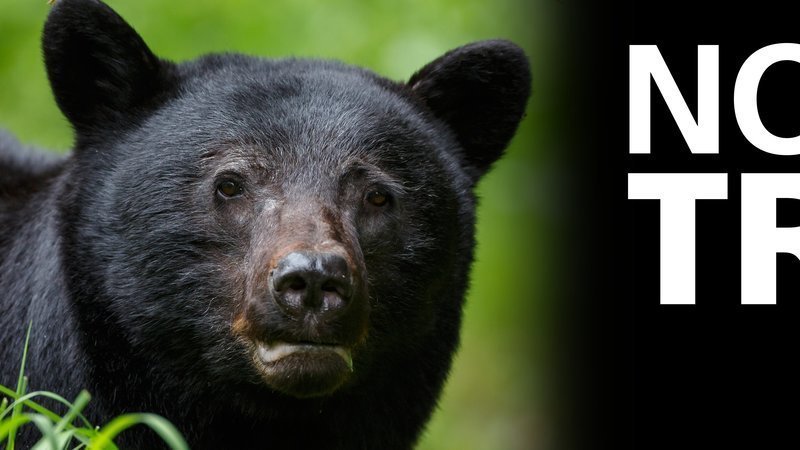
During the convention, and for two months afterward, we will post a billboard in Reno with an image of a black bear and the words “Not Your Trophy”. The billboard will be installed on January 7th.
We would like to continue with a third month of the billboard and to move it to the Carson City area to remind Nevada legislators, who will then be in session, that the majority of Nevadans oppose trophy hunting and the senseless killing of our local wildlife. We have most of the money we need for the third month; however we are short approximately $450. Click this link to contribute toward the billboard. (Please note “bear billboard” in a comment on your donation.)
With changes in the Nevada government, and increased interest
ELKO – Detectives with the Elko Sheriff’s Office responded to a report of a person being accidentally shot in a hunting accident Saturday morning at South Fork Road and Jiggs Highway.
When detectives arrived on the scene, the ambulance was present and had treated the victim of the shooting. Kevin Vella was one of four hunters pursuing coyotes that morning when Jamie Salazar accidentally shot Vella, according to Elko County Sheriff’s Office preliminary reports.
“What happened is the four were set up to hunt the coyotes and calling them in,” said Undersheriff Ron Supp. “The coyotes then started to come behind [Salazar] and he took a shot. The two other guys were in line with him, but he didn’t know where [Vella] was.”
All four hunters were reportedly wearing camouflage during the incident, which occurred around 9 a..m.
Salazar shot Vella with a .223 caliber rifle, and reported the incident to the Elko Sheriff’s Office. Vella sustained injuries to his arm.
The investigation is ongoing as detectives continue to collect statements and evidence.
We are sad to share that since the Nevada bear hunt began on September 15th, 8 bears have already lost their lives to despicable trophy hunters.
Up to an additional 12 are slated to be killed before the season ends on December 1.
In the Spring, we will be calling on all of you to speak out against the Nevada bear hunt during the annual Nevada Board of Wildlife Commissioners meeting to set the quota for number of bears to be killed in 2018. We will be demanding that the wildlife commissioners set a zero quota.
If you are wondering why we don’t simply ask for the hunt to come to an end, the reason is that the Nevada bear hunt is mandated in NV law. The law was made to protect the “rights” of those who want to slaughter animals for fun, despite Nevada’s small bear population of just 3-400 and despite the fact that the majority of Nevadans oppose trophy hunting. We hope to circumvent the “necessity” for a hunt by asking for the hunt to continue…with zero bears killed.
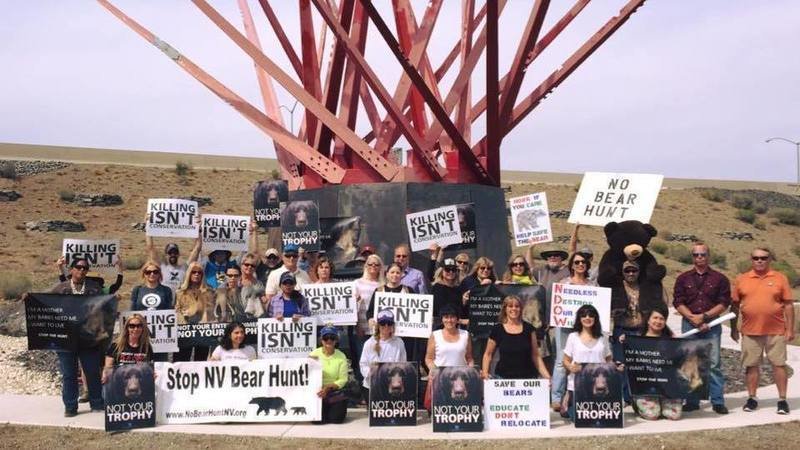
We are pleased to share that many individuals are rising up against the bear hunt. Alongside No Bear Hunt NV, CompassionWorks International held a very successful and well-attended protest in Reno, NV on September 16th that gained ample media coverage.
Also, having successfully raised the funds, in the next two weeks we will be distributing a postcard encouraging residents to be “bear smart” to 15,000 homes in the Tahoe basin where human/bear encounters are frequent. We hope this will curb encounters that result in bears being relocated or killed.
Finally, here in Nevada we are suffering from the tragedy that occurred just days ago in Las Vegas. Unbelievably, the Las Vegas Convention and Visitors Authority are continuing with their plan to host the annual conference of Safari Club International in Las Vegas next January/February. To host a vile group of “thrill killers” after what Las Vegas has just endured is beyond the pale. Please join us in speaking out against Safari Club International (the world’s largest group of trophy hunters) and their conference in Las Vegas by signing this petition: https://www.change.org/p/las-vegas-convention-and-visitors-authority-stop-supporting-guns-and-killing-ban-sci.
Finally, we are grateful to all who donated to our postcard campaign. If you would like to support our efforts to hold protests, petition for a zero quota, and do other outreach aimed at saving the lives of Nevada’s precious bears, please visit www.cwint.org/donate to make your secure, tax-deductible donation online.
Thank you, as always, for your friendship and support, and for your care for Nevada’s wildlife.
For the Animals,
Carrie LeBlanc, M.A.
Executive Director
CompassionWorks International
Coyotes in Nevada need your voice! On March 20th, the Nevada Board of Wildlife Commissioners will vote to accept or reject a petition to ban coyote-killing contests in the state. You do not have to be a Nevada resident to express your support and have it count! Encourage the Commission to accept this petition; there are four ways to do so:
Testify at the Commission meeting on Friday, March 20th. You do not need to be an “expert” or have detailed information! Since these contests involve the unnecessary destruction of a public “resource” (wildlife, including coyotes, belongs to everyone per NRS 501.100), your opinion and related comments are pertinent. Please see “talking points” below to guide your testimony and remember, anyone can testify – kids included (and encouraged).
If you can’t make it to the meeting, email or write to the Commission at the address below to express your support for a ban and to encourage the Commission to accept the petition. See “talking points” for guidance on what to say.
In addition to the above, submit letters to the editor of Nevada papers in support of a ban on coyote-killing contests. See “talking points” below, but as always, the more you personalize your letter, the more effective.
Spread the word! Pass this alert on to others in Nevada and encourage them to take action.
When: Friday, March 20, 2015.
Meeting starts at 8:30am. Petition hearing should begin around 9:30-10:00am but arrive early to get a seat and to sign up to testify.
Where: TMCC, 7000 Dandini Blvd (Parr Blvd exit off 395), Sierra Building, Room 108 (auditorium), Reno.
There will also be a video conference connection in Las Vegas and Elko.
In Las Vegas:
College of S. Nevada, 3200 Cheyenne Ave., Main Building, Room 2638.
In Elko:
Great Basin College, 1500 College Parkway, High Tech Center, Room 137.
What to expect: The petition will be presented including a short summary of the issue and supporting documents. Those wishing to testify need to put their name on a yellow card (provided). Following public comment, the Commission will discuss the issue and make a decision.
Commissioner Contact Information (for sending letters and emails):
Nevada Board of Wildlife Commissioners
1100 Valley Road
Reno, NV 89512
Talking Points (please personalize your letters!):
Please be sure to state that you encourage the Commissioners to accept the petition to ban coyote-killing contests in addition to outlining your arguments against such contests.
Coyote-killing contests are conducted for profit, entertainment, prizes, and simply for the “fun” of killing. In December 2014, the California Fish and Game Commission voted to close the loopholes that allowed the killing of wildlife for prizes and inducements – becoming the first in the nation to ban the practice for coyotes, foxes, bobcats and other species. Nevada should follow California’s lead.
Coyotes are often baited and lured with distress calls of pups or wounded prey, placing coyotes at an even greater and unfair disadvantage. Read more here.
No evidence exists showing that indiscriminate killing contests serve any effective wildlife management function. Coyote populations that are not exploited (e.g. hunted or trapped) form stable “extended family” social structures that naturally limit populations through defense of territory and the suppression of breeding by subordinate female members of the family group. Indiscriminate killing of coyotes disrupts this social stability resulting in increased reproduction and pup survival. Read more here.
Coyotes have been shown to provide ecosystem services that benefit humans, including the control of rodents and rabbits which compete with domestic livestock for forage and which are associated with diseases such as plague, hantavirus, tularemia and Lyme disease. Read more here.
Coyote-killing contests perpetuate a culture of violence and send the message to children that life has little value and that an entire species of animals is disposable.
Coyote-Killing contests put non-target wildlife, companion animals, and people at risk.
A ban on coyote-killing contests in Nevada will not restrict the ability to protect property including livestock, will not undermine Second Amendment gun ownership rights, nor will it limit hunting in any other way.
by Jeff DeLong, RGJ 6:25 a.m. PST February 17, 2015
Critics of coyote hunting contests hope to ban the controversial practice in Nevada, insisting it amounts to little more than wanton slaughter of wildlife.
Hunters counter that it is a legally protected sport that may help keep in check a soaring coyote population increasingly posing threats to livestock, pets and people.
Don Molde of Reno and Fred Voltz of Carson City have petitioned the Nevada Board of Wildlife Commissioners for regulatory changes that would outlaw contests awarding cash or other prizes for killing coyotes.
The proposal, scheduled to be discussed by commissioners in March, comes as state lawmakers discuss similar action in New Mexico and two months after California enacted a first-of-its-kind ban on coyote hunting contests.
Molde, of Nevadans for Responsible Wildlife Management, moved to change Nevada regulations after a “coyote calling contest” was conducted in the North Valleys outside Reno in December, generating controversy and drawing national media attention.
“Somebody has to do something. These contests are outrageous,” Molde said. “It is the willful killing of wildlife just for the fun of it. It’s just not right.”
Across the West, the coyote is classified as an unprotected animal. They can be hunted without a license or permit, shot on sight, and there’s no limit on the number that can be killed at one time.
In coyote calling contests, coyotes are typically lured with devices that mimic the howls and yips of coyotes or the sounds of prey animals such as rabbits or rodents. Prizes are awarded based on number of kills.
Last December’s coyote call in the North Valleys was a small affair, with only 10 coyotes killed, according to organizers. Others are huge. During the 2013 World Coyote Calling Championship in Elko, 110 two-person hunting teams killed more than 300 coyotes.
Jason Schroeder, a heavy equipment mechanic who organized December’s contest, called controversy over the event unjustified and predicted efforts to ban such contests in Nevada will “never fly.”
“They are entitled to their opinion, and we’re entitled to ours,” Schroeder said. “The law says you can hunt coyotes on public land and that’s what we’ve done.”
Coyotes clearly pose a mounting problem, Schroeder said, adding that three dens of coyotes are now living on his Lemmon Valley property.
“Coyotes are moving out of the wild and into town,” he said. “Coyotes are biting people right now. They are attacking people’s animals.”
But hunting contests are not an effective method of controlling coyote populations, said Camille Fox, executive director of Project Coyote, the organization that successfully petitioned the California Fish and Game Commission to ban coyote hunting contests. California law still allows hunters to shoot as many of the predators as they wish year-round but outlaws the awarding of prizes.
Fox points to studies indicating that coyote hunts have only short-lived effectiveness at best in controlling coyote populations due to the animal’s natural resiliency. Other non-lethal steps can protect livestock and other animals from coyotes, including better fencing and use of guard dogs, she said.
Hunt contests should be outlawed simply as a matter of decency, Fox said.
“Like dogfighting and cockfighting, killing contests are an archaic tradition that really should be left to the history books,” Fox said. “We’re increasingly seeing a backlash against these contests. I do think the American public is fairly outraged by this practice.”
Rick Gipson, who shot his first coyote at age 6, is observing the debate unfold from his home in Boise, Idaho. Gipson has participated in numerous coyote hunting contests over the years, including three world championships like the one held in Elko in 2013.
“The contests are getting larger and the take is getting larger but it’s not getting close to controlling them,” Gipson said, adding that the contests account for a only small percentage of coyotes being killed.
Coyotes are trapped, poisoned and shot from the air by government hunters, yet numbers continue to grow, Gipson said.
“These animals have survived persecution for 200 years and they’ve flourished,” Gipson said. “We’ve been doing this for decades and we’re not even coming close to slowing them down. They just keep coming.”
The successful ban in California and proposals now being discussed in Nevada and New Mexico are bound to be followed by other states, said Gipson, describing the effort as part of a larger anti-hunting agenda.
“They’re going to try it in every Western state,” he said. “These anti-hunters will stop at nothing.”
Fox acknowledges the proposed ban will likely face steep opposition in Nevada.
“It’s not going to be an easy process there,” she said.
Maybe so, said Molde, who said he wants the discussion to occur in any case.
“This board of wildlife commissioners is not going to get into this unless they are forced to,” Molde said. “Either way, we get them on the record.”
COYOTE CONTEST BAN PROPOSAL
WHAT: Nevada Board of Wildlife Commissioners.
WHEN: 8:30 a.m. March 20.
WHERE: Sierra Building, Room 198, Truckee Meadows Community College, 7000 Dandini, Blvd., Reno.

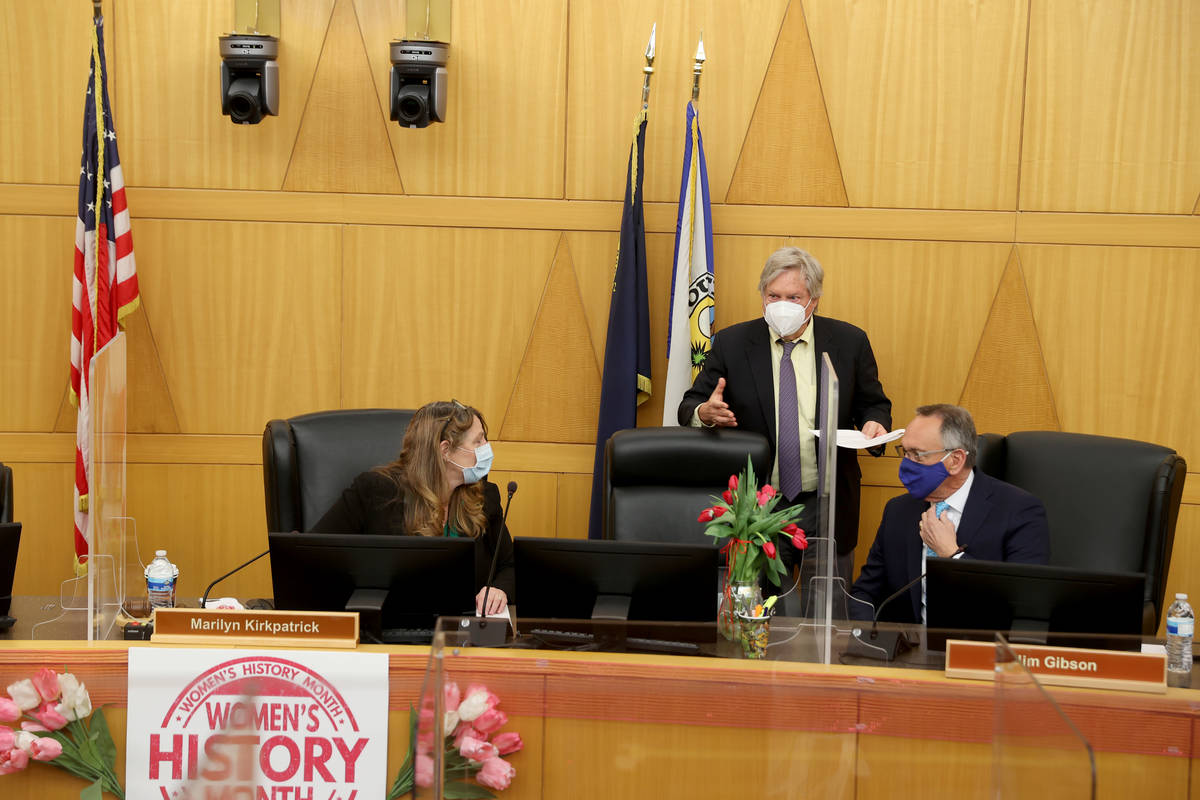 Clark County Commissioners, from left, Chairman Marilyn Kirkpatrick, Tick Segerblom and Jim Gibson during a break in a commission meeting at the Clark County Government Center in Las Vegas Tuesday, March 2, 2021. (K.M. Cannon/Las Vegas Review-Journal) @KMCannonPhoto
 Clark County Commissioners, from left, William McCurdy II, Michael Naft, Justin Jones, Chairman Marilyn Kirkpatrick, Jim Gibson and Tick Segerblom during a commission meeting at the Clark County Government Center in Las Vegas Tuesday, March 2, 2021. (K.M. Cannon/Las Vegas Review-Journal) @KMCannonPhotoMore StoriesNellis AFB commits land for first responder vehicle training complexFood service and hospitality workers can now get vaccinesNevada adds highest one-day total of new COVID cases in nearly a monthState: Vaccine groups not changing, despite unused appointments



 Exposing the Big Game