An 18-year-old driver in Old Forge was ticketed late last month by state conservation officers for intentionally speeding up his pickup truck, hitting and critically injuring a white-tailed deer.
That incident and other recent incidents below involving state Department of Environmental Conservation officers (ECOs) was reported this week by the DEC.
Intentional Deer Strike – Herkimer County
“On March 31, Town of Webb Police contacted a state Conservation Officer about a deer struck and killed by a vehicle in the village of Old Forge. Multiple eyewitnesses claimed the driver intentionally accelerated his truck toward two deer standing in the road, striking one and dragging it approximately 70 to 100 yards down the road. Due to the extent of its injuries, the deer had to be euthanized, according to wktv.com. An officer accessed video footage from a local business’ security camera that corroborated eyewitness statements. With help from Old Forge Police, ECOs located the truck and driver in the town of Forestport, Oneida County, and found deer hair in the front bumper of the suspect’s truck. After interviewing him and presenting him with the evidence, the driver, Grady Boulier, 18, admitted to accelerating toward the two deer, striking one, and dragging it down the road before stopping. The subject was issued appearance tickets to the Town of Webb Court for Environmental Conservation Law violations of taking deer from a public highway, taking deer while in a motor vehicle and taking deer during the closed season.”
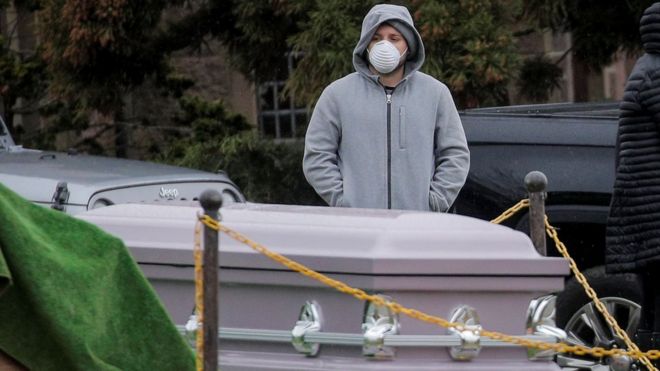
Image copyrightREUTERSImage captionMourners attend a funeral in Brooklyn, New York, as the city’s coronavirus death toll hit a record high for a third day
New York state now has more coronavirus cases than any single country outside the US, according to latest figures.
The state’s confirmed caseload of Covid-19 jumped by 10,000 on Thursday to 159,937, placing it ahead of Spain (153,000 cases) and Italy (143,000).
China, where the virus emerged last year, has reported 82,000 cases.
The US as a whole has recorded 462,000 cases and nearly 16,500 deaths. Globally there are 1.6 million cases and 95,000 deaths.
While New York state leads the world in coronavirus cases, its death toll (7,000) lags behind Spain (15,500) and Italy (18,000), though it is more than double the official figure from China (3,300).
Photos have emerged of workers in hazmat outfits burying coffins in a mass grave in New York City.
Image copyrightREUTERSImage captionAbout 40 coffins were buried on ThursdayImage copyrightREUTERS
Drone footage showed workers using a ladder to descend into the huge pit where the caskets were stacked.
The images were taken at Hart Island, off the Bronx, which has been used for more than 150 years by city officials as a mass burial site for those with no next-of-kin, or families who cannot afford funerals.
Burial operations at the site have ramped up amid the pandemic from one day a week to five days a week, according to the Department of Corrections.
Prisoners from Rikers Island usually do the job, but the rising workload has recently been taken over by contractors.
New York City Mayor Bill de Blasio indicated earlier this week the city’s public cemetery might be used for burials during the pandemic.
“Obviously the place we have used historically is Hart Island,” he said.
Media captionIs it too soon for a thriller movie on coronavirus?
The number of coronavirus deaths in New York state increased to 799 on Wednesday, a record high for a third day.
But Governor Andrew Cuomo took heart from the fact that the number of Covid-19 patients admitted to New York hospitals dropped for a second day, to 200.
He said it was a sign social distancing was working. He called the outbreak a “silent explosion that ripples through society with the same randomness, the same evil that we saw on 9/11”.
Another glimmer of hope was heralded on Thursday as official projections for the nationwide death toll were lowered.
Dr Anthony Fauci, a key member of the White House’s coronavirus task force, told NBC News’ Today show on Thursday the final number of Americans who will die from Covid-19 in the outbreak “looks more like 60,000”.
In late March, Dr Fauci estimated “between 100,000 and 200,000” could die.
The 60,000 projection would match the upper estimate for total flu deaths in the US between October 2019 to March 2020, according to government data.
But Vice-President Mike Pence stressed on Thursday that Covid-19 is about three times as contagious as influenza.
The White House has previously touted estimates that 2.2 million Americans could die from coronavirus if nothing was done to stop its spread.
Stay-at-home orders have in the meantime closed non-essential businesses in 42 states, while drastically slowing the US economy.
New data on Thursday showed unemployment claims topped 6 million for the second week in a row, bringing the number of Americans out of work over the last three weeks to 16.8 million.
Chicago meanwhile imposed a curfew on liquor sales from 21:00 local time on Thursday to stop the persistent violation of a ban on large gatherings.
Media captionHow caravans are helping frontline medics with a place to stay
The measure, due to remain in place until 30 April, comes after health officials this week said black Chicagoans account for half of all the Illinois city’s coronavirus cases and more than 70% of its deaths, despite making up just 30% of the population.
“We are putting this curfew in place because too many individuals and businesses have been violating the stay-at-home order,” said Mayor Lori Lightfoot on Wednesday.
Gun violence in Chicago on Tuesday left seven dead and 14 injured, which city officials said was unforgivable given the virus crisis.
“Every one of those ER beds taken up by a gunshot victim could be somebody’s grandmother, somebody with pre-existing conditions, somebody that is in danger of losing their lives because of the pandemic,” Supt Charlie Beck said.
Media caption‘I just had a baby – now I’m going to the frontline.’
Figures from Louisiana, Mississippi, Michigan, Wisconsin and New York reflect the same racial disparity in coronavirus infections.
Presumptive Democratic White House nominee Joe Biden joined growing calls on Thursday for the release of comprehensive racial data on the pandemic.
He said it had cast a spotlight on inequity and the impact of “structural racism”.
Meanwhile, a court has blocked parts of Texas’ temporary abortion ban, which the state announced last month citing the coronavirus outbreak.
The order against “medically unnecessary” procedures was introduced to reserve valuable medical resources for those treating Covid-19 only, the state’s Republican attorney general said in March.
Media captionItalian PM Giuseppe Conte said he might begin to relax some measures by the end of this month
But Judge Lee Yaekel, a George W Bush appointee, granted a temporary restraining order against the ban on Thursday.
“As a minimum, this is an undue burden on a woman’s right to a previability abortion,” he wrote in his ruling.
Alabama, Iowa, Ohio and Oklahoma have introduced similar abortion bans.
While there is still no vaccine for Covid-19, America’s culture wars have proved similarly incurable.
Legal battles have also ensued over whether guns shops should be closed during the pandemic, and if religious services should be exempt from state orders that ban large gatherings.
New drone video shows a giant trench being dug at New York City’s public cemetery on Hart Island to help handle an influx of unclaimed bodies due to the coronavirus pandemic.
As the death toll mounts in New York, the city’s public cemetery has started receiving about the same amount of bodies per day that it used to bury there each week.
Normally, about 25 bodies a week are interred on the island, mostly for people whose families can’t afford a funeral, or who go unclaimed by relatives. But recently, burial operations have increased from one day a week to five days a week, with around 24 burials each day, said Department of Correction spokesman Jason Kersten.
The medical examiner’s office will only keep bodies for 14 days before they are sent to be buried in the city’s potter’s field on Hart Island in the Bronx.
Aerial images taken Thursday by The Associated Press captured workers digging graves on the island. About 40 caskets were lined up for burial on the island on Thursday, and two fresh trenches have been dug in recent days.
Workers wearing personal protective equipment bury bodies in a trench on Hart Island, in the Bronx, N.Y., on April 9, 2020.John Minchillo / AP
The island may also be used for temporary interments should deaths surge past the city’s morgue capacity. The Office of the Chief Medical Examiner can store about 800 to 900 bodies, while about 4,000 can be stored in refrigerated trucks dispatched to city hospitals.
Download the NBC News app for full coverage of the coronavirus outbreak
This plan for temporary burials at Hart was finalized in 2008 and is part of the Office of the Chief Medical Examiner’s plan for pandemic influenza outbreaks. Currently, New York City’s daily death rate is far below the “maximum scenario” the plan was designed to handle.
Mayor Bill de Blasio told TV station NY1 earlier this week that under such a contingency plan, bodies of COVID-19 victims would be buried individually — not in mass graves — so families could later reclaim them.
The city is able to accommodate burials of 19,000 dead on Hart Island.
Elisha Fieldstadt
Elisha Fieldstadt is a breaking news reporter for NBC News.
New York City has over 80 wet markets – businesses that sell live animals to the public and slaughter them onsite. New York’s live animal markets are located in all five boroughs.
Since 2016, public health and animal rights advocates have been sounding alarm bells about the City’s wet markets, pleading with health officials and lawmakers to shut them down in order to prevent the transmission and spread of infectious disease. COVID-19 is believed to have been transmitted from animal to human in a wet market in Wuhan, China.
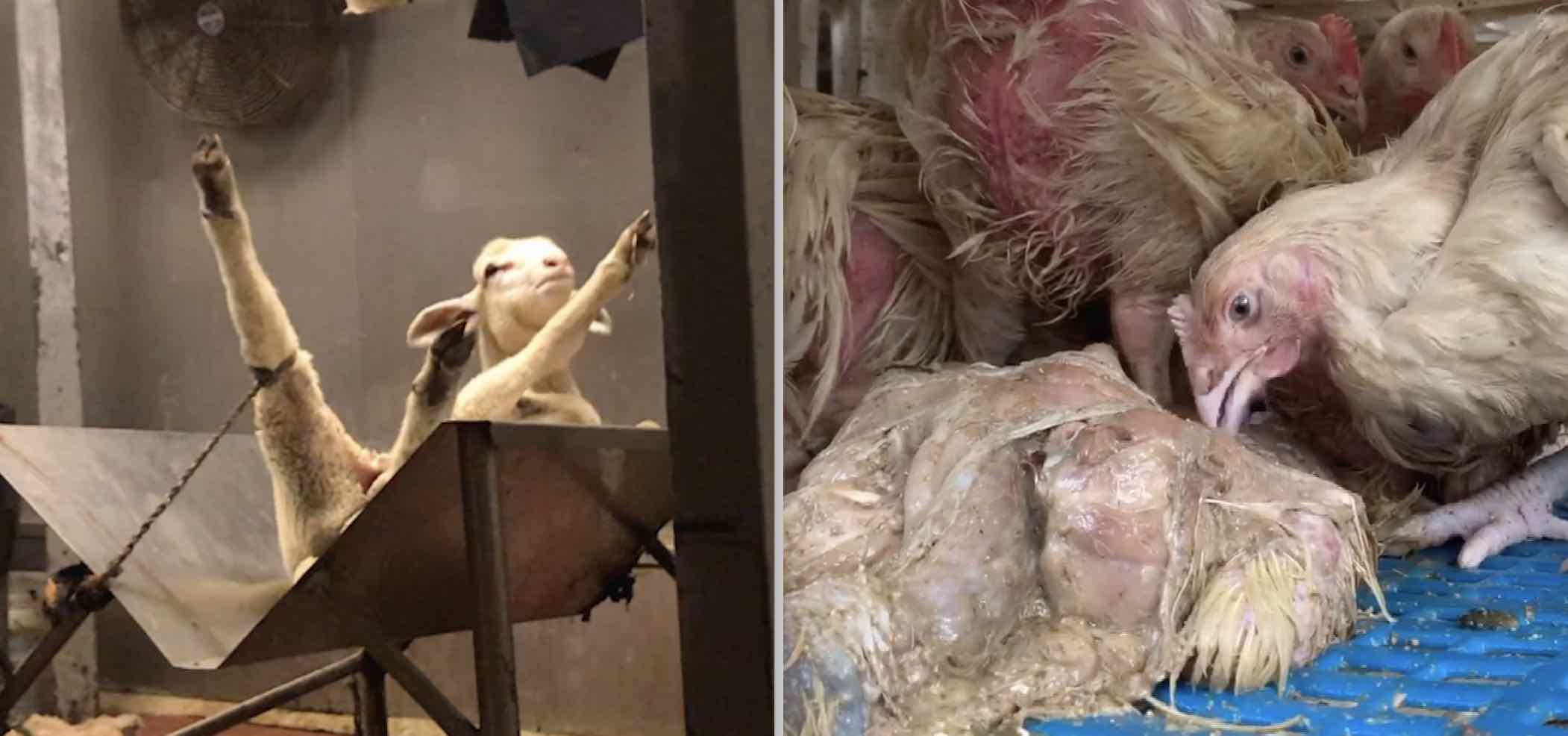
Sheep and chickens are among the approximately 10 different species of live animals sold at NYC’s wet markets
NYC’s wet markets sell approximately ten animal species, including goats, sheep, chickens, guinea hens, rabbits, pigeons, Muscovy ducks, and quail. The animals are confined in small cages or pens where they can sicken each other and the people who work and shop there. Animal feces, body parts, feathers and blood are tracked in and out by customers and pedestrians who then carry the refuse on to the subways and into their homes, offices and communities.
Wet markets, or live animal markets, are storefront slaughterhouses that sell live animals to public and slaughter them on site
“New York City’s wet markets are a ticking time bomb,” said Jill Carnegie, a co-organizer with Slaughter Free NYC, an organization advocating to shut down wet markets and other slaughterhouses in NYC. “If avian flu or another infectious disease is transmitted to just one human, it could spread very rapidly in New York City and beyond, as we have seen with COVID-19.”
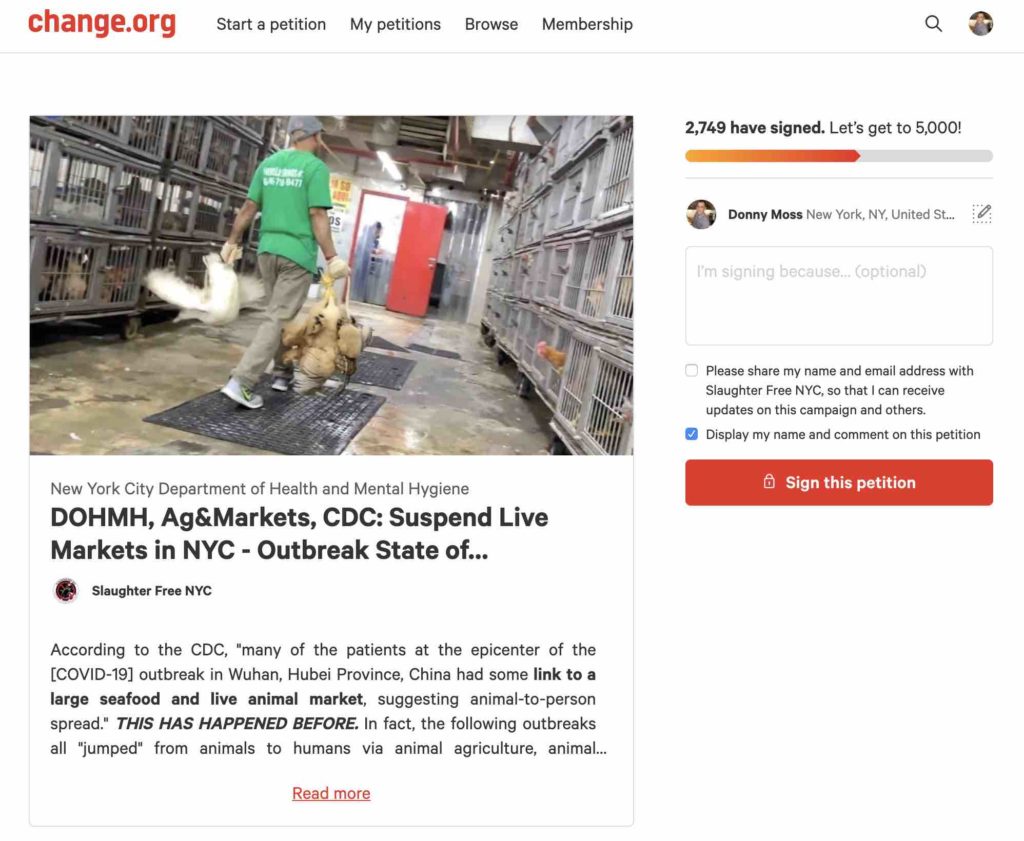
The COVID-19 pandemic has increased the advocates’ sense of urgency. Slaughter Free NYC is now asking Mayor Bill de Blasio, Health Commissioner Dr. Oxiris Barbot and Deputy Commissioner of Disease Control Dr. Demetre Daskalakis to prohibit the slaughter of live animals in the five boroughs of New York. In February, the organization launched a petition with its demand.
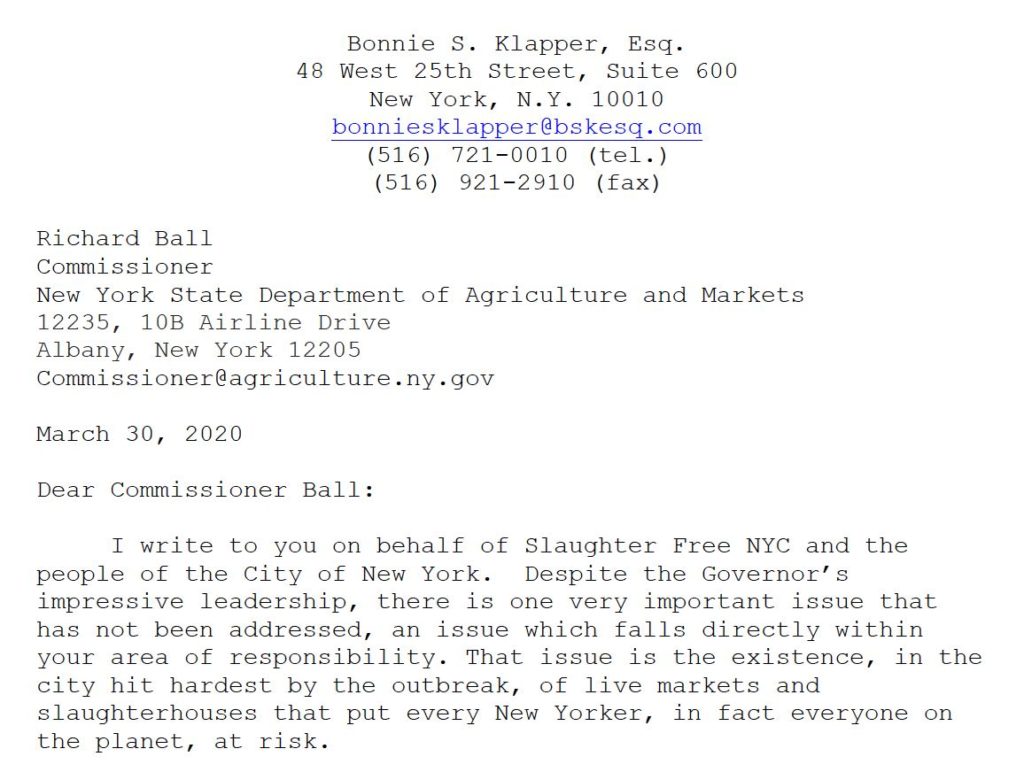
In a letter to NY Governor Andrew Cuomo and the NY State Department of Agriculture & Markets, Bonnie S. Klapper, a New York City-based attorney working on several cases involving animal agriculture, wrote that City and State health authorities are turning a blind eye to the well-documented health code violations
Click letter to view in full
“The NYC Department of Health claims that it has no regulatory authority over these markets and defers to NY State Department of Agriculture & Markets, but state health officials have told me that these wet markets are never inspected unless they receive numerous complaints,” Klapper told TheirTurn. “That said, no amount of oversight can prevent disease transmission in storefront slaughterhouses where sick animals are coming into contact with humans.”
PCRM Petition to the Surgeon General to outlaw live markets in the United State
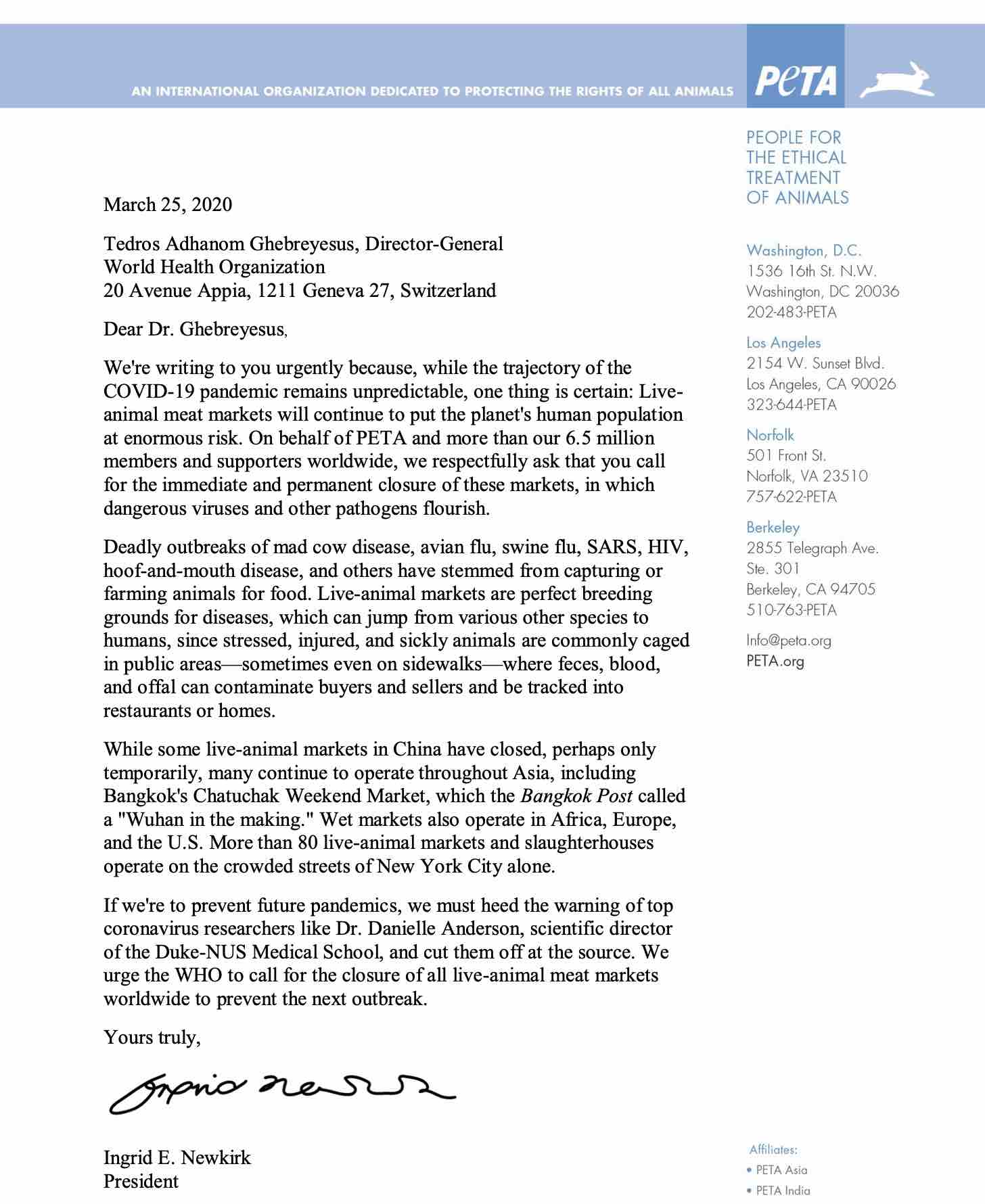
On March 25th, People for the Ethical Treatment of Animals (PETA) sent a letter to the Tedros Adhanom Ghebreyesus, the Director-General of the World Health Organization (WHO) encouraging him to call for the permanent closure of [wet] markets: “Deadly outbreaks of mad cow disease, avian flu, swine flu, SARS, HIV, hoof-and-mouth disease and others have stemmed from capturing or farming animals for food. Live animal markets are perfect breeding grounds for diseases, which can jump from various others species to humans . . . If we’re to prevent future pandemics, we must heed the warning of top coronavirus researchers like Dr. Danielle Anderson, scientific director of the Duke-NUS Medical School, and cut them off at the source.”
In partnership with The Save Movement, an organization that stages vigils at slaughterhouses around the word, Slaughter Free NYC conducts vigils and educational outreach at New York City’s wet markets.
New York City Council Speaker Corey Johnson is being dubbed an animal hero on the heels of a package of animal protection bills, from a ban on foie gras to new work standards for carriage horses.
Animals are in trouble if this is the best the city can do.
In the spring, Johnson sounded like an animal hero during the public hearing for a ban on fur sales. He berated the furriers in attendance for the horrific ways they treat animals before they kill them, and urged his colleagues to ban the sale of fur in the city, calling it the “moral thing to do.”
But the fur ban never made it over the finish line. I guess morality takes a backseat when there are political pressures.
PAID POST
What Is This?
American-made cars: Find the most USA madeDiscover which new cars and trucks contribute more to the U.S. economy, regardless of where the manufacturer’s brand is actually headquartered. Click to read learn more.
It seems that Johnson, who is eyeing a mayoral run in 2021, doesn’t want to draw the ire of a group of black clergy members, who came out in opposition, arguing that fur garments had a special significance in their community. We’ve read headlines like, “Proposed fur ban pits animal rights advocates against black ministers.”
But we disagree that because someone wants to defend the rights of animals, they’re somehow against African-American churchgoers. That’s insulting, and nothing could be further from the truth.
The storyline that fur is a natural fit for church, and that black people have some special affinity for animal cruelty, has been stoked by the fur lobby. Knowing it will always lose the animal cruelty arguments, it creates distractions.
The reality is wearing your “Sunday best” is not exclusive to one community or another. I’m white and grew up in the Roman Catholic Church in a small town in Connecticut. When it got colder, my mom dressed my sister and me in rabbit coats and hand muffs, while she donned her red fox coat that my dad had given her.
My dad came from very humble beginnings, but eventually opened his own jewelry store. Those coats, and the Cadillac he drove around in, represented that he had made it.
Regardless of race, we all have a history of having seen fur as a status symbol. And regardless of race, we can all overcome that history to do the right thing.
NYC, one of the fashion capitals of the world, is missing an opportunity to be a role model for consumers across all ethnicities by showing them a look of status, or a desire to dress up as a sign of respect, can be achieved with faux fur.
It’s the same fur look, but it doesn’t kill. In my own household, we evolved. I vividly remember the pink faux-fur coat that replaced the real thing when we realized animal cruelty does not look good on anyone.
Surely, one would assume people attracted to fur as a status symbol would reject a mink coat once they learned the confined animals are riddled with injuries, covered in sores and living in their own feces because their cages often go uncleaned for weeks. Fur farms are as far from luxury and prestige as one can get.
Furthermore, New York City is already becoming one of the most vibrant places for faux fur — successful, eco-friendly, luxury fashion labels have opened here.
A ban on retail fur sales in the nation’s fashion capital will spare the lives of millions of animals who skins are sold here in the name of luxury and status.
The city’s fur industry is already disappearing; the number of manufacturers and retailers selling it has dropped precipitously. Dozens of big-name fashion designers — many headquartered here — have already spurned fur. Macy’s, whose flagship store is in New York, just announced it is ending fur sales by the end of 2020. Multiple municipalities have banned fur sales, including Los Angeles and the entire state of California.
ALBANY, N.Y. (AP) — Canada goose hunting season is open throughout most of New York state.
Environmental Conservation Commissioner Basil Seggos says the September goose hunting season is designed to help reduce the resident Canada goose population, which has expanded to nuisance levels in some areas.
New York’s population of non-migrating Canada geese has grown from 80,000 in 1995 to more than 340,000 today. Hunting seasons have been liberalized in efforts to curb population growth.
The September Canada goose season runs from Sept. 1 through Sept. 25 in upstate goose hunting zones.
Hunters are allowed to take eight to 15 birds a day depending on the zone.
The poll, conducted by Mason-Dixon Polling and Research earlier this month, found that 75 percent of respondents support a citywide law to prohibit the sale of fur apparel. The results show widespread support for legislation introduced by City Council Speaker Corey Johnson – Intro 1476<https://legistar.council.nyc.gov/LegislationDetail.aspx?ID=3903503&GUID=EBE55293-8737-4620-945A-308ADC3A23DC&Options=&Search=> – that would ban fur apparel sales in the city. The Council’s Committee on Consumer Affairs and Business Licensing is holding a hearing on the bill Wednesday.
“The results show that New York City needs to take action to catch up to what is clearly society’s sentiment, that cruelty is not fashionable,” said Friends of Animals President Priscilla Feral. “NYC can be the ultimate fashion forward role model by passing this legislation. Showing compassion for animals, and all sentient beings, is one of the purest expressions of our humanity.”
Friends of Animals has joined with FurFreeNYC,<https://www.furfreenyc.com/blog/coalition-statement-of-support-for-intro-1476-a-bill-to-prohibit-the-sale-of-fur-apparel-in-new-york-city> a coalition of public interest organizations, to support the fur sales ban legislation. FoA will be showing support for the bill at a Wednesday rally at noon at City Hall and testifying at the hearing as well.
The poll showed that about two-thirds of voters surveyed in every borough supported the ban.
In a statement Monday, Feral noted there has been widespread misinformation about the fur ban bill circulating by opponents. The bill prohibits the sale of any fur or fur apparel including any skin in whole or part with hair, fleece or fibers attached. It does not restrict or prevent residents in any way from wearing fur apparel they have already purchased. The bill does not ban leather; it has exemption for fur worn as a matter of religious custom and for used fur.
Additionally, while opponents contend fur is environmentally sustainable, the fur industry likes to ignore studies that have found real fur to be the most harmful of all fabrics. The production of real fur is significantly more harmful than other types of fabric in 17 out of 18 areas including climate change, in part because of chemicals used to prevent the skins from decomposing and decomposing of mink feces, according to a study by CE Delft. Increasingly, faux fur manufacturers and fashion houses are using innovative, sustainable fabrics.
“The fur industry is trying to divert attention and scare the public,” said Feral. “But New York City residents understand the issue and want to see an end to the cruelty.”
***
Friends of Animals, an international animal protection organization founded in New York in 1957 and headquartered in Darien, CT, advocates for the rights of animals, free-living and domestic around the world. It has been a decades-long leader in the anti-fur movement. Friends of Animals is proud to be a woman-founded and led organization.
I’m amazed at the depths some of us can sink to, all in the name of good, clean fun for the whole family.
I’m perplexed at how some of us can rationalize our deviant behavior regardless of how much pain and suffering results from it.
And I’m disgusted that some of us will attempt to justify the invalidation of the sanctity of all life in order to satiate an appetite for blood drawn by their own hands.
What happens in Holley, New York later today isn’t about hunting. Nor is it about guns or Second Amendment rights or nuisance abatement or the industrial agriculture vs. living off the land debate or feeding the hungry.
What happens in Holley, New York later today is about the sad fact there exists in a certain segment of our society a mindset that derives a perverse pleasure from needlessly preying on the weak and defenseless. for no good reason other than it’s fun to kill them.
i can’t imagine seeing the world through their eyes.
What an ugly place it must be.
Where we see the miraculous beauty of all living things, they instead see unfeeling objects there for the plundering, whose life value can be minimized to the point where it’s worth little more than prize redemption in a killing contest.
Be mad.
Or be sad.
But be something.
If we’re indeed the superior species on this planet (as so many seem to think), isn’t it high time we act the part? If not for their good, at least for our own?”
A Tompkins County man has been charged with three violations of state Environmental Conservation Law after he shot an adult bald eagle Saturday, using deer carcasses as bait.
The DEC said Donald N. Mix, of Caroline, N.Y. shot the protected bird in the Town of Caroline. Bald eagles are listed as a “threatened species” in New York.
According to the DEC, Environmental Conservation Officer Ozzie Eisenberg responded to a complaint Saturday from a town resident who “who heard a shot and then spotted a large bird round in a nearby field.”
The conservation officer found a dead adult bald eagle at the scene, and “a subsequent interview with a neighbor revealed that the man had placed deer carcasses in the field to shoot coyotes and turkey vultures, another protected species.” It is legal to shoot coyotes over bait. Read more about hunting coyotes.
According to the complainant, the neighbor found the eagle “still breathing slowly,” and was with the bird as it died while she awaited the DEC officer’s arrival.
The DEC said Mix “thought the bird was a turkey vulture and was unaware that he had killed a threatened bald eagle.”
The man is due to return to Town of Caroline Court on Jan. 22.
According to the DEC, Mix faces the following charges and penalties:
Illegal taking of protected wildlife ECL 11-0107 (1) – “No person shall, at any time of the year, pursue, take, wound or kill in any manner, number or quantity, any fish protected by law, game, protected wildlife, shellfish, harbor seals, crustacea protected by law, or protected insects, except as permitted by the Fish and Wildlife Law.”
The fines and punishment can range from up to $250 and up to 15 days in jail or both.
Illegal taking of wild birds ECL 11-0901 (9) – “No protected wild bird for which no open season is established by law or fixed by regulation shall be taken.”
The fines and punishment can range from up to $250 and up to 15 days in jail or both.
Illegal taking of a bald eagle ECL 11-0537 – “It shall be unlawful to knowingly or with wanton disregard for the consequences of this act to take, possess, sell, purchase, barter, offer to sell, purchase or barter, transport, export or import, at any time or in any manner, any bald eagle commonly known as the American eagle, or any golden eagle, alive or dead, or any part, nest, or egg thereof of the foregoing eagles without a permit from a lawful authority. ”
The fines and punishment can range from, in the case of a first violation, up to $5,000 and up to 90 days in jail or both.
A deer that was thought to be dead hopped out of the back of a pickup truck recently of two Upstate New York men who were illegally hunting at night from the motor vehicle with the aid of lights. The incident eventually led to the men being discovered and issued several tickets by a state conservation officer.
That incident and other involving environmental conservation officers occurred between Nov. 20-25. All specifics below were supplied by the state Department of Environmental Conservation.
The Undead Deer — Albany County
“On Thanksgiving night, Nov. 22, ECO Brian Canzeri responded to assist Albany County Sheriff’s Deputies in the town of Berne who had stopped a pick-up truck with two occupants. A witness spotted them shoot from the truck and then drive off. Fresh blood on the tailgate, rear bumper and floormats of the truck, along with hunting attire, rifles and spotlights inside the truck supported information from the witness. ECO Canzeri obtained statements from both suspects about the evening’s events. While driving on Bradt Hollow Road, a 4-point buck had run in front of the suspect’s vehicle. The passenger shot out of the driver’s side window, hitting the deer. Both subjects then loaded the deer in the back of the pickup and drove off. However, the deer was not dead and approximately a mile down the road the deer jumped out of the bed of the truck. They turned around to look for animal and were stopped by Deputies as they tried to flee. The wounded deer was located soon after and put down. ECO Canzeri seized two rifles and two spotlights. Both suspects had suspended drivers licenses. One had an arrest warrant pending and the other had past hunting violations in Washington County, including taking deer with the aid of an artificial light as well as an order of protection prohibiting him from possession of firearms. On Nov. 24, three more dead deer were found in the area with evidence showing that they were connected to the men. ECO Canzeri issued tickets to both subjects for taking big game deer with the aid of light, shooting within 500 feet of a dwelling, discharging from a public road, loaded gun in a motor vehicle, taking by means not specified, and taking deer from a motor vehicle. Additional charges may be filed.”
Tip Leads to Seizure of Multiple Big Bucks — Sullivan County
“On Nov. 20, ECO Ricky Wood received a tip that a hunter had shot two bucks on the opening weekend of rifle season in Sullivan County. ECO Wood and State Trooper D’Angelo interviewed the suspect, who claimed that he had only shot one buck and provided ECO Wood with the exact location. ECO Wood and D’Angelo then hiked several miles into the property, where they observed another hunter’s vehicle. ECO Wood deployed K-9 Deming, who successfully tracked several miles to a baited treestand occupied by a hunter. Another hunter was located a short distance away. Through extensive interviews, the officers determined that four large bucks had been shot on the baited property in the past few days. All four were later found hanging at a hunting camp in the town of Thompson. ECO Wood contacted ECOs Tom Koepf and Corey Hornicek along with State Troopers Drown and Reimer for assistance in the investigation. One of the hunters who smelled strongly of alcohol failed field sobriety tests and a Preliminary Breath Test (PBT). Koepf and Drown processed this hunter at the State Police Barracks in Liberty, where he registered a .12-percent Blood Alcohol Content. That hunter was charged with hunting while intoxicated and two counts of hunting deer with the aid of bait, possessing tags of another hunter, and illegal taking of protected wildlife for the buck he had shot a day earlier on the baited property. Wood, Hornicek, D’Angelo and Reimer conducted multiple interviews that confirmed that all of the bucks had been killed with the aid of bait. All four deer were seized, and six more tickets were issued to the hunters at the camp for hunting deer with the aid of bait and illegal take of protected wildlife. All the charges are returnable to the Town of Forestburgh Court.”
Deer Jacking — Ulster County
“On Nov. 20 at approximately 2:30 a.m., ECO Lucas Palmateer was contacted by the New Paltz Police Department about a shot being fired on Plutarch Road. A NPPD officer had responded to the scene and located a vehicle shining a light into the woods. He stopped the vehicle and interviewed the driver. The driver admitted to taking a shot at a deer, but wasn’t sure if he hit it. A large 9-point buck was located deceased 30 yards from the road. The driver told ECO Palmateer that he knew there was a big buck in the area, so he just couldn’t resist and went out that night to try to shoot it, firing a .30-06 rifle from his vehicle when he spotted it. The subject was charged with five misdemeanors, including discharging a firearm within 500 feet of a dwelling, illegal taking of protected wildlife, taking deer with the aid of artificial light, discharge of a firearm from a public highway, and possessing a loaded firearm and artificial light in a motor vehicle. Two violations were also issued, hunting big game with the aid of a motor vehicle and using artificial light within 500 feet of a dwelling. The light, gun and deer were seized as evidence and the case will be heard in the Town of New Paltz Court.”
Know Your Surroundings — Ulster County
“On Nov. 21, ECO Lucas Palmateer was contacted by a complainant who stated that an individual had shot a deer on their front lawn in the town of Rosendale the previous evening. The complainants had heard a loud gunshot, looked out their window and saw a large buck collapse on their front lawn. ECO Palmateer located a blood trail, determined the location that the deer had been shot from and who the possible responsible party was. The suspect told ECO Palmateer that he had permission to hunt in a 1.5-acre property next to the home where the deer had been shot. He stated that he was sitting on a rock wall, approximately 375 feet from the neighboring house, when he saw a buck cross a road and make its way onto the neighboring property when he shot. ECOs Adam Johnson and Ricky Wood assisted with the investigation on Nov. 23. The subject was issued tickets for discharging a firearm within 500 feet of a dwelling and illegal taking of protected wildlife, returnable to the Town of Rosendale Court. The large 10-point buck was seized as evidence, and the meat was given to the venison donation program.”
Thanksgiving Confession – Essex County
“On the evening of Nov. 21, ECO Maxwell Nicols received a report of hunters trespassing, firing two shots and killing an antlerless deer on private property in the town of Schroon. ECO Nicols arrived to find numerous footprints entering the woods off Letsonville Road and crossing two separate posted properties. ECO Matt Lacroix with K-9 Diesel were contacted to assist with the investigation. Two .30-06 shell casings were quickly located by K-9 Diesel, identifying the caliber and location the shots had come from. On the morning of Thanksgiving Day, ECO Nicols questioned a subject who had been seen at the scene of the complaint the previous day. With mounting evidence, he gave a confession and was charged with trespassing on posted land, discharging a firearm within 500 feet of a dwelling, and the illegal take of the antlerless deer. The case will be heard in the Town of Schroon Court, and the deer was seized and donated to the venison donation program.”
Not a White Tail — Cattaraugus County
“On Nov. 25, Lt. Don Pleakis, ECOs Jason Powers, Nate Mead and Wildlife Biologist Ryan Rockefeller responded to a report of a red deer taken in the town of Franklinville. DLE and the Division of Wildlife had received reports that there was a red deer, a species not native to New York, living in the wild in that area. New York’s Department of Agriculture and Markets had attempted to locate the owner unsuccessfully. On Nov. 23, a 16-year-old female shot her first deer, an unusually large doe. The family field dressed it, transported it to their residence in Farmersville, and called ECO Jason Powers when they became suspicious of the animal. The officers confirmed the doe to be a red deer, weighing roughly 175 pounds.”




















 Exposing the Big Game