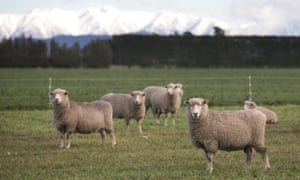
The New Zealand livestock industry has begun a ‘global first’ program to breed low methane-emitting sheep. Photograph: Carly Earl/The Guardian
The New Zealand livestock industry has begun a “global first” genetic program that would help to tackle climate change by breeding low methane-emitting sheep.
There are about six sheep for each person in New Zealand, and the livestock industry accounts for about one-third of the country’s total greenhouse gas emissions.
The livestock industry’s peak body, Beef and Lamb New Zealand, already uses a measure called “breeding value” to help breeders select rams with characteristics they want to bolster within their flocks. Within two years breeders will be able to select rams whose traits include lower methane emissions.
“Farmers are more interested than I anticipated,” said a stud breeder, Russell Proffit. His family has been producing rams for more than 40 years.
“I’ve undertaken the [methane] measurements because I believe an animal that is healthy and doing well should produce less methane and I wanted to test that.
“I don’t know if that’s the case yet, but either way breeding for less methane complements what we are working to achieve on our stud. That is, more robust rams that require [fewer] inputs and make less demand on the environment.”
Breeders who want to produce low-methane rams will need to measure a portion of their flock in an accumulation chamber, where their gas emissions are measured. Sheep spend 50 minutes in the chamber, and must be measured twice with an interval of more than 14 days.
The resulting data is used alongside other genetic information to calculate a “methane breeding value”.
Farmers who want to participate are expected to have access to breeding rams within two years, given the time it takes to breed the rams on a commercial scale.
The pastoral greenhouse gas research consortium, which is jointly funded by the agricultural sector and the government, said the concept was to take advantage of variations in levels of methane emissions and research that found the differences were passed on to the next generation.
“This is a global first for any species of livestock,” the consortium’s general manager, Mark Aspin, said.
“Launching the methane breeding value gives New Zealand’s sheep sector a practical tool to help lower our agricultural greenhouse gases. This is significant. Up until now, the only option available to farmers wanting to lower their greenhouse gas emissions has been to constantly improve their overall farming efficiency.
“This takes us a step further – towards actually lowering sheep methane emissions, in keeping with the sector’s commitment to work towards reducing its greenhouse emissions.”
Progress via breeding could be about 1% a year, but it would be cumulative and have no negative impact on farm productivity.
Aspin said amounts of feed were the biggest factor that contributed to methane emissions, and the consortium was working on three technologies that aimed to reduce amounts of methane generated by feed.
“So by breeding sheep that produce less methane per mouthful eaten – as other methane-reducing technologies come on stream – the influence of these sheep on the national flock’s methane production becomes compounding.”
Beef and Livestock New Zealand’s chief executive, Sam McIvor, said recent research of 1,000 farmers found that information about reducing greenhouse emissions was among farmers’ top five priorities.
A collection of bird bones sat in lab storage for more than a decade, believed to be the remains of an ancient eagle. Little did scientists know what was hiding in the fossils: “Squawkzilla.”
Heracles inexpectatus was discovered by scientists in New Zealand, according to a study published Wednesday. At about 3 feet (1 meter) tall, the bird would probably have stood nearly as tall as the average American 4-year-old.
Scientists have been finding enormous prehistoric birds for years, but this one still shocked them. It’s the largest parrot ever known to have walked the Earth. It might have even preyed on other birds.
At an estimated 15 pounds (7 kilograms), the now-extinct bird beats out all the other parrot competitors, at nearly double the weight of the endangered kakapo, New Zealand’s reigning giant parrot.
The scientists approximated its size based on two leg bones, called tibiotarsi, under the assumption that they both came from the same bird. The researchers compared the drumstick-like bones to bird skeletons in the South Australian Museum collection and the Smithsonian National Museum of Natural History’s electronic collection.
The fossils were dug up in 2008 in St Bathans, New Zealand, where many thousands of bird bones have been found.
The large bones, believed to be the bones of an ancient eagle, flew under the radar for a decade. It was during a research project in the lab of Flinders University paleontologist Trevor Worthy that graduate student Ellen Mather rediscovered the bones.
After that, a team of researchers began reanalyzing the findings earlier this year, according to the BBC.
“It was completely unexpected and quite novel,” Worthy, the study’s lead author, told National Geographic. “Once I had convinced myself it was a parrot, then I obviously had to convince the world.”
The bird probably lived during the Early Miocene, which spanned from about 23 million to 16 million years ago.
Researchers concluded that the bird probably couldn’t fly and consumed what was along the ground and easy to reach, according to National Geographic. But that might not have been enough to satiate the giant parrot.
It’s possible the bird had more carnivorous ways, like another New Zealand parrot, the kea, which has been known to attack and subsequently munch upon living sheep, the magazine reported.
Michael Archer, a co-author of the research and paleontologist at the University of New South Wales, told National Geographic that Heracles might have even been eating other parrots, giving way to a nickname: “Squawkzilla.”
Archer told Agence France-Presse the bird had “a massive parrot beak that could crack wide open anything it fancied.”
Heracles probably won’t be the final unforeseen fossil from the St Bathans area, Worthy told AFP. The researchers have turned up many surprising birds and animals over the years.
“No doubt there are many more unexpected species yet to be discovered in this most interesting deposit,” Worthy said.
WELLINGTON (Reuters) – New Zealand’s government will introduce legislation to tackle climate change on Wednesday which includes a target for cutting methane emissions from livestock by at least 10 percent by 2030.
FILE PHOTO: A cattle farm is seen in Fernside outside Christchurch, New Zealand March 29, 2019. Picture taken March 29, 2019. REUTERS/Jorge Silva/File Photo
The agriculture sector slammed the bill as a threat to one of the largest contributors to New Zealand’s economy, though environmentalists say it is also a major polluter.
Prime Minister Jacinda Ardern, who has set a goal for the country to be carbon neutral by 2025, said on Wednesday the Climate Change Response (Zero Carbon) Amendment Bill is a “landmark action” on climate change.
The bill treats methane emissions from animals differently than other greenhouse gas emissions, but still targets a 10 percent reduction in biological methane by 2030, and a reduction of up to 47 percent by 2050.
Carbon emissions would be reduced to net zero by 2050, according to the legislation.
ADVERTISEMENT
“We’ve built a practical consensus across government that creates a plan for the next 30 years, which provides the certainty industries need to get in front of this challenge,” Ardern said in a statement.
Climate Change Minister James Shaw said the Zero Carbon Bill would make it a legally binding objective to help keep global warming below the 1.5 degrees Celsius rise forecast by U.N. experts between 2030 and 2052.
“Agriculture is incredibly important to New Zealand, but it also needs to be part of the solution,” Shaw said.
The U.N. says livestock farming alone is responsible for up to 18 percent of the greenhouse gases that contribute to global warming.
New Zealand’s main agriculture lobby group said the methane target would hurt the country and do little to help the climate.
ADVERTISEMENT
“This decision is frustratingly cruel, because there is nothing I can do on my farm today that will give me confidence I can ever achieve these targets,” said Andrew Hoggard, President of the Federated Farmers of New Zealand.
A meat industry group said it was alarmed by the target and warned of the negative impact on rural communities.
“This will impose enormous economic costs on the country and threaten many regional communities who depend on pastoral agriculture,” said Tim Ritchie, chief executive of the Meat Industry Association.
New official research suggest we need 10-22 per cent reduction of livestock emissions
New Zealand would need to reduce livestock methane emissions by up to 22 per cent by 2050 to stop any additional global warming, official research shows.
This would likely require a serious reduction in the number of livestock farmed, unless new and untried technologies can be shown to work.
Livestock contribute the vast majority of our methane emissions, mostly through belching.
The release from the Parliamentary Commissioner for the Environment throws a wrench into an emerging consensus across the country that “stabilising” NZ’s short-lived methane emissions at current levels could be a viable option to stop warming.
It suggests that actual “stabilisation” would still require a reduction in livestock or the success of new methods to lower emissions, such as special feeds, vaccines or tweaking livestock breeding.
Climate Change Minister James Shaw is currently consulting on plans for a Zero Carbon Act, which would set some kind of reduction target in law.
Parliamentary Commissioner and former National Party Environment Minister Simon Upton is working on a wider report concerning the Zero Carbon Act but decided to put out this research from Andy Reisinger early in order to inform debate.
Federated Farmers vice-president Andrew Hoggard said the key point of the report was reductions of 10-22 per cent were needed by 2050, whereas earlier reports before said they just needed to be stabilised.
There are three goals for 2050 currently on the table – and none of them consider “no more warming” to be the actual goal.
One is exactly what it says on the tin: net zero carbon, but nothing else, meaning agriculture’s “short-lived” methane emissions would be left alone. The second or middle option is net zero long-lived gases, like carbon dioxide and nitrous oxide, and “stabilised” short-term gases, like methane.
Finally, the third option is simply net zero for all greenhouse gas emissions by 2050.
“To me the report is saying we don’t need to go to complete net zero,” Hoggard said.
The middle option of “stabilisation” has attracted a lot of interest but has not yet been made completely clear. The idea behind it is that since methane emissions decay in the atmosphere much faster than carbon, the Government could keep a steady level of methane emissions over time and, because of the drop-off from emissions ten years ago, simply keep the level consistent without contributing much to further warming, recycling the decaying methane with new emissions.
About 43 per cent of New Zealand’s greenhouse gases are caused by methane and 11 per cent by nitrous oxide, the first generated by all livestock burping, the latter mainly by cows urinating.
The research released by Upton is careful not to suggest policy, but to simply make clear that while methane mostly decays within a decade or so, its lasting effects are such that a significant reduction would still be needed for New Zealand to contribute to no further warming.
“It shows that holding New Zealand’s methane emissions steady at current levels would not be enough to avoid additional global warming,” Upton said.
“If New Zealand’s emissions of livestock methane were held steady at 2016 levels, then within about ten years the amount of methane in the atmosphere from that source would level off. However the warming effect of that methane would continue to increase at a gradually declining rate for more than a century.”
KELLY HODEL/FAIRFAX NZ
Livestock contribute the vast majority of our methane emissions, mostly through belching.
Hoggard said if cow efficiency could be improved as it has, and farmers reduced stock, the reductions could occur.
“There are things I could do but might not be allowed. One the things that holds me back are dry conditions. Irrigation would help but that’s a dirty word, and a herd home would help but people get upset if cows are in there for a length of time.”
“People say cut cow numbers but they have an ideological view of the sector and don’t understand the trade-offs in operating a biological system,” Hoggard said.
The research shows that even if stabilised at 2016 levels warming from methane would increase by 10-20 per cent by 2050, and 25-40 per cent by 2100.
To avoid this New Zealand would need to reduce livestock methane emissions by between 10 and 22 per cent by 2050 and then 20-27 per cent by 2100.
The range of options depends on the amount that other countries reduce their emissions, as methane interacts with other gases in complex ways.
National climate change spokesman Todd Muller welcomed the report, saying it showed New Zealand needed to reduce agricultural emissions by “just” 10-22 per cent.
“The research released today shows that reducing methane emissions by just 10 – 22 per cent will mean New Zealand’s methane emissions have a neutral impact on global temperature,” Muller said.
“If we reduce methane by 10 – 22 per cent, and reduce all other gases to zero, it is equivalent to a 54 – 60 per cent reduction in our total emissions which is in line with New Zealand’s existing 2050 target.”
Muller and party leader Simon Bridges have made clear they want to work with the Government on setting a target not likely to be changed the moment the Government does.
“We are working with the Government to make meaningful bi-partisan progress on climate change. National wants an independent, non-political Climate Change Commission established so we have a framework through which we address climate change issues in the future,” Muller said.
Acting Climate Change Minister Eugenie Sage said it was a useful contribution to the policy debate, and the reduction was achievable.
“This report shows New Zealand’s methane emissions would need to reduce by about 10 to 22 per cent below 2016 levels (ie the latest year for which emissions data is available) by 2050, with further reductions between 20 to 27 per cent by 2100, if we want to ensure methane emissions from livestock don’t contribute to additional global warming,” Sage said.
She noted some in the sector believed the reduction was possible with existing technology.
“That is seen as achievable by some in the agricultural sector, given that methane output per unit of production has been in decline by about 1 per cent per year for the last few decades, and given some leaders in the sector believe they can reduce methane output by as much as 30 per cent using existing technology and best practice.”
Greenpeace sustainable agriculture campaigner Gen Toop disagreed, saying a reduction in cow numbers was the only viable path forwards.
“The dairy industry say there are no easy solutions for reducing methane emissions from ruminants but they deny the obvious solution is to reduce livestock numbers. Fewer cows means fewer emissions,” Toop said.
“The simple truth is there are already too many cows for our climate to cope with, yet the Government is still allowing dairy conversions to continue – even in fragile and unique places like the Mackenzie country.”
Upton himself said the country and world needed to focus on reducing emissions.
“This whole debate started off in the early 1990s and we all said ‘we’re going to plant pine trees in the mean time because we don’t have an easy set of technologies, we’re going to use that time to find the technologies to find a way out,'” Upton said.
“We’ve used up 25 years, we still haven’t found the technologies. We haven’t focused on reducing emissions. We have to now focus on that.”
“2050 is not far away. You can’t turn things around overnight.”
He said there were encouraging technological breakthroughs, particularly on the carbon side of the issue, but actual reduction would still be needed.
Upton expected Governments would make peace with some level of warming from methane emissions, but should aim to get carbon down to net zero.



 Exposing the Big Game