CDC confirms two people in Washington infected with bird flu

 Prev

Previous

Previous

Washington students scored high on ACT — but few take the test

Washington high school students continue to test better on the ACT college admis…

 Next

Next Up

Next Up

Democrats could decide Republican duel for central WA congressional seat

Democrats in central Washington never had as much love from Republicans as they …

Support Local JournalismIf you value these stories, please consider subscribing.
Subscribe

Federal health authorities have confirmed at least two people in Washington have contracted bird flu after working around poultry with the virus at a commercial egg farm in Franklin County.

State and local health officials on Sunday revealed four people in Washington were “presumptively” positive for the illness, based on initial testing at a state lab. Since then, the number of presumptive positive cases climbed to seven.

On Thursday, the state health department said that the U.S. Centers for Disease Control and Prevention had confirmed two of the positive tests announced over the weekend. Confirmation of other positive test results is still pending.

RELATED NEWS: Historical context of fascism in America, and the 2024 presidential race

close

volume_off

-00:00

sd

closed_captions

fullscreen

Staff from the CDC has been on site in Franklin County, in southeast Washington, since Wednesday. The federal agency, along with the state health department and the local health district for Benton and Franklin counties were working together on testing and other response efforts.

Roberto Bonaccorso, a spokesperson for the state Department of Health, said health agencies are working to test more than 100 people. Some people will be tested more than once.

Washington is one of six states where bird flu has spread to people. The CDC has so far counted 31 human cases of the disease during 2024 in those states, including the two confirmed in Washington.

There is no evidence of human-to-human spread of the disease at this time — all identified infections are among workers who had contact with infected birds or their environments, the Washington State Department of Health said Thursday morning.

The department also said that no patients have experienced severe illness or been hospitalized. Infected individuals had shown signs of mild upper respiratory illness, including runny nose, sore throat, and mild cough, as well as conjunctivitis — often referred to as “pink eye.”

For now, risks from the disease for people who are not around animals that can catch it are considered low. But health officials are keeping watch for signs the illness may be evolving in a way where it can spread between people or cause more severe symptoms.

People who have tested positive in Washington were exposed to the outbreak among poultry at the egg farm in Franklin County. There, a flock of about 800,000 birds became infected with what is formally known as highly pathogenic avian influenza.

Testing in mid-October showed poultry on the farm were infected. Health officials arranged for testing on Oct. 18 of workers showing symptoms. Presumptive positive tests for people came back the next day.

Washington’s Department of Agriculture is also reporting bird flu detections this month in two small backyard flocks — one in Kitsap County on Oct. 17 and another in Lewis County on Wednesday. The Lewis County incident is listed as “presumptive” by the department.

“Every backyard flock is at risk right now,” state veterinarian Amber Itle said in a statement. “Avian influenza is a very serious disease with serious implications for animal welfare. It’s crucial to stay alert for any sudden illness and deaths in your flock”

When poultry is suspected of having the virus, tests are run at the state level at the Washington Animal Disease Diagnostic Laboratory. Positive results are then confirmed by National Veterinary Services Laboratories.

Bird flu, which is relatively common in wild birds, spreads rapidly through poultry flocks, sickening and killing the animals. To stop the spread, birds are euthanized. Fall is a risky time of year for the disease in Washington as migrating birds pass through.

Since 2022, 48 commercial and backyard flocks in the state have been stricken with the virus, according to state department of agriculture figures. The three this month are the first ones recorded in 2024.

The agriculture department said Thursday that “humane depopulation” of the birds was complete at the Franklin County facility and that cleaning, disinfection, and disposal activities were underway. The plan was to destroy eggs on the farm as well.

Agriculture officials also said no infected birds or eggs have entered the food supply chain.

Monitoring of poultry in the area where the farm is located has been taking place. Dairy cows were being watched too since they’ve caught the virus in other states. On Thursday, the state agriculture department said there were no confirmed or suspected cases at Washington dairy farms.
Kunce talks about incident where reporter was hit during campaign stop at shooting range

by: Hannah King

Posted: Oct 23, 2024 / 06:42 PM CDT

Updated: Oct 23, 2024 / 06:42 PM CDT

SHARE https://fox4kc.com/news/kunce-talks-about-incident-where-reporter-was-hit-during-campaign-stop-at-shooting-range/

KANSAS CITY, Mo. — Democratic U.S. Senate candidate Lucas Kunce was on the campaign trail Wednesday, just a day after getting some new and national attention.

FOX4 caught up with him at the KC-area Pipefitters Training Facility where he toured the shop.

“I don’t take any money from corporate PACs. I don’t take any money from federal lobbyists. No big farm executives. For me, it’s all about helping working people. This is one of those facilities down here where we train folks up to have good union wages and a good job and benefits,” Kunce said, referring to the Pipefitters Training Center Wednesday.

Up Next – Young voters could be decisive in the election

volume_off

-00:13

sd

closed_captions

fullscreenMissouri Amendment 6 ‘going to have a drastic impact on public safety’

Wednesday’s event came on the heels of a visit to the backyard of a home in Holt, Missouri.

“Me and Adam Kinzinger were out there, and we were kind of taking turns on the range and it seems like a fragment off of either a target or a bullet ricocheted off and nicked a reporter in the arm,” Kunce described.

“When we saw it, we administered first aid, put a bandage on him. He’s great. He seems like he’s fine. I talked to him last night.”

The incident occurred in Clinton County, Missouri. Sheriff Larry Fish shared with FOX4: “On October 23, the Clinton County Sheriff’s Office was informed of a target shooting incident that occurred on October 22, 2024, in an unincorporated area of Holt, MO, on private property.”

According to Kunce’s campaign, “Lt. Col. Lucas Kunce (USMCR, 13 years active duty) was joined by Lt. Col. Adam Kinzinger (Air National Guard), a former Republican Congressman, at a gun range just outside of Kansas City, alongside about a dozen union members on the campaign trail. The range is owned by a UAW 249 retiree and is managed by a UAW member and NRA Training Counselor.”When, where does early voting start for Kansas City, Missouri metro voters?

Kunce called the incident a ‘total accident’. He gave aid to the injured TV reporter.

“I’m glad he’s fine. I’m glad we had the first aid kits handy. We were able to take care of him,” he said.

Kunce says local law enforcement was contacted. Sheriff Fish said the injured reporter was allegedly struck in the arm by flying shrapnel while covering the event.

“Thankfully, the reporter sustained only minor injuries and later sought medical attention at an area hospital,” Sheriff Fish said.

Sheriff Fish says Kunce, one of several people present at the private event, reported the incident to law enforcement.

“This incident is currently under investigation, and all indications at this time suggest that it was an unfortunate accident.”

Bird flu suspected in four Washington farm workers, CDC sends team

By Tom Polansek

October 21, 20241:59 PM PDTUpdated a day ago

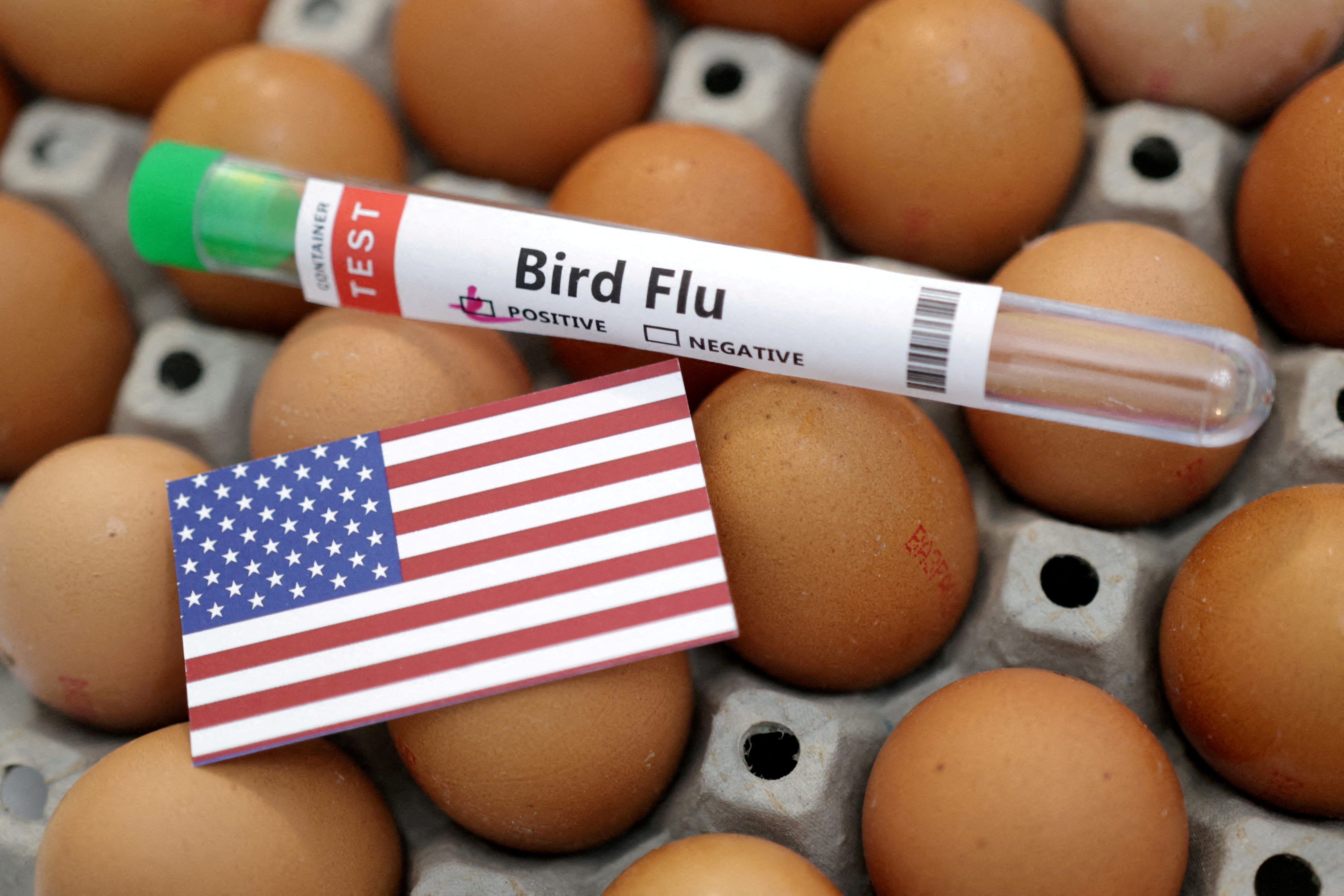
Illustration shows test tube labelled "Bird Flu", eggs and U.S. flag

CHICAGO, Oct 21 (Reuters) – The CDC is deploying a team to Washington state to assess the health of farm workers who culled poultry suffering from bird flu after four workers are presumed to have been infected by the virus, U.S. and state health officials said on Monday.

The infections would make Washington the sixth state to identify human cases this year.

The cases fuel growing concern among public health experts, as infections of U.S. dairy cattle and more than two dozen farm workers have worried scientists and federal officials about the risks to humans.

Advertisement · Scroll to continue

California and Washington have said they are seeking to administer seasonal flu vaccines to farm workers to reduce their risk of being infected with both bird flu and seasonal influenza.

Infections with both types of virus simultaneously could increase the risk of changes that could make bird flu spread more easily in people and potentially cause a pandemic, virologists say.

“We don’t have evidence yet of transmission between people,” said Roberto Bonaccorso, spokesperson for the Washington State Department of Health.

Advertisement · Scroll to continue

The Centers for Disease Control and Prevention is awaiting specimens for testing from Washington and sending a team to support the state’s assessment of farm workers, an agency spokesperson said. The risk to the public from the outbreak in cattle remains low, but those with exposure to infected animals are at heightened risk, according to the CDC.

The four tested presumptively positive after working at an infected egg farm, Washington’s health department said, adding their use of protective gear was inconsistent. The workers suffered mild respiratory symptoms and conjunctivitis, and were given antiviral medication, officials said.

The workers were removing carcasses and litter and cleaning facilities where about 800,000 chickens were culled, the health department said. The farm was hit by a strain of the virus from wild birds, according to Washington’s agriculture department.

Nationwide, 27 people had tested positive for the virus in 2024 before the cases in Washington. All but one had known exposure to infected poultry or dairy cattle.

Nearly 2 million chickens must be killed in Utah after major flock tests positive for the flu

The outbreak in northern Utah is the first the state has seen this year.

(Francisco Kjolseth  |  The Salt Lake Tribune) Chickens managed by Phillip Gleason on his 2 acre lot are pictured on Saturday, Feb. 17, 2024, as he works on his multi phase plan to be self reliant at Riverbed Ranch, a remote community he founded in the western desert of Utah.

(Francisco Kjolseth | The Salt Lake Tribune) Chickens managed by Phillip Gleason on his 2 acre lot are pictured on Saturday, Feb. 17, 2024, as he works on his multi phase plan to be self reliant at Riverbed Ranch, a remote community he founded in the western desert of Utah.

https://www.sltrib.com/news/2024/10/18/bird-flu-hits-utah-requiring/

By Clarissa Casper

  | Oct. 18, 2024, 5:00 a.m.

Comment

Cache Valley • The onset of fall has brought cooler temperatures and bright colors. It has also brought birds — flocks of migrating waterfowl that chant their calls to each other in the sky each evening.

But with the birds comes disease.

Highly pathogenic avian influenza has taken over a commercial poultry flock in Cache County, according to the Utah Department of Agriculture and Food. An estimated 1.6 to 1.8 million chickens have been quarantined and are in the process of being killed, according to state veterinarian Daniel Christensen, who said this is the biggest outbreak the state has seen in recent years.

Why Joseph Smith was slain and why it was about more than religion

“These poor guys,” Christensen said.

Subscribe To Top Stories Newsletter

Get the latest news by subscribing to our Top Stories newsletter. Enter your email below to receive more stories like these right to your inbox.

The illness was discovered last week after the poultry farm reported an unusually high mortality rate among its flock. Upon hearing this, the state agriculture department immediately tested the birds and quarantined the facility to prevent further spread.

freestar

Report this ad

Depopulation — the euthanasia of infected birds — is necessary in these cases, Christensen said, and it must happen as quickly as possible to prevent the spread of the virus while ensuring the animals don’t experience unnecessary suffering or stress.

The state did not name the facility affected by the outbreak.

The bird flu is spread by migratory waterfowl, such as ducks and geese, which are currently on their fall migration through Utah. Though the illness is often fatal to domestic poultry like chickens and turkeys, migratory birds typically carry the virus without showing severe symptoms, Christensen said.

“We were hoping we were going to make it through this year without an outbreak,” he said. “I don’t have a crystal ball, but it’s reasonable to expect that for a while, we’re going to be seeing stuff like this every fall.”

Christensen said the outbreak currently is limited to the one commercial poultry facility and does not pose an immediate public health risk. While the flu is devastating to poultry, the risk to people is low. Though a few people have reported mild symptoms in the past, like pink eye, after exposure to infected birds, Christensen said such cases are rare and not a major cause for concern.

freestar

Report this ad

What Utahns should be concerned about, however, is their backyard poultry. Christensen said it is crucial for poultry owners to have biosecurity measures in place. These include limiting access to their flock, practicing strict hygiene, quarantining new or sick birds, preventing contact with wild birds and monitoring the health of flocks daily.

“We see this from time to time,” Christensen said, “where someone will have a stream going through their property, and ducks get in the stream and then mix with their chickens, and then all their chickens die.”

Signs of a flu outbreak in poultry include a sudden high death rate in flocks, nasal discharge, decreased appetite or water consumption, and lack of coordination. If your birds show any of these signs, contact the state veterinarian’s office at statevet@utah.gov.

Reported bear attack on Montana camper turns out to be brutal homicide

https://www.aol.com/reported-bear-attack-montana-camper-102119287.html

Stephen Smith

Updated October 17, 2024 at 12:27 PM

Authorities in Montana say a 911 caller discovered his friend dead in a tent in what appeared to have been a fatal bear attack — but officials soon discovered the camper was actually the victim of a brutal murder.

Dustin Kjersem, 35, was found dead in his tent on Saturday morning along Moose Creek Road north of Big Sky, Montana, Gallatin County Sheriff Dan Springer said at news conference Wednesday. A friend who was supposed to have met Kjersem went searching for him when he didn’t show up as scheduled on Friday.

The friend ultimately discovered Kjersem’s body in a tent at a makeshift campsite and called 911, telling responders the death appeared to have been caused by a bear attack, the sheriff’s office said.

An agent with the Montana Fish, Wildlife and Parks agency who visited the site, however, found no signs of bear activity, and investigators said they soon found evidence of a “vicious attack,” which is being investigated as a homicide.

  Dustin Kjersem / Credit: Gallatin County Sheriff's Office
Dustin Kjersem / Credit: Gallatin County Sheriff’s Office

Kjersem, who was last seen on Thursday afternoon, sustained “multiple chop wounds,” including to his skull, an autopsy showed.

“He was brutally killed at his campsite and we need your help,” Springer said, adding that his detectives were working “all hours of day and night to find his killer.”

No suspects have been identified, and Springer said the remote area of the crime scene, where there is no cellphone service, was making the investigation more difficult than most cases.

“People have asked me if there’s a threat to this community and the answer is we don’t know. We don’t have enough information to know at this time,” he said.

The sheriff urged residents to be careful.

“We do know that someone was out there who killed someone in a very heinous way so if you’re out in the woods you need to be paying attention, you need to remain vigilant,” Springer said.

Kjersem was driving a black 2013 Ford F-150 with a black topper and a silver aluminum ladder rack, and police have asked the public to come forward with any information they might have.

  2013 Ford F-150 / Credit: Gallatin County Sheriff's Office
2013 Ford F-150 / Credit: Gallatin County Sheriff’s Office

“Think of the whole canyon,” Captain Nathan Kamerman said at the news conference. “If you saw something weird in the canyon area, or in town with his truck, please reach out to us.”

Kjersem’s sister Jillian Price called her brother a skilled tradesman and a loving father.

“I asked our community to please find out who did this,” she said. “There is someone in our valley who is capable of truly heinous things.”

NRA chief involved in gruesome cat killing as college fraternity member

Stephanie Kirchgaessner in Washington

October 14, 2024 at 3:00 AM

Douglas Hamlin, who was appointed to lead the NRA this summer in the wake of a long-running corruption scandal at the gun rights group, was involved decades ago in the sadistic killing of a fraternity house cat named BK, according to several local media reports at the time.

Hamlin pleaded no contest to a misdemeanor charge of animal cruelty brought against him and four of his fraternity brothers in 1980, when he was an undergraduate student at the University of Michigan at Ann Arbor. The charge was brought against Hamlin under a local Ann Arbor ordinance. All five members of Alpha Delta Phi were later expelled from the fraternity.

The details of the case, described in local media reports at the time, are gruesome. The house cat was captured, its paws were cut off, and was then strung up and set on fire. The killing, which occurred in December 1979, was allegedly prompted by anger that the cat was not using its litterbox.

The case caused such a furore locally that some students and animal rights activists wore buttons and armbands in memory of BK.

Hamlin served as the fraternity president at the time, according to the media reports. While Hamlin’s exact role in the killing is unclear, a report in the Ann Arbor News published in March 1980 – at the time of the court case – said that district court judge SJ Elden singled Hamlin out for criticism, saying he could have prevented it from happening as the leader of the fraternity.

The judge called the cat killing an “unconscionable and heinous” act and suggested the fraternity had tried to engage in a coverup to protect its members after the crime was exposed.

“Heartlessness must be in the job description to run the NRA,” said Nick Suplina, senior vice president for law and policy at Everytown for Gun Safety. “This revelation shows that the NRA has failed to turn the page on its scandal-plagued leaders and its doom spiral continues with Hamlin at the helm.”

One of the fraternity brothers who was charged at the time and spoke to the Guardian on the condition that his name would not be used said the incident had been “regrettable” and “not a good chapter for anybody”.

The Guardian contacted Hamlin through multiple spokespersons at the NRA and tried to reach Hamlin by phone but did not receive any response to questions about the incident.

Shelagh Abbs Winter, who was named in a media report as the student who reported the incident to authorities at the time, told the Guardian she recalled many of the details, including that she had felt compelled to report the incident to authorities after she learned what had happened from another student who was a pledge at the fraternity.

Winter was and remains an animal rights activist, and expressed surprise when she was contacted by the Guardian for this story, because she had not followed Hamlin’s career nor realized that the 1979 incident would still be personally relevant decades later.

“You don’t know how amazing this is to me, because I am a member of Moms Demand Action,” she said, referring to one of the most influential grassroots gun control advocacy groups in the country, which has proved to be a thorn in the side of the NRA. Winter said she remembered feeling threatened at the time for coming forward.

“Once a creep, always a creep,” she said.

A cook who worked at the fraternity at the time and asked not to be named said he recalled speaking to police and never returning back to work because he feared reprisal. “After it was disclosed that the police were investigating, a meeting was called, and the members were told to say nothing; not to cooperate; and not to, essentially, give up their brothers,” the person told the Guardian.

Related: How Tim Walz went from NRA favorite to ‘straight Fs’ on gun rights

According to press reports, the charges were ultimately expunged from the men’s records after they completed 200 hours each of animal-related community service.

Hamlin was elected by the NRA’s board to serve as CEO in July. After graduating from college, Hamlin joined the Marine Corps and later began working at the gun rights group, serving as executive director of its publications division.

Hamlin’s promotion followed a New York judge’s ruling that the longtime head of the NRA, Wayne LaPierre, would be barred from holding a paid position with the group after a jury found him guilty of misspending millions of dollars in NRA funds for his own benefit.

How Denver Could Become the First City to Ban Slaughterhouses

Activists got a slaughterhouse moratorium on Denver’s ballot — but what are its chances?

Advocate Aidan Kankyoku
Featured: Aidan Kankyoku, Pro-Animal Future. Credit: Paul Miller

Mon October 7th, 2024

Solutions • Food • Food Systems

Words by Grace Hussain

– Share on Facebook– Share on LinkedIn– Share on Whatsapp– Share on X– Copy

– Republish

7 min read

The largest lamb slaughterhouse in the country is located in the Globeville neighborhood of Denver, Colorado. Each year, up to 500,000 young sheep are carted into the facility, and leave as packaged meat. Now, Denver is poised to be the first city in the nation to ban slaughterhouses like this one. Thanks to a campaign spearheaded by Pro Animal Future — a nonprofit organization with tactics backed by research — voters will decide this November whether to allow the facility to continue operations.

Its success or failure could have broad implications for the animal rights movement. While it’s certainly not the first time that animal advocates have sought to leverage ballot initiatives — there’s currently also an initiative to ban factory farms from Sonoma County, California — the Denver campaign could serve as a blueprint for future campaigns in cities across the country.

Pro Animal Future was started to test out the research generated by their sister organization, Pax Fauna. That research suggested that animal rights activists could garner success by shifting the framing of their work to ask for people’s votes instead of personal dietary change — a finding that let to this and another ballot initiative in Denver.

“We had a lot of people sign these petitions, including the slaughterhouse petition, while eating animals,”  Aidan Kankyoku, who worked on the research and is now spearheading the campaign, tells Sentient.

Though the fate of the slaughterhouse still hangs in the balance, even getting the question on the ballot was an uphill climb. Kankyoku embarked on it in hopes of testing the findings of Pax Fauna’s research. So far, those findings are holding up, which may have far-reaching implications for animal welfare groups.

Why Ballot Measures May Be More Effective Than Advocating for Dietary Change

In 2023, Pax Fauna published research, which found that calling meat out as unsustainable or cruel is not very effective for the average consumer — in part because it ignores the large role of corporations and policymakers, and relies too heavily on changing personal choice. Instead, focusing on collective action and civic duty — via voting, for example — appears to be more effective.

Those findings were based upon a series of focus groups, surveys and interviews with over 200 participants, all of whom eat meat. After writing up and publishing their findings, their next steps were clear: the new grassroots framework they had designed needed to be tested. For that testing, they chose Denver.

“This is where we have the most progressive and liberal voters who are going to take the first step and set this precedent to say ‘no’ to slaughterhouses,” says Kankyoku. In November of last year, the team dropped off 10,488 signatures supporting a ballot initiative to ban slaughterhouses from the city — well above the 8,940 needed to get on the ballot. Pro Animal Future ran a fur ban initiative alongside the slaughterhouse ban, which received 11,708 signatures and will also be appearing on ballots in November. Each of those signatures represents a conversation with a campaigner.

A Focus on Deep Canvassing

One of those campaigners is volunteer Alaina Sigler, who runs the nonprofit The Night Sky Garden. “These very meaningful conversations are going to be one of the most important tactics for us to continue to focus on,” Sigler says, referencing the deep canvassing technique at the center of the campaign. Deep canvassing relies on having sincere conversations with voters, and offers space for people to express their concerns without judgment. Though the tactic is great for helping people understand an issue, it is time intensive. “It’ll be anywhere from three to 12 voters in an hour, if you’re walking up to groups,” says Kankyoku.

In addition to these conversations, volunteers have been hosting postcard writing parties in collaboration with other local organizations, including nearby Luvin Arms Animal Sanctuary. While most of those writing parties are dominated by people already involved with the campaign, Pro-Animal Future works hard to ensure a welcoming environment for everyone — whether they eat meat or not.

“If you have friends, family members…and they’re not vegan, we actively are asking folks to bring them to the social events,” Sigler, who has organized several such parties, says.

From Sigler’s perspective, the campaign is cause for “immense hope for these initiatives, after not seeing much change occur locally for animals.” A longtime grassroots activist, Sigler has years of experience as an organizer for Direct Action Everywhere, standing vigil outside slaughterhouses and canvassing.

She and other volunteers have also been active in another facet of the campaign: flyering the city. “We do have this kind of guerrilla marketing component of the campaign as well,” says Kankyoku. In addition to the flyers, volunteers hand out stickers, chalk art and messages around the city and are working with businesses to host events.

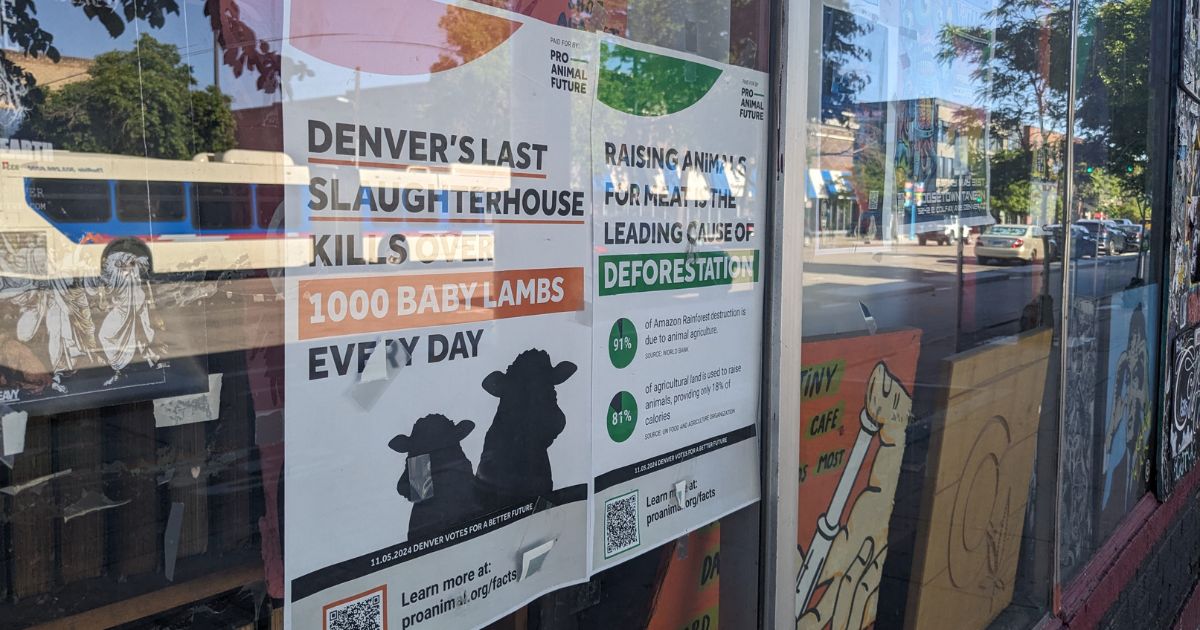
Pro Animal Future signs hanging in a window. They say "Denver's last slaughterhouse kills over 1000 baby lambs every day" and "Raising animals for meat is the leading cause of deforestation"
Campaign signage in a downtown Denver shop. Credit: Grace Hussain

The Economic and Political Implications of Banning Slaughterhouses

In addition to being home to the nation’s largest lamb slaughterhouse, Colorado also plays host to Colorado State University (CSU). CSU is home to AgNext, (an agricultural research institute that has come under fire for its connections to animal agriculture), as well as Regional Economic Development Institute (REDI), a research center focused on economic development.

In April of this year, REDI released a policy brief arguing that eliminating the slaughterhouse could result in a maximum loss of 629 jobs and over $861 million. Kanyuko says he doesn’t believe those numbers are feasible, given that the facility has 160 employees and generates roughly $250 million in revenue annually. “It’s just obvious propaganda, if you’re going to dig into it a little bit,” he says, but “they’re using the letterhead of this respected university.”

The processes put into the report are standard within economics, says Dawn Thilmany, PhD, who led the team that put together the REDI brief. Analysis was based upon government data run through an economics software program that calculates likely ripple effects.

The analysis outlines three possible scenarios, based upon how much of the lamb industry exits the state of Colorado. Should the initiative pass, Thilmany is concerned that the most drastic of those is the most likely to take place. “It’s [likely to be] really hard to get investors to build processing capacity in other parts of [Colorado] because they’re afraid the ban is going to get wider than Denver County,” she says.

From her perspective working with small producers, the Denver slaughterhouse is unique in that it allows producers to get back their animals following slaughter — a rarity within the industry. For producers who sell meat locally, getting their animals back is essential.“Anyone who’s selling local[ly], that’s what they have to do,” she says. “For lamb, I think they’re about the only one who can do that, even in the region.”

Even if the report’s worst-case economic scenario does come to pass, points out Kankyoku, the projected impact of shutting down the slaughterhouse represents only a small fraction of the state’s overall economy. In the third quarter of 2023, Colorado’s real Gross Domestic Product — a measure of economic activity — was $529.1 billion.

What Comes Next

“What’s so exciting about the ballot initiative approach is that we’d much rather be talking to voters than to a few city council members,” says Kankyoku. Focusing on voters also means that even a loss is a win, in Kankyoku’s eyes. “If we focus all our attention on engaging with the public and connecting with local businesses and building a really strong community around this objective, [even] if the measure doesn’t pass, we can still feel very confident that all of that work is setting us up to do better next time, whether it’s the same policy or a different policy for the next campaign.”

Pro Animal Future’s partner organization, Pax Fauna, is already gearing up to launch similar campaigns in cities across the country — starting with Portland.

Even with the growing popularity of ballot initiatives as a means of activism, advocates are restricted to the cities and states that allow them. But with roughly three quarters of cities allowing some form of citizen-supported legislation making, the opportunities for animal advocates are numerous.

This story is part of a series called How Food Justice is Made: Stories and Solutions, in which Sentient dives into four different communities, and the unique ways they’re combatting slaughterhouses.

There’s an international bird flu summit in Arkansas this week, and this is why it is important

by Lara FarrarOctober 2, 2024 4:27 pm

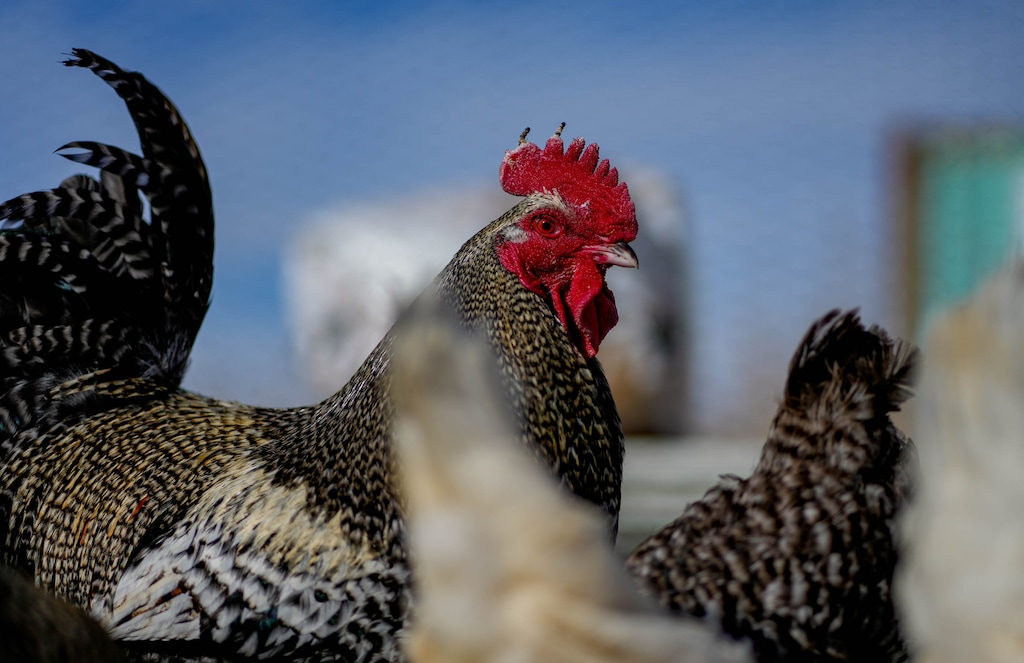
Portrait of chicken close-up. Breeding chickens for meat

With the race on to investigate the first possible human-to-human infections of bird flu in the United States, avian flu experts from around the world are meeting in Fayetteville this week to contain the spread.

This is the second year for the International Avian Influenza and One Health Emerging Issues Summit, a four-day conference held virtually and in-person at the Don Tyson Center for Agricultural Sciences in Fayetteville, part of the University of Arkansas System Division of Agriculture.

The summit is significant because there are not many other conferences in the United States, or even globally, that bring together international experts to discuss the disease, which is increasingly alarming scientists as it spreads through poultry and infects other species. 

Yellow Rocket Concepts

“We decided to do this summit because the world is getting hit very badly by this virus that is now basically a pandemic,” said Guillermo Tellez-Isaias, the summit’s organizer and a research professor in the Center of Excellence in Poultry Science, a unit of both the Division of Agriculture and the University of Arkansas Dale Bumpers College of Agricultural, Food and Life Sciences. “It is present in all continents now, even Antarctica.” 

“We are facing a unique virus that has been able to adapt and infect other species that it traditionally did not used to infect,” Tellez-Isaias told Arkansas Times. (In Vietnam, 47 tigers, three lions and a panther died in zoos because of bird flu, Agence France-Presse reported Wednesday. In 2023, avian influenza killed tens of thousands of pelicans and more than 700 sea lions in Peru.)

In July, Reuters published a report based on interviews with more than a dozen disease experts who characterized the avian flu as a “pandemic unfolding in slow motion.” The experts said its rapid spread to more than 100 dairy herds in the U.S., as well as infections found in other mammals including alpacas and house cats, is an alarming indication that bird flu could soon be transmissible between humans.

MOAD-Digital-Banners-BIKE_300x250 (1) (1).gif

In fact, this scenario may already be unfolding in Missouri. The U.S. Centers for Disease Control and Prevention announced last week that seven people who came into contact with an avian flu patient in Missouri later showed symptoms of a respiratory illness. In humans, avian flu symptoms include fever, body aches, headache and shortness of breath. Officials are testing them for antibodies to the H5N1 avian flu strain, which would indicate they had been infected by avian flu.

Since April 2024, the CDC reports that there have been 14 human cases of avian influenza in the U.S. All but one were the result of direct contact with sick cows or poultry. The source of the most recent human case, the one in Missouri that may have resulted in human-to-human transmission, is still unknown. (Note, the CDC says the immediate risk to the general public from bird flu remains low.)

It would be prudent not to forget that a pandemic in 1918 that killed at least 50 million people globally, known as the Spanish flu, was caused by a virus “with genes of avian origin,” according to the U.S. Centers for Disease Control and Prevention. Although the origin of that influenza strain is not known, the 1918 outbreak was called the Spanish flu because it killed millions of people in Spain as it spread worldwide. About 500 million people, or half the world’s population at the time, contracted the Spanish flu, making it the worst pandemic in modern history. (Strains of the disease have continued to infect humans globally, with some outbreaks resulting in notably high fatality rates nearing 50% of those infected.) 

Though the data remains imprecise, estimates of global deaths from the COVID-19 pandemic range from about 7 million to close to 20 million, less than half of the death toll of the Spanish flu.  

While a great deal of the content presented at the International Avian Flu Summit this week is esoterically scientific in nature, and largely focusing on the risks the bird flu continues to pose to the poultry industry, the event is again notable in relation to COVID-19. 

The national and international response to the coronavirus pandemic was catastrophically disorganized and shockingly dysfunctional, revealing not just cracks, but gaping fissures, in unquestionably broken public and global health systems that led to countless unnecessary deaths.

The response to COVID was so bad, The Lancet labeled it a “massive global failure” in a 2022 report from the medical journal’s COVID-19 commission. The death toll from the coronavirus “is both a profound tragedy and a massive global failure at multiple levels,” the Lancet commission wrote. “Too many governments have failed to adhere to basic norms of institutional rationality and transparency, too many people – often influenced by misinformation – have disrespected and protested against basic public health precautions, and the world’s major powers have failed to collaborate and control the pandemic.” 

About 1,000 people representing 55 countries are taking part in the International Avian Flu Summit. Organizer Tellez-Isaias, the UA poultry professor, said the conference is intended to address some of the failures that occurred during COVID-19. 

“If this virus is able to adapt to humans, it will make COVID-19 look like a small cold compared to the mortality that the human race could see,” Tellez-Isaias said. “It happened before with the 1918 Spanish flu. It could happen again. We need to prepare ourselves and work together. This is serious.” 

Throughout the week, International Avian Influenza Summit participants will craft recommendations centered on the avian flu and global efforts, or lack thereof, to contain it and monitor its spread in commercial farming, wildlife and humans. The recommendations will be presented to the World Health Organization, the CDC, the Food and Agriculture Organization of the United Nations and the World Organization for Animal Health, among others, Tellez-Isaias said.

“This is something that is going to have to involve the collaboration of agencies that involve human and animal health at all levels in all countries,” Tellez-Isaias said. “What we are facing is a problem that needs to be controlled as soon as possible.” 

Undoubtedly the poultry industry in Arkansas and elsewhere has a vested interest in controlling bird flu. Infections in Arkansas have been sporadic and mostly isolated, but the industry has had to cull millions of birds.

The poultry sector engages in numerous unsavory business practices, but if it takes Big Chicken to get policymakers to pay attention to what could become another global pandemic in an instant, then kudos to Tellez-Isaias and his colleagues for making this very important summit happen.