Putin Flaunted Five Powerful Weapons. Are They a Threat?

The animated videos show Russian warheads speeding toward Florida and missiles outmaneuvering obstacles in the southern Atlantic. Russia has a new class of weapons, President Vladimir V. Putin said on Thursday, that could make American defenses obsolete.

Mr. Putin could be bluffing. It’s unclear how many of the five weapons he described actually exist. But a close look at the videos he presented indicates some telling details about their state of readiness and how they work.

Here is what we know:

Nuclear Cruise Missile

Video

00:00
0:45

The Russian cruise missile in this animation zigs and zags all over the globe, avoiding antimissile defense systems.Published OnCreditImage by Ru-RTR, via Associated Press

Most cruise missiles are like small airplanes. Their engines suck in air and burn hydrocarbon fuels. A nuclear cruise missile, in theory, would use a small reactor to heat air and fire it out the rear end to create forward thrust.

Russian scientists have developed “a small-scale heavy-duty nuclear energy unit,” Mr. Putin said, that can power a cruise missile so that it could achieve “basically an unlimited range.”

Such a technology could evade American defenses and alter the balance of power. But analysts were skeptical.

“If we’re talking about nuclear-armed cruise missiles, that’s a technological breakthrough and a gigantic achievement,” said Aleksandr M. Golts, an independent Russian military analyst. But, he added, “The question is, is this true?”

You have 3 free articles remaining.

Subscribe to The Times

Mr. Putin said the nuclear cruise missile had been tested successfully late last year. But American officials said they believed it is not yet operational, despite Mr. Putin’s claims, and that it had crashed during testing in the Arctic.

The video shows a missile launching and then fades into an animation in which a cruise missile maneuvers around natural barriers, like mountains, as well as missile defense systems created to intercept it. “It is invincible against all existing and prospective missile defense and counter-air defense systems,” Mr. Putin claimed. At the end of the animation, the missile zeros in on Hawaii.

Sarmat Intercontinental Ballistic Missile

Video

0:46
0:47

The Sarmat

0:47The Sarmat
The Sarmat, which NATO calls Satan 2, is a replacement for the SS-18, the biggest and deadliest Soviet missile of the Cold War.Published OnCreditImage by Ru-RTR, via Associated Press

In theory, this missile could loft many nuclear warheads or decoys meant to outwit antimissile systems. In a video animation, the missile is able to zoom round either Earth pole, reaching anywhere in the world.

The Sarmat is a replacement for the Voevoda, or SS-18, the biggest and most deadly Soviet-era missile of the Cold War. According to Mr. Putin, its weight exceeds 200 tons and has practically no range restrictions. Images of the missile were first revealed in 2016, as reported by Russian news sources.

The Sarmat has not been deployed, but “the Defense Ministry and enterprises of the missile and aerospace industry are in the active phase of testing,” Mr. Putin told his audience.

The video opens with footage from what appears to be a test site. The missile was successfully ejected from an underground silo in a December test, according to Russian news reports.The video closes with an image of nine warheads zeroing in on Florida, where President Trump often stays at his Mar-a-Lago resort.

Hypersonic Cruise Missile

Video

00:00
0:53

Launched from a jet, this missile burns regular fuel.Published OnCreditImage by Ru-RTR, via Associated Press

By definition, hypersonic vehicles travel at speeds of one to five miles per second — or up to dozens of times faster than modern airliners. Such blinding speeds would enable a hypersonic cruise missile to evade interceptor rockets, which fly at relatively slow speeds. Mr. Putin said such superfast missiles have been tested successfully and begun trial service.

The video shows what appears to be a possible test launching from a military jet. The missile engine is apparently a type of ramjet or scramjet, meaning it burns regular fuel, unlike the nuclear cruise missile. In the animation, the weapon rapidly gains altitude, then hits targets precisely with powerful warheads. American officials have talked about deploying such weapons in the 2020s.

Status-6 Nuclear Torpedo

Video

00:00
1:07

The animation shows a torpedo that could operate at great depths and over long distances at tremendous speed.Published OnCreditImage by Ru-RTR, via Associated Press

This nuclear-powered torpedo, launched from a submarine, could carry conventional or nuclear warheads. Most modern torpedoes have relatively short ranges. A torpedo powered by a small nuclear mechanism, in theory, could possess unlimited range, spanning oceans or circling until a target appeared.

The Trump Nuclear Posture Review, released in early February, makes the first known federal reference to this Russian weapon, calling it “a new intercontinental, nuclear-armed, nuclear-powered, undersea autonomous torpedo.” After years of development, this technology was successfully tested in December, according to Mr. Putin, who called it “really fantastic.” The United States appears to have nothing similar.

The video shows what appears to be a factory for making the weapon, as well as submarines. In the subsequent animation, a submarine navigates deep in the ocean and releases the torpedo, which then maneuvers to hit targets in the water and on land.

Avengard Hypersonic Glide Vehicle

Video

00:00
0:49

This kind of weapon can fly into space on a regular rocket, zoom around the atmosphere and outwit defense systems.Published OnCreditImage by Ru-RTR, via Associated Press

All the big powers — Russia, China, and the United States — are racing to develop this kind of superfast maneuverable warhead. It can fly into space on a regular rocket and then navigate autonomously in the atmosphere. That way, it can evade antimissile defenses, as well as shorten or eliminate enemy warning time.

Citing such dangers, the Rand Corporation produced a detailed report last year on the technology and called on nations to curb its spread. Mr. Putin said Russia had successfully tested the novel warhead technology, capable of travel at 20 times the speed of sound.

ADVERTISEMENT

The video shows a rocket laboratory and launch. The animation segment shows the hypersonic glide vehicle separating from the rocket that launches it into space. It then avoids spy satellite tracking and military counter strikes. Hans Kristensen, of the Federation of American Scientists, says the Avengard is an ideal fit for the Sarmat heavy-lift intercontinental ballistic missile.

“For obvious reasons we cannot show the outer appearance of this system here,” Mr. Putin said. “But let me assure you that we have all this and it is working well.”

UN Chief Calls for New Push to Rid World of Nuclear Weapons

by Reuters and Algemeiner Staff

UN Chief Calls for New Push to Rid World of Nuclear Weapons

UN Secretary-General Antonio Guterres. Photo: UN.

UN Secretary-General Antonio Guterres called on Monday for a new global effort to get rid of nuclear weapons, drawing a cautious response from envoys of atomic-armed powers at odds for decades over nuclear disarmament.

Speaking to the Conference on Disarmament at the UN complex in Geneva, Guterres said many states still wrongly thought that nuclear weapons made the world safer.

“There is great and justified anxiety around the world about the threat of nuclear war,” he said.

“Countries persist in clinging to the fallacious idea that nuclear arms make the world safer … At the global level, we must work towards forging a new momentum on eliminating nuclear weapons.”

MARCH 1, 2018 3:19 PM
0

Europeans Engage With Iran on Regional Issues as Trump Deadline Nears

European powers and Iran have started talks over Tehran’s role in the Middle East and will meet again this month…

The Conference on Disarmament is the world’s main forum for nuclear disarmament, but since 1996 it has been deadlocked by disagreements and distrust between rival nuclear powers.

Ambassadors from the United States, China and France said they shared his concerns about the current security environment but their comments suggested it would be an uphill struggle to end two decades of stalemate in nuclear negotiations.

US Ambassador Robert Wood said negotiators needed to “look reality in the eye” and accept that nuclear disarmament in the near term was unrealistic.

It was not the time for bold new disarmament initiatives, but the United States was committed to the “aspirational goal” of eliminating nuclear weapons and would stand by its commitments, Wood said.

“Even in these difficult times, the United States will seek the development of measures that may be effective in creating the conditions for future nuclear disarmament negotiations,” he told the forum.

Chinese Ambassador Fu Cong said China appreciated Guterres’ efforts but said reform should not be rushed.

“Reducing the role of nuclear weapons in national security doctrines and abandoning the nuclear deterrent policy based on the first use of nuclear weapons constitutes the most practical and feasible nuclear disarmament measure at present,” Fu said.

French Ambassador Alice Guitton said Guterres’ statement was very timely, but disarmament could not be decreed, it needed to be built with patience, perseverance and realism.

Dangerous direction

Guterres said talks should target not only nuclear, chemical and conventional arms but also autonomous and unmanned weapons, artificial intelligence, biotechnology and space-based systems.

There are currently around 15,000 nuclear weapons worldwide and the arms trade is flourishing more than at any time since the Cold war, with $1.5 trillion of spending annually, he said.

Taboos on nuclear tests and chemical weapons usage were under threat, he added, while talk of tactical nuclear weapons was leading in an extremely dangerous direction.

Earlier this month the United States published its “nuclear posture review,” which justified an expansion of its “low-yield” nuclear capability by saying it would deter Russia’s tactical nuclear weapons.

Last week diplomats and disarmament experts discussed Guterres’s initiative with UN officials during a retreat near New York, and he is expected to launch his plans around April or May with “practical and implementable actions.”

“The challenges are enormous, but history shows that it has been possible to reach agreement on disarmament and arms control even at the most difficult moments,” Guterres said.

Also: https://www.washingtonpost.com/world/national-security/the-white-houses-bloody-nose-strategy-on-north-korea-sounds-trumpian-so-why-do-his-aides-hate-it/2018/02/26/9ec20744-18b5-11e8-b681-2d4d462a1921_story.html?utm_term=.a439977d1c53

Ten Strikes Against Nuclear Power

http://www.greenamerica.org/programs/climate/dirtyenergy/nuclear.cfm

NukesGreen America works to address the climate crisis by transitioning the US electricity mix away from its heavy emphasis on coal-fired power.  But all of that work will be wasted if we transition from coal to an equally dangerous source – nuclear power. Nuclear power is not a climate solution. It may produce lower-carbon energy, but it is not clean energy.

Solar power, wind power, geothermal power, hybrid and electric cars, and aggressive energy efficiency are climate solutions that are safer, cheaper, faster, more secure, and less wasteful than nuclear power.  Our country needs a massive influx of investment in these solutions if we are to avoid the worst consequences of climate change, enjoy energy security, jump-start our economy, create jobs, and work to lead the world in development of clean energy.

Thankfully, no new nuclear plants have been built in the US for over 30 years.  That means that a whole new generation of concerned citizens grew up without knowing the facts about nuclear power – or remembering the terrible disasters at Three Mile Island and Chernobyl. With the Nuclear Regulatory Commission now voting to allow the first new nuclear plants in the US, and after witnessing the 2011 nuclear disaster in Fukushima, Japan, it is time to remind everyone that nuclear is not the answer.

Currently around 400 nuclear plants exist worldwide.  Nuclear proponents say we would have to scale up to around 17,000 nuclear plants to offset enough fossil fuels to address climate change.  This isn’t possible, and neither are 2,500 or 3,000 more nuclear plants that many people frightened about climate change suggest.  Here’s why:


1. Nuclear waste The waste from nuclear power plants will be toxic for humans for more than 100,000 years.  It’s untenable now to secure and store all of the waste from the plants that exist.  To scale up to 2,500 or 3,000, let alone 17,000 plants is unthinkable.

Nuclear proponents hope that the next generation of nuclear plants will generate much less waste, but this technology is not yet fully developed or proven.  Even if new technology eventually can successfully reduce the waste involved, the waste that remains will still be toxic for 100,000 years.  There will be less per plant, perhaps, but likely more overall, should nuclear power scale up to 2,500, 3,000 or 17,000 plants.  No community should have to accept a nuclear waste site, or even accept the risks of nuclear waste being transported through on route to its final destination.  The waste problem alone should take nuclear power off the table.

President Obama took the proposed solution of a national nuclear waste storage facility at Yucca Mountain, Nevada, off the table, though members of the president’s Blue Ribbon Commission on America’s Nuclear Future have suggested reopening discussion of this location. But the people of Nevada have said they don’t want a nuclear waste facility there, and we would need to transfer the waste to this facility from plants around the country, which puts thousands of other communities at risk.


2. Nuclear proliferationIn discussing the nuclear proliferation issue, Al Gore said, “During my eight years in the White House, every nuclear weapons proliferation issue we dealt with was connected to a nuclear reactor program.”  Iran and North Korea are reminding us of this every day.  We can’t develop a domestic nuclear energy program without confronting proliferation in other countries.

Here too, nuclear power proponents hope that the reduction of nuclear waste will reduce the risk of proliferation from any given plant, but again, the technology is not yet proven – and reduced risk doesn’t mean no risk of proliferation.  If we want to be serious about stopping proliferation in the rest of the world, we need to get serious here at home, and not push the next generation of nuclear power forward as an answer to climate change. There is simply no way to guarantee that nuclear materials will not fall into the wrong hands


3. National SecurityNuclear reactors represent a clear national security risk, and an attractive target for terrorists.  In researching the security around nuclear power plants, Robert Kennedy, Jr. found that there are at least eight relatively easy ways to cause a major meltdown at a nuclear power plant.

What’s more, Kennedy has sailed boats right into the Indian Point Nuclear Power Plant on the Hudson River outside of New York City not just once but twice, to point out the lack of security around nuclear plants.  The unfortunate fact is that our nuclear power plants remain unsecured, without adequate evacuation plans in the case of an emergency.  Remember the government response to Hurricane Katrina, and cross that with a Chernobyl-style disaster to begin to imagine what a terrorist attack at a nuclear power plant might be like.


4. AccidentsForget terrorism for a moment, and remember that mere accidents – human error or natural disasters – can wreak just as much havoc at a nuclear power plant site.  The Chernobyl disaster forced the evacuation and resettlement of nearly 400,000 people, with thousands poisoned by radiation. The Fukushima disaster forced the evacuation of 150,000 people, and the costs of the clean-up are still being calculated.

Here in the US, the partial meltdown at Three Mile Island in 1979 triggered a clean-up effort that ultimately lasted for nearly 15 years, and topped more than two billion dollars in cost. The cost of cleaning up after one of these disasters is simply too great, in both dollars and human cost – and if we were to scale up to 17,000 plants, is it reasonable to imagine that not one of them would ever have a single meltdown?   Many nuclear plants are located close to major population centers.  For example, experts argue that if there was an accident at the Indian Point Nuclear Power Plant outside of New York City, evacuation would be impossible.

And accidents aren’t limited to power plants. Also in 1979, another nuclear-related accident occurred at the Church Rock uranium mine in New Mexico, where more than 1,000 tons of radioactive mill waste was spilled into the Puerco River. The accident, occuring in a rural area of the Navajo Reservation, received little media attention, though it would have long-term consequences. A 2007 study found significant radiation still present in the area, and in 2008 Congress authorized funds for continued clean-up efforts. In the US, uranium mining occurs disproportionately on Native American lands, with Native communities facing the worst consequences of potential accidents.


5. Cancer There are growing concerns that living near nuclear plants increases the risk for childhood leukemia and other forms of cancer – even when a plant has an accident-free track record.  One Texas study found increased cancer rates in north central Texas since the Comanche Peak nuclear power plant was established in 1990, and a recent German study found childhood leukemia clusters near several nuclear power sites in Europe.

According to Dr. Helen Caldicott, a nuclear energy expert, nuclear power plants produce numerous dangerous, carcinogenic elements.  Among them are:  iodine 131, which bio-concentrates in leafy vegetables and milk and can induce thyroid cancer; strontium 90, which bio-concentrates in milk and bone, and can induce breast cancer, bone cancer, and leukemia; cesium 137, which bio-concentrates in meat, and can induce a malignant muscle cancer called a sarcoma; and plutonium 239.  Plutonium 239 is so dangerous that one-millionth of a gram is carcinogenic, and can cause liver cancer, bone cancer, lung cancer, testicular cancer, and birth defects.  Uranium mining and transportation increase background radiation and cancer risks worldwide, not only at nuclear power-plant sites. Because safe and healthy power sources like solar and wind exist now, we don’t have to rely on risky nuclear power.


6. Not enough sitesScaling up to 17,000 – or 2,500 or 3,000 —  nuclear plants isn’t possible simply due to the limitation of feasible sites.  Nuclear plants need to be located near a source of water for cooling, and there aren’t enough locations in the world that are safe from droughts, flooding, hurricanes, earthquakes, or other potential disasters that could trigger a nuclear accident.  Over 24 nuclear plants were at risk of needing to be shut down in the summer of 2008 because of the drought in the Southeast.  No water, no nuclear power.

There are many communities around the country that simply won’t allow a new nuclear plant to be built – further limiting potential sites.  And there are whole areas of the world that are unsafe because of political instability and the high risk of proliferation.  In short, because of geography, local politics, political instability and climate change itself, there are not enough sites for a scaled-up nuclear power strategy.


7. Not enough uraniumEven if we could find enough feasible sites for a new generation of nuclear plants, we’re running out of the uranium necessary to power them.  Scientists in both the US and UK have shown that if the current level of nuclear power were expanded to provide all the world’s electricity, our uranium would be depleted in less than ten years.  

As uranium supplies dwindle, nuclear plants will actually begin to use up more energy to mine and mill the uranium than can be recovered through the nuclear reactor process.   Dwindling supplies will also trigger the use of ever lower grades of uranium, which produce ever more climate-change-producing emissions – resulting in a climate-change catch 22. To increase our access to uranium, there will be heightened pressure to open new mines and expand existing mines, including in fragile or protected areas, bringing increased risk to mine workers and local communities, and contributing to the overall issue of increases in background radiation local to the mines and globally.


8. CostsSome types of energy production, such as solar power, experience decreasing costs to scale.  Like computers and cell phones, when you make more solar panels, costs come down.  Nuclear power, however, will experience increasing costs to scale.  Due to dwindling sites and uranium resources, each successive new nuclear power plant will only see its costs rise, with taxpayers and consumers ultimately paying the price.   

What’s worse, nuclear power is centralized power.  A nuclear power plant brings few jobs to its local economy.  In contrast, accelerating solar and energy efficiency solutions create good-paying, green-collar jobs in every community.

Around the world, nuclear plants are seeing major cost overruns. For example, a new generation nuclear plant in Finland is already experiencing numerous problems and cost overruns of 25 percent of its $4 billion budget.  The US government’s current energy policy providing more than $11 billion in subsidies to the nuclear energy could be much better spent providing safe and clean energy that would give a boost to local communities, like solar and wind power do.  Subsidizing costly nuclear power plants directs that money to large, centralized facilities, built by a few large companies that will take the profits out of the communities they build in.


9. Private sector unwilling to financeDue to all of the above, the private sector has largely chosen to take a pass on the financial risks of nuclear power, which is what leads the industry to seek taxpayer loan-guarantees and insurance from Congress in the first place. 

As the Nuclear Energy Institute reported in a brief to the US Department of Energy, “100 percent loan coverage [by taxpayers] is essential … because the capital markets are unwilling, now and for the foreseeable future, to provide the financing necessary” for new nuclear power plants.  Wall Street refuses to invest in nuclear power because the plants are assumed to have a 50 percent default rate.  The only way that Wall Street will put their  money behind these plants is if American taxpayers underwrite the risks.  If the private sector has deemed nuclear power too risky, it makes no sense to force taxpayers to bear the burden.

And finally, even if all of the above strikes against nuclear power didn’t exist, nuclear power still can’t be a climate solution because there is …


10. No time  – Even if nuclear waste, proliferation, national security, accidents, cancer and other dangers of uranium mining and transport, lack of sites, increasing costs, and a private sector unwilling to insure and finance the projects weren’t enough to put an end to the debate of nuclear power as a solution for climate change, the final nail in nuclear’s coffin is time.  We have the next ten years to mount a global effort against climate change.  It simply isn’t possible to build 17,000 – or 2,500 or 17 for that matter – in ten years. 

With so many strikes against nuclear power, it should be off the table as a climate solution, and we need to turn our energies toward the technologies and strategies that can truly make a difference:  solar power, wind power, and energy conservation.

Fukushima clean-up falters six years after tsunami/Japan bans Fukushima rice after radiation breaches limits

Exploration work inside the nuclear plant’s failed reactors has barely begun, with the scale of the task described as ‘almost beyond comprehension’

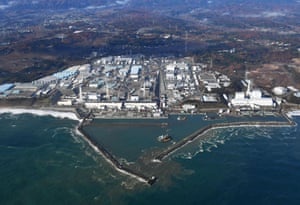
This aerial photo shows Fukushima Dai-ichi nuclear power plant in Okuma, Fukushima Prefecture
Cleaning up the Fukushima Daiichi nuclear plant is expected to take 30 to 40 years. Photograph: AP

Barely a fifth of the way into their mission, the engineers monitoring the Scorpion’s progress conceded defeat. With a remote-controlled snip of its cable, the latest robot sent into the bowels of one of Fukushima Daiichi’s damaged reactors was cut loose, its progress stalled by lumps of fuel that overheated when the nuclear plant suffered a triple meltdown six years ago this week.

As the 60cm-long Toshiba robot, equipped with a pair of cameras and sensors to gauge radiation levels was left to its fate last month, the plant’s operator, Tokyo Electric Power (Tepco), attempted to play down the failure of yet another reconnaissance mission to determine the exact location and condition of the melted fuel.

Even though its mission had been aborted, the utility said, “valuable information was obtained which will help us determine the methods to eventually remove fuel debris”.

The Scorpion mishap, two hours into an exploration that was supposed to last 10 hours, underlined the scale and difficulty of decommissioning Fukushima Daiichi – an unprecedented undertaking one expert has described as “almost beyond comprehension”.

Cleaning up the plant, scene of the world’s worst nuclear disaster since Chernobyl after it was struck by a magnitude-9 earthquake and tsunami on the afternoon of 11 March 2011, is expected to take 30 to 40 years, at a cost Japan’s trade and industry ministry recently estimated at 21.5tr yen ($189bn).

The figure, which includes compensating tens of thousands of evacuees, is nearly double an estimate released three years ago.

The tsunami killed almost 19,000 people, most of them in areas north of Fukushima, and forced 160,000 people living near the plant to flee their homes. Six years on, only a small number have returned to areas deemed safe by the authorities.

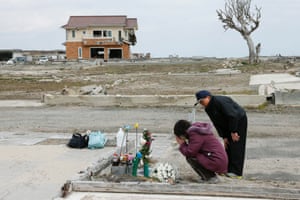
Grieving people
Pinterest
The tsunami on 11 March 2011 killed almost 19,000 people. Photograph: Kimimasa Mayama/EPA

Developing robots capable of penetrating the most dangerous parts of Fukushima Daiichi’s reactors – and spending enough time there to obtain crucial data – is proving a near-impossible challenge for Tepco. The Scorpion – so called because of its camera-mounted folding tail – “died” after stalling along a rail beneath the reactor pressure vessel, its path blocked by lumps of fuel and other debris.

Advertisement

The device, along with other robots, may also have been damaged by an unseen enemy: radiation. Before it was abandoned, its dosimeter indicated that radiation levels inside the No 2 containment vessel were at 250 sieverts an hour. In an earlier probe using a remote-controlled camera, radiation at about the same spot was as high as 650 sieverts an hour – enough to kill a human within a minute.

Shunji Uchida, the Fukushima Daiichi plant manager, concedes that Tepco acquired “limited” knowledge about the state of the melted fuel. “So far we’ve only managed to take a peek, as the last experiment with the robot didn’t go well,” he tells the Guardian and other media on a recent visit to the plant. “But we’re not thinking of another approach at this moment.”

Robotic mishaps aside, exploration work in the two other reactors, where radiation levels are even higher than in reactor No 2, has barely begun. There are plans to send a tiny waterproof robot into reactor No 1 in the next few weeks, but no date has been set for the more seriously damaged reactor No 3.

Naohiro Masuda, the president of Fukushima Daiichi’s decommissioning arm, says he wants another probe sent in before deciding on how to remove the melted fuel.

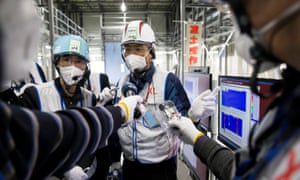
A Tepco employee speaks to the media at the company’s Fukushima Daiichi nuclear power plant.
Pinterest
A Tepco employee speaks to the media at the company’s Fukushima Daiichi nuclear power plant. Photograph: Reuters

Despite the setbacks, Tepco insists it will begin extracting the melted fuel in 2021 – a decade after the disaster – after consulting government officials this summer.

But Shaun Burnie, a senior nuclear specialist at Greenpeace Germany who is based in Japan, describes the challenge confronting the utility as “unprecedented and almost beyond comprehension”, adding that the decommissioning schedule was “never realistic or credible”.

The latest aborted exploration of reactor No 2 “only reinforces that reality”, Burnie says. “Without a technical solution for dealing with unit one or three, unit two was seen as less challenging. So much of what is communicated to the public and media is speculation and wishful thinking on the part of industry and government.

“The current schedule for the removal of hundreds of tons of molten nuclear fuel, the location and condition of which they still have no real understanding, was based on the timetable of prime minister [Shinzo] Abe in Tokyo and the nuclear industry – not the reality on the ground and based on sound engineering and science.”

Even Shunichi Tanaka, the chairman of Japan’s nuclear regulation authority, does not appear to share Tepco’s optimism that it will stick to its decommissioning roadmap. “It is still early to talk in such an optimistic way,” he says. “At the moment, we are still feeling around in the dark.”

‘The situation is not under control’

On the surface, much has changed since the Guardian’s first visit to Fukushima Daiichi five years ago.

Then, the site was still strewn with tsunami wreckage. Hoses, pipes and building materials covered the ground, as thousands of workers braved high radiation levels to bring a semblance of order to the scene of a nuclear disaster.

Six years later, damaged reactor buildings have been reinforced, and more than 1,300 spent fuel assemblies have been safely removed from a storage pool in reactor No 4. The ground has been covered with a special coating to prevent rainwater from adding to Tepco’s water-management woes.

Workers who once had to change into protective gear before they approached Fukushima Daiichi now wear light clothing and simple surgical masks in most areas of the plant. The 6,000 workers, including thousands of contract staff, can now eat hot meals and take breaks at a “rest house” that opened in 2015.

But further up the hill from the coastline, row upon row of steel tanks are a reminder of the decommissioning effort’s other great nemesis: contaminated water. The tanks now hold about 900,000 tons of water, with the quantity soon expected to reach 1m tons.

Tepco’s once-vaunted underground ice wall, built at a cost of 24.5bn yen, has so far failed to completely prevent groundwater from leaking into the reactor basements and mixing with radioactive coolant water.

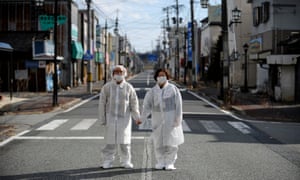
Couple hold hands on Fukushima street
Pinterest
Much has changed in Fukushima since the disaster. Photograph: Franck Robichon/EPA

The structure, which freezes the soil to a depth of 30 metres, is still allowing 150 tonnes of groundwater to seep into the reactor basements every day, said Yuichi Okamura, a Tepco spokesman. Five sections have been kept open deliberately to prevent water inside the reactor basements from rising and flowing out more rapidly. “We have to close the wall gradually,” Okamura said. “By April we want to keep the influx of groundwater to about 100 tonnes a day, and to eliminate all contaminated water on the site by 2020.”

Critics of the clean-up note that 2020 is the year Tokyo is due to host the Olympics, having been awarded the Games after Abe assured the International Olympic Committee that Fukushima was “under control”.

Mitsuhiko Tanaka, a former Babcock-Hitachi nuclear engineer, accuses Abe and other government officials of playing down the severity of the decommissioning challenge in an attempt to win public support for the restart of nuclear reactors across the country.

“Abe said Fukushima was under control when he went overseas to promote the Tokyo Olympics, but he never said anything like that in Japan,” says Tanaka. “Anyone here could see that the situation was not under control.

“If people of Abe’s stature repeat something often enough, it becomes accepted as the truth.”


Too much caesium found in rice grown near Fukushima Daiichi nuclear plant, which was hit by tsunami in March
Japan bans Fukushima rice
Japanese rice that was found contain radioactive contamination well above the legal limit is displayed in Fukushima city. Photograph: Jiji Press/AFP/Getty Images

Japan has banned shipments of rice grown near a tsunami-hit nuclear power plant, after detecting radiation exceeding the legal limit.

The cabinet secretary, Osamu Fujimura, said on Thursday that a sample of rice from a farm contained 630 becquerels of caesium a kg.

Caesium was among the radioactive materials that leaked from the FukushimaDaiichi nuclear plant after it was damaged by the earthquake and tsunami in March.

Under Japanese regulations, rice with more than 500 becquerels of caesium per kilogram must not be consumed.

Officials have tested rice at hundreds of spots in Fukushima, but none had previously exceeded the limit. Only last month Fukushima declared that rice grown in the prefecture was safe.

Humans: Overall, Not Favorably Impressive So Far

The human species is surely impressed with itself. Even the name they chose to classify themselves—Homo sapiens (Latin for “wise man”)—suggests it. Undoubtedly, there must have been some thought involved in the process of mushrooming from a simple tree-dwelling leaf eater in one small corner of the planet, to becoming the scariest big game hunter to rule the Earth.

 UGH

(Carrying a torch)

                               “I’ll use this fire stick to chase that group of peacefully grazing, gregarious gazelles toward that cliff over there, and you guys try to spear as many as you can”

THAG

(Carrying a spear)

                                           “Good thinking, Ugh.”

Scenes like this played themselves out over and over as the species spread out and burgeoned to 7.2 billion. Now the technology of the killingest of creatures has advanced to the point that a single hunter, dressed in camouflage and drenched in another animal’s urine to con his victim as much as possible, can bring down the mightiest moose or tallest giraffe with the slightest squeeze of a trigger.

And still the species grows exponentially and continues to claim every last habitat.

It was impressive when man built the first rocket and took a walk on the moon. However, the rockets they build to blow their enemies sky-high (while irradiating the land and sea) more clearly typify the species’ overall achievements to date. But lately it seems that nuclear annihilation won’t get to see its day; anthropogenic climate change and a man-made extinction spasm are now higher on the agenda.

Perhaps the human, the only creature capable of destroying the Earth, should have been named Homo horribilus mactabilis (Latin for “horrible, dreadful, fearful; deadly, lethal man”).

What would really be impressive is if people were to drop their steak knives (and other weapons of mass destruction) en masse and make peace with this amazing planet and all of its inhabitants. The potential is there, but do they still have the will to learn?

1527138_271312873037188_1829199472_n

Weapons Were Made For Killing

Ever since the first hominid shunned our primate predecessor’s plant-eating lifestyle and sank his teeth into the flesh of another animal, our hairy fore-bearers have been scratching their heads, and armpits, trying to devise deadlier weapons than their neighbors. From the atlatl and arrow to the atomic bomb, the one thing weapons all have in common is that they were made for killing other living beings. Rare is the modern archery aficionado or target-plunker that doesn’t harbor secret fantasies about hitting a wild animal or some bad guy with a praiseworthy shot.

Vast expanses of human history are characterized by the weapon of the day; the cruder the weapon, the longer its period of use. A simple, sharpened stick, later recognizable as the spear, reigned for over a hundred centuries before the atlatl propelled the human predator to a higher level of planetary destruction. With this new technology, localized over-hunting, then early mass extinctions, followed the spread of Homo sapiens to every corner of the earth. Later, gunpowder unleashed a firestorm the likes of which the world had never known.

No weapon ever sat idle for very long, unless it was outdated or obsolete…until today. For the past half-century we’ve been stockpiling weapons whose sole purpose is to discourage others from using theirs. How long can we keep up this posturing before someone challenges the uneasy truce?

With the cold war allegedly over, we’re taught to fear a nuclear-armed Saddam or Iran or North Korea—that other Axis of Evil country who would be a lot better off providing food for its people than building a couple of handfuls of atomic weapons of their own. Now, I don’t like the thought of nuclear weapons in the hands of desperate, crazy people any more than you. If the only countries allowed to have these weapons were the ones we consider reasonable or sane, then, well, we wouldn’t need nuclear weapons, would we? Speaking purely as an advocate for the living Earth now, in terms of overall firepower there’s a much greater threat posed by the estimated 7,650 nukes still waiting and ready in US silos, or the 8,420 Russia still holds, than the fewer than ten claimed by tiny North Korea.

In the immortal words of Mr. Bob Dylan:

But now we got weapons
Of the chemical dust
If fire them we’re forced to
Then fire them we must
One push of the button
And a shot the world wide
And you never ask questions
When God’s on your side.

E95688ABF88792AE42A8914230F586_h316_w628_m5_cBUxDElwb