Exposing the Big Game

Forget Hunters' Feeble Rationalizations and Trust Your Gut Feelings: Making Sport of Killing Is Not Healthy Human Behavior

Exposing the Big Game

Sharks and rays to be given new international protections

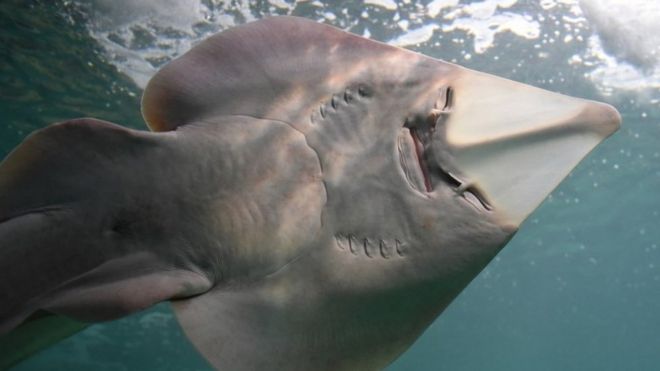
Guitarfish are one of the newly protected speciesImage copyrightGETTY IMAGES
Image captionGuitarfish are one of the newly protected species

Countries have agreed to strengthen protections for 18 threatened species of sharks and rays, including those hunted for their meat and fins.

The proposal was passed at the Convention on International Trade in Endangered Species (CITES) on Sunday.

The newly protected species include mako sharks, wedgefishes and guitarfishes.

A demand for shark fin soup is one of the driving factors in the depleting numbers of sharks in the ocean.

The proposal, which was tabled by Mexico and requires ratification this week, means that the species can no longer be traded unless it can be proven that their fishing will not impact the possibility of their survival.

The number of sharks killed each year in commercial fisheries is estimated at 100 million, with a range between 63 million and 273 million, according to The Pew Trust.

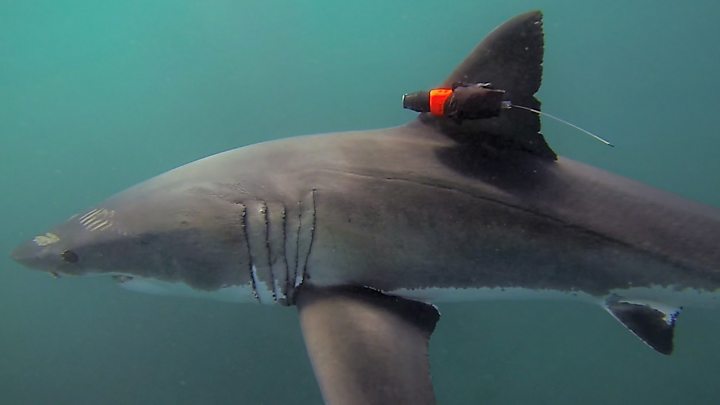
Makos, the fastest shark species, have almost disappeared completely from the Mediterranean and numbers are diminishing rapidly in the Atlantic, Northern Pacific and Indian oceans.

Although 102 countries voted in favour of the move, 40 – including China, Iceland, Japan, Malaysia and New Zealand – opposed it.

Some argued that there was not enough evidence to show that mako sharks were disappearing as a result of fishing.

Presentational white space

Sharks and rays: The facts on the “rhinos of the seas”

  • A group of 16 very unusual animals called wedgefish and guitarfish, together known as rhino rays
  • They are assessed as the most threatened family of marine fish – all bar one is critically endangered
  • Two of the wedgefish species may already have been driven to extinction by commercial fisheries
  • Wedgefish have two large dorsal fins and a large tail lobe, prized for use in soup.
Presentational white space

Ali Hood, director of conservation at Shark Trust, welcomed the move.

“Mako are highly valued for their meat and fins. Decades of unrestricted overfishing, particularly on the high seas, has led to significant population declines,” Ms Hood told the BBC.

The “listing would be critical for ensuring that international trade is held to sustainable levels, prompting urgently needed catch limits and improving traceability”, she added.

Media captionGreat white sharks filmed hunting in kelp forests for the first time

Microplastics discovered in ‘extreme’ concentrations in the North Atlantic

https://www.cnn.com/2019/08/19/world/microplastics-sargasso-sea-north-atlantic-intl/index.html

Sargasso Sea (CNN)Within the Atlantic Ocean is the world’s only sea without shores, its borders defined by the currents of the North Atlantic gyre. The Sargasso Sea takes its name from sargassum, a free-floating golden brown seaweed that is a haven for hatchling sea turtles and hundreds of other marine species who use it to feed, grow and hide from predators. But the sargassum is now home to objects wholly unnatural too.

Caught up in the swirling gyre is a growing collection of human waste: trash from countries that border the Atlantic, from the west coast of Africa to the east coast of the US, slowly breaking up on its long journey into microplastics that end up in the gills and stomachs of aquatic animals.
We joined a Greenpeace expedition to the Sargasso where scientists were studying plastic pollution and turtle habitats. Our mission was to get a better understanding of what lives out on the sargassum ecosystem, what is threatening it, and how that may impact us.

Into the blue

My cameraman, Brice Laine, and I thought we had an understanding of how humanity’s reliance on plastic has impacted Earth. We have reported from the remotest regions of our planet, from the Arctic to the Antarctic, where we witnessed the discovery of microplastics, fibers and PFAS (chemicals that are used as stain and water repellents in things like cookware and outdoor gear).
The Sargasso Sea is another place where few humans venture. Constantly changing with the currents, this oval shaped body of water is around 1,000 miles wide and 3,000 miles long. From the bow of our ship, Greenpeace’s Esperanza, the water looks pristine, inviting. Having never really been in waters like this — the open ocean, often believed to be a biodiversity desert — we’re excited to get in.
There are small schools of juvenile trigger and file fish, and other species darting around or just hiding within the sargassum. There are many species we don’t see, too small, too apt at blending into this rich nursery ground like young shrimp and crab, tiny frog fish, and what we really hoped to find but didn’t — baby turtles.
Embedded in most of the sargassum are the easily visible pieces of trash: shampoo bottles, fishing gear, thick hard containers or thin soft bags amongst many other types of plastic. One of the scientists points out fish bite marks in a small plastic sheet we pull out. But what is really jarring is when you dive down and look into the blue and realize you are surrounded by tiny glittering pieces of broken up plastic called microplastic.
It wasn’t until witnessing it that the extent of plastic pollution and what it means sank in. And it’s terrifying.
Greenpeace scientists say they found “extreme” concentrations of microplastic pollution in the Sargasso Sea, although they are still reviewing their findings. In one sample, they discovered almost 1,300 fragments of microplastic — more than the levels found last year in the notorious Great Pacific Garbage Patch.
Their analysis indicates this pollution originates from single-use plastic bottles and plastic packaging, according to Greenpeace.
Greenpeace’s trip to the Sargasso is part of its year-long pole-to-pole expedition to campaign for a Global Ocean Treaty that calls for the protection of a network of ocean sanctuaries covering 30% of the world’s oceans by 2030.
Off the side of the Esperanza, the manta trawl lazily gobbles up water samples from the ocean’s surface that are filtered through its long mesh tail. An hour later, what is collected shows us the bleak reality of what is in the water.
“In most of the samples that we have been sampling where there is sargassum we have seen a lot of plastics because they get entangled in the sargassum,” Celia Ojeda, a marine biologist with a PhD in ocean conservation, explains, pointing to the tiny pieces floating at the top of one sample.
“It’s a really nice blue; you can’t imagine what is under there, and then when you get the sample you get really shocked at the numbers,” she says.
Along with research assistant Shane Antonition, who is with the Bermuda Aquarium Museum and Zoo, Ojeda spends hours picking through the sargassum and what was collected in the manta trawl net.
Grabbing the tiny pieces with tweezers, she places them carefully on paper to count.
Antonition was part of a similar study years ago. “The more I learn, the more I see how much more like a spaceship Earth is, and how fragile these systems are and how much we rely on these ecosystems services to keep us alive. So, (we are) learning more about our impact on the earth and using those discoveries to inform the change that can prevent further degradation of our environment,” he says.

From your bin to your plate, via the ocean

Only around 9% of plastic produced has ever been recycled. Most single-use plastics end up in landfills or are burned in huge toxic fires. Some finds its way into our rivers or the oceans, either flushed into water systems or blown by wind currents.
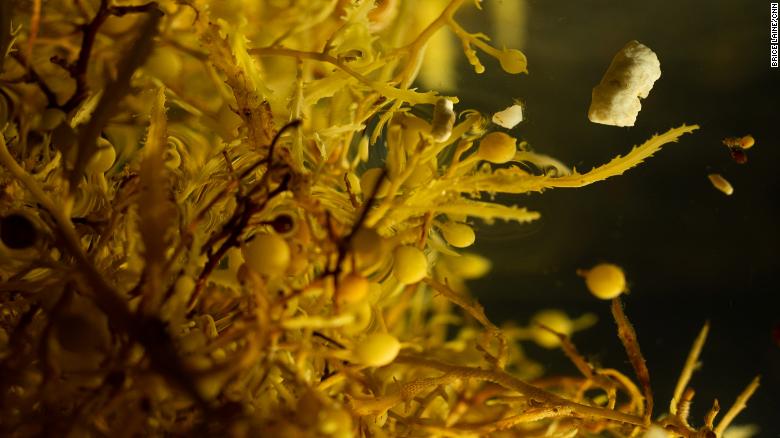
A close up shot of small pieces of plastic among the Sargassum. Plastics become broken down until they're so small they're consumed by wildlife and enter the food chain.

“This goes into the food chain.” Ojeda explains. “The fish and shrimps eat the plastic, we are eating them or the fish that eat them, and this will end up in our bodies somehow.”
The plastic humans discard — food wrappers, plastic bags, even nappies — find their way back into homes in the food that you buy. A study from June 2019 said the average person ingests around 2,000 microplastic particles a week — around five grams, or the weight of a credit card. What scientists don’t yet fully understand is what that plastic or the toxins that plastic contains can do to us.
Plastic pollution is hardly a new phenomenon. A study off the shore of Bermuda back in the early 1970s found 3,500 pieces of plastic per square kilometer. A more recent, as yet unpublished study by the Bermuda Aquarium Museum and Zoo found that nearly 42% of fish samples had ingested microplastics.
The weight of evidence that humans are contaminating one of our major food sources is overwhelming — not only introducing potential toxins into our own bodies, but also polluting whole ecosystems and killing precious marine animals.

How can you protect the ocean?

The key to tackling ocean plastic is to stop it getting there in the first place, but the solution doesn’t just lie with recycling.
“We need to be reusing and refilling,” Ojeda says. “The consumers are doing a lot of things, but if you as a consumer are going to the supermarket and you are unable to buy something which is not wrapped in plastic it’s not your fault. You are a person. It’s companies; companies need to take the step, need to lead the change — and governments need to push the companies.
“For the oceans to recover to we need to stop them (plastics) now. If we are thinking we can stop them in 10 years, we can phase them out, no: we need to stop single-use plastic. Then the seas will have time to clean up.”
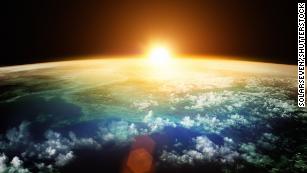
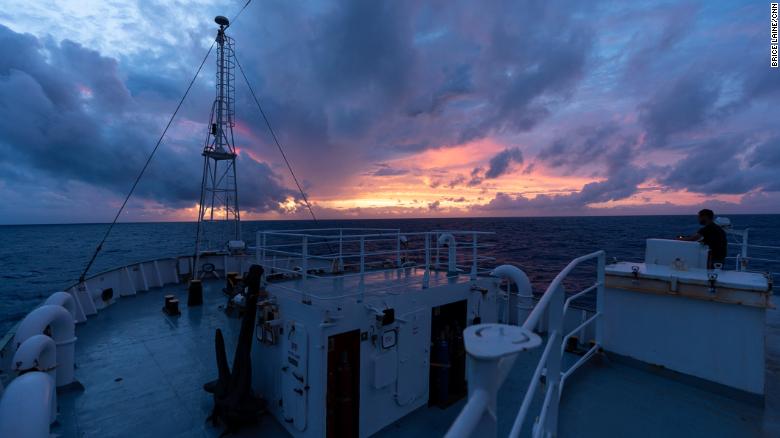
Sunset aboard the Esperanza, a Greenpeace vessel scouring the Sargasso Sea for microplastic samples.

“We need to look at all the ways we are not understanding the fate of plastic,” says Robbie Smith, a marine ecologist and the curator of the Bermuda Aquarium and Zoo. “Recycling is terrible, even in the US. Countries are facing up to the reality, but they are not ready to turn off the tap.
“We need to look at the types of plastic we are using and eliminate the ones that can’t be recycled. We need to tidy up land-based sources (landfills and the like).
“We need to be more respectful that plastic is a great tool but can become a nightmare,” he adds. “There is no quick fix. Nothing is going away fast. It takes a decade or two for plastic to make its way into the watershed.”
Few of us witness what is out in the open oceans far from our homes, which is one of the many challenges for ocean protection and why few truly understand how dire the situation is. Out of sight, out of mind.
But in reality, it’s ending up right back in front of us — and inside us — even though we may not see it.

Turns out there’s more plastic pollution in the deep ocean than the Great Pacific Garbage Patch

CLOSE

Nurdles, also known as “mermaid tears,” are actually small plastic pellets used to make plastic items. Buzz60

SAN FRANCISCO — The problem of plastic pollution in the ocean is even worse than anyone feared. Tiny broken up pieces of plastic — microplastic — aren’t just floating at the water’s surface but are pervasive down thousands of feet. There’s actually more microplastic 1,000 feet down than there is in the Great Pacific Garbage Patch, research published Thursday found.

“We didn’t think there would be four times as much plastic floating at depth than at the surface,” said Kyle Van Houtan, chief scientist at the Monterey Bay Aquarium.

He’s one of the authors of the study published in this week’s edition of Scientific Reports from the journal Nature that investigated just how much plastic there is in the ocean’s depths.

Literally tons of plastic trash wash down rivers and out to sea each day, fouling the surface and endangering sea life. It’s long been believed that most of it floated. But when the researchers looked deep below the surface, they found tiny broken-down plastic pieces, smaller than rice grains, wherever they looked.

The issue of plastic ocean trash has been a focus of public concern over the past decade, a concern that’s centered on the Great Pacific Garbage Patch. That’s a huge floating blob of plastic trash halfway between California and Hawaii drawn together by ocean currents to create a gyre. This vortex of waves concentrates the floating trash pieces in an area twice the size of Texas.

ADVERTISEMENT

It’s important to remember that the patch isn’t composed of big floating rafts of trash, but rather a pervasive almost mist of tiny bits of plastic floating in the water. Think of it more as a fog in the water than as a bleach bottle bobbing along.

That same fog of plastic bits extends deep down below the surface, the scientists found. And deeper down, it’s worse than at the surface.

Previous research found concentrations of microplastic in the Great Pacific Garbage Patch were about 12 particles per cubic meter of water. “We topped out at 16,” said Van Houtan of his team’s underwater findings.

The deep-sea methods they used were highly innovative, and confirmed a bleak picture of what the last decade’s research has been pointing toward, said Brendan Godley, a conservation scientist who studies plastic ocean pollution at the University of Exeter in the United Kingdom.

Newsletters
Get the News Alerts newsletter in your inbox.

Get alerted to the latest stories to stay on top of the news.

Delivery: Varies

Your Email

“Scientists are now beginning to realize that microplastics are truly ubiquitous. They’ve been found from the seafloor to the mountain tops, in the air we breathe and in the salt we put on our meals,” he said.

The biggest shock of all, says Peter Ross, a toxicologist who studies the impacts of microplastics on marine life at Canada’s Vancouver Aquarium in Vancouver, British Columbia, is that it’s not a surprise at all how much plastic there was even deep down in the ocean.

“This research demonstrates the way in which we’ve gone from zero understanding of the problem 15 years ago to full-fledged appreciation that this pollutant is completely distributed around our entire planet,” he said.

What they found

The researchers used drone micro-submarines to sample the water from the surface all the way down to the ocean floor, 3,200 feet. The sample area included one site near Monterey Bay on the California coast and one site 15 miles offshore.

The highest concentrations of microplastics were between 600 and 2,000 feet down.

They also inspected the guts of red pelagic crabs and a kind of jellyfish-like filter feeders called a giant larvacean. Both species play key roles in ocean food webs, from the surface to the seafloor. Every one of them contained plastic.

“Even if you don’t care about the crabs and the larvaceans, they’re the food of things you do care about – tuna, seabirds, whales and turtles all feed on them, or feed on things that feed on them,” said Anela Choy, a professor at the Scripps Institution of Oceanography at the University of California, San Diego and one of the paper’s authors.

While they sampled just two areas, Van Houtan believes they would find similar patterns given ocean currents and the ongoing mix of waters.

Laser spectroscopy allowed them to analyze what kind of plastic each of the particles they found came from, which also turned up some surprises.

Some have suggested that the majority of plastic in the sea comes from discarded or lost commercial fishing gear. However the researchers found that very few particles were from fishing gear. Almost all were from terrestrial sources.

The one piece of good news Van Houtan found in what they saw was that the single largest type of plastic they found floating in the water – about 40% – came from single-use plastics such as beverage and food containers.

“That’s something we as consumers can do something about,” Van Houtan said. “Single-use products are something that we can demand better alternatives for.”

LINKEDINCOMMENTMORE

Dozens of grey whales washing up dead along migration route — and B.C. is their next stop

The whales appear emaciated but whether from decline of food supply or overpopulation is unclear

Every spring, the grey whales migrate from Mexico to the North Pacific. (Craig Hayslip/Oregon State University Marine Mammal Institute)

41
comments

An unusually high number of grey whales are washing up dead on West Coast shorelines on their annual migration north and B.C. is the next stop, warns a U.S.-based marine biologist.

More than 20 grey whales were stranded ashore in California this spring, and, further north along the coast in Oregon, several more have washed up recently.

Eleven whales were recently stranded in Washington state. Only one survived.

“We’re already beyond what we would typically consider high numbers and this is still early in our stranding season,” said Jessie Huggins, stranding co-ordinator for the Cascadia Research Collective.

in one of the longest migrations of any mammal, grey whales migrate from their wintering areas near Mexico to their summer feeding grounds in the North Pacific every year.

“They’re heading towards Canada,” Huggins told CBC’s On The Island. The whales are expected to pass by Vancouver Island.

Young grey whale pictured washed up on Ucluelet beach on Vancouver Island in 2016. (Les Doiron)

Food shortage

From necropsies on the animals, Huggins said it appears that food shortage is an underlying cause of the deaths.

“We’ve been seeing a lot of emaciated animals,” she said.

Grey whales feed on sediment along the ocean floor, which brings them closer to shore than other types of whales. Their proximity to land means they are more likely to wash ashore and for their deaths to be noted.

“Many other whales, when they die further off-shore, we never see them,” Huggins said.

“Especially skinny ones because they tend to sink first.”

Thanks to wildlife protection measures like the Marine Mammal Protection Act, grey whales became a “success story” and their numbers increased over the last decades.

The research hasn’t concluded whether the recent deaths are due to a decline in food sources or an overpopulation of grey whales or some combination of both.

“It’s difficult for us to tell at the moment, but we do know that, for the last year or two, there have been a number of very skinny whales,” Huggins said.

“They didn’t get enough food last summer and, along their normal migration patterns, are just not able to make it all the way to Alaska.”

On The Island
Dozens of grey whales washing up dead along migration route – and B.C. is their next stop
 LISTEN

00:00 06:53

An unusually high number of grey whales are washing up dead on West Coast shorelines on their annual migration north and B.C. is the next stop, warns a U.S.-based marine biologist. 6:53

Watson – The Movie

Image may contain: one or more people and text

WATSON – The Movie poster

Just saw the new movie poster for WATSON. Amazing!!! I’m honoured that Leslie Chicott made this incredibly well done film about my life and about Sea Shepherd. Love the poster, love the film and I adore Leslie and Louise. Thank-you Terra Mater and Participant.

WATSON has been shown three times to sold out theatres at the Tribeca Film Festival in NYC and it was shown at the Dallas Earth X Conference yesterday.

It is of corse difficult to promote a film about one’s self especially when it’s named WATSON. But what is important is that it is the story of what has become a global movement.

The film is a brilliant distillation of a half century of activism. It is my hope that it will be inspiring to a younger generation now facing challenges and struggles for greater and more perilous than anything that I have experienced during my lifetime.

The film hopefully will soon have a theatrical release.

Spread of ‘zombie’ disease killing off starfish linked to rising ocean temperatures Social Sharing

Rapidly spreading infection causes sunflower sea stars in Pacific coast to lose their limbs and die en masse

A newly released study says a combination of warm waters and infectious diseases has been determined as the cause of a die-off of populations of sunflower starfish across the Pacific coast. (Janna Nichols/University of California Davis via Associated Press)

42 comments

Listen6:29

When scientists first noticed a strange disease affecting sunflower starfish on the Pacific coast, the colourful creatures had just started to sprout “little white lesions” on their bodies.

Not long after that, it was like a “zombie apocalypse,” says Joseph Gaydos, science director of the SeaDoc Society at the University of California, Davis.

“They’re walking around and arms are falling off them,” he told As It Happens host Carol Off. “Ones that are in a greater progression of the disease, they’re just kind of melting into piles of ossicles.”

A few weeks later, divers recorded “a complete absence of these sunflower stars,” he said.

A study by Gaydos and his colleagues has connected the rapid spread of the so-called “wasting disease” behind mass die-offs of sunflower starfish to rising in ocean temperatures. The findings were published Wednesday in the journal Science Advances.

Sunflower starfish, also known as sunflower sea stars, are among the largest starfish in the world and come in a variety of bright colours, including purple and orange.

They can grow up to a metre wide and have as many as 24 arms.

A decade ago, they were “super abundant,” Gaydos said. “If you were to ask me then, you know, would these ever be rare, I would say no way, how could that ever happen?”

Population drops between 80-100%

But in 2013, scientists began noticing populations of the species declining between 80 and 100 per cent in deep and shallow waters, from Alaska and British Columbia right down to California.

The nature of the disease itself still eludes scientists, but one of the research theorize an increase in temperature makes the sea stars more susceptible to the disease that was already present, especially since they don’t have complex immune systems.

With global warming causing a heat wave in the oceans, the future is not looking bright for the starfish.

A side-by-side comparison of two photographs taken near Croker Island in B.C. shows thousands of sunflower sea stars swarming a rock on Oct. 9, 2013 on the left, and the same site, three weeks later, bereft of the sea creatures. (Neil McDaniel/UC Davis)

“Dealing with climate change is a huge thing. The other thing that I think we need to start thinking about now is what can we do to save these sunflower stars?” Gaydos said.

“We kind of have a mandate to take care of animals and not let them go extinct on our watch and we really are not certain what can we done at this point.”

A domino effect on the ecosystem

Gaydos said conservationists are looking at ways to preserve the species, possibly through selective breeding in captivity.

But it’s not just the starfish at risk.

The once-bountiful population feeds on sea urchins, which themselves feed on kelp — a major source of food and habitat for other ocean life.

“So with the sunflower stars gone, in a lot of places, the urchin population exploded and then they just gobbled up the kelp forest,” Gaydos said. “It’s just kind of like clear-cutting a forest on land.”

The die-offs, he said, should be a wake-up call.

“I think we can all make differences in everything we do with our life. We can push our governments to make differences. We can take the bus more. We can use less fossil fuels, ride our bikes,” he said.

“If we all start doing things, we’re going to have some impact. We can’t just throw our hands up.”

Written by Sheena Goodyear with Canadian Press. Produced by Allie Jaynes. 

Ocean Deoxygenation as an Indicator of Abrupt Climate Change

The true Renaissance person is endowed with panoramic attention …. The habit of noticing the ensemble of everything and its constituent parts is a matter of will, not of innate aptitude. It involves the conscious noticing of things and the gaps that separate and connect them.~ Christy Wampole 

I’ve responded to Max Li’s inane email messages. Doing so did not make him go away. One of the adverse consequences of making myself available to the public is frequent exposure to a public characterized by people long on unsupported opinions and short on intelligence. My prior responses to Mr. Li’s correspondence did not clear up his obvious insanity. As a result, my future responses to him will appear in this space. As a result, I expect to hear from him less often, and I also expect others to benefit from Li’s ongoing errors.

Saw this on a foreign website. You are so far out in your human extinction calculation you look like a bloody fool.

Scientists know what killed most life on Earth 250m years ago and say we’re on the same path. http://www.stuff.co.nz/environment/climate-news/109167147/humans-blazing-similar-path-to-cause-of-ancient-mass-extinction

Mr. Li’s link references a review paper in Science, a premiere refereed journal. The journal article was widely reported by the corporate press (for example, the New York Times), probably because it adheres to the 2100 meme. It’s the standard, halfway-there approach. Color me shocked.

I turn, as usual, to evidence beyond the headlines. I know few people are impressed with this unusual approach. Indeed, I suspect few people even understand the idea. This is why I write primarily for myself: Writing forces clear articulation of the writer’s thoughts, as I explained to resistant college students for more than two decades.

Shifting the baseline is a common trick used by governments, media, and paid climate scientists, as I have explained repeatedly. We were on the brink in 1965, we had 10 years in 1989, and now we have until 2030. Shifting the baseline continues, even in the journal literature, which claims we are striving to achieve a target we passed long ago: 1.5 C above the pre-industrial baseline.

In the current case, shifting the baseline is hardly the only problem with the journal article. Indeed, the article refers to ocean deoxygenation (also known as hypoxia) as if this phenomenon could never occur in the near future, much less today. The study adds to information published in a March 2017 edition of Proceedings of the National Academy of Sciences pointing to deoxygenation of the oceans. Neither study draws attention to earlier research indicating deoxygenation could become a major issue by 2030. Nor do they point out obvious, ongoing harbingers. They similarly downplay the rapidity with which deoxygenation can occur, as reported in the August 2017 issue of Science Advances. The latter paper mentions, quite importantly, that dead zones in today’s oceans bear remarkable resemblance to those during the Cretaceous. As pointed out in an article in the 19 December 2018 issue of Science Advances, “ocean oxygen loss may, thus, elicit major changes to midwater ecosystem structure and function.”

Even U.S. Senator Bernie Sanders is willing to describe ocean deoxygenation as a contemporary issue, as illustrated in the short video embedded below.

https://www.facebook.com/v2.6/plugins/post.php?app_id=&channel=https%3A%2F%2Fstaticxx.facebook.com%2Fconnect%2Fxd_arbiter%2Fr%2Fj-GHT1gpo6-.js%3Fversion%3D43%23cb%3Df1589c8116610f8%26domain%3Dguymcpherson.com%26origin%3Dhttps%253A%252F%252Fguymcpherson.com%252Ff1dfed07f616bbc%26relation%3Dparent.parent&container_width=0&href=https%3A%2F%2Fwww.facebook.com%2F9124187907%2Fposts%2F10157522565032908%2F&locale=en_US&sdk=joey&width=500


The 10 December 2018 online issue of Proceedings of the National Academy of Sciencesincludes a paper titled, “Pliocene and Eocene provide best analogs for near-future climates.” When does the paper propose such a profoundly rapid rise in global-average temperature? As early as 2030, from this most conservative of sources.

It’s not only the world’s oceans currently impacted by hypoxia. Dead zones have already spread to freshwater lakes and streams.

Lacking habitat, humans will not survive Earth with a Pliocene-style climate. The same holds for Earth with an Eocene-style climate. Sadly, hothouse Earth is simply not suitable for us. We are vertebrates. We are mammals. Neither vertebrates nor mammals can “keep up” with projected gradual changes. To believe we can adapt to or mitigate for the abrupt climate currently under way is absurdly human.

Precisely zero humans will witness 2100. Indeed, there will be nary a human more than seven decades before the calendar reads 2100. As a result, no calendars will be turned to 2100. Rather, our species has a scant few years left on Earth.

Our extinction is imminent. As usual, I encourage readers to live accordingly.

THE POLITICALLY CORRECT MURDER OF WHALES


Commentary by Captain Paul Watson

One thousand whales will die because of a vote amongst a group of arrogant humans today in Florianopolis, Brazil

The vote was on so called indigenous whaling. In other words a slaughter quota for the Inuit, the Yupik, possibly the Makah, some Greenlanders and a few bogus aboriginal groups in the Caribbean.

Bogus?

Well the Aboriginal people of the Caribbean were the Caribs and they were wiped out by the Spanish colonizers. Thus, the people wanting to kill Humpbacks and pilot whales in Bequi, St. Vincent and the Grenadines and St. Lucia have no indigenous “rights” to slaughter whales at all.

Not that anyone has a right to murder a highly intelligent, self-aware, socially complex sentient being like a whale.

The position of the Sea Shepherd Conservation Society is that no one should have the “right” to kill whales anywhere for any reason.

Killing whales is plain and simply – murder!

The Japanese, Icelanders, Norwegians and Danes and Faroese are mass murderers and the killing of whales by indigenous cultures is also an act of murder.

I make no apologies for this position. We have been called racist for opposing the murder of whales but we are not motivated by racism. We don’t care what the color or the culture is of the hand that fires the harpoon. There is no justification for the mass murder of whales.

Racism is allowing one group to have special rights to commit murder based on culture and race.

We oppose whaling by the Japanese but also by the white Europeans of Iceland, Denmark and Norway.

Our passion and our loyalty is to the nation of whales and we will not betray them for any cultural justification.

I would like to salute the 7 nations that had the courage to vote against indigenous whaling.

Argentina
Colombia
Costa Rica
Dominican Republic
Ecuador
Panama
Uruguay

58 nations voted to slaughter whales in a proposal led by the United States.

Brazil, Chile, Gabon, Mexico and Peru abstained.

Australia has little respect for Aboriginals but voted to allow the Inuit on a distant continent to kill whales.

Japan has denied the indigenous Ainu people the right to whale and hunt but they have no problem backing indigenous peoples in the USA, Canada and Greenland to kill whales.

Perhaps the United States believes they can absolve the guilt of genocide by allowing the slaughter of whales so that the whales must die for their colonial sins.

It all reeks of self-serving hypocrisy.

Denmark will now try to convince the world that the slaughter in the Faroes is indigenous.

Will the Makah once again try to kill whales just to prove then have the right to do so? They have no subsistence necessity and nothing in their culture justifies killing a whale with a .50 caliber recoilless rifle.

How many more Humpbacks must die in Greenland to provide fad foodie meals for bored tourists?

How many 100 to 200 year-old Bowheads must die in the Arctic by people using explosive harpoons, motor boats, and sonar?

Sea Shepherd’s position on Aboriginal whaling may be controversial but it is consistent. We have always opposed the murder of whales and we always will, by anyone, for any reason, anywhere.


Massive boom will corral Pacific Ocean’s plastic trash

Massive boom will corral Pacific Ocean’s plastic trashPhoto: AP Photo.

https://www.whec.com/news/-massive-boom-will-corral-pacific-oceanrsquos-plastic-trash-/5063246/

September 08, 2018 03:03 PM

SAN FRANCISCO (AP) — Engineers will deploy a trash collection device to corral plastic litter floating between California and Hawaii in an attempt to clean up the world’s largest garbage patch in the heart of the Pacific Ocean.

The 2,000-foot (600-meter) long floating boom will be towed Saturday from San Francisco to the Great Pacific Garbage Patch — an island of trash twice the size of Texas.

The system was created by The Ocean Cleanup, an organization founded by Boyan Slat, a 24-year-old innovator from the Netherlands who first became passionate about cleaning the oceans when he went scuba diving at age 16 in the Mediterranean Sea and saw more plastic bags than fish.

“The plastic is really persistent and it doesn’t go away by itself and the time to act is now,” Slat said, adding that researchers with his organization found plastic going back to the 1960s and 1970s bobbing in the patch.

The buoyant, a U-shaped barrier made of plastic and with a tapered 10-foot (3-meter) deep screen, is intended to act like a coastline, trapping some of the 1.8 trillion pieces of plastic that scientists estimate are swirling in that gyre but allowing marine life to safely swim beneath it.

Fitted with solar power lights, cameras, sensors and satellite antennas, the cleanup system will communicate its position at all times, allowing a support vessel to fish out the collected plastic every few months and transport it to dry land where it will be recycled, said Slat.

Shipping containers filled with the fishing nets, plastic bottles, laundry baskets and other plastic refuse scooped up by the system being deployed Saturday are expected to be back on land within a year, he said.

The Ocean Cleanup, which has raised $35 million in donations to fund the project, including from Salesforce.com chief executive Marc Benioff and PayPal co-founder Peter Thiel, will deploy 60 free-floating barriers in the Pacific Ocean by 2020.

“One of our goals is to remove 50 percent of the Great Pacific Garbage Patch in five years,” Slat said.

The free-floating barriers are made to withstand harsh weather conditions and constant wear and tear. They will stay in the water for two decades and in that time collect 90 percent of the trash in the patch, he added.

George Leonard, chief scientist of the Ocean Conservancy, a nonprofit environmental advocacy group, said he’s skeptical Slat can achieve that goal because even if plastic trash can be taken out of the ocean, a lot more is pouring in each year.

“The plastic is really persistent and it doesn’t go away by itself and the time to act is now,” Slat said, adding that researchers with his organization found plastic going back to the 1960s and 1970s bobbing in the patch.

The buoyant, a U-shaped barrier made of plastic and with a tapered 10-foot (3-meter) deep screen, is intended to act like a coastline, trapping some of the 1.8 trillion pieces of plastic that scientists estimate are swirling in that gyre but allowing marine life to safely swim beneath it.

Fitted with solar power lights, cameras, sensors and satellite antennas, the cleanup system will communicate its position at all times, allowing a support vessel to fish out the collected plastic every few months and transport it to dry land where it will be recycled, said Slat.

Shipping containers filled with the fishing nets, plastic bottles, laundry baskets and other plastic refuse scooped up by the system being deployed Saturday are expected to be back on land within a year, he said.

The Ocean Cleanup, which has raised $35 million in donations to fund the project, including from Salesforce.com chief executive Marc Benioff and PayPal co-founder Peter Thiel, will deploy 60 free-floating barriers in the Pacific Ocean by 2020.

“One of our goals is to remove 50 percent of the Great Pacific Garbage Patch in five years,” Slat said.

The free-floating barriers are made to withstand harsh weather conditions and constant wear and tear. They will stay in the water for two decades and in that time collect 90 percent of the trash in the patch, he added.

George Leonard, chief scientist of the Ocean Conservancy, a nonprofit environmental advocacy group, said he’s skeptical Slat can achieve that goal because even if plastic trash can be taken out of the ocean, a lot more is pouring in each year.