Arctic Drilling Is Not Just Wrong—It’s Crazy!

1979851_303991166423363_1363126940602880439_n

Saturday we participated in a Sea Shepherd volunteer garbage clean-up at Cannon Beach, a stretch of the Oregon coast noted for its nesting pelagic birds on scenic Haystack Rock. Haystack is one of the few sites on Earth where you can see fledgling murres, pigeon guillemots, puffins and cormorants, etc. take their first flights without intruding on some remote, fragile location like the arctic

Being the birthplace of so many vast flocks of seabirds, the arctic is supposed to be remote, but now, because of climate change, the Arctic Ocean is becoming more and more accessible to people most of whom have nothing but bad intent, like those at Shell Oil, who’s planning to drill for oil in the Arctic’s Chukchi Sea in a matter of days. In 1980, before most scientists even understood about global warming, Canadian naturalist John Livingston wrote a book, Arctic Oil: the Destruction of the North? about the risks to wildlife and nature inherent in drilling for oil in such an environment.

From Arctic Oil, “In winter, vast flocks of murres from the arctic islands drift south on prevailing currents to waters off Newfoundland, where they find themselves on or adjacent to major shipping lanes between North America and Europe. The concentration of murres often coincides with the concentration of oil. If a bird’s wings are oiled, they cannot fly, and if food is not immediately available, it will starve. Or, if its body is even slightly oiled, its feathers will lose their insulating properties and the bird will succumb to exposure in icy waters. Some birds, on the other hand, do make it to shore, where they attempt to preen their feathers clean. These will often die of starvation before they can take to the air again, or will perish from the toxicity of the oil swallowed during the preening process.

“It is impossible to know how many murres, eider ducks and other sea birds have been destroyed in this way over the years.”

In one spill off the British coastline, “160 kilometers had been oiled; it was estimated later that 25,000 sea birds died. It was a good ten years before the local biological system appeared to have healed.

“The record of accidental spills is cause not for mere concern but for raw fear. Oil tankers have become very large and numerous. At more or less regular intervals one of them cracks up.

“There seems no option but to expect that there will be more such events as super-tanker traffic intensifies on the high seas of the world. Year-round shipping, under all conditions, is being seriously proposed for the Northwest Passage. Accidents are wholly unpredictable as to timing and location, but entirely predictable in a sense of probability.

And on drilling Livingston writes, “In the high arctic islands, unfortunately, and in the Beaufort Sea and the Mackenzie Delta there are zones of ‘abnormally high’ geostatic pressure, which of course heightens the possibility of accident…The first such event in the Canadian arctic…took two weeks to shut off the gushing gas [natural—mostly methane.] A month later the well blew out of control again; this time it could not beDeepwater-Horizon-CDVIDS shut down until more than a year after the initial explosion. During that time it lost gas at the rate of 85,000 cubic meters per day. Five months after the Drake Point well blew out, another Pan Arctic well, this time on King Christian Island, went out. This one lost gas at about 2.8 million cubic meters per day, and, unlike the Drake Point gas jet, this one was on fire. The gigantic flame was finally extinguished three months later.

“Leaving to one side for the moment the sheer mechanical difficulty of dealing with a blow-out under the ice, or on the sea floor, or on the permafrost, the possible consequences for wildlife such as sea birds, even on the open arctic water, are hair-raising. (Of course a blow-out of Campeche massiveness would not be required; a much lesser spill, or even the accumulated effect of ‘normal’ leakage, could create havoc in the high arctic waters.)

“The critical question seems to be this: in certain knowledge of the undeniable risk, is the risk worth taking?”

Drilling for oil in the arctic is not just dead wrong, as Al Gore recently stated, “It’s crazy!” And he wasn’t even talking about global warming at the time.

11214207_829677830435133_118593585578390559_n

Dolphins drowning in oil‏

image

From Avaaz:

Dear friends,

I live on the California coast, and I’m crying as I write this. Last week a massive oil pipeline burst off of Santa Barbara, and now thousands of dolphins, sea lions, and pelicans are drowning in slick rivers of oil. But my rage and sadness is also hope, because I know together we can make sure this never happens again.

While our rocky shores are awash in oil and dead fish, Plains All American CEO Greg Armstrong raked in over $5 million in compensation last year, and is guaranteed $29 – $87 million in golden parachute cash! These guys broke the law to make a quick buck. But if we hold them accountable, we can prevent another catastrophe by putting oil company executives everywhere on notice that they can’t get away with these kinds of shady games on our watch.

Let’s tell California Attorney General Kamala Harris and local District Attorney Joyce Dudly to file civil and criminal charges against Plains All American and its shady CEOs! Sign now, and spread the word:

https://secure.avaaz.org/en/santa_barbara_oil_spill_loc/?bVYyJab&v=59386

The pipeline that burst lacked basic safety features, like an automatic shut-off valve. And Plains All American is one of the most reckless companies in the US, with over 175 documented violations in the past decade.  They’ve been warned time and again, but did nothing.

I live in San Diego, just 200 miles south of this devastating oil spill. My best days are the days I surf with seals and dolphins. Floating in the waves as they frolic with joy and abandon makes the whole world make sense.

These precious creatures are now drowning in oil because of the profiteering short cuts of the Plains All American, but we can hold the culprits accountable. Click now to tell the DA and AG to bring the maximum possible charges:

https://secure.avaaz.org/en/santa_barbara_oil_spill_loc/?bVYyJab&v=59386

50 years ago a similar oil spill devastated Santa Barbara’s coastal sanctuary, sparking the modern environmental movement around the world.  Together people everywhere rose-up then in fury and hope, writing new laws to protect our planet and our children’s future.  Let us allow this tragedy to renew our determination, so together we can rise again.

With love and hope,

Terra, Joseph, Rosa and the rest of the Avaaz team

More information:

Santa Barbara oil spill: Authorities, environmentalists step up response (CNN)
http://www.cnn.com/2015/05/22/us/california-oil-spill

Santa Barbara oil pipeline leak rekindles memories of 1969 disaster (LA Times)
http://www.latimes.com/local/california/la-me-santa-barbara-spill-20150521-story.html#page=1

Huge Oversight Gap on Refugio Pipeline (Santa Barbara Independent)
http://www.independent.com/news/2015/may/21/whos-watching-man-whos-watching-pipeline

SEC Form 10-K Annual Report (SEC)
http://www.sec.gov/Archives/edgar/data/1070423/000110465915013616/a14-25277_110k.htm#Item11_Executiv…

Executive Profile (Boardroom Insiders)
http://people.equilar.com/bio/greg-armstrong-plains-all/salary/25718#.VWYDse0azCQ


Support the Avaaz Community!
We’re entirely funded by donations and receive no money from governments or corporations. Our dedicated team ensures even the smallest contributions go a long way.

Ironic Timing for New Offshore CA Oil Spill

Santa Barbara oil spill recalls 1969 spill that changed oil and gas exploration forever

The estimated 21,000-gallon oil spill that sent plumes of black through the waters off Santa Barbara County on Tuesday brought haunting echoes of a much larger spill nearly half a century ago, one that gave birth to the modern environmental movement and forever changed the trajectory of oil and gas exploration in California.

The Santa Barbara oil spill of 1969 spewed an estimated 3 million gallons of crude oil into the ocean, creating an oil slick 35 miles long along California’s coast, and killing countless birds, fish and sea mammals.

Following the spill, the region became ground zero for some of the most significant conservation efforts of the 20th century.

More: http://www.latimes.com/local/lanow/la-me-ln-santa-barbara-oil-spill-1969-20150520-htmlstory.html

Anti-Arctic drilling kayaktivists to hold ‘Shell No’ protest

http://www.komonews.com/news/local/Anti-Arctic-drilling-kayaktivists-hold-Shell-No-protest-303995901.html

Republicans- How they have sold out our environment and their Soul

by Stephen Capra

For the past few years I have spoken with many good Republican friends who feel as though they have lost the party they once so proudly belonged too. These Republicans I speak of care deeply about issues like wilderness, global climate change and wildlife, but they view it through the prism of being Republican means a far broader interpretation than that of the current Tea Party driven, oil and gas industry controlled party of today.

If you look at their plans should they take control of the Senate, their goal should be called the “Destroy Americans Wildlands and Water Act.” They only seem to see our wildlands as a place of exploitation. Their economic strategy includes getting the Keystone pipeline approved, more drilling and fracking, but removing that silly regulation that somehow tries to protect drinking water,  and of course open up more of our coasts to drilling. Let’s not forget selling off public lands in the West as their means of reducing the deficit. Its pure madness and it’s not that far removed from reality.

To watch the Republican party of 2014, is to witness a party bought and paid for by oil and gas, Koch Brothers, the religious right and the extremism of the Tea Party, which is large corporations, exploiting rural America and people who feel their lives are not working according to their white status, especially because of an African-American President of thought and reason.

Chevron is pumping millions into Senator McConnell of Kentucky’s tight Senate race with the goal of becoming the majority leader in the Senate. Now, let’s be clear, Democrats suffer from some of the same influences brought by lobbyists and the many special interests they represent, however, my focus is conservation and on this issue there is an amazing gulf.

It’s important to look at the interconnectedness of life. How would a party that fights woman’s rights that seemingly want to go to war daily, expand military budgets and subsidies to ranchers along with oil and gas interests. While rabidly fighting health care, how can we expect them to care about conservation? They are not just detached from reality; they have traded their connection to the earth for the madness of perceived wealth.

Republicans since the Reagan years rarely seem to see a wilderness bill they support. They have become obstructionists to most environmental legislation and only tend to agree if some major pork for their district is attached. They seem to have very little sense of the importance or spiritual renewal that comes with protected land.

The influence of oil and gas interests has lead governors in the southeast to demand the opening of their coasts to drilling. In North Dakota, they are just now discovering the spills, crime, loss of a night sky, and the dangers that come with putting faith in big oil. The “drill baby drill” propaganda that Fox news and many Republicans now proudly speak of has become a point of pride for many Americans.

From this also comes the carefully choreographed messaging about denying Climate Change and the long list of Republicans from oil states that speak out and pushback from sound science in such a pious manner while the planet screams for reason. It is a sickness that permeates this party and we are paying the price in funding to parks, the obsession of spending cuts from a group that gave us the Iraq war and the destruction of our economy.
The same party has leaders like representative Stephen King of Iowa who supports dog fighting and made sure to add an amendment to the Farm bill that removed protections and inspections of farm animals. Perhaps it’s our own Stevan Pearce of New Mexico, (he even spells his name weird) who proudly spoke of selling off public lands to remove our nation’s debt and who has done all he can behind the scene to block Mexican wolf recovery efforts.

It is a tragedy for this country and the world to see the decline of a once great party that has devolved into a tightly controlled group so devoid of feelings, so full of greed and drunk with power, that they would create a world where most of us are numbers and our lands and waters destroyed for the mansion on the hill.

We have become, not a nation of people, but an island of individuals. That sadly works against the shared responsibility of our public lands and waters.

Elections are less than 10 days away. Voting, like land protection, is more difficult than ever for those in states determined to reinstate the poll tax. Meanwhile our parks will absorb another year of cuts, federal agencies that mange lands will also see cuts, but God forbid, a Republican accepts a cut in military spending!

This party must come back to its roots, its origins. The years of Teddy Roosevelt and the magic he inspired. If they will not- then they must be defeated, for all the reasons I mentioned above, but most of all, if we are to protect lands, end our addiction to oil, and live in harmony with wildlife, stopping them is not about politics, but rather survival.
It comes back to morality, the morality reflected in the magic that is our planet. Something the Republican party of 2014 has turned a blind eye to.

Tell the Feds NO Arctic Offshore Drilling

From Ocean Conservancy.org:

Breaking: The U.S. government is beginning to make plans for future offshore oil and gas operations—and those plans could open Arctic waters to risky drilling.

This follows Shell Oil’s decision to abandon Arctic drilling this summer, after an accident-plagued 2012.

If a disaster like BP Deepwater Horizon happened in the Arctic, spill response would be even more challenging. The Arctic’s sea ice, freezing temperatures, gale force winds, and lack of visibility could make cleanup next to impossible.

The government’s public comment period ends on July 31, so we only have 10 days to respond. We need you to tell the Bureau of Ocean Energy Management (BOEM) to say no to risky Arctic drilling now.

Take a stand against oil and gas operations in the Arctic Ocean. Act now, and tell BOEM not to open additional Arctic waters to oil and gas drilling!

The Arctic Ocean and all those who depend on it are already under stress. The rapidly changing climate, including extreme deterioration of the summer sea ice, is putting Arctic marine animals at risk. Many people who live in coastal communities in the Arctic depend on a clean and healthy ocean to support their subsistence way of life. Offshore drilling for oil and gas would expose this already fragile ecosystem to significant noise, pollution and traffic.

Stand against risky oil and gas operations in the Arctic Ocean. Tell BOEM not to open additional Arctic waters to oil and gas drilling!

also see: http://www.yakimaherald.com/news/yhr/saturday/2358984-8/change-in-climate-sparking-ever-growing-wildfire-dangers

and: https://exposingthebiggame.wordpress.com/2014/07/24/obama-western-wildfires-have-a-lot-to-do-with-climate-change/

Galveston Bay Oil Spill: What We Birders Can Do

The March 22 spill of 168,000 gallons of highly toxic bunker fuel into Galveston Bay can be expected to take a huge toll on migrating, nesting, and still-wintering birds. If you want to donate money to help, Houston Audubon seems to be the go-to organization right now. But whether or not you can make a financial contribution, if you spend time on the Texas coast this spring, you can make a vitally important difference in what happens next, by submitting the sightings of every oiled bird you see into eBird. Enter the species, numbers, time, and place as always, and for each bird click “Add Details,” then click “Oiled Birds.” Provide photos whenever possible.

Even though eBird can be the perfect repository for this wealth of data, how can entering bird sightings actually help this horrible situation?

After the Exxon Valdez spill in 1989, volunteers and professionals descended upon Alaska in huge numbers. Some volunteers may have gotten in the way here and there, but with all those eyes and cameras bearing witness to the devastation, there was no way that Exxon could hide the environmental damage and the toll on wildlife. The final tally for oiled birds was between 100,000 and 250,000 oiled seabirds and at least 247 Bald Eagles. Thanks to the huge public outcry, the issue of single-hulled tankers was kept alive, and a great deal of pressure was put on Congress to enact legislation to strengthen protections for our vital waterways.

After the BP spill in 2010, I was disillusioned to see how dramatically things had changed. Only a handful of volunteers and very few professionals went to the Gulf. Marge Gibson, past president of the International Wildlife Rehabilitation Council and the woman who led the team recovering oiled Bald Eagles after the Exxon Valdez spill, was turned away from helping—literally prohibited from providing her valuable expertise—as were countless other specialists experienced in retrieving oiled pelicans and other birds along the Florida and California coasts. BP, the US Fish and Wildlife Service, conservation organizations, and the media gave out phone numbers for people to call if they wanted to help, and those of us who called were told we’d be notified if our services were necessary, but I know of no one who was ever called back. Qualified people with years of expertise in helping animals after oil spills waited for phone calls or email that never came. Marge Gibson waited for months with her bags packed.

Marge writes:

What changed between the Exxon and BP spills was that the companies learned from what they considered Exxon’s P.R. mistakes.  They learned that preventing access to the area and trying to minimize photographic evidence was the way to go.  If the public doesn’t see it, it does not exist.  Exxon has been judged severely for the Valdez accident, but in fact, after the spill they did their honest best, enlisting top scientists worldwide that were not just suits—they wore survival gear because they were physically on site—in ships and on the ground.  I was there. I worked with them.

That spill was an open book not only for the public, but for the scientists that worked on it.  B.P. decided that was not good because scientists document their work and put the data and their findings in the literature where it is available forever. The scientists who were allowed to produce studies in the aftermath of the BP spill had to sign away their rights to publish any of them for at least 5 years.

Yes, Exxon made mistakes. But it wasn’t Exxon who declared that oil companies could use single hulls again. Exxon allowed every aspect of the spill and the cleanup to be an open book. We could have learned how to reduce the potential for future spills, but all that seems to have been learned is how to do more effective cover-ups to minimize liability as much as humanly possible.

From the standpoint of wildlife conservation, the specific critical change between the 1989 Exxon spill and the 2010 BP spill is in the protocol for counting oiled animals—the only means of assessing damage to wildlife. After the Exxon spill, EVERY oiled animal that was seen was counted. Even though a quarter million oiled birds were documented, this number is considered by most authorities to be a gross underestimate, considering the huge area involved and how many birds, tiny and large, washed away undetected in the vast ocean.

With the BP spill, the new policy was to count only those oiled birds that were physically collected—picked up dead or alive. Minimizing the toll further, only a handful of people were authorized to retrieve these animals. Unauthorized people who found an oiled animal of any species were supposed to call a number and give directions to the animal, but were not allowed to not touch it or remove it under threat of heavy fines and jail.

Even authorized people were prohibited from capturing any bird still capable of flight. And “flight” was defined to include even the most pathetic fluttering. This Black-crowned Night-Heron that I photographed at the edge of Cat Island in Barataria Bay after the BP spill is not included in the official count of oiled birds.
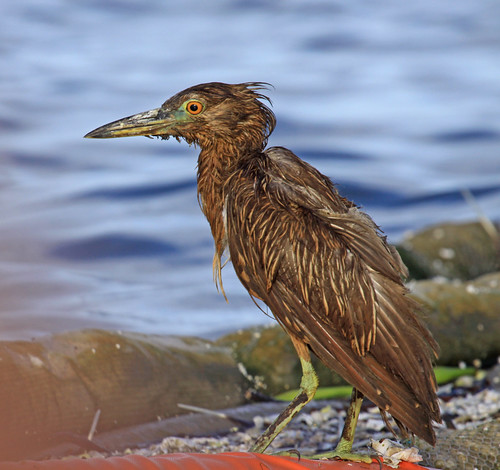
Oiled Heron

Our boat spooked it and it fluttered a few feet into the water and then struggled to shore. Our boat captain told us that because none of us were authorized to collect oiled animals, he would lose his license if we did anything to try to save it. He also said that he was prohibited from calling in people who were authorized to retrieve oiled birds because it was still “flying.” I wish I were making this up.

The timing, during nesting season, made the situation even worse. In the weeks following the explosion, birders and other experts clearly observed that 50 to 80 percent of the 10,000 breeding birds on Raccoon Island were oiled. Yet not one of those birds is included in the official count of oiled wildlife. Thanks to another bizarre rule change, people who’d been permitted to take photos and videos of nesting birds on the island before the spill were shooed away, and even those people authorized to collect wildlife were prohibited from approaching the island, ostensibly to ensure nesting success of unoiled birds. Just the oiled adult birds on Raccoon Island would have doubled the final count of oiled birds, yet not one of them, nor any of their oiled eggs and chicks, nor a single oiled bird on other nesting colonies, is included in the official total.

I rejoined ABA in the aftermath of the BP spill because ABA sponsored and provided a forum for Drew Wheelan, the only birder consistently and steadily out in the field throughout the aftermath. Drew tirelessly and against a great many forces documented everything he saw about the disaster. I spent a few weeks down there in July and August, and saw for myself that everything Drew had written about was true. As far as I’m concerned, ABA proved itself a true conservation organization by using our strength—birding expertise—to document the effects of the spill on birds.

Drew Wheelan

Some people speculate that rehabilitating oiled birds is not worth the cost and effort, when that money and energy could be going to support projects with the potential to help far greater numbers of birds. Even though I strongly believe that rehabilitating oiled birds is worth it, I agree that the subject is debatable. But the timing of the debate always seems to come right on the heels of these disasters, and following the BP spill, that debate played right into BP’s hands. Even some normally conscientious conservationists criticized the effort of retrieving these birds, presumably not realizing why retrieving these birds was so very important.

Regardless of the value of wildlife rehab, under current rules, the only oiled wildlife included in official numbers are ones that have been retrieved, dead or alive. This matters. It’s these official numbers that are used to assess damages against responsible parties. Thanks to the changes in protocol, barely 7,000 birds are in the official total of oiled wildlife after the BP spill. Just 7,000, compared to the quarter million in the official total after the Exxon Valdez spill. The National Wildlife Federation has a webpage directly comparing the two spills, but they present only the official numbers with no mention whatsoever that the method of counting changed so dramatically between the two events.

This is why it’s crucial that we birders document EVERY oiled bird. eBird is the way to do this. It will take a lot of work for scientists to identify and take out double counted birds and tease out the meaning and validity of the numbers, but only with a robust body of data can we establish with any accuracy at all the magnitude of damage from this spill.

For updates on the Galveston Bay oil spill and what you can do to help, please see Houston Audubon’s website.

To sign a petition to encourage access for rehabbers and accurate reporting of oiled birds, go here.


Hey Humans, Slow the Fuck Down

The following is the first of a series on Deniers and the Damage They Do…


By now you’ve more than likely read that the Arctic Ocean’s floating sea ice has already retreated to a record minimum.  And you’ve probably heard that every scientist who hasn’t been bought off agrees: global warming is to blame. And you might have even heard that Greenpeace activists have been staging protests and attaching themselves to oil rigs and ice breakers en-route to the polar region. You may already be one of the 1.6 million people who have signed the group’s online petition urging world leaders to declare the Arctic a global sanctuary, off limits to oil exploration and industrial fishing. And there’s an off-chance you’re one of the dozens of celebrities, including Robert Redford, Paul McCartney and Penelope Cruz, who have announced your support for Greenpeace’s campaign.

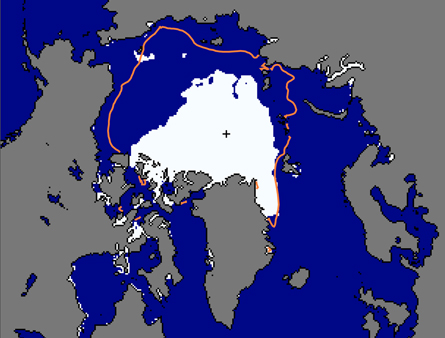
The following map and excerpt from a Science News article titled, “Arctic sea ice hits record low and keeps going,” reveals the present status of the Arctic ice cap. The average ice coverage for the 21 years between 1979 and 2000 is demarked by the orange line that can be seen running from the Greenland Sea, west and north of Svalbard, through the Laptev Sea to Russia’s Wrangel Island and through the Beaufort Sea to the Canadian Archipelago. The difference between that area and the area presently covered by ice is at best, shocking. … 

The six lowest sea-ice extents on satellite record have occurred in just the last six years. More melt means more open water exposed to sunlight. In turn, that water absorbs more heat and causes feedback loops that heat the Arctic even more.

As of August 26, Arctic sea ice covered 70,000 square kilometers below the previous satellite-era record from 2007, according to the National Snow and Ice Data Center in Boulder, Colo.

“The ice cover is now just so thin and weak in the springtime that large parts of it can’t survive the melt season,” says NSIDC director Mark Serreze.

Arctic sea ice grows in winter and melts partly away each summer. Overall, more sea ice has been lost each year as temperatures rise. From 1979 to 2011, the amount of sea ice left in September at the end of each melt season dropped by an average of 12 percent per decade.

The ice isn’t just shrinking; it’s also thinning. The Arctic used to contain lots of thick ice — some 3 to 4 meters thick — that survived year after year. Now it’s dominated by thinner ice only 1 to 2 meters thick and just one to two summers old. “It’s almost like parts of the Arctic have become a giant slushee at this time of year,” says Walt Meier, a sea ice expert at NSIDC.

In 2007, the previous record year, winds, cloud cover and other weather conditions were just right for a lot of ice to melt away. “There were a number of people saying [2007] was a one-off and you’ll never see this perfect storm again,” says Serreze. “What Mother Nature is telling us is that you don’t need a perfect storm anymore, just because the ice is so thin now.” …

_____________________________________

Meanwhile, in answer to these new conditions, oil companies are poised to begin installing offshore oils rigs and drilling in the backyards of walrus and polar bears. Greenpeace and other environmental groups say an oil spill in the Arctic could cause irreparable damage to wildlife and marine ecosystems. That’s no shit. With a brief growing season and comparatively little seawater circulation, the Arctic Ocean must be one the most delicate environs on the planet.

Fears that the oil industry is unprepared to operate in the hostile conditions of the far north where storms are frequent were accentuated when a floating oil rig capsized off eastern Russia last December, killing more than 50 workers.

Surely halting any new oil and gas drilling in the fragile north is an important step in solving the world’s problems. But considering that the loss of the polar ice cap is a direct result of global warming, and global warming is a direct result of human activities (chiefly the burning of fossil fuels for energy, transportation and meat production), wouldn’t the real answer be to put a halt to ALL further oil exploration and drilling everywhere? When you take into account that further planetary warming could well result in a steady flow of cold Arctic melt-water into the North Atlantic, thereby disrupting the deep sea conveyer that cycles weather as we know it, while fueling the very vitality of the living oceans, the answer must be a resounding, if reluctant “Yes!”

So what does all this have to do with deniers and the damage they do?

Chances are if you’ve heard of global warming, you’ve heard of global warming deniers. Maybe you are one yourself. If so, it’s time to wake up and smell the methane! The planet can’t wait for people to quit bickering and decide to make some major changes. If we don’t curtail our daily carbon output and change our consumptive ways, the climate is going to change for us, and leave our mechanized world in the dust.

Like “young Earth” creationists who still deny evolution because they don’t like to think of humans as mere animals, or hunters who don’t want to admit their species’ role in the ongoing extinction spasm, global warming deniers don’t want to accept humankind’s hand in radically changing the climate—to the detriment of all who’ve adapted to it over the eons. It’s time to evolve out of this hyper age of planes, trains and automobiles, put away our motorbikes, jet boats and snowmobiles along with the rest of our gas-burning toys, slow the fuck down and try to live at pace more in keeping with the rest of this living planet—while we still have one.

Text and Wildlife Photography ©Jim Robertson