
Whale Museum in Washington releases audio of the mourning mother communicating with her pod

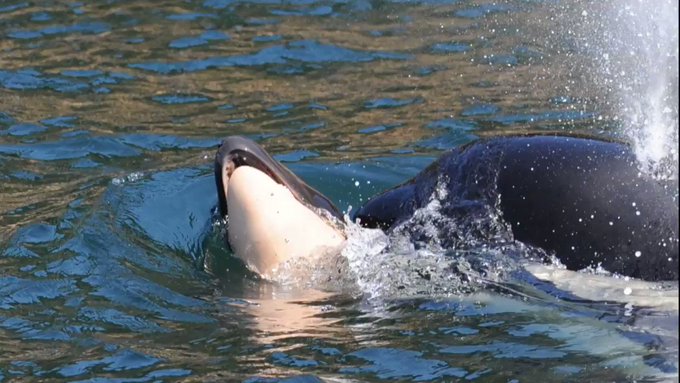
Mother orca J-35 has been balancing body of its dead calf on its nose for more than a week. (Soundwatch NMFS Permit #21114/Whale Museum )
Listen6:00
Members of a pod of endangered killer whales now appear to be taking turns floating the body of a newborn calf that died more than week ago.
As It Happens reported on Friday about J-35, a mother orca from B.C.’s endangered killer whale population that has been balancing her dead calf on her nose near San Juan Island, Wash.
It’s now been more than a week and the mother whale is still carrying the calf’s remains — sparking concerns among researchers that she’ll tire herself out.
“We do know her family is sharing the responsibility of caring for this calf, that she’s not always the one carrying it, that they seem to take turns,” Jenny Atkinson, director of the Whale Museum on San Juan Island, told As It Happens guest host Piya Chattopadhyay.
“While we don’t have photos of the other whales carrying it, because we’ve seen her so many times without the calf, we know that somebody else has it.”
New audio released
The Whale Museum released an audio recording on Monday of the mother communicating with her pod.
“You’re hearing them communicate with one another. They’re using a series of calls and whistles to communicate. And then you’ll hear a clicking noise. That’s echo-location,” Atkinson said.
“They use it to pick up their food source as well as map their underwater environment.”
The Whale Museum recorded the sound of the killer whale pod communicating to each other off San Juan Island, using geo-location to alert each other to potential obstacles and food sources. 0:20
She said it’s possible the sounds are related to their mourning of the calf — but researchers can’t know for sure.
“We picked up some calls earlier in the week and we hear things that sounded more like a very urgent call,” she said. “If you think of going to a wake for a family, things can go on for multiple days and the grief is still deep, but the emotions kind of soften.”
A whale funeral
That’s exactly what Atkinson believes the whales are doing with the calf — holding their own version of a wake or a funeral.
“Ceremonies can go on for days to honour and mourn the loss of a loved one,” she said. “I think that what you’re seeing is the depth of importance of this calf and the grief of the mother and the family.”

This July 25 photo shows the orca mother, J-35, balancing her dead baby on her nose trying to keep it afloat. (Ken Balcomb/Centre for Whale Research)
Anthropologist Barbara King, who studies animal emotion, agrees the whale’s behaviour is likely a display of grief.
There is a body of evidence that shows whales and dolphins mark the passing of their dead, King told CBC’s On The Coast.
Sometimes they will surround dead companions, showing curiosity or exploration, King said. Other times, it goes further: they keep vigils around the bodies of dead podmates or keep them afloat.
“It’s not anthropomorphic to use this label for them,” King said. “Grief and love are not human qualities. They’re things we share with some other animals.”
Population in crisis
The southern resident killer whale population consists of three orca pods that live around the coast of Oregon, Washington and Vancouver Island.
Their numbers are dwindling and they haven’t have a successful birth since 2015.
After the death of a 23-year-old orca June, the total number of southern resident killer whales is down to 75, the lowest it’s been since the early ’80s. The population has dropped by eight since 2016.
 CBC News
✔@CBCNews
This orca mother has been holding her dead calf afloat for more than a week in a “heartbreaking” ritual.
Read more at http://www.cbc.ca/1.4731063?cmp=FB_Post_News …
Their decline is attributed largely to a lack of available chinook salmon, their primary food source.
Researchers are already worried that another young whale in the pod — J-50 — could be the next to die. The four-year-old is becoming increasingly emaciated.
“I don’t see how she can survive,” Dave Ellifrit of the Center for Whale Research, told the Seattle Times.
In May, Canada’s federal government announced plans to cut the allowable catch of chinook by 25 to 35 per cent.
In June, it announced further measures to help the endangered population, including reducing underwater vessel noise and better monitoring of pollution.
Human empathy
Atkinson said it’s not hard to see why people have had such visceral reactions to images of J-35 and her calf.
“Watching what she’s going through, most people have been through some level of grief and have had some situation that this touches, because they can understand losing a child, losing a calf, and how heart-wrenching that is,” she said.
“And then not to be able to do anything when humans like to take action. We like to be able to do stuff. Sometimes the hardest thing is just to sit back and give respect and be a witness to a situation.”
Written by Sheena Goodyear. Interview with Jenny Atkinson produced by Samantha Lui.

 Exposing the Big Game