Cormorant culling causes concerns

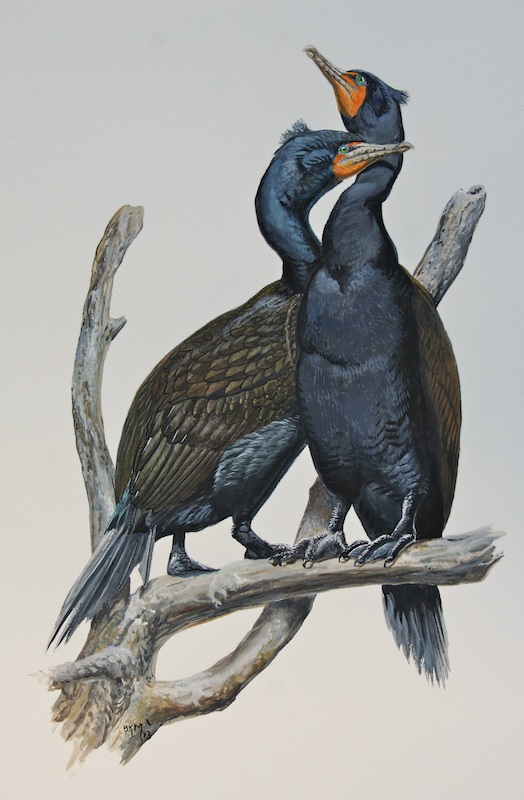
Painting Courtesy  Barry Kent MacKay

Painting Courtesy Barry Kent MacKay

Thursday, July 31, 2014 1:36 pm

A plan to kill 16,000 double-crested cormorants on East Sand Island has some residents on the North Coast scratching their heads.

Although still in the proposal phase, the plan drew many to an open house in Astoria last week to ask questions of the federal agencies involved.

“I can’t believe in this day and age we can’t come up with an alternative solution to killing things,” said Tommy Huntington of Cannon Beach.

The Alternative C plan is the preferred option of the U.S. Army Corps of Engineers to stem the ravenous consumption of juvenile salmon and steelhead each year. A final decision won’t be reached until after a public comment period and a review process are completed by the end of this year.

“I don’t want them to shoot the birds anymore than anyone else,” said Nancy Holmes of Seaside, explaining that she believes many people feel the same way.

The Army Corps released its plan to reduce the East Sand Island colony to 5,600 breeding pairs June 12. A public comment period has been extended to Aug. 19 after organizations advocated for more time. The federal agency, which manages hydropower dams and dredges the Columbia River, is required by the Endangered Species Act to come up with a management plan to control the burgeoning seabird population.

There were about 100 breeding pairs on the island in 1989, according to officials, but it has grown to 14,900 breeding pairs today. Dredge spoils were dumped there in the 1980s creating a perfectly flat and sandy location for the birds to nest.

The colony is estimated to have consumed about 11 million young salmon and steelhead annually over the past 15 years. Endangered and threatened wild stocks as well as hatchery fish are scooped up mostly in May by the seabirds as they head for the Pacific Ocean.

Since 1997 the Army Corps has done research on juvenile predation by the black birds. In 2008, they began to try out nonlethal methods to move nesting away from the mouth by hazing with lights, reducing nesting habitat and scaring them off. The available habitat is about 11 acres on the western portion of the island. In 2011, researchers began focusing on reducing that by putting in barrier fences and forcing birds from the nondesignated areas. They eventually restricted it to 4.4 acres, reducing 75 percent of prime nesting area. The federal agency even marked cormorants with satellite transmitters and banded hundreds of adults to provide information about where they moved during the restrictive period.

The Army Corps presented four options for reducing the colony to a size that would lessen the impact on endangered and threatened fish. A federal Biological Opinion of endangered Columbia River stocks requires the Army Corps to manage predation as one of three federal agencies that oversee hyrdoelectric dams on the river.

Alternative C was considered to be the best solution by the agency. The three other options did not include killing the cormorants, but forms of hazing and removal of nesting habitat.

“We feel it’s the one that gives us the most certainty of achieving the requirements that have been put upon us by the Biological Opinion,” said Joyce Casey, chief of the agency’s environmental resources branch in Portland. “It’s the most cost effective and it’s the one that has the best likelihood of not moving the problem somewhere else.”

The proposed plan includes land- and boat-based hazing and taking a limited amount of eggs, all with an “adaptive management” approach over four years. About 20 percent would be killed each year with 5,230 being taken the first year. The agency will have to file an annual depredation permit with the U.S. Fish and Wildlife Service for the “take levels.” The killing would take place on and off the island within the 15.5 mile foraging range around the island.

“It’s not a great plan,” said Holmes, adding that she’s at least glad that an adaptive management strategy is being used.

Huntington said he acknowledges the strong feelings that fishermen have about fish runs being consumed, but that the management plan shouldn’t have to be one or the other.

“You have to kill one to save the other one?” Huntington said. “It doesn’t make any sense.”

The federal agency also has to take into consideration the Caspian terns, brown pelicans and other birds on the island. The total number of nesting birds is about 60,000.

Casey said the preferred option also provides a balance because the agency wouldn’t have to eliminate all cormorant habitat on the island. With Alternative C, she said inundation of part of the nesting site will create habitat for shorebirds searching for food in the shallow water.

The Army Corps is also in the process of reducing habitat for Caspian terns on the island by about a third. The terns accounted for about 5.5 million juveniles consumed annually between 2000 and 2009.

URGENT CALL TO ACTION: Oppose the Planned Killing of 16,000 Cormorants Along the Columbia River

http://www.seashepherd.org/news-and-media/2014/07/07/call-to-action-oppose-the-planned-killing-of-16000-cormorants-along-the-columbia-river-1602

Cormorants are being targeted simply because they eat salmonCormorants are being targeted simply
because they eat salmon
Photo: Sea Shepherd
The U.S. Army Corps of Engineers has announced plans to shoot thousands of double-crested cormorants in the Columbia River Estuary beginning next year.

Much like California sea lions at the Columbia River, cormorants are being targeted simply because they eat salmon. Federal officials are claiming that these seabirds, protected under the Migratory Bird Treaty Act, eat too many juvenile salmon, as well as steelhead, as the fish migrate through the river estuary to the Pacific Ocean. The proposed cull program would claim the lives of 16,000 cormorants over the course of four years, with killing taking place during the birds’ nesting seasons. Oil will also be spread over cormorant eggs to suffocate the eggs and ensure that they do not hatch. While the Army Corps emphasizes the increase in the East Sand Island double-crested cormorant population in recent years, populations of these birds in general have been declining and the sustainability of this large-scale cull is questionable at best.

Sea Shepherd’s Dam Guardians were on the frontlines along the Columbia River and at the Bonneville Dam in 2012 and 2013, documenting the hazing, trapping and cruel branding of sea lions by the Oregon and Washington Departments of Fish & Wildlife for the “crime” of eating salmon. If any of the branded sea lions are determined to be eating “too many” salmon, they are killed – and the federal government has allowed these states to kill up to 92 federally protected sea lions each year until June 2016. It is important to note that “too many salmon” might constitute just one salmonid. The sea lion cull continues, despite the fact that they consume only 1-4% of the salmon, while fisheries are typically allowed to take 10-12%.

USDA bird hazer sets off explosives at the Bonneville Dam, May 2013USDA bird hazer sets off explosives at the
Bonneville Dam, May 2013
Photo: Sea Shepherd
The Army Corps reports that non-lethal methods – including “hazing with lights, reducing nesting habitat, and using human presence to flush double-crested cormorants off potential nesting sites” – have been tested. Sea Shepherd has documented bird hazers from the USDA harassing cormorants along the river, frightening the birds with explosives.

Just as the taxpayer-funded culling of sea lions at the Bonneville Dam will not solve the problem of a declining salmon population, nor will the shooting and killing of cormorants – set to cost up to $1.5 million each year of the four-year cull. The scapegoating of these innocent animals redirects the public’s focus from the real problems at the Columbia – overfishing, a polluted river filled with toxins, and the dam itself.

CALL TO ACTION: Though Sea Shepherd does not currently have Dam Guardians on the ground, we remain dedicated to protecting the animals who call the Columbia River home and exposing the true threats to this endangered salmon population. Please join us in speaking out against the planned killing of 16,000 cormorants for the “crime” of eating salmon. Here are ways you can help:

1) Attend one or both of the upcoming public meetings scheduled by the Army Corps of Engineers to discuss the proposed cull to show that you stand with the cormorants and the sea lions, as well as the salmon:

July 10 from 2:30pm to 5:30pm PT
Matt Dishman Community Center
77 N.E. Knott St.
Portland, Oregon

July 24 from 3pm to 6pm

Best Western Lincoln Inn
555 Hamburg Ave.
Astoria, Oregon

2) Submit public comments against the cull:

Email: Cormorant-EIS@usace.army.mil

Mail:

Sondra Ruckwardt
U.S. Army Corps of Engineers, Portland District
Attn: CENWP-PM-E / Double-creasted cormorant draft EIS
P.O. Box 2946
Portland, OR 97208-2946

The deadline for public comments is August 4, 2014.

First sea lions. Now cormorants. Where and when will it end?

Dam Guardians
Visit our
Dam Guardians
site for more information.

CALL TO ACTION: Oppose the Planned Killing of 16,000 Cormorants Along the Columbia River

http://www.seashepherd.org/news-and-media/2014/07/07/call-to-action-oppose-the-planned-killing-of-16000-cormorants-along-the-columbia-river-1602

Cormorants are being targeted simply because they eat salmonCormorants are being targeted simply
because they eat salmon
Photo: Sea Shepherd
The U.S. Army Corps of Engineers has announced plans to shoot thousands of double-crested cormorants in the Columbia River Estuary beginning next year.

Much like California sea lions at the Columbia River, cormorants are being targeted simply because they eat salmon. Federal officials are claiming that these seabirds, protected under the Migratory Bird Treaty Act, eat too many juvenile salmon, as well as steelhead, as the fish migrate through the river estuary to the Pacific Ocean. The proposed cull program would claim the lives of 16,000 cormorants over the course of four years, with killing taking place during the birds’ nesting seasons. Oil will also be spread over cormorant eggs to suffocate the eggs and ensure that they do not hatch. While the Army Corps emphasizes the increase in the East Sand Island double-crested cormorant population in recent years, populations of these birds in general have been declining and the sustainability of this large-scale cull is questionable at best.

Sea Shepherd’s Dam Guardians were on the frontlines along the Columbia River and at the Bonneville Dam in 2012 and 2013, documenting the hazing, trapping and cruel branding of sea lions by the Oregon and Washington Departments of Fish & Wildlife for the “crime” of eating salmon. If any of the branded sea lions are determined to be eating “too many” salmon, they are killed – and the federal government has allowed these states to kill up to 92 federally protected sea lions each year until June 2016. It is important to note that “too many salmon” might constitute just one salmonid. The sea lion cull continues, despite the fact that they consume only 1-4% of the salmon, while fisheries are typically allowed to take 10-12%.

USDA bird hazer sets off explosives at the Bonneville Dam, May 2013USDA bird hazer sets off explosives at the
Bonneville Dam, May 2013
Photo: Sea Shepherd
The Army Corps reports that non-lethal methods – including “hazing with lights, reducing nesting habitat, and using human presence to flush double-crested cormorants off potential nesting sites” – have been tested. Sea Shepherd has documented bird hazers from the USDA harassing cormorants along the river, frightening the birds with explosives.

Just as the taxpayer-funded culling of sea lions at the Bonneville Dam will not solve the problem of a declining salmon population, nor will the shooting and killing of cormorants – set to cost up to $1.5 million each year of the four-year cull. The scapegoating of these innocent animals redirects the public’s focus from the real problems at the Columbia – overfishing, a polluted river filled with toxins, and the dam itself.

CALL TO ACTION: Though Sea Shepherd does not currently have Dam Guardians on the ground, we remain dedicated to protecting the animals who call the Columbia River home and exposing the true threats to this endangered salmon population. Please join us in speaking out against the planned killing of 16,000 cormorants for the “crime” of eating salmon. Here are ways you can help:

1) Attend one or both of the upcoming public meetings scheduled by the Army Corps of Engineers to discuss the proposed cull to show that you stand with the cormorants and the sea lions, as well as the salmon:

July 10 from 2:30pm to 5:30pm PT
Matt Dishman Community Center
77 N.E. Knott St.
Portland, Oregon

July 24 from 3pm to 6pm

Best Western Lincoln Inn
555 Hamburg Ave.
Astoria, Oregon

2) Submit public comments against the cull:

Email: Cormorant-EIS@usace.army.mil

Mail:

Sondra Ruckwardt
U.S. Army Corps of Engineers, Portland District
Attn: CENWP-PM-E / Double-creasted cormorant draft EIS
P.O. Box 2946
Portland, OR 97208-2946

The deadline for public comments is August 4, 2014.

First sea lions. Now cormorants. Where and when will it end?

Dam Guardians
Visit our
Dam Guardians
site

Great News for Elk: Hunting Nixed in Ecola Creek reserve

Photo  Jim Robertson

Photo Jim Robertson

By Nancy McCarthy
The Daily Astorian

CANNON BEACH — Hunting will no longer be allowed in the Ecola Creek Forest Reserve.

The Cannon Beach City Council decided Tuesday night to discontinue hunting on the north side of the city-owned 1,040-acre parcel in the Ecola Creek Watershed. The vote was 4-1, with councilors Mike Benefield, George Vetter and Melissa Cadwallader and Mayor Mike Morgan supporting a motion to ban hunting. Wendy Higgins, who said the council should fulfill its commitment to allow hunting for five years, opposed the motion.

Although the council had agreed in 2012 to allow bowhunting, and in 2013 to allow shotgun hunting in the reserve for five years, several councilors said they wanted to reconsider the decision. They pointed out that only five hunters – none of them Cannon Beach residents – had hunted in the area in the past two years.

“I did vote for the bond measure (providing $4 million for the Ecola reserve); I like to hike; I’m not a hunter, although I don’t have opposition to people who are hunters; and I definitely agree that hunting does not fit the definition of passive recreation,” said Councilor Mike Benefield.

Noting that a majority of those responding to a survey conducted when the reserve was initially proposed said they didn’t want hunting and wanted to allow only “passive recreation” in the area, Benefield called the idea of hunting “intimidating.” Benefield, who was appointed to the council to fill a vacancy several months ago, didn’t originally vote to allow hunting.

“I think the City Council made a mistake allowing hunting on the property, and I will vote to eliminate it,” Benefield said.

Morgan called it a “contentious issue” in the community.

“I think it’s barely worth the effort,” said Mayor Mike Morgan. “I think it’s time to end it.

“We’ve had only five hunters,” he added. “For all the angst and anxiety this has caused in this community, I don’t think it’s worth it.”

Those in the audience who supported hunting said they would have hunted in the reserve, but they weren’t able to acquire a tag from the Oregon Department and Fish and Wildlife, which issues tags on a lottery basis. However, the tags aren’t specifically for the Ecola Reserve but for all 800 square miles of the Saddle Mountain Unit, where hunting is allowed.

They also said the fee the city charged was a deterrent. The city charged $200 for a hunting permit during the first year and $50 last year.

“Why are you discussing this today when you agreed hunting would be allowed for five years?” asked Troy Laws, a hunter from Seaside. “It’s a matter of integrity.”

Despite hikers’ fears of potential harm when hunters are in the reserve, no problems have occurred so far, said Herman Bierdebeck, ODFW wildlife biologist. Bierdebeck said land where hunting has been allowed for generations – including the Ecola Forest Reserve before the city acquired it from the state Department of Forestry – is increasingly being removed from hunters’ access.

“You can continue this experiment,” he told the council. “There haven’t been any problems that we’re aware of, so why not let it continue?

Councilor Melissa Cadwallader, who opposed hunting in the reserve when the council originally approved it, noted that the reserve was a “very small piece of land” in the Saddle Mountain Unit. She pointed out that the city-approved management plan for the reserve provides for “adaptive management” that allows policy adjustments for the reserve’s management if changes occur.

“The surveys are not in favor of hunting, and the bond measure approving the creation of the reserve calls for passive recreation,” Cadwallader said. “I thought we had defined it.”

Although Councilor George Vetter suggested that the council consider adding a “sunset” clause allowing hunting for another year, no motion was made, and it wasn’t considered.

Wolf pups confirmed in Oregon Cascades for first time since 1940s

 
By Mark Furman Published: Jun 4, 2014 at 9:38 AM PDT Last Updated: Jun 4, 2014 at 12:15 PM PDT
Two of wolf OR-7’s pups peek out from a log on the Rogue River-Siskiyou National Forest, June 2, 2014. Photo courtesy of U.S. Fish and Wildlife Service
Related Content


EUGENE, Ore. – Biologists confirmed that Oregon’s wandering wolf is a proud papa.

OR-7 and his mate have produced offspring in southwestern Oregon, the first pups confirmed born in the Oregon Cascades since the 1940s.

“This is very exciting news,” said Paul Henson, state supervisor of the Oregon U.S. Fish and Wildlife Service Office.  “It continues to illustrate that gray wolves are being recovered.”

Rep. Peter DeFazio cheered the discovery but vowed to oppose removing the wolf form the Endangered Species List.
“This is great news, but the critical federal protections that have allowed OR-7 to start his new pack are in jeopardy,” DeFazio, D-Oregon, said. “As we celebrate OR-7 and his new family, the U.S. Fish and Wildlife Service is threatening to disregard science and take the gray wolf off the Endangered Species list. If the Service delists the gray wolf, states could declare open season on gray wolves like OR-7, his mate, and these new pups. For over a year, I have fought to keep these critical federal protections for gray wolves and will continue to do so until Fish and Wildlife Service makes their final decision later this year.”

Biologists theorized last month that OR-7 had found a mate after spotting a female in the same vicinity. 

GPS data from a collar on OR-7 also showed that the wandering wolf, which had walked from Northeastern Oregon to California and back into Southern Oregon over the last few years, had stuck around the same area of the southern Oregon Cascades, suggesting a possible den and offspring.

OR-7’s territory includes eastern Douglas County south to the California border.

On June 2, biologists observed and photographed 2 pups. They suspect there could be as many as 4 or 6 pups, based on typical wolf litters.

Wolves in Oregon are protected by the state Endangered Species Act.  Wolves west of Oregon Highways 395, 78 and 95 are also protected by the federal Endangered Species Act. 

At the end of 2013, there were 64 known wolves in Oregon.  

Most known wolves are in the northeast corner of the state. 

OR-7 was born in April 2009 in northeastern Oregon in the area around the Imnaha River.

Oregon Department of Fish and Wildlife collared him with a GPS tracker in February 2011, allowing biologists to observe his movements.

He left the pack in September 2011 and walked across Oregon and into California on Dec. 28, 2011, the first known wolf in that state since 1924.  

Since March 2013, OR-7 has spent the majority of its time in the southwest Cascades in the Cascades south of Crater Lake.  

Wolf OR7 may have found a mate

May 12, 2014

PORTLAND, Ore.— OR7, a wolf originally from northeast Oregon, may have found a mate in southwest Oregon’s Cascade Mountains.

In early May, remote cameras on the Rogue River-Siskiyou National Forest captured several images of what appears to be a black female wolf in the same area where OR7 is currently located. The images were found by wildlife biologists when they checked cameras on May 7.

The remote cameras were set up by U.S. Fish and Wildlife Service (Service) and Oregon Department of Fish and Wildlife (ODFW) as part of ongoing cooperative wolf monitoring efforts.  New images of OR7 were also captured on the same cameras and can be accessed and viewed at ODFW’s wolf photo gallery (see first three images).

“This information is not definitive, but it is likely that this new wolf and OR7 have paired up.  More localized GPS collar data from OR7 is an indicator that they may have denned,” said John Stephenson, Service wolf biologist. “If that is correct, they would be rearing pups at this time of year.”

The Service and ODFW probably won’t be able to confirm the presence of pups until June or later, the earliest pup surveys are conducted, so as not to disturb them at such a young age.  Wolf pups are generally born in mid-April, so any pups would be less than a month old at this time.

If confirmed, the pups would mark the first known wolf breeding in the Oregon Cascades since the early 20th century.

Wolf OR7 is already well-known due to his long trek and his search for a mate—normal behavior for a wolf, which will leave a pack to look for new territory and for a chance to mate.  “This latest development is another twist in OR7’s interesting story,” said Russ Morgan, ODFW wolf coordinator.

The Service and ODFW will continue to monitor the area to gather additional information on the pair and possible pups. That monitoring will include the use of remote cameras, DNA sample collection from scats found, and pup surveys when appropriate.

Wolves throughout Oregon are protected by the state Endangered Species Act.  Wolves west of Oregon Highways 395-78-95, including OR7 and the female wolf, are also protected by the federal Endangered Species Act, with the Service as the lead management agency.

At the end of last year, there were 64 known wolves in Oregon.  Except for OR7, most known wolves are in the northeast corner of the state.

About OR7

OR7 was born into northeast Oregon’s Imnaha wolf pack in April 2009 and collared by ODFW on Feb. 25, 2011.  He left the pack in September 2011, travelled across Oregon and into California on Dec. 28, 2011, becoming the first known wolf in that state since 1924.

Other wolves have travelled further, and other uncollared wolves may have made it to California.  But OR7’s GPS collar, which transmits his location data several times a day, enabled wildlife managers to track him closely.

Since March 2013, OR7 has spent the majority of his time in the southwest Cascades in an area mapped on ODFW’s website.

###

Contact:

Department of the Interior
U.S. Fish and Wildlife Service, Oregon Fish & Wildlife Office
2600 SE 98th Avenue, Suite 100, Portland, Oregon  97266
Contact: Elizabeth Materna, Phone: 503-231-6179 Fax: 503-231-6195
http://www.fws.gov/oregonfwo/

Oregon Department of Fish and Wildlife
Michelle Dennehy
Michelle.N.Dennehy@state.or.us
Tel. (503) 947-6022

http://www.dfw.state.or.us/news/2014/may/051214.asp

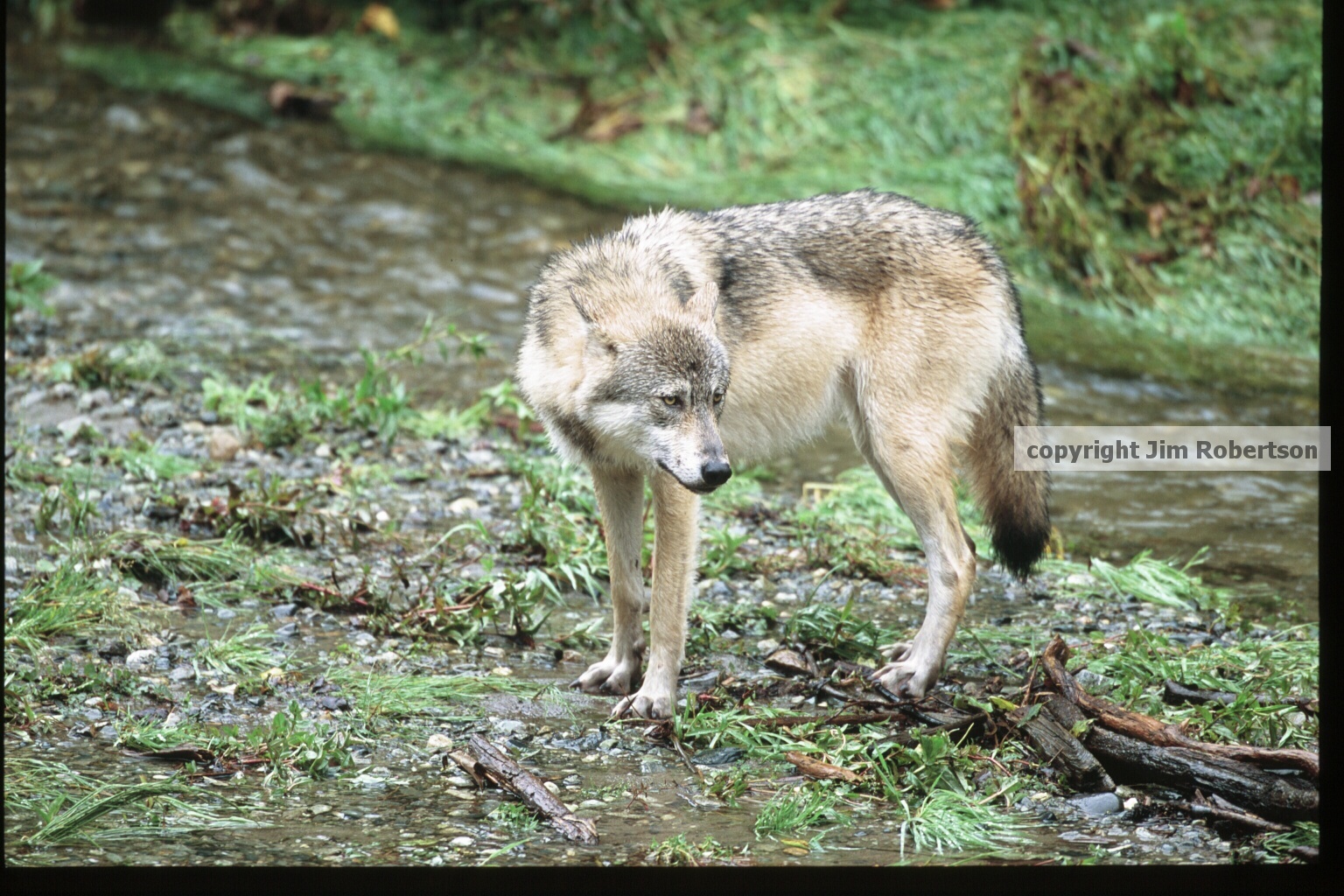
copyrighted wolf in river

Something Serious to Protest

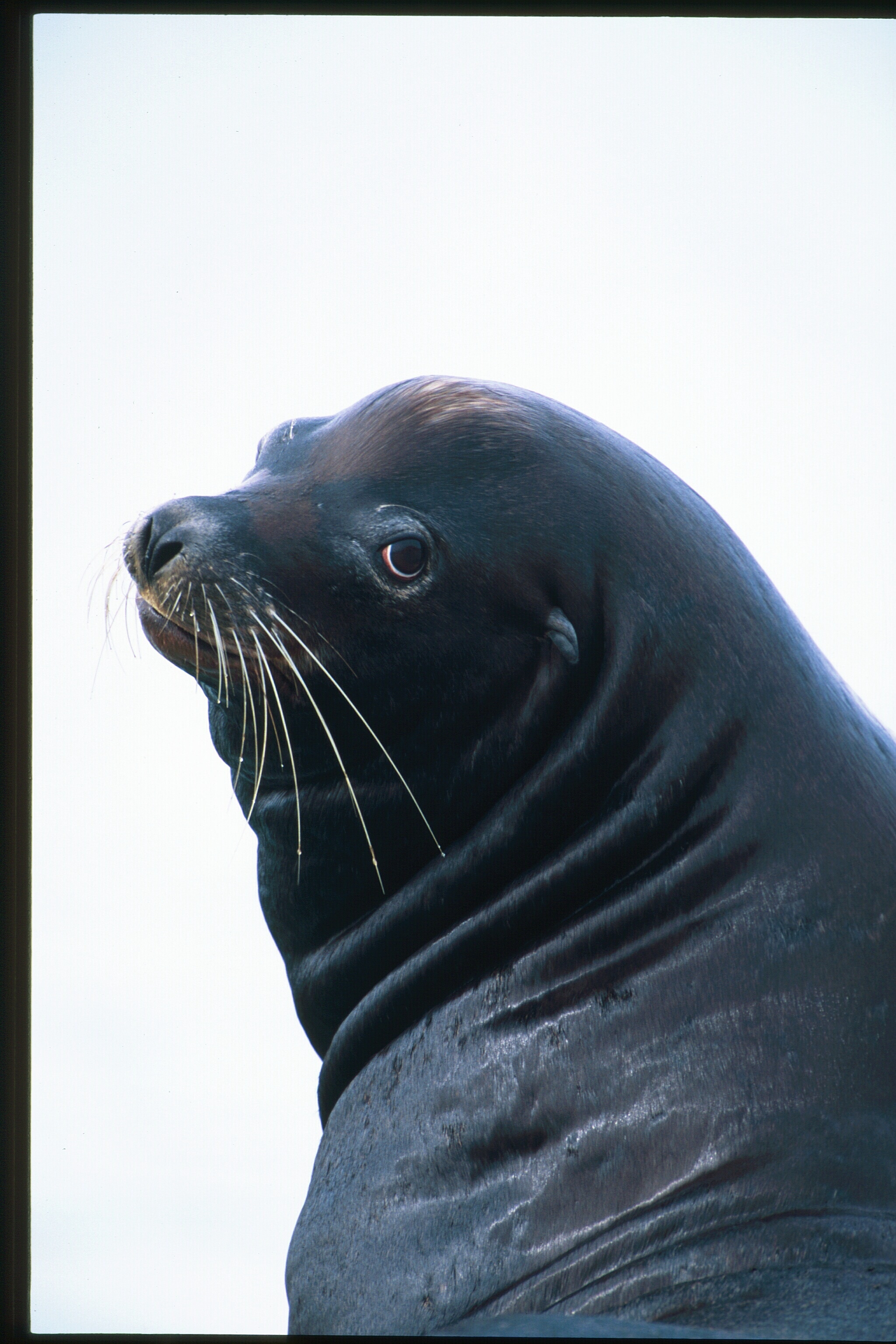
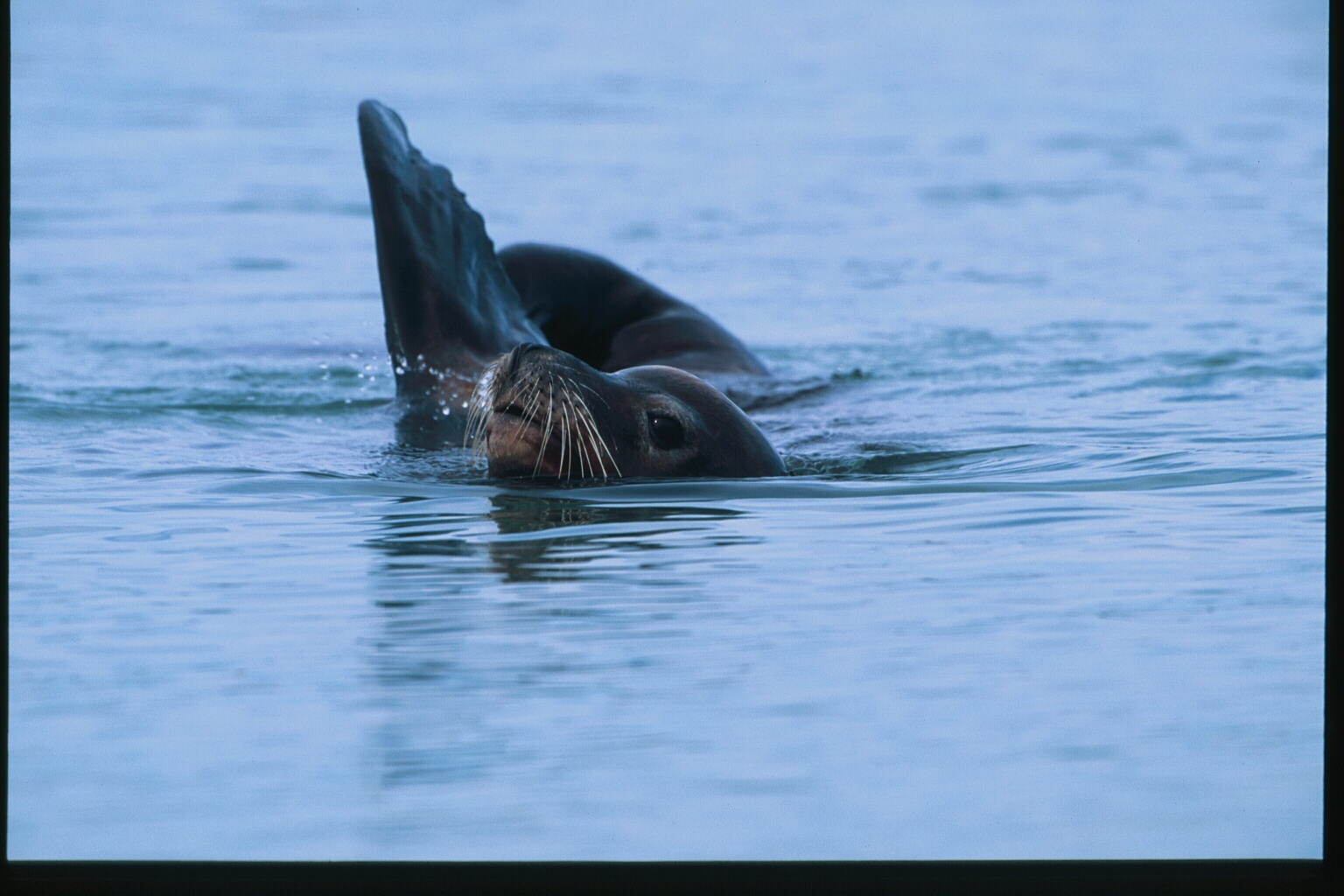
On Friday, May 4, my wife and I stopped at the East Moring Basin on the Columbia River in Astoria, Oregon, to see the sea lions who spend the daytime hours hauled out on one of the floating docks there. It’s always a treat to watch their antics and to hear the raucous roaring of competitive bulls mouthing off to anyone who might try to wriggle in and crowd their personal space. As expected we heard bellowing as soon as we arrived, but this time the sea lions had something serious to protest: an unfortunate herd-mate had been trapped and was being held down tightly and tormented by a group of strange and menacing two-leggers wearing orange raingear, one of whom pulled out a hot iron and repeatedly branded the restrained sea lion. As the victim struggled, acrid smoke from his burning flesh drifted for a hundred yards across the harbor.

The searing pain of the branding may have been temporary, but now the sea lion is branded in the figurative sense of the word as well, and his troubles are just beginning. With the numbers viciously burned onto the animal’s back, the Oregon Department of Fish and Wildlife thus has a clever way to recognize him. Later, they will decide whether or not to add him to their annual hit list of 92 sea lions they plan to kill if they reach the man-made dam that impedes the ancient migration route of spawning salmon.

It speaks volumes about the trusting nature of sea lions that they are willing to return to Astoria year after year. Since its establishment in 1811 as a hub for the booming, bloody fur trade, Astoria has been the scene of countless crimes against marine animals, including sea lions, who were killed along the Oregon coast by the thousands—exclusively for lamp oil.

Image

Charles M. Scammon—whaler, sealer, mariner and infamous discoverer and exploiter of the gray whale birthing lagoons in Baja California—devoted a chapter to sea lions in his book, The Marine Mammals of the Northwestern Coast of North America: Together with an account of the American Whale-Fishery. He begins that chapter with the lines, “Among the numerous species of marine mammalia found upon the Pacific coast of North America, none excite more interest than the sea lion;” Scammon goes on to describe an average day in the life of the pitiless sealers, and the last day ever for a group of sea lions. “On the south coast of Santa Barbara Island was a plateau, elevated less than a hundred feet above the sea, stretching to the brink of a cliff that overhung the shore, and a narrow gorge leading up from the beach, through which the animals crawled to their favorite resting-place. Several unsuccessful attempts had been made to take them; but, at last, a fresh breeze commenced blowing directly from the shore, and prevented their scenting the hunters, who landed some distance from the rookery, then cautiously advanced, and suddenly, yelling and flourishing muskets, clubs, and lances, rushed up within a few yards of them, while the pleading creatures, with lolling tongues and glaring eyes, were quite overcome with dismay, and remained nearly motionless. At last, two overgrown males broke through the line formed by the men, but they paid the penalty with their lives before reaching the water. A few moments passed, when all hands moved slowly toward the rookery, which had slowly retreated. This maneuver is called “turning them” and, when once accomplished, the disheartened creatures appear to abandon all hope of escape, and resign themselves to their fate. The herd at that time numbered 75, which were soon dispatched by shooting the largest ones, and clubbing and lancing the others, save for one young sea lion, which they spared to ascertain whether it would make any resistance by being driven over the hills beyond. The poor creature only moved along through the prickly pears that covered the ground, when compelled by his cruel pursuers; and, at last, with an imploring look and writhing in pain, it held out its fin-like arms, which were pierced with thorns, in such a manner as to touch the sympathy of the barbarous sealers who put the sufferer out of its misery with the stroke of a heavy club.”

Scammon ends his chapter with the prediction that the Pacific Coast sea lions “…will soon be exterminated by the deadly shot of the rifle, or driven away to less accessible haunts.” Today the few sea lions who have managed to hold on are again under attack, this time for the crime of daring to survive despite industrial scale over-fishing depleting their only food source.

No More Mr. Nice Guy

I sent this letter to the editor to the Daily Astorian, over a week ago, a few days before the seal was run over on a nearby beach, but they don’t seem inclined to print it  I guess I shouldn’t have taken the nice guy approach. To tell the truth, I don’t care if their tourist trade goes under, the town dries up and blows away for good…

Dear Editor,

It seems there are a lot of reasons people can dream up to hate the wildlife their area is blessed with—especially if they already have their minds made up to be intolerant. Lately we’ve been reading a lot in the news about the sea lions in Astoria and the elk in Gearhart. If residents there would decide to accept their animal neighbors, they would find that the draw of watchable wildlife is worth any perceived problems that might come from having a few animals around.

Here’s part of a comment I read from a fellow wildlife photographer about the sea lions: “We talked to several people in nearby shops who expressed such hatred for the animals and spewed such misinformation, I swore I’d never return to Astoria. I realize not everyone who lives there shares these sentiments, but you’d think the citizens would understand (or care) what a wretched image this creates for their town.”

But there have been signs of tolerance recently in this paper, on both the sea lion and elk fronts. The article “Sea lion sanctuary a proven possibility” informs us that a haul out built specifically for sea lions would benefit both the animals and the town’s tourist trade. Meanwhile, in the poll “Elk: Love them or let them leave?” the most popular solution by far was simply, “better signage.” Clearly, in cases, the old adage, “live and let live” is in the best interest for all and is the right thing to do.

littleboyc09


500 Sport Fishermen At Bonneville Dam, Only 38 Sea Lions

From Sea Lion Defense Brigade:
Bonneville Dam – The Army Corps of Engineers reports they have viewed 38 California Sea Lions in the area. Today there are an estimated 500 fishermen on the surrounding banks.

It is obvious which species is overfishing. Yet, scapegoating continues and fishermen are actively hazing Sea Lions by throwing large rocks at their heads! While documenting this cruelty, 2 SLDB female observers were threatened with bodily harm.

There is no government agency checking fishing licenses or regulating catch limits today. The Oregon Department of Fish and Wildlife can employee 6 workers to brand and KILL Sea Lions with tax payers money but can’t check fishing limits?!

Humans have many food options, Sea Lions do not!

Until the states of Washington and Oregon take responsibility for the real causes of the salmon decline and stop politically scapegoating Sea Lions, BOYCOTT COLUMBIA RIVER SALMON! See More

Photo: Bonneville Dam - The Army Corps of Engineers reports they have viewed 38 California Sea Lions in the area. Today there are an estimated 500 fishermen on the surrounding banks.

It is obvious which species is overfishing. Yet, scapegoating continues and fishermen are actively hazing Sea Lions by throwing large rocks at their heads! While documenting this cruelty, 2 SLDB female observers were threatened with bodily harm.

There is no government agency checking fishing licenses or regulating catch limits today. The Oregon Department of Fish and Wildlife can employee 6 workers to brand and KILL Sea Lions with tax payers money but can't check fishing limits?! 

Humans have many food options, Sea Lions do not! 

Until the states of Washington and Oregon take responsibility for the real causes of the salmon decline and stop politically scapegoating Sea Lions, BOYCOTT COLUMBIA RIVER SALMON!