Exposing the Big Game

Forget Hunters' Feeble Rationalizations and Trust Your Gut Feelings: Making Sport of Killing Is Not Healthy Human Behavior

Exposing the Big Game

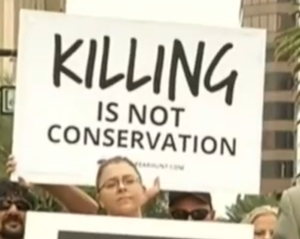
Take Action to Save Oregon Cougars from Hound Hunting

Screen Shot 2015-09-28 at 3.17.20 PM

http://mountainlion.org/ActionAlerts/020217ORfourbills/020217ORfourbills.asp?utm_source=Action+Alert+OR+Hounding+Bills+02-2017&utm_campaign=Action+Alert+9%2F29%2F2015+SD+lower&utm_medium=email

Oregon has introduced four threatening bills that not only promote cruel and unethical hunting methods, they strike at the very heart of the democratic process. Send a message to your Oregon state representative and state senator urging them to oppose bills H.B.2107, H.B.2589, S.B.371 and S.B.458.


      • H.B. 2107, H.B. 2589 and S.B. 371: These three bills would allow counties to opt out of Measure 18 via a county-wide vote. Measure 18 is a statewide law banning use of hounds to trophy hunt cougars and was passed by a wide majority of voters throughout Oregon in 1994. These bills would set a dangerous precedent.
      • H.B. 458: Perhaps the most frightening bill, would mandate the Oregon Fish and Wildlife Department to set up a controlled hound hunting program for cougars, bypassing the citizen majority who has repeatedly said no to the sport hunting of cougars with hounds.


Hound hunting allows a pack of dogs to run down a cougar until the animal is cornered in a tree or on a rock ledge. The hounds are GPS radio-collared and send a signal to the hounder when they have ‘treed’ an animal and the hounder is then able to shoot the exhausted and terrified cougar at point blank range. There is no fair chase and many hunters don’t approve of the use of hounds for sport hunting.


    Letters from Oregon residents will be sent forward via US mail to your legislator. Letters sent from outside of Oregon will be held and sent to the Governor and other decision makers if necessary.
    1. IF YOU LIVE IN OREGON YOUR OPINION IS CRUCIAL.

      Send an electronic letter above and we will forward a paper copy to your representative and send a copy to the Governor of Oregon

http://mountainlion.org/ActionAlerts/020217ORfourbills/020217ORfourbills.asp?utm_source=Action+Alert+OR+Hounding+Bills+02-2017&utm_campaign=Action+Alert+9%2F29%2F2015+SD+lower&utm_medium=email

Please be sure to use your own voice and experiences when adding your comments and feel free to use and expand on the talking points below:

      • These bills would undo Measure 18, the statewide initiative that passed in 1994 by a majority vote to ban cougar trophy hunting with hounds.
      • The passage of these bills would give counties authority to override state law and set a dangerous precedent by rendering majority votes on statewide ballot measure initiatives meaningless.
      • These bills would put Oregon’s cougar population and other wildlife in grave danger from indiscriminate chase by hounds.
      • Hounders should know where their hounds are at all times because of the radio collars they wear, but hounds can range miles from hounders, crossing private land and attacking, injuring and killing non-target game and even pets.
      • Dependent cougar kittens fall victim to hound packs as well, as they are attacked and killed during the chase.
      • Hounds are injured and killed on the hunt as they face large male lions and mother lions who are trying to protect their kittens.
      • Hunting with hounds is not fair chase and many ethical hunters do not approve of hounding.
      • Cougars are ‘treed’ by hounds and must wait with no escape until the hunter arrives to shoot and kill the terrified and exhausted animal at close range.


    1. NO MATTER WHERE YOU LIVE, YOU CAN STILL SEND A LETTER.

      If you live outside of Oregon we will forward a paper copy of your letter to the Governor of Oregon. Let’s let them know that MOUNTAIN LIONS SHOULD NOT BE HUNTED BY DOGS!


    1. You can SIGN UP FOR EMAIL NOTIFICATIONS for these four bills at: https://olis.leg.state.or.us/liz/2017R1/Measures/list/ by searching for the bill numbers, clicking on them and signing up in the upper right screen for “e-subscribe Email”. You will be notified of legislative actions and hearings on the bills you subscribe to.


Brutal Northwest winter has been horrific for wild animals

Antelope injured while falling on ice. Horses stranded in snowy mountains. Cougars descending from their wilderness lairs to forage in a town.

It’s been a beastly winter in the American West, not just for people but for animals too. One storm after another has buried much of the region in snow, and temperatures have often stayed below freezing, endangering a rich diversity of wild animals.

In southern Idaho, about 500 pronghorn antelope tried to cross the frozen Snake River earlier this month at Lake Walcott, but part of the herd spooked and ran onto a slick spot where they slipped and fell. Idaho Fish and Game workers rescued six of the stranded pronghorn, but 10 were killed by coyotes and 20 had to be euthanized because of injuries suffered when they fell down.

Another 50 pronghorn were found dead in the small western Idaho city of Payette after they nibbled on Japanese yew, a landscaping shrub that’s toxic. Tough winter conditions have forced some wildlife to feed on the plant in urban areas.

Heavy snow has forced Idaho’s fish and game department to begin emergency feeding of big game animals in southern Idaho.

In eastern Oregon, state wildlife officials are feeding elk, but the weather makes accessing them difficult. When highways and the Interstate are closed because of the snow, the workers must still get to the rural feeding stations where they feed the elk alfalfa hay.

“When you run feed programs, you can’t take a day off because of bad weather. If you take a day off, the elk wander away,” said Nick Myatt, district manager of La Grande office of the Oregon Department of Fish and Wildlife.

Wandering elk tend to feed on haystacks that ranchers have left for their cattle, and congregate in low-elevation sites along Interstate 84 in northeastern Oregon, where cars have hit them in recent weeks, Myatt said.

In western Wyoming, supplemental feeding of elk wintering on the National Elk Refuge near Jackson started the first week of January, three weeks earlier than usual because heavier than normal snowfall buried the natural forage the thousands of elk graze on at the 24,700-acre refuge.

Mule deer, which are smaller than elk, have not only been prevented by a layer of ice from pawing through powdery snow to reach their natural forage, but that ice also makes them easier prey. The deer break through the ice and stumble while animals like coyotes can stay on top of the surface.

“With conditions that we have, we do anticipate higher mule deer mortality,” Myatt said.

John Stephenson of the U.S. Fish and Wildlife Service said wolves are also more agile in deep snow than deer or elk because their lighter bodies and big feet help them stay on the surface better. Stephenson said he is amazed that a wolf he’s tracking south of Crater Lake, Oregon, traveled roughly 30 miles through 6-foot-deep snow in less than 12 hours recently.

Some animal lovers have been taking matters into their own hands by feeding deer, but experts warn they will likely do more harm than good and could end up killing the animals.

“What they’re feeding the deer is an improper diet,” said Rick Hargrave, a spokesman for the Oregon wildlife department. “They have a complex digestive tract, and they require the right mix of crude protein, fat, carbohydrates, vitamins and minerals.”

The deep snow likely caused a group of normally elusive cougars to come to the woodsy community of La Pine in recent days, where they preyed on pets and chickens, the Oregon wildlife department said. Authorities on Thursday killed a fifth cougar in the central Oregon town. Four others were shot dead on Saturday and Monday, raising an outcry among some conservationists.

Amid the grim news, there were some bright spots.

In central Idaho, volunteers earlier this month rescued a horse stranded on a snowy mountain by tranquilizing it, placing it in a sling and then attaching it on a long line to a helicopter. It was flown, dangling from the belly of the chopper to safety. A second stranded horse was not found and is believed to have died.

The experience was emotional for the rescuers.

“You get your adrenaline going and everyone gets all excited and choked up,” Robert Bruno, president of Idaho Horse Rescue, told KTVB-TV of Boise.

In California, some of the heaviest snow and rain in decades should prove a life-saver for threatened native salmon, whose numbers have dropped during the state’s five-year drought that is now easing.

Flooding this winter has greatly expanded the bug-rich wetlands where young salmon can eat and grow strong on their way to the ocean, said John McManus of the Golden Gate Salmon Association, a fishing-industry group.

“They eat like little pigs, and they love it,” McManus said. “It’s a little smorgasbord for them.”

___

AP journalists Rebecca Boone in Boise, Idaho, Bob Moen in Cheyenne, Wyoming, and Ellen Knickmeyer in San Francisco contributed to this report.

Why the Malheur verdict sets a dangerous example

http://www.hcn.org/articles/the-malheur-invasion-and-its-unfortunate-legacy?utm_source=wcn1&utm_medium=email

Lawyers “aimed too high” for a conspiracy charge—and lost it all.

Imagine running a business — say a bank or gas station — and every now and then a band of disgruntled customers barges in with guns, takes over your office and spouts nonsense about how you have no right to exist in the first place. How could you continue to conduct your business? How could you recruit new employees? How could you ensure the safety of your customers?

That is exactly the kinds of questions that leaders of our land management agencies — the folks who take care of our national parks, forests and wildlife refuges — now must face.

Because that is exactly what six men and one woman got away with at the Malheur National Wildlife Refuge in rural Oregon. Under the guidance of the Bundy family of Nevada, they took over the refuge headquarters last January, claiming that it was illegitimate, and causing havoc for employees and the local residents for 41 days. One militant was killed in a confrontation with police. After a tense, negotiated end to the standoff, seven militants were charged with federal conspiracy and weapons charges.

damage-jpg
Discarded camping equipment, trash and a car were among the litter and damage left at the Malheur National Wildlife Refuge headquarters after the occupiers left.
U.S. Fish & Wildlife Service

Now, 10 months later, an Oregon jury has acquitted them. By choosing the more difficult path of proving conspiracy rather than criminal trespass or some lesser charge, the government lawyers aimed too high and lost it all. The verdicts stunned even the defense attorneys.*

Without second-guessing the jury, it’s clear that the repercussions of this case will play out for years to come. But I fear that the greatest and most lasting damage caused by the thugs who took over Malheur will prove to be the way they vandalized something essential to every functioning society: Trust. If America doesn’t get its act together, this verdict may prove to be the beginning of the end of one of our greatest experiments in democracy: our public lands.

Make no mistake. There are plenty of people who would like to shoot Smokey Bear, stuff him and relegate him to some mothballed museum. The Bundy brothers who spearheaded the Oregon standoff insist that the federal government is not allowed to control any land beyond Washington, D.C., and military bases. They simply hate the idea of Yellowstone National Park and consider any other national nature reserve unconstitutional.

The Bundys’ Oregon acquittal doesn’t make their absurd reading of the Constitution any more viable. But it does embolden those who share their misguided fervor in the political sphere. Don’t take my word for it; consider the words of elation uttered by those who supported the Bundys. Montana state Rep. Theresa Manzella, R-Darby, responded to the news with a Facebook post that read: “BEST NEWS IN A LONG TIME!!! Doin’ a happy dance! Didn’t expect the verdict today!!! Hurray!”

She elaborated to a newspaper reporter: “I think it will be very empowering. It indicates that American citizens are waking up and we don’t want to be kept under the thumb of the federal government.”

The mood at the Bundy family ranch in Nevada was also jubilant: “We are partying it up,” Arden Bundy told another reporter. “This is a big step, not just up there, but for the people down here in Nevada. Knowing that they let them go scot-free, it’s going to … be a big influence on the people down here.”

The bullies who want to rule the playground just got a pat on the head by the principal and were sent back outside to play the same old game. Managing public lands is a messy, difficult and often thankless job. But in no way do these public servants deserve the kind of verbal abuse and physical intimidation reflected at Malheur. I am thankful for these hard-working people, and I marvel at how they remain true to their mission despite taking constant verbal jabs from all sides.

They deserve better. This issue reflects some larger illness in the American psyche. We have replaced civil discourse with kneejerk tribalism.

It’s much harder to restore trust than to lose it. But all of us who appreciate public lands — whether we want to log a particular place or preserve it, whether we want to hunt or watch birds, whether we enjoy riding motorcycles or horses or just walking around — need to be together on one thing. We can disagree on how we manage our lands, but we need to do so with respect. We all deserve to be heard, but we also need to listen. What happened at the Malheur National Wildlife Preserve wasn’t a revolution, it was mob rule, and it’s unfortunate for all of us that a jury failed to understand that.

*This story was updated to correct an error about the possibility of appeal. It’s the prosecutors who might have wanted to appeal, not the defense. In federal cases, such as this, government prosecution cannot appeal. 

Juror: Acquittal was not endorsement of Oregon occupiers

http://www.msn.com/en-us/news/us/juror-acquittal-was-not-endorsement-of-oregon-occupiers/ar-AAjuNGT?li=AA4ZnC&ocid=spartandhp

Associated Press

By ANDREW SELSKY, Associated Press1 hr ago
 
FILE - In this Jan. 22, 2016, file photo, Ammon Bundy, right, shakes hand with a federal agent guarding the gate at the Burns Municipal Airport in Burns, Ore. The stunning acquittal of seven people who occupied a federal bird refuge in Oregon as part of a Western land dispute was a rejection of the prosecution’s conspiracy case, not an endorsement of the armed protest, a juror said Friday, Oct. 28, 2016. (AP Photo/Keith Ridler, File).© The Associated Press FILE – In this Jan. 22, 2016, file photo, Ammon Bundy, right, shakes hand with a federal agent guarding the gate at the Burns Municipal Airport in Burns, Ore. The stunning acquittal… PORTLAND, Ore. — The stunning acquittal of seven people who occupied a federal wildlife sanctuary in Oregon was a rejection of the prosecution’s conspiracy case, not an endorsement of the defendants’ actions in the armed protest, a juror said Friday.

But sympathizers who believe such resistance to the government is justified could feel emboldened by the verdict, which might invite more confrontations in a long-running dispute over Western lands.

Worried that Thursday’s verdict could lead to more land takeovers, Interior Secretary Sally Jewell on Friday urged all government employees to “remain vigilant and report any suspicious activity.” In a statement, she said she was “profoundly disappointed” in the jury’s decision.

William C. Fisher, an activist from Boise, Idaho, who once camped by a memorial to occupier LaVoy Finicum at the site where he was shot dead by police, predicted that the verdict would encourage others to act.

“I think a lot more people will be revolting, rebelling and standing up against what we see as a tyrannical government,” Fisher said in a telephone interview.

The 41-day takeover of the Malheur National Wildlife Refuge last January in remote eastern Oregon was part of a larger debate about the use of federal lands in the West. The militants led by Ammon Bundy, a small business owner from Arizona, wanted to hand the refuge over to local officials, saying the federal government should not have dominion over it.

The U.S. government owns nearly half of all land in the West, compared with only 4 percent in the other states, according to the Congressional Overview of Federal Land Ownership.

One of the jurors in the case asserted Friday that the panel was not endorsing militancy to resolve those issues.

The juror, identified only as Juror No. 4, wrote in an email to The Oregonian/OregonLive that the verdicts were a “statement” about the prosecution’s failure to prove a conspiracy charge “and not any form of affirmation of the defense’s various beliefs, actions or aspirations.”

Bundy, his brother Ryan Bundy and five others were charged with conspiring to impede federal workers from their jobs at the refuge.

One of the jurors questioned whether criminal trespassing charges could have been filed instead. But Laurie Levenson, a professor at Loyola Law School in Los Angeles and a former federal prosecutor, said trespassing is only a misdemeanor and prosecutors wanted felony convictions.

They had few other options to seek serious charges because the defendants never attacked anyone, Levenson said.

Rather than attempting to retake the land and risking a gunbattle, authorities took a cautious approach. They closed nearby roads and stayed miles away while urging the occupiers to abandon the land.

“This may be a case of no good deed goes unpunished,” Levenson said. “The upside of not confronting them was it was less likely there would be violence. The downside was it was less likely that they could use the assault charge.”

The standoff finally ended when the Bundys and other key figures were arrested in a Jan. 26 traffic stop outside the refuge. That’s when Finicum was killed. Most occupiers left after his death, but four holdouts remained until Feb. 11, when they surrendered following lengthy negotiations.

Bundy remains in jail because he still faces charges in Nevada stemming from an armed standoff at his father Cliven Bundy’s ranch two years ago.

Joel Hansen, Cliven Bundy’s attorney, said Friday that he thinks the jury in Oregon “saw through the lies of a government which is trying to prove these Bundy brothers and their compatriots were some kind of terrorists.”

In Hansen’s view and some others in the rural West, ownership of public land is a constitutional question that has not been settled.

“There is a seething anger among those who use the land because of the oppressive management of the land in the West,” Hansen said. “It’s the ranchers, the loggers, the miners, the Indians. It’s all part of tyrannical oppression. Their goal is to manage them out of business to get them off the land.”

The jury’s decision came on the same day that officers in riot gear evicted protesters from private land in the path of the Dakota Access oil pipeline in rural North Dakota. Authorities fired bean bags and pepper spray as they surrounded the camp of demonstrators, who have spent months embroiled in a dispute over Native American rights and the environmental effects of the project. At least 117 people were arrested.

The Oregon occupiers had chosen, perhaps inadvertently, a part of Oregon where locals and the feds had a recent history of working together. Few who live near the sanctuary welcomed the occupiers, most of whom were from out of state.

Not long before the takeover began on Jan. 2, locals and federal officials had determined the fate of large swaths of land, Harney County Judge Steve Grasty, the top local administrative official, said last summer in an interview.

The High Desert Partnership in Harney County, a group that includes the Bureau of Land Management, the Nature Conservancy and timber business owners, had been working quietly to determine land stewardship, which Jewell credited in her statement on Friday.

Surprise response from OFW on 3 wolf attacks on cattle

State officials have confirmed three recent wolf attacks against livestock in the Fort Klamath area resulting in two calves dead and one injured.

In a release published Monday, the Oregon Department of Fish and Wildlife (ODFW) said they confirmed three attacks took place last week on private land in the Wood River Valley.

The first two attacks were reported Wednesday by a cattle producer who discovered the calves among his herd.

According to the release, the first attack occurred Oct. 2 against an 800-pound calf, who was found dead the next day by a ranchhand who said he saw three wolves feeding on the carcass.

The second attack was on Oct. 4 and resulted in the death of a 600-pound calf.

The third attack took place Wednesday night against a 300-pound calf, which the rancher said he heard making noises of distress that evening consistent with a nearby threat. The calf was found Thursday morning with injuries with bite marks and scratches to all four legs.

While it is believed the Rogue Pack was the most likely cause of the depredation, as they are known to be in the area during this time of year, authorities said wolves in the pack are not equipped with radio collars and they cannot say for sure.

“There’s a chance it’s not (the Rogue Pack), but we believe it was,” said John Stephenson, wolf coordinator for the U.S. Fish and Wildlife Service.

Stephenson said his agency has been seeking opportunities to fit a member of the pack with a radio collar but has yet to do so. He said the opportunities still exists that an undocumented wolf or group of wolves in the area was responsible.

Stephenson said the plan at this time is to compose a conflict deterrence plan with non-lethal methods for avoiding conflicts with wolves. Despite the number of animals involved, Stephen said the attacks remain isolated incidents and there is no plan yet to reduce the number of wolves in the area.

“I think there’s a good chance to make it stop with nonlethal action,” said Stephenson.

Once completed, a copy of the plan will be available atwww.dfw.state.or.us/Wolves/wolf_livestock_updates.asp.

Wolf pack led by OR-7 suspected in three livestock attacks

Oregon’s famous wolf, OR-7, could be in hot water.

The wolf that captured international headlines for roaming into territory untouched by wolves for almost a century is now a suspect in multiple attacks on livestock in Southern Oregon.

Federal and state officials say the Rogue Pack, which OR-7 started with a mate in 2014, were likely involved in three depredations in Klamath County earlier this month.

The attacks killed two calves and injured another on Oct. 4 at a ranch in Wood River Valley, according to reports filed by the Oregon Department of Fish and Wildlife.

“It happened on the edge of the Rogue Pack’s territory, and it very well could have been them, but we’re not 100 percent sure yet,” said John Stephenson, the U.S. Fish and Wildlife Service’s Wolf Coordinator. “There has been some other wolf activity in that area. We’re working hard to deal with this situation and stop it from continuing.”

Reports from ODFW said evidence is “adequate to confirm the death(s) as wolf depredation” and that the “Rogue Pack is known to frequent this general area at this time of year.”

Wolves in Western Oregon, including the Rogue Pack, remain protected under the federal Endangered Species Act, meaning they won’t be killed as a result. Stephenson said he’s been setting up non-lethal deterrence at the ranch to prevent future attacks.

“We’re taking it very seriously, and hoping to nip this in the bud,” he said.


Poll: Most Oregonians Oppose Hunting of Wolves, Favor Nonlethal Conflict Prevention

http://www.biologicaldiversity.org/news/press_releases/2016/wolf-10-07-2016.html

PORTLAND, Ore.— A new poll conducted by Mason Dixon Polling and Research finds that the vast majority of Oregon voters — from both rural and urban areas — oppose using hunting as a management tool for wolves in the state and believe wildlife officials wrongly removed state protections from wolves. The poll also revealed that most Oregonians believe nonlethal methods should be the primary focus in reducing conflicts between wolves and livestock.

Details of the poll results include the following:

  • 72 percent oppose changing Oregon law to allow trophy hunting of wolves.
  • 67 percent oppose hunting wolves as a tool to maintain deer and elk populations.
  • 63 percent oppose Oregon’s removal last year of endangered species protections for wolves.
  • 67 percent said they don’t believe wolves pose an economic threat to the cattle industry that necessitates killing wolves.
  • 72 percent said nonlethal conflict prevention measures must be attempted before officials are allowed to kill wolves.

“It’s very encouraging — and far from surprising — that the survey indicates a broad majority of Oregonians believe we can, and should, find ways to coexist with wolves,” said Dr. Michael Paul Nelson, a professor at Oregon State University whose research focuses on ecosystems and society. “And it should be instructive to policymakers that these results demonstrate that people across the state — even in rural areas most affected by wolves — want our public policies on wolves to reflect the facts, not unsubstantiated rhetoric and opinions.”

The Oregon wolf conservation and management plan adopted by the state in 2005 is now belatedly undergoing a legally mandated five-year review. The Oregon Fish and Wildlife Commission is holding meetings, including one taking place today in La Grande and another on Dec. 2 in Salem, to accept public testimony on proposed updates to the plan. Conservation groups are calling for a revival of provisions that require clear, enforceable standards that helped reduce conflict from 2013 to 2015. The livestock industry and some in the hunting community are calling for policies that make it easier to kill wolves. In March Commission Chair Finley argued for allowing trophy hunts to fund conservation. Without revision the plan reduces protections for wolves, eliminates enforceable standards, and could allow hunting as soon as next year.

At the end of 2015, the Oregon Department of Fish and Wildlife confirmed an estimated 110 wolves in the state, ranging across 12 percent of habitat defined by that agency as currently suitable. Published science indicates that Oregon is capable of supporting up to 1,450 wolves. The tiny population of wolves that currently exists occupies only around 8 percent of the animals’ full historic range in the state. Last year the Oregon Fish and Wildlife Commission voted to strip wolves of protections under the state endangered species law, despite comments submitted by more than two dozen leading scientists highly critical of that decision. The commission’s decision is being challenged in court by Cascadia Wildlands, the Center for Biological Diversity and Oregon Wild.

“It is clear from the feedback and analysis the state received that there was no scientific basis for delisting wolves in Oregon,” said Nick Cady, legal director of Cascadia Wildlands and an attorney on the delisting case. “And to the extent that the state was responding to public wishes of Oregonians, this poll demonstrates that Oregonians did not support this premature delisting by the state.”

“Oregonians value wolves and feel that the state should be doing more to protect them, including resolving conflicts with livestock without resorting to guns and traps,” said Amaroq Weiss, West Coast wolf organizer at the Center for Biological Diversity. “With the state wolf plan review now underway, we hope the Fish and Wildlife Commission follows the science and refuses to make changes to the wolf plan based on fearmongering from those opposed to sharing our landscapes with wildlife.”

“Science shows that effective management of wolves does not involve hunting, and this poll clearly shows the people of Oregon stand with the science. We trust that any future management decisions made by the commission will represent the wishes of the people and current research,” said Danielle Moser of the Endangered Species Coalition.

“It’s clear from the poll that Oregonians are in favor of conservation, not deputizing hunters to kill more wolves,” said Arran Robertson, communications coordinator for Oregon Wild. “The idea that wolf-hunting is an appropriate tool to manage deer and elk populations is absurd. Rather than stooping to Oregon’s default policy of scapegoating and killing native wildlife, officials should focus on enforcing poaching laws and maintaining quality habitat.”

“Oregonians strongly support the recovery of wolves in our state,” said Quinn Read, Northwest representative for Defenders of Wildlife. “And they want to see common-sense management practices such as the use of nonlethal conflict prevention tools to allow wolves and people to share the landscape.”

“On behalf of the Pacific Wolf Coalition, we are pleased to hear from Oregonians,” said Lindsay Raber, coordinator for the Pacific Wolf Coalition. “This is an opportunity to learn from the public’s perspectives and values which will help inform and guide our continued efforts toward wolf recovery in the Pacific West states.”

The Pacific Wolf Coalition commissioned the poll, which was conducted by Mason-Dixon Polling & Research on 800 registered Oregon voters on Sept. 20-22, 2016. The margin of error is + or – 3.5 percent.

The mission of the Pacific Wolf Coalition is to optimize an alliance of organizations and individuals dedicated to protecting wolves in the Pacific West. Together we hold a common vision where wolves once again play a positive, meaningful, and sustainable role on the landscape and in our culture. For more information, visit www.pacificwolves.org

copyrighted wolf in water

Bowhunter Charged With Killing Fellow Hunter


LA PINE, OR — A Tillamook man faces charges after a fatal hunting accident near Paulina Lake.


The Deschutes County Sheriff’s Office says 52-year-old Michael Pekarek was bow hunting with 45-year-old Jeffrey Cummings, of Wood Village, Monday morning. Pekarek spotted a deer and was ready to fire when the animal moved. Investigators believe he turned to tell Cummings the deer was moving toward him when he released the arrow, shooting Cummings in the stomach.


Pekarek called 911 and performed CPR, but the victim was pronounced dead by first responders. Pekarek is charged with Criminally Negligent Homicide.

The new Malheur occupants: Grazing cattle

http://www.hcn.org/articles/grazing-cattle-the-new-malheur-occupants?utm_source=wcn1&utm_medium=email

The Bundy clan may be in jail, but ranchers continue to take advantage of the refuge.

Now that the focus has shifted to the upcoming trials of the outlaws who took over Oregon’s Malheur National Wildlife Refuge offices last January, we might recall that the actual, physical occupation lasted for a total of 41 days. In many ways, however, it never ended, and there is every reason to conclude that the occupiers won.

The refuge’s headquarters are still closed, federal cops guard the area, and no one answers the phone. At least six staff members have left, including the fisheries expert and the ecologist. They have not been replaced.

The refuge is drier now than I have ever seen it; the usually flooded ditches along Center Patrol Road are without waterfowl.  Only two ponds hold water and the birds that depend on it.

The Malheur Refuge website cautions prospective visitors: “Buildings and grounds are active work sites and are closed for safety reasons.”  When I found a refuge employee in a pickup on the side of the road, I asked him what “active work site” meant.  He smiled wryly and answered, “That answer would have to come from a higher pay grade.”

Cattle graze in Southeastern Oregon.
Angela Sitz/USFWS

I first visited the Malheur Wildlife Refuge in 1966, and I started teaching in the vicinity in 1973.  Virtually every Memorial Day weekend since then, I have gone birding on the headquarters grounds, along with other bird watchers from the Northwest birding community and beyond.  I teach a summer ornithology class now on nearby Steens Mountain, and every August I tour the refuge with my students.

But this year, we were not allowed in; in fact, a federal truck stood by the blockaded entrance to keep us out. Yet nearly a hundred days had gone by since the last occupier left, and the site had been safely visited by U.S. Fish and Wildlife Service Director Daniel M. Ashe and even Interior Secretary Sally Jewell.  Both hosted the press on the “active work sites,” and no problems were reported. Ashe said that the occupiers had done damage estimated at $6 million, and now the rumor is that this venerable and beautiful oasis — once a showplace visited regularly by Supreme Justice William O. Douglas — will undergo a fancy facelift.

That makes me fear that the old buildings, built by the Civilian Conservation Corps out of pink Dufurrena sandstone in the 1930s, might be sacrificed to some Washington, D.C. architect’s vision of modernity. I doubt that the occupiers, slovenly though they reportedly were, could have done that much damage.

Meanwhile, all is not quiet on this Western front. Some or all of the 13 ranchers with grazing privileges on the refuge were going full-bore when my students and I drove north along the refuge on Aug. 12.

Thousands of acres of the Blitzen Valley part of the refuge had been mowed. Three huge double-flatbed trailered semis passed us going south, ready to welcome on board the valuable hay bales. Ranchers apparently pay with “in kind services,” which in this case means that the hay is paid for by mowing, baling and hauling it off. Because the mowing is considered beneficial to wildlife, it is considered a “service’ to the refuge and to wildlife, so little or no cash changes hands.

So ubiquitous was the haying activity I saw that it is hard to believe that it had only been going on for two days. Aug. 10 is the first day any haying efforts are allowed, in part because that is the date that most, but not all, young sandhill cranes are believed to be out of danger of being baled, along with the hay.  A young crane, faced with an advancing piece of machinery, will crouch down instead of fleeing, and thus get macerated by a combine.

The first of the thousands of cattle that will graze there for the better part of nine months were visible, but I was concerned with some trespass livestock I had seen on Aug. 5, about a mile south of headquarters.  I find trespassing cattle almost every year — there were cowpies last year right in front of refuge headquarters — but this year I was unable to report them, because nobody seems to be at work.

And so the occupation continues, even though most of the occupiers are safely tucked away in jail cells.  The headquarters compound may be off-limits to human visitors, but the refuge is wide open for the grazing “treatments” that are allowed in order to “meet management objectives.” Sadly, the wildlife meant to find refuge in this place no longer seem to count for much.

Bald eagle poisonings bewilder investigators

From Predator Defense: “We’ve been working this case since 2003. This article was published in 2004. Raptors and mammals continue to be poisoned with 1080 and fenthion. Just another example of the ranching industry in the American West. For the most part poisoning of wildlife goes unreported because carcasses are usually so degraded when found that it’s hard to pinpoint the exact cause of death.”

A judge's ruling keeps federal agencies from cooperating to find who is
killing the birds with tainted sheep meat

Monday, May 10, 2004
MARK LARABEE

For more than a decade, someone has been poisoning bald eagles in the
mid-Willamette Valley.Since 1991, 18 bald eagles -- including three this
year -- have been
found dead in a 25-mile radius of Linn, Benton and Lane county farmland.

Fifteen had the same poison and sheep meat in their bellies.

"It's a fact that somebody is putting out dead sheep and putting
thispesticide on them to kill bald eagles," said Chris Brong, who heads the
U.S. Fish and Wildlife Service's law enforcement office in Wilsonville.
"I firmly believe it's a sheep rancher."

Despite that assertion, wildlife agents have no idea who's doing it.They
hypothesize that it's someone upset with losing lambs.

>>>Such tensions between ranchers and wildlife have gone on for
>>>generations in the West. On the Willamette Valley's fertile grasslands,
>>>ranchers and natural predators such as cougars, bears, coyotes and
>>>eagles are in an ever-shifting battle over dominion.
>>>
>>>Exacerbating the problem is that bald eagles love Oregon. Wildlife
>>>experts counted 416 nesting pairs last year as the eagles flock to
theNorthwest in winter looking for food.

They scavenge on road kill and prey on small animals and fish. Theywill take
advantage of the easiest food source, be it ground squirrelsor newborn
lambs.

Federal wildlife agents say the poisonings are more than a simplecrime.

The bald eagle, the national symbol, was listed as endangered in 1978after
shootings, pesticides, habitat destruction and pollution caused its numbers
to dwindle to fewer than 500 nesting pairs in the Lower 48.

The protections worked, and there are now more than 6,000 nesting pairs and
more than 20,000 individual birds in the Lower 48. Considered a rare success
in the struggle for recovery, the bald eagle came off the endangered species
list in 1995 but still has protections under a federal designation of
threatened.

The poisonings have pitted one federal agency against another. Theyhave
galvanized wildlife advocates against a well-entrenched,taxpayer-funded
system for controlling predators. And the situation has ranchers and farming
advocates walking a razor's edge between outrage
and explanation -- one in which they say they abhor what's being done while
explaining that unchecked predators can devastate a farmer's income.

One pin, one dead eagle

Brong's team of three wildlife investigators works from a
nondescriptindustrial park in Wilsonville. It's there that he points to
aposter-board map of Oregon sheep country dotted with colored pins and case
numbers. Some show where a dead bald eagle was found. Others mark
the nearby Cascade foothills where eagles roost.

Brong, who has been with the agency since 1993, was a U.S. Bureau of Land
Management law enforcement officer for 10 years before that and has worked
for the federal government since he was a 19-year-old forest
ranger. He came to Oregon last year, looked at case trends, and found the
eagle poisonings unsolved.

Fifteen of the 18 dead eagles were poisoned with fenthion, a heavily
regulated poison used to control parasites on cattle and pigs, he
said.Oregon banned its use in 2002, and Brong notes it was never allowed for
sheep.

Because investigators figured a rancher was targeting eagles, they turned to
the U.S. Department of Agriculture for help. The agency's Wildlife Services
program keeps animals out of airport lands, prevents beavers from doing work
that floods roads and deals with problem animals, such as a cougar close to
a schoolyard.

The program also teaches farmers husbandry and helps them apply a variety of
"hazing" methods to deter predators from damaging crops and herds. Livestock
lost to predators, mostly coyotes, reaches a value of about $71 million a
year nationally, according to the USDA.

The agency also traps, shoots and poisons predators. In fiscal 2002, the
agency killed 5,689 coyotes in Oregon, most by shooting them from the air.
It cannot kill eagles.

The USDA, citing a federal judge's order, has said it cannot cooperatewith
investigators looking into the eagle deaths.

In 2003, the judge ordered the USDA to keep quiet about its clients after it
was sued by the Texas Farm Bureau and three farmers. An environmental group
sought the names through the Freedom of Information Act. Farmers said their
privacy would be invaded if the USDA revealed who was using government
trappers.

Brong said the lack of cooperation from a sister agency is frustrating."They
know that there are certain ranchers that want to kill eagles,and they won't
tell us," he said. "Their function is to go out and kill wildlife, and my
function is to protect the wildlife, so we're kind of in conflict."

Dave Williams, who heads the USDA's Wildlife Services in Oregon, saidUSDA
employees are wildlife people who think the poisonings are deplorable. He
said it's frustrating for him, but he must follow the court order.

"Prior to this injunction, we could have said that this is the area that
eagles have been hard on livestock this year," he said. "If we were asked in
years past who might be doing this, we would tell them the areas and it
would be very focused, because it would be with individuals who had
contacted us."

While the Texas ruling is under appeal, the U.S. Justice Department is
seeking clarification on how far the ruling should go. A Justice official in
Washington, D.C., said privately that he would be surprised if the judge
meant to hinder criminal investigations.

No conclusive proof

There is no conclusive proof that eagles are taking sheep in great numbers,
let alone putting a dent in business. Williams said his agency had had no
complaints this year. In the past, he said individual ranchers have been
greatly affected by bald eagles. But no one interviewed for this story had
actually seen an eagle kill a lamb.

Cleve Dumdi, 70, of Junction City is one of the largest sheep ranchersin the
Willamette Valley, with more than 8,000 animals. He's been ranching for 35
years and has two sons in the business. Dumdi said it is a common belief
among farmers that eagles will "swoop down" and take a
newborn lamb, although he's never seen it.

"I hope I'm not the one who finds out who's doing this," Dumdi said."It's
throwing a black eye on the industry, and I don't like that."

Frank Isaacs, a senior faculty research assistant at Oregon State
University, has conducted the state's annual eagles' nest survey since1979.
He said eagles mostly feed on fish, waterfowl, dead livestock and
afterbirth, a conclusion supported by federal scientists who studied the
feeding pattern of Willamette Valley eagles in the late 1980s.

"The (sheep) either die naturally, or the coyote's killing them in thenight,
and at dawn, the eagle's standing out there and the eagle gets accused,"
Isaacs said. "There's no doubt that an eagle can kill a lamb,but I don't
think they have to, because there's so much food available."


Isaacs noted that one reason the eagle has come so far is because ranchers
have given them the room and respect they needed to prosper.

"There's a certain amount of damage that comes with the territory,"said Greg
Addington of the Oregon Farm Bureau. "Most guys enjoy wildlife until it
becomes a significant problem. There's a certain amount of
pride in having wildlife at your place."

Addington said it's frustrating to hear law enforcement making premature
conclusions. "It may very well be that it's a rancher involved in this, but
they should hold their tongue until they know for sure," he said.

Looking for carcasses

The wind is whipping south, pushing knee-high rye grass in waves,driving
rain deep into the soil with percussive bursts.At a crossroads west of
Harrisburg, Brooks Fahy jumps a roadside ditch to tack a sheet of paper to a
telephone pole.

"Who's poisoning our pets and wildlife?" asks the flier, which includes the
telephone number for Predator Defense, the nonprofit he directs.

Fahy and other wildlife advocates rail against the practice of trapping and
poisoning. He said the dead eagles are proof that government predator
control perpetuates an outdated attitude -- that man is king and wildlife
cutting into profit should be stopped.

He crisscrosses the vast valley, "establishing a presence," hoping to find a
poisoned lamb carcass or meet someone who could help break the bald eagle
case. "People reluctant to call in a tip to law enforcement might be willing
to call us," he said.

He scans fields with binoculars, looking for the fluttering brown and white
plumage of a dead eagle. He said he realizes he's chasing a ghost,but
worries that more eagles have been killed than have been discovered.

"An eagle ends up dead in the sagebrush, and you're not going to find it,"
he said.

Bob Sallinger of the Portland Audubon Society said he thinks Fahy's efforts
will pay off.

"This is a species we've almost lost," he said. "I do have sympathy for
folks because a lot of them are struggling, but killing eagles is just way
over the line."

Mark Larabee: 503-294-7664; marklarabee at news.oregonian.com

13533278_1489665091056950_3215226751240158290_n