Exposing the Big Game

Forget Hunters' Feeble Rationalizations and Trust Your Gut Feelings: Making Sport of Killing Is Not Healthy Human Behavior

Exposing the Big Game

One Casualty of the Palm Oil Industry: An Orangutan Mother, Shot 74 Times

BUNGA TANJUNG, Indonesia — The men came at Hope and her baby with spears and guns. But she would not leave. There was no place for her to go.

When the air-gun pellets pierced Hope’s eyes, blinding her, she felt her way up the tree trunks, auburn-furred fingers searching out tropical fruit for sustenance.

By the end, Hope’s torso was slashed with deep lacerations. Multiple bones were broken. Seventy-four pellets were lodged in her body. Her months-old baby had been ripped away.

Sign Up For the Morning Briefing Newsletter

Hope, who was named at a rehabilitation center, is a Sumatran orangutan — a critically endangered animal that scientists warn could be the first major great ape species to go extinct. As jungle and swamp are cleared for palm oil plantations, orangutans, whose name means “people of the forest” in Malay, are losing the very habitat that gives them their identity.

All around the Indonesian island of Sumatra, charred landscapes of blackened tree stumps and singed earth attest to the devastation wrought by humans.

“Twenty thousand hectares are cleared and a couple trees are left and the orangutan looks around and says, ‘What happened to my forest?’” said Ian Singleton, the director of the Sumatran Orangutan Conservation Program.

Two nations, Indonesia and Malaysia, provide the world with more than 80 percent of the palm oil used in everything from biofuel and cooking oil to lipstick and chocolate. Last September, amid concerns over diminishing habitat for endangered species and dangerous carbon emissions from mass burnings to clear land, Indonesia stopped issuing new licenses for palm oil plantations.

But as Hope’s plight shows, directives issued in air-conditioned government offices can mean little in poor villages. The global appetite for palm oil is still voracious.

“They say there is a moratorium, but I can see with my own eyes that land is being lost every day,” said Krisna, a coordinator for the Human Orangutan Conflict Response Unit, a group based on Sumatra that has rescued more than 170 injured orangutans since 2012. (Like many Indonesians, Krisna goes by a single name.)

Orangutans live on just two islands in the world. Apart from humans, they are the only great ape species that resides outside of Africa.

From 1999 to 2015, the orangutan population on the island of Borneo declined by more than 100,000, researchers reported in Current Biology, a scientific journal. There are about 100,000 orangutans remaining on Borneo, according to the World Wildlife Fund. On Sumatra — where more than half of the forest cover has been lost since 1985, according to a coalition of environmental groups called Eyes on the Earth — there are now fewer than 14,000 Sumatran orangutans.

That might not sound like a figure heralding certain extinction. But because orangutan mothers let so much time pass between births — eight to nine years are dedicated to raising each child — scientists fear that the population is in a death spiral.

The unluckiest orangutans die in the fires set to clear the land. The more fortunate are marooned on small islands of trees among oil palms. Desperate for food, they stray into areas inhabited by humans, raiding crops and provoking villagers to act.

“They eat a couple fruit, and they get shot,” said Mr. Singleton. “And nothing’s done about it. There’s no law enforcement.”

When Hope showed up earlier this year on the outskirts of Bunga Tanjung village in Aceh Province on Sumatra, some of the earth was still smoldering. Neat rows of oil palm seedlings stretched toward the horizon. Confined to a narrow strip of secondary forest, Hope gobbled fruit from village orchards to survive.

The majority of Bunga Tanjung’s residents are not from Aceh, but are poor, economic migrants from other parts of Indonesia, lured by the demand for palm oil.

The palms, a species native to West Africa, provide essential income for often struggling farmers, even if the plants spread pernicious roots that make it difficult to till the land again.

“Without palm oil, we cannot survive,” said Sanita, the mayor of a Bunga Tanjung borough.

Over a period of weeks, villagers repeatedly shot at Hope, trying to scare her away. But with few places to go but the sliver of jungle, Hope stayed put.

A 100-pound orange ape is considered an oversized pest, but Hope’s baby held promise for some in the village. Although selling endangered species is illegal, orangutan babies are often captured for the pet trade, or for zoos in need of a star attraction.

Compared to humans or chimpanzees, orangutans are the introverts of the ape world, leading largely solitary lives. But in captivity, they have been taught sign language, and their eye contact is disarming. Their exuberant smooching noises sound suspiciously like flirting.

A big-eyed baby with tufts of coppery hair can earn villagers $70, according to local conservationists who have tracked the endangered species trade. By the time the apes are sold to unscrupulous zoos or private owners, they can go for 100 times that.

Adulthood, though, devalues the captive orangutans. They aren’t as cute. They are too strong. And few people have the time and energy to devote to such intelligent creatures, leaving many forgotten behind bars, their limbs and minds atrophied.

“We wouldn’t put a human in a cage so small they couldn’t turn around,” said Harista, a keeper at a rescue center, who once taught an orangutan to swing on his arms again after 17 years of confinement. “Why do we do this to orangutans?”

In March, a teenager from Bunga Tanjung headed for a cluster of trees. His aim: To pry Hope’s baby from her arms. Even though pellets had robbed the mother of her eyesight, Hope struggled to protect her child, leaving scratches on the boy’s arms.

But the teenager did ultimately succeed in taking the baby away, keeping it in a basket outside his home.

By the time local forestry officials were alerted to Hope’s presence and mounted a rescue effort, the baby was barely responsive, said Mr. Krisna, the coordinator for the orangutan rescue organization.

Mr. Sanita, the mayor, presented a different version of events. Hope was only in the village for a couple of days, he said, contradicting the evidence of weeks of orangutan nests built in nearby trees. No one in his village had shot her, he said, discounting the 74 pellets.

“We wouldn’t do anything to hurt orangutans, even though the orangutans bother us,” he said.

Mr. Sanita said he had no idea a baby was involved, although he later amended his story. If anyone had kidnapped a baby orangutan, he said, it would have been children.

“Adults know that taking an orangutan is illegal, so I’m sure no one in the village would do that,” he said. “Maybe it was just children playing around.”

With Hope sedated in the back of a vehicle, the baby restored to her embrace, Mr. Krisna rushed to Mr. Singleton’s rehabilitation center near the city of Medan, 10 hours away.

The baby died along the way.

A Swiss surgeon flew out to operate on Hope. (Surgeons tend to be more adept than veterinarians at ape surgery.)

Hope is now recovering in an enclosure. She has learned through touch to accept a papaya or bottle of milk from a keeper.

Nearby, orphaned orangutans whimper and squeak. When Hope hears the babies, she curls into a fetal position and cries out.

Orangutans share nearly 97 percent of their DNA sequence with humans. The remaining 3 percent do not preclude Hope from mourning her baby. Her body is still producing milk.

“Hope’s body was broken, she lost her vision and her baby, and now she’s a wild animal in a cage,” said Yenny Saraswati, a veterinarian at the center. “I can’t think of a more stressful situation.”

Back in Bunga Tanjung, Hope’s shadow lingers. The teenager, whose name is being withheld because he is a minor, has been questioned by the police, but because he’s underage it’s not clear whether he will be charged. No adults have come forward to claim responsibility for Hope’s many injuries.

The teenager has given up his dream of becoming a mechanic and rarely comes home now, according to his father, Aliong Sitepu. “He’s always in a bad mood,” Mr. Aliong said. “I don’t know how to talk to him.”

Sitting outside his wooden shack, the jungle heat oppressing every pore, Mr. Aliong wondered whether it was time to leave this place, where the fruit of an African palm had failed to make his fortune. An orange beast, he said, had cursed the family.

“Is this a fair world,” he said, “in which my son’s life is worth less than an orangutan’s?”

Muktita Suhartono contributed reporting.
James Woods calls for ‘licensed hunting of poachers’ following Idaho game commissioner controversy

WARNING: Article contains graphic photo.

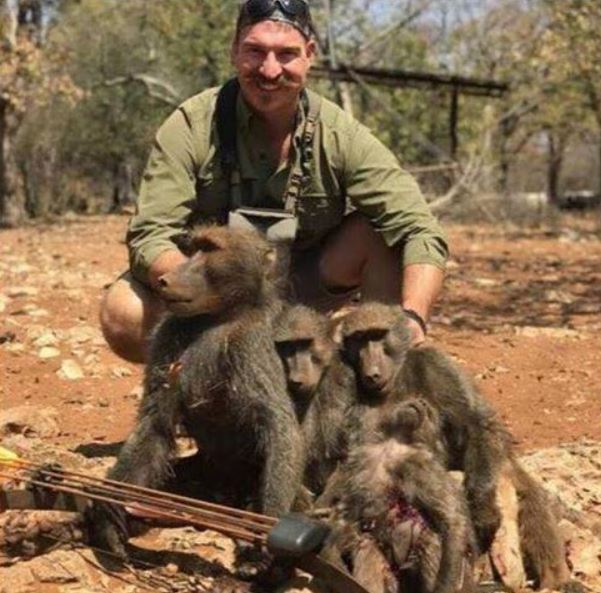
Oscar-nominated actor James Woods took to Twitter on Monday morning to denounce the practice of trophy hunting, presumably after learning of the controversy surrounding former Idaho Fish and Game Commissioner Blake Fischer.

“Honestly some things are just obvious, so please stop selling this nonsense that killing innocent wildlife helps conserve the species. It’s just bull—-,” posted Woods, alongside a link to an article concerning Fischer and his vacation in Africa, during which he claimed to have killed “a whole family of baboons.”

“Killing these glorious creatures is barbaric,” Woods added. “Just stop it.”

BIG-GAME HUNTER AND FORMER BEAUTY QUEEN BLASTED OVER HUNTING COMMENTS

Woods also responded to critics on Twitter who defended conservationists, saying that he was specifically referring to the practice of trophy hunting.

“I eat hamburgers. Somebody does the killing. I’m not going to get holier-than-thou about hunters. If you’re a carnivore, then somebody has to do the killing. But killing for a “trophy” is absurd. What I’d really like to see is the licensed hunting of poachers,” he tweeted.

Woods also called hunting exotic animals on regulated land “vile,” and suggested that sport hunters should hunt each other to create a more “level playing field.”

Woods’ posts came days after news of Fischer’s trip to Africa came to light, along with photos of the animals Fischer and his wife had shot in Namibia, which included a leopard and giraffe, among others.

“First day [my wife] wanted to watch me, and ‘get a feel’ of Africa,” Fischer reportedly recounted in an email to over 100 friends and co-workers following his trip, according to a public records request from the Boise’s KBOI and The Idaho Statesman. “So I shot a whole family of baboons.”

Fischer, who resigned Monday following a request from Idaho Governor Butch Otter, had initially defended his actions, saying nothing he did was “illegal,” “unethical” or “immoral.” He also said he had paid a trophy fee to hunt certain species.

OKLAHOMA MAN FACES CHARGES FOR SHOOTING DEER HOURS BEFORE SEASON STARTED

Still, his actions were met with criticism from former fish and game officials in Idaho who saw the email, with two calling for his resignation and another requesting an apology for what they called unsportsmanlike hunting practices — especially in regards to the family of baboons.

“I’m sure what you did was legal, however, legal does not make it right,” said Frank Trevey, a former Idaho fish and game warden, to Fischer after seeing the email.

Gov. Butch Otter had also reportedly asked for Fischer to resign earlier in the day, the Statesman reported, saying “every member of my administration is expected to exercise good judgment. Commissioner Fischer did not.”

Fischer apologized to Idaho’s hunters and anglers in a resignation letter obtained by the paper.

“I recently made some poor judgments that resulted in sharing photos of a hunt in which I did not display an appropriate level of sportsmanship and respect for the animals I harvested,” he said, in part.

FOLLOW US ON FACEBOOK FOR MORE FOX LIFESTYLE NEWS

Fischer was slated to serve a second term as a fish and game commissioner for Idaho, The Washington Post reported.

Fox News’ Edmund DeMarche contributed to this article.

The Pa. Game Commission should slow down move to semi-automatic weapons for hunting: David Levdansky

shutterstock_598067309.jpg

PennLive Op-EdBy PennLive Op-Ed
on March 16, 2017 at 8:45 AM, updated March 16, 2017 at 8:46 AM

By David Levdansky

Last year the Legislature and Gov. Tom Wolf removed a long-standing statutory prohibition against the use of semi-automatic rifles for hunting in Pennsylvania.

That legislation conveyed to the Pennsylvania Game Commission (PGC) authority to regulate how, when and where semi-auto rifles could be used for hunting.

Game commissioners, sworn to represent and uphold the interests of the state’s hunters, should also consider the impact of permitting semi-automatic rifle use for hunting on the non-hunting public.

After all, the Game Commission is required by law to manage all wildlife in the interests of all citizens – hunters and non-hunters alike.

As that legislation moved toward enactment, several Game Commissioners indicated publicly their intent to “go slow” in authorizing semi-auto use.

Moving so rapidly to permit semi-auto rifle use for all hunting will have unintended consequences.

Some even shared possible scenarios, where semi-autos might be permitted for use in hunting predators, like coyotes, but not during the regular big game seasons for deer and bear.

But surprisingly, at their January meeting, commissioners voted unanimously to permit the use of semi-automatic rifles in all seasons, for all species and have indicated their intent to follow through and grant final approval to this sweeping proposal at their next meeting on March 28.

Pennsylvania hunters can use semi-automatic weapons, but not this deer season 

Pennsylvania hunters can use semi-automatic weapons, but not this deer season

The new law doesn’t make semi-automatic weapons legal for hunting in time for the upcoming firearm deer season, which begins Monday.

Anyone who followed this unfolding issue assumed from earlier PGC statements that the debate would “go slow,” following a conservative approach to introducing semi-automatic rifles into Pennsylvania hunting.

What happened in the course of a few weeks that caused the sweeping approval of semi-autos to be fast-tracked? It’s obvious that something influenced commissioners’ earlier stated intent to be deliberate in handling this issue. Is this part of a legislative deal in the works?

Game commissioners who have spoken about the unanimous preliminary approval stated their rationale this way–that other states have not experienced an increase in hunting accidents caused by hunters using semi-auto rifles in the woods.

But I question that enough time was available, between the governor’s signature on the legislation and the Game Commission’s initial unanimous vote, to conduct a thorough review.

Furthermore, commissioners’ defense of their vote is based entirely on one factor. But is safety the only issue the PGC should consider?

We hunters make up about five percent of the total Pennsylvania population. That doesn’t mean the other 95 percent are “anti-hunters” but they are non-hunters. Their perception of hunters and hunting is vital to the continuation of our hunting traditions.

Moving so rapidly to permit semi-auto rifle use for all hunting will have unintended consequences.

From personal experience, I notice a difference in the reaction of non-hunters when I discuss hunting with a bow or a flintlock. They respect and support the ethical taking of game through methods that conform with the “fair chase” intrinsic to our hunting tradition.

My concern is with their perception of hunters when they see us using firearms designed for military purposes in the deer woods.

Eventually, there will be an accident involving a semi-auto rifle. It may even be an accident that has nothing to do with semi-auto technology, but the public won’t care about that.

All they will see is a hunter with a semi-automatic rifle designed for combat use, and they’ll blame all hunters and the Game Commission for whatever tragedy occurred. We hunters don’t need that kind of black eye. Is the rapid expansion of the semi-automatic rifle to hunt deer worth this risk?

The proposed rule implicitly recognizes this risk as it limits semi-auto rifles to a 5-shell capacity magazine for hunting. But these guns come equipped to carry a 20-shell magazine.

In view of the Game Commission’s sudden “flip” from its original intention to carefully deliberate semi-autos for hunting, how can we be assured that the 5-shell maximum will not soon expand, until the full 20-shell banana clip is legalized?

The deer woods will echo with “if it’s brown, it’s going down.” More errant shots, more deer wounded and left to rot in Penn’s Woods.

Several commissioners have defended their preliminary vote to authorize by saying hunter opposition was less than they expected.

It’s obvious that opposition was light because commissioners misled everyone. They initially said they’d take a slow and deliberate course.

People who are concerned about this trusted them to fully consider this issue, from all viewpoints.

But then commissioners surprised everyone with the unanimous vote and intention to move rapidly forward. The classic bait-and-switch tactic. Why?

I am a life-long hunter who was taught the importance of one-shot discipline while qualifying for the Boy Scouts marksmanship merit badge, by my NRA-certified Hunter Education instructor, and by my father, recognized for distinguished marksmanship during WWII Battle of the Bulge.

All my early shooting and hunting mentors reinforced the importance of minimizing a reliance on firepower but maximizing self-control while hunting, in the interest of safety, humaneness and the accuracy of my own shooting.

I believe we must continue to emphasize this ethic in training future hunters.

The use of semi-auto rifles for hunting undermines that ethic and will erode our standing in the eyes of public opinion, critical to our future.

I am not opposed to change. But this issue has many facets and ramifications that need studied and thought through. I want us to manage change with deliberation so that we hunters, and the honored tradition of hunting, do not suffer unintended damage we cannot repair.

The Game Commission should table this misguided proposal at their March 28 meeting and allow for more public input from hunters and non-hunters alike.

David Levdansky, a Democrat from Allegheny County, was a member of the Pennsylvania House of Representatives from 1985 to 2010. He is a life-long hunter.