Go Manage Yourself

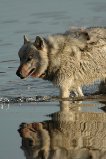
Whenever I hear people use words like “manage” or “control” in reference to wildlife,wolf in water my first thought is: go manage yourself. How arrogant of “game” departments, hunters or even so-called conservationists to pretend they know better than Mother Nature.
Wolves and elk have been managing themselves for eons. If elk were too numerous, wolves thrived; if elk populations dropped, wolf numbers were sure to follow. And whenever either of their populations got too far out of hand, Nature would step in with a few tricks up her sleeve to restore the balance.

By the time humans dreamed up notions like wildlife “management,” they’d so severely disrupted the natural order that nothing short of a reintroduction of elk or wolves could ever put it right. Of all the Earth’s invasive species, Homo sapiens is the one in dire need of controlling. Yet, we’ve been able to cleverly avoid or survive every effort Nature has so far come up with to regulate our numbers.

Know this, lowly human: Mom N still has a few tricks to throw at us if we aren’t willing to manage our own population.

382317_114375108747245_762037891_n

Montana’s Wolf “Problem” Doesn’t Add Up

Montana’s resident human population recently topped a million, according to census takers. That may not seem like a lot in today’s grossly overcrowded world, where dozens of U.S. cities could boast three or four times that number (if wall to wall people were something to boast about). But compare 1,000,000 humans to the estimated 650 or so wolves in the state and it’s pretty clear which species’ population is out of control.

It’s not like I’m comparing apples and oranges here, either. Both species are predatory mammals (although human beings don’t have to predate, they just do it for fun), and carnivorous (unlike wolves, we can get by–a lot healthier, I might add–on a plant-based diet). Both wolves and humans would be considered large animals, roughly equal to each other in size and weight (well, actually, the average wolf weighs around 100 pounds, whereas the average Montanan weighs in at 3 or 4 times that nowadays).

Meanwhile, thanks to humans, there are two and a half million cows in the state. That’s two and half million cows, each of whom is slated to eventually be killed and eaten by humans. Wolf livestock predation amounts to only a tiny of that number; in 2011 for instance, 74 cows were killed by wolves. As Roger commented yesterday, 74 divided by 2,500,000 is .00029 percent, statistically zero. Range cattle are 147 times more likely to fall prey to intestinal parasites than to wolves. Yet those 74 cows amount to a wolf “problem,” according to the state of Montana and are cause to declare open season on wolves there.

So far this season, hunters and trappers have killed nearly 200 wolves. Montana wildlife officials say they are hoping to reduce the wolf population to around 450. That number does not even come close to representing a recovered state wolf population by any historical standards when you consider that in 1884, 5,450 wolves were killed in the Montana Territory, after a bounty was first initiated there. Before that, wolves probably outnumbered people.
How I long for the good old days.

Text and Wildlife Photography ©Jim Robertson, 2013. All Rights Reserved

Text and Wildlife Photography ©Jim Robertson, 2013. All Rights Reserved

To Breed or Not to Breed

Yesterday I asked the question, “Who is the creeping cancer?” The choice was between the bison—a species nearly hunted off the face of the Earth that is still extinct over practically all its former range—or humans.

The answer is so ridiculously obvious it’s hardly worth asking; while the human species increases by over one million infants a day (1,000 were born just in the past minute), almost every other life form is on its way out of existence.

Thus, when the Seattle Times recently ran a piece by one of their columnists, Sharon Pian Chan, titled “Why I am not having kids,” I felt it was my duty to share the link here.  Chan brings up many good reasons not to breed, but the benefit to the environment was only mentioned once: “…not having a child is the most important thing I could do to reduce my carbon footprint, according to a 2009 study by Oregon State University statisticians. (Of course, like all parents, I believe my theoretical child would have grown up to become a brilliant physicist and saved the world from global warming, so this is a moot point.)”

Possibly…on the other hand it could have grown up to become the next Sarah Palin, Dick Cheney, Ted Bundy or terrible Ted Nugent.

Chan goes on to point out that by not having kids… “I will have a lot more attention and money to shower on real-life nieces, nephews, mentees and philanthropic causes.” Causes like educating the masses on just how many ways human overpopulation is ruining the planet, perhaps?

Those contemplating childbirth could always benefit from a bit of trivia, such as the fact that though it’s taken all of human history to until around the year 1800 for the world human population to reach one billion, the second billion was achieved in only 130 years (1930), the third billion in less than 30 years (1959), the fourth billion in 15 years (1974), and the fifth billion in only 13 years (1987). During the 20th century alone, the population in the world has grown from 1.65 billion to 6 billion.

The world population clock estimates that by 2025 the eight-billionth will be born and in 2045 the planet will be expected to feed and provide for nine billion hungry human beings. All the while the world will continue to see its biodiversity vanish.

Paul R. Ehrlich, author of the 1960s bestseller, The Population Bomb, foresaw peril in the ongoing disappearance of all other life forms except ours: “It isn’t a question of people or animals–it’s got to be both of us or we’re finished. We can’t get along without them. They could get along without us.”

Text and Wildlife Photography ©Jim Robertson, 2013. All Rights Reserved

Text and Wildlife Photography ©Jim Robertson, 2013. All Rights Reserved

Remember, Tuesday Is Soylent Green Day

As with Christmas, Thanksgiving has become a rather hedonistic holiday these days. You’d have to pin your ears back, with empty cornucopias held tightly against them, to hear even a faint reference to the giving of thanks through the din of loud chatter about seemingly more important things like football, where to get the best deals on Black Friday, or how to deep fry a turkey. But any thanks you heard would be to “the lord above,” rather than to the victims of the decadent feast.

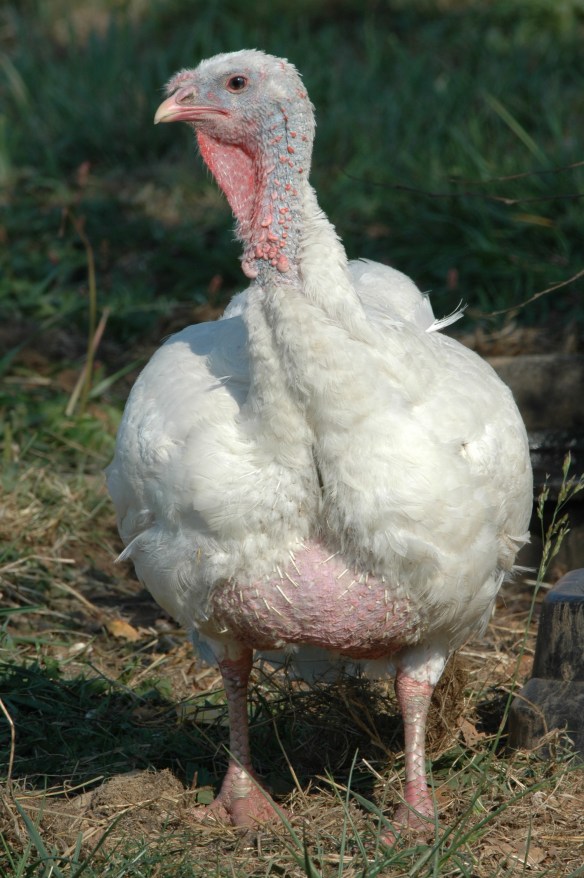
Completely lost in the hype of “tradition” and “Turkey-day” is any mention of giving even a passing “thank you” to the birds who suffered more indignities than space would allow me to mention here. Indignities that include the fact that turkeys on factory farms receive less than three square feet of personal space. And after they hatch, their beaks are cut off—a standard practice for chickens as well. No anesthesia or painkiller is used for either species. This process, which is known as “debeaking”, has been compared to having the ends of your fingers sliced off. It deprives birds of one of their most important sources of sensory input.

A debeaked bird cannot eat properly or explore his or her environment fully, nor can they preen themselves or their flockmates.  They may also experience acute and chronic pain in their beak, head, and face. In addition to being debeaked, turkeys also have the ends of their toes and their snoods cut off, often with nothing more than a pair of scissors (and as with debeaking, performed without anesthesia).

According to Liberation BC, both chickens and turkeys on modern factory farms have been genetically engineered and pumped with antibiotics; as a result they grow much faster than ever before. For example, in the 1960’s, it took a turkey 32 weeks to reach slaughter size, but now it takes only 13-16 weeks. In the 1950’s, it took a chicken 84 days to reach five pounds. Today, it takes 45 days, meaning that they are not even old enough to cluck yet when they die.

And PETA adds, their unnaturally large size also causes many turkeys to die from organ failure or heart attacks before they are even 6 months old. According to an investigative report in the Wall Street Journal on the miserable conditions on turkey farms, “It’s common in a rearing house to find a dead bird surrounded by four others whose hearts failed after they watched the first one ‘fall back and go into convulsions, with its wings flapping wildly.

Factory farm operators walk through the shed to kill the slow-growing turkeys (so that they don’t eat any more food), such as those who fall ill because of the filthy conditions or become crippled under their own weight.

In Canada, turkeys and chickens can legally be transported for up to 36 hours without food, water, or rest, and there are no limits as to the length of the journey. They are transported in open-air crates, resulting in high mortality as the birds are exposed to all sorts of weather.  Each bird is worth so little, however, that it is cheaper overall for the industry to use open-air crates.  Every year in Canada, 2 million broiler chickens and 20,000 turkeys are already dead when they arrive at slaughterhouses.  An additional 8 million broiler chickens and 200,000 turkeys arrive so diseased or injured that they are considered “unfit for human consumption”.
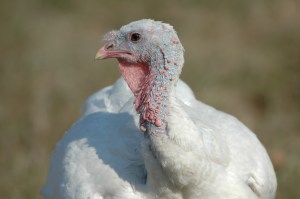
The surviving birds are handled roughly at the slaughterhouse, where they are unloaded by forklift and dropped onto a conveyor belt. With thousands of birds to be processed every hour, there is no reason for employees to stop and pick up the individual birds who miss the belt and fall to the ground.

When it comes time to slaughter the birds, they are hung by their feet on a moving rail and dragged through the stunning tank, an electrified water bath meant to stun and immobilize them. These are often set lower than is necessary to truly render the birds unconscious out of concerns that high voltage might damage the carcass and therefore diminish its value.

They are then carried past the tank to have their throats cut either by a mechanical blade or a plant employee. Often, struggling birds are cut improperly. As a result they are moved, fully conscious, to the scalding tank, where they are boiled alive.  Estimates place the number of affected birds at about one in twenty; at any rate, this occurrence is so common that the industry has a term for it: “redskins.”   …

Clearly, nobody gives much in the way of thanks to the “most important guest” at the table (as a recent Safeway ad described the turkey carcasses they were selling). You’d be damned lucky to overhear even a cursory mention of the miserable existence their edible “guest” underwent prior to the killing and plucking process. There is scarcely a sign that the hundreds of millions of Americans who gorge on the bodies of 45 million turkeys each year give a whit about whether these amazing and impressive birds had—prior to “harvest”—a life that allowed even a modicum of the freedom they would have experienced before the grossly over-populated human world made them their food-slaves.

Appropriately, I watched the timeless 1970s movie Soylent Green last night. Set in 2022, the film opens with a slide show of earlier eras, back when the Earth was covered with forests and open fields, and there were only a few scattered settlements of people who travelled in horse-drawn wagons.

As the images pass quickly by, we see the first automobiles (tail pipes spewing toxic carbon gases), followed by a massive blacktop parking lot jam packed with Model Ts. The pictures begin to flash almost more rapidly than we can focus, but we catch glimpses of factories with smokestacks billowing and crowds of people barely able to

move without trampling one another. (Come to think of it, what we are witnessing looks a lot like the inside of an average modern-day poultry barn, where Thanksgiving turkeys are forced to live out their lives in intense confinement.)

The first scene of action takes place in a cramped little New York City apartment, the dwelling of the film’s two main characters, Thorn, a semi-corrupt detective, and his elderly room-mate and research partner, Sol, who is constantly going on about the good old days—a world that Thorn can’t possibly envision or relate to.

They are among the lucky few; most people sleep on the stairways or in the hallways or anywhere they can find shelter from the oppressive heat caused by an out of control greenhouse effect. We overhear a program on their worn out old TV which is an interview with the governor of New York, touting a new food product called “Soylent Green,” ostensibly made from the ocean’s plankton. (Everyone in that day and age knows that the land is used up, but they’re told the oceans can still provide for them).

Food in this depressing, human-ravaged world comes in the form of color-coded wafers, distributed under strict government supervision. Hordes of people stand in line for their ration of Soylent yellow or blue made from soy, or other high protein plants grown behind the fortress-walls of heavily guarded farms.

Signs remind the throng that “Tuesday is Soylent Green day.”

The multitudes are exceptionally unruly on Tuesday. Brimming with anticipation, they can’t wait to obtain a ration of the special new product. When they get out of hand, “scoops” (garbage trucks fitted with backhoe-like buckets on the front) are called in to scoop them up and haul them off…

Spoiler Alert:

To make a long story short, by the end of the film, Thorn learns that the oceans are dead and the actual ingredients of Soylent Green are something a bit harder to stomach than plankton. In the final scene, a mortally-wounded Thorn is carried away on a stretcher as he desperately tries to tell skeptical onlookers, “Soylent Green is People!” “They’re making our food out of people. Next thing, they’ll be breeding us like cattle for food!”

Could it ever happen? Could the human race ever stoop so low? If the scenario seems too hard to swallow­, consider this: the conditions animals are forced to endure on today’s factory farms would have seemed unimaginable to people living a hundred years ago.
­­

Over 7 Billion Served

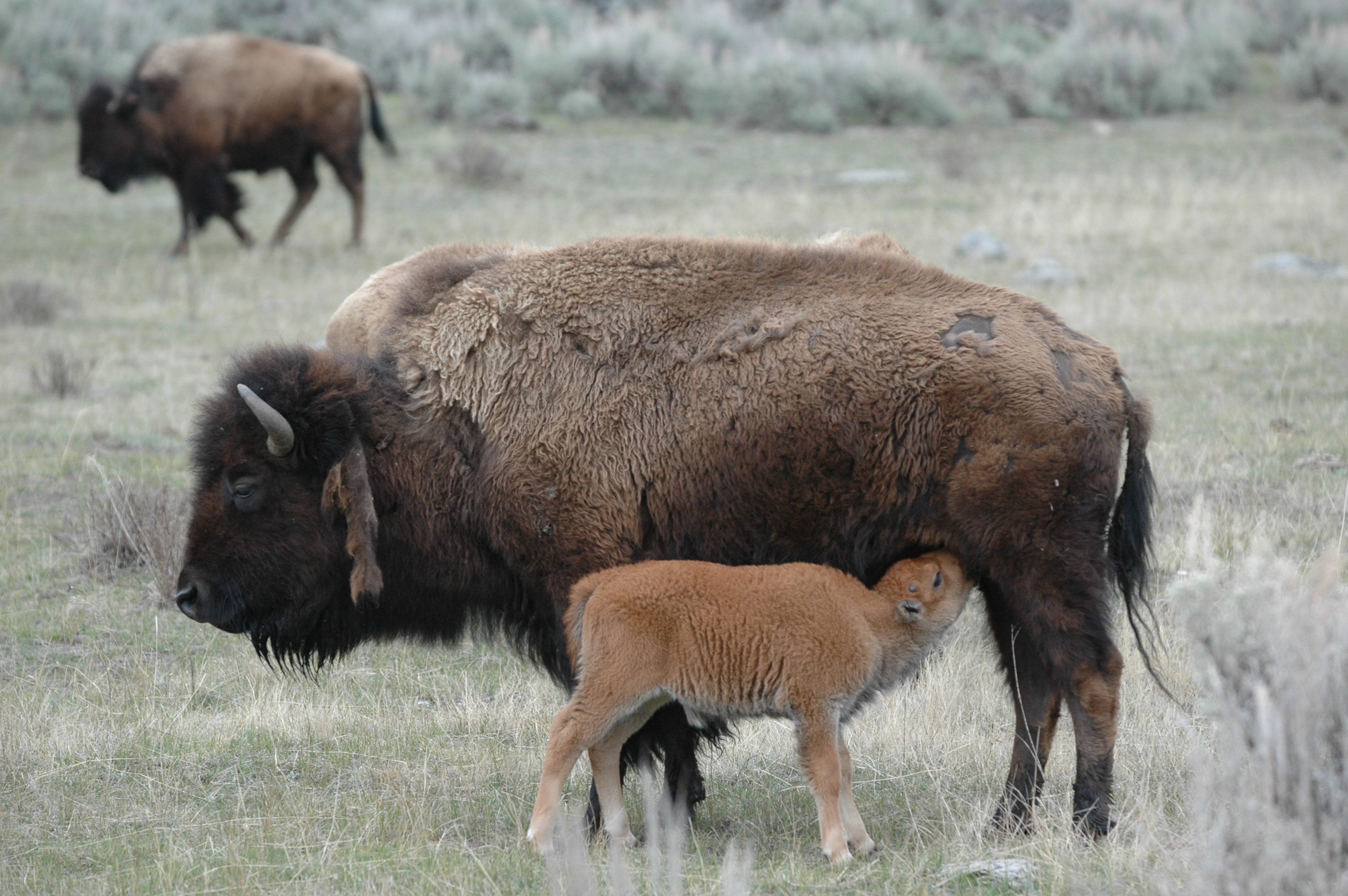
Bison calves are normally born in the spring or early summer. For the first few months of their lives they’re coat is an orange-ish color, turning progressively darker through the warm summertime, until by late August they are as dark as their parents and the other adult and sub-adult members of their herd.

So I was surprised to hear from my wolf-watching friend and former neighbor in southwest Montana that an orange bison calf was just seen in Yellowstone trailing an umbilical cord, a sure sign he was born within the past few days.

Not good timing, as nighttime temperatures hover in the teens now, and snow has already begun falling in the park. The snows will only get deeper and the temps colder for months to come. Life will be tough for the poor little calf this first winter; chances are good he won’t survive.

This is precisely the reason bison have evolved, as a rule, to being receptive to breeding exclusively in August. The ensuing gestation period assures that newborn calves are greeted with a full summer ahead of them. Nearly every animal species living above or below the equatorial belt has adapted to Earth’s changing seasons by only ovulating during a brief window of opportunity, thereby naturally limiting their populations.

Conversely, Homo sapiens can impregnate one another year-round. Our species has had it easy for so long—starting fires for warmth and skinning animals for clothes and shelter—that now human babies are  brought forth continuously, 24-7. At last report, 490,000 new humans per day are born to add to the 7 billion mostly carnivorous hominids already here.

Meanwhile, whenever bison herds in Yellowstone thrive enough to reach the arbitrary number of 3,000 total “head,” the park service and the Montana Department of Livestock implement a longer “hunting” (read: walk up and blast the benign, grazing, half-tame bison) season on them, or truck them off to the slaughterhouse—those nightmarish death camps where so many of the bison’s forcibly domesticated bovine cousins meet their ghastly ends in the name of human hedonism.

And people think we need to control their population?

Text and Wildlife Photography © Jim Robertson

Live With It, Elmers!

Sorry Elmers, it’s time to snuff out one of the most overused and overstated rationalizations for your beloved sport.

Hunters would have you ingest the preposterous pabulum that hunting helps animals; that hunters are their philanthropic fairy godparents (well-armed well-wishers, if you will) performing the gallant duty of keeping animal populations in check; that animals won’t go on living unless they kindheartedly kill them (this of course is all the more outrageous in light of how many species have been wiped off the face of the earth, or perilously close to it, exclusively by hunting).

But deer, along with most other animal species—besides Homo sapiens, have built-in mechanisms that cause their reproduction rate to slow down when their population is high or food is scarce.  Though state “game” departments are usually loath to share any information that might work against one of their arguments for selling hunting licenses, even they know that in reality the wildlife can ultimately take care of their own. According to the Western Association of Fish and Wildlife Agencies, “A mule deer herd that is at or above the carrying capacity of its habitat may produce fewer fawns than one that is below carrying capacity.”

The fact is, hunting encourages ungulates to reproduce more, thus seemingly warranting the alleged need for population controls via, you guessed it, more hunting.

Hunting industry propagandists have a lot of people convinced that culling is a necessary evil for controlling animal overpopulation. Lethal removal is their one-size-fits-all solution, no matter the circumstance. But there are always alternatives to that fatal fallback position. When we finally get past the viewpoint of animals as objects, or “property of the state,” and start to see them instead as individuals, the justifications for culling begin to wear thin.

Many places that provide habitat for healthy populations of deer could also support the natural predators who evolved alongside them. All that’s required of humans is to get out of the way and let nature take its course, or, in some cases, repair the damage they’ve done by reintroducing wolves or other native carnivores who were fool-heartedly eradicated. Yet, in the western US and Alaska, as well as in Canada, natural predators are still being killed to allow deer, moose or elk hunters a better chance at success. While some people complain that these browsers and grazers have gotten too tame, hunters in states like Idaho and Montana are whining that wolves make the elk too wild and thus harder for them to hunt.

I tend to be even more cynical about areas where humans have claimed every square inch for themselves and aren’t willing to share with native grazers. When I hear grumbling about deer, elk or geese pooping on a golf course, I have a hard time relating to people’s grievances. It’s the height of speciesism to expect that these animals should face lethal culling for successfully adapting to an unnaturally overcrowded human world.

Ours is the invasive species, overpopulating and destroying habitats wherever we go. We wouldn’t want some other being jumping to a knee-jerk “cull them all” reaction every time humans reached their carrying capacity in a given area.

Sooner or later Mother Nature will tire of humans’ destructive dominance and come up with a way to bring life back into balance. I can just hear her telling off the hunters: “Other animals have a right to be here too—just live with it, Elmers!”

______________________________________________________________

Portions of this post were excerpted from the book, Exposing the Big Game: Living Targets of a Dying Sport 

Text and Wildlife Photography ©Jim Robertson

Someone Has To Say It

Hunters often spout off about their “birth right” to shoot and kill wildlife recreationally. The rest of us be damned—they’ve got a god-given entitlement to “harvest” elk, or further disrupt the balance of nature by eliminating wolves. Heck, it’s not their doing that the last of the wild places and species are disappearing fast. After all, they’ve got seven kids to feed…

As much as it turns the stomach to envision, the “boiling frog syndrome” (based on the fable that a frog placed in hot water will jump out, but the same frog placed in cold water which is slowly heated will not recognize the danger) is a fitting metaphor for people’s failure to react to the momentous changes they are affecting across the planet.

The human’s ability to adapt to change is impressive. It always amazes me to see how easily the inhabitants of a busy city can accept ridiculous conditions. As an infrequent visitor, I can’t get used to ever-worsening traffic jams, but to those adapted to it, being wedged in among thousands of others is just a fact of life. With each new lane added to the highways, there’s less and less wildlife habitat and open space. So, what’s fueling the human expansion into every last vestige of wilderness?

Dare I say it? I guess someone has to:

Overpopulation!

Professor Paul R. Ehrlich, author of The Population Bomb, dared to say it in 1968 (when humans numbered only 3.5 billion), following it up in 1991 (when 5.3 billion humans walked the Earth) with The Population Explosion.  In 1970, he told National Wildlife Magazine, “It isn’t a question of people or animals–it’s got to be both of us or we’re finished. We can’t get along without them. They could get along without us.” Today, the human population has erupted to over 7 billion, while the number of species now extinct or endangered continues to grow exponentially as well.

The “boiling frog” story may only be a fable, but humans had best be mindful of gradual changes lest they suffer unfavorable consequences.