QUEENS, New York — A seemingly troubled woman at a town hall hosted by Democratic New York Rep. Alexandria Ocasio-Cortez in her district stood up to demand the congresswoman support drastic measures to combat climate change, such as “eating babies.”
“We’re not going to be here for much longer, because of the climate crisis,” the woman pleaded. “We only have a few months left. I love that you support the Green Deal, but it’s not gonna get rid of fossil fuel. It’s not going to solve the problem fast enough. A Swedish professor said we can eat dead people, but it’s not fast enough! So, I think your next campaign slogan needs to be this: We’ve got to start eating babies.”
Many of Ocasio-Cortez’s constituents appeared confused by the woman’s declarations.
Removing her jacket to reveal a T-shirt with the phrase “Save the planet Eat the Children,” the woman continued, “We don’t have a enough time. There’s too much Co2.”
“All of you!” she went on, turning to those around her, “You’re a pollutant! Too much Co2. We have to start now. Please — you are so great. I’m so happy that you are supporting a Green New Deal, but it’s not enough. Even if we were to bomb Russia, it’s not enough. There’s too many people, too much pollution. So, we have to get rid of the babies. That’s a big problem. Just stopping having babies just isn’t enough. We need to eat the babies. This is very serious. Please give a response.”
Staffers of the New York congresswoman approached the woman toward the end of her remarks, as attendees in the room became increasingly uncomfortable.
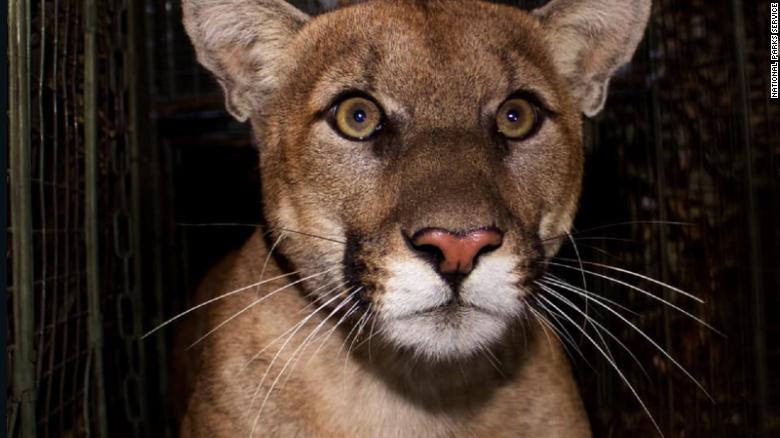
The mountain lion, known as P-61 to researchers, was struck and killed on the 405 freeway.
(CNN)A mountain lion known for crossing the Los Angeles 405 freeway was struck and killed by a vehicle early Saturday morning, according to National Park Service (NPS) Ranger Ana Beatriz.
The mountain lion known as P-61 lived in the Santa Monica mountains near the Sepulveda Pass, Beatriz said in a statement. He wore a radio collar around his neck so researchers could track his movements.
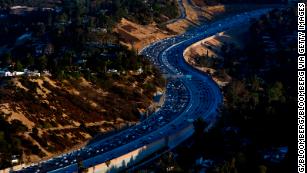
The 405 freeway through the Sepulveda pass
The 4-year-old cat’s final GPS point showed him between Bel Air Crest Road and the Sepulveda Boulevard underpass.
City of Los Angeles Animal Control officer retrieved his body, the Santa Monica Mountains National Recreation Area said on Facebook.
It appears he was trying to cross the 405 freeway, Beatriz said.
Just months ago, he had successfully crossed that same freeway, the first time a GPS-collared mountain lion had done so over the course of the NPS’s 17-year study of mountain lions in and around the Santa Monica Mountains, Beatriz said.
Despite being 90 years old and receiving a life-threatening diagnosis, the beautiful Miss Norma was still full of life. Just days after her husband’s passing, she received a hard diagnose, too. However, Norma decided she doesn’t want to see the inside of any more hospitals, but to see the world, instead.
And so she did. The 90-year-old woman decided to hit the road with her son, daughter-in-law, and their Poodle, Ringo, in their RV.” I’m having the time of my life! I’m done with doctors,” she said.
The woman’s positivity; her energetic spirit and enthusiasm have surprised even her doctor. The Facebook page, Driving Miss Norma, recounts a conversation between them:
We explained to the well-meaning doctor and his student that we live in an RV and that we will be taking her wherever she wants to go. He didn’t hesitate to say, “RIGHT ON!” We asked if he thought us irresponsible for this approach. His reply was telling.
“As doctors,” he said, “we see what treatment looks like everyday. ICU, nursing homes, awful side effects and honestly, there is no guarantee she will survive the initial surgery to remove the mass. You are doing exactly what I would want to do in this situation. Have a fantastic trip!”
And now with Ringo as the co-pilot, son Tim and his wife Ramie, Norma is having the time of her life. So far, the adventurous team traveled thousands of miles and they have no intentions of stopping anytime soon.
“We have no idea where or when it will end. We are living in the present moment,” Ramie said. Let the good times rolls, Norma!
The entire food system needs to change, researchers say. Image: By nima hatami on Unsplash
To feed 9 billion people by 2050, and keep planet Earth from overheating, will mean massive and radical food changes – and not just in the way food is grown.
To contain global temperatures to no more than 2 °C above the average for most of human history will require humanity to change its diet, contain its appetite and reform the entire system of food production and distribution.
This is the verdict of the latest study of the challenge set in Paris in 2015, when 195 nations promised to limit global warming – driven by profligate use of fossil fuels and by the conversion of forest, grassland and wetlands into commercial use – to “well below” 2 °C by 2100.
Researchers report in the journal Sustainability that they looked at 160 studies and analyses of global agriculture and food systems and most closely at the world’s smallholders and markets that sustain as many as 2.5 billion people, mostly in the developing world.
Agriculture, together with forestry and changes in land use, accounts for a quarter of all the carbon dioxide, methane and oxides of nitrogen that fuel global warming.
Just on its own, the action of growing grain, fruit and vegetables or feeding grazing animals accounts for no more than 12% of global warming, but a third of all the food that leaves the farm gate is wasted before it arrives on the supper table.
The researchers see reductions in food loss as a “big opportunity” that will benefit farmers and consumers as well as reduce emissions. A more challenging problem is to change global appetites: the meat and dairy business accounts for about 18% of all human-triggered emissions, counting the clearance of forests and the impact of changes in the way land is used to feed the demand for meat, milk, butter and cheese.
“This means reducing emissions by stopping deforestation, decreasing food loss and waste, reducing supply chain emissions and rethinking human diets, if we really want to get on track to that target.”
“The global health benefits from climate policy could reach trillions of dollars annually, but will importantly depend on the air quality policies that nations adopt independently of climate change,” they write in the journal Nature Communications.
And Mark Budolfson of the University of Vermont, one of the authors, said: “We show the climate conversation doesn’t need to be about the current generation investing in the further future. By making smart investments in climate action, we can save lives now through improved air quality and health.”
The authors assert that, ‘Retaining the integrity of intact tropical forests will not be possible if global and national environmental strategies do not address ongoing hunting practices.’ Credit: Ruth Archer from Pixabay
Defaunation—the loss of species or decline of animal populations—is reaching even the most remote and pristine tropical forests. Within the tropics, only 20% of the remaining area is considered intact, where no logging or deforestation has been detected by remote sensing. However, a new study publishing May 14 in the open-access journal PLOS Biology, led by Ana Benítez-López from Radboud University, the Netherlands, predicts that even under the seemingly undisturbed canopy, hunting is reducing populations of large mammals by 40% on average, largely due to increased human accessibility to these remote areas.
Overhunting, as opposed to deforestation, is undetectable by remote-sensing techniques, and to date, there were vast understudied areas in the tropics where hunting impacts on mammal communities were unknown. In this study, the authors have projected for the first time the spatial patterns of hunting-induced mammal defaunation in the tropics and have identified areas where hunting impacts on mammal communities are expected to be high.
Predicted hotspots of hunting-induced defaunation are located in West and Central Africa, particularly Cameroon, and in Central America, NW South America and areas in SE Asia (Thailand, Malaysia and SW China). Predictions were based on a newly developed hunting regression model, based upon socio-economic drivers, such as human population density and hunters’ access points, and species traits, such as body size. The model relies on more than 3,200 abundance data estimates from the last 40 years and included more than 160 studies and hundreds of authors studying approximately 300 mammal species across the tropics.
These defaunation maps are expected to become an important input for large-scale biodiversity assessments, which have routinely ignored hunting impacts due to data paucity, and may inform species extinction risk assessments, conservation planning and progress evaluations to achieve global biodiversity targets.
Craig Packer is the director of the Lion Center, a research and conservation center at the University of Minnesota. The views expressed in this commentary are his own. View more opinion on CNN.
(CNN)Lions eat people. In fact, they eat them all the time. And although the news last week focused on a suspected rhino poacher who was eaten by lions after being trampled by elephants, the story may tell us more about the hazards of poverty than about nature taking vengeance against the sins of mankind.
In southern Tanzania, lions attacked nearly 900 people in a 15-year period starting in the 1990s, and two-thirds of their victims died. The motive? Humans make a decent food source. These lions, who had lost most of their normal prey to habitat damage and human population growth, instead began consuming bush pigs, a native species that is also a serious and nocturnal crop pest.
Craig Packer
To protect their crops, subsistence farmers had to sleep in their fields at harvest time. Lions followed the pigs to the fields, and some learned to add sleeping farmers to their diet.
A similarly desperate situation has persisted for many years in South Africa’s Kruger National Park, which is located along the border with the much poorer nation of Mozambique. Impoverished Mozambicans seeking employment in South Africa have continuously attempted to cross Kruger Park on foot, and hundreds have ended up victims to Kruger’s many lions.
I once met a Kruger ranger who had recently performed a routine inspection of a dead lion in the middle of the park. Its stomach contents included a human hand.
In recent years, Kruger has attracted another type of illicit foot traffic: As home to one of the largest remaining populations of rhinos, it has drawn record numbers of poachers. From the point of view of a poor family in Mozambique, a single rhino horn is the equivalent of a year’s salary. The risks of getting caught by rangers, trampled by elephants or eaten by lions may seem insubstantial compared to the opportunity to feed your entire family for a whole year.
Not all rhino poachers are poor villagers — the trade in illegal animal parts can attract a broad section of corrupt society, including drug dealers and gun traders. And while I don’t know if last week’s suspected poacher was acting out of desperation or greed, the fact that he was on foot implies a similar dilemma as a Tanzanian farmer who must choose between the near certain loss of his sole crop of the year versus the risks of a lion attack.
So, when I read about the death of the Kruger rhino poacher, I thought first of the poverty that drives so many people toward danger. Add in Mozambique’s overwhelming humanitarian disaster caused by last month’s Cyclone Idai, and there’s even more reason to ask what drove this man into the park in the first place. The combination of rhino poaching, elephant trampling and man-eating lions may have captured the attention of the moment, but this man wasn’t the first — and he won’t be the last.
In the industrialized world, we view lions and elephants with affection and an enduring sense of awe. But all-pervasive poverty is the root cause of the conservation crisis in Africa — land is increasingly scarce, elephants trample crops and lions kill livestock and people.
The United Nations’ Sustainable Development Goals aim to eliminate extreme poverty by 2030. If this lofty ambition were actually to be achieved, we might one day be justified in considering a trampled poacher to have received his just deserts, but until then, let’s also consider the possibility that his death might signify a much larger problem.
The apocalypse has a new date: 2048.That’s when the world’s oceans will be empty of fish, predicts an international team of ecologists and economists. The cause: the disappearance of species due to overfishing, pollution, habitat loss, and climate change.
The study by Boris Worm, PhD, of Dalhousie University in Halifax, Nova Scotia, — with colleagues in the U.K., U.S., Sweden, and Panama — was an effort to understand what this loss of ocean species might mean to the world.
The researchers analyzed several different kinds of data. Even to these ecology-minded scientists, the results were an unpleasant surprise.
“I was shocked and disturbed by how consistent these trends are — beyond anything we suspected,” Worm says in a news release.
“This isn’t predicted to happen. This is happening now,” study researcher Nicola Beaumont, PhD, of the Plymouth Marine Laboratory, U.K., says in a news release.
“If biodiversity continues to decline, the marine environment will not be able to sustain our way of life. Indeed, it may not be able to sustain our lives at all,” Beaumont adds.
Already, 29% of edible fish and seafood species have declined by 90% — a drop that means the collapse of these fisheries.
But the issue isn’t just having seafood on our plates. Ocean species filter toxins from the water. They protect shorelines. And they reduce the risks of algae blooms such as the red tide.
“A large and increasing proportion of our population lives close to the coast; thus the loss of services such as flood control and waste detoxification can have disastrous consequences,” Worm and colleagues say.
The researchers analyzed data from 32 experiments on different marine environments.
They then analyzed the 1,000-year history of 12 coastal regions around the world, including San Francisco and Chesapeake bays in the U.S., and the Adriatic, Baltic, and North seas in Europe.
Next, they analyzed fishery data from 64 large marine ecosystems.
And finally, they looked at the recovery of 48 protected ocean areas.
Their bottom line: Everything that lives in the ocean is important. The diversity of ocean life is the key to its survival. The areas of the ocean with the most different kinds of life are the healthiest.
But the loss of species isn’t gradual. It’s happening fast — and getting faster, the researchers say.
Worm and colleagues call for sustainable fisheries management, pollution control, habitat maintenance, and the creation of more ocean reserves.
This, they say, isn’t a cost; it’s an investment that will pay off in lower insurance costs, a sustainable fish industry, fewer natural disasters, human health, and more.
“It’s not too late. We can turn this around,” Worm says. “But less than 1% of the global ocean is effectively protected right now.”
Worm and colleagues report their findings in the Nov. 3 issue of Science.
SOURCES: Worm, B. Science, Nov. 3, 2006; vol 314: pp 787-790. News release, SeaWeb. News release, American Association for the Advancement of Science.
Known for their distinctive long necks and spotted patterns, giraffes are one of nature’s most iconic and awe-inspiring wild animals. The discovery of four unique giraffe species now indicates an urgent need for international conservation efforts to save these majestic animals.
Over the past three decades, Africa’s giraffe population as a whole has declined by 40% with less than 100,000 individuals remaining in the wild today. Compare that to our worldwide human population which expands by over twice that amount each and every day, and you can begin to understand the scope of the issue.
Africa is the second largest and second most populous continent in the world. As is the case almost everywhere humans are found on Earth, rapid human population growth disrupts and displaces the ranges of wild animals, leading to habitat loss.
Poaching is also a contributor to a decline in overall giraffe numbers.
As a single species, giraffes were classified as “vulnerable” in 2016. However, since giraffes were recently discovered to belong to four genetically and geographically distinct species with nine subspecies, “vulnerable” status does not effectively communicate the dangerously low numbers of giraffe subgroups.
Today, the Masai giraffe species (G. tippelskirchi) population has just 32,050 individuals. The southern giraffe (G. giraffe) has just 52,050 including two subspecies: the Angolan giraffe (G. g. angolensis) and the South African giraffe (G. g. giraffe).
Some giraffe populations need immediate protection, including the endangeredreticulated giraffe (G. reticulata) with just 8,700 individuals in existence. It is estimated the northern giraffe species (G. camelopardalis) has just 5,195 individuals in the wild, including the West African giraffe (G. c. peralta) subspecies and the critically endangeredKordofan (G. c. antiquorum) and Nubian (G. c. Camelopardalis) subspecies.
Now, five wildlife protection groups have filed a lawsuit against the U.S. Fish and Wildlife Service for its failure to list northern giraffes under the Endangered Species Act, arguing that the listing of the northern giraffe species crucial for the subspecies’ survival.
Listing northern giraffes would not mandate the habitat protections granted to domestic species, however, it could drastically cut down on poaching by regulating international and interstate imports and exports of giraffe trophies and body parts.
Thank you for taking action for giraffes sharing this story and signing up for eNews so you can get the latest updates and actions to help giraffes and other wild animals.
THERE’S AN ENTIRE industry built around dieting. Most of its products are intended to help people lose weight, gain muscle, or live longer.
But as the global human population steadily climbs, scientists are scrambling to devise a diet plan that can feed 10 billion people by 2050.
A new report, published in the British medical journal The Lancet, claims to do just that. It recommends a largely plant-based diet, with small, occasional allowances for meat, dairy, and sugar. The report was compiled by a group of 30 scientists from around the world who study nutrition or food policy. For three years, they deliberated with the intent of creating recommendations that could be adopted by governments to meet the challenge of feeding a growing world population.
“Even small increases in the consumption of red meat or dairy foods would make this goal difficult or impossible to achieve,” a summary of the report states.
The report’s authors reached their conclusions by weighing different side-effects of food production. They included greenhouse gases, water and crop use, nitrogen or phosphorous from fertilizers, and the potential for biodiversity to take a hit should a region be converted into farmland. By managing all these factors, the report’s authors say climate change-inducing gases could be reduced and enough land could be reserved to feed the world’s growing population.
Under the report’s conclusions, meat and sugar consumption around the world should drop by 50 percent. Who eats less meat and where will vary, says Jessica Fanzo, a report author and professor of food policy and ethics at Johns Hopkins University. Meat consumption in the U.S., for instance, would have to go down and be replaced by fruits and vegetables. But other countries already facing poor nutrition could incorporate meat into roughly three percent of their diet.
Hares are cannibals and eat meat, surprising photos reveal
“We’ll be in dire straits,” if no action is taken, says Fanzo.
Following a vegan trend
Recommendations to scale back meat consumption aren’t new. Just this past October, a study published in the journal Nature set similar guidelines for reducing meat and sugar consumption.
What’s different about this new report, says Fanzo, are the steps outlined to put such a change into place.
Branded what the authors call a “Great Food Transformation,” it outlines strategies that range from the least active, simply sharing information, to the most aggressive, eliminating consumer choice.
“I think it’s hard for people on a daily basis because the incentives and political structures that are in place don’t make it so easy,” says Fanzo. Shifting what sort of agricultural practices receive subsidies is one tactic for overhauling the food system, the report outlines. That would change the relative prices of foods, and thus build in consumer incentives.
Whether a plan like this could actually grow legs around the world is a different story, says Fanzo.
“With the current [presidential] administration, I just don’t think anything is going to move,” she notes.
Greg Miller is the chief science officer for the U.S. National Dairy Council. In addition to citing health benefits of milk like calcium and vitamin D, he cautions against transforming America’s food landscape.
“You have a million people whose lives depend on dairy,” Miller says of those who work on farms or are otherwise employed by the dairy industry.
“We could get there with the right incentives and the right policies,” Miller says of making dairy farming more sustainable. “Subsidies are needed for better technology right now. [Small-scale farmers] don’t have additional income to do some of the things that could be done.”
Better breeding has created cows that are capable of producing more milk for instance, and better tracking systems can monitor an animal’s food intake and activity.
Lingering emissions debates
Not all experts are convinced that plant-based diets are a food security panacea. Frank Mitloehner, an animal scientist from the University of California, Davis has been vocal about his view that meat has been disproportionately linked to climate change emissions.
A Texas butcher chops a side of beef into various cuts.
PHOTOGRAPH BY BRIAN FINKE, NAT GEO IMAGE COLLECTION
“What concerns me the most is that, while livestock has an impact, the report makes it sound as if it was the leading source of the impacts. By far the use of fossil fuels are the leading source of carbon emissions,” says Mitloehner.
According to the EPA, burning fossil fuels for industry, electricity, and transportation comprises the bulk of greenhouse gas emissions. Agriculture is nine percent of emissions and livestock roughly four percent of that.
Mitloehner also disagrees with the method used by the council to determine the amount of greenhouse gases produced by livestock, saying too much weight was given to methane during calculations. Compared to carbon, methane stays in the atmosphere for a relatively short amount of time. Scientists debate how long exactly, but studies have shown methane plays a large roll in warming oceans.
Reducing food waste
Though the report’s dietary guidelines are receiving criticism, its push to reduce food wasteis being more widely received. In the U.S. alone, nearly30 percentof all food is wasted.
Strategies to reduce waste are outlined for both consumers and producers in the report. Better storage technology and contamination spotting could help businesses reduce the amount of food that’s thrown out, but educating consumers is also touted as an effective strategy.
It’s a daunting prospect for many—changing eating habits and reducing food waste. But Kathryn Kellogg, author of the book 101 Ways to Go Zero Waste, says she gets by with just $250 a month.
“There’s so many creative ways to use our food to prevent waste, and I feel like most people just don’t know about them,” she says. She cites knowing how to cook each part of a vegetable and being constantly aware of the food in her fridge as some of her most effective habits. (Learn more about so-called zero-waste families.)
Kellogg, however, lives in California near neighborhoods with accessible farmers markets. For other communities living in so-called food deserts—regions where grocery stores or markets aren’t readily available—accessing fresh fruits and vegetables can be more difficult.
“All the actions we recommend are available now,” says Fanzo. “They’re not ‘pie in the sky’ future technologies. They’re just not done at a large scale.”
The report’s commissioners will hold launch events in more than 30 countries around the world starting Thursday. They plan to appeal to international organizations like the U.N. as potential enforcers of their new guidelines.








 Exposing the Big Game