


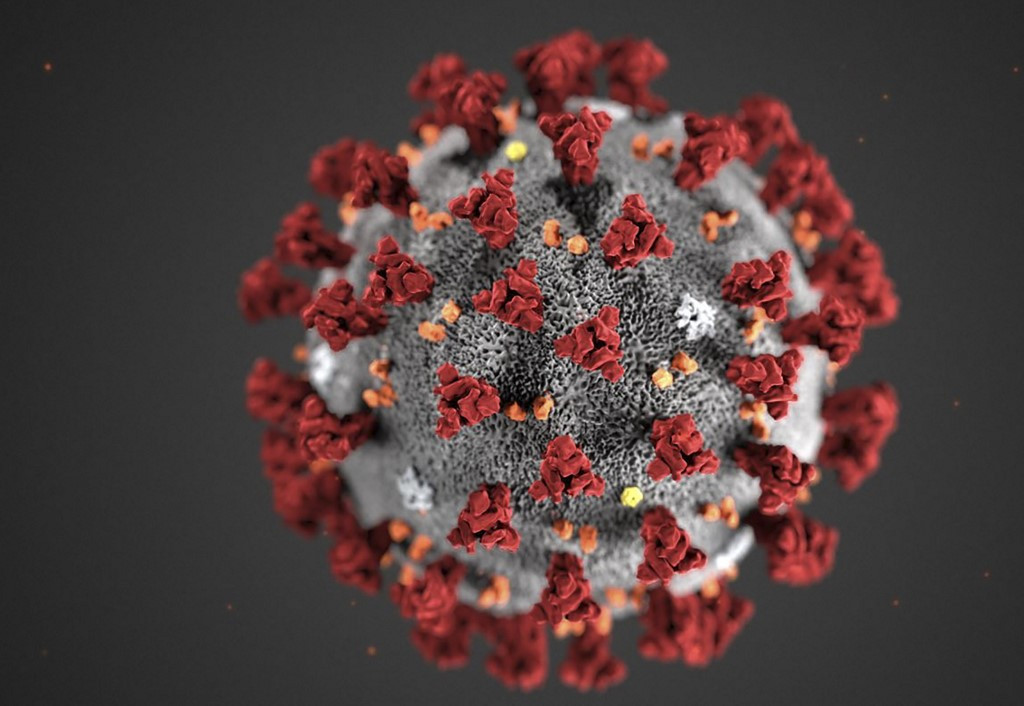
 This illustration image obtained on Feb. 3 courtesy of the Centers for Disease Control and Prevention, and created at the Centers for Disease Control and Prevention (CDC), reveals ultrastructural morphology exhibited by coronaviruses. (AFP/Lizabeth Menzies / Centers for Disease Control and Prevention )
The current situation in Indonesia brought about by the novel coronavirus (SARS-CoV-2) makes me want to pull my hair out. Not just because it’s disruptive, but because the signs that an outbreak like COVID-19 would happen were so clear.
Seventeen years ago, when SARS first made headlines, I locked myself in a cage in Hong Kong to illustrate the way our taste for animal flesh contributes to animal-borne diseases. That same year, I wore a hazmat suit to the ASEAN+3 Summit in Bali, where officials were discussing ways to prevent killer diseases. I also dressed as a chicken and demonstrated at a KFC in Bangkok during a deadly bird flu outbreak. All in all, I’ve spent more than two decades warning people that it’s unhealthy – and downright dangerous – to raise animals for food.
Seeing people get sick and die from COVID-19 has only strengthened my resolve to persuade everyone to stop eating animals. We have to learn from past pandemics and go vegan before wearing face masks becomes as commonplace as wearing clothes.
Meat markets, factory farms and slaughterhouses provide the perfect breeding ground for coronaviruses and other potentially devastating pathogens. The high demand for animal-based food means that animals must be mass-produced in crowded, feces-ridden farms and slaughtered on killing floors that are contaminated with blood, vomit and other bodily fluids. Pathogens flourish in such conditions. And when an outbreak does occur, the animals, who have already suffered so much, are slaughtered en masse in horrific ways. I know. I was in Manilla when countless pigs were killed because of a swine flu outbreak.
Some scientists say SARS-CoV-2 started in a Chinese “wet market” that sold seafood, live poultry and exotic animals for human consumption. Others suspect the virus may have been spread by pangolins, scaly anteaters that are often poached and used in traditional Chinese medicine or eaten in China and Vietnam. Whatever its exact origin, SARS-CoV-2 most likely started in animals.
According to the United Nations, 70 percent of new human diseases originate in animals, and most of those are directly linked to animals used for food. Most scientists believe that every flu virus originated in birds, as birds are known to carry every single one of the 144 varieties of influenza.
It’s not unusual for animal-borne pathogens to mutate and sicken humans. While precautions such as suspending travel, quarantining at-risk individuals and practicing good hygiene may help stop the spread of COVID-19 and other deadly diseases, we need to take one more significant step to prevent future epidemics of animal-borne diseases in the first place: Stop raising animals for food.
It’s bad enough that the consumption of meat and other animal-based food contributes to heart disease, diabetes and cancer and that harmful bacteria, including salmonella and E. coli, found in the intestines and feces of warm-blooded animals, often lead to food-poisoning outbreaks. Do we really want to add potentially deadly animal-borne viruses to the mix?
—
PETA’s senior vice president for international campaigns
Disclaimer: The opinions expressed in this article are those of the author and do not reflect the official stance of The Jakarta Post.
/arc-anglerfish-arc2-prod-sltrib.s3.amazonaws.com/public/IN73QGJSQZBTHLYNDJ5MLJLO4Q.jpg)
“The greatness of a nation and its moral progress can be judged by the way its animals are treated.”
— Mahatma Gandhi
In order to fix any problem and prevent it from happening again, we must first look at the cause. Our current pandemic did not just appear out of nowhere.
Like other zoonotic viruses — such as H1N1/Swine Flu (2009), H7N9/Bird Flu (2013), Ebola (2016), Cowpox and even Mad Cow disease, which is considered a “prion” — Covid-19 originated in a meat market. In this particular case, it is strongly suggested they were pangolins kept in horrid caged conditions to be sold as dinner in Asian markets. Conditions no different from how cows, pigs, turkeys, sheep, goats and chickens are exploited for food here in the U.S.
Although it’s easy to point our finger at China, at the end of the day we can take this opportunity to look in the mirror, look at our plates and realize we are all connected no matter what gender, sexual orientation, political party, nation or species. Let’s take responsibility for humanity’s disregard and exploitation of wild and domestic animals we share this planet with.
I like to think of it as Mother Earth sending us to our rooms to think about what we have done while giving us the opportunity and hope to change our behavior and actions. Not just as a country, as an entire world. She may even shake us up a little with an earthquake, fire, flood or hurricane.
As we are realizing, pandemics are world wide. Country and state lines don’t matter. What happens in one country deeply impacts ALL of us.
The repercussions of our desire to eat animals are being reflected through ill health, climate change and deadly pandemics. The Centers for Disease Control and Prevention warns that three out of four new or emerging diseases in people come from animals.
Right now we are faced with two choices: Continue with a band-aid solution until another virus shows up or heal the wound from the inside through a healthy sustainable vegan lifestyle.
I have hope for all of us and our capacity to create a better world and right now is our chance! Even in the last few weeks, air and water pollution has dropped significantly in India, China, Italy and cities such as Los Angeles and San Francisco. Will this spark even more change in infrastructure and energy?
Coyotes are emerging in places such as San Francisco and here in Park City. Nature wants to balance out again. In some grocery stores we are now asked to use recycled boxes for groceries instead of paper or plastic bags. As humans, we have the capacity to create a much more compassionate and sustainable world for all just through behavior change.
Perhaps that is the opportunity in all of this. We are all in this together where I becomes us and me becomes we. Stay hopeful, healthy and let us listen and rise to the occasion.
“Human beings, while capable of the worst, are also capable of rising above themselves, choosing again what is good, and making a new start, despite their mental and social conditioning.”
— Pope Francis
/arc-anglerfish-arc2-prod-sltrib.s3.amazonaws.com/public/Z7BDEGS6F5A5XAZEBDCWYRMAC4.jpg)
Lauren Lockey is the co founder of Sage Mountain, Park City, a nonprofit sanctuary for rescued farm animals.


The COVID-19 pandemic has changed almost every aspect of life as we know it. According to experts, the novel coronavirus likely originated in a market in China’s Hubei province, where a vast number of species who would naturally never encounter each other – including bats, pangolins, wolves, peacocks, snakes, badgers, and more – were crammed together, slaughtered, and sold for human consumption.
Much like swine flu (H1N1), bird flu, and SARS (another coronavirus linked to a Chinese market), scientists suspect that humans first contracted the new coronavirus by eating or touching an infected animal.
It’s not unusual for viruses and other pathogens to spread from animals to humans. According to the US Centers for Disease Control and Prevention, 75% of new or emerging infectious diseases originate in animals. Kevin Olival, a disease ecologist and conservationist at EcoHealth Alliance, says, “When you bring animals together in … unnatural situations, you have the risk of human diseases emerging.”
Put differently, many devastating disease outbreaks arise because humans house animals in filthy, severely crowded farms and markets – breeding grounds for pathogens – in order to satisfy their meat habit.
But while it might be easy point the finger at China, doing so is neither fair nor helpful. There are disease-ridden animal facilities around the globe, including right here at home. In the UK, billions of animals are killed for their flesh every year, after living in abject fear, pain, and horror.
Britain has nearly 800 “mega-farms”, meaning they house at least 40,000 birds or 2,000 pigs in close confinement, as well as industrial-scale intensive farms scattered across the countryside.
These animals are tightly crammed into cages, barren sheds, or concrete barns, with virtually no access to the outdoors or opportunity for mental stimulation. Many will never see sunlight. Chickens raised for meat each live on a patch of floor no larger than an A4 piece of paper. It is difficult for these inquisitive, social animals to spread even a single wing, let alone engage in any natural behaviour.
Pigs fare no better. Mother pigs are repeatedly artificially inseminated, spending most of their life in some form of filthy cage until they are no longer productive and are slaughtered for cheap meat.
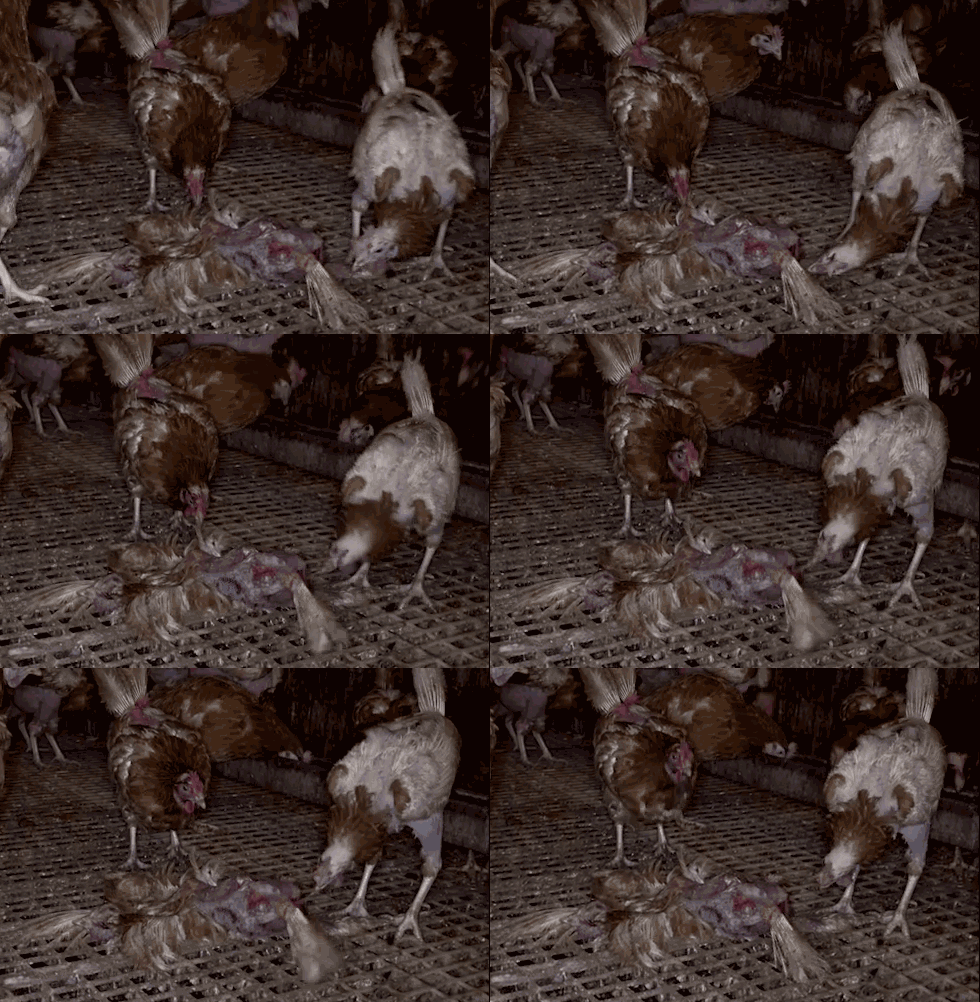
Numerous investigations have shown that on factory farms, dead and rotting animals are routinely left among the living, many with untreated injuries. Cannibalism may result from frustration and unnatural group sizes. Millions of animals die before they reach the abattoir, victims of the industry who aren’t even officially counted by the government.
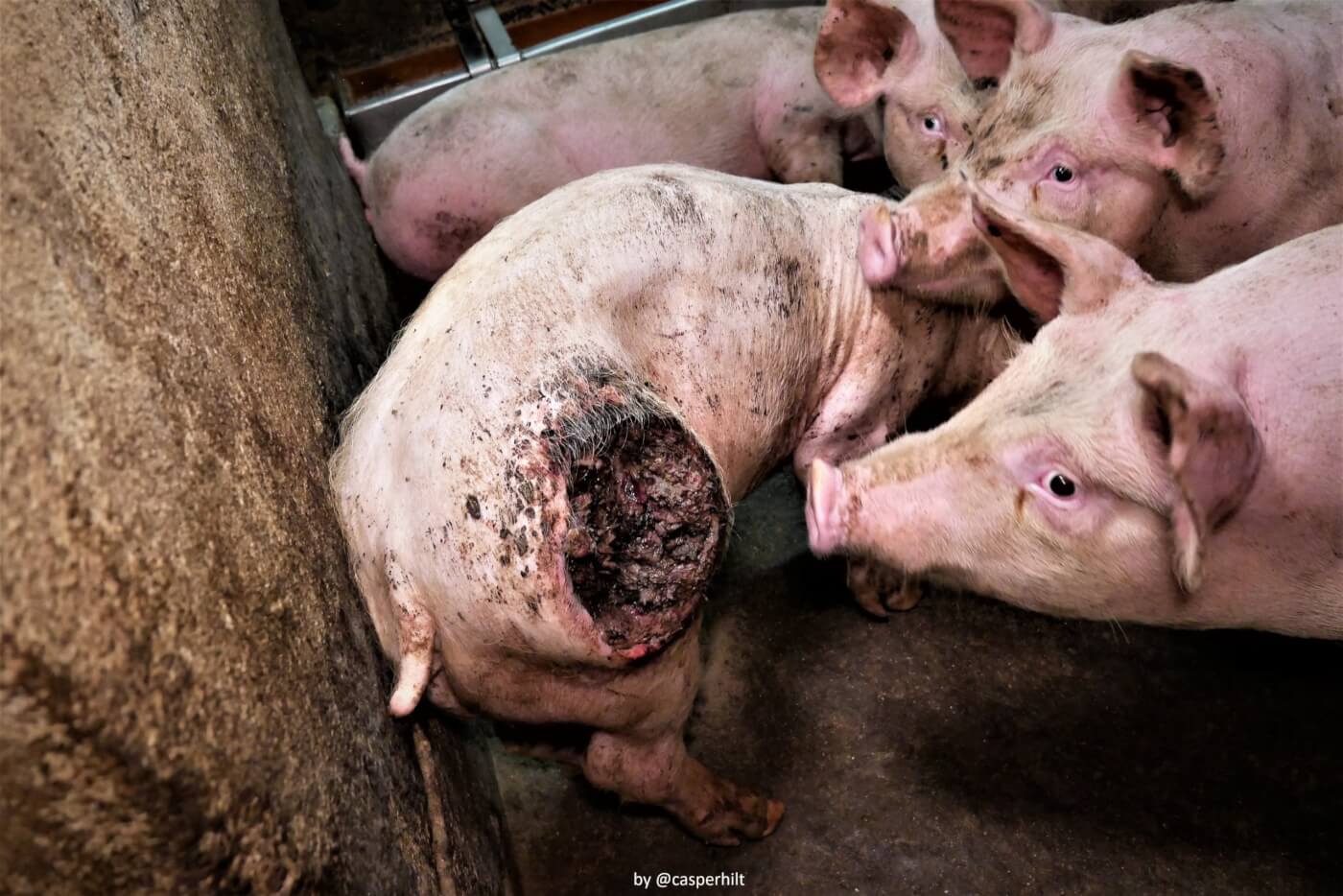 casperhilt
Human demand for meat causes huge numbers of animals to be crammed together on crowded, faeces-ridden farms; transported in filthy lorries; and slaughtered on killing floors soaked with blood, urine, and other bodily fluids. Pathogens flourish in such conditions.
To make them grow quickly and keep them alive in disease-ridden conditions that could otherwise kill them, animals on factory farms are routinely fed antibiotics. This causes a number of problems, the most worrying being the development of bacteria resistant to the antibiotics that we rely on to fight infections. According to the OECD, “agriculture accounts for over 75% of annual antimicrobial consumption in the EU and the US.”
We are playing a dangerous game. At our current rate, experts believe that by 2050, more people will die from antibiotic-resistant diseases than from cancer.
Salmonella and E. coli are also more common on intensive farms. Chickens grown unnaturally large in just 42 days experience a high level of stress that makes them more susceptible to Campylobacter infection, too, which is easily passed to humans in chicken flesh and is “the most common bacterial cause of human gastroenteritis in the world“, according to the World Health Organization. Long-distance transport of animals to slaughter further increases the risk of infection.
Given the huge population of animals living on factory farms in the UK and around the world, we are leaving ourselves vulnerable to further catastrophic disease outbreaks and pandemics.
As China finally beings to lift lockdown restrictions, the UK looks forward to the same freedom in a couple of months’ time. When we emerge into this new world, it’s imperative that we prevent future, even deadlier pandemics by ending the demand for animal-derived foods and choosing a vegan lifestyle.
Together, we must show a new respect for our planet and each other. Making kinder, more compassionate consumer choices will save human and animal lives.
Check out PETA’s recipes as well as our vegan food guide to get you through self-isolation. And don’t forget to order a free vegan starter kit to kick-start the new you post–COVID-19!
 Self-Isolation Vegan Food Guide
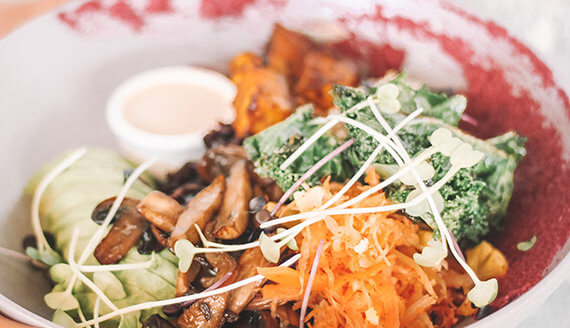 Vegan Recipes
As meatpackers rush to meet demand, their employees are starting to get COVID-19. But some workers say they’re going to work ill because they don’t have paid sick days and can be penalized for staying home.

Here’s what has happened in the meatpacking industry in the last week alone:
A federal food safety inspector in New York City, who oversaw meat processing plants, died from the illness caused by the novel coronavirus.
A poultry worker in Mississippi, employed by America’s third largest chicken company, tested positive for the virus, causing a half-dozen workers to self-quarantine. Another worker in South Dakota, employed by the world’s largest pork producer, also tested positive.
In Georgia, dozens of workers walked out of a Perdue Farms chicken plant, demanding that the company do more to protect them.
And Tyson Foods told ProPublica on Friday that “a limited number of team members” had tested positive for the disease.
As COVID-19 makes its way across the country, leading to panic grocery buying in state after state, the stresses on the nation’s food supply chain have ratcheted ever higher. But in industries like meatpacking, which rely on often grueling shoulder-to-shoulder work, so have the risks to workers’ health.
In interviews this week, meat and poultry workers, some in the country without authorization, noted with irony that they have recently been labeled “essential” by an administration now facing down a pandemic. Yet the rules of their workplaces — and the need to keep food moving — pressure them to work in close quarters, even when sick.
And it’s unclear how federal regulations that traditionally protect workers from harm in their workplaces will address a potentially deadly coronavirus.
“They are listening about social distancing on the TV and some of them try to practice it in their home, but when they go to work, they can’t do it,” said Father Roberto Mena, who ministers to many poultry workers at St. Michael Catholic Church in Forest, Mississippi.
Many of the nation’s meatpackers declined to respond to specific questions about how they’ve dealt with infected workers or what they’ve done to try to mitigate the spread of COVID-19 in their plants. Or they offered vague assurances that workers are being protected.
So far, only two meatpacking companies — Tyson Foods and Cargill — have announced companywide temperature checks to screen employees for signs of the virus. Two more say they have begun rolling them out.
But except for unionized plants, meat and poultry workers rarely get paid when they’re sick. At many companies, including Tyson, workers receive disciplinary points for calling in sick. Because points lead to termination, workers told ProPublica, they and some of their colleagues have continued to work even when sick, despite the coronavirus.
“We are all afraid,” said Maria, who works on the evisceration line at a Tyson plant in Arkansas and asked to be identified by her first name. “The problem is if people feel sick, they’re not going to say anything because they need the money. They don’t want the points.”
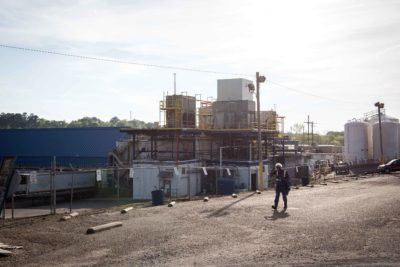
In an email, Tyson said it had recently altered its policies to allow workers who contract the coronavirus or exhibit symptoms to apply for short-term disability without a waiting period. “This is an evolving situation and we’re continuing to consider additional measures to support our team,” spokesman Worth Sparkman said. “We don’t want team members who feel sick to come to work.”
Tyson announced this month it was “eliminating any punitive effect for missing work due to illness.” But Maria said that at her plant, nothing had changed.
Despite the “essential” role meat and poultry workers play in the food chain, the sick-time bill signed by President Donald Trump last week doesn’t cover most meat and poultry workers because it exempts companies with more than 500 employees.
The uncertain economy, with millions of people filing jobless claims last week, is adding to the tension.
At Koch Foods in Mississippi, Ramirez, an undocumented Guatemalan immigrant who asked to go by his last name, said a woman who worked near him showed up for her shift last week with a heavy cough. But after she told her supervisor, he said, she was told she couldn’t come back. The message was clear, he said. So, when he started feeling sick a few days later, he simply kept quiet and continued working.
“People are worried,” Ramirez said, that if they say they are sick, “they’ll fire us.”
Going to the doctor is not an option, he said, because he doesn’t have health insurance and fears it could expose his immigration status.
Koch Foods didn’t respond to calls and emails asking about its policies for sick workers.
Even before the coronavirus, the meat industry had complained of a labor shortage as low pay and harsh conditions collided with a tight labor market, tighter borders and dramatic reductions by the Trump administration in the number of refugees, who make up the backbone of many plants’ workforce.
While there’s no evidence that the coronavirus can be transmitted through food, workers say they fear it could spread among them, even though they wear butcher coats and latex gloves, and the plants are sanitized every night.
If it does, it could take out a critical cog in the nation’s food supply chain just as it struggles to keep up with increased demand, workers and their advocates said. Grocery meat sales, excluding deli meat, surged a staggering 77% for the week ending March 15, according to one industry analysis.
To meet the demand, companies have been scrambling, adding additional weekend shifts and changing lines to produce whole birds and bigger cuts of beef. Under pressure from unions and wage increases at supermarkets and warehouses, some companies like Cargill and National Beef have announced temporary $2 per hour bonuses for the next several weeks to retain their workers and reward them for sticking through difficult times.
Company executives have said that the empty shelves aren’t a sign of a food shortage and that they’re capable of meeting the surge, aided in part by lower demand from restaurants that have been ordered to close.
“Our primary focus is to keep our plants running so that we can feed America,” Tyson’s president, Dean Banks, said on CNN. “We’re running the plants as hard as we can.”
And some analysts note that even if an outbreak of the virus forced a plant to close, the industry — with more than 500,000 employees at 4,000 slaughterhouses and processing plants across the country — is big enough to absorb the loss.
Tim Ramey, a retired food industry analyst, said “there could be significant disruptions” in a company’s output if an outbreak occurred. But supermarkets and restaurants buy meat from many suppliers, he said, and another plant could pick up the slack.
“There are plenty of ways you could have risk to the worker supply,” Ramey said. “I doubt that would be enough to disrupt the food supply.”
But no one knows what would happen if multiple plants suffered outbreaks.
The closest precedent may be immigration raids, which have temporarily shuttered meat and poultry plants periodically over the last 25 years. For months after, those plants struggled to find new workers and ramp up to speed. But the supply lines continued to feed America.
Some immigrant workers caught up in those raids now marvel that the country is leaning on them. Last summer, after finishing his shift pulling the guts out of thousands of chickens, Ramirez flipped on his TV and watched in shock as immigration agents descended on central Mississippi, rounding up hundreds of his coworkers in the Trump administration’s biggest immigration sting.
In the weeks that followed, Ramirez watched the three children of a friend who’d been detained and hunkered down at home, fearing he could be next. It was easy to feel disposable, he said, especially when Trump praised the raids as “a very good deterrent.”
Now, when Ramirez watches the news, Trump is calling workers like him “critical,” telling them, “you have a special responsibility to maintain your normal work schedule.”
“I don’t understand, if they have a big need for all of the workers,” Ramirez asked, “why aren’t they worried about us?”
The slaughtering of chickens, hogs and cattle has become increasingly automated in the last few decades. But several tasks on the disassembly line still have to be done by hand. In poultry plants, in an area known as “live hang,” workers in a small, black-lit room crowd around a trough grabbing live chickens by their feet and hanging them on shackles.
In another area known as “debone,” workers stand side by side cutting raw chicken into breasts and tenders, so close that they occasionally cut coworkers with their knives.
In pork plants, workers are so packed together that a little over a decade ago, two dozen workers at a Minnesota factory developed a neurological illness from inhaling aerosolized pig brains that drifted from a nearby station that was making an ingredient used in stir-fry thickeners.
So even as everyone from the president to Snoop Dogg are urging people to stay home and avoid groups of more than 10 people, meat and poultry workers are required to do the opposite.
ProPublica asked the nation’s largest meat companies what they were doing to try to achieve social distancing. Cargill, which produces billions of pounds of beef and turkey for supermarkets and restaurants each year, was the only company that said it was doing anything other than staggering start and break times. Daniel Sullivan, a spokesman for the Minnesota-based meatpacker, said it had increased spacing in its factory work areas and put up partitions in its cafeteria.
The evisceration line where Maria, the Tyson employee, works doesn’t have as many people as other parts of the factory because it is heavily automated. But she said that because workers can’t leave the line unless it’s an emergency, she regularly encounters large crowds as everyone rushes to the bathroom during breaks. The company has placed hand sanitizers at the entrance, she said, but inside the plant, the bathrooms don’t always have paper towels.
As COVID-19 cases at the plants become public, workers fear it’s only the beginning.
On Monday, Sanderson Farms, the nation’s third largest chicken company, said an employee at its McComb, Mississippi, plant had tested positive for the virus. Sanderson said the employee’s work area was contained to one small processing table. In response, the company notified its workers and sent six other employees in the work area home to self-quarantine with pay.
The company did not respond to calls or emails seeking additional information.
On Thursday, a worker at pork producer Smithfield Foods’ plant in Sioux Falls, South Dakota, tested positive. The company told the Argus Leader that the employee’s work area and all common areas were “thoroughly sanitized.” But it did not say anything about workers who might have come in contact with the employee.
There have been even fewer details about the federal food safety inspector who died. U.S. Agriculture Secretary Sonny Perdue said in a statement that he was “terribly saddened to hear” that one of the department’s employees had passed away due to the coronavirus and thanked “those working on the front lines of our food supply chain.” But the department did not specify which plants the inspector had worked in or what had been done to alert or quarantine others the inspector may have been in contact with.
Paula Schelling, a union representative for the nation’s food inspectors at the American Federation of Government Employees, said the USDA’s Food Safety and Inspection Service needs to do more to protect its front-line workers.
“FSIS is doing nothing to provide any protection for any employee who is out in the field,” she said. “They are just saying, ‘We are following the CDC guidelines.’ What does that mean to us?”
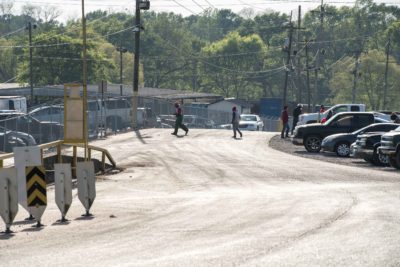
Concerns that meat companies aren’t being forthcoming have already led to increased anxiety at several plants. Workers who walked out of the Perdue plant in Georgia said the unrest started because supervisors dismissed concerns that some employees were continuing to work despite being in contact with people who had the coronavirus.
“We’re not getting nothing,” Kendilyn Granville told a TV news reporter outside the plant Monday night. “No type of compensation, no nothing, not even no cleanliness, no extra pay — no nothing. We’re up here risking our life for chicken.”
Perdue spokeswoman Diana Souder said that after speaking with managers, the majority of those who walked out returned to work.
“We know that many are feeling anxious during these uncertain times and we’re doing everything we can to take good care of our associates while continuing to produce safe and reliable food,” she said.
Typically, when workers feel unsafe, they can complain to the Occupational Safety and Health Administration. But it’s unclear how OSHA will respond to complaints related to the coronavirus. The agency, which has seen its ranks depleted under the Trump administration, has issued guidance for employers. But there is no specific standard related to the virus, and the agency has not said how it might interpret its general duty clause, which requires employers to keep their worksites free from recognized hazards that might cause death or “serious physical harm.”
Employers are only required to notify OSHA when an employee is hospitalized, suffers an amputation or is killed at work. But under a patchwork of rules, some employers might have to notify their state and local health departments.
As cases started to pop up this week, some employers began offering additional pay. Perdue said it would provide all hourly workers a $1-per-hour raise for the next several weeks. Hormel, the maker of Spam, said it would offer a $300 bonus for full-time workers and $150 for part-time associates.
On Thursday, the United Food and Commercial Workers, which represents 250,000 food processing workers, said it had negotiated additional pay and benefits increases, including a $600 bonus in May for its members at the nation’s second-largest meatpacker, JBS, which includes Pilgrim’s chicken. JBS spokesman Cameron Bruett did not answer whether the company would match that for nonunion employees.
Several large meat and poultry companies, including Tyson, Smithfield, Sanderson and Koch, have not announced raises or bonuses.
On Friday, Perdue told ProPublica it was starting to roll out temperature checks at its plants. And Bruett said JBS had set up “triage stations” outside plants to screen employees for temperature and symptoms. But it’s unclear if all employees will be tested or only those exhibiting symptoms.
Meanwhile, Venceremos, a group advocating for poultry workers in northwest Arkansas, has started a petition asking that Tyson and other processors provide paid sick leave for workers as the coronavirus begins to spread to rural America.
“Everyone is realizing that they are essential and have been essential to the country,” said Magaly Licolli, one of the group’s leaders. “And now it’s time that everybody should demand fair rights for them. That’s what we’ve been arguing all this time. They are the ones that provide for the country.”
Do you have access to information about how businesses are protecting — or not protecting — workers from the coronavirus that should be public? Email michael.grabell@propublica.org. Here’s how to send tips and documents to ProPublica securely.


|
|||||||||
|
by Imelda Abano on 4 March 2020
Illegal wildlife trafficking remains a perennial problem in Southeast Asia, but with the ongoing spread of the new coronavirus, there’s added impetus for governments in the region to clamp down on the illicit trade.
The coronavirus disease, or COVID-19, has infected more than 90,000 people worldwide and killed more than 3,000, according to the World Health Organization.
Initial findings, though not conclusive, have linked the virus to pangolins, the most trafficked mammal on Earth and one of the mainstays of the illegal wildlife trade in Southeast Asia that feeds the Chinese market.
Despite having a regional cooperation framework designed to curb wildlife trafficking, Southeast Asian governments have yet to agree on and finance a sustainability plan to strengthen efforts against the illegal trade.
MANILA — Governments across Southeast Asia have vowed to strengthen cooperation in curbing the illegal wildlife trade, suspected to have sparked the novel coronavirus epidemic. The issue will be at the top of the agenda at the Biodiversity Conference in Kuala Lumpur later this month.
“What needs to be enhanced is more collaboration to address wildlife trafficking at a multi-country or at the regional level,” said Theresa Mundita-Lim of the ASEAN Centre for Biodiversity (ACB), an institute under the auspices of the Association of Southeast Asian Nations. “The region is ready to step up efforts to curb illegal wildlife trade.”
As of March 3, there were 90,893 reported cases of the coronavirus disease, or COVID-19, around the world, with 3,110 deaths, according to the World Health Organization. Cases have been reported in 80 countries, but the majority are in China. The virus is believed to have originated from a market in the central Chinese city of Wuhan that sold exotic live mammals, including bats and civets — previously linked to the spread of a similar disease, SARS, in 2002.
In the less than three months since the first case was detected last December, the WHO has raised the epidemic’s global risk assessment to “very high.” Various countries have declared public health emergencies, imposed travel bans, and implemented strict quarantine stations in efforts to contain the virus. Disruptions to tourism, aviation, manufacturing and other economic activity are expected to throttle back global economic growth from a projected 2.9% this year to 2.4%, according to the Organisation for Economic Co-operation and Development.
With China’s recent move to ban the wildlife trade and consumption, officials say it’s about time ASEAN unify against wildlife trafficking, especially as reports point to a sophisticated network of illegal wildlife trade routes from Southeast Asia to China’s wildlife markets.
As early as 2003, the region started exploring solutions to wildlife trafficking after Thailand admitted to being a wildlife trade hub, open source data fusion center Analytical Center of Excellence on Trafficking
(ACET) says in its latest report. With China entering the crackdown a decade later, Southeast Asia has seen an increase in reported cases, and thousands of seizures, arrests and prosecutions.
A sunda pangolin (Manis javanensis) is a species native to Southeast Asia. Image by Dan Challender/Save Vietnam’s Wildlife
This, however, has not been enough for the region to support a sustainability plan against wildlife trafficking, which involves each member state committing $15,000 a year. The stalemate is due in part to the bloc’s consensus voting rule. “As ASEAN is based on consensus, it only takes one out of ten members to veto a motion,” the report says.
“For nine years, Malaysia cast that vote of opposition. When Malaysia finally agreed to join the majority to support a sustainability plan, a new and surprising vote of opposition appeared: Thailand.”
But as the COVID-19 epidemic spreads, it might tip the scales and prompt ASEAN governments to support the sustainability plan and implement stringent policies to protect native species. This would also be in line with stronger measures that governments are expected to take after the lapse of the 2020 Aichi Biodiversity Targets, including the creation of heritage parks and protected areas.
“Actions on transboundary cooperation and promoting sustainable livelihoods in and around ASEAN heritage parks and natural habitats will help stop the reliance of local communities to poaching, overharvesting and illegal trading of wildlife and their by-products as means to earn income,” Mundita-Lim said.
Among the animals that need to be protected are the little-known pangolins, the most trafficked mammal in the world and which have been identified as a possible vector of the coronavirus. Recent studies have found high genomic similarities between the novel coronavirus and a virus found in pangolins, but these studies remain inconclusive. Being linked to the epidemic, however, increases the threats to these docile species as people might kill them en masse — similar to what happened to civets after the SARS outbreak, Nature reports.
Populations of these scaly mammals in the region have dwindled drastically due to heavy poaching activities in the past two decades, according to the international wildlife trade monitoring group TRAFFIC.
A TRAFFIC report released last month estimated that around 895,000 pangolins were smuggled in Southeast Asia from 2000 to 2019.
Range of the four Asia pangolin species: the Chinese, Indian, Sunda and Philippine pangolins. A mix of colors within the maps indicates an overlap in the different species’ distributions. The species’ ranges are based on the IUCN Red List assessments (IUCN 2014). Note: The distribution maps are currently being updated by the IUCN Pangolin Specialist Group. Image courtesy of University of Adelaide/TRAFFIC.
Image courtesy of University of Adelaide/TRAFFIC
There are eight pangolin species in the world, four native to Africa and four to Asia. All the Asian species are declared critically endangered by the IUCN, including the two species native to Southeast Asia: the Sunda pangolin (Manis javanica) and the Philippine pangolin (Manis culionensis).
Populations of both the Sunda and the Philippine pangolins remain unknown but are assumed to be decreasing rapidly. In Palawan province, the only place where the Philippine pangolin occurs, only 17 individuals were spotted in a 2019 survey that covered 2,400 hectares (5,930 acres) of the 165,000-hectare (407,700-acre) Victoria-Anepahan mountain range in the town of Rizal. The survey, part of USAID’s Protect Wildlife project, noted the decline in pangolin sightings in the province.
“Pangolin poaching and trafficking continue as long as there is a demand from active buyers, both foreign and local,” the report says, adding that limited information on pangolins “hampers the ability of conservationists and local authorities to establish proper baselines for protecting the remaining pangolin strongholds in the wild.”
Reports of rampant trafficking prompted international wildlife trade regulator CITES to bump pangolins into the highest bracket of protection in 2016 by banning all international trade in the species. In spite of this, however, trafficking of pangolins and pangolin parts (scales, meat and blood) continue; the biggest and most recent seizure was of 9 tons of pangolin scales, taken from approximately 14,000 pangolins from Africa, and intercepted in Hong Kong in early 2019.
Prior to the ban, pangolins were openly shipped in the region, often smuggled alongside parts from tigers and hawksbill sea turtles, both threatened species. “Pangolins were sourced and openly shipped from Indonesia, with smaller loads gathered in Cambodia, Thailand, Myanmar, Malaysia and the Philippines,” ACET’s latest report states. “Since prices in pangolins were modest, the volume of trade was also relatively low and seemingly sustainable.”
The trafficking ring in the region follows an intricate maze, ACET’s report says, with animals sourced from Indonesia and Malaysia transiting through Cambodia, Thailand, Laos and Vietnam until it enters China.
“Live animals and body parts were sent to Yunnan and Guangdong by road, ship and eventually by air to Kunming, Guangzhou and Hong Kong,” the report says.
A pangolin, meaning the “one who rolls up” in Malay, balls up in its characteristic defensive posture. Image courtesy of Priyan Perera
The illicit trade has since been intertwined with that of illegal drugs and other contraband, making it challenging for security forces to crack down on shipments. Indonesian authorities described the region’s illegal wildlife trade as being as sophisticated as the drug trade, according to the Global Environmental Reporting Collective’s The Pangolin Reports.
In the Philippines, the Palawan Center for Sustainable Development
(PCSD) has identified a transnational route that starts at the port of Balabac in southern Palawan and heads north to the island of Mindoro and across to the port of Batangas before exiting the archipelago.
While crackdowns on illegal wildlife trafficking continue on a top-down model, groups on the ground have also initiated efforts to engage communities against poaching not just of pangolins but other trafficked mammals in the region.
“Communities can be front-liners in the fight against poaching of pangolins and wildlife by organizing community-based efforts to protect their forests, support enforcers on the ground, and advocate for and spread the word about the importance of protecting wildlife and their habitats,” said Rebecca Paz, chief of party for USAID’s Protect Wildlife project. “We also need to look into boosting opportunities for viable and sustainable livelihoods in these communities to dissuade them from engaging in illegal practices that are harming wildlife and other natural resources.”
A wet market, where animals are freshly slaughtered rather than chilled was identified as the source of the coronavirus outbreak. But experts have long warned of dangers

Each evening, under cover of darkness, hundreds of live pigs from farms across China are trucked through the rusting gates of a cluster of mildew-stained quarantine and inspection buildings in the Qingshuihe logistics zone in Shenzhen.
Overnight they are checked for illness, primarily the African swine fever (ASF) that is expected to kill off a quarter of the world’s pigs, and reloaded on to ventilated trucks with dual mainland China and Hong Kong licence plates.
Before sunrise the caravan makes its way five-and-a-half miles south to the border at Man Kam To, a small customs and immigration checkpoint, where the pigs go through further visual health checks before crossing into Hong Kong.
They are bound for Sheung Shui slaughterhouse, the largest of three abattoirs in the territory. Once there they will be checked again before being dispatched in less than 24 hours under new rules meant to prevent the spread of ASF.
It’s a lot of effort to get fresh meat from the 1,400 pigs that cross the border each day.
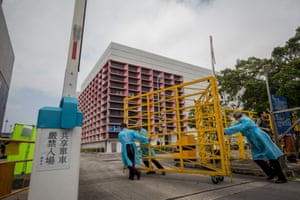
For various reasons, the Chinese prefer freshly slaughtered pig, chicken and beef over chilled or frozen meat that has been slaughtered before being shipped.
That desire is at the heart of why diseases such as avian flu in poultry and ASF have been so difficult to eradicate, with huge movements of live animals from all over the country – from farm to slaughterhouse to market – on a daily basis making controlling the spread of disease incredibly difficult.
A recent coronavirus outbreak in China has been linked to a wet market in Wuhan, eastern China. Like other respiratory illnesses, the disease was initially transmitted from animal to human, but is now being passed human to human.
But despite awareness of the issues, the markets are a huge part of Chinese life. On a busy morning at a so-called “wet market” in the Shajing area, the oldest inhabited and very Cantonese part of Shenzhen, hundreds of shoppers arrive soon after daybreak. Slabs of pork hang from the stalls and various cuts are piled on the counters amid lights with a reddish glare and the occasional buzzing of flies.
Just a few minutes away at the nearby Walmart, where there are also options for fresh, chilled and frozen meat, the customer flow at this time of day is only a trickle compared to the wet market. It has your average western supermarket vibe – white daylight lighting, sterile and clean.
Staff at the meat counter in Walmart and at the stalls in the wet market both say the meat comes in from the same slaughterhouse around 2am. So why the huge difference in foot traffic?
Molly Maj, a corporate communications representative for Walmart, says “the average customer in China still prefers fresh meat” over other options.
One reason for the demand for wet markets is that widespread refrigeration only came to China in recent years. While most urban homes now have refrigerators, many in rural areas and low income urban renters still do not own one, or only a mini-fridge if they do.

The habit of buying perishable food for daily use is still prevalent in many consumers, particularly older shoppers who grew up without refrigerators. They say they can tell the quality of fresh meat by its smell, colour and how it feels to the touch.
“When I’m talking with my students I say: ‘The term warm meat, fresh meat, sounds disgusting to me, I grew up [in Germany] with chilled meat, that’s all I know,” Dirk Pfeiffer, a professor of veterinary medicine at City University in Hong Kong and an expert on diseases related to animal husbandry, says.
If you or someone you know has expertise in this field, we would like to hear from you. You can get in touch by filling in the form below, anonymously if you wish. Only the Guardian can see your contributions and one of our journalists may contact you to discuss further.
“So I ask them why and they come up with all sorts of vague things like the soup tastes better or that it is a trust issue, knowing it is a live animal at the other end and not some diseased animal,” he says. “It’s all very subjective.”
Wet markets are central to the perception that fresh meat is better, says Pfeiffer. They evoke nostalgia among shoppers, many of whom come from rural areas where all they knew were wet markets and no refrigeration.
Where a wet market feels familiar a supermarket can seem alien and out of place.
“I actually believe that it is an important thing for the older generation to go to the wet market and chat,” says Pfeiffer. However, the way the animal trade operates in China is “an utter disaster”, for animal disease and welfare, he adds.

A year ago, before rising concerns about the spread of ASF, nearly 4,000 pigs crossed daily with less scrutiny. Pigs were held in dismal conditions for as long as five days before being slaughtered on the Hong Kong side, greatly enhancing the possibility of disease transmission, says Pfeiffer.
The recent shortages due to the ASF outbreak have doubled and tripled prices for fresh pork at wet markets across Hong Kong. Farms in Hong Kong itself can usually supply about 300 pigs a day. Land use and environmental restrictions prevent any increase in production. The result is further worries about Hong Kong’s reliance on mainland China beyond its water and energy dependence.
“Many years ago, we had imports from all over Asia of live animals, but eventually the entire supply was monopolised by mainland China,” said Helena Wong, a member of Hong Kong’s legislative council panel on food safety and environmental hygiene. “They killed all their competitors and monopolised the supply of live pig and chicken.”
More than 6,000 pigs at the Sheung Shui slaughterhouse were culled in May 2019 after ASF was found among animals brought in from China. Hong Kong’s legislative council is now trying to figure out how much it owes traders and farmers in compensation.
Massive culls of poultry due to avian flu in imported mainland chickens in the last decade also led to large compensation bills and, eventually, to ending live chicken imports in early 2016.
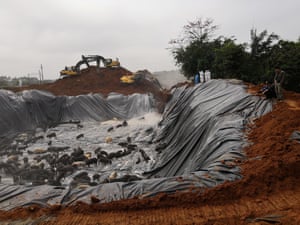
“We as taxpayers have to give that money,” said Wong. “So now we are in a big crisis because in the past few years we have experienced avian flu and now African swine fever.”
Disease outbreaks have raised wider questions about the sustainability of Chinese consumers’ appetite – both on the mainland and in Hong Kong – for what is often called “warm” meat.
For Deborah Cao, a professor at Griffith University in Australia and an expert on animal protection in China, a deeper issue driving the live animal trade is a cultural disconnect about animal welfare.
“The main problem is the indifference or perception of people who simply regard animals as food, tools, or as things that people can do anything they want to,” she said.
“In particular, there is no perception of farm animals as having feelings, or being capable of feeling pain or suffering.”
Hong Kong may find it difficult to switch to a different model. There is almost no chance of farm expansion to support larger scale production within Hong Kong and, although the government is looking at possibilities of live imports from other Asian countries, the ports do not have adequate facilities to cope with large numbers.
“To a large extent, if we insist on fresh food, we have to rely on China,” said Wong. “If we can change and make certain concessions, Hong Kong has always been an open market for importing food items from many parts of the world. It is only for the provision of live animals that we are monopolised by the mainland farms.”
Reporting assistance from Zhong Yunfan.

 Exposing the Big Game