Exposing the Big Game

Forget Hunters' Feeble Rationalizations and Trust Your Gut Feelings: Making Sport of Killing Is Not Healthy Human Behavior

Exposing the Big Game

Black market for live chickens thrives in China despite bird flu bans

Vans stocked with live poultry can be found down alleyways in the southern city of Guangzhou, with customers shrugging off the health risks

PUBLISHED : Monday, 27 February, 2017

Guangdong housewife Zhang Yi makes no compromises on the quality of chicken for her Sunday family feasts.

Once a week, Zhang scours the narrow alleyways near the Wancongyuan wet market in Guangzhou’s Haizhu district.

The market has four poultry stalls but she disregards them all because she, like many other cooks in the city, is a diehard devotee of freshly slaughtered chicken – something that even the deadly H7N9 bird flu outbreak has failed to dampen.

Freshly slaughtered chicken has been off the official menu in downtown Guangzhou for more than a year but Zhang combs the alleys looking for signs of black market poultry on offer. One signal could be a temporary boiler set up on a quiet side street.

“These mobile vendors are always on the move. They don’t stay in the same spot to avoid being caught,” Zhang said.

“Some operate from a van so they can drive away the moment inspectors turn up.”

Guangzhou introduced a five-year live poultry ban in 2015, with the restrictions applying to various downtown districts, including Yuexiu and parts of Haizhu, Tianhe, Baiyun and Liwan.

Under the ban, wet market vendors are only allowed to sell chilled chickens killed at a central slaughterhouse – a deeply unappetising prospect for the city’s “Lao Guang”, or long-time ­residents.

The poultry trade has also been banned at wet markets citywide for cleaning between the 16th and 18th days of January, February and March.

The aim of the bans is to contain the spread of bird flu. Since January, the H7N9 strain of the virus has killed at least 94 people across the country – the highest death toll since the first known case of human infection in 2013.

Most of the fatalities have been in the Pearl and Yangtze river delta areas.

In January alone, Guangdong reported 21 cases of H7N9, 10 of them fatal. That compares with 10 in the first two months of 2015 and 16 a year earlier.

Since January, human deaths and infections from H7N9 have been reported in 16 provinces and municipalities, according to the National Health and Family Planning Commission. Elsewhere in Asia, Taiwan, Japan and South Korea are battling bird flu outbreaks.

Analysts said the spike was probably partly caused by greater human exposure to infected poultry before and during the Lunar New Year festive season, with more people shopping for poultry, especially live birds. The H7N9 virus shows little or no clinical symptoms in poultry, complicating detection.

The spread of the strain has prompted authorities throughout the country to step up containment efforts going into the peak season for the virus.

Some Guangzhou wet markets, like the ones in Yuexiu district, have been banned from trading in poultry for the rest of this month. Live poultry markets have also been shut down in Zhejiang and various cities in Jiangsu. Parts of Guangdong, including Shenzhen, Zhuhai, Foshan, Dongguan and Zhongshan in the Pearl River Delta, have made similar prohibitions.

In some other high-risks areas such as Anhui province, where 23 deaths have been reported this winter, various cities and counties were ordered to restrict the live poultry trade.

Shanghai authorities have gone a step further by suspending the live poultry trade from January 28 until the end of April. Despite occasional reports suggesting the black market live poultry trade has been spotted in the city, the city’s health department reported only five cases of human infection last month.

But in Guangzhou, the fresh chicken black market is well and alive, with customers prepared to take the risk and pay around 60 yuan (HK$68) per kilogram for the illicit product. That compares to the 80 or so yuan more demanding customers will pay at the Wancongyuan wet market for the best chilled chicken processed by a slaughterhouse.

Zhang said she knew the black market was a health risk and tried to minimise her chances of contracting the virus. “It’s always dirty in the alleyways. Guts and feathers are scattered everywhere – you can’t expect much hygiene. We usually just point at the chicken we want and come back for it after the vendor was done processing it,” she said. “It’s OK as long as we don’t touch it.”

Zhang said she was not convinced that a sweeping ban on the live trade could ever be effectively implemented.

“Guangzhou, let alone the entire Guangdong province, is too big for a blanket ban,” she said.

“Guangzhou has been trying to sort out its rubbish problem for the past seven years and has failed miserably. They can’t ban live chickens.”

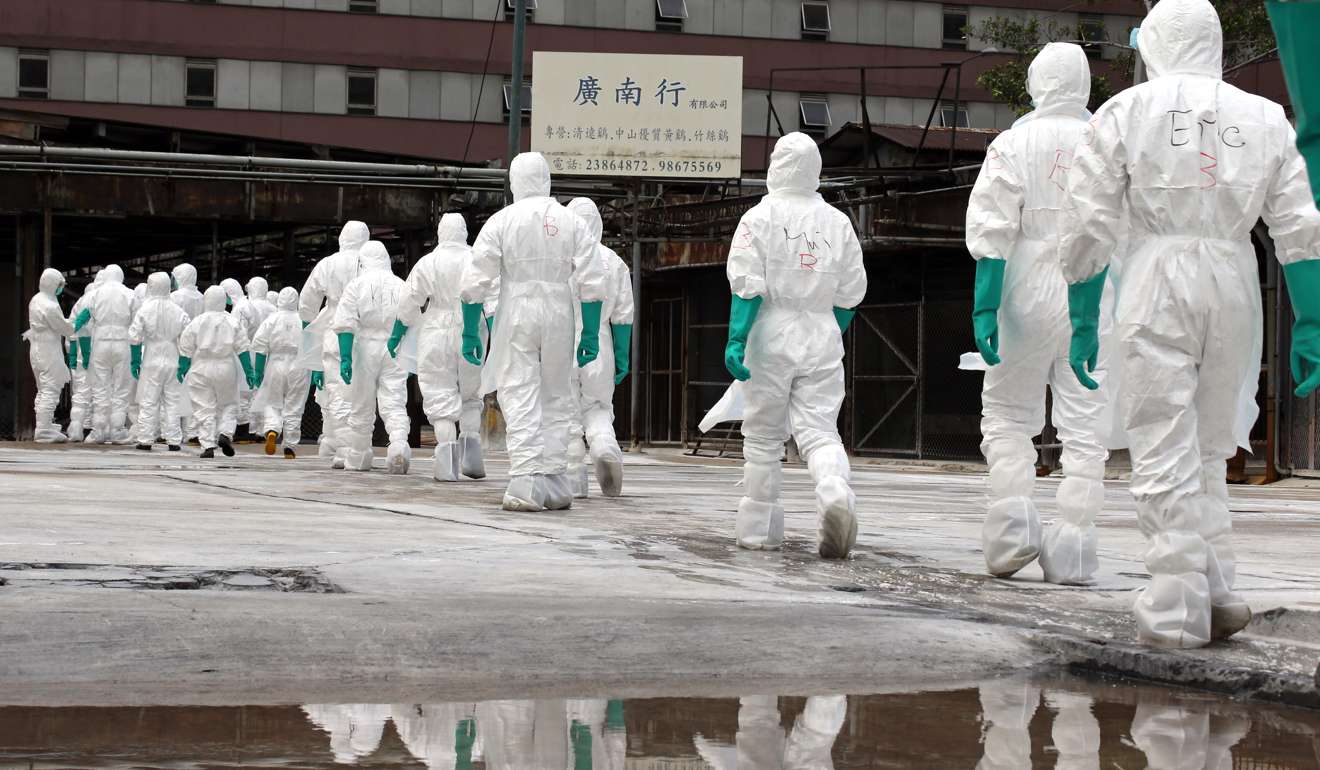
As bird flu outbreaks become more common in China and elsewhere, scientists debate the underlying cause

 http://www.scmp.com/news/china/policies-politics/article/2074048/bird-flu-outbreaks-become-more-common-china-and

Experts argue whether blame for spread of virus lies with factory farming or live poultry markets

PUBLISHED : Sunday, 26 February, 2017, 8:01am

The answer to whether industrial-scale poultry farming is responsible for bird flu differs depending on who you ask – a virologist or a geographer.

In a book published last month, Stephen Hinchliffe, a professor of human geography at the University of Exeter in Britain, argues that mass livestock production is driving molecular changes in diseases that could lead to human pandemics.

According to the United Nations Food and Agriculture Organisation (FAO), the world raised more than 21 billion chickens in 2014, up from 19 billion in 2011, or about three fowls for every person on the planet. The bulk of that production came from the United States, China and Europe.

Rapidly rising global poultry numbers, along with selective breeding and production techniques that have dramatically altered the physiology of chickens and other poultry, have made the planet more “infectable”, Hinchliffe and three co-authors argue in their book, Pathological Lives: Disease, Space and Biopolitics.

 A combination of factors ranging from virus evolution to economics places humans and animals at risk, they say.

But other researchers say poultry farms are just victims. The biggest culprits in the spread of bird flu viruses, they say, were the live poultry markets in China and Southeast Asia, which should be reformed if not eliminated.

More than 90 people on the mainland have died in the latest seasonal outbreak of H7N9 bird flu. Taiwan has also began culling hundreds of thousands of domestic birds to contain the spread.

Hinchliffe argues that the bird flu crisis stems from “our economies and modes of organising life”.

“We question the sustainability and security of the kinds of intensive protein production that are being rolled out across the planet,” Hinchliffe said.

Some current forms of bird flu can infect people. Some scientists warn that the current “swarm” of flu viruses in circulation are cause for heightened concern.

“Avian flu has been around for a long time, circulating in wild birds without being too much of an issue. But as inexpensively produced protein-rich diets become a worldwide norm, poultry populations, growth rates and metabolisms have changed accordingly,” Hinchliffe said.

Economic considerations were driving selective breeding, feed and dietary supplements, and sometimes the inappropriate use of pharmacueticals, especially antibiotics.

“Raising a bird to market weight takes a third of the time it did 30 or so years ago, with the result that disease tolerance is often compromised,” he said.

“Between that and sheer numbers, flock densities and global connectivity, humans have created a new set of conditions for viral selection and evolution.

“As any epidemiologist will tell you, a microbe can only become deadly or pathogenic if there are the right environmental and host conditions.

“Bird numbers and altered bodies have, in short, made the planet more ‘infectable’,” Hinchliffe said.

Dr Chen Quanjiao, associate researcher of bird flu epidemiology at the Wuhan Institute of Virology, under the Chinese Academy of Sciences, disagreed.

The detection rate of bird flu at poultry farms was usually “very low”, she said. Farmers regularly jabbed birds with vaccines and erected nets to fence out wild species.

The outbreak of bird flu happened in live poultry markets where birds from different places were kept in the same cages, sometimes for days, which gave the virus a chance to mutate and spread to humans.

“Hong Kong has implemented a very effective method to regulate its live poultry market. If other places in China and Asia can follow Hong Kong’s practice, we can significantly reduce the risk,” Chen said.

Bird flu strain hitting China may be getting more infectious

Threatwatch is your early warning system for global dangers, from nuclear peril to deadly viral outbreaks. Debora MacKenzie highlights the threats to civilisation – and suggests solutions

GettyImages-635563542

STR/AFP/Getty

Another bird flu is on the rampage in China. Already this winter there have been 424 cases in humans, more than a third of all those identified since the virus emerged in 2013. And it is spreading. This week it was announced that it seems poised to acquire mutations that could make it a much worse problem.

H7N9 first started infecting people in China in 2013. Like its cousin H5N1, the virus that drew attention to bird flu in 2004, it mainly infects birds and doesn’t readily pass from human to human – but should it acquire this ability a deadly pandemic could ensue.

H7N9 seems to jump to people from poultry more easily than H5N1, staging regular winter outbreaks in the last 4 years. By mid-2016 there were 798 known cases, and around 40 per cent of the people died. But since last October alone, there have been 424, the most ever seen in one season – and it isn’t over yet.

“I suspect the spike in cases of H7N9 is real,” says Malik Peiris of Hong Kong University, and not due to better diagnosis. He thinks the jump is due to an increase in poultry infections. Tests in poultry markets are finding H7N9 more often, he says, and it is spreading: this winter has seen human cases in 18 provinces of mainland China, including for the first time in southern Yunnan province, and it could spread to Vietnam from there.

When people fall ill

But we only know this because someone in Yunnan became severely ill with the virus. H7N9 spreads in poultry without making birds visibly sick. It is often only discovered when people fall ill.

Most were exposed to the virus in live poultry markets. Despite calls to close them, public demand for freshly killed chicken keeps markets open – although four of the hardest-hit provinces in China have now temporarily closed some markets.

But H7N9 could be coming out of hiding. This week both mainland China and Taiwan reported human cases in which the virus’s haemagglutinin surface protein had a mutation that makes it lethal to chickens. This would make it a “highly pathogenic” bird flu like H5N1 and its descendants such as H5N8, which is killing birds across Eurasia.

While the mutation doesn’t affect illness in people, it allows the virus to replicate much faster in chickens. If the mutation spreads in poultry, as it has with other kinds of bird flu, H7N9 will rip through flocks, making its presence much easier to spot.

But the trouble is these sick birds will shed much more of the virus, meaning more cases in people and perhaps other mammals such as pigs, each an opportunity for H7N9 to adapt to mammals and learn to spread from person to person. H7N9 already has some of the mutations thought to be required before bird flu can do this, and it is already capable of limited spread between ferrets, the best animal model for human flu.

There could also be more cases of H7N9 in people than we think, says Ab Osterhaus of the Research Centre for Emerging Infections and Zoonoses in Hannover, Germany. Usually, only people sick enough to require a trip to hospital are tested to see which virus they have.  Two of the cases reported by the World Health Organisation this week were mild, but the individuals were tested because of exposure to known cases. There could be many more mild cases.

Our only real defence, say the virologists, is a vaccine. The WHO has approved eight vaccine strains of H7N9, and last week China launched clinical trials of four strains by a state-owned vaccine company.

But even if the trials are successful, WHO officials admit that we still have no means of making enough flu vaccine in time to protect large numbers of people, should H7N9, or any other flu virus, go pandemic.

Spread of H7N9 Bird Flu Worries Officials in China

As many as 79 people died from H7N9 bird flu in China last month, the Chinese government said, stoking worries that the spread of the virus this season could be the worst on record.

January’s fatalities were up to four times higher than the same month in past years, and brought the total H7N9 death toll to 100 people since October, data from the National Health and Family Planning Commission showed late on Tuesday.

Image: Chickens
An Iowa-based chicken broiler breeding farm has initially tested positive for the highly pathogenic h5 bird flu. AP

Authorities have repeatedly warned the public to stay alert for the virus, and cautioned against panic in the world’s second-largest economy.

Related: CDC Issues Bird Flu Warning

But the latest bird flu data has sparked concerns of a repeat of previous health crises, like the 2002 outbreak of Severe Acute Respiratory Syndrome (SARS).

“It’s mid-February already and we are just getting the January numbers. With the death rate almost catching up with SARS, shouldn’t warnings be issued earlier?” said one user of popular microblog Sina Weibo.

Other netizens in the Chinese blogosphere worried about the pace of infections, and called for even more up-to-date reports.

The People’s Daily, the official paper of the ruling Communist Party, warned people in a social media post to stay away from live poultry markets, saying it was “extremely clear” that poultry and their excrement were the cause of the infections.

Related: Watch Out for H7N9 Bird Flu, WHO Says

“The situation is still ongoing, and our Chinese counterparts are actively investigating the reported cases,” the World Health Organization’s China Representative Office said in an emailed statement to Reuters.

“As the investigation is ongoing, it is premature to conclusively identify the cause for the increased number of cases. Nevertheless, we know that the majority of human cases got the A(H7N9) virus through contact with infected poultry or contaminated environments, including live poultry markets.”

China, which first reported a human infection from the virus in March 2013, has seen a sharp rise in H7N9 cases since December. The official government total is 306 since October, with 192 reported last month.

But others believe the number of infections is higher.

The Center for Infectious Disease Research and Policy (CIDRAP) at the University of Minnesota last week estimated China had at least 347 human infections so far this winter, eclipsing the record of 319 seen three years ago.

“An important factor in the past waves of H7N9 cases among humans in China has been rapid closure of live poultry markets,” said Ian Mackay, a virologist at the University of Queensland in Australia.

“This season there seems to have been a slower response to the outbreak, which may be leading to greater numbers of human exposures to infected birds.”

Related: H7N9 Bird Flu Spreads Like Ordinary Flu

The National Health and Family Planning Commission has yet to respond to a request from Reuters seeking comment on the recent bird flu deaths.

Most of the H7N9 human infections reported this season have been in the south and along the coast.

In Hong Kong, where two of the four patients infected with H7N9 this winter have died, health officials said they would step up checks at poultry farms.

H7N9 had spread widely and early this year, but most cases were contained in the same areas as previous years, including the Yangtze River Delta and Guangdong, Shu Yuelong, head of the Chinese National Influenza Center, told state radio.

Beijing on Saturday reported its first human H7N9 case this year. The patient is a 68-year-old man from Langfang city in neighbouring Hebei province.

A second human case was reported on Tuesday.

“It is highly likely that further sporadic cases will continue to be reported,” the WHO said.

“Whenever influenza viruses are circulating in poultry, sporadic infections or small clusters of human cases are possible.”

Proliferation of bird flu outbreaks raises risk of human pandemic

Reuters

A man shops for eggs imported from the United States as South Korea scrambles to boost imports to relieve a shortage amid its worst-ever bird flu outbreak, at a market in Seoul on Monday.

ReutersLONDON (Reuters) — The global spread of bird flu and the number of viral strains currently circulating and causing infections have reached unprecedented levels, raising the risk of a potential human outbreak, according to disease experts.

Multiple outbreaks have been reported in poultry farms and wild flocks across Europe, Africa and Asia in the past three months. While most involve strains that are currently low risk for human health, the sheer number of different types, and their presence in so many parts of the world at the same time, increases the risk of viruses mixing and mutating — and possibly jumping to people.

“This is a fundamental change in the natural history of influenza viruses,” Michael Osterholm, an infectious disease specialist at University of Minnesota, said of the proliferation of bird flu in terms of geography and strains — a situation he described as “unprecedented.”

Global health officials are worried another strain could make a jump into humans, like H5N1 did in the late 1990s. It has since caused hundreds of human infections and deaths, but has not acquired the ability to transmit easily from person to person.

The greatest fear is that a deadly strain of avian flu could then mutate into a pandemic form that can be passed easily between people — something that has not yet been seen.

While avian flu has been a prominent public health issue since the 1990s, ongoing outbreaks have never been so widely spread around the world — something infectious disease experts put down to greater resilience of strains currently circulating, rather than improved detection or reporting.

While there would normally be around two or three bird flu strains recorded in birds at any one time, now there are at least half a dozen, including H5N1, H5N2, H5N8 and H7N8.

The Organization for Animal Health (OIE) says the concurrent outbreaks in birds in recent months are “a global public health concern,” and the World Health Organization’s director-general recently warned the world “cannot afford to miss the early signals” of a possible human flu pandemic.

The precise reasons for the unusually large number and sustained nature of bird outbreaks in recent months, and the proliferation of strains, is unclear — although such developments compound the global spreading process.

Ian MacKay, a virologist at Australia’s University of Queensland, said the current proliferation of strains means that “by definition, there is an increased risk” to humans.

“You’ve got more exposures, to more farmers, more often, and in greater numbers, in more parts of the world — so there has to be an increased risk of spillover human cases,” he told Reuters.

Nearly 40 countries have reported new outbreaks of highly pathogenic avian influenza in poultry or wild birds since November, according to the WHO.

In China, H7N9 strains of bird flu have been infecting both birds and people, with the human cases rising in recent weeks due to the peak of the flu season there. According to the WHO, more than 900 people have been infected with H7N9 bird flu since it emerged in early 2013.

In birds, latest data from the OIE showed that outbreaks of highly pathogenic avian flu have been detected in Britain, Italy, Kuwait and Bangladesh in the last few days alone.

Russia’s agriculture watchdog issued a statement describing the situation as “extremely tense” as it reported H5N8 flu outbreaks in another four regions. Hungarian farmers have had to cull three million birds, mostly geese and ducks.

These come on top of epidemics across Europe and Asia which have been ongoing since late last year, leading to mass culling of poultry in many countries.

Highly pathogenic H5N1

Strains currently documented as circulating in birds include H5N8 in many parts of Europe as well as in Kuwait, Egypt and elsewhere, and H5N1 in Bangladesh and India.

In Africa — which experts say is especially vulnerable to missing flu outbreak warning signs due to limited local government capacities and weak animal and human health services — H5N1 outbreaks have been reported in birds in Burkina Faso, Cameroon, Ghana, Niger, Nigeria and Togo. H5N8 has been detected in Tunisia and Egypt, and H7N1 in Algeria.

The United States has, so far this year, largely escaped bird flu, but is on high alert after outbreaks of H5N2, a highly pathogenic bird flu, hit farms in 15 states in 2015 and led to the culling of more than 43 million poultry.

David Nabarro, a former senior WHO official who has also served as U.N. system senior coordinator for avian and human influenza, says the situation is worrying. “For me the threat from avian influenza is the most serious [to public health], because you never know when,” he told Reuters in Geneva.

H5N1 is under close surveillance by health authorities around the world. It has long been seen as one to watch, feared by infectious disease experts because of its pandemic potential if it were to mutate an acquire human-to-human transmission capability.

A highly pathogenic virus, it jumped into humans in Hong Kong in 1997 and then re-emerged in 2003/2004, spreading from Asia to Europe and Africa. It has caused hundreds of infections and deaths in people and prompted the culling of hundreds of millions of poultry.

Against that background, global health authorities and infectious disease experts want awareness, surveillance and vigilance stepped up.

Wherever wild birds are found to be infected, they say, and wherever there are farms or smallholdings with affected poultry or aquatic bird flocks, regular, repeated and consistent testing of everyone and anyone who comes into contact is vital.

“Influenza is a very tough beast because it changes all the time, so the ones we’re tracking may not include one that suddenly emerges and takes hold,” said MacKay.

“Right now, it’s hard to say whether we’re doing enough [to keep on top of the threat]. I guess that while it isn’t taking off, we seem to be doing enough.”Speech

Wild duck tests positive for bird flu

http://www.mycolumbiabasin.com/2015/12/09/wild-duck-tests-positive-for-bird-flu/

duckWASHINGTON, D.C. – The U.S. Department of Agriculture’s Animal and Plant Health Inspection Service has tested more than 24,000 birds across the nation through the fall, and only one tested positive for Eurasian avian influenza, in a wild duck killed in Morrow County.

In a prepared release, APHIS states that the bird tested positive for H5 influenza, but states it could not determine the exact strain of the viruses or if they are highly pathogenic. The mallard duck was killed by a hunter in November. Because the service could not determine the strain, it does not know if the flu is capable of infecting domestic poultry.

APHIS plans on testing a total of 40,000 wild birds through July 1, 2016. Samples are being collected from both hunter-harvested birds and from wild birds that are found dead for other reasons.

Spread of Avian Flu Raises Concerns About Human Pandemic

http://www.cnbc.com/id/102715155

Avian flu spread raises some concerns about human infection

At least for now, chickens, turkeys and other fowl are the only direct targets of the avian flu outbreak that has spread across the U.S. Yet scientists say there is a subtype of the virus that may have the potential to become a human pandemic.

The outbreak, which the U.S. Department of Agriculture says has affected 20 states, has resulted in the destruction of at least 6 million chickens and turkeys and has put upward pressure on poultry prices. It has also triggered fears that much worse could be in store.

Daniel Janies, professor of bioinformatics and genomics at the University of North Carolina at Charlotte who co-authored a paper this year on the spread of an avian influenza, admits it’s “hard to say” whether the flu could make the jump from contained to catastrophe. Still, according to his research, bird flu has the potential to be “highly pathogenic and periodically infect humans.”

The Centers for Disease Control and Prevention says that human infection, though rare, has been known to happen when people come into contact with an infected bird. Most recently, the H7N9 variant of bird flu infected some people in China, according to the CDC.

“Our work and that of others suggest that H7N9 has pandemic potential,” saids Janies, who is also a research associate in the invertebrate zoology department at the American Museum of Natural History, “but we have not seen human to human transmission yet.”

Read MoreAvian flu in Midwest hits egg prices, may hit harder

Bill Gates gets worried

Flu pandemics, which are based on how a disease spreads rather than its death toll, have only occurred four times since the beginning of the 20th century, kicked off by the Spanish flu of 1918 that killed about 50 million people. The most recent was swine flu, which “quickly spread across the United States and around the world” in the spring of 2009, according to the Department of Health and Human Services.

This new avian flu subtype, first reported in China in the spring of 2013, hits the human body hard. Federal officials say that many patients experience “severe respiratory illness, with about one-third resulting in a death.” The strain still seems to be outside of the United States, but in January it reached Canada from two people who had been in China.

As of March, more than 640 human cases and 224 deaths from H7N9 flu have been reported globally.

Epidemiologists have been worrying about a global pandemic for years. Just this week, philanthropist and billionaire Bill Gates—whose foundation is involved in disease prevention in developing economies—told Vox he was worried about the potential for a global disease outbreak, although he acknowledged that the probability is “very low.”

In a normal season, human influenza can kill at least 10,000 and result in the hospitalization of more than 200,000 others in the U.S. each year, according to the CDC. That translates into an economic cost of $14.9 billion in direct medical costs and lost productivity each year. Some estimate this is just a fraction of the damage a severe flu pandemic could create. One study by the CDC puts the economic impact as high as $166.5 billion.

Read MoreThe cost of halting a pandemic? $344 billion: Study

A recent study in mBio looked at the H5N1 avian flu’s spread in Egypt, and whether it has the potential to become airborne. It found that the virus there “could rapidly adapt to growth in the human airway microenvironment,” but emphasized that such a mutation was not one that “enhanced viral airborne transmission between humans.”

In other words, explained Janies, the H5N1 in Egypt is not adapting to become transmitted between humans. Rather, the bug is doing “a better job of deepening the infection” in humans.

However, the question remains whether scientific inquiry and technology can keep pace with mutating viruses. That area at least offers modest comfort, according to Janies.

“We are much better equipped to see, via genetic sequencers, and communicate, via data sharing over the Internet, on viral spread than in the past,” he said.


Be Careful What You Pray For…

…it just might happen (if you’re praying for a pandemic, that is).

Anytime now, we’re likely to hear that the current strain of bird flu mutated and crossed the species barrier to infect homo sapiens. But don’t worry, it’ll still be “safe to eat” (though you’d think it would lose it’s appeal).

TIMELINE-Tracing the bird flu outbreak in U.S. poultry flocks

(Reuters) – Two highly pathogenic strains of avian influenza (HPAI) have been found in 14 U.S. states since December, prompting partial to total bans on imports of U.S. poultry and egg products to other countries that were valued at more than $6 billion last year.

The H5N2 strain has been reported in Arkansas, Idaho, Iowa, Kansas, Kentucky, Minnesota, Missouri, Montana, North Dakota, Oregon, South Dakota, Washington and Wisconsin. It has also been identified on farms in Ontario, Canada. The H5N8 strain has been identified in California and also in Idaho, according to the U.S. Department of Agriculture (USDA).

Following is a timeline of the spread of the viruses, according to the USDA’s Animal and Plant Health Inspection Service (APHIS), and responses by the industry and trade partners.302023_10150378903781188_1851399709_n

Dec. 19, 2014 – Highly pathogenic H5N8 avian influenza strain confirmed in a backyard mixed poultry flock of 130 birds in Douglas county, Oregon.

Dec. 20 – South Korea, one of the top importers of U.S. poultry, halts imports of poultry and poultry products from the United States, a market valued at $113 million in 2014, in response to the HPAI finding.

Jan. 3, 2015 – The first case of the highly pathogenic H5N2 avian influenza strain confirmed in a backyard mixed poultry flock of 140 birds in Benton county, Washington. The virus is believed to have been spread by wild birds migrating along the Pacific flyway which runs along the U.S. West Coast.

Jan. 6 – Mexico, the largest market for U.S. poultry valued at $1.2 billion in 2014, bans imports from states with confirmed cases.

Jan. 7 – No. 2 U.S. poultry importer Canada, which bought $589 million in poultry and products last year, bans imports from affected areas. The ban is later widened to include all or parts of 13 states. Ottawa imposed the ban despite several cases of bird flu within its own borders.

Jan. 8 – Imports of U.S. poultry, poultry products and eggs banned by China, a $315 million market in 2014.

Jan. 23 – The first commercial flock hit by H5N8 in Stanislaus county, California. The farm had 134,400 turkeys.

Feb. 12 – Veterinary officials confirm H5N8 in the first commercial chicken flock. The Kings county, California, flock had 112,900 birds.

March 4 – The first instance of HPAI along the Mississippi flyway, which runs from the Gulf of Mexico to the northern Midwest along the Mississippi River valley, is confirmed in a commercial flock of 26,310 turkeys in Pope county in Minnesota, the country’s top turkey producing state.

April 7 – The H5N2 strain strikes a 310,000-bird commercial turkey flock in Meeker county, Minnesota, bringing the total number of birds in infected flocks above 1 million.

April 13 – H5N2 is confirmed in the first commercial chicken operation in a 200,000-bird flock of egg-laying hens in Jefferson county, Wisconsin.

April 20 – The biggest outbreak so far as H5N2 is confirmed in 3.8 million egg-laying hens in Osceola county, Iowa. The finding in the country’s top egg producing state prompts Mexico to expand its import ban to include live birds and eggs from Iowa.

April 20 – Wisconsin declares a state of emergency and authorizes the state’s National Guard to help contain the virus.

April 22 – The USDA reports a year-over-year surge in frozen chicken stocks as the bird flu outbreak slows exports.

April 23 – Minnesota declares a state of emergency. State officials say they are offering prescriptions for the antiviral drug Tamiflu to people who have been in contact with infected flocks.

April 26 – The National Guard is called on to deliver water for use in efforts to contain the virus’ spread in Minnesota.

April 27 – Iowa’s Department of Agriculture and the USDA say initial tests have found probable bird flu outbreaks at five commercial poultry sites in Iowa containing more than 6 million birds. One site was confirmed as positive for HPAI a day later. If the other four are confirmed, the country’s outbreak would reach more than 15.1 million birds, just short of the largest-ever U.S. avian influenza outbreak of 17 million birds in 1983 and 1984.

April 28 – The USDA confirms H5N2 in three more flocks, including a flock of 1.7 million chickens in Sioux county, Iowa, bringing the state’s confirmed tally to more than 5.5 million birds. The three new confirmations lift the nationwide confirmed total to more than 11 million birds. (Reporting by Karl Plume in Chicago; Editing by Bernard Orr)

DSC_0277

Avian flu outbreak hits 2 British Columbia farms

http://www.komonews.com/news/national/Avian-flu-outbreak-hits-2-British-Columbia-farms-284622091.html

VANCOUVER, British Columbia (AP) – Two poultry farms where an outbreak of avian influenza was discovered in southwestern British Columbia are under quarantine and thousands of their turkeys and chickens that did not die from the illness will be euthanized, provincial and Canadian officials said Tuesday.

There are no reports of the disease being transmitted to humans.

Tests to determine the precise strain of the virus were conducted Sunday after bird deaths were reported at a turkey farm in Abbotsford and a chicken farm in Chilliwack. The farms are about 5 miles apart in the Fraser Valley east of Vancouver.

The Abbotsford farm housed 11,000 turkeys that were to be slaughtered for Christmas. Half died from the bird flu. The Chilliwack barn housed 7,000 chickens and about 1,000 of those had died.

The remaining birds will be euthanized using carbon dioxide and then composted inside their barns, said Jane Pritchard, British Columbia’s chief veterinary officer. The compost could be safely used on other farms, she said.

Test results will guide the response from the Canadian Food Inspection Agency, said Harpreet Kochhar, Canada’s chief veterinary officer.

The results expected Thursday should show whether the virus is the dangerous H5N1 strain or another variation, said Perry Kendall, British Columbia’s provincial health officer.

More poultry will be tested in surveillance zones 6 miles around the infected farms.

In 2004, health officials ordered 17 million chickens, turkeys and other domestic birds slaughtered to contain an outbreak of avian influenza at 42 poultry farms in the Fraser Valley. It cost the industry hundreds of millions of dollars and led to temporary trade restrictions on British Columbia poultry.

Avian influenza poses little risk to people who are consuming poultry meat if it is handled and cooked properly. In rare cases, the virus can transmit to people who have had close contact with the birds, health officials said.

1011767_10152168496128769_1859093580_n