Exposing the Big Game

Forget Hunters' Feeble Rationalizations and Trust Your Gut Feelings: Making Sport of Killing Is Not Healthy Human Behavior

Exposing the Big Game

Ebola a Symptom of Ecological and Social Collapse

The global environment is collapsing and dying under the weight of inequitable over-population and ecosystem loss.

“We learn the meaning of enough and how to share or it is the end of being.” ― Dr. Glen Barry

The surging Ebola epidemic is the result of broad-based ecological and social collapse including rainforest loss, over-population, poverty and war. This preventable environmental and human tragedy demonstrates the extent to which the world has gone dramatically wrong as ecosystem collapse, inequity, grotesque injustice, religious extremism, nationalistic militarism, and resurgent authoritarianism threaten our species and planet’s very being.

Any humane person is appalled by the escalating Ebola crisis, and let’s be clear expressing these concerns regarding causation is NOT an attempt to hijack a tragedy. Things happen for a reason, and Ebola was preventable, and future catastrophes of potentially greater magnitude can be foreseen and avoided by the truth.

The single greatest truth underlying the Ebola tragedy is that humanity is systematically dismantling the ecosystems that make Earth habitable. In particular, the potential for Ebola outbreaks and threats from other emergent diseases is made worse by cutting down forests [1]. Exponentially growing human populations and consumption – be it subsistence agriculture or mining for luxury consumer items – are pushing deeper into African old-growth forests where Ebola circulated before spillover into humans.

Poverty stricken communities in West Africa are increasingly desperate, and are eating infected “bushmeat” such as bats and gorilla, bringing them into contact with infected wildlife blood. Increasingly fragmented forests, further diminished by climate change, are forcing bats to find other places to live that are often amongst human communities.

Some 90% of West Africa’s original forests have already been lost. Over half of Liberia’s old-growth forests have recently been sold for industrial logging by President Ellen Johnson Sirleaf’s post-war government. Only 4% of Sierra Leone’s forest cover remains and they are expected to totally disappear soon under the pressure of logging, agriculture, and mining.

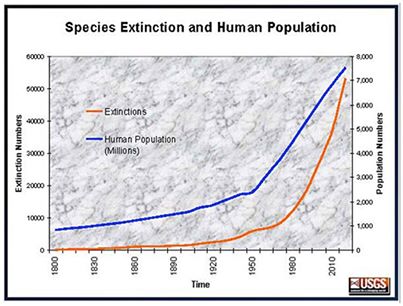
My recently published peer-reviewed scientific research [2] on ecosystem loss and biosphere collapse indicates more natural ecosystems have been lost than the global environment can handle without collapsing. Recently published science reports that 50% of Earth’s wildlife has died (in fact been murdered) in the last 40 years [3].

Loss of natural life-giving habitats has consequences. We are each witnesses to and participants in global ecosystem collapse.

There are other major social ills which potentially foster global pandemics. Rising inequity, abject poverty, and lack of justice threaten Earth’s and humanity’s very being. These ills and global ecosystem collapse are causing increased nationalistic war, migration and rise of authoritarian corporatism. West Africa has been ravaged by war and poverty for decades, which shows little signs of abating, particularly since natural habitats for community based sustainable development are nearly gone.

War breeds disease. It is no coincidence that the 1918 flu pandemic – the last great global disease outbreak that killed an estimated 50-100 million – occurred just as the ravages of World War I were ending. Conditions after ecosystems are stripped by over-population and poverty are not that different – each providing ravaged landscapes that are prime habitat for disease organisms.

West Africa’s ecological collapse has brought people into contact with blood from infected animals causing the Ebola epidemic. Once human infection occurs, ecologically denuded, conflict ridden, over-populated, and squalid impoverished communities are ripe for a pandemic. As the Ebola virus threatens to become endemic to the region, it potentially offers a permanent base from which infections can indefinitely continue to spread globally.


Since 911 America has slashed all other spending as it militarizes, viewing all sources of conflict as resolvable by waging perma-war. Africa needs doctors and the U.S. sends the military. Both terrorism and infectious disease are best prevented by long-term investments in equitably reducing poverty and meeting human needs – including universal health-care, living wage jobs, education, family planning, and establishment of greater global medical rapid response capabilities.

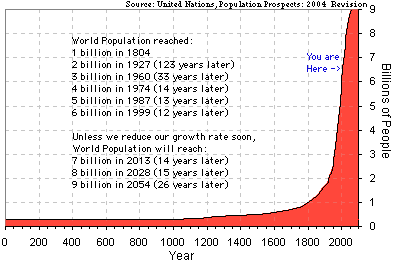
We are all in this together. Our over-populated, over-consuming, inequitable human dominated Earth continues to wildly careen toward biosphere collapse as sheer sum consumption overwhelms nature. West Africa’s 2010 population of 317 million people is still growing at 2.35%, and is expected to nearly double in 25 years, even as squalor, lack of basic needs, ecosystem loss, and pestilence increase. This can never, ever be ecologically or socially sustainable, and can only end in ruin.

Equity, education, condoms, and lower taxes and other incentives to stabilize and then reduce human population are a huge part of the solution for a just, equitable, and sustainable future. Otherwise Earth will limit human numbers with Ebola and worse. It may be happening already.

We are one human family and in a globalized world no nation is an island unto itself. By failing to invest in reducing poverty and in meeting basic human needs in Africa and globally (even as we temporarily enrich ourselves by gorging upon the destruction of their natural ecosystems), we in the over-developed world ensure that much of the world is fertile ground for disease and war. There is no way to keep Ebola and other social and ecological scourges out of Europe and America if they overwhelm the rest of humanity.

Ebola is what happens when the rich ignore poverty, as well as environmental and social decline, falsely believing they are not their concern. There can be no security ever again for anybody as long as billions live in abject poverty on a couple dollars a day as a few hundred people control half of Earth’s wealth.

We learn the meaning of enough and how to share or it is the end of being.

Walmart parking lots and iPads don’t sustain or feed you. Healthy ecosystems and land do. The hairless ape with opposable thumbs – that once showed so much potential – has instead become an out of control, barbaric and ecocidal beast with barely more sentience of its environmental constraints than yeast on sugar.

Ebola is very, very serious but can be beat with public health investments, coming together and showing courage, and by dealing with underlying causes. In the short-term, it is absolutely vital that the world organizes a massive infusion of doctors and quarantined hospital beds into West Africa immediately, even as we work on the long-term solutions highlighted here.

Ultimately commitments to sustainable community development, universal health care and education, free family planning, global demilitarization, equity, and ecosystem protection and restoration are the only means to minimize the risk of emergent disease. Unless we come together now as one human family and change fast – by cutting emissions, protecting ecosystems, having fewer kids, ending war, investing in ending abject poverty, and embracing agro-ecology – we face biosphere collapse and the end of being.

A pathway exists to global ecological sustainability; yet it requires shared sacrifice and for us all to be strong, as we come together to vigorously resist all sources of ecocide. It is up to each and every one of us to commit our full being to sustaining ecology and living gently upon Earth… or our ONE SHARED BIOSPHERE collapses and being ends

I desperately hope that Ebola does not become a global pandemic killing hundreds of millions or even billions. But if it does, it is a natural response from an Earth under siege defending herself from our own ignorant yet willful actions. We have some urgent changes to make as a species, let’s get going today before it is too late.

###

[1] We Are Making Ebola Outbreaks Worse by Cutting Down Forests: Mother Jones

[2] Barry, G. (2014), “Terrestrial ecosystem loss and biosphere collapse”, Management of Environmental Quality, Vol. 25 No. 5, pp. 542-563. Read online for personal use only: http://bit.ly/MEQ_Biosphere

[3] Living Planet Index: Zoological Society of London and WWF


Support Earth through a donation to EcoInternet at http://www.climateark.org/shared/donate/
Save the Earth: Pray for a Pandemic

I don’t mean to sound like some hateful misanthrope who wants to see humanity suffer for all its crimes against the environment. Rather, my misanthropy stems from a profound love of nature and a will to save non-humans from the cruelty and exploitation they’re routinely subjected to by the one species fully capable of causing a mass extinction. Indeed, the species Homo sapiens is currently in the process of putting an end to the most biologically diverse period the Earth has ever known—the Age of Mammals, a class which the human race must reluctantly finds itself included in.

Being nothing more than mere mammals themselves, humans are ultimately at the mercy of Mother Nature’s self-preserving tactics. And what better way to reign in an errant child than with a major global pandemic that takes down only humans? Let’s face it; humans are never going to reverse the ill-effects of climate change willingly. Oh, world leaders sometimes give it lip service, but they almost never mention the parallel scourge of overpopulation. It seems it’s hard to be “green” and keep 7,185,322,300 (as of this writing) people fed, clothed, sheltered and transported in the manner they’re currently accustomed to.

If people want to come out of this alive, they’re going to have to make some serious lifestyle changes. That means no more oil-dependent cars, trains, jet airplanes, no more Walmarts full of plastic trinkets built with coal power in Chinese factories, then sent overseas in gargantuan container ships. No offshore oil wells, no fracking, no tar sands pipelines; no freeways, no commuter traffic, no immensely-popular sporting events selling factory-farmed hot dogs by the billions. No people by the billions, for that matter. No more breeding until humans have figured out how to live alongside the rest of the Earth’s inhabitants without wiping them out or making slaves out of them.

No more! Starting right now! No false-starts or baby steps. Time to change or be changed!

It’s not just the politicians who lack the will to do what it will take to soften the blow of climate change. But while humans debate their role in causing relatively dependable weather systems to go topsy-turvy worldwide, Nature is poised to unleash a pandemic or two from her bag of tricks and take care of the human problem herself. I’m not talking about Ebola, that’s too slow and nasty.

When Nature gets serious, I’m hoping it’ll be quick and painless for all.  By the time humans know what hit ‘em, there’ll be no one left to test the experimental vaccine on the animals who’ll be too busy inheriting the Earth anyway.

1451324_650954518277931_1616731734_n

Ebola and Climate Change: Are Humans Responsible for the Severity of the Current Outbreak?

http://www.newsweek.com/climate-change-ebola-outbreak-globalization-infectious-disease-264163

burning-forest-sierra-leone
Sierra Leone has, in recent years, seen significant deforestation and other man-made environmental changes which, some argue, could be one cause of the recent Ebola outbreak. Finbarr O’Reilly/Reuters

The army base, a cut of cleared land amidst a thick, verdant, unnamed jungle, is filled with soldiers and locals, dead or dying of a mystery disease. A pile of bodies burns outside. At the sound of a U.S. army plane approaching, Americans and Africans both run out of the medical tents, arms raised to the sky in welcome and anticipation. But one man’s smile turns to horror when he realizes the airdropped package isn’t relief in the form of a cure or supplies, but instead another kind of solution. The bomb explodes, killing the men and devastating their arboreal surroundings; out of the wreckage run two white-headed capuchin monkeys.

This is the opening scene—ground zero—in the 1995 film Outbreak, in which an Ebola-like virus ultimately lands on U.S. soil and becomes an unstoppable killer. In the film, the virus is connected directly to the deforestation of the land enacted by western military: a local health care worker tells a U.S. army virologist, played by Dustin Hoffman, that the local “juju man” believes “the gods were awoken by their sleep by the man cutting down the trees where no man should be, and the gods got angry; this is their punishment.”

In 2011, Steven Soderbergh’s Contagion looked anew at the same issues of global infection, and here too, the filmmakers came to the same conclusion: the source of the killer virus is (spoiler alert) also industrial deforestation. In the 21st century edition, a multinational bulldozes a grove of palm trees in China for some unnamed purpose, destroying the nest of some local bats. Those bats end up flying over a pig farm, dropping a piece of infected fruit into the pen. The pig eats the fruit, the humans eat the pig, and the next thing you know, the contagion is spreading.

These, and other, pop culture characterization of Ebola-like viruses place the blame for the spread of the disease squarely on the shoulders of globalization and man’s careless despoiling of the environment. It’s not just Hollywood that believe that we are the cause of our own potential demise.

“Humans are the major driver of emerging diseases,” says Jonathan Epstein, an epidemiologist at the non-profit EcoHealth Alliance who studies Ebola and other infectious disease. “Things like agricultural expansion and deforestation…and certainly travel and trade — these are things that manipulate our environment and allow pathogens to get from animal hosts to people and then travel around the world.”

In a study published in 2012, researchers asked national infectious disease experts in 30 different countries whether or not they thought climate change would affect infectious disease patterns in their countries. The majority agreed.

Nevertheless, it’s unclear whether these beliefs are driven by good science, or, as Malcolm Gladwell argued way back in 1995, a guilt-driven “idea of disease as a punishment for wickedness.”

It’s true that West Africa, where the latest and most catastrophic Ebola outbreak is currently raging, has faced unequivocal environmental changes in recent years. The International Food Policy Research Institute published a report in 2013, finding that in Sierra Leone (the epicenter of the outbreak), climate change has resulted in “seasonal droughts, strong winds, thunderstorms, landslides, heat waves, floods, and changed rainfall patterns.”

And there is, according to the World Health Organization, a recent global increase in infectious diseases that seems to correspond with rising global temperatures. But determining whether there is a direct causative relation between the two is a hazy business.

One issue at play is food scarcity. The Ebola virus is known to spread into human populations through contact with an infected animal. The virus can live for years in animal populations (such as bats and monkeys) without harming the animals, becoming dangerous to humans only when humans prepare and eat infected bush meat. Poorer populations, living in resource-strapped areas, are the most likely to become stricken with the virus—because they’re the ones most likely to rely on bush meat to feed their families. And according to the 2013 IFPRI report, “poor communities suffer the most from climate change impacts.” It’s not hard to extrapolate from there and estimate that as these communities become more and more needy, they will encroach further into the wild in search of food. These changes in human behavior will likely impact the natural environment.

“We we see more incursion into the forest, we might see more exposure to Ebola,” says Stephen Morse, an infectious disease and epidemiology expert at Columbia University. “But it’s unclear whether there would be a net positive or net negative.”

Morse believes that the only way to make an educated guess at how climate change will impact future Ebola outbreaks is to undertake nuanced microclimate analyses of the specific African regions that have been affected in the past. And even that might not say all that much, given that Ebola and other emerging diseases seem to pop up in new parts of the continent every few years.

On the other hand, research does suggest strongly that warming global temperatures will make vector-borne diseases like malaria more common, mostly because the vectors that carry those diseases — like mosquitoes — thrive in warmer climates.

In the past few century, the temperatures of the oceans have risen significantly, at an average of  0.13 degrees Fahrenheit per decade. And it turns out cholera thrives in warm water; research has shown that rising sea temperature seem to be connected to rising incidences of cholera. Further, as temperatures rise, the polar ice caps will continue to melt, leading to rising sea levels. The most dire prognosticators warn that low-elevation coastal zones

This is particularly problematic in developing countries. Globalization has  led to significant change in the demographics in these parts of the world; in Africa, more and more people are moving out of the rural areas and into the growing cities. That, in turn, has had some serious public health consequences that look to worsen in coming years.

“As you move towards these megacities and mega populations on coastal areas, you wind up with huge vulnerability to infectious outbreaks because of inadequate sanitation and water,” says Stephen Morrison, the director of the Center for Strategic & International Studies’ Global Health Policy Center. “And then if you have flooding, those coastal environments will be more at risk because of climate change. You’ll be at a higher risk of the kind of infectious outbreaks like cholera.”

And the reality is that both malaria and cholera have had — and are expected to continue to have — a much bigger impact on public health than Ebola (unless the current outbreak becomes a truly once-in-a-lifetime, Hollywood-style pandemic). The WHO estimates about 110,000 deaths due to cholera every year; malaria killed an estimated 627,000 in 2012 alone. Meanwhile, since the first Ebola case was identified in 1976 there have been only 1,600 Ebola-related deaths.

That, though, is not exactly good news for human populations. Because though modern society’s impact on the Earth’s environment may not result in an explosion in Ebola, it seems that it will almost certainly drive up rates of these other, far more dread diseases.

The African Ebola outbreak that keeps getting worse

http://www.washingtonpost.com/news/morning-mix/wp/2014/04/07/the-african-pandemic-that-keeps-getting-worse/?tid=hp_mm

by Terrence McCoy  April 7, 2014

It began early this year in the forested villages of southeast Guinea. For months, the infected went undiagnosed. It wasn’t until March 23 that the news finally hit the World Health Organization. And by then, Ebola had already claimed 29 lives, the organization reported in a one-paragraph press release.

Since then, the organization has dispatched nine additional updates on a ballooning outbreak that’s received modest notice in the West, but has sent waves of panic across the African continent.

March 24: The outbreak is “rapidly evolving.” 59 dead. 86 confirmed cases.

March 27: The sickness spread to Liberia and Sierra Leone. 66 dead. 103 confirmed cases.

March 30: “This is a rapidly changing situation,” WHO reported. 70 dead. 112 confirmed cases.

April 3: Ebola “has a case fatality rate of up to 90 percent,” the organization said. 83 dead. 127 confirmed cases.

On Sunday, after the number of dead topped 90 and Mali and Ghana recorded their first suspected cases of the disease, trouble began in remote villages.

A mob attacked an Ebola treatment center in Guinea, accusing it of infecting the town with disease, according to Reuters. In other villages, people stopped shaking hands.

“We fully understand that the outbreak of Ebola is alarming for the local population,” one doctor told the Independent. ”But it is essential in the fight against the disease that patients remain in the treatment center.”

What terrifies people so much about Ebola?

For starters, there’s no cure. Because it’s such a rare disease that primarily affects poor African villages, big drug companies perhaps haven’t seen enough economic opportunity to study the virus, Bloomberg reports.

Then there’s the fact that Ebola deaths are particularly gruesome. The disease comes from an infected animal – most likely the fruit bat, which infects monkeys, apes, pigs and, finally, humans. The disease is not airborne, but spreads through blood, secretions or other bodily fluids. Its early symptoms include fever and intense weakness, WHO says, then deepens with bouts of diarrhea, vomiting, and internal and external bleeding.

The migratory pattern of the outbreak, which aid workers call “unprecedented,” has baffled doctors. Outbreaks before this have stayed in remote pockets of the country, but this iteration shot hundreds of miles from southwest Guinea to the coastal capital of Conakry.

Exacerbating the situation is the scarcity of medical professionals in Guinea. According to the World Bank, there are only .1 physicians per 1,000 people — among the lowest ratios in the world, below even Afghanistan.

This has fed animosity among some in Guinea toward the government for its perceived inability to dispense medical services — or even enforce quarantines.

“You have a lot of people who have recovered from civil war and are living in war-ravaged areas with very poor infrastructures,” said Laurie Garrett of the Council on Foreign Relations. “As soon as word goes out of quarantine, you have people start trying to escape and get away from the clutches of authorities.”

This has already happened, some in Guinea claim.

“How can we trust them now?” Conakry resident Dede Diallo told Reuters. She’s stopped working — and keeps her kids at home, where she says it’s safe. “We have to look after ourselves.”

SOURCES: Steve Monroe, deputy director of the CDC’s National Center for Emerging and Zoonotic Infectious Diseases; World Health Organization. Graphic: The Washington Post.

Q&A: Challenges of Containing Ebola’s Spread in West Africa

“Transmission is human to human. There is no known cure.” … This could be it, people.

Health care workers struggle to stop infection from spreading.

Photo of health workers teaching people about the Ebola virus.

Health care workers teach people about the Ebola virus and how to prevent infection in Conakry, Guinea, on March 31, 2014.

Photograph by Youssouf Bah, AP

Susan Brink

for National Geographic

Published April 3, 2014

The deadly Ebola virus has broken out in the West African country of Guinea for the first time, alarming the public and catching health care workers off guard.

Since January the virus has spread from rural areas to the capital city of Conakry, so far infecting at least 122 patients and killing 83. Other cases, suspected or diagnosed, were also found recently in Sierra Leone and Liberia, making this a regional outbreak.

The disease, which first appeared in the Democratic Republic of Congo in 1976, is marked by fever and severe internal bleeding. Transmission is human to human. There is no known cure. Patients normally receive supportive care consisting of balancing their fluids, maintaining oxygen and blood pressure levels, and treating other infections. The Ebola virus is fatal in up to 90 percent of patients.

We spoke to two experts about efforts to contain the outbreak. Tarik Jasarevic, a spokesperson for the World Health Organization, spoke to us from Conakry. And Roland Berenger, West Africa emergency manager for Plan International, an aid organization that works in developing countries around the world, spoke to us from Dakar just after returning from ten days in Guinea.

What are the basic strategies for controlling this outbreak in Guinea?

Jasarevic: We need to provide isolation wards, where infected people are treated and health workers are safeguarded. Where that is in place, health workers are using standardized protective equipment, like gloves, masks, eye protection, gowns, boots. It’s all single use, discarded after each use, except for the boots that can be disinfected.

Another strategy is contact tracing—looking for those who have been in contact with an infected person. We’ve deployed two mobile labs to provide testing and supportive care. And very important is information and communication. This is the first time Guinea is facing Ebola, so we need a big effort to educate the people.

At least 11 health care workers are among those infected. So did even local health care workers need a quick course in Ebola?

Berenger: Yes, the first people to be affected were health care workers themselves. People were thinking about cholera and lassa fever. They didn’t know what they were dealing with.

Jasarevic: Educating health care workers was the first thing to be done. Immediately, the Minister of Health organized meetings with all health authorities. We sent brochures to all health centers in the country.

How is information getting out to the general population in Guinea?

Jasarevic: Several things are happening. The president [of Guinea, Alpha Condé] gave a televised speech on Sunday on the outbreak. Journalists are getting really well briefed. People are going out to religious organizations to provide information. We’re in the process of designing posters that even illiterate people can understand, with images, say, of a hand with the international red circle and line through it. It indicates: Don’t touch. Don’t touch a person who is infected or dead.

Berenger: There are some gaps in providing the information to all the people. We need to reach all the people in the farthest villages. We need to do more with social media, radio, and using posters. We need to be more proactive. People are getting adequate information through TV and radio, but there is a part of the population who do not have access to those things, in very remote areas.

How are the people in Guinea dealing with this outbreak?

Jasarevic: Of course people are worried. But they are going about their business. Like anywhere, no one can afford to stay home all day.

Berenger: People understand the outbreak when you take time to explain things clearly. The people who have seen cases of Ebola are really scared. When you see people dying, bleeding to death, and there is nothing anyone can do, you get scared. In Conakry, they are going about their daily business, but I think many avoid going to crowded places. You see many people using hand sanitizers.

Some neighboring countries, including Liberia, have closed their borders, or are considering closing borders. Is this an effective strategy for control?

Berenger: The borders in many places are really porous. You can’t really prevent people from crossing the forest and going to other countries. It has already become a regional threat. I think it’s time for people to wake up and work on this as one planet.

http://news.nationalgeographic.com/news/2014/04/140403-ebola-virus-outbreak-deaths-guinea-health-geography/


Eight things you should know about the deadly Ebola virus

http://www.straitstimes.com/breaking-news/world/story/eight-things-you-should-know-about-the-deadly-ebola-virus-20140402

By Joyce Teo

An outbreak of Ebola virus disease (EVD) in Guinea, West Africa has killed 78 people, prompting travel alerts and putting the spotlight back on one of the world’s deadliest diseases.

Cases have been confirmed in several locations in Guinea, including the capital Conakry.

This is in contrast to previous outbreaks, which were much more geographically contained. They also occurred in more remote places.

Here’s what you should know about the viral haemorrhagic fever.

1. The World Health Organisation (WHO) calls it “one of the most virulent diseases known to humankind”.

2. It can kill up to 90 per cent of the people who are infected with it.

There has been more than 1,800 Ebola cases, with nearly 1,300 deaths.

3. Outbreaks occur primarily in remote villages in Central and West Africa, near tropical rainforests.

4. The virus first appeared in 1976 in Nzara, Sudan and in Yambuku, Democratic Republic of the Congo.

It took its name from the Ebola River, which was near the village in Yambuku where the outbreak occurred.

4. Ebola can be caught from both humans and animals.

It is transmitted through close contact with blood, secretions or other bodily fluids. Fruit bats are considered to be the natural host of the Ebola virus.

5. It spreads quickly through human-to-human transmission, as family and friends care for infected people.

Health-care workers have frequently been infected while treating Ebola patients.

6. Symptoms can appear from two to 21 days after exposure. Early symptoms such as rashes and red eyes are common, making it hard to diagnose in the early stages.

7. The virus spreads in the blood and paralyses the immune system.

Ebola is often characterised by the sudden onset of fever, intense weakness, muscle pain, headache and sore throat.

This is followed by vomiting, diarrhoea, rash, impaired kidney and liver function, and in some cases, both internal and external bleeding such as from the nose or via a person’s urine.

8. There is no specific treatment or vaccine available for people or animals.

Sources: WHO, Médecins Sans Frontières

graph

Bat-eating banned to curb Ebola virus

http://www.bbc.com/news/world-africa-26735118

Guinea Ebola outbreak: Bat-eating banned to curb virus

File photo of officials from the World Health Organization in protective clothing preparing to enter Kagadi Hospital in Kibale District, about 200 kilometres from Kampala, where an outbreak of Ebola virus started (28 July 2012) There is no known cure or vaccine for Ebola

Guinea has banned the sale and consumption of bats to prevent the spread of the deadly Ebola virus, its health minister has said.

Bats appeared to be the “main agents” for the Ebola outbreak in the remote south, Rene Lamah said.

Sixty-two people have now been killed by the virus in Guinea, with suspected cases reported in neighbouring Liberia and Sierra Leone.

Ebola is spread by close contact and kills between 25% and 90% of victims.

There is no known cure or vaccine.

Symptoms include internal and external bleeding, diarrhoea and vomiting.

‘Quarantine sites’

It is said to be the first time Ebola has struck Guinea, with recent outbreaks thousands of miles away, in Uganda and the Democratic Republic of Congo.

Mr Lamah announced the ban on the sale and consumption of bats during a tour of Forest Region, the epicentre of the epidemic, reports the BBC’s Alhassan Sillah from the capital, Conakry.

The medical charity Medecins Sans Frontieres said it had set up two quarantine sites in southern Guinea to try to contain the outbreak, the Associated Press news agency reports.

Health officials reported one more death on Tuesday, bringing the number of people killed by Ebola to 62, our correspondent says.

Sierra Leone’s health ministry said it was investigating two suspected cases of Ebola, the AFP news agency reports.

Medical supplies being loaded in Guinea's capital, Conakry (24 March 2014) Aid agencies and the government are taking medical supplies to the affected areas in Guinea

“We still do not have any confirmed cases of Ebola in the country,” its chief medical officer Brima Kargbo is quoted as saying.

“What we do have are suspected cases, which our health teams are investigating and taking blood samples from people who had come in contact with those suspected to have the virus,” he added.

Mr Kargbo said the one suspected case involved a 14-year-old boy who was thought to have died two weeks ago in Guinea and then brought to his village on the Sierra Leonean side of the border in the eastern district of Kono.

map

The other case was in the northern border district Kambia, he added, without giving further details.

“This is the first time such a national health threat has come to our borders. In any case, we are prepared and on the alert in readiness in case the disease is diagnosed in Sierra Leone,” Mr Kargbo was quoted as saying by AFPs.

Five people are reported to have died in Liberia after crossing from southern Guinea for treatment, Liberia’s Health Minister Walter Gwenigale told journalists on Monday.

However, it is not clear whether they had Ebola.

Outbreaks of Ebola occur primarily in remote villages in central and west Africa, near tropical rainforests, the World Health Organization says.