
by Barry Kent MacKay in Blog, Canada, Coexisting with Wildlife on August 03, 2020
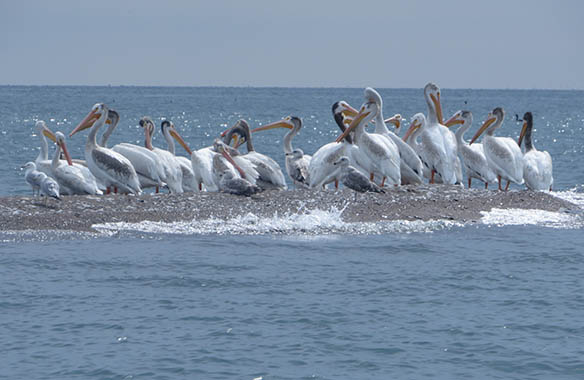
The American white pelican is so called to distinguish it from the distinctively different Eurasian white pelican, but it nests in Canada’s three prairie provinces and the westernmost part of Ontario.
You may recall from prior blogs that we have been trying to prevent the shooting of thousands of nesting double-crested cormorants on Middle Island by Parks Canada, a federal agency. Middle Island is the southernmost land belonging to Canada, a little over 100 yards from the U.S. border in the middle of the southwest end of Lake Erie. It is 46 acres, uninhabited, and part of Point Pelee National Park, the main part of which is on the mainland, over 20 miles away. The island is closed to visitors all spring and summer, ostensibly to protect the colonially nesting birds there – double-crested cormorants, great blue herons, black-crowned night-herons, and great egrets, plus herring and ring-billed gulls and Canada geese.
Each spring since 2008, except for this year, when boating was halted to reduce infection by COVID-19, thousands of these birds have been shot by Parks Canada staff (and more recently, shooters from First Nations) based on claims that the killing must take place in order to protect “at risk” vegetation on the ground. Even though the plant species of are common in the U.S., which starts about 100 yards to the south of the island, Ontario lists the plants as “threatened” under the provincial Endangered Species Act.
The cormorants change the vegetation dynamics mainly by accumulation of their excrement. Vegetation that can withstand the high nitrogen load from the guano survives while other vegetation does not. As our colleague James Kamstra points out in his evaluation of the Middle Island vegetation, island climates are mercurial due to harsher conditions and plant species thrive and then disappear with the changing conditions.
I have gone with my Canadian colleagues each spring to monitor the cull, and I have been saddened to see the huge degradation of the colony, with ever fewer of various species, not just cormorants. There is a ghost forest emptied of birds where once there was so much life, vibrancy, and activity.
In these last few years, we have also seen Parks Canada activity prevent American white pelicans from using the island. That the pelicans were there at all was a surprise as they were previously designated as a “rare vagrant” in the region, with their nearest nesting site in the northwest corner of the province, roughly 700 miles away. Yet, there they were, in the nesting season.
Because Parks Canada has not allowed them on Middle Island (ironically called a bird sanctuary), the pelicans have tried other islands nearby, first on a low-lying island where high waters washed the nests away, but lately with success on Big Chicken Island, really just a small, treeless sandbar, and Middle Sister Island, about nine acres, privately owned by Americans, uninhabited, and, most importantly, treed. The latter nesting proved that the pelicans, which typically nest in the company of cormorants on treeless islands, can nest on habitat similar to Middle Island, but for Parks Canada’s gunmen.
Because of the pandemic and a ban on boating during the time of the cull, Parks Canada’s annual cormorant slaughter did not happen. This spring, the cormorants, pelicans, and all wildlife on the island, were, for the first time in a dozen years, left in peace. The island is still out of bounds to Canadian taxpayers, until September, but we decided to investigate the status of the colony offshore from Middle Island and, on July 23, Liz White, Vicki Van Linden, and I travelled more than 20 miles across the water to see if we could find young pelicans on Middle Island.
Yes! We were pleasantly surprised and elated. We saw lots of them, both adults and fully grown youngsters, in company with cormorants on the shore and on a nearby exposed sandbar. It was not proof that they nested on the island itself, but indicative. We also travelled to two other islands in the area, Hen and East Sister. As we neared Hen Island, we observed white pelicans on the dock. Hen Island is owned by Americans, who use it as the base for the Quinnebog Fishing Club, complete with a hotel like central building, lawn, retro-decorated club house, and docks and has been unused due to the pandemic. On East Sister Island, we saw flocks reaching 50 birds in number. Again, because of the pandemic, the island had been undisturbed.
Why do we care? Because the pelican, no less than the plants, is a threatened species under provincial legislation, making it illegal to disturb their nesting sites. They and cormorants habitually nest together. Parks Canada can’t cull cormorants without disturbing the nesting pelicans. Aside from the gun shots, which cause massive number of birds to flee the island, their very presence would negatively impact the pelicans. Parks Canada cannot have it both ways. They cannot argue to necessity of protecting “at risk” vegetation while not protecting “at risk” pelicans.
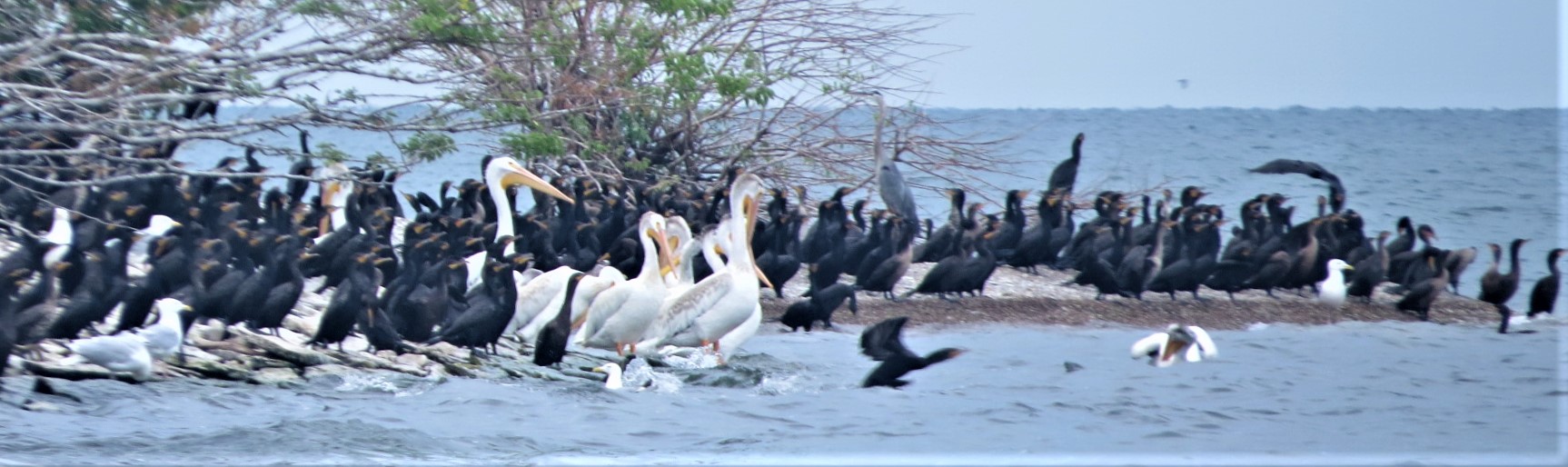
Less than a week later, the Ontario government did something no other government on the continent has done, and turned the virtually inedible cormorant into a “game bird” whose meat can be wasted. An open season starts this September 15, with a bag limit of 15 birds per day. Originally Ontario wanted the killing season to go most of the year, so we’ve won a major concession, as I will discuss in a future blog.
Keep Wildlife in the Wild,
Barry
Barry Kent MacKay
Director of Canadian and Special Programs


 Exposing the Big Game