Exposing the Big Game

Forget Hunters' Feeble Rationalizations and Trust Your Gut Feelings: Making Sport of Killing Is Not Healthy Human Behavior

Exposing the Big Game

Small Temperature Bumps Can Cause Big Arctic Methane Burps

Warming can encourage the growth of microbes in permafrost that produce more greenhouse gases
Small Temperature Bumps Can Cause Big Arctic Methane Burps
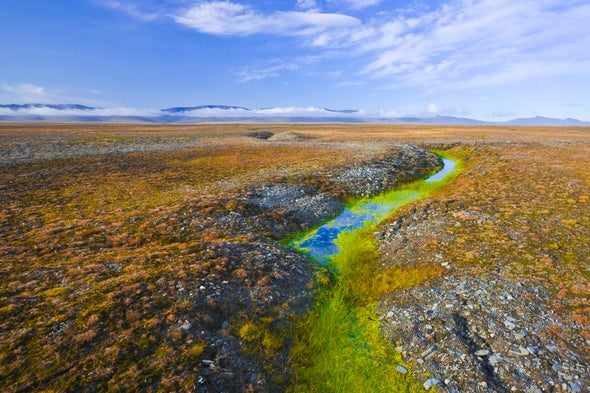
Thawing permafrost on the tundra of Wrangel Island. Credit: Jenny E. Ross Getty Images

As temperatures rise in the rapidly warming Arctic, scientists are growing more and more concerned about the region’s permafrost—the carbon-rich, frozen soil that covers much of the landscape. As permafrost warms up and begins to thaw out, microbes in the soil may release large quantities of both climate-warming carbon dioxide and methane into the atmosphere, potentially worsening the effects of climate change.

Researchers are carefully monitoring the natural emissions from permafrost in the Arctic. And in recent years, they’ve also begun designing their own experiments aimed at investigating the way the frozen soil might react to future climate change.

They’re finding that even a little bit of warming may cause permafrost to release significantly higher levels of greenhouse gases into the air.

The new study relied on experiments from a special research site in Alaska, where scientists have designed a way to manipulate the natural landscape to investigate the effects of rising temperatures. They’ve built special fences that allow snow to pile up deeper on the ground, forming a kind of insulation and causing the permafrost below the surface to warm up. Permafrost at the experimental sites was around a degree Celsius warmer than nearby sites that hadn’t been insulated.

The research site—known as the Carbon in Permafrost Experimental Heating Project—provides a unique opportunity to simulate the effects of future climate change. In a laboratory setting, it might be more difficult to exactly reconstruct the natural landscape, making scientists less sure of their results.

For the new study, the researchers conducted special forms of genetic sequencing to determine how microbe communities changed in the warmer plots. The shifts were apparent after less than five years of elevated temperatures.

In shallower layers of the soil, they found an increase in microbes that produce more carbon dioxide. And in deeper layers, they found an increase in microbes that produce larger amounts of methane, an even more potent greenhouse gas. At the same time, methane emissions from the experimental sites also increased.

The study provides experimental support for scientists’ ongoing fears about thawing permafrost. Throughout the Arctic, researchers are finding that large swaths of frozen soil are steadily heating up, sometimes faster than scientists had previously predicted.

The research also underscores a growing scientific interest in the links between climate change and the world’s tiniest organisms.

In addition to permafrost, they pointed to changes in microbe communities that affect the ocean’s carbon uptake and the marine food web, lead to algae blooms, alter the growth of vegetation, influence agricultural production, and contribute to the spread of infectious diseases.

Reprinted from Climatewire with permission from E&E News. E&E provides daily coverage of essential energy and environmental news at www.eenews.net.

The most dangerous climate feedback loop is speeding up

In Siberia, the carbon-rich permafrost warmed by 1.6°F in just the last decade.

AWI permafrost scientists investigate the eroding coastline at the Siberian island Sobo-Sise. CREDIT: Alfred Wegener Institute.
AWI PERMAFROST SCIENTISTS INVESTIGATE THE ERODING COASTLINE AT THE SIBERIAN ISLAND SOBO-SISE. CREDIT: ALFRED WEGENER INSTITUTE.

The carbon-rich permafrost warmed “in all permafrost zones on Earth” from 2007 to 2016, according to a new study.

Most ominously, Siberian permafrost at depths of up to 30 feet warmed a remarkable 1.6°F (0.9°C) in those 10 years, the researchers found. The permafrost, or tundra, is soil that stays below freezing (32°F) for at least two years.

Permafrost warming can “amplify global climate change, because when frozen sediments thaw it unlocks soil organic carbon,” warns the study, which was released Wednesday by the journal Nature Communications.

The thawing releases not only carbon dioxide but also methane (CH4) — a far more potent greenhouse gas — thereby further warming the planet. And as the planet continues to warm, more permafrost will melt, releasing even more greenhouse gases in a continuous feedback loop.

Thawing permafrost is an especially dangerous amplifying feedback loop because the global permafrost contains twice as much carbon as the atmosphere does today .

Normally, plants capture CO2 from the air during photosynthesis and slowly release that carbon back into the atmosphere after they die. But the Arctic permafrost acts like a very large carbon freezer — and the decomposition rate is very low. Or, rather, it was.

Humanity is leaving the freezer door wide open. As a result, the tundra is being transformed from a long-term carbon locker to a short-term carbon un-locker.

2017 study found the Alaskan tundra is warming so quickly it had become a net emitter of CO2 ahead of schedule. That study was the first to report a major portion of the Arctic had already become a net source of heat-trapping emissions.

The lead author, Dr. Roisin Commane, told ThinkProgress at the time, “We’re seeing this much earlier than we thought we would see it.”

The new study released on January 16 is the first “globally consistent assessment of permafrost temperature.” Four dozen researchers from around the world found that the ground temperature tens of feet below the surface “increased in all permafrost zones on Earth” — in the Northern Hemisphere, the mountains, and Antarctica.

“My take home [on the new study] is that the anecdotal site thawing that I heard about this winter is part of a region-wide warming that seems to be accelerating faster in this decade than in previous decades,” Dr. Commane told Inside Climate News.

That’s no surprise given that “Arctic air temperatures for the past five years (2014-18) have exceeded all previous records since 1900,” as the National Oceanic and Atmospheric Administration reported in its annual Arctic Report Card last month.

The only surprise is that the world continues to ignore this gravest of threats to humanity, even as it speeds up, triggers amplifying feedbacks, and rapidly approaches a climate death spiral.