Default Mono Sans Mono Serif Sans Serif Comic Fancy Small CapsDefault X-Small Small Medium Large X-Large XX-LargeDefault Outline Dark Outline Light Outline Dark Bold Outline Light Bold Shadow Dark Shadow Light Shadow Dark Bold Shadow Light BoldDefault Black Silver Gray White Maroon Red Purple Fuchsia Green Lime Olive Yellow Navy Blue Teal Aqua OrangeDefault 100% 75% 50% 25% 0%Default Black Silver Gray White Maroon Red Purple Fuchsia Green Lime Olive Yellow Navy Blue Teal Aqua OrangeDefault 100% 75% 50% 25% 0%After a Berkeley Co. man’s hunting dog was shot this month, he wants the public to be aware of what protections these animals face in South Carolina.
BERKELEY COUNTY, S.C. (WCSC) – After a Berkeley Co. man’s hunting dog was shot this month, he wants the public to be aware of what protections — or lack thereof — these animals face in South Carolina.
Hunter KJ Rhode says he was out hunting with his dogs Wednesday within the Francis Marion National Forest when his dog Highball chased a buck and crossed onto private property. He says that’s when Michael Trent Williams shot him.
Williams has been charged with one count of shooting and killing a hunting dog and two counts of removing dog collars, according to the South Carolina Department of Natural Resources. He has since been released from jail on bond.
Michael Trent Williams is charged with one count of shooting and killing a hunting dog and two counts of removing dog collars, the South Carolina Department of Natural Resources said.(Hill-Finklea Detention Center)
“If he would’ve let my dog go 50 more yards, I would’ve had my hands on him,” Rhode said.
But Rhode isn’t the only person affected. SCDNR says they’ve handed out 48 charges under the statute for dog hunting since Sept. 1, 2023. Four of them were for specifically killing or harming a hunting dog.
A person who does this could face up to a $500 fine or up to 30 days in jail. However, attorney Stephan Futeral says there’s a minimum.
“It’s possible to get charged with it and suffer no penalty,” Futeral said.
He says the results are discretionary.
“You take the same case and put it in front of a different magistrate, well, you may get a completely different outcome,” Futeral said.
For example, Rhode says his friend lost his dog in an extremely similar incident in Sumter County last year. He says the person convicted was only fined $125.
“I feel like it should be the same for any dog, you know?” Rhode said. “No matter if it’s a house dog, a hunting dog, any of it I feel like should be straight up, across the board.”
Futeral says the only way to avoid this from being subjective is for South Carolina to sign a stricter law to make the harsh results mandatory.
“For magistrates to take sort of a hard stance, if you will, and be a little more uniform in their decision-making,” Futeral said.
Rhode says he just wants justice for Highball.
Williams’ court date is set for Dec. 2. For the charges for removing the electronic dog collars, he could also face up to a $500 fine or 10 days in jail for a first offense or up to a $1,000 fine or 30 days in jail for a second.
“They are not just hunting dogs,” Rhode said. “I mean, we care for these dogs every day.”
SCDNR says if anyone suspects hunting laws are being violated to contact them through their 24/7 Operation Game Thief Hotline at 1-800-922-5431 or submit an anonymous tip by texting 847411. Use the keyword SCDNR along with the tip information.
UPDATE: The Berkeley County Sheriff’s Office tells News 2 they are investigating this case. Anyone with information can call 843-723-3800.
—
SUMMERVILLE, S.C. (WCBD) – An investigation is underway in Summerville after more than a dozen animals were found dead on a recently sold property along Drop Off Drive.
Biden administration focuses on ‘climate resilience’ after Helene
close
volume_off
-00:00
sd
closed_captions
fullscreen
Pet Helpers said 12 cats and three possums, part of a monitored cat colony, were discovered scattered throughout the wooded area where they lived.
Lowcountry TNR and Feral Cat Network have been monitoring and caring for the animals. According to Pet Helpers, the groups are “committed to trap-neuter-return efforts” for feral cats in the community.
Stephanie Fauvelle, president and co-founder of the Charleston Animal Legislative Action League, said in an email to News 2 that the cats were found poisoned on the recently sold property. She said the previous owner agreed to sell the land with the “explicit condition that the colony of cats […] would be cared for.” She added that the previous owner was devastated upon learning about the deaths.
According to Pet Helpers, police are actively investigating the incident. The animal shelter is now offering a $5,000 reward for information that leads to an arrest and conviction of those responsible.
Members of the TNR group are monitoring the area to collect any surviving animals to protect them from further harm. So far, seven additional felines have been found and trapped.
Melissa Susko, executive director of Pet Helpers, called the incident a “heartbreaking and horrifying situation.”
“The cruelty inflicted on these innocent animals is beyond comprehension,” said Susko. “These cats were being cared for, loved, and looked after by volunteers who had committed their time to helping them. We are committed to seeking justice for these animals and will do everything in our power to ensure those responsible are held accountable. Our thoughts are with the caregivers of this colony, and we hope no more animals are harmed. We urge anyone with information to come forward to ensure that those responsible are held accountable.”
Anyone with information is asked to contact the Berkeley County Sheriff’s Office at 843-723-3800.
Nevada, along with North Carolina, Oklahoma, Alabama and Wisconsin, are the only outliers without such a law, and that’s why we are excited to see the state finally move to pass one. Photo by Shivang Mehta/Alamy Stock Photo154SHARES
Nevada, one of the last remaining states without a ban on the ownership of exotic wild animals as pets, is now moving to pass a law to do exactly that.
A bill, SB 344, recently passed the Senate and now awaits action in the Assembly. It would, among other measures, end the private ownership of animals like big cats, bears, hyenas, elephants, wolves and primates. The bill would also end the exploitation of wild animals, and particularly cubs, by unscrupulous roadside zoos and exhibits that offer up these animals for petting and photo ops.
As our investigations have revealed, animals in this industry are horribly mistreated. Jeff Lowe, one of the roadside zoo owners seen in the Netflix series “Tiger King,” smuggled tiger cubs into hotel rooms in Las Vegas for paying visitors to pet them and pose with them. The city eventually confiscated a tiger cub, a liliger cub (the hybrid offspring of a male lion and a female tiger) and a young lemur from him. The animals were underweight and suffering from several health conditions.
Ending such cruelty wherever it exists is an important priority for our organizations and to date 45 states have passed laws to protect citizens from those who exploit wild animals in this manner. Many of these states acted swiftly after one incident that remains raw in our nation’s collective memory: a suicidal man in Zanesville, Ohio, released nearly 50 big cats and other dangerous animals from his backyard menagerie in 2012, creating a major public safety hazard and a tragic situation for the animals who authorities were forced to shoot and kill.
Nevada, along with North Carolina, Oklahoma, Alabama and Wisconsin, are the only states with virtually no laws on this issue, and that’s why we are excited to see the state finally move to pass one. At the federal level, the Humane Society Legislative Fund is working to secure passage of the Big Cat Public Safety Act, which has been reintroduced in the House and Senate and previously passed the House. The bills would prohibit public contact with big cats like tigers, lions and leopards and ban keeping these animals as pets. Federal action is necessary because these animals may be moved across state lines for such activities.
The Nevada bill makes allowances for those who already own exotic animals as pets, permitting them to keep the animals so long as they meet some basic animal welfare and safety requirements, although they will be prohibited from acquiring new animals. Zoos and all U.S. Department of Agriculture licensed exhibitors can continue to keep animals like big cats, bears, etc., and can acquire more of these animals, but will be required to meet a few additional requirements, including creating emergency plans for the animals. The facilities should also have no USDA citations within the past three years for violations in which a dangerous wild animal’s health and well-being or the public safety was jeopardized.
These are commonsense requirements and ones most Nevadans support. Wild animals have very unique needs and suffer terribly at the hands of unqualified individuals. In the United States, wild animals have been found badly neglected and living in deplorable conditions in places ranging from junkyards to basements.
It often falls upon sanctuaries and animal protection organizations to clean up the mess these irresponsible owners create. Two years back, a tiger was rescued from a garage in Houston, and earlier this year authorities in San Antonio found a tiger cub freezing in a backyard during a historic winter storm. Both animals, Loki and Elsa, have since found forever homes at our Cleveland Amory Black Beauty Ranch. However, no organization has the capacity to continue rehoming the countless exotic pets that enter U.S. homes each day, and we need to tackle this problem at the root, by preventing irresponsible breeding and ownership.
Captive exotic animals also create a major problem for law enforcement authorities. In Nevada, for instance, in a well-publicized incident in 2012, a male and female chimpanzee escaped from a backyard cage in a residential neighborhood after the male chimpanzee ripped the cage from the concrete and then broke through a padlocked gate. Police responded to emergency calls with more than 20 squad cars as the chimpanzees ran amok, climbing into cars, pounding on vehicles, and banging on windows of homes. The male chimpanzee was shot and killed when he darted toward a crowd of onlookers.
There should be no debate over this issue: chimpanzees, elephants, tigers, leopards and wolves are not pets and they do not belong inside someone’s basement or garage or backyard. If you live in Nevada, please urge your lawmakers to pass SB 344 and get this law on the books without delay. It is time we stop this abuse for good, in Nevada and everywhere it exists.
July 30, 2020The U.S. Department of Agriculture reports that so far fewer than two dozen companion animals have tested positive, with no infections reported among birds, reptiles and fish. Photo by iStock.comWe received the sad news today that Buddy, the first dog in the United States known to have contracted the novel coronavirus, passed away on July 11. We share in the grief Buddy’s family is no doubt feeling over the loss of their beloved companion during what already is an extremely stressful time. A human family member had also tested positive for the virus and is believed to have passed it on to Buddy.We are also mindful of the concerns of millions of pet owners who must be understandably worried, upon hearing this news, about keeping their pets and themselves safe during the pandemic. While there is still much to learn about the coronavirus, and its transmissibility between pets and people, experts believe that the risks are low.It’s important to note that the National Geographic article that broke the news revealed that Buddy’s bloodwork showed he had lymphoma, a type of cancer. “It’s unclear whether cancer made him more susceptible to contracting the coronavirus, or if the virus made him ill, or if it was just a case of coincidental timing,” the article reported.It is also important to remember that while there are now 17 million confirmed cases of the coronavirus in humans worldwide, including more than 4.5 million people in the United States, there are just a handful of documented instances of companion animals contracting the disease. The U.S. Department of Agriculture keeps track of those numbers and so far fewer than two dozen companionanimals have tested positive, with no infections reported among birds, reptiles and fish.In late April, the Centers for Disease Control and Prevention and the USDA announced the first confirmed cases of coronavirus infection in two pet cats in New York state. The cats had mild respiratory illness and were the first pets in the United States to test positive for the virus.The first case of the virus in a companion animal worldwide was recorded in February, when a dog in Hong Kong tested positive, most likely after contracting the virus from his owner. The 17-year-old dog later tested negative for the virus but died in July from other existing health issues, authorities believe.The CDC, USDA and the World Organization for Animal Health have issued advisories saying that at this time there is no evidence that animals play a significant role in spreading the virus that causes COVID-19. It also appears to be the case that the virus cannot sustain itself in pet fur for very long, so the CDC and the veterinary community have taken the position that there is no evidence that a person could contract the coronavirus by touching a pet. That said, we are closely monitoring the evidence with both animal welfare and the human-animal bond in mind. With Buddy and his family in our thoughts, I’d like to share some tips developed by the Humane Society Veterinary Medical Association (HSVMA) for keeping yourself and your pets safe during the pandemic:If you are confirmed to have COVID-19 (or if you are symptomatic or believe you may have been exposed) you should avoid contact with other people as well as with pets, and you should also avoid sharing any food.Have a plan in place for someone to help care for your pet(s) in the event you get sick or are hospitalized.If you must provide care for your pet or be around other animals while you are sick, wear a cloth face covering and wash your hands before and after you interact with them. Do not let pets interact with people or other animals outside the household. Keep cats indoors whenever possible to prevent them from interacting with other animals or people. Walk dogs on a leash, maintaining at least six feet (two meters) from other people and animals. Avoid dog parks or public places in which large number of people and dogs gather. Talk to your veterinarian if your pet gets sick or if you have any concerns about your pet’s health. Dr. Gail Hansen of HSVMA says it is critically important that pet owners keep matters in perspective and not make rash decisions concerning their pets. “All of the known cases in pets were in households with a person infected with COVID-19. The key point is that pets should be treated the same as any other family member,” she adds.That’s our view too. The welfare of companion animals in the midst of this pandemic is inextricably connected to our own. We’ll continue to deliver the message that people should exercise the greatest caution with their pets, and avoid unnecessary risks, while also reinforcing the widely shared sentiment that they depend upon our mercy and care, now more than ever.The post Risk of coronavirus among pets remains low, health officials say appeared first on A Humane World.Related StoriesMore than 100 dogs rescued from Korean dog meat farms arrive in the U.S. for adoptionMore than 100 dogs rescued from Korean dog meat farms arrive in the U.S. for adoption – EnclosurePup paralyzed after brutal beating demonstrates urgency for Iowa to make animal torture a felony
(CNN)Fireworks explode like magnified gunfire in the exquisitely sensitive ears of many of our pets.Measuring between 150 and 175 decibels, fireworks are louder than gunfire (140 decibels) and even many planes at takeoff (120 decibels). Decibels measures the loudness of a sound while hertz measures the frequency of a sound.Human ears are damaged at a mere 85 decibels. Yet we can hear to only about 20,000 hertz, while dogs can hear between 45,000 and 65,000 hertz. Just think of the physical and emotional damage that might occur to a dog left outside to face the noise.Due to Covid-19, animal advocates say this year has been extremely bad for pets with noise phobias. Instead of going people to central locations to watch a huge, orchestrated display, they have been buying fireworks in record numbers, setting them off in the streets next to homes for weeks.
Fireworks at home: Risks and safer alternatives, as sales skyrocketThat’s expected to explode Saturday, as people use their stash to celebrate the Fourth of July. When frightened, dogs bolt and owners may lose their best friends in the night.”Dogs have been known to dig under or jump over fences, break tethers or even shatter windows in response to their fireworks fears,” said Temma Martin, the public relations manager for the Best Friends Animal Society, one of the nation’s oldest no-kill agencies.In addition, she said in a statement, “some animal control agencies have their officers working on an ’emergencies-only’ basis, which means that they only pick up stray animals who are sick, injured or already contained.”That leaves dogs running loose, to possibly be struck by cars, picked up by strangers, even turned into local animal shelters, many of which are still closed. Anxious pet owners won’t likelybe able to visit in person to identify and rescue their pet.
Prevention is key
Statistics show at least 40% of dogs have noise phobias, which can include fear of thunderstorms, leaf blowers, power drills, even hair dryers. But those noises are relatively constant, experts say, while fireworks are frighteningly sporadic and therefore unexpected.”It’s hard not to feel helpless when you see them shaking and panting and so obviously distressed,” said Dr. John Howe, president of the American Veterinary Medical Association, in a statement.And it’s not just dogs. Cats and many other domestic (and wild) animals have sensitive hearing, provided by nature to find and hunt prey.
Prepare your pet before dark
The key to helping your pet survive this onslaught, experts say, is being prepared.”With a little advance planning and preparation you can ease your pets’ anxiety and help get them through this time,” Howe said.Tags and microchips. Be sure your pet has a well-fitting collar with current identification tags. If your pet has a microchip, make sure your correct contact info is recorded with the vet clinic or shelter that implanted the chip.That way, if your pet does escape into the night, you will be able to immediately call and alert the vet or shelter about their absence.Exercise before dark. A tired dog is a calmer dog. A happy cat is a more relaxed cat. Fit in some extra playtime for your cats, and take dogs out for play and exercise earlier in the day. Such activities burn off extra energy, thus limiting anxiety later when it’s time to sleep.Bring all pets indoors. Don’t leave your pet outside to suffer alone. Put a dog’s crate or bed in the quietest, most enclosed room possible, and see if they like being covered with a blanket.Cats like to go high to feel secure, so give them a covered cozy cave that is elevated off the ground, like a hut on an indoor cat tree or in a closet.Distract your pet. Provide lots of new toys and long-lasting chews and treats. Food puzzles may also keep them distracted from the unnerving noises.Use calming aids. Many pets respond to “thunder” shirts or blankets that wrap them in a heavy, calming cocoon. Cats and dogs often enjoy smelling species-specific pheromones. Cats can wear collars with scents that mimic the pheromone mother cats produce to calm their kittens. Dogs respond to the scent of lactating female dogs, called appropriately “dog appeasing pheromone,” or DAP.Use calming sounds. First, muffle sounds by closing curtains and doors near your pet. Calming music, white noise or television can be used to provide comfortable, familiar sounds.”Some experts even suggest playing a war movie to blend the sound from the TV with the sounds from outside,” Martin said.Use medication as a last resort. While there’s nothing wrong with turning to your vet for calming medications, experts worry that pet owners might rely on that first, without doing the behavior modification tips above. But if you’ve tried all these ideas and your furry friend is still in a panic, reach out to your vet for advice.
Fireworks and other explosive materials, whose reactions can produce sparks, flames, and fumes, cause various harms to nonhuman animals. These often affect animals who are human companions, and whose reactions we can easily see. They also harm the other animals who are around us, both in urban environments and outside them, as well as those who are on farms or confined in other spaces.
Physical damage to the hearing organs of animals
The hearing of many animals is much more sensitive than it is in humans, so the explosions of fireworks are not only more disturbing to them, but they can damage their hearing more severely. Fireworks can emit sounds of up to 190 decibels (110 to 115 decibels above the range of 75 to 80 decibels where the damage to the human ear begins). Fireworks generate a higher noise level than firecrackers, gunshots (140 decibels), and some jet planes (100 decibels).
Noises caused by fireworks and firecrackers can lead to loss of hearing and tinnitus. Dogs are known to suffer irreversible hearing loss caused by proximity to the noise of gunfire.
Fear and stress
In addition to these harms, the noises caused by fireworks harm animals by causing fear. In fact, repeated exposure to unexpected, unpredictable loud noises can cause phobias in many animals, increasing panic reactions to loud noises in the future.1
It is estimated that one-fifth of disappearances of animals who are companions to humans are due to very loud sounds, mainly fireworks and storms.2
The effects of fireworks on animals can be observed very clearly in zoos.3 It has been shown that the noise of fireworks makes animals such as rhinos and cheetahs very nervous, also visibly affecting others such as elephants, while rodents continue running minutes after the noises cease.4
Harmful effects by chemical particles
In addition, firecrackers are poisonous, and their explosion releases harmful particles such as fine dust (PM10) that is toxic to inhale. It can worsen existing diseases and cause others. Therefore, fireworks represent a danger both to animals who live in areas where they explode, or in relatively distant locations when the wind transports the particles.5 There is also a risk of ingestion of the residue of fireworks and firecrackers.6 The proximity of the animals to the areas where the firecrackers are made often causes burns and damage to the eyes.
The chemicals are also dangerous for cats and dogs, just as they are for humans with respiratory diseases such as asthma. Careless use of fireworks can also cause mutilations and fatal accidents in animals near the event, as well as causing fires that harm animals. When accidents of this type occur that affect humans, it is common for us to talk about it, but we must remember such things often affect animals of other species even when humans aren’t badly affected.
Ways different animals are affected by fireworks
Dogs
Dogs are able to hear up to 60,000hz, while humans can’t hear anything above 20,000hz, which is only a third of the capacity of dogs. This auditory acuity of dogs is one of the reasons the sound of fireworks can be so harmful to them. They show signs of overwhelming anxiety as they are unable to escape from the sound.7
Dogs, like many other animals, also suffer from other phenomena that produce loud sounds, such as storms. However, in the case of storms, the noises are accompanied by previous warning signs, so that animals can perceive them in advance. This can cause them anguish in anticipation, but it does not cause them the unexpected fright caused by fireworks, which are sudden and not identifiable.8 The fear of noise among older dogs is more common.9
Many urban dogs suffer negative symptoms from the explosions of firecrackers. Common reactions are freezing or paralysis, uncontrolled attempts to escape and hide, and tremors. Other more intense signs may also be present, such as salivation, tachycardia, intense vocalizations, urination or defecation, increased activity, hyper alertness and gastrointestinal disorders. All these signs are indicative of great discomfort.
It has been pointed out that the reaction of dogs to the sound of fireworks is similar to post-traumatic stress in human animals. However, this effect could be much more harmful in dogs, because they do not have the ability to rationalize their anxiety, or the possibility of an immediate cognitive response that allows them to respond to their fear. It is likely they experience a deeper and more intense form of terror. This is in addition to the noise phobia which can be greater in some dogs due to personality differences. It is important to keep in mind that in the first years of their lives, dogs are especially vulnerable to the development of phobias, and exposing them to sounds like fireworks contributes to future fear responses that they might not otherwise have had. It has been estimated that one in two dogs has significant fear reactions to fireworks.10
Cats
The effects of fireworks on cats are less obvious, but their responses are similar to those of dogs, such as trying to hide or escape.11 However, regardless of the fear they have, they have a higher risk of being poisoned. Many cats who are near areas where firecrackers are made ingest them or their parts. In addition, they can go blind or be seriously injured by the explosions of firecrackers.12
Horses
Horses can easily feel threatened by fireworks due to their hypervigilance since they are constantly on high alert due to possible predators.13 Horses also act quite similarly to dogs and cats, showing signs of stress and fear, and trying to flee or escape. It is estimated that 79% of horses experience anxiety because of firecrackers, and 26% suffer injuries from them. Sometimes they react to fireworks by trying to jump fences and flee to dangerous areas where they can be run over by cars.14
Birds
The noise of firecrackers can cause birds tachycardia and even death by fright. The high degree of stress birds experience is indicated by the fact that birds may temporarily or permanently abandon the places where they are.15
In areas that are aircraft flyover zones, Creole ducks grow more slowly and have a lower body weight than Creole ducks who live in areas with little noise. Snow geese affected by these noises spend less time eating during the day and try to compensate during the night, which entails shortening their period of rest and sleep, gradually reducing their survival rate.16
Disorientation and panic from fireworks can cause birds to crash into buildings or fly towards the sea. The colonial species of birds who nest in high densities, such as silver gulls, are at greater risk of this during explosions of firecrackers. Many birds who flee from their nests due to the sounds do not know how to return to their nests once the noise ends, which leaves many of their young helpless.
Invertebrates and small vertebrates
The harms caused to invertebrates and small vertebrates have been evaluated much less than those caused to the animals discussed above. Presumably, these animals can do little to avoid harm if the explosions occur in areas near where they live. Keep in mind that for these animals fireworks are very large explosions, so the harms to them can be much greater than in other animals.17
Alternatives to the use of fireworks
There is a growing acceptance of alternatives to fireworks, such as laser light shows. One notable case is in the city of Collechio (Italy), one of the first to program silent fireworks, with the message that it is possible to enjoy fireworks without causing panic among the nonhuman inhabitants of the municipality.18 However, there is the possibility that this type of show may affect birds negatively.
Some might think that administering a soothing drug to animals could be the solution, but this proposal isn’t satisfactory for two reasons. First, the use of drugs to calm animals could cause harmful side effects. Second, we wouldn’t be able to reach almost all of the animals affected by fireworks. The animals who live with human beings are not the only ones harmed. Even if we only consider domesticated animals in urban areas, there are animals who live in the street or are alone. In addition, domesticated animals are the minority of animals affected. We must take into account all animals who live outside the reach of humans, whether in the wild or in urban environments, as well as those on farms and other places where they are exploited. For this reason, the only really satisfactory solution is to reject the use of fireworks.
Gahagan, P. & Wismer, T. (2012) “Toxicology of explosives and fireworks in small animals”, Veterinary Clinics of North America: Small animal practice, 42, pp. 361-373.
Overall, K. L.; Dunham, A. E. & Frank, D. (2001) “Frequency of nonspecific clinical signs in dogs with separation anxiety, thunderstorm phobia, and noise phobia, alone or in combination”, Journal of the American Veterinary Medical Association, 219, pp. 467-473.
Shamoun-Baranes, J.; Dokter, A. M.; van Gasteren, H.; van Loon, E. E.; Leijnse, H. & Bouten, W. (2011) “Birds flee en mass from New Year’s Eve fireworks”, Behavioral Ecology, 22, pp. 1173-1177 [accessed on 30 March 2019].
Shannon, G.; McKenna, M. F.; Angeloni, L. M.; Crooks, K. R.; Fristrup, K. M.; Brown, E.; Warner, K. A.; Nelson, M. D.; White, C.; Briggs, J.; McFarland, S. & Wittemyer, G. (2016) “A synthesis of two decades of research documenting the effects of noise on wildlife”, Biological Reviews, 91, pp. 982-1005.
Simpson, S. D.; Radford, A. N.; Nedelec, S. L.; Ferrari, M. C.; Chivers, D. P.; McCormick, M. I. & Meekan, M. G. (2016) “Anthropogenic noise increases fish mortality by predation”, Nature Communications, 7 [accessed on 12 May 2019].
Notes
1 British Small Animal Veterinary Association (2019) “Fireworks”, BSAVA [accessed on 18 June 2019].
3 In one case, the noise caused by nearby works were a cause of stress for snow leopards kept in zoos. They withdrew to the most remote parts of their exhibition area, and spent more time sleeping than on the days when there was no noise. We can imagine the harm caused by much more thunderous sounds, such as those caused by fireworks. Sulser, E.; Steck, B. L. & Baur, B. (2008) “Effects of construction noise on behaviour of and exhibit use by snow leopards Uncia uncia at Basel zoo”, International Zoo Yearbook, 42, pp. 199-205.
4 Rodewald, A.; Gansloßer, U. & Kölpin, T. (2014) “Influence of fireworks on zoo animals: Studying different species at the zoopark erfurt during the classic nights”, International Zoo News, 61, pp. 264-271.
6 Stanley, M. K.; Kelers, K.; Boller, E. & Boller, M. (2019) “Acute barium poisoning in a dog after ingestion of handheld fireworks (party sparklers)”, Journal of Veterinary Emergency and Critical Care, 29, pp. 201-207.
7 Blackwell, E. J.; Bradshaw, J. W. & Casey, R. A. (2013) “Fear responses to noises in domestic dogs: Prevalence, risk factors and co-occurrence with other fear related behaviour”, Applied Animal Behaviour Science, 145, pp. 15-25.
8 Franzini de Souza, C. C.; Martins Maccariello, C. E.; Martins Dias, D. P.; dos Santos Almeida, N. A.; Alves de Medeiros, M. (2017) “Autonomic, endocrine and behavioural responses to thunder in laboratory and companion dogs”, Physiology & Behavior, 169, pp. 208-215.
9 Storengen, L. M. & Lingaas, F. (2015) “Noise sensitivity in 17 dog breeds: Prevalence, breed risk and correlation with fear in other situations”, Applied Animal Behaviour Science, 171, pp. 152-160.
10 Hargrave, C. (2018) “Firework fears and phobias in companion animals – why do we let owners take the one in two chance?”, The Veterinary Nurse, 9, pp. 392-392.
16 Conomy, J. T.; Dubovsky, J. A.; Collazo, J. A. & Fleming, W. J. (1998) “Do black ducks and wood ducks habituate to aircraft disturbance?”, Journal of Wildlife Management, 62, pp. 1135-1142.
17 Morley, E. L.; Jones, G. & Radford, A. N. (2014) “The importance of invertebrates when considering the impacts of anthropogenic noise”, Proceedings of the Royal Society B: Biological Sciences, 281, 20132683. Studies have also been conducted on the effects of noise on marine invertebrates, due to their economic interest. Hawkins, A. D.; Pembroke, A. E. & Popper, A. N. (2015) “Information gaps in understanding the effects of noise on fishes and invertebrates”, Reviews in Fish Biology and Fisheries, 25, 39-64; Nedelec, S. L.; Radford, A. N.; Simpson, S. D.; Nedelec, B.; Lecchini, D. & Mills, S. C. (2014) “Anthropogenic noise playback impairs embryonic development and increases mortality in a marine invertebrate”, Scientific Reports, 4, p. 5891.
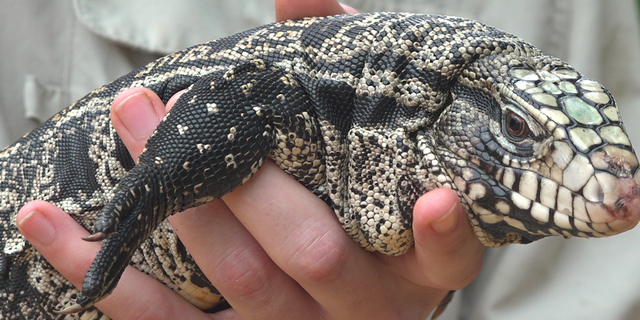
Georgia and Florida officials are working to stop the Argentine black and white tegu lizard from spreading. The lizards can grow up to 4 feet long and will eat anything they can put in their mouth, especially eggs.
REIDSVILLE, Ga. — An invasive, giant, and dangerous lizard is creeping its way through southeast Georgia and beyond.
The Argentine black and white tegu lizards are originally from South America, and now they are wreaking havoc on wildlife throughout the South.
Daniel Sollengberge, senior wildlife biologist with the Georgia wildlife, said they never knew there was a population established in the wild until recently.
Tegu lizards are known to eat anything that they want, especially the eggs of other reptiles.
“We presume that the animals started as the result of escaped or released pets in the area… there really common in the pet trade,” Sollengberger said.
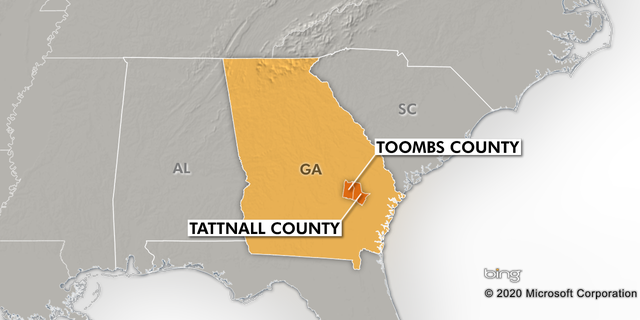
After over a dozen sightings of the lizards in southeast Georgia, Tegus have become known as an invasive species particularly in Toombs and Tattnall counties.
Map showing the two southeastern counties that have been invaded by Tegu lizards.
Georgia Southern professor, Dr. Lance Mcbrayer studies the evolution of lizards and leads the U.S Geological Survey team.
“Already in 2020 we’ve caught five animals at this site right here,” Mcbrayer said.
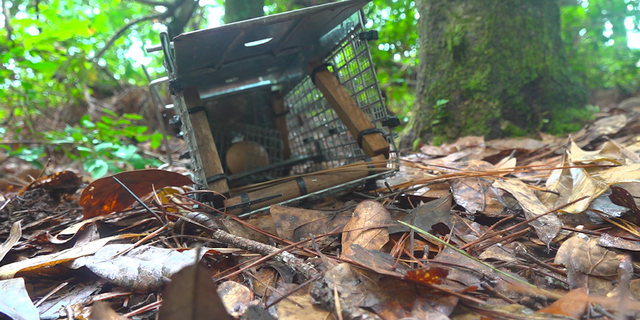
The lizards can grow up to four feet long. As the number of lizards in southeast Georgia continue to increase, the geological survey team is racing to put down traps.
The traps are placed about 100 meters apart and members of the Geological team check them daily.
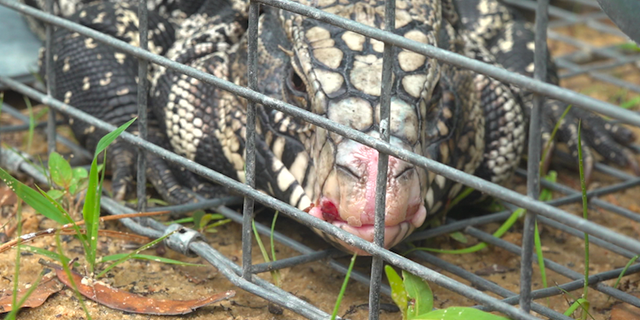
One trap in southeast Georgia that is set up to capture Tegu lizards.
Daniel Haro is a part of the geological team and works in the field about three to four times a week. “In general, right now, we have 85 and we’re going to get to 90… so, this week I’m hoping to place five more,” Haro said.
According to Georgia wildlife, the lizards don’t attack people unless provoked. However, with their strong jaws and sharp teeth, they will eat anything they can put in their mouth, especially eggs.
Crews hold Tegu lizards that was captured years ago.
“Whereby they’re damaging our gopher tortoise populations or bobwhite quail populations or turkey populations…the animal walks around and it hunts up nests on the ground,” Mcbrayer said.
On top of that, tegu lizards can lay up to 40 eggs, and once they hatch, they will be around 6 to 10 inches long. “That’s our real concern… that there could be a very rapid increase in the number of tegus in just a few years,” Mcbrayer said.
The crew in southeast Georgia has not caught a juvenile tegu yet but, “all the habitat and the size of the animals we’re catching suggest that they’re reproducing – so that’s a problem,” Mcbrayer said.
The U.S Geological survey team works to capture Tegu lizards in Reidsville, GA.
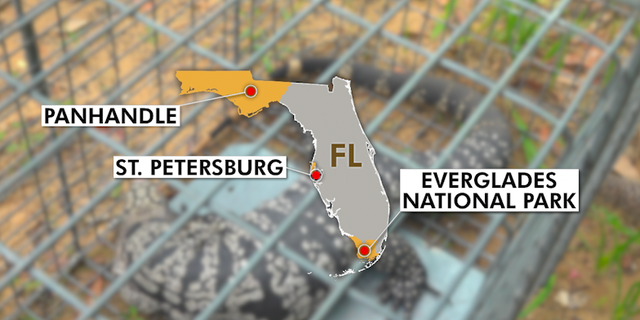
Tegu lizards have established themselves as invasive species in Florida, too. “There’s at least three populations in Florida… the north side of the Everglades…one inland in St. Pete from Tampa … and now one in the Panhandle,” Mcbrayer said.
Map shows areas in Florida that have been impacted by Tegu lizards.
The population of lizards in the South could spread rapidly because, unlike most lizards, Tegus move around.
“These animals can walk several miles in a day. They could walk 10 or 12vmiles just in a day or two,” Mcbrayer said.
As the population of lizards continues to grow, Mcbrayer says the lizards will spread if they aren’t stopped.
“These animals can be trapped or hunted humanely in safely,” Mcbrayer said. “We encourage anyone to do that to remove these animals from the wild.”
Two house cats in New York State are the first in the U.S. to test positive for the coronavirus that causes COVID-19, the Centers for Disease Control and Prevention announced on April 22. The owner of one of the cats had been diagnosed with the disease, but no one in the household of the second cat had tested positive, so it’s not yet known how the cat contracted the virus. Both cats had mild respiratory symptoms and are expected to recover.
Experts say it’s important to know that cases of pet cats acquiring coronavirus are very rare: In the world, there are only three confirmed cases of domestic cats (and two confirmed cases of dogs) getting sick. The CDC says there is no evidence at this time that the disease could spread in the opposite direction—from pets to humans.
“This is almost exclusively a human-to-human transmitted disease,” Michael San Filippo, a spokesperson for the American Veterinary Medicine Association, told NBC affiliates. “The risk to pets is very low, with only a handful of cases of the virus appearing in companion animals, and no cases of people getting sick from their pets.” (Many other human illnesses, including the common cold, do not pose threats to pets because they’re caused by species-specific viruses that are unable to infect other animals.)
The hunt for the next potential coronavirus animal host
One recent study, from a veterinary diagnostic lab in Maine, tested thousands of samples from dogs and cats and found no cases of the disease. While an early version of a report on a small experiment testing whether the virus could spread between cats found that indeed it can, research does not suggest that cats are a vector in spreading disease among humans.
With more than 2.6 million cases of COVID-19 globally, experts say that if pets were a significant vector, we’d know by now.
Keeping pets healthy
Many pet owners are more worried about getting their animals sick than they are about contracting illness from their pets.
To keep your pets healthy, treat them as you would any family member: If someone in your house is sick, they should isolate themselves. Make sure your pet maintains social distancing; the CDC recommends that pets not interact with anyone outside your household. When walking a dog, stay six feet away from other people (and animals) and avoid dog parks. Experts recommend washing your hands before and after interacting with a pet, just as you would with a fellow human.
A champion chinchilla Persian rests near a stack of books “like a lordly little lion” in Bloomsberg, Pennsylvania.
PHOTOGRAPH BY WILLARD CULVER, NAT GEO IMAGE COLLECTION
A trio of Siamese kittens sleep on a sofa in Washington, D.C.
PHOTOGRAPH BY WILLARD CULVER, NAT GEO IMAGE COLLECTION
An owner lovingly strokes her Persian in New York City. The 1938 National Geographic article captioned this image as “Stately, kindly, lordly friend, condescend here to sit by me.”
PHOTOGRAPH BY WILLARD CULVER, NAT GEO IMAGE COLLECTION
A pair of blue Persian cats pose on a recliner in Bogota, New Jersey. At the time, in the 1930s, the blue Persian regularly won best-in-show cat competitions.
PHOTOGRAPH BY WILLARD CULVER, NAT GEO IMAGE COLLECTION
A trio of Persian cats—which Eddy described as “unusually affectionate”—recline on furniture in Silver Spring, Maryland.
PHOTOGRAPH BY WILLARD CULVER, NAT GEO IMAGE COLLECTION
“Wary Princess Pat, with silvery frill and hypnotic stare, seems poised for flight,” Frederick Eddy wrote in the November 1938 National Geographic. The smoke Persian lived in New York City.
PHOTOGRAPH BY WILLARD CULVER, NAT GEO IMAGE COLLECTION
A black domestic shorthair named Midnight sits in front of the fireplace in Washington, D.C. Culver notes that the cat “had to be dragged, snarling, from under the sofa for a split-second pose.”
PHOTOGRAPH BY WILLARD CULVER, NAT GEO IMAGE COLLECTION
A blue Persian stares intensely at a goldfish bowl in Washington, D.C.
PHOTOGRAPH BY WILLARD CULVER, NAT GEO IMAGE COLLECTION
A Burmese cat poses in Cambridge, Massachusetts. At the time, Elmer was one of the only Burmese cats in the eastern U.S.
PHOTOGRAPH BY WILLARD CULVER, NAT GEO IMAGE COLLECTION
Three tailless Manx cats play on furniture in Washington, D.C.
PHOTOGRAPH BY WILLARD CULVER, NAT GEO IMAGE COLLECTION
“You can throw me on the table, but just try to put me on the shelf!” Eddy captioned this image of a champion red Persian in the 1938 National Geographic magazine article.
PHOTOGRAPH BY WILLARD CULVER, NAT GEO IMAGE COLLECTION
A pair of Siamese cats huddle together for a photo in Newton, Massachusetts.
PHOTOGRAPH BY WILLARD CULVER, NAT GEO IMAGE COLLECTION
A tortoiseshell domestic shorthair, named Joseph for her “coat of many colors,” perches on a shelf in Washington, D.C. “Only on humiliating hands and knees may fond humans visit this scornful kitty in her own domain,” Eddy wrote in the magazine article.
Wild animal worries
On April 5, we learned that a Malayan tiger at the Bronx Zoo tested positive for the coronavirus; on April 22, we learned that six more tigers and a lion at the Bronx Zoo have it, as well. These are the first tigers and lions known to have the virus.
Both wild and domestic cats had been known to be susceptible to feline coronavirus, a different strain, but until recently it was unknown whether they could contract SARS-CoV-2, the coronavirus that causes COVID-19.
It’s believed that the SARS-CoV-2 strain of the virus developed from a closely related coronavirus in bats. Researchers theorize that the strain evolved and jumped to an intermediate host animal, and then evolved again to infect humans.
Scientists have been working quickly to determine what other species are susceptible to infection by SARS-CoV2. Initial studies are working to identify any animal that the coronavirus could infect, whether or not it causes illness in that species. Among the species scientists are studying are cats and ferrets, both of which appear to be at least somewhat vulnerable to infection in laboratory settings (other animals studied include dogs, bats, civets, and pigs). Pangolins can carry a closely related coronavirus, but they have not been found to carry SARS-CoV-2.
Virologists caution that although the pathogen can enter the cells of some species in a lab, such infection might not occur outside of a laboratory setting. They have also determined that animals infected in a lab might not become sick. Additional testing will be needed to develop a better understanding of how this develops in animals. (Read more about how these tests are done and what we can extrapolate from them.)
The bottom line: We know that humans can pass on the novel coronavirus to some animals, but there is no evidence at this time that animals can pass it on to humans. More research is needed. In the meantime, the best practice is to take the same precautions with your pets as you would with humans.







 Exposing the Big Game