People just covered themselves in fake blood in the middle of a downtown Toronto street

Save Posthttps://www.facebook.com/v2.5/plugins/share_button.php?app_id=100616073343311&channel=https%3A%2F%2Fstaticxx.facebook.com%2Fx%2Fconnect%2Fxd_arbiter%2F%3Fversion%3D46%23cb%3Df3b34ef0be3b33c%26domain%3Dwww.blogto.com%26origin%3Dhttps%253A%252F%252Fwww.blogto.com%252Ff1aff1556bd9478%26relation%3Dparent.parent&container_width=94&href=http%3A%2F%2Fwww.blogto.com%2Fcity%2F2020%2F07%2Ffake-blood-toronto-street%2F&layout=button_count&locale=en_US&sdk=joeyhttps://platform.twitter.com/widgets/tweet_button.c4b33f07650267db9f8a72eaac551cac.en.html#dnt=false&id=twitter-widget-5&lang=en&original_referer=https%3A%2F%2Fwww.blogto.com%2Fcity%2F2020%2F07%2Ffake-blood-toronto-street%2F&size=m&text=People%20just%20covered%20themselves%20in%20fake%20blood%20in%20the%20middle%20of%20a%20downtown%20Toronto%20street&time=1595093742184&type=share&url=http%3A%2F%2Fwww.blogto.com%2Fcity%2F2020%2F07%2Ffake-blood-toronto-street%2F

https://www.blogto.com/city/2020/07/fake-blood-toronto-street/

Stay in the loop

Sign up for our free email newsletter. Unsubscribe anytime or contact us for details.ShareTweetSave this Article

Hundreds of animal rights advocates marched through the streets of Toronto this afternoon to demand justice for Regan Russell, the activist who was killed by a pig transport truck while protesting at Fearman’s slaughterhouse in Burlington. 

Russell was dragged by the truck for more than 15 metres during the incident, and charges against the driver have not yet been pressed as Halton Police are still investigating. 

On Friday, protestors took to the streets to demand that Russell’s memory be honoured and that justice be served. https://platform.twitter.com/embed/index.html?dnt=false&embedId=twitter-widget-0&frame=false&hideCard=false&hideThread=false&id=1284158186807689216&lang=en&origin=https%3A%2F%2Fwww.blogto.com%2Fcity%2F2020%2F07%2Ffake-blood-toronto-street%2F&siteScreenName=blogTO&theme=light&widgetsVersion=9066bb2%3A1593540614199&width=550px

Activists marched from CBC Headquarters to Queen’s Park, where speakers including Russell’s husband, Toronto Pig Save’s lawyer, activists and friends of Russell passionately addressed the crowd. https://platform.twitter.com/embed/index.html?dnt=false&embedId=twitter-widget-1&frame=false&hideCard=false&hideThread=false&id=1284196253342085121&lang=en&origin=https%3A%2F%2Fwww.blogto.com%2Fcity%2F2020%2F07%2Ffake-blood-toronto-street%2F&siteScreenName=blogTO&theme=light&widgetsVersion=9066bb2%3A1593540614199&width=550px

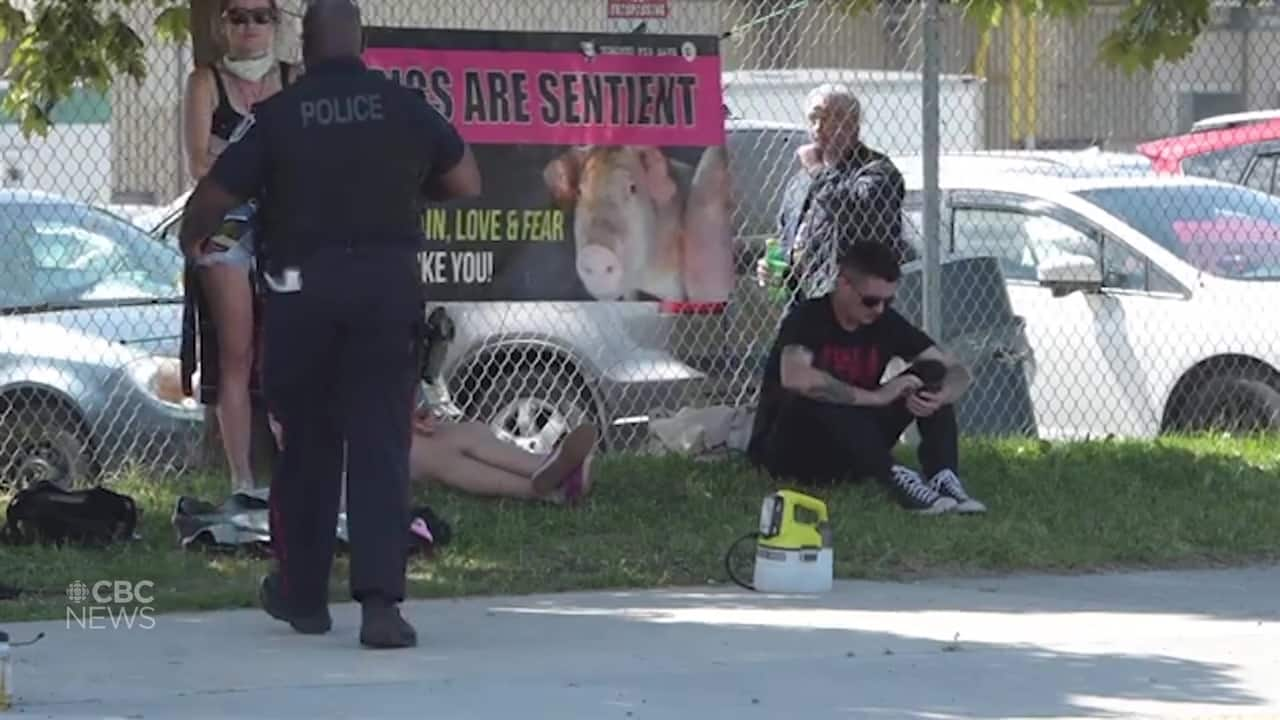
At one point, while walking down Queen Street West, activists laid down in the middle of sidewalk and street and covered themselves in fake blood in order to make a statement about Russell’s tragic death. https://platform.twitter.com/embed/index.html?dnt=false&embedId=twitter-widget-2&frame=false&hideCard=false&hideThread=false&id=1284217385109651456&lang=en&origin=https%3A%2F%2Fwww.blogto.com%2Fcity%2F2020%2F07%2Ffake-blood-toronto-street%2F&siteScreenName=blogTO&theme=light&widgetsVersion=9066bb2%3A1593540614199&width=550px

The entire protest was livestreamed from the Animal Save Movement’s Facebook page, and it shows masked protestors holding signs saying things like “We are Regan Russell,” and “Go vegan 4 Regan.”https://platform.twitter.com/embed/index.html?dnt=false&embedId=twitter-widget-3&frame=false&hideCard=false&hideThread=false&id=1284189643794251777&lang=en&origin=https%3A%2F%2Fwww.blogto.com%2Fcity%2F2020%2F07%2Ffake-blood-toronto-street%2F&siteScreenName=blogTO&theme=light&widgetsVersion=9066bb2%3A1593540614199&width=550px

In addition to honouring Russell, activists also demanded that Bill 156 be repealed and replaced.

The new legislation was passed by the Ontario government earlier this year and makes it much easier for farms to hide the conditions in which animals are kept from the public.https://platform.twitter.com/embed/index.html?dnt=false&embedId=twitter-widget-4&frame=false&hideCard=false&hideThread=false&id=1284220436495110144&lang=en&origin=https%3A%2F%2Fwww.blogto.com%2Fcity%2F2020%2F07%2Ffake-blood-toronto-street%2F&siteScreenName=blogTO&theme=light&widgetsVersion=9066bb2%3A1593540614199&width=550px

“The Bill is intended to protect farm animals, the food supply, farmers and others from risks that are created when trespassers enter places where farm animals are kept or when persons engage in unauthorized interactions with farm animals,” reads theexplanatory note at the beginning of the bill.

The law states that activists, media and any other trespassers could receive fines of up to $25,000 for entering a farm property for a number of reasons, including to document the animals’ living conditions or to simply interact with them.

“Activists are demanding that Bill 156, the ag-gag law passed by the Ontario legislature just two days before Regan was run over, be converted into Regan’s law, which protects farmed animals from abuse as well as the whistleblowers who expose the suffering of animals,” reads a statement from protestors. 

“Doug Ford and the members of the Ontario legislature need to know what Regan Russell stood for and how Bill 156 has failed her!!!”Lead photo by 
Toronto Pig Save

Ventilation Shutdown Used to “Depopulate” Farm Animals During Pandemic Causes Severe Suffering

Photo by Direct Action Everywhere
Photo by Direct Action EverywhereJuly 1, 2020

https://awionline.org/press-releases/ventilation-shutdown-used-depopulate-farm-animals-during-pandemic-causes-severe

Washington, DC—COVID-19 has shut down, at least temporarily, dozens of pig, chicken, and turkey slaughter plants in the United States, leaving millions of farm animals with nowhere to go. Some producers have arranged to keep animals on the farm until plants reopen, while others have chosen to kill healthy animals and bury or compost their bodies.

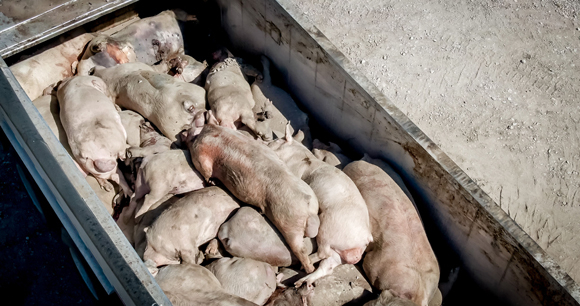
The term euthanasia, which literally means “a good death,” has been inappropriately used to characterize the killing by inhumane methods of healthy farm animals due to slaughter and processing capacity problems. The American Veterinary Medical Association (AVMA) uses the term “depopulation” to describe the rapid destruction of a population of animals in response to urgent circumstances. One method that has been used to kill large numbers of farm animals is “ventilation shutdown,” which involves turning off the airflow in a barn and ratcheting up the heat to as high as 120 degrees, leaving trapped birds and pigs to die from a combination of heat stress and suffocation.

Dena Jones, director of the farm animal program at the Animal Welfare Institute (AWI), issued the following statement regarding the use of ventilation shutdown to kill farm animals due to limited slaughter capacity during the pandemic:

The ventilation shutdown process can take hours and likely results in severe animal suffering. Intentionally inflicting death in a manner that causes elevated and prolonged distress is unacceptable and does not qualify as “euthanasia.” It is particularly insupportable for the AVMA — a professional scientific body representing veterinarians sworn to protect animals — to allow its guidelines to be used in such an inappropriate manner.

When the AVMA proposed allowing the use of ventilation shutdown to kill animals “in constrained circumstances,” AWI warned that the AVMA guidelines might not prevent producers from using this extreme method in situations that instead call for euthanasia. In fact, that is exactly what is happening now; healthy animals posing no public health risk are being killed by a grossly inhumane method to aid the meatpacking industry.

Ventilation shutdown was last used in 2015 in response to an outbreak of highly pathogenic bird flu, which killed nearly 50 million chickens and turkeys in the United States. During the current pandemic, however, animals are not suffering from disease, nor are they at risk of transmitting disease to other animals or to humans. Instead, they are being destroyed because meat companies have failed to properly protect their slaughterhouse workers.

The modern animal agriculture industry in the United States routinely puts profits over the well-being of both animals and workers. It runs slaughter lines as fast as possible, provides animals the lowest level of care required, and offers minimal health and safety protections to its workers. There is no margin for error in this intensive, high-production system. As a result, the wave of plant closures has left millions of animals in limbo. Nevertheless, the current situation does not justify subjecting any animal to a cruel death.

###Media Contact

Margie Fishman, (202) 446-2128, margie@awionline.org

Ontario Passes Controversial New Ag-Gag Law, But Animal Rights Activists Aren’t Backing Down

Kayo Brewster

Reading Time: 3 minutes  

On June 17, 2020, the Ontario government passed Bill 156, an ag-gag law that criminalizes whistleblowing on factory farms.

Under this law, it is now illegal for anyone to photograph animals in transport or to approach trucks to offer water to animals that have legally been transported without food, water, or rest for up to 36 hours in sweltering conditions. The new legislation also targets journalists, whistleblowers, and investigators, preventing them from exposing animal cruelty on farms and in slaughterhouses. 

Without the cruelty unveiled by undercover investigators and whistleblowers, animals will continue to live in squalid conditions and be subjected to inhumane treatment without repercussions for the farm owners or workers committing these acts.

Amy Soranno is one of the many investigators fighting back, with the support of the Canadian Association of Journalists, the Canadian Civil Liberties Association, and thousands of activists who believe the new law poses a serious threat to free speech.

In a recent video, Soranno discusses her life as an animal rights activist, including organizing Canada’s first mass farm occupation Meat The Victims, and investigating some of the country’s largest animal farming operations.

Following the video’s release, we chatted with Soranno about Ontario’s new ag-gag law and what the further criminalization of on-farm activism in Canada means for the rest of the animal protection movement.

“The animal agriculture industry wants to scare animal activists away from escalating their tactics or taking part in direct action because they recognize that these actions are highly effective,” Soranno states. “My hope is that Bill 156 (and other ag-gag laws) will have the opposite effect, lighting a fire within activists to fight even harder, challenging Bill 156 in court, and fighting for animals to be protected under the law.”
The Importance of Whistleblowers and Undercover Investigators
The meat and dairy industries’ unsavory practices are upsetting and unprofitable, so companies do what they can to “humane wash” their marketing strategies—giving the illusion that their products come from happy, well-treated animals. Undercover investigators, activists, and whistleblowers continue to risk their mental and physical health to expose the truth.  In June of 2019, Animal Outlook—formerly Compassion Over Killing—and the Public Justice Food Project brought suit on behalf of a whistleblower following a hidden-camera investigation inside the Superior Farms lamb slaughterhouse conducted in Dixon, California from May to November 2016. In a first for the animal agriculture industry, Superior Farms entered a consent decree with the USDA to reform its killing methods and other inhumane and otherwise misleading practices that Animal Outlook’s investigation brought into question.
 In July of 2019, Animal Recovery Mission’s (ARM) investigation at Natural Prairie Dairy stands as the first-ever cruelty investigation into an organic dairy farm in the United States, and the third installment of the largest dairy investigation of all time into Fairlife and Select Milk Producers, Inc. The first two investigations released by ARM were Operation Fair Oaks Farms and Operation Fairlife. After the investigations gained media attention, Fairlife milk and Natural Prairie Dairy products were pulled from grocery store shelves across the country.
 In October of 2019, Animal Outlook released the first-ever undercover footage of a salmon aquaculture farm—Cooke Aquaculture. The farm is a massive salmon hatchery whose subsidiary, True North, has partnered on a new seafood brand with Martha Stewart. The footage reveals heinous scenes of animal abuse, giving consumers a first look into the highly secretive salmon farming industry. Animal Outlook submitted their evidence to authorities, and after being contacted about the investigation, Cory Baker, COO of Marquee Brands—which owns the Martha Stewart True North Line—replied promptly. Booker stated that the company will be opening its own investigation immediately and is committed to “sustainability and of course ensuring cruelty free practices.”
Similar ag-gag laws are being introduced and implemented into provinces across Canada, including Alberta and British Columbia.

“These bills would increase penalties for people who attempt to rescue animals from harm and would implement higher charges for those who trespass onto farm properties, like hundreds of thousands of dollars in fines or years in jail…This is for entering a business and taking out your phone to record. These new Bills are one of the biggest threats to Canadian farmed animals right now. Not only are the animals being silenced, but now so are their advocates.”

Read the full story here
Getting our facts right is vital in journalism. Join us Thursday, July 23rd at 9am PT to learn from author, researcher, and lecturer Christopher Sebastian how to fact check effectively. Sign up here.
Covering COVID-19
With the worst global pandemic we’ve seen in over a century, it’s more important than ever to make sure the truth is reported in its entirety, not just what’s convenient.

Help us share the facts during these uncertain times and make sure the world knows our species cannot survive if we continue our exploitation of the planet and nonhuman animals.

Flu virus with ‘pandemic potential’ found in China

https://www.bbc.com/news/health-53218704

By Michelle RobertsHealth editor, BBC News online

  • 1 hour ago

Related Topics

pig being transported
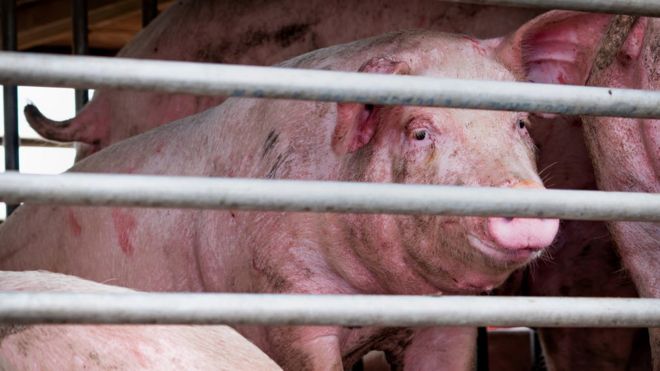
Image captionThe new flu strain is similar to the swine flu that spread globally in 2009

A new strain of flu that has the potential to become a pandemic has been identified in China by scientists.

It emerged recently and is carried by pigs, but can infect humans, they say.

The researchers are concerned that it could mutate further so that it can spread easily from person to person, and trigger a global outbreak.

While it is not an immediate problem, they say, it has “all the hallmarks” of being highly adapted to infect humans and needs close monitoring.

As it’s new, people could have little or no immunity to the virus.

Pandemic threat

A bad new strain of influenza is among the top disease threats that experts are watching for, even as the world attempts to bring to an end the current coronavirus pandemic.

The last pandemic flu the world encountered – the swine flu outbreak of 2009 that began in Mexico – was less deadly than initially feared, largely because many older people had some immunity to it, probably because of its similarity to other flu viruses that had circulated years before.

That virus, called A/H1N1pdm09, is now covered by the annual flu vaccine to make sure people are protected.

The new flu strain that has been identified in China is similar to 2009 swine flu, but with some new changes.

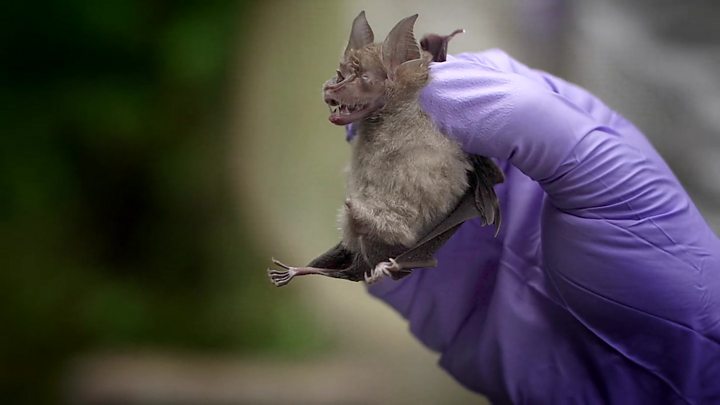
Media captionSearching for viruses in Thai bats – watch scientists collect samples from the animals in order to look for clues about coronaviruses

So far, it hasn’t posed a big threat, but Prof Kin-Chow Chang and colleagues who have been studying it, say it is one to keep an eye on.

The virus, which the researchers call G4 EA H1N1, can grow and multiply in the cells that line the human airways.

They found evidence of recent infection starting in people who worked in abattoirs and the swine industry in China.

Current flu vaccines do not appear to protect against it, although they could be adapted to do so if needed.

Prof Kin-Chow Chang, who works at Nottingham University in the UK, told the BBC: “Right now we are distracted with coronavirus and rightly so. But we must not lose sight of potentially dangerous new viruses.”

While this new virus is not an immediate problem, he says: “We should not ignore it”.

The scientists write in the journal Proceedings of the National Academy of Sciences that measures to control the virus in pigs and closely monitor working populations should be swiftly implemented.

Prof James Wood, Head of the Department of Veterinary Medicine at the University of Cambridge, said the work “comes as a salutary reminder” that we are constantly at risk of new emergence of pathogens, and that farmed animals, with which humans have greater contact than with wildlife, may act as the source for important pandemic viruses.

Media captionHow swine fever devastated China’s pigs in 2019

Joaquin Phoenix Attends Vigil for Animal Rights Activist After She Died Outside a Slaughterhouse

Joaquin Phoenix honored Regan Russell, an animal rights activist who was killed outside of a slaughterhouse in Toronto, CanadaBy Alexia Fernandez June 26, 2020 10:02 PMhttps://7df0782deefdfbba75c64735113f71eb.safeframe.googlesyndication.com/safeframe/1-0-37/html/container.htmlhttps://7df0782deefdfbba75c64735113f71eb.safeframe.googlesyndication.com/safeframe/1-0-37/html/container.htmlADVERTISEMENTFBTweetMore

Joaquin Phoenix

Joaquin Phoenix and Michelle Cho; (inset) Regan Russell BOBBY SUD

Joaquin Phoenix paid tribute to an animal rights activist after she died giving pigs water outside of a Canadian slaughterhouse.

The Oscar-winning actor, 45, joined more than 100 animal rights activists for a vigil to commemorate Regan Russell outside of the Farmer John slaughterhouse in Vernon, California, on Thursday night.

Phoenix, who has been an outspoken proponent for animal rights and veganism, stood outside of the slaughterhouse in a black hoodie reading “LA Animal Save,” a mask, and a sign that read, “#SavePigs4Regan.”

Standing beside him was his friend, Michelle Cho, with a sign that read, “Rest in power Regan.”

RELATED: Joaquin Phoenix Comforted Pigs at L.A. Slaughterhouse After SAG Award Win: ‘I Have to Be Here’

In a statement obtained by PEOPLE, Phoenix said, “Regan Russell spent the final moments of her life providing comfort to pigs who had never experienced the touch of a kind hand.”

“While her tragic death has brought upon deep sorrow in the Animal Save community, we will honor her memory by vigorously confronting the cruelties she fought so hard to prevent by marching with Black Lives, protecting Indigenous rights, fighting for LGBTQ equality, and living a compassionate vegan life,” he said.

Joaquin Phoenix

Regan Russell died on June 19 GOFUNDME

“The Ontario government can attempt to silence us with the passage of its Ag-Gag bill -Bill 156 – but we will never go away and we will never back down,” he said. “My heart goes out to the Toronto Animal Save community and to Regan’s lifelong partner, Mark Powell.”

Part of Russell’s fight was to repeal a new bill passed in Ontario, Bill 156, that will soon make it illegal for anyone to be on private property such as farms where animals intended for slaughter are usually held.

Russell died on the morning of June 19 outside of the Fearman’s Pork Inc. when she was hit by a transport truck as she was attempting to give water to pigs headed to slaughter.

A spokesperson for the Halton Regional Police Service did not immediately respond to PEOPLE’s request for comment, although an investigation into her death is being conducted, a spokesperson told CBC.

Russell’s partner, Powell, told The Hamilton Spectator shortly after her death he didn’t know how she ended up underneath the transport truck, but that he was willing to continue her legacy of fighting for animal welfare.

RELATED: Rooney Mara and Joaquin Phoenix March with Dead Animals After Sparking Engagement Rumors

“She died fighting for what she believed in,” Powell said. “Whatever it cost, she would pay. Sometimes it’s money. Sometimes, it’s this.”

On Friday, Powell told the CBC he’d fight Bill 156 for “the rest of my life.”

“My life ended on Friday [June 19], so for as long as I’m left here, we have to pick up the torch and we have to fight things like Bill 156,” he said.

GoFundMe for Russell has been created by her family to provide funds for her funeral and legal expenses.

The Long History Of Murdered Animal Rights And Environmental Activists

Regan Russell and other activists killed

ActivismAnimal RightsArticlesEnvironmentFeaturedFeatured ActivistsLatest

 Brandon Kirkwood  0 CommentsActivistskilledmurderSpread the love

With the recent passing of Regan Russell who died when run over by a slaughterhouse truck at a vigil in Canada, a long horrible chain of violence has been added to.

Below is a timeline of vegan activists who died speaking out for the animals.

When possible I have posted pictures of the slain individuals so they can be more than just words on a page.

1976, January 6th: William Sweet, LACS member Anti-hunting activist, Murdered after an altercation with a man who was shooting birds. His murderer was jailed for life but was later released.

1985 October 7th: Fernando Pereira a Greenpeace photographer was murdered by the French Secret Service when the vessel “Rainbow Warrior” was sunk by two explosions in Auckland Harbor, New Zealand.

The Photographer Fernando Pereira (right) and Rongelap Islander Bonemej Namwe ride ashore in the ‘bum bum’. Born on Kwajalein, Namwe, 62, has lived most of her life on Rongelap. The Rainbow Warrior is in Rongelap to assist in the evacuation of islanders to Mejato. Rongelap suffered nuclear fallout in 1954, making it a hazardous place for this community to continue living in. Eyes of Fire: p49
Mediavine

1988, December 22nd: Chico Mendes an anti-deforestation activist was murdered in his own home after an assassination order by a cattle rancher. He was the 19th Brazilian rainforest activist murdered that year. 

1991, February 9th: Mike Hill an 18 year old hunt saboteur was deliberately run over and killed during a meet of the Cheshire Beagles. Death is deemed “accidental”. No charges are brought against the driver Allan Summersgill. 

1993, April 3rd: 15-year-old hunt saboteur, Tom Warby, is deliberately run over and killed by a fox hunter as other huntsmen stand and laugh, proclaiming a “victory”. The driver, Alan Ball, is not prosecuted. 

Microsoft

Mediavine

1995, February 1st: Jill Phipps was a 31-year-old British activist and mother, who was crushed to death under the wheels of a veal transporter truck carrying live animals for export at a protest at Coventry airport. The Crown Prosecution Service decided not to bring any charges against the driver.

1995, March: Dr. Karel Van Noppen was a Belgium veterinarian who was assassinated in 1993 by hitmen after exposing mafia connections to the meat industry. Dr. Van Noppen was the victim of a powerful, international mafia who violently imposing its rule on the meat business, ruthlessly bullying anyone daring to stand in its way. In 1995, a few days before his murder, Van Noppen was explicitly threatened by people linked to the “hormone black mafia” underworld.

Dr. Karel Van Noppen
Mediavine

1998, September 17th: David “Gypsy” Chain was an American eco-activist who was crushed to death after an irate logger fell a tree on him in California’s redwood forest. On September 17, 1998, the 24-year-old environmental activist was crushed to death by a falling tree at the Headwaters Forest in Northern California.

Activists from Earth First! accused loggers of deliberately cutting down trees in their direction, part of escalating violence against activists condoned by the Pacific Lumber Company and the Humboldt County Sheriff’s Department.

Gypsy was part of an action to stop PL from destroying one of the last ancient redwood forests in the world.

The logging operation was illegal as a survey had yet to be done for the marbled murrelet, an endangered species of bird. PL attempted to portray the death as a “freak accident” and even tried to blame the victim as well as Earth First! According to PL spokesperson, Mary Bullwinkle:https://tpc.googlesyndication.com/safeframe/1-0-37/html/container.html

Mediavine

“Despite all our precautions, a trespasser was apparently killed by a falling tree at one of our logging sites on our private property.”

On September 18, Earth First! released a videotape revealing that loggers not only knew that demonstrators were in the area, but were angrily threatening them shortly before Gypsy was killed.

A logger shown shouting profanities and threats was, according to Earth First!, the very same logger who felled the tree that struck David. The video also showed activists scrambling up a steep hillside to escape falling trees. According to a witness statement:

“Gypsy’s death is not an isolated incident of violence. In the last several months trees have been intentionally felled at nonviolent activists at the Luna tree sit and in the Mattole watershed in Humboldt County. This is part of an escalation of violence against nonviolent forest defenders in the Northwest and all over the world.”

On September 18, the Humboldt County Sheriff’s Department issued preliminary findings concluding that the death was “accidental”. According to an Earth First! activist speaking at a press conference, “Police have routinely refused to file charges against anybody who assaults a forest activist.” In 1999, Mr. Chain’s parents filed a wrongful death lawsuit against PL. The company settled out of court in October of 2001, just three days before the trial was set to begin.

A collage of David “Gypsy” Chain made by a morner
Mediavine

2003: Animal rights activist Jane Tipson is murdered in an alleged contract killing after protesting against the construction of a dolphin aquarium in St Lucia. To this day, her killers have not been found or prosecuted.

2005: 73-year-old anti-deforestation campaigner, Dorothy Stang, is approached in the Amazon by 2 armed men working on behalf of an animal agriculture organization. Asked if she has any weapons, she produces her Bible and says that’s all she has. She is shot in the stomach, then fatally shot 5 more times as she lays on the ground.

Dorothy Stang

https://tpc.googlesyndication.com/safeframe/1-0-37/html/container.html

Mediavine

2006: Joan Root, a conservationist, and activist against poaching and illegal fishing is murdered by 4 gunmen in her own home. To this day, her killers have not been found or prosecuted.

Joan Root and Alan Root

2010, May 12th: Elvio Fichera a volunteer for the Association of Abandoned Animals was murdered while trying to serve a warrant with police on Renzo Castagnola for cruelty to animals. Renzo Castagnola shot Elvio dead.

Elvio Fichera

More: https://vegannewsnow.com/2020/06/24/regan-russell-history-activists/

May 12, 2010: Paola Quartini, animal activist for LIPU (Italian League for Bird Protection – UK) from Genoa, Italy was murdered whilst trying, with police, to serve a warrant on Renzo Castagnola for cruelty to animals. Renzo Castagnola shot him dead.

2011: Two anti-deforestation activists, Jose Claudio Ribeiro da Silva and Maria do Espirito Santo, are shot dead by hired thugs, after years of constant death threats from cattle ranchers. The main suspect is acquitted. No other prosecutions.

https://tpc.googlesyndication.com/safeframe/1-0-37/html/container.html

Mediavine

2013: Jairo Mora Sandoval, a sea turtle activist, is bound, beaten, then fatally shot in the head by sea turtle poachers, after being kidnapped along with 4 other activists.

2020, June 19th: Regan Russell, an activist with the Animal Save Movement was murdered by a slaughterhouse truck driver that by all accounts did so on purpose.

Regan Russell

https://tpc.googlesyndication.com/safeframe/1-0-37/html/container.html

We remember our fellow fallen friends by continuing on with the activism they died for. Any single one of their deaths could easily have been ours and that’s one reason their deaths hit so hard.

Every time we go to a vigil, protest, shutdown, undercover investigation, or any form of protest we place our lives at risk so that we can help change the world.

Never forgetting those who have sacrificed everything for a more just and equal world is the least we can do but it’s even better if we remember on the days we are too tired, or sick to go to an event.

In the end we are all brothers and sisters in this together fighting for what’s right. We are all in this together.

Help Vegan News continue to get the news that matters to our community and help us move forward in these hard times.

You can help us continue creating and telling the stories of animals and activists by becoming a Patreon supporter at: https://www.patreon.com/vegannews

Or with a one time donation through:

Venmo: @VeganNews

CashApp: @VeganNews

Paypal: PayPal.Me/vegannewsHelp keep Vegan News Independent by becoming our Patron!

‘My life ended’ Friday: Regan Russell’s supporters want justice, Bill 156 overturned

‘I’ll fight it the rest of my life,’ says Regan Russell’s husband, Mark Powell

Samantha Craggs · CBC News · Posted: Jun 26, 2020 12:55 PM ET | Last Updated: June 26

https://www.cbc.ca/news/canada/hamilton/regan-russell-1.5627216

Regan Russell, says friend Julie Maue, “taught me how to have long friendships. How lucky am I?” (Agnes Cseke)

As far as Mark Powell is concerned, his life ended last Friday when his wife, Regan Russell, was hit and killed by a transport truck during a Burlington animal rights protest.

Now he’ll spend the rest of his days, he says, trying to get rid of the bill that haunted her.

Powell, a west Hamilton contractor, says there’s been an international outpouring over Russell’s death, from artwork to YouTube tributes, and it’s helped make the grief a little lighter. His wife was deeply rattled by Bill 156, which creates “animal protection zones” that prohibits animal rights activists from “interfering or interacting with the farm animals in the motor vehicle.” 

He’s hired a lawyer for two reasons: to see justice in her death, and to try to get the new bill repealed. 

“I’ll fight it the rest of my life,” he said. “My life ended on Friday, so for as long as I’m left here, we have to pick up the torch, and we have to fight things like Bill 156.”

The notion of Russell having a legacy is comforting to Powell and others who knew her. The 65-year-old activist often protested in front of Fearman’s Pork Inc. as part of Toronto Pig Save. The group gives a last gulp of water to pigs packed into hot trailers, moments before they’re slaughtered.

That’s what she was doing at 10:20 a.m. June 19. Somehow, witnesses say, she ended up being hit by the transport truck.

Regan Russell (left) and Katherine Wightman are shown as young models in the photo on the left. In the more recent photo, Russell is on the right. “I’ve lost my right arm,” Wightman says. (Katherine Wightman)

Halton Regional Police Service said Thursday that the collision reconstruction unit is doing a “thorough investigation.” 

“A determination on charges will be made by the collision reconstruction unit once the investigation is complete,” said Const. Steve Elms in an email. “At that time, investigators will issue a media release to update the community.”

Russell was also a women’s rights and Black Lives Matter supporter and attended a rally days before her death, says close friend Katherine Wightman. She believed strongly, Wightman says, that all beings are equals, and that informed her activism.

Russell often posted her thoughts on Facebook, most recently about Bill 156. “Bill 156 has passed,” she wrote on the day before she died. “Now, any time an animal is suffering on a farm in Ontario, no one, not even an employee, has the right to expose it.”

Animal rights activists have been rallying against the Security From Trespass and Protecting Food Safety Act, 2019  since January. 

The bill was introduced in the Ontario legislature late last year. Agriculture Minister Ernie Hardeman said it’s in response to complaints from farmers about animal rights groups trespassing on their private property. 

Friends and community, including Russell’s parents and husband, gathered for a vigil last weekend. (Jo-Anne McArthur / We Animals)

The bill, he said, is a “bio-security” measure. It increases the fines for anyone caught trespassing on farms or food processing plants, and makes it illegal to gain access to a farm under “false pretenses,” which effectively makes undercover filming an offence.

The Ontario Federation of Agriculture rallied support for the bill, saying it “protects our farms, families, livestock and food supply” from increasingly aggressive tactics from animal rights groups.

“Ontario farms have come under increasing threat from trespassers and activists who illegally enter property, barns and buildings, breaching biosecurity protocols,” president Keith Currie said in a June 12 media release

“Once peaceful protests have now escalated to trespassing, invasions, barn break-ins, theft and harassment.”

There’s precedent, however, to what Powell is considering. In Idaho, Iowa and Utah, courts have struck down similar “Ag-Gag” laws as being unconstitutional. That’s led Ontario animal rights activists to consider whether Ontario’s law could be struck down in court.

“She was dynamic,” friend Julie Maue says of Russell. “She was confident. She always made you feel like you were as beautiful as her.” (Toronto Pig Save)

Powell has retained Anandi Naipaul at Ross & McBride LLP. Russell’s family has also launched a fundraising campaign “to continue Regan’s work and assist the family.”

Powell says it’s the best way he knows to honour his wife’s life. Russell’s activism began when she was 24, he says, and living in Winnipeg. She made her own sign that said “Stop the seal hunt” and stood outside a downtown government building on a frigid winter day. After several hours, she thought she’d instigated some change.

“She went home, freezing cold,” Powell said. “She took a hot bath and thought, ‘There, that’s done. What’s next?'”

Russell was born and raised in Hamilton, Powell said, and moved to Moose Jaw and then Winnipeg. In Winnipeg, she became a model, an occupation that continued until 2002. She also enjoyed spending time with the family’s seven rescue cats, which Russell warned Powell about when they started dating. 

“She said, ‘You have to understand there will be cats, plural,'” he recalled. “I accepted that, and it’s grown to a family of seven cats.”

Animal activists embrace at the scene on June 19. (Andrew Collins/CBC)

In 1985, Powell says, she read Animal Liberation: A New Ethics for Our Treatment of Animals by Peter Singer, which changed her life, and she became vegan. She gave her dad Bill, now 89, the book, and he became an animal rights activist too. The pair protested together at Marineland, Powell says, and also at a 2017 Bill Cosby show in Hamilton.

Wightman met Russell as a teenage model in Winnipeg, and “she was instantly like a big sister.” The pair talked on the phone as often as five times a day. Wightman called Russell’s cell phone on June 19, not knowing Russell had died until Powell answered it and told her. 

Now, “it feels like I’ve lost my right arm,” Wightman said. Their last conversation, she said, was about Bill 156. “She said, ‘I am so tired. Do you realize now the work that lies ahead of me?'”

If there is a bright spot, she said, it’s that “the word has become global about who she is and what she stood for.”

Russell’s friend Julie Maue says the last time she saw her friend, they went to the office of Hamilton West-Ancaster-Dundas MPP Sandy Shaw to talk about Bill 156. Russell, Maue says, was compassionate, intelligent and logical.

Watch

Activist killed after being struck by vehicle during Burlington pig plant protest

  • 8 days ago
  • 0:54

A animal activist protest in Burlington has turned deadly after Halton police say a vehicle struck and killed one of the activists. 0:54

“She was dynamic,” Maue said. “She was confident. She always made you feel like you were as beautiful as her.”

Anita Krajnc, founder of the Save movement, says Russell’s death has inspired vigils in multiple countries. She wants to keep the momentum going.

Krajnc made headlines at the Burlington plant in 2016 when she was charged with mischief for giving water to pigs. She was ultimately found not guilty after a lengthy trial that included slaughterhouse footage and testimony from a variety of experts. Russell attended the trial.

“I wake up multiple times a night, and I’m instantaneously thinking about her,” Krajnc said. Then “I go online and I watch the vigils.”

“I believe that site where Regan was killed, there will one day be a plant-based facility. I truly believe that.”

Protester dead in Burlington after being struck by transport truck at pig slaughterhouse

Halton Regional Police are investigating a pedestrian fatality in Burlington Friday after a protester was reportedly struck and killed by a transport truck outside the slaughterhouse.

The incident occurred outside the Fearmans Pork meat processing facility at Appleby Line and Harvester Road.

There are reports the protester — a woman — was trying to feed the pigs inside the transport truck while it was still moving when she was struck and killed.

Animal rights protesters have a long history of protesting at Fearmans.

The events’ declared purpose is to bear witness to the animals arriving for slaughter and reduce the disconnect people have with the food they have on their plate.

“This is so tragic, so heartbreaking,” said Geena Morrison, who has participated in pasts protests outside the plant. “I’m in tears.”

US producers ‘in tears’ at having to cull livestock on their farms

With slaughterhouse capacity in crisis due to Covid-19, one farmer believes he has developed a more humane way of ‘depopulating’ animals

Pigs at a farm near Le Mars, Iowa

Pigs at a farm near Le Mars, Iowa. Breeders are having to slaughter animals on their farms. Photograph: Dan Brouillette/Bloomberg /Getty Images

Animals farmed is supported by

Animals farmedAbout this content

Published onWed 10 Jun 2020 06.29 EDT

As traumatised US farmers continue to cull their animals in response to the slaughterhouse crisis, an Iowan pig producer has developed an on-farm method which he believes is quicker and more humane than other available options.

The coronavirus crisis has hit US meat plants particularly hard. As a result there is a lack of slaughter capacity, and farmers are being forced to cull or “depopulate” their animals on-farm.

Approved methods include gassing with CO2, but the practice is controversial. “Dying this way is not a peaceful experience”, even under normal circumstances, let alone in makeshift sheds or trailers, said president of welfare group, Mercy for Animals, Leah Garcés.

Gassing the animals is currently thought to be one of the fastest and most humane methods, leaving animals unconscious within two minutes and dead within 10. The carcasses are incinerated, composted or rendered for fat, fertiliser and pet food.

But for Dwight Mogler of Iowa’s Pig Hill Farms, that is too long. Mogler is a sixth-generation pig farmer with firsthand experience of gassing newborn pigs. “I have talked to people who have been on site for a CO2 depopulation and we have used it for neonatal [new-born] pigs. It can take up to a minute,” he said.

Mogler, who produces about 150,000 pigs a year, says he is fairly confident the gassing is not painful for newborns, but it is disturbing. “There are muscle spasms and the limbs flail, but no vocalising,” he said.

Another depopulation option is overheating, or hyperthermia, commonly known as ventilator shutdown (VSD). A recent undercover video of an alleged VSD pig cull at a different Iowa producer contained disturbing scenes and sounds.

Asked about the video, Mogler said it would have involved turning off the ventilation, turning up the temperature and then the introduction of steam. “It would take less than one hour and any remaining pigs would be shot with bolt guns. It might only take 10 minutes in fact for the pigs to die. But for us that is too long.”

Having rejected CO2 and VSD, Mogler decided to build his own cull facility. It will replicate a slaughterhouse death time of less than two seconds. Ready to undergo testing, Mogler’s system consists of a mobile unit with a V-restrainer, an electrical stunning point and a captive-bolt gun.

Mogler aims to slaughter about 170 pigs every 45 minutes, using a rotating slaughter crew to avoid mental or physical fatigue. “Our capacity would be about 1,500 to 2,000 pigs a day,” he said, and no pig caretakers will be involved in the slaughter.

As well as developing his own cull technique, Mogler donated two pigs to a Missouri sanctuary. Initially reluctant, because the goals of a sanctuary are so at odds with those of a farmer, Mogler changed his mind after talking to a rescue coordinator. “ I found we had so much more in common [than expected]”, he said.

Donating pigs to food programmes is another option for farmers, particularly with so many Americans facing increased financial and food insecurity, but slaughtering remains a challenge. For a few there is still space at local lockers, as Iowa’s smaller, state-inspected butchers are known. Most, however, are already overwhelmed, with some fully booked into 2021.

Despite donation difficulties, psychologist and Iowan farmer Dr Michael Rosmann thinks it’s worth the effort. “It helps the farmers a bit, to know they have tried to find a solution for at least some of their pigs,” Rosmann said. “It’s probably only going to help with about 1% of their animals. These are farmers with anywhere from 3,000 to 10,000 pigs. It’s a very complex situation and it is not going to end soon.”

Farmers are extremely distressed by the possibility of having to depopulate their animals, said Rosmann, who has talked to several in the past few weeks. “One of them was in tears. He could not bring himself to kill his pigs and he was asking for advice,” Rosmann said. “My suggestion was to find food programmes or local butchers, or people who are able to butcher the animals themselves – that’s allowed by law, if you kill it and eat it yourself.” Sadly, he said, many of those able to slaughter their own animals might be illegal migrants and afraid to come forward.

At industry level, Iowa Pork Producers Association spokesperson, Dal Grooms, said its newly created food-bank donation programme, Pass the Pork, has seen 48,404lb of pork, about 456 pigs, enter the food chain via local lockers.

Cruel practice of trapping animals with explosive fruit should stop

Elephants or Wild Boars:  By Shreya | Updated: Monday, June 8, 2020, 13:20 [IST] New Delhi, June 08: The death of a starving, pregnant elephant in Palakkad allegedly consuming a pineapple stuffed with explosives caused outrage on social media. The jumbo went through unthinkable trauma, stood impassively in a river and died a slow death. Video grab Various theories have shrouded the ghastly death of the elephant. While people are blaming the farmer responsible for the incident, it is important to note that the elephant was an unintended target. Primary investigations into the death of pregnant elephant in Kerala has found that it may have accidentally consumed a cracker-stuffed fruit, the environment ministry noted. NGT takes cognisance of elephant death in Kerala, seeks action-taken report from panel India public places reopen even as Covid-19 infections surge by 9000 for 5 days | Oneindia News The government noted that many a times locals resort to an illegal act of planting explosive-filled fruits to repel wild boars from entering plantation farms. In a series of tweets, the ministry has said that one person has been arrested in the matter. “Primary investigations revealed, the elephant may have accidentally consumed in such fruit.” Ministry is in constant touch with Kerala Govt and has sent them detailed advisory for immediate arrest of culprits & stringent action against any erring official that led to elephant’s death,” the ministry said. “As of now, one person has been arrested & efforts are on to nab more individuals who may have participated in this illegal & utterly inhuman act. The @WCCBHQ has also been directed to act on this matter with utmost sense of urgency. #WildlifeProtection,” the ministry posted on its official Twitter handle. So now, it has come to the light that the elephant had strayed into a trap that was intended for wild boars. Wild boars are a chronic problem to farmers because they tend to destroy crops in their search for food. To avert them, farmers have come up with cruel methods like the explosive-laced traps that claimed the elephant’s life. It’s a common practice in most of the Indian states to ward-off the animals. But that does not make this practice less evil and it has to stop at any cost. The intended target is an elephant or a wild boar, it is an inhumane method of dealing with wildlife.

Read more at: https://www.oneindia.com/india/elephants-or-wild-boars-cruel-practice-of-trapping-animals-with-explosive-fruit-strap-should-stop-3101171.html