Exposing the Big Game

Forget Hunters' Feeble Rationalizations and Trust Your Gut Feelings: Making Sport of Killing Is Not Healthy Human Behavior

Exposing the Big Game

Southern African nations threaten to quit wildlife trade monitor

https://www.sierraleonetimes.com/news/262271801/southern-african-nations-threaten-to-quit-wildlife-trade-monitor
01 Sep 2019, 17:40 GMT+10

US must stand against capturing baby African elephants for zoos and circuses

BY JOHANNA HAMBURGER, OPINION CONTRIBUTOR — 08/26/19 07:00 AM EDT THE VIEWS EXPRESSED BY CONTRIBUTORS ARE THEIR OWN AND NOT THE VIEW OF THE HILL

View Latest Opinions >>

US must stand against capturing baby African elephants for zoos and circuses © Getty Images Baby African elephants won a historic reprieve at the world’s largest wildlife trade conference last week when delegates voted in committee to end the barbaric practice of capturing live elephants from the wild and shipping them off to zoos, wildlife parks and circuses, where they spend the rest of their lives in captivity.

At the 18th meeting of the Conference of the Parties to the Convention on International Trade in Endangered Species of Wild Fauna and Flora
(CITES) in Geneva, 46-member countries voted to restrict trade in live elephants from Zimbabwe and Botswana to conservation programs or to secure areas in the elephants’ natural range — except in cases of temporary, emergency transfers. This would shut down the pipeline for elephants to be sold into captivity to foreign countries.

However, this debate is not over. At a CITES plenary meeting scheduled for Tuesday, the issue may be reopened for discussion, triggering a second vote. Shamefully, the United States voted against the ban the first time and will likely do so again if the parties call for a second vote.

Similarly, the European Union spoke against the ban and may seek to overturn it. The 28-nation bloc, which has significant voting power, was prevented from casting votes earlier because not all members were credentialed at the time. Since then, delegates have faced intense lobbying pressure from China, Zimbabwe, Botswana, and zoo associations trying to flip the vote.

Elephants are social and emotional creatures that form strong family bonds and suffer tremendously in captivity, both physically and psychologically. Elephants often face horrific abuse during the capture process. Footage of wild-caught baby elephants, newly snatched from their mothers, shows them being beaten and kicked as they await export from Zimbabwe. From a helicopter, captors shoot tranquilizer darts at the young elephants, and then maneuver the chopper to drive away the rest of the herd. Some elephants die while waiting to be shipped, in transit or upon arrival at their destination.

Elephants who do survive the long journey have been observed living in dark, barren cells in holding facilities and zoos — in contrast to roaming the vast African wilderness with family groups and larger clans.

Moreover, the export of live wild elephants serves no credible conservation purpose and has been condemned by the International Union for Conservation of Nature, the 31 African countries that belong to the African Elephant Coalition, and by many prominent elephant biologists.

Yet, since 2012, Zimbabwe has captured and exported more than 100 baby elephants to Chinese zoos and entertainment venues. Very young elephants are pursued due to their small size, which makes them easier to transport. Recently, we learned that Zimbabwe has begun targeting infants as young as eight months old. Such captures have far-reaching consequences, damaging individuals, families, larger social groups, and ecological health.

Some countries, zoos and zoo associations mistakenly believe that this proposal would prevent zoos from sending their legally acquired elephants to other zoos, circuses or sanctuaries in other countries.
This is simply not true. The proposal would not apply retroactively, which means that if an elephant was imported legally in the past, that animal could be exported legally in the future.

By voting against this proposal, the United States is disregarding the growing public opposition to this cruel practice, which harms elephant welfare and fails to promote elephant conservation.

We urge U.S. delegates not to seek to overturn the decision. If the proposed ban is reopened for a vote this week, the United States should throw its weight behind this proposal or — at the very least — abstain from voting.

A “yes” vote would reflect the position held by a majority of U.S.
citizens, African elephant range states and leading elephant experts.
Without U.S. leadership on this issue, elephant calves from Zimbabwe and Botswana may continue to be stolen from the wild and conscripted into a lifetime of captivity

Johanna Hamburger is a wildlife attorney for the Washington, D.C.-based Animal Welfare Institute who is attending CITES this week.

https://thehill.com/opinion/energy-environment/458615-us-must-stand-against-capturing-baby-african-elephants-for-zoos

Illicit wildlife products for sale at the Myoma Market in Mongla

, June 2019.
Illicit wildlife products for sale at the Myoma Market in Mongla, June 2019.
RFA

Weak implementation of the law and strong demand in neighboring China are fueling the illicit trade of endangered wildlife in Myanmar’s Shan State, according to shop owners in the regional town of Mongla, despite claims by local authorities that the practice has been stamped out.

Shan State’s Special Region 4, where the border town of Mongla is located, is under the administration of the National Democratic Alliance Army (NDAA)—an ethnic army chaired by former Chinese national Sai Lin, who migrated to the area in the 1960s after being sent to China’s Yunnan province during the Cultural Revolution.

The NDAA was formed in 1989 after splitting with the Communist Party of Burma and on June 30 that same year marked the 30th anniversary of the group’s truce with Myanmar’s government with a ceremony at which Sai Lin pledged to preserve “eternal peace” in the region.

But peace has come at a cost. In exchange for a ceasefire with the NDAA, Myanmar’s government in essence granted Sai Lin a free hand and allowed him to build an empire of lawlessness propped up initially on the cultivation and sale of opium, and later on gambling revenues when the region became “opium free” in 1997.

Gambling is illegal in China, and casinos and other forms of entertainment in Mongla have drawn patrons from across the border who also seek out endangered wildlife products for their purported medicinal properties in local markets that operate largely unregulated, as authorities look the other way in exchange for bribes, despite claims by officials that the illegal trade has been eradicated.

During a press conference held at the conclusion of the June 30 anniversary event, Khan Maung, a spokesperson for the Information Office in Mongla, said that local residents have long hunted wild animals—including muntjac or “barking deer,” sambar, and Indian boar for food, and acknowledged that they had learned they could profit by selling their meat at area markets.

“At some point, the hill people wanted to earn money, so they brought [the animals] to the market,” he said.

“However, the global community objected to the practice, so we prohibited it and no one does it anymore.”

While muntjacs and the Indian boar are not considered endangered, sambar—a large deer with three-tined antlers—are categorized as “vulnerable” by the Switzerland-based International Union for Conservation of Nature (IUCN).

Trade ongoing

But vendors at the Myoma Market in Mongla told RFA’s Myanmar Service that not only does the sale of muntjacs, Indian boar, and sambar continue, but a large variety of other, mostly endangered animals are also on offer to customers at the right price.

The vendors, who spoke to RFA on condition of anonymity, said authorities had declared a ban on the sale of wild animals 10 days prior to the June 30 anniversary event, which hosted dignitaries from across Myanmar, but that the trade had flourished prior to the decree.

“They won’t let us sell them until the end of the ceremony,” one vendor said ahead of the event.

“We have many to display, but they have stopped us [from doing so] for the moment … I have [ivory] tusks, as well as traditional medicines and other things, if you want them. I even have live animals.”

The vendor said he also had access to tiger parts and various reptiles, including tortoises with their shells.

“Everything is fine here—we have all kinds of animals, it’s just that we’re currently closed [due to the temporary ban],” he said.

In another market in the Nampan region of Mongla, an RFA reporter saw skins, claws, and horns from various endangered animals for sale, including from the critically endangered pangolin, all with prices listed in Chinese yuan.

A hunter from Magway region said he used to be able to kill various animals in the jungle around Special Region 4 to sell to vendors in the area, but that quarry had become scarce due to high demand.

“For internal organs from smaller animals, vendors will pay 200-300 yuan (U.S. $28-42),” he said.

“We sell them to [intermediaries], who might sell them to China, or distribute them to restaurants in Mongla.”

When asked about the claims made by vendors, Jay Gaung, a representative of Mongla’s Department of Justice, told RFA that the hunting and sale of endangered animals is not tolerated in the region.

“We don’t allow people to shoot wild animals—we confiscate their arms and give them prison terms,” he said.

But when pressed to provide details of relevant legal action against wildlife traders, he acknowledged that authorities “haven’t put anyone in jail,” adding that “we are currently educating [offenders].”

And when asked whether the illegal trade of endangered wildlife persists in the region, Jay Gaung answered, “not lately—this kind of thing took place in the past.”

Wildlife legislation

RFA’s investigation of the endangered wildlife trade in Mongla came after Myanmar’s National Hluttaw, or parliament, approved a motion in December last year calling on the government to take “serious action”
against wildlife trafficking.

Myanmar’s Wildlife Protection and Protected Areas Law of 1994 was revised and enacted in May 2018, and the unlawful killing of animals is now punishable by up to seven years in prison and a 50,000 kyat (U.S.
$33) fine.

But Mongla’s distance from the central government means that local authorities are less inclined to ensure those laws are implemented, particularly given how lucrative the illicit animal trade is because of Chinese demand.

On Dec. 31, 2017, China, the world’s largest ivory market, banned all domestic ivory sales.

But in October last year, conservation group Save the Elephants said the ban had done little to stop the “prolific growth” in trade in Mongla, where it said there had been a 60 percent growth in new ivory items seen for sale over the previous three years.

Reported and translated by RFA’s Myanmar Service. Written in English by Joshua Lipes.

https://www.rfa.org/english/news/myanmar/wildlife-08082019150839.html

Scientists successfully transfer first test tube rhino embryo in hopes of saving the species

Berlin — Scientists in Europe said Tuesday they’ve successfully transferred a test tube rhino embryo back into a female whose eggs were fertilized in vitro, as part of an effort to save another nearly extinct subspecies of the giant horned mammal. The procedure was performed last month on a southern white rhino at Chorzow zoo in Poland, said Thomas Hildebrandt of the Leibniz Institute for Zoo and Wildlife Research in Berlin.

Hildebrandt is part of BioRescue, an international team of scientists and conservationists trying to use IVF to save the rare northern white rhino.

Only two northern white rhinos — both females — are left. The last male northern white rhino, named Sudan, died in March 2018. Scientists had preserved frozen sperm samples from several males that they now hope to use to revive the species.

  • Scientists chose to test the IVF transfer on southern white rhinos, a closely related sub-species whose numbers have stabilized in the wild.

“This is the first positive proof that the entire procedure we’ve developed in theory can be successful,” Hildebrandt told reporters in Berlin.

But time is running out.

The BioRescue team is waiting for permission from the Kenyan government to harvest eggs from the last two surviving female northern white rhinos, a mother and daughter called Najin and Fatu.

DOUNIAMAG-KENYA-ENVIRONMENT-ANIMAL-RHINO
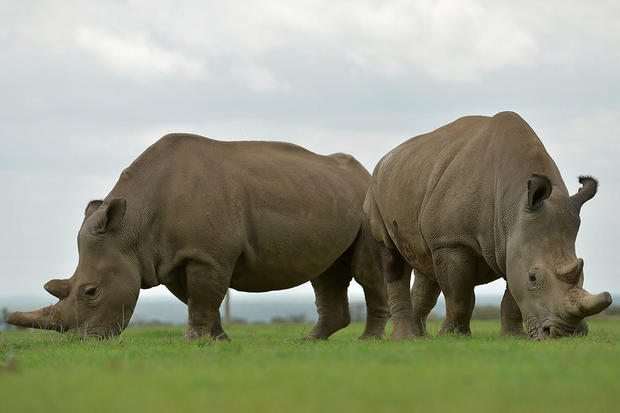
Najin and Fatu, the only two remaining female northern white rhinos, graze together on March 20, 2018 at the ol-Pejeta conservancy in Nanyuki, Kenya.TONY KARUMBA / AFP/GETTY

They are unable to bear offspring themselves, so once the embryos are fertilized in the lab they would be implanted in a southern white rhino surrogate mother.

Kenya’s ambassador in Germany, Joseph Magutt, said his country supports the effort, but didn’t say how long it would take to clear the paperwork.

Hildebrandt cautioned that while ultrasound tests show the embryo transferred at Chorzow zoo has grown, it’s smaller than expected and it remains to be seen whether it will implant in the mother’s uterine lining and result in a pregnancy.

In the meantime, others in the BioRescue team are working on ways to turn preserved skin cells from deceased rhinos into eggs or sperm, a procedure that’s so far only been performed with mice.

Rhinos have long been under pressure from poachers because of their horns, and several sub-species are at risk of extinction. Conservationists say rhinos are important for the survival of many other species because of the role they play in landscaping their native habitat.

Earlier this week, five eastern black rhinos were transported from European zoos to Rwanda’s Akagera National Park to help increase the genetic diversity of the rhino population there.

More broadly, a recent United Nations report warned that a million species are at risk of extinction in the coming decades, largely because of human activity.

Silencing the Songbirds: Southeast Asia’s illegal and unsustainable trade is pushing a multitude of songbird species towards extinction.


By Chris R. Shepherd –

Having birds around is something most Canadians take for granted. Spring, especially, is full of bird songs as the migrants return and mating season’s singing rituals commence. However, in some parts of the world, these songs are being silenced by the illegal and unsustainable wildlife trade.

Black-winged starlings are in high demand in Indonesia, and as a result, very few are left. Enforcement efforts in the bird markets are needed to end the trade in these Critically Endangered birds. Photo: Chris R. Shepherd / Monitor

Globally, the illegal wildlife trade is estimated to be worth between US$7 billion and US$23 billion annually. While its clandestine nature makes accurate valuation impossible, it is considered the fourth most lucrative global crime after drugs, humans, and arms. It is recognized as a major threat to biodiversity, often acting in concert with habitat loss and hunting, compounded by unchecked demand, weak legislation, lax enforcement, public indifference, and widespread corruption—and it is pushing a multitude of birds towards imminent extinction.

At current rates of over-harvesting and habitat conversion, it is estimated that one-third of Southeast Asia’s bird species will be extinct by 2100, with at least 50% representing global extinctions. Of the approximately 850 species of bird native to Southeast Asia, more than 50 are assessed as Critically Endangered by the IUCN Red List of Threatened Species.

Bird markets are found in most towns and cities throughout Indonesia, with thousands of birds being openly traded daily. Photo: Jordi Janssen / Monitor

Birds are traded for meat, for their parts used in traditional medicines, and as cagebirds. Among the birds in trade are the songbirds. Desired for their remarkable singing abilities, colourful plumage, and increasing rarity, Southeast Asian songbirds are trapped in the millions from the wild and traded on both a national and international scale.
Despite many species being afforded legal protection by national laws and regulatory policies in some countries, enforcement efforts are often lacking, allowing the songbird trade to continue unhindered. Enforcement takes a backseat, often because the authorities lack the necessary knowledge and awareness. Although sellers are often found to be aware of the illegality of their actions, they are not deterred by any threat of prosecution.

The fascination with songbirds is deeply ingrained in various Asian cultures and involves hundreds of species. Throughout the region, particularly in Indonesia, Malaysia, Thailand, and Singapore, songbird competitions, where birds are judged on their singing abilities, are highly popular. Songbirds, especially rare species or those extraordinarily attractive, are also frequently kept as status symbols.

Indonesia is at the centre of this conservation crisis, having more species of songbirds threatened by illegal and unsustainable trade than any other country. Already, many endemic species have been pushed to the edge, with only a mere handful of individuals left in existence, such as the Black-winged myna Acridotheresmelanopterus, the Javan green magpie Cissathalassina, the Rufous-fronted laughing thrush Garrulaxrufifrons, and the Niashill myna Gracularobusta. Some species, such as the Javan pied starling Sturnus jalla, are believed extinct in the wild and remain only in the hands of collectors and traders.

Javan Green Magpies, like this one photographed in a conservation breeding program in Indonesia, are all but extinct in the wild thanks to the illegal bird trade. Photo: Chris R. Shepherd / Monitor

In 2015, the Southeast Asian Songbird Crisis Summit was heldin Singapore, gathering experts to address the crisis with utmost urgency. The summit saw the formation of the Southeast Asian Songbird Working Group, which would devise a Southeast Asian songbird action plan. In 2016, the Conservation Strategy for Southeast Asian Songbirds in Tradewas launched, which included a list of high priority species and necessary actions to stave off their extinction—some of these numbered fewer than 100 individuals. In 2017, the IUCN SSC Asian Songbird Trade Specialist Group (ASTSG) was formed to further elevate efforts. Made up of experts from conservation organizations, academia, zoological institutions, and enforcement agencies,it is tasked with conducting research on the taxonomy and wild populations, monitoring trade, lobbying for enhanced protection and effective enforcement, establishing and expanding ex situ assurance and breeding colonies, and developing education and community outreach. In early 2019, the ASTSG met for the first time since its formation to identify immediate priorities for the more than 40 species listed as priority species that will likely vanish if actions are not taken.

Birds, like these White-rumped Munias, are crammed into cages for sale in the bird markets. Mortality rates are extremely high in conditions like these, further fueling the demand for more wild-caught birds. Credit: Jordi Janssen, Monitor

The Monitor Conservation Research Society (Monitor), established in 2017, has joined this effort to protect songbirds from extinction. Through its Asian songbird programme, Monitor aims to put the Southeast Asian Songbird Conservation Action Plan into motion by concentrating on trade, legislation and enforcement. By continuing extensive research in key countries within Southeast Asia, Monitor seeks to gather much needed trade data—the lack of evidence and information is the greatest obstacle to legally protecting these species. Finally, to ultimately eliminate or significantly reduce the illegal and unsustainable trade in songbirds, government buy-in in the countries in question is essential. Monitor and partners will use evidence obtained through research on the trade to assist and lobby governments in key countries to increase their enforcement efforts, improve existing laws and policies and provide effective protective measures to commercially traded species. Through these efforts, it is hoped the songs of all Southeast Asia’s songbird species will be heard in the wilds forever.

Dr. Chris R. Shepherd is a vice-chair of the IUCN SSC Asian Songbird Trade Specialist Group and is the executive director of the Monitor Conservation Research Society (Monitor). Having worked on wildlife trade issues for more than 25 years, Dr. Shepherd focuses largely on lesser known species and species groups threatened by trade, such as the songbirds.

Eco groups sue Chinese forestry department for failing to save smuggled pangolins 

https://www.scmp.com/news/china/society/article/3009183/chinese-forestry-dep
artment-sued-failing-save-smuggled-pangolins

– Environmental NGO files lawsuit against Guangxi regional bodies accusing
them of failing to look after endangered animals properly after rescuing
them
– Pangolins are among the world’s most trafficked mammals because of the
demand for their scales in traditional Chinese medicine

Alice Yan
South China Morning Post
Published: 3:50pm, 7 May, 2019

In the first lawsuit of its kind, a Chinese forestry authority has been sued
for failing to save a group of smuggled pangolins.
The forestry department in Guangxi and its terrestrial wild animals rescue
centre are accused of dereliction of duty in relation to the deaths of 32
pangolins two years ago, a court in Nanning, the region’s capital, heard on
Monday.

The case, filed by Beijing-based non-governmental organisation the China
Biodiversity Conservation and Green Development Foundation,is the first
public welfare lawsuit in China involving the endangered animals, according
to The Beijing News.

Pangolins are among the world’s most trafficked mammals and China is the
most common destination for large shipments of pangolins because their
scales are valued as ingredients in traditional medicine, their meat is
considered a luxury food item and their blood is used as a healing tonic.

The foundation said that when the Guangxi rescue centre received the live
pangolins that police seized from smugglers in August 2017, it offered to
help treat the mammals, but the offer was rejected.

The pangolins all died within 66 days. The foundation wants the two
defendants to pay compensation for the ecological losses caused by the death
of the animals and to apologise for their mistake in state media. It is
asking the court to evaluate the scale of ecological losses.

The court has yet to hand down a decision.

Zhang Zhenqiu, deputy director of the forestry department’s protection
section, told the newspaper that the accusation that it had failed to
protect the pangolins was just “hype” because they were difficult to look
after.

The authority said the pangolins died because of they had low immunity and
were stressed by the long journey from being trafficked from Vietnam.

Many had digestive system illnesses as a result of being force-fed by the
smugglers and some had serious injuries.

In February, 130 pangolins intercepted by Guangxi police from smugglers all
died soon after they were sent to two breeding bases – one in Guangxi and
one in Guangdong province.

At least 28 hippos found dead in Ethiopia’s national park

By Aanu Adeoye, CNN
a dog swimming in the water: Hippos swimming in Namibia's Kwando River.© Michaela Urban/Chicago Tribune/TNS via Getty Images Hippos swimming in Namibia’s Kwando River.
The bodies of at least 28 hippopotamuses have been found in Ethiopia’s national park in the southwest of the country, local media reported Monday.

The semi-aquatic mammals died in the Gibe Sheleko National Park, a part of the Gibe River, local broadcaster FANA said.

Behirwa Mega, head of the park told FANA that the animals died between April 14 and 21 and that the cause of their deaths is presently unknown.

The Gibe Sheleko National Park, was only established in 2011, is reportedly home to about 200 hippos and covers approximately 36,000 square kilometers in land area.

Although the cause of death of the hippos remains unclear, the animals are described as vulnerable on the International Union for Conservation of Nature’s Red List of Threatened Species (IUCN).

The IUCN estimates the global population of hippos is between 115,000 and 130,000 and that their conservation should be a “priority” in countries where they exist.

Hippo populations are threatened by poaching, disease, loss of habitat, deforestation, and pollution, according to experts.

They are hunted by poachers who export their long canine teeth from African countries to places such as Hong Kong and the United States where they serve as substitutes for elephant tusks, says the wildlife trade monitoring network TRAFFIC.

More than 200 hippos were killed in a massive anthrax outbreak at Namibia’s Bwabwata National Park in 2017.

And the hippo population in Africa will face a significant reduction when a scheduled culling of the animals in Zambia begin in May despite objections from animal rights groups.

The cull will happen in the Luangwa River Valley in Zambia’s Eastern province, the Department of National Parks & Wildlife said in February.

https://www.msn.com/en-us/news/world/at-least-28-hippos-found-dead-in-ethiopias-national-park/ar-BBWdcrw?ocid=spartanntp

Deer were being trapped, killed on Tulsa County property, game wardens say

Warning: The Facebook post below may be considered disturbing.  

TULSA COUNTY, Okla. – A man has pleaded guilty and was ordered to pay more than $10,000 in fines and restitution after game wardens found an illegal deer trap on a Tulsa County property.

According to game wardens, in fall 2018, Game Warden Brandon Fulton was patrolling in a secluded area of Tulsa County when he noticed a “snare-style trap made using a tree near a residence.”

Fulton contacted the owner and informed him “it would be illegal to use such a trap on anything, including large animals such as deer. The snare had no sign of hair or blood on or around it,” game wardens said on Facebook.

The trap was removed by the owner.

Months later, on January 2, 2019, Fulton was patrolling the same area and noticed a trap-style net hanging from a tree on the same property.

Fulton noticed there were deer tracks and corn on the ground under the net, which had blood and deer hair in it, officials say. He also noticed a remote motion sensor pointed toward the net along with a release rope running from the net through a window in the home to trigger the trap.

A person in the home told Fulton the trap was built for wolves.

Officials said a search warrant was issued for the property and two illegal deer were found along with photo and video evidence of the crimes.

Game wardens say evidence showed “deer were being trapped alive, tied up, then taken into a building and killed.”

The maker of the trap, who was not identified, was charged with several violations of state law and commission regulations.

He did plead guilty to all charges and paid $10,300 in fines and restitution.

678 birds released from traps, nets and illegal aviaries in 10 weeks – CABS

Poachers kill elephant in Cambodia wildlife sanctuary

https://today.rtl.lu/news/science-and-environment/a/1311855.html

ILLEGAL IVORY TRADE

AFP | Update: 26.02.2019 00:00

The body of a male Asian elephant was found in a wildlife sanctuary in
northeastern Cambodia on Sunday / © Cambodian Ministry of Environment/AFP

An elephant has been found dead with its tusks and tail sliced off in a
wildlife sanctuary in Cambodia, where wild elephant numbers have dwindled to
just a few hundred due to poaching and deforestation.

The Southeast Asian nation has emerged in recent years as a key transit hub
for the multi-billion dollar illicit wildlife trade, with demand for
products made from tusks, pangolin scales and rhino horns high in China and
neighbouring Vietnam.

According to the Mondulkiri Project, an animal rescue NGO, there are about
400 elephants in the wild in Cambodia, and about 50 held in captivity.

The body of the male Asian elephant was found on Sunday in a wildlife
sanctuary in northeastern Mondulkiri province, said Environment Ministry
spokesman Neth Pheaktra.

“The elephant’s tusks were missing and its tail was also cut off,” he told
AFP on Monday, adding the animal was killed about 10 days ago.

“There was a wound from a gunshot under its right eye,” Neth Pheaktra said,
adding authorities are still hunting for the poachers.

A baby elephant was found dead last year in the same sanctuary when it was
caught in a trap set by poachers, he said.

The Asian elephant is hunted for its precious tusks, while its tail hair is
considered lucky and embedded in rings and bracelets.

The demand for the animal parts threatens Cambodia’s dwindling elephant
population found in the northeast and southwest forests, where illegal
logging and deforestation is reducing their habitat.

Cambodia’s high levels of corruption and lax law enforcement make the
country an easy transit point for traffickers facing a crackdown in
neighbouring Thailand.

In December, Cambodian authorities seized more than one thousand elephant
tusks hidden in a storage container sent from Mozambique, the country’s
largest ever ivory bust.

Another significant haul occurred in 2016 when authorities discovered nearly
a tonne of ivory hidden in hollowed-out logs inside an abandoned container
— also owned by a company based in Mozambique.