The next president of the United States must be prepared to take bolder, faster climate action than any leader has before. But the media is still ignoring the issue, giving cover to politicians who refuse to take action.
We need to put climate change on the national political stage. One powerful way to do that is through a presidential primary debate dedicated to the issue. Holding a climate-centered debate would highlight the climate crisis at a time when more people than ever are tuned in to national politics – and force candidates to be explicit about their commitments to meet the scale of the crisis.
Voters deserve to know:
Which candidates commit to acting on climate change as a “Day One” priority when in office
Whether presidential candidates support the Green New Deal or can offer their own climate plan that also meets the scale of the crisis
Candidates’ plans for a managed phase-out of fossil fuel production and end to the expansion of fossil fuel extraction
How candidates would protect frontline communities and ensure a transition for workers that leaves no one behind
How candidates would help communities adapt to the climate impacts already happening
Whether candidates believe that fossil fuel companies should pay their fair share of climate costs and how they will make sure it happens
The first two Democratic debates are happening this summer in two cities with deep ties to the crisis. Miami is one of the world’s most vulnerable cities with respect to sea level rise and Detroit, the former center of the global automotive industry, has long struggled with the challenges of deindustraliziation. Either would provide a powerful backdrop for a debate on this complex crisis and its solutions.
In the primary season, unless the DNC prioritizes the issue, we know that news networks and other debate host organizations won’t ask more than one or two token debate questions on climate change. We have to demand that it leads now.
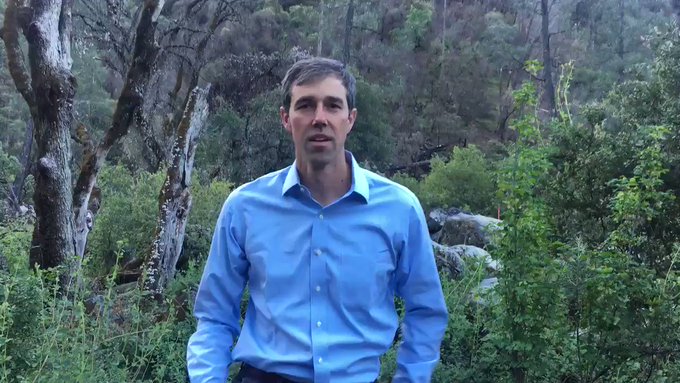
2020 presidential contender Beto O’Rourke toured Yosemite National Park on Monday, where he announced his $5 trillion plan to fight climate change. Beto O’Rourke/Twitter
Former Democratic Texas representative, 2020 presidential contender, and table-standerBeto O’Rourke on Monday released a new policy proposal, what he called “the most ambitious climate plan in the history of the United States.” While not entirely aligned with the Green New Deal resolution, the broad framework introduced to Congress in February, it’s the most comprehensive climate policy proposal put out by any 2020 contender to date.
Beto O’Rourke
✔@BetoORourke
Heading into Yosemite National Park to talk about our historic climate action plan. Follow along throughout the day and read the plan at http://BetoORourke.com/climate-change
O’Rourke is pitching big numbers and ambitious targets: $5 trillion in new investments, halving greenhouse gas emissions by 2030, and net-zero emissions by 2050. It’s his first major policy proposal and it’s a stab at distinguishing himself from the crowded field of 2020 presidential candidates on a major issue for Democratic primary voters. An April Monmouth Universitypoll of Iowa Democratic voters showed that climate change was the second-most important issue to voters after healthcare.
But getting more specific with his policies also opens him up to scrutiny and criticism. The plan has already drawn a scolding from activists who claimed right off the bad O’Rourke should have offered more aggressive goals. And Washington Gov. Jay Inslee, a fellow 2020 presidential contender, responded to the new plan by attacking O’Rourke’s record in Congress. These reactions are revealing a fissure between candidates and environmental activists who keep pushing further, a gap that could haunt both sides come election day.
O’Rourke’s climate plan brings more specifics and a narrower scope
The proposal lays out a four-pronged approach to how an O’Rourke administration will tackle climate change. That includes 1) executive action, 2) mobilizing $5 trillion over 10 years to invest in a clean energy transition, 3) guaranteeing net-zero emissions by 2050, and 4) preparing vulnerable communities for the impacts of climate change.
O’Rourke pulls no punches in laying out the stakes.
“Climate change is the greatest threat we face — one which will test our country, our democracy, and every single one of us,” he writes on his website.
Among its provisions, O’Rourke’s framework attaches dollar amounts to some specific line items, like $250 billion to research and development. It include grants for job training as part of its path to a cleaner economy, but for the most part, it’s narrowly focused on climate and energy — cutting emissions and creating alternatives.
Out of the top-line $5 trillion number, roughly $3.5 trillion in O’Rourke’s climate plan is allocated through tax incentives, loans, and other financing mechanisms for infrastructure, research, resilience, and clean energy deployment. The $1.5 trillion outlay would be funded by “structural changes to the tax code” that end tax breaks to fossil fuel companies and raise rates on corporations and top earners. Of that, $1.2 trillion would to grants for sustainable housing, transportation, public health, farming, and start-ups.
In that sense, O’Rourke’s climate plan actually looks quite a bit like the American Recovery and Reinvestment Act of 2009 in that it leverages a big chunk of public money and tax incentives to finance public infrastructure projects and spur innovation. In O’Rourke’s case, the aim to curb energy consumption and boost cleaner fuels and electricity sources.
However, it takes more than wind turbines and solar panels to fight climate change; you have to cut greenhouse gas emissions from existing fuel sources. And despite the attrition of coal, overall energy use, including fossil fuels, is still rising in the United States.
But rather than a carbon tax or a cap-and-trade system, O’Rourke is anchoring a legally binding net-zero emissions standard by 2050. “This standard will send a clear price signal to the market while putting in place a mechanism that will ensure the environmental integrity of this endeavor — providing us with the confidence that we are moving at least as quickly as we need in order to meet a 2050 deadline,” according to O’Rourke’s proposal. This doesn’t rule out pricing carbon but instead focuses on setting definitive goal posts.
While there is some funding allocated for job training, O’Rourke doesn’t include a federal jobs guarantee, a key element in the Green New Deal. And O’Rourke counts on market forces and incentives to move the needle toward cleaner energy to greater extent than the authors of the Green New Deal.
The backlash to O’Rourke’s proposal, explained
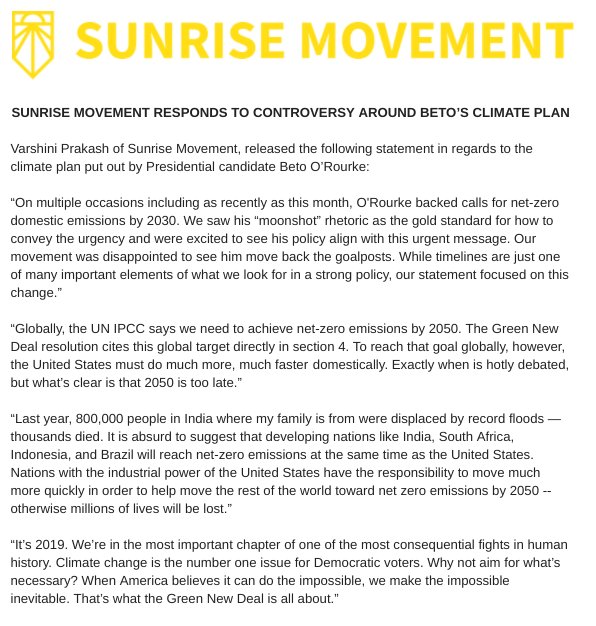
The Sunrise Movement, an activist group promoting the Green New Deal, immediately criticized the new proposal, not for its provisions, but for its timeline.
“Unfortunately, Beto gets the science wrong and walks back his commitments from earlier this month in Iowa to move to net-zero emissions by 2030,” Varshini Prakash, executive director of Sunrise, wrote in a statement Monday. “Beto claims to support the Green New Deal, but his plan is out of line with the timeline it lays out and the scale of action that scientists say is necessary to take here in the United States to give our generation a livable future.”
It’s true that O’Rourke said he wanted net-zero greenhouse gas emissions by 2030 during a campaign stop in early April. But that’s not in line with what scientists say is necessary. The Intergovernmental Panel on Climate Change reported last year that in order to keep global warming limited to 1.5 degrees Celsius this century, the world must halve greenhouse gas emissions by roughly 2030, get to zero net emissions by 2050, and go negative thereafter.
Getting to net-zero emissions by the middle of the century is already an incredibly ambitious target. Getting there in 10 years is damn near impossible.
My main concern with Beto’s plan is that net zero by 2050 is a global goal, not a U.S. goal. The U.S. goal needs to be much much more ambitious than that in order to motivate deeper cuts internationally that are consistent with the 1.5 degree target.https://twitter.com/EricHolthaus/status/1122888302678429703 …
JesseJenkins@JesseJenkins
Okay. In my professional opinion, it is not really feasible to imagine a net zero transition by 2030, and the GND Resolution itself does not call for such a timeline. But I can see how you’d reach that conclusion from the IPCC report.
Back in March, Zeke Hausfather, a climate scientist and analyst with Carbon Brief, ran through, sector by sector, the extraordinary list of things that would need to happen in a 10-year mobilization to net-zero emissions vs. a 30-year mobilization.
Zeke Hausfather@hausfath
The targets set in the proposed Green New Deal are a bit ambiguous. It suggests a 10-year mobilization, but does not necessarily set a goal of net-zero carbon by 2030. Lets explore the impact of the goals on the climate and the challenge of mitigation *epic thread*. 1/27
And even the Green New Deal’s framers aren’t aiming for net-zero emissions by 2030. My colleague David Roberts directly asked Sen. Ed Markey (D-MA), one of authors of the Green New Deal resolution, if this was the target. The senator emphatically said no.
Yet Sunrise at first said that the Green New Deal calls for a 10-year mobilization to meet 100 percent of US power demand with zero-emissions sources.
Update, Wednesday, 2:21 pm: Prakash released another statement acknowledging that the Green New Deal cited the IPCC target of net-zero emission by 2050, but that “2050 is too late.”
Other environmental groups had a more favorable read of O’Rourke’s proposal. “This plan to confront the climate crisis is the kind of leadership we need from our next president,” Tiernan Sittenfeld, senior vice president for government affairs at the League of Conservation Voters, wrote in a statement.
O’Rourke isn’t counting on Congress to drive climate policy
Should O’Rourke take the oath of office in 2021, he says he will reenter the Paris climate agreement, implement rules to cut emissions of super-potent greenhouse gases like methane and hydrofluorocarbons, set tighter clean air rules, ramp up appliance efficiency standards, demand clean energy procurement from federal contractors, and end new fossil fuel leases on public lands.
Some states might sue to block these changes, but they are grounded in existing legal authorities and are likely the most feasible parts of his climate agenda, especially if Congress remains just as gridlocked after the next election.
Still, a comprehensive, enduring climate policy would still have to go through the House and Senate at some point. Lawmakers pushing the Green New Deal show no sign of letting up so far, but with the Senate filibuster in place, most meaningful climate policies have grim prospects barring a massive sweep in the next election. (O’Rourke has broached getting rid of the filibuster.)
O’Rourke deserves credit for going beyond simply giving a thumbs up or thumbs down on the Green New Deal like other presidential contenders. And it’s likely other candidates will soon weigh in with more robust climate proposals of their own. Sen. Elizabeth Warren (D-MA) as already taken a stab at climate policy through her plan for public lands released in April, which also calls for ending new leases for fossil fuel extraction. Her proposal adds a commitment to generate 10 percent of US electricity from renewables on public lands.
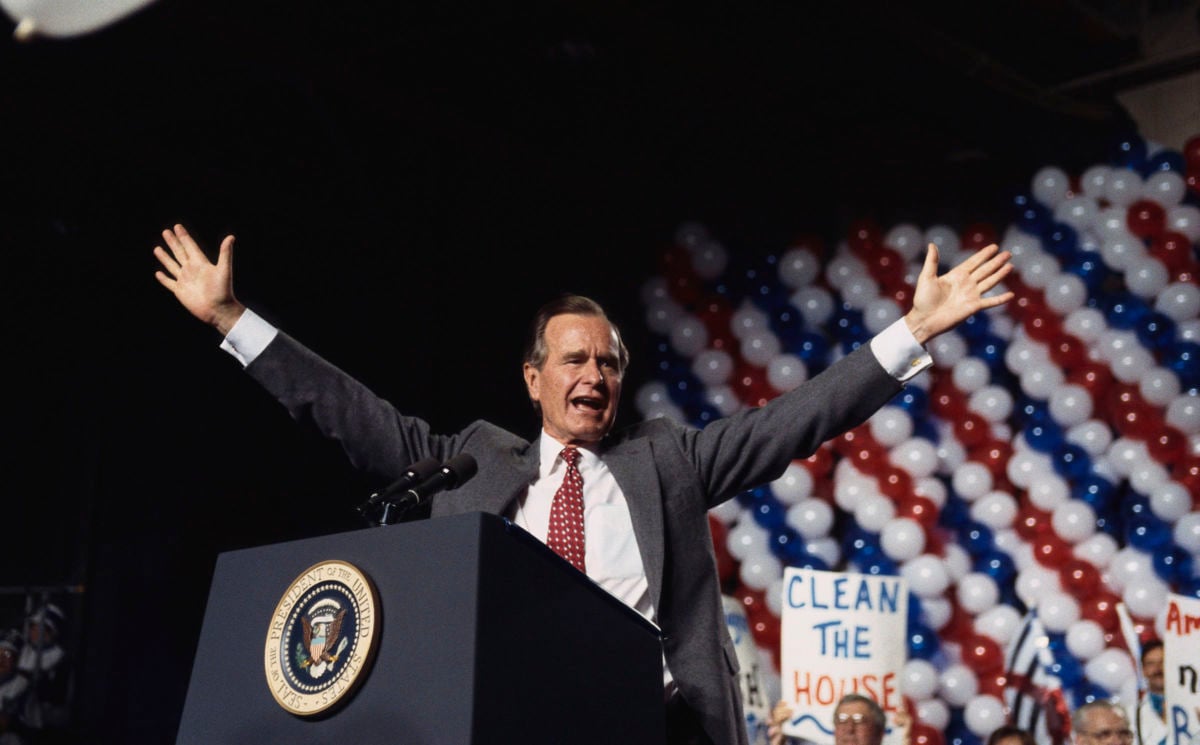
President George H.W. Bush speaks during his unsuccessful bid for re-election for the presidency, October 29, 1992.WALLY MCNAMEE / CORBIS VIA GETTY IMAGES
The television spent the entire weekend reminding me that George Herbert Walker Bush loved his country, his wife, his children, his grandchildren, his great-grandchildren, his dog, the city of Houston, the town of Kennebunkport, baseball, football, golf and so very much else besides.
Our 41st US president, the talking heads assured me, was a veritable ocean of love. The newspaper folks did their part to paint this picture, as well; stealing a leaf from Jesus of Nazareth over the weekend, Bush Sr. died and rose again on the warm updraft of early 1990s B-roll footage and gushing headlines from all corners of the country.
This legion of whitewashers was at pains to commend Bush Sr.’s decency, fairness and honor before, during and after the commercial breaks. In the age of Trump, the power-loving media clearly relished the opportunity to say good things about a president again. It was a fused loop: Bush Sr. is dead; he was nice; lather, rinse, repeat.
The hagiography festival made a particularly grand to-do about the fact that George H.W. Bush was president when the Cold War ended. What the glowing obituaries obscured, however, was that Bush Sr. was a Cold Warrior of the first order, actively involved in a number of genuine atrocities that spanned the globe.
Most of Bush Sr.’s biography has been well documented for good and ill, but his time at the helm of the Central Intelligence Agency (CIA) is seldom discussed in this hemisphere. He spent only a year in that job, but it was one of the bloodiest years South America has ever known. Fifteen years later, he personally, if inadvertently, opened the door for the proto-fascist takeover of his own party. Those two tales, combined with some other dark chapters of Bush Sr.’s life, frame a career in power and politics that did damage most everywhere it went.
The stories you care about, right at your fingertips
Get Truthout’s daily edition delivered to your inbox.
Your Email
As director of the CIA from 1976 to 1977, Bush Sr. was an integral part of a US government covert terrorism/torture program in South America. Known as Operation Condor by the participants, the program was aimed at destroying left-leaning governments and organizations they feared might come to support the Soviet Union. Forty years later, the horror and chaos unleashed by Operation Condor still plagues that region, and is a fair explanation for why massive caravans of asylum-seeking migrants continue to arrive at the US-Mexico border.
Documents that were recently declassified reveal that the “Dirty War” in Argentina, the Augusto Pinochet regime in Chile, Alfredo Stoessner’s dictatorship in Paraguay and other atrocities across the continent were actively supported by the US government. Thousands of leftist peasants, union leaders, teachers, students, priests, and nuns were slaughtered, imprisoned and tortured, and George Herbert Walker Bush went to work every day at CIA headquarters to make sure it happened.
Many years later, when Bush Sr. rose to accept the Republican nomination for president in 1988, he made a fateful promise. “Read my lips,” he told the enthusiastic crowd, “no new taxes.” He broke that pledge in 1990, and in doing so dropped an atomic bomb on politics in the United States. Breaking that pledge infuriated the conservative wing of his party, which was deeply suspicious of Bush’s internationalist leanings to begin with.
Political opportunists like Newt Gingrich, Pat Buchanan, Rush Limbaugh and Grover Norquist “made their bones” in conservative circles by attacking Bush Sr. from the right for breaking that promise on taxes. Buchanan’s 1992 primary challenge, combined with Ross Perot’s outsider run for the presidency, conspired to make Bush Sr.’s first term his last. Notorious GOP operative Lee Atwater couldn’t help this time; he’d been dead for a year.
When Bush Sr. lost to Clinton in 1992, Gingrich and his ilk began a takeover of the Republican Party that became complete during the administration of Barack Obama. Odd as it may seem, it was the Cold War that ultimately caused all this: Bush Sr. couldn’t afford his Gulf War after Reagan’s long military binge, and that binge happened because the Reaganites (Bush Sr. included) decided to spend the Soviet Union out of existence. Raising taxes was Bush Sr.’s only option, and it was the end of him in politics.
The fascist upswelling that came in the wake of his broken campaign promise is as much a part of Bush Sr.’s legacy as the crisis at the southern border. Operation Condor happened even though the TV people this weekend chose to leave it off the script. The GOP’s neo-fascist twist erupted during Sr.’s administration. Both are side effects of the Cold War that will be with us for many years to come, and deserve their own wing in Bush Sr.’s library down in College Station.
Bush Sr. was the first president I was fully aware of from the beginning of his administration to the end. I was barely alive for Richard Nixon, only a boy during Gerald Ford and Jimmy Carter, and only half-aware of Ronald Reagan’s first term. I remember being afraid of nuclear bombs for much of that time but didn’t really understand how terrible Reagan was until his second term, and by then he was already gone.
It is fair to say that I have actively disliked Bush Sr. for my entire adult life. When he became president, I hated and protested his war, scuffled for work during his economic downturn, laughed my ass off when he barfed on the Japanese prime minister and voted gleefully against him in 1992, helping to make him a one-term Republican president just like Ford and Herbert Hoover. As I grew older and somewhat wiser, I came to fully appreciate all the many reasons why my bedrock disgust for the man was not merely justified, but required.
Bush Sr.’s involvement with and subsequent cover-up of the Iran-Contra scandal could give Donald Trump lessons on how to obstruct justice.
He became a member of the #MeToo fraternity of scumbags after eight women claimed he groped them during picture-taking sessions.
He lied about the threat Iraq posed in order to justify the Gulf War a full 13 years before lying about Iraq and war became the hip family thing to do.
US forces deliberately bombed water-treatment facilities during that conflict, actions that were nothing more or less than biological warfare waged upon a civilian populace, also known as “war crimes.”
Iraq still glows in the dark from the depleted uranium left behind by all the exploded US ordnance during that war.
He tripled down on the Nixon/Reagan “Southern Strategy” during his 1988 presidential campaign by turning Atwater loose with the “Willie Horton ad” that set the low bar for gutter racist politics in the US for a generation.
That institutional bigotry also fed Bush’s vicious ramp-up of the so-called “war on drugs,” which even many Republicans now call a giant racist failure.
He fathered George W. Bush and Jeb Bush, raised them to be the men they became, and while the sins of a father should not necessarily reflect upon the sons, the sins of the sons — W. in particular — certainly cast a grim light upon the father. Something in that household made those two boys into the malevolent fools they grew into, and it wasn’t the fishing on Cape Porpoise Harbor.
The benign, benevolent, grandfatherly figure we’ve been seeing on TV was also, thanks to W., one of the more shameless war profiteers of the 21st century. As a board member and unofficial “ambassador” of the private equity Carlyle Group, Bush Sr. made many millions from that company’s weapons sales thanks to his son’s ongoing Iraq catastrophe. “A tidy gift,” I wrote some 15 years ago, “from son to father.”
Bush Sr. was a creature of the Cold War and all the derangement that entailed, to be sure, but the man also had free will and made his choices. His legacy is not binary — as vice president and then president, he championed the 1990 Clean Air Act Amendments which are still protecting the environment to this day — but there is a hell of a lot of suffering and death out there with his name all over it, for which he was paid very, very well.
Ignoring these truths in the service of a palatable mythology is a disservice to the future. The TV people can buff up George H.W. Bush’s resume all they please. We deserve better heroes than him.
Regardless of the results on Election Day, America will finally be free of the failed ‘leadership’ of Republican Paul Ryan.
Wisconsin Republican Paul Ryan, the self-proclaimed wunderkind policy wonk, is almost done.
Ryan once had huge political aspirations. He joined Mitt Romney’s train wreck presidential ticket in 2012, ostensibly to lend some of his far-far-right credibility to the tanking campaign. That didn’t work.
In 2015, Ryan reluctantly accepted the role of House speaker, after Ohio Republican John Boehner was run out of town by the nihilist wing of the Republican Party, the uber-conservative House Freedom Caucus — and House Republicans exhausted their admittedly small list of other options.
California’s Kevin McCarthy was next in line, but his flirtation with getting the gavel was short-livedand ended in a swirl of scandalous rumors and criticism from the far-right.
Oh, plus this guy:
Donald J. Trump
✔@realDonaldTrump
Great, Kevin McCarthy drops out of SPEAKER race. We need a really smart and really tough person to take over this very important job!
Ryan’s so-called leadership has been a disaster from day one. The far-right extremists in Congress never trusted him, and Ryan learned the hard way that actually getting stuff done was not as easy as former Speaker Nancy Pelosi — the most effective speaker in the modern era — made it look.
And then Ryan had to contend with Trump. From the very beginning of Trump’s presidential campaign, when he called Mexicans rapists, Ryan has tried to pretend Trump simply does not exist. He has dodged questions about Trump’s unending stream of racist, sexist, xenophobic bile, absurdly claiming he hasn’t seen that tweet, isn’t familiar with that quote, not aware of that story.
Occasionally, Ryan would limply insist that there is no room for that kind of talk in the Republican Party — even though the Republican Party certainly made plenty of room for it by electing Trump.
Not that Ryan cared as long as he could finally accomplish his agenda, with full Republican control of the White House and both chambers of Congress. But even that proved too difficult for the woefully inadequate and ineffective Ryan.
The one vow every single Republican has made to voters since the Affordable Care Act was passed is that if Republicans were in control they would repeal and replace it.
That still hasn’t happened.
Instead, Ryan’s singular “achievement” as House speaker is ramming through last year’s tax scam. But even that has turned into an embarrassing and catastrophic failure.
In February, Ryan and his fellow Republicans still foolishly believed they would be able to tout their tax scam as a reason to maintain power in November. But Ryan managed to bury that argument six feet under ground when he infamously boasted that a high school secretary had seen a whopping $1.50 added to her weekly paycheck after the tax scam was enacted. That, according to Ryan, was somehow proof that the trillion dollar giveaway to corporations and millionaires was working for regular Americans.
It was a far cry from the “thousands” of dollars Republicans had promised middle America would be seeing. Ryan’s boast was so widely mocked that he deleted the tweet.
The secretary, Julia Ketchum, called out Ryan for bragging about such a minimal increase while the millionaires and billionaires of America benefitted so greatly from the tax scam.
And it didn’t take long after that for Republicans to stop talking about their tax bill and revert to the most classic of Republican playbooks: bad old-fashioned racism to rile up the right-wing base.
Meanwhile, Ryan sat back and watched it happen, just as he watched Trump take over his party and infect his toxic brand of in-your-face bigotry. As Trump spent the final weeks of the 2018 campaign turning his racism — and his lies — up to 11, Ryan still did nothing.
It was not until the Sunday before Election Day that Ryan reportedly picked up the phone and suggested that the leader of his party should focus on Ryan’s beloved tax cuts instead of screeching hysterically about a non-existent “invasion” from the south.
As has been the case throughout Ryan’s short speakership, he failed.
We don’t know what will happen on Election Day. Maybe Democrats will take back the House and put the speaker’s gavel back in Pelosi’s hands, where it belongs. Or maybe the already-failed-once McCarthy will finally get the gig, and Republicans, including Trump, will pretend they didn’t scoff at the idea just three years ago.
But whatever the result, we will finally be free of Ryan, the utterly failed leader who never once showed the moral courage to stand up to the temper-tantrum-throwing Trump — and to stand forthe American people.
Published with permission of The American Independent.
Photo: 1996-98 AccuSoft Inc., All rights reserved/Courtesy of TIFF
You could argue that Michael Moore’s Fahrenheit 11/9 has too many irons in the fire, being variously an acid evocation of the rise of Donald Trump, a peroration against establishment Democrats (among them both Clintons and Barack Obama), an earnest exhortation to grass-roots activism, and an alarmist examination of the current moment’s parallels to Weimar Germany. But I’d say Moore has about the right number of irons, and that he strikes the living hell out of every one. This isn’t his smoothest film, but it’s his fullest and most original. It’s also his most urgent, which is really saying something. It’s one of the most urgent films ever made.
The thrust is that the United States of America is toast, or at least pretty close. Closer than it has been in 250 years — not that Moore thinks the country has ever lived up to its branding as a place of liberty and justice for all. (His own brand wouldn’t exist if he did.) But the Constitution, imperfect as it is, is only as strong as the democracy that protects it, and the democracy that protects it is only as strong as… Thereby hangs his tale.
It must be said that Fahrenheit 11/9 is something of a bait-and-switch. It opens funny, if you can forget for a second the broader narrative. 11/9, of course, is the day (it was early a.m.) that Donald Trump became president-elect, and Moore’s prologue and first section is a Greatest Hits collection of low points: from the media’s certainty he’d never win a primary/the nomination/the presidency to the certainty of Hillary Clinton and her followers that no halfway intelligent country would elect a vulgar, boastful, racist, misogynistic grifter. But after making the case that Trump’s presidency can be blamed on Gwen Stefani (hint: it was her salary on The Voice), Moore offers a hilariously annotated list of since-dethroned male harassers harassing Clinton about her e-mails and/or competency to occupy the Oval office, and then demonstrates how “the malignant narcissist played the media for suckers.” He includes himself.
He once had a bit of fun with Trump on Roseanne Barr’s short-lived yak show, grinning when Trump said he loved Roger & Me and hoped Moore would never make a film about him. Moore follows with a somewhat amusing but generally icky montage depicting Trump’s lechery towards his daughter.
Moore is barreling along when he segues to a spiritual cousin of Trump, Michigan governor Rick Snyder, a very rich man who joined the government in order to privatize it. And then comes Flint, the laughs stop abruptly, and Fahrenheit 11/9 becomes a story of criminal Republican malfeasance, establishment Democratic uninterest and/or impotence, and the rise of local activism that rattles the poohbahs of both parties.
We get Flint because it illustrates one kind of malignant governance. Snyder decided to build a second pipeline from Lake Huron (the existing one worked fine), drew water in the meantime from the ghastly Flint River, and ignored evidence that elevated levels of lead were sickening children—and permanently damaging their brains. Here’s the sort of rhetoric Moore does best: He portrays Snyder as criminally indifferent to the poisoning of poor and black children (Moore calls this “a slow-motion ethnic cleansing”) while incensed when General Motors complains that Flint water is corroding the steel in the cars still being made there. When the world premiere screening audience heard that Snyder restored the Lake Huron water to GM but not residents of Flint, there were gasps.
Moore gets a few cheap laughs when he goes to the state capitol to make a citizen’s arrest and then deluges the governor’s lawn with a truckload of Flint water. But it was the efforts of Flint mother LeeAnne Walters; Dr. Mona Hanna-Atisha; and the previously little-known whistleblower April Cook-Hawkins, who refused to follow orders and reduce the levels of lead on a report of children’s blood tests, that Moore is here to celebrate. They’re “ordinary” people who stepped up in the absence of politicians — among them President Obama, who visited the community but declined to declare a national disaster, offering only words of encouragement, and, in an uncharacteristically tone-deaf move, pretending to drink Flint water while only wetting his lips. Later, Moore notes that disgust with the Democrats kept many Flint voters from the polls in that vital Midwest state. It went narrowly for Trump.
That’s a yuuge point in Fahrenheit 11/9. Moore doesn’t reiterate his support for Bernie Sanders here. He’s more concerned with accusing newspapers like the New York Times of misrepresenting Sanders’s youthful constituency with a front-page story headlined, “Sanders’s Messages Resonates with One Age Group: His Own.” More damagingly, he accuses state parties of outright lying at the Democratic Convention about unanimous county majorities for Hillary Clinton. In a close election, the weeping — and, more important, rage — of Sanders’s voters made a difference. And don’t get him started on the Electoral College, a holdover from an era of American aristocracy.
After Flint, Trump is on to West Virginia and a teacher’s strike over wages that put them below the poverty line. While union leaders behaved wimpily and politicians did little, the strike spread to all 55 counties — and inspired teachers in other states to challenge legislatures. The next stop is Parkland, Florida. First, Moore meets for a strategy session with former Stoneman Douglas High School student David Hogg and his posse, and then he accompanies them to the state capitol in Tallahassee, where he captures the most cringeworthy evasions of NRA-funded Republican legislators.
Finally, Moore arrives at the most provocative chapter of Fahrenheit 11/9: He disputes the idea that comparisons to Nazi Germany are spurious, demonstrating the identical kind of rhetoric in the early 1930s on behalf of despotism — and sampling the editorial of a leading German Jewish newspaper that assured its readers that Hitler would be forced to moderate his proposals to conform to the German Constitution. That was before a trumped-up “national emergency,” the dissolution of much of said constitution, the Reichstag fire, and the appointment of Nazi-affiliated legislators and judges. Non-party journalists became Enemies of the People.
Where are the Russians in Fahrenheit 11/9? Putin shows up two or three times in passing. For Moore’s thesis, they’re only relevant in demonstrating Trump’s affection for despots, and, more important, for the ways in which his asides about postponing the 2020 election and becoming president for life might creep into mainstream of public discourse. What Robert Mueller will or won’t do is of no concern to him, either. Moore ridicules hope. After the movie’s premiere screening at the Toronto International Film Festival, Moore bridled when a questioner dared to use the “h” word. Fuck hope, he said. The new word is “action.”
After the world premiere screening, April Cook-Hawkins came onstage to a standing ovation. So did David Hogg and several of his peers, to an even longer one. But this is Canada, you say, the northernmost coordinate of this administration’s new Axis of Evil. (The other two are that old standby Iran and maybe Germany, Iraq being an unmentionable and Kim Jung-un a great guy whose people love him.)
A Michael Moore movie will always have cheap shots, and many liberals and progressives will wince when they’re aimed at the likes of Obama, who only by a miracle managed to pass the watered-down national health care bill that is currently being eviscerated. But can anyone committed to social justice not gag watching crypto-Republican Holy Joe Lieberman complain on Fox News about shrill progressives like Alexandria Ocasio-Cortez? (Bring a barf bag.) “I have a question for you guys,” said Moore on the Toronto stage. “Who’s ready to save America?” Yes, he’s a bit of a blowhard, but the air is blowing hard in the right direction. You need to see this film.
No modern political party has injected politics into Wisconsin’s hunting and wildlife-management programs like Republicans during Gov. Scott Walker’s administration, and yet several GOP leaders in key natural-resources positions have feeble credentials as license-buying, game-harvesting hunters.
Harsh? Not really. When Walker ran for governor in 2010, he touted “Scott’s Plan” for deer hunting. He promised voters he would appoint a “deer trustee” to revise the state’s deer hunting program, and told crowds, “Like most sportsmen, I’m tired of sitting in a deer stand all day and not seeing any deer.”
During the 2010 and 2014 races, as well as the recall election in 2012, “Sportsmen for Walker” signs were common statewide.
The GOP even institutionalized litmus tests for the outdoors. After taking office in 2011, Walker and his party passed Act 149, which requires at least three members of the seven-citizen Natural Resources Board to have held a hunting, fishing or trapping license in at least seven of the 10 years before they were nominated to serve. That policy took effect in May 2017 for the NRB, which sets policy for the Department of Natural Resources.
You’d think folks setting such standards would have impeccable qualifications themselves. But an open-records review of license purchases and game-registration files shows Walker himself wouldn’t have qualified for one of those license-based NRB seats until three years ago. He didn’t buy his first hunting license until March 2007, and didn’t fish until buying his first all-inclusive conservation patron license in March 2010.
That standard also would have disqualified Cathy Stepp, who served as Walker’s DNR secretary from January 2011 through August 2017. Stepp didn’t buy a hunting, fishing or trapping license from 2003 through 2010. She then bought a fishing license, and hunting licenses for deer, turkeys and geese in March 2011, roughly two months after taking control of the agency the NRB oversees.
Unlike Walker – who has yet to register a deer in Wisconsin despite being licensed to do so every year from 2007 through 2017 – Stepp shot deer three straight years from 2011 to 2013. She added a turkey to her kills in May 2016.
Although Walker and Stepp would now qualify for any NRB seat, Sen. Tom Tiffany, R-Hazelhurst, does not. Tiffany, chairman of the Senate Committee on Sporting Heritage, Mining and Forestry, has owned hunting or fishing licenses only five times since 2004. He bought no licenses from 2009 through 2014, and none in 2017.
And even though only two of Tiffany’s licenses included deer hunting privileges, he felt qualified to lead efforts to eliminate earn-a-buck rules and October gun-deer hunts statewide in 2011. Earlier this year, he also helped relax baiting-feeding bans for deer hunting.
Even so, one of Tiffany’s cheerleaders is Mukwonago’s Greg Kazmierski, who’s been widely regarded by DNR staff as Wisconsin’s true “deer czar” since Gov. Walker appointed him to the NRB in 2011. “Kaz” is credited with getting the governor to appoint Texas’ James Kroll as Wisconsin’s deer trustee in 2012, and then rewriting deer regulations to his liking once Kroll went home.
Still, no one can look at Kaz’s license-buying history and lump him in with Stepp and Walker as a politically expedient deer hunter. He’s registered seven deer in 11 seasons since 2007, and bought gun and archery deer licenses annually since the state began tracking sales electronically in 1999.
But Kaz is no “hunting and fishing fool” – a compliment among outdoors-folks. He hasn’t bought a turkey license since 2005 or a small-game license since 2002, and never fished from 2001 through 2012. He even qualified for a $5 first-timer’s fishing license in 2013, but hasn’t fished since.
Current DNR Secretary Daniel Meyer, who replaced Stepp in September, has more diverse outdoors interests. Judging by his license purchases, Meyer routinely fishes. He also regularly hunts small game, including waterfowl and wild turkeys, but seems more casual about deer. Meyer bought an archery-deer license in 2003, never registered a deer from 2007 through 2016, and didn’t buy a gun-deer license in 2005, 2006, 2008, 2015 and 2016. However, Meyer killed a deer in November.
That brings us to Rep. Joel Kleefisch, R-Oconomowoc, chairman of the Assembly Committee on Natural Resources and Sporting Heritage. Given the modest overall credentials of the GOP’s aforementioned outdoors team, one might mistakenly think Kleefisch is trying to single-handedly boost the party’s hunting credibility.
He’s kept his hunting knife bloody since buying his first small-game license in 2003 and his first deer license in 2004. I say that with respect. Since the DNR began tracking individual harvest data on whitetails, wild turkeys and Canada geese in 2007, Kleefisch has registered 19 deer, 39 turkeys and 236 geese. Those aren’t misprints.
Further, by my unofficial tally, Kleefisch has spent $2,577 on tags, licenses and associated fees since 1999. Few of his fellow legislators can rival such numbers.
Unfortunately, Kleefisch likely leads the Legislature in game violations, too. The DNR cited him in 2013 for registering a deer too late, and cited him again in 2016 for overbagging turkeys when accidentally killing two with one shot. He also received three warnings for previous turkey- and goose-hunting violations.
One thing these GOP leaders seldom do, however, is donate extra money to state-run conservation efforts such as the Cherish Wisconsin Outdoors Fund, venison and turkey processing fund, or the endangered species or aquatic invasive species programs. Kazmierski donated $10 to Cherish Wisconsin in 2016. Walker gave $10 to general fish and wildlife funding in 2011; and twice contributed to venison processing, giving $1 in 2009 and $20 in 2010. The rest combined to give $0.
And just so you know, DNR records credit me with 12 deer registrations since 2007; 18 straight years of buying a patron’s license and extra tags for $2,602.50; and $49 in donations to the venison processing, fish and wildlife, Cherish Wisconsin and aquatic invasive species programs.
Does any of that make me special? Of course not. But I’m also not the one who uses hunting for political gain.
The hunt takes place at the Hole ‘N the Wall Lodge in Akron, Iowa and includes a campaign fundraiser for King, so having the president’s eldest son in attendance is undoubtedly a get.
“If Donald Trump Jr. defends 2nd Amendment as well as he shoots, we have nothing to worry about,” King tweeted Saturday, along with a photo of himself and Trump Jr. at the Hole ‘N the Wall Lodge.
According to the Des Moines Register, Trump Jr. didn’t bring his own gun because he flew to Iowa on a commercial flight, so he hunted with a loaned 12-gauge semi-automatic model.
The newspaper reported that Trump Jr. shot at least four pheasants and was joined by about 30 other hunters. “He is a very, very good shot,” King said. “It was a beautiful, clear day in Iowa, and the sky was so full of feathers that one could be convinced that the angels were having pillow fights.”
About a hundred guests turned up for the Saturday night pork chop and deep-fried pheasant dinner at the lodge.
“Tonight we’re going to have Iowa chops — these are special Iowa chops that are injected with the mysterious formula that comes out of the Remsen locker — they’re the best chops in the world and I’m already starting to drool,” King told KCAU. “And we’ll have a big batch of Iowa sweet corn, every kernel cut off with love in the kitchen by Marilyn or me.”
Scientists recently announced that the “dead zone” in the Gulf of Mexico, an area the size of New Jersey where oxygen levels are too low to sustain most forms of life, is larger than ever. For years, environmentalists have used annual surveys of the dead zone to bring attention to large amounts of agricultural pollution from the nation’s breadbasket that flows down the Mississippi River and fuels oxygen-depleting algae blooms in the Gulf.
This year, the message is hitting much closer to home, especially for those living near farmlands.
A new report from the Environmental Working Group shows that the agricultural pollution causing the dead zone is also contaminating drinking water supplies for millions of Americans with potentially dangerous chemicals. Environmental groups particularly blame large-scale meat production, which require huge supplies of industrially grown corn and soy to raise animals to satisfy the nation’s appetite for cheap meat.
The US leads the world in meat production. One-third of all land in the continental US is used to grow feed and provide pasture for animals that will be killed for meat, according to the environmental group Mighty Earth. Now that agricultural pollution’s impact on drinking water is coming into focus, meat producers such as Tyson Foods are under pressure to set standards that would require large farms in their supply chains to clean up their acts.
“People just naturally pay more attention to the pollution issue in their own backyard than they do [to] pollution issues thousands of miles away,” said Matt Rota, senior policy director at the Gulf Restoration Network, a group that works to reduce pollution in the Gulf South.
Chemicals called nitrates and other pollutants can contaminate drinking water sources when fertilizer and manure drain from poorly protected agricultural fields. Drinking water supplies for roughly 200 million Americans in 49 states have some level of nitrate contamination, but the highest levels are found in rural towns surrounded by industrial farms, according to the Environmental Working Group.
Runoff from farm fields finds its way from rural watersheds to the Gulf, providing nutrients for summertime algae blooms that force fish to migrate and kill off smaller creatures at the bottom of the food chain. The dead zone spanned 8,777 square miles off the coast of Louisiana and Texas when marine scientists measured it over the past summer.
Agricultural Pollution Is a Threat to Public Health
Nitrates are naturally found in soil and water, but high levels of exposure have been linked to birth defects, cancer and a dangerous condition known as blue baby syndrome in infants, which results from low levels of oxygen in the blood. Few water supplies in the US have levels of nitrates above the federal limit of 10 parts per million, which was set 25 years ago to prevent blue baby syndrome, but studies have found that the risk of cancer increases at levels as low as 5 parts per million.
Treating polluted water is expensive, and drinking water utilities often use chlorine and other disinfecting treatments when agricultural pollution contaminates sources of drinking water with manure and other pollutants. When these treatment chemicals interact with plant and animal waste, they create potentially dangerous byproducts such as trihalomethanes (THMs), a group of chemicals linked to liver, kidney and intestinal tumors in animals, according to the Environmental Working Group.
The EPA sets limits on the amount of THMs allowed in drinking water, but environmentalists say those limits were based on the technical feasibility of removing the chemicals, not concerns over their long-term toxicity. In 2010, state scientists in California estimated that levels 100 times lower the legal limit would pose a one-in-a-million lifetime risk of cancer.
Nationwide, water supplies in 1,647 communities, serving 4.4 million people, are contaminated with THMs in amounts at least 75 times higher than California’s one-in-a-million cancer risk level. In 2014 and 2015, 411 of those communities had levels of THMs at or above the EPA’s limits, and two-thirds were found in five states with high levels of agricultural pollution — Louisiana, California, Oklahoma, Missouri and Texas. (You can find out if THMs and other pollutants are in your water supply using this database.)
Craig Cox, the Environmental Working Group’s vice president for agriculture and natural resources, said farmers can take simple steps to reduce agricultural runoff, but too few farmers are taking action. Agricultural trade groups have considerable political clout in Washington, and farmers are exempt from many state and federal environmental regulations. A federal program pays billions of dollars a year to farmers that adopt conservation practices; however, that money does not always support the best pollution control methods.
“Decades of ill-conceived federal farm policy has been a driving factor in this situation we have today that puts millions of American families at risk of drinking tap water contaminated with these dangerous pollutants,” Cox said in a statement.
Activists Target Meat Mega-Producers
Environmentalists in the Gulf spent years fighting for tougher regulation of industrial farming to protect waterways from runoff and ultimately reduce the size of the dead zone, even filing an unsuccessful lawsuit against the Environmental Protection Agency (EPA) for failing to act during the Obama administration. The EPA did introduce eight policy guidelines to help states reduce fertilizer pollution in 2011, but no states have implemented more than two of them because the program is largely voluntarily, according to the Mississippi River Collaborative.
Now that the Trump administration is in charge, prospects for establishing tougher standards are slim at best.
“I don’t have a whole lot of confidence that the feds will be taking stronger steps to make sure that nitrogen pollution isn’t getting into our drinking [water] supply,” Rota told Truthout.
Unable to change farming practices with regulation, activists are now focusing on brand-name companies that buy from industrial farms. Mighty Earth recently mapped high levels of nitrates in Midwestern waterways and found that supply chains for major meat companies were responsible for much of the fertilizer pollution. Tyson Foods, which produces roughly 20 percent of the country’s meat supply through brands, such as Jimmy Dean, Hillshire Farms, Ball Park and Sara Lee, stood out from the rest, with major processing facilities in all five states that are top contributors to pollution in the Gulf.
Activists across the country are now calling on Tyson directly, demanding that the company pressure its subsidiaries and suppliers to clean up their acts. Audrey Beedle, a community organizer with the Clean It Up Tyson campaign in Louisiana, said that Tyson’s new CEO has shown interest in sustainability, and activists see an opening to hold the company to task. Unlike individual farmers, large companies like Tyson are more responsive to pressure from consumers.
“They are a household name; everybody knows Tyson,” Beedle said in an interview. “People want to know what’s in their food. They are sick of unchecked corporations.”
Activists say there are several methods farms can use to prevent agricultural runoff, including rotating crops with small grains, planting cover crops, optimizing fertilizer applications to prevent runoff and using conservation tillage practices. They are also calling for a moratorium on the further clearing of native prairie ecosystems for industrial farming.
Tyson, which runs meat packaging and processing plants, not farms, claims it’s “misleading” to single out one company when water pollution is a problem across the agriculture industry. Nearly 40 percent of corn, for example, is grown to produce ethanol, not meat. In a statement to Truthout, Tyson said that real change on this issue requires “a broad coalition of stakeholders,” and the company is working with trade associations and researchers to “promote continuous improvement in how we and our suppliers operate.”
Rota said individual farmers generally don’t want to cause problems in their own communities or downstream. He thinks they will do the right thing if they are provided with the right solutions and held accountable.
“Farmers aren’t bad people, and I don’t know of any farmer who goes out to say, ‘I’m going to pollute other people’s drinking water,'” Rota said. “But they are business people, and they need to be responsible for their businesses.”
We live in a country that I sometimes no longer recognize. It is a place where a large segment of our population has decided that wild nature and the conservation of our precious resources have no value. Let’s be clear, they still hunt, hike and visit our National Parks, but they are angry, religiously distorted, ignorant or devoid of caring, but they have put their faith in a monster that calls himself President. Their reasoning is varied, but it comes back to money and the delusion of grandeur that spills from the lips of a man that has made exploitation of our natural world a driving force in his presidency.
In less than a year, this White House in concert with the Republican majority have rammed through legislation that has allowed the killing of wildlife in their dens, pushed to open wild oceans to drilling, opened public lands to more fracking and drilling, opened wildlife refuges to trapping, while removing protections for our precious National Monuments. They have also set their sights on the priceless Arctic National Wildlife Refuge, in their endless genuflecting to the dying oil industry.
Perhaps even more alarming is the selection of people to fill positions designed to protect the environment. Using the Republican playbook, most selections are those with strong ties to the industries doing the most harm. From the EPA to Interior, from Department of Agriculture to anything based in science, this White House and Congress have made clear, its war!
Yet across our nation, 37 percent of the public is content with this direction. Recent months have made clear that this year’s- Time Person of the Year, will not be a person, but once again a raging planet that is showing, without question, the impacts of such kamikaze policies and the crushing of bi-partisan efforts at sanity for the earth.
What is it like to be that 37 percent? How can you use our public lands and then ignore their peril? How can you sit on a beach and disregard the discharges in Florida that support Big Sugar, or live in southeast Alaska and not see the destruction of your beautiful and vital rainforest? How can you flock to Yellowstone to see and experience wolves and stand by silently as they are destroyed for ranching interests and Republican fundraising?
How can you perceive the world as us against them, rather than we are one? We are a divided nation like never before and it seems clear that those who support this President will allow him full reign and support even while it destroys the places and quality of life that they clearly take for granted. When will the drape finally be opened to expose the incompetence that we have created, a man devoid of empathy and emotion, a child leader that will destroy all that defy him and his interests. He sees our natural resources as a profit pool to be plundered for his personal enrichment.
It’s like a Jim Jones flashback to listen to supporters as they defend the undefendable. As we pull away from the Climate accords and the world watches they see a nation that no longer pretends to care. We have devolved into a nation that has sucked the world of its natural resources and now has made clear that it will continue to plunder and steal the right to life on this planet. When, many are asking, will we have the maturity and moral guidance to stop corporate special interests that are determined to drain the life out of our planet, for short-term profit.
What world does this 37 percent want to live in? They seem to believe in code words like cutting regulations, refusing to acknowledge that that means filthy water and foul air, less bees and more cancer. It is a Monsanto free world, more oil spills and mountains blown apart for cheap coal. Who wins in such a scenario, certainly not people or communities, not any part of our country or the world.
For our country to move forward we must use any measure possible to block the oil and gas industry. Time is on our side, not theirs. We must demand of our leaders that this President be removed from office. We must stop spending more on our military and focus on clean, renewable energy, not as an option, but as a human right. We must respect wildlife and stop their slaughter and we must fill positions in our federal agencies with qualified people who put our wild lands and the planet first and can never again have ties to corporate interests. Democrats must push for strong environmental goals, no matter the majority; they must use this time to stand on the principle of defending the morality of a healthy planet and its importance to our quality of life, communities and the peace and stability of our world.
We know so much more about our natural world than we did even fifty years ago. We must use our knowledge to defend and rewild our planet, not exploit it any further.
But perhaps the most important thing we can do is to awaken the 37 percent and if nothing else, shame them into making the protection of our natural resources a priority for Republicans. If they continue to ignore the reality before them, they are accomplices to destroying our nation’s best ideals- our land, water and wildlife. They are cheerleaders of their own ruin.
37 percent is not a majority, but they remain a voice filled by fear, ignorance has historically reared its ugliness, but this fight goes beyond a people or a nation, it’s about life and the planet that has been so giving.
Ignorance in this case cannot be tolerated. We fight for life, for beauty and for the freedom that comes from true wildness.
A Big Sky businessman seeking the Republican nomination to run against U.S. Democratic Sen. Jon Tester in 2018 is facing seven misdemeanor charges accusing him of trying to buy Montana resident hunting or fishing licenses as an out-of-state resident.
Troy Downing was cited July 21 seven times for unlawful purchase of or apply for resident license by nonresident. He was cited an eighth time for transferring a hunting license to another person and a ninth time for assisting an unqualified applicant in obtaining a hunting license.
Downing pleaded not guilty to the charges at an Aug. 23 appearance in Gallatin County Justice Court. The dates of the violations range from Nov. 11, 2011, to June 16, 2016. The citations did not include a court affidavit, and Montana Fish, Wildlife and Parks officials would not release the residential license requirements Downing is accused of violating.
Christopher Williams, a Bozeman attorney representing Downing, said the Republican candidate would not comment because of the pending charges.
“He’s confident that these violations are an administrative oversight that will be resolved in his favor once he’s had an opportunity to make his case,” Williams said.
Andrea Jones, FWP spokeswoman, confirmed the case against Downing and the ongoing investigation.
Downing’s citations accuse him of illegally buying licenses in 2011, 2012, 2013, 2014, 2015 and 2016. The citation for transferring a license accuses him of loaning a 2011 Montana elk license to another for killing a bull elk. And the citation for assisting an unqualified applicant accuses him of helping his nonresident adult son obtain a 2015 Montana resident conservation, deer and elk licenses.
Kathryn QannaYahu, who writes an environmental newsletter called Enhancing Montana’s Wildlife and Habitat, first reported the case against Downing on a blog after receiving court documents from an open records request.
A person must live in Montana for 180 days prior to buying a resident hunting and fishing license. The person also must register a vehicle in Montana, file state income tax returns as a resident, and not possess or apply for any resident hunting, fishing or trapping privileges in another state.
Downing is scheduled to appear in Gallatin County Justice Court on Nov. 15 at 1:30 p.m. for a status hearing.
Downing is seeking the Republican nomination along with State Auditor Matt Rosendale, state Sen. Albert Olszewski of Kalispell and Belgrade businessman Ron Murray. Downing’s campaign chair is Lola Zinke, wife of U.S. Secretary of Interior Ryan Zinke.






/cdn.vox-cdn.com/uploads/chorus_image/image/63694908/Screen_Shot_2019_04_29_at_6.28.05_PM.0.jpg)






 Exposing the Big Game