Exposing the Big Game

Forget Hunters' Feeble Rationalizations and Trust Your Gut Feelings: Making Sport of Killing Is Not Healthy Human Behavior

Exposing the Big Game

Dumped fishing gear is biggest plastic polluter in ocean, finds report

https://amp.theguardian.com/environment/2019/nov/06/dumped-fishing-gear-is-biggest-plastic-polluter-in-ocean-finds-report?fbclid=IwAR1h_HPV6ferfDXKjvILXpctxAEh-Rl9DrO0WyMd8MhtjR14x1xmV-IOwwA

Greenpeace calls for global action over nets, lines and traps that are deadly for marine life

Tue 5 Nov 2019 19.01 EST

Lost and abandoned fishing gear which is deadly to marine life makes up the majority of large plastic pollution in the oceans, according to a report by Greenpeace.

More than 640,000 tonnes of nets, lines, pots and traps used in commercial fishing are dumped and discarded in the sea every year, the same weight as 55,000 double-decker buses.

The report, which draws on the most up-to-date research on “ghost gear” polluting the oceans, calls for international action to stop the plastic pollution, which is deadly for marine wildlife.

About 300 sea turtles were found dead as a result of entanglement in ghost gear off the coast of Oaxaca, Mexico, last year. And in October, a pregnant whale was found entangled in ghost gear off the Orkney coast. The fishing gear was jammed in the animal’s baleen, the filter-feeder system inside its mouth, and scientists said the net would have hugely impaired the minke whale’s feeding and movement.

Louisa Casson, an oceans campaigner at Greenpeace UK, said: “Ghost gear is a major source of ocean plastic pollution and it affects marine life in the UK as much as anywhere else.

“The UK’s waters do not exist in a vacuum as oceans have no borders. The world’s governments must take action to protect our global oceans, and hold the under-regulated fishing industry to account for its dangerous waste. This should start with a strong global ocean treaty being agreed at the United Nations next year.”

The report said abandoned fishing gear was particularly deadly. “Nets and lines can pose a threat to wildlife for years or decades, ensnaring everything from small fish and crustaceans to endangered turtles, seabirds and even whales,” it said.

“Spreading throughout the ocean on tides and currents, lost and discarded fishing gear is now drifting to Arctic coastlines, washing up on remote Pacific islands, entangled on coral reefs and littering the deep seafloor.”

Ghost gear is estimated to make up 10% of ocean plastic pollution but forms the majority of large plastic littering the waters. One study found that as much as 70% (by weight) of macroplastics (in excess of 20cm) found floating on the surface of the ocean was fishing related.

A recent study of the “great Pacific garbage patch”, an area of plastic accumulation in the north Pacific, estimated that it contained 42,000 tonnes of megaplastics, of which 86% was fishing nets.

Another expedition to the south Pacific found an estimated 18 tonnes of plastic debris on a 2.5km stretch of beach on the uninhabited Henderson Island and it was reportedly accumulating at a rate of several thousand pieces per day. In a collection of 6 tonnes of garbage, an estimated 60% originated from industrial fisheries.

Greenpeace said ghost gear was particularly prevalent from illegal, unregulated and unreported fishing, but overcrowded fisheries also contributed to the problem. “Poor regulation and slow political progress in creating ocean sanctuaries that are off-limits to industrial fishing allow this problem to exist and persist,” the report said.

Greenpeace is calling for the UN treaty to provide a comprehensive framework for marine protection, paving the way for a global network of ocean sanctuaries covering 30% of the world’s oceans by 2030.

Topics

Seven tonnes of marine plastic pollution collected on remote Arnhem Land beach

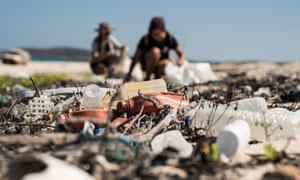
Plastic waste strewn on Djulpan beach
 Plastic waste strewn on Djulpan beach in Arnhem Land, in Australia’s Northern Territory. Photograph: Rebecca Griffiths/Sea Shepherd

Further evidence that plastic does not discriminate as it spreads across the planet: the marine conservation organisation Sea Shepherd said it is washing up in large quantities on a remote Australian beach.

Sea Shepherd joined Indigenous rangers in picking up more than seven tonnes of marine plastic pollution on a two-kilometre stretch of Djulpan beach, in northeastern Arnhem Land.

Using the same analysis technique employed in a recent study that found a staggering amount of rubbish on the tiny Cocos (Keeling) Islands in the Indian Ocean, researchers have estimated there would have been 250m pieces of debris along the full stretch of the 14km beach.

The clean-up of Djulpan beach, about 2 1/2 hours drive from the township of Nhulunbuy on the western side of the Gulf of Carpentaria, was conducted over two weeks last October. There is no road to the beach. The rangers from Dhimurru Aboriginal Corporation cut a 4WD track through scrub to reach it.

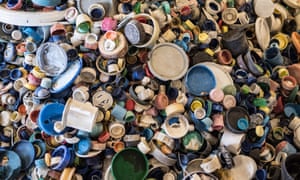
A collection of the bottle tops
Pinterest
 A collection of the bottle tops removed from Djulpan beach during the clean-up. Photograph: Rebecca Griffiths/Sea Shepherd

Liza Dicks, from Sea Shepherd Australia, said it was the worst case of plastic rubbish the group had found in more than 600 clean-up exercises at mainland Australian beaches.

About two-thirds of the debris were consumer items: water bottles, cigarette lighters, ice block wrappers, shoes, thongs, toys and toothbrushes. The rest was 72 types of discarded fishing net, some of which contained turtle bones.

Jennifer Lavers, a marine biologist at the University of Tasmania who led the Cocos (Keeling) Islands study and helped Sea Shepherd analyse what it found at Djulpan beach, said much of the rubbish was single-use and disposable. Some of the plastic appeared to be decades old.

“It is likely this waste came from southeast Asia, but we know at the same time Australia’s waste is going over to somewhere else,” she said.

“It is incredibly commonplace, but for the average ordinary person it’s probably pretty shocking to learn that these remote pristine places have such a high density of plastic. This is not some untouchable thing. It is a thing we can do something about.”

Last month the prime minister, Scott Morrison, vowed to do more to stop Australian plastic ending up in oceans. He won in principle backing from state and territory leaders to boost the struggling local recycling industry and ban the export of recyclable material.

No timeframe has been set for the ban, which will be discussed at a meeting of environment ministers in November. Government data suggests just 12% of the plastic waste Australians put in kerbside bins is recycled.

Microplastics discovered in ‘extreme’ concentrations in the North Atlantic

https://www.cnn.com/2019/08/19/world/microplastics-sargasso-sea-north-atlantic-intl/index.html

Sargasso Sea (CNN)Within the Atlantic Ocean is the world’s only sea without shores, its borders defined by the currents of the North Atlantic gyre. The Sargasso Sea takes its name from sargassum, a free-floating golden brown seaweed that is a haven for hatchling sea turtles and hundreds of other marine species who use it to feed, grow and hide from predators. But the sargassum is now home to objects wholly unnatural too.

Caught up in the swirling gyre is a growing collection of human waste: trash from countries that border the Atlantic, from the west coast of Africa to the east coast of the US, slowly breaking up on its long journey into microplastics that end up in the gills and stomachs of aquatic animals.
We joined a Greenpeace expedition to the Sargasso where scientists were studying plastic pollution and turtle habitats. Our mission was to get a better understanding of what lives out on the sargassum ecosystem, what is threatening it, and how that may impact us.

Into the blue

My cameraman, Brice Laine, and I thought we had an understanding of how humanity’s reliance on plastic has impacted Earth. We have reported from the remotest regions of our planet, from the Arctic to the Antarctic, where we witnessed the discovery of microplastics, fibers and PFAS (chemicals that are used as stain and water repellents in things like cookware and outdoor gear).
The Sargasso Sea is another place where few humans venture. Constantly changing with the currents, this oval shaped body of water is around 1,000 miles wide and 3,000 miles long. From the bow of our ship, Greenpeace’s Esperanza, the water looks pristine, inviting. Having never really been in waters like this — the open ocean, often believed to be a biodiversity desert — we’re excited to get in.
There are small schools of juvenile trigger and file fish, and other species darting around or just hiding within the sargassum. There are many species we don’t see, too small, too apt at blending into this rich nursery ground like young shrimp and crab, tiny frog fish, and what we really hoped to find but didn’t — baby turtles.
Embedded in most of the sargassum are the easily visible pieces of trash: shampoo bottles, fishing gear, thick hard containers or thin soft bags amongst many other types of plastic. One of the scientists points out fish bite marks in a small plastic sheet we pull out. But what is really jarring is when you dive down and look into the blue and realize you are surrounded by tiny glittering pieces of broken up plastic called microplastic.
It wasn’t until witnessing it that the extent of plastic pollution and what it means sank in. And it’s terrifying.
Greenpeace scientists say they found “extreme” concentrations of microplastic pollution in the Sargasso Sea, although they are still reviewing their findings. In one sample, they discovered almost 1,300 fragments of microplastic — more than the levels found last year in the notorious Great Pacific Garbage Patch.
Their analysis indicates this pollution originates from single-use plastic bottles and plastic packaging, according to Greenpeace.
Greenpeace’s trip to the Sargasso is part of its year-long pole-to-pole expedition to campaign for a Global Ocean Treaty that calls for the protection of a network of ocean sanctuaries covering 30% of the world’s oceans by 2030.
Off the side of the Esperanza, the manta trawl lazily gobbles up water samples from the ocean’s surface that are filtered through its long mesh tail. An hour later, what is collected shows us the bleak reality of what is in the water.
“In most of the samples that we have been sampling where there is sargassum we have seen a lot of plastics because they get entangled in the sargassum,” Celia Ojeda, a marine biologist with a PhD in ocean conservation, explains, pointing to the tiny pieces floating at the top of one sample.
“It’s a really nice blue; you can’t imagine what is under there, and then when you get the sample you get really shocked at the numbers,” she says.
Along with research assistant Shane Antonition, who is with the Bermuda Aquarium Museum and Zoo, Ojeda spends hours picking through the sargassum and what was collected in the manta trawl net.
Grabbing the tiny pieces with tweezers, she places them carefully on paper to count.
Antonition was part of a similar study years ago. “The more I learn, the more I see how much more like a spaceship Earth is, and how fragile these systems are and how much we rely on these ecosystems services to keep us alive. So, (we are) learning more about our impact on the earth and using those discoveries to inform the change that can prevent further degradation of our environment,” he says.

From your bin to your plate, via the ocean

Only around 9% of plastic produced has ever been recycled. Most single-use plastics end up in landfills or are burned in huge toxic fires. Some finds its way into our rivers or the oceans, either flushed into water systems or blown by wind currents.
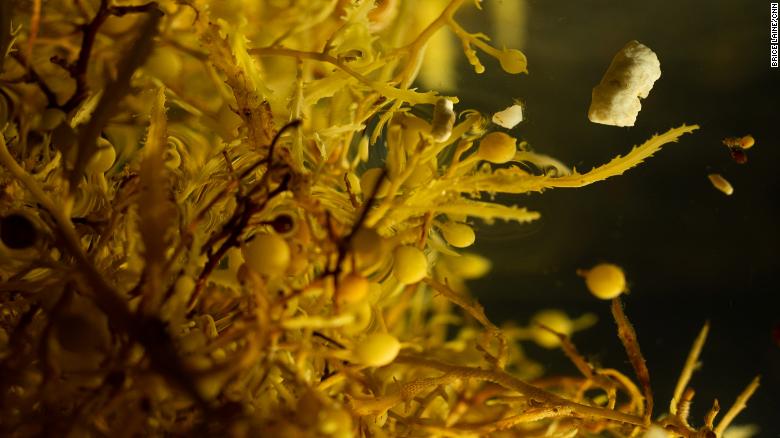
A close up shot of small pieces of plastic among the Sargassum. Plastics become broken down until they're so small they're consumed by wildlife and enter the food chain.

“This goes into the food chain.” Ojeda explains. “The fish and shrimps eat the plastic, we are eating them or the fish that eat them, and this will end up in our bodies somehow.”
The plastic humans discard — food wrappers, plastic bags, even nappies — find their way back into homes in the food that you buy. A study from June 2019 said the average person ingests around 2,000 microplastic particles a week — around five grams, or the weight of a credit card. What scientists don’t yet fully understand is what that plastic or the toxins that plastic contains can do to us.
Plastic pollution is hardly a new phenomenon. A study off the shore of Bermuda back in the early 1970s found 3,500 pieces of plastic per square kilometer. A more recent, as yet unpublished study by the Bermuda Aquarium Museum and Zoo found that nearly 42% of fish samples had ingested microplastics.
The weight of evidence that humans are contaminating one of our major food sources is overwhelming — not only introducing potential toxins into our own bodies, but also polluting whole ecosystems and killing precious marine animals.

How can you protect the ocean?

The key to tackling ocean plastic is to stop it getting there in the first place, but the solution doesn’t just lie with recycling.
“We need to be reusing and refilling,” Ojeda says. “The consumers are doing a lot of things, but if you as a consumer are going to the supermarket and you are unable to buy something which is not wrapped in plastic it’s not your fault. You are a person. It’s companies; companies need to take the step, need to lead the change — and governments need to push the companies.
“For the oceans to recover to we need to stop them (plastics) now. If we are thinking we can stop them in 10 years, we can phase them out, no: we need to stop single-use plastic. Then the seas will have time to clean up.”
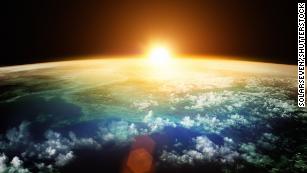
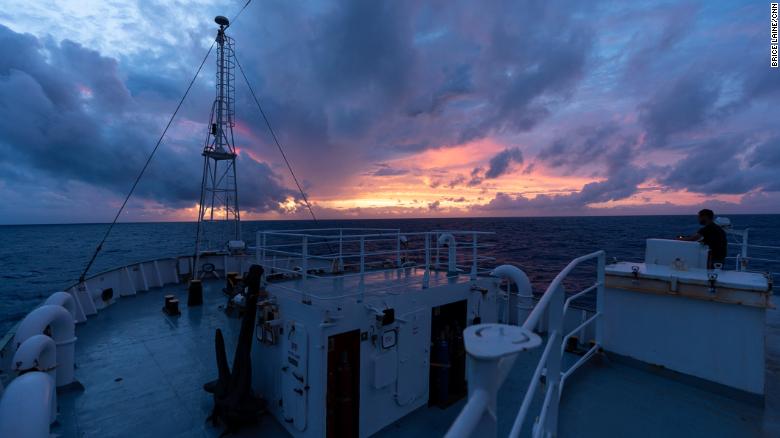
Sunset aboard the Esperanza, a Greenpeace vessel scouring the Sargasso Sea for microplastic samples.

“We need to look at all the ways we are not understanding the fate of plastic,” says Robbie Smith, a marine ecologist and the curator of the Bermuda Aquarium and Zoo. “Recycling is terrible, even in the US. Countries are facing up to the reality, but they are not ready to turn off the tap.
“We need to look at the types of plastic we are using and eliminate the ones that can’t be recycled. We need to tidy up land-based sources (landfills and the like).
“We need to be more respectful that plastic is a great tool but can become a nightmare,” he adds. “There is no quick fix. Nothing is going away fast. It takes a decade or two for plastic to make its way into the watershed.”
Few of us witness what is out in the open oceans far from our homes, which is one of the many challenges for ocean protection and why few truly understand how dire the situation is. Out of sight, out of mind.
But in reality, it’s ending up right back in front of us — and inside us — even though we may not see it.

Wild bees are building their homes from plastic—and scientists aren’t sure why

Sarah Gibbens
a small insect on a white background: Portrait of a leaf cutter bee, the species believed to be using plastic for construction material in Argentina.© Photograph by Joel Sartore, National Geographic Photo ArkPortrait of a leaf cutter bee, the species believed to be using plastic for construction material in Argentina.

Wild bees, nesting in Argentinian crop fields, were recently found constructing nests entirely made of the flimsy plastic packaging material left on farms.

From 2017 to 2018, researchers at Argentina’s National Agricultural Technology Institute crafted wooden, artificial nests for wild bees. Unlike bee species that have a large hive with queens and workers, wild bees burrow into nests to individually lay larvae. The constructed nests fit together like long rectangles with a narrow, hollow opening that allowed wild bees to crawl inside and fill it with cut leaves, twigs, and mud.

Sixty-three wooden nests were constructed, and three were found lined entirely with plastic. Similar in size and shape to a fingernail, the bits of plastic had been carefully cut by bees and arranged in an overlapping pattern in their nests. Based on the material, researchers think the plastic may have come from a plastic bag or film, which has a similar texture to the leaves bees typically use to line their nests.

Of the three plastic nests, one had not been finished, meaning the bee did not use it to lay her larvae, Science Alert reports. In the remaining two, one larva died and the other was not found, leading the researchers to believe it survived.

What does it mean for bees?

This new research, published in the journal Apidologie, documents the first time bees have been seen making nests only out of plastic, but for years scientists have known bees were incorporating plastic into their building materials.

In 2013, a paper published in Ecosphere outlined how bees were using plastic films and foams to line nests in urban areas throughout Toronto, Canada. Similar to the bees in Argentina, the wild bees observed in Canada cut pieces of plastic that resembled the leaves they commonly use.

Notably, the Canadian study found it wasn’t just flaps of plastic bags the bees were using. Plant resins, which can be fashioned into anything from gum to latex, often bind a bee’s building materials together. But some individuals, they observed, were hauling a plastic-based caulk back to their nests to use instead.

Both studies noted that more research needs to be done before scientists can outline the potential impact plastic might have on bees, but the nest building shows that bees are highly adaptive to changing environments. In both places, leaves were readily available as a building material.

“It would demonstrate the adaptive flexibility that certain species of bees would have in the face of changes in environmental conditions,” the study’s lead author Mariana Allasino wrote in a press release translated from Spanish.

Plastic dangers

Hollis Woodard, an entomologist who studies bees at the University of California Riversides Woodard Lab, isn’t surprised to see bees hauling plastic to their nests.

“I think it’s really sad,” she says. “It’s another example of the rampant use of materials that end up in places we don’t intend them to.”

Plastic often presents a threat to wildlife in the form of microplastics, the incredibly tiny bits of plastic that form as larger plastic trash breaks down. Microplastics are a danger to the animals that mistake them for food, which many do, especially in marine environments. No study, however, indicates that bees might be consuming plastic.

Among the dangers that bees face are pesticides, habitat destruction, and exposure to viruses or parasites.

Researchers have speculated that plastic may form a barrier against common nest issues like mold and parasites.

If the bees are in fact choosing plastic over natural materials, it wouldn’t be the first time animals have used trash to their advantage.

Sparrows and finches line their nests with cigarette butts to ward off parasitic mites, and black kites in the Italian Alps collect bright strips of plastic to decorate their nests and attract mates.

“It would take a lot more research to know what this means for the bees themselves,” says Woodard. “Sure it’s possible it might afford some benefits, but that hasn’t been shown yet. I think it’s equally likely to have things that are harmful.”

Turns out there’s more plastic pollution in the deep ocean than the Great Pacific Garbage Patch

CLOSE

Nurdles, also known as “mermaid tears,” are actually small plastic pellets used to make plastic items. Buzz60

SAN FRANCISCO — The problem of plastic pollution in the ocean is even worse than anyone feared. Tiny broken up pieces of plastic — microplastic — aren’t just floating at the water’s surface but are pervasive down thousands of feet. There’s actually more microplastic 1,000 feet down than there is in the Great Pacific Garbage Patch, research published Thursday found.

“We didn’t think there would be four times as much plastic floating at depth than at the surface,” said Kyle Van Houtan, chief scientist at the Monterey Bay Aquarium.

He’s one of the authors of the study published in this week’s edition of Scientific Reports from the journal Nature that investigated just how much plastic there is in the ocean’s depths.

Literally tons of plastic trash wash down rivers and out to sea each day, fouling the surface and endangering sea life. It’s long been believed that most of it floated. But when the researchers looked deep below the surface, they found tiny broken-down plastic pieces, smaller than rice grains, wherever they looked.

The issue of plastic ocean trash has been a focus of public concern over the past decade, a concern that’s centered on the Great Pacific Garbage Patch. That’s a huge floating blob of plastic trash halfway between California and Hawaii drawn together by ocean currents to create a gyre. This vortex of waves concentrates the floating trash pieces in an area twice the size of Texas.

ADVERTISEMENT

It’s important to remember that the patch isn’t composed of big floating rafts of trash, but rather a pervasive almost mist of tiny bits of plastic floating in the water. Think of it more as a fog in the water than as a bleach bottle bobbing along.

That same fog of plastic bits extends deep down below the surface, the scientists found. And deeper down, it’s worse than at the surface.

Previous research found concentrations of microplastic in the Great Pacific Garbage Patch were about 12 particles per cubic meter of water. “We topped out at 16,” said Van Houtan of his team’s underwater findings.

The deep-sea methods they used were highly innovative, and confirmed a bleak picture of what the last decade’s research has been pointing toward, said Brendan Godley, a conservation scientist who studies plastic ocean pollution at the University of Exeter in the United Kingdom.

Newsletters
Get the News Alerts newsletter in your inbox.

Get alerted to the latest stories to stay on top of the news.

Delivery: Varies

Your Email

“Scientists are now beginning to realize that microplastics are truly ubiquitous. They’ve been found from the seafloor to the mountain tops, in the air we breathe and in the salt we put on our meals,” he said.

The biggest shock of all, says Peter Ross, a toxicologist who studies the impacts of microplastics on marine life at Canada’s Vancouver Aquarium in Vancouver, British Columbia, is that it’s not a surprise at all how much plastic there was even deep down in the ocean.

“This research demonstrates the way in which we’ve gone from zero understanding of the problem 15 years ago to full-fledged appreciation that this pollutant is completely distributed around our entire planet,” he said.

What they found

The researchers used drone micro-submarines to sample the water from the surface all the way down to the ocean floor, 3,200 feet. The sample area included one site near Monterey Bay on the California coast and one site 15 miles offshore.

The highest concentrations of microplastics were between 600 and 2,000 feet down.

They also inspected the guts of red pelagic crabs and a kind of jellyfish-like filter feeders called a giant larvacean. Both species play key roles in ocean food webs, from the surface to the seafloor. Every one of them contained plastic.

“Even if you don’t care about the crabs and the larvaceans, they’re the food of things you do care about – tuna, seabirds, whales and turtles all feed on them, or feed on things that feed on them,” said Anela Choy, a professor at the Scripps Institution of Oceanography at the University of California, San Diego and one of the paper’s authors.

While they sampled just two areas, Van Houtan believes they would find similar patterns given ocean currents and the ongoing mix of waters.

Laser spectroscopy allowed them to analyze what kind of plastic each of the particles they found came from, which also turned up some surprises.

Some have suggested that the majority of plastic in the sea comes from discarded or lost commercial fishing gear. However the researchers found that very few particles were from fishing gear. Almost all were from terrestrial sources.

The one piece of good news Van Houtan found in what they saw was that the single largest type of plastic they found floating in the water – about 40% – came from single-use plastics such as beverage and food containers.

“That’s something we as consumers can do something about,” Van Houtan said. “Single-use products are something that we can demand better alternatives for.”

LINKEDINCOMMENTMORE

Malaysia to Ship Plastic Trash Back to the U.S., Other Origin Countries

The country will send roughly 3,300 tons of plastic waste to countries like the U.S., its environment minister announced.

By Cecelia Smith-Schoenwalder, Staff WriterMay 28, 2019, at 11:39 a.m.
LHOKSEUMAWE, ACEH, INDONESIA - 2019/04/21: (Photo taken by a drone)
A scavenger seen looking for plastic bottle trash at a garbage dump in Lhokseumawe, Aceh province, Indonesia.
Based on a study by McKinsey and Co. and Ocean Conservancy, Indonesia is the number two plastic waste producing country in the world after China. The large amount of waste production, especially plastics sent to the Indonesian seas, directly contributes to making coastal areas and small islands dirty and full of garbage. Moreover, from the results of the study, it was found that the waste in the coastal area was dominated by plastic with a percentage of 36 to 38 percent. (Photo by Zikri Maulana/SOPA Images/LightRocket via Getty Images)

A man scavenges in a garbage dump in Lhokseumawe, Indonesia, in April. Malaysia will be sending 60 containers of waste back to their countries of origin, the country’s environmental minister announced Tuesday.ZIKRI MAULANA/SOPA IMAGES/LIGHTROCKET VIA GETTY IMAGES

MALAYSIA PLANS TO SEND back roughly 3,300 tons of plastic trash to countries like the U.S. and Canada, its environmental minister announced Tuesday.

After China banned the import of plastic waste last year, Malaysia and other developing countries became the destination for much of the world’s trash.

Environment Minister Yeo Bee Yin said the country will be sending 60 containers of waste back to their countries of origin. They were discovered while they were being smuggled to illegal processing facilities.

“These containers were illegally brought into the country under false declaration and other offences which clearly violates our environmental law,” Yeo said.

RELATED CONTENT

China Doesn’t Want Your Trash

Yeo added that many citizens in developed countries were mostly unaware that their trash – which they think is being recycled – is actually being dumped in Malaysia.

“We are urging developed nations to review their management of plastic waste and stop shipping garbage to developing countries,” she said. “If you ship to Malaysia, we will return it back without mercy.”

At least 14 countries, including the U.S., Canada, Japan, France, Australia, Saudi Arabia and China, will get trash shipped back to them, according to Malaysian officials.

The move makes Malaysia the latest Asian country to start rejecting other nations’ trash.

Last week the president of the Philippines said he would send back 69 containers of garbage to Canada to be left in international waters if the country doesn’t accept them.

As the world grapples with what to do with its trash, many nations have promised to try to address the problem.

Earlier this month more than 180 countries pledged to meet control measures to curb plastic pollution under the Basel Convention. The U.S. was not one of them.

Items that can’t be recycled are usually burnt or put into landfills, contaminating air, dirt and water sources.

More states aim to join Florida to knock air out of festive balloon launches

 – The tradition of releasing balloons at weddings, birthdays and memorials may soon get deflated by lawmakers in more than half a dozen states.

Critics say the helium-filled balloons pollute the environment, and threaten birds and other wildlife when they fall to earth. In Florida, if ten or more balloons are released at once, it could lead to a $250 fine.

CONTINUE READING BELOW

“People don’t really realize that it’s littering. That’s why we want to bring attention to this,” said state Rep. Lydia Blume, who’s supporting a balloon bill in Maine. “It’s a common sense thing.”

Earlier last week, a baby dolphin was euthanized. Biologists said the found two plastic bags and a shredded balloon during a necropsy.

“This finding highlights the need to reduce single use plastic and to not release balloons into the environment,” explained the Florida Fish and Wildlife Conservation Commission in a Facebook post.

Nationwide, there’s a growing awareness of the problem, and it has energized legislation in state governments. Bills to limit the intentional release of large numbers of balloons are being aired in legislatures in Arizona, Connecticut, Massachusetts, New Hampshire, New Jersey, New York and Rhode Island, in addition to Maine, said Jennifer Schultz of the National Conference of State Legislatures.

Texas is also considering a study on windblown and waterborne litter that would include helium balloons, she said. A similar proposal was terminated while in committee in the Kentucky legislature last month.

These states would join California, Connecticut, Florida, Tennessee and Virginia – all of which already have laws that ban or restrict launches. California’s law applies only to foil balloons, while Connecticut is currently considering a stricter law, said Danielle Vosburgh, a Florida environmental activist who helped launch a nonprofit organization, Balloons Blow.

Maine’s proposal to ban mass balloon releases took flight at a town meeting last month in Unity. Penny Sampson, chairwoman of the Select Board, said she had witnessed a couple releases in person. Once was in 2000 when triplet boys died in a fire in Unity. Another time, balloons were released at the Wiscasset Raceway to memorialize someone who died.

“To pollute the environment and cause marine and wildlife issues is really not a good way to memorialize someone. There are plenty of other ways to do it,” Sampson said.

Critics are having some recent success in battling the feel-good tradition of releasing balloons. Clemson University stopped releasing balloons at its football games. The Indianapolis 500 and the Nebraska Cornhuskers have faced pressure to do the same.

And a growing number of communities are tackling the issue, too.

The New Jersey-based Balloon Council, which represents manufacturers, wholesalers, distributors and retailers, used to be opposed to bans on balloon releases because of the impact on small businesses. These days, the council still prefers education over legislation, but it is not opposing any of the legislative efforts to stop balloon releases.

“The balloon council feels that all balloons should be deflated and properly disposed of,” said spokeswoman Lorna O’Hara. “There is a heightened attention across the globe. We’re rising to what’s happening in the United States and globally.”

Some folks are getting the message – with or without legislative intervention.

At Fort Leavenworth, Kansas, officials at the Army installation quickly decreed there will be no more balloon releases after children released balloons on April 1 to mark the “month of the military child.” The balloon launch caused an uproar in the community.

“We’ve been beaten up on social media,” said base spokesman Jeffrey Wingo.

But the outrage sparked a discussion about environmental stewardship. “Is this the right thing to do? Is this environmentally sound, or not?” he said. “It is not.”

Dead whale washed up in Philippines had 40kg of plastic bags in its stomach

Marine biologists horrified to find 16 rice sacks and multiple shopping bags inside Cuvier’s beaked whale

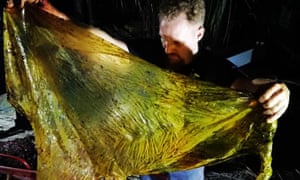
Darrell Blatchley pulling plastic out of the juvenile male Cuvier’s beaked whale
 Darrell Blatchley pulling plastic out of the juvenile male Cuvier’s beaked whale Photograph: Darrell Blatchley/D’ Bone Collector Museum Inc.

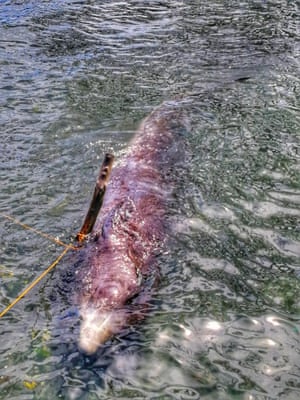
A young whale that washed up in the Philippines died from “gastric shock” after ingesting 40kg of plastic bags.

Marine biologists and volunteers from the D’Bone Collector Museum in Davao City, in the Philippine island of Mindanao, were shocked to discover the brutal cause of death for the young Cuvier’s beaked whale, which washed ashore on Saturday.

In a damning statement on their Facebook page, the museum said they uncovered “40 kilos of plastic bags, including 16 rice sacks. 4 banana plantation style bags and multiple shopping bags” in the whale’s stomach after conducting an autopsy.

Images from the autopsy showed endless piles of rubbish being extracted from the inside of the animal, which was said to have died from “gastric shock” after ingesting all the plastic.

The juvenile male curvier beaked whale died from ingesting plastic bags
Pinterest
 The juvenile male curvier beaked whale died from ingesting plastic bags Photograph: Darrell Blatchley/D’ Bone Collector Museum Inc.

The D’ Bone Collector Museum biologists who conducted the autopsy said it was “the most plastic we have ever seen in a whale”.

The use of single-use plastic is rampant in south-east Asia. A 2017 report by Ocean Conservancy stated that China, Indonesia, the Philippines, Thailand, and Vietnam have been dumping more plastic into the ocean than the rest of the world combined.

Marine biologist Darrell Blatchley, who also owns the D’Bone Collector Museum, said that in the 10 years they have examined dead whales and dolphins, 57 of them were found to have died due to accumulated rubbish and plastic in their stomachs.

In June last year, a whale died in southern Thailand after swallowing more than 80 plastic bags, which weighed up to 8kg (18lb) in the creature’s stomach, and marine biologists estimate around300 marine animals including pilot whales, sea turtles and dolphins, perished each year in Thai waters after ingesting plastic.

15 ways the Trump administration has impacted the environment

President Donald Trump signs a presidential memorandum to “minimize unnecessary regulatory burdens” on October 19, 2018. Since his earliest days in office, President Trump has been

… Read More

PHOTOGRAPH BY DOUG MILLS, THE NEW YORK TIMES

For the past three years, National Geographic has been tracking how this administration’s decisions will influence air, water, and wildlife.

SINCE THE TRUMP administration took office, it has been fighting what they call an “anti-growth” agenda put in place by the Obama administration. Regulations that required businesses to spend time and money to meet the former administration’s environmental standards were swiftly reviewed and, in many cases, rolled back.

National Geographic has been tracking the decisions that will impact America’s land, water, air, and wildlife. What started with curtailing information when the president took office in 2017 has evolved into actions like executive orders that open public land for business.

States, municipalities, and NGOs have responded to these changes by filing lawsuits to block the administration. Some, like lawsuits against the Keystone XL pipeline, have successfully kept public land closed to additional development.

Below are 15 influential decisions made by the Trump administration that could impact the future of our nation.

Clean air

1. U.S. pulls out of Paris Climate Agreement

This is perhaps the decision that set the tone for the Trump administration’s approach to the environment: when he moved to withdraw from the Paris Climate Agreement in June of 2017. To many, it signaled less U.S. leadership in international climate change agreements. (Read more about this decision.)

2. Trump EPA poised to scrap clean power plan

The Clean Power Plan was one of the Obama’s signature environmental policies. It required the energy sector to cut carbon emissions by 32 percent by 2030, but in October 2017 it was rolled back by Trump’s EPA. Among the reasons cited were unfair burdens on the power sector and a “war on coal.” (Read more on why Trump can’t make coal great again.)

3. EPA loosens regulations on toxic air pollution

This regulation revolved around a complicated rule referred to as “once in, always in” or OIAI. Essentially, OIAI said that if a company polluted over the legal limit, they would have to match the lowest levels set by their industry peers and they would have to match them indefinitely. By dropping OIAI, the Trump EPA forces companies to innovate ways to decrease their emissions, but once those lower targets are met, they’re no longer required to keep using those innovations. (Read more about air pollution.)

4. Rescinding methane-flaring rules

Under the Affordable Clean Energy rule issued in August 2018, states were given more power over regulating emissions. In states like California, that means regulations would likely be stricter, whereas states that produce fossil fuels are likely to weaken regulations. The following month, the EPA announced they would relax rules around releasing methane flares, inspecting equipment, and repairing leaks. (Read more about methane.)

5. Trump announces plan to weaken Obama-era fuel economy rules

Under the Obama administration’s fuel economy targets, cars made after 2012 would, on average, have to get 54 miles per gallon by 2025. In August 2018, the Trump Department of Transportation and EPA capped that target at 34 miles per gallon by 2021. The decision created legal conflict with states like California that have higher emission caps. (Read more about speed bumps in the way of super-efficient cars.)

Water

6. Trump revokes flood standards accounting for sea-level rise

In August 2017, President Trump revoked an Obama-era executive order that required federally funded projects to factor rising sea levels into construction. However, in 2018, the Department of Housing and Urban Development required buildings constructed with disaster relief grants do just that. (Read more about how rising sea levels may imperil the internet.)

7. Waters of the U.S. Rule revocation

What are the “waters of the U.S.?” President Trump issued an executive order in 2017 ordering the EPA to formally review what waters fell under the jurisdiction of the EPA and Army Corps of Engineers according to the 1972 Clean Water Act. The proposed change narrowed the definition of what’s considered a federally protected river or wetland. (Read more about Trump’s plans to roll back the Clean Water Act.)

Wildlife

8. NOAA green lights seismic airgun blasts for oil and gas drilling

Five companies were approved to use seismic air gun blasts to search for underwater oil and gas deposits. Debate over the deafening blasts stem from concerns that they disorient marine mammals that use sonar to communicate and kill plankton. The blasts were shot down by the Bureau of Energy Management in 2017 but approved after NOAA found they would not violate the Marine Mammal Protection Act. (Read more about how scientists think seismic air guns will harm marine life.)

9. Interior Department relaxes sage grouse protection

The uniquely American sage grouse, a bird resembling a turkey with spiked feathers, has become the face of the debate between land developers and conservationists. In both 2017 and 2018, the Trump administration Department of Interior eased restrictions on activities like mining and drilling that had been restricted to protect the endangered bird. (Read more about how the sage grouse become caught in the fight over who owns America’s west.)

10. Trump officials propose changes to handling the Endangered Species Act

In July of 2018, the Trump administration announced its intention to change the way the Endangered Species Act is administered, saying more weight would be put on economic considerations when designating an endangered animal’s habitat. (Read more about the rollbacks facing endangered animals.)

11. Migratory Bird Treaty Act reinterpretation

Companies installing large wind turbines, constructing power lines, or leaving oil exposed are no longer violating the Migratory Bird Treaty Act if their activities kill birds. This controversial change was declared by the Trump administration in December of 2017. (Read more about why legally protecting birds is important.)

Opening public lands for business

12. Trump unveils plan to dramatically downsize two national monuments

Unlike national parks, which have to be approved by Congress, national monuments can be created by an executive order, which the president said means they can be dismantled just as easily. Such was the case for Bears Ears and Grand Staircase-Escalante in Utah, which President Trump reduced and opened for mining and drilling companies in 2017. Tribes and environmental groups are challenging that interpretation in court. (Read more about the impacts of downsizing these two monuments.)

13. Executive order calls for sharp logging increase on public lands

Just a day before the longest government shutdown in U.S. history, President Trump issued an executive order that called for a 30 percent increase in logging on public lands. The decision was billed as wildfire prevention, though environmental groups say it ignores the role climate change plays in starting wildfires. (Read more about California’s historic wildfires.)

Security & Enforcement

14. Trump drops climate change from list of national security threats

The Trump administration’s decision to delist climate change from national security threats in December of 2017 meant less Department of Defense research funding and a nationalistic viewpoint on the potential impacts of wildfires, droughts, hurricanes, and other natural disasters. (Read more about how climate change is forcing migration in Guatemala.)

15. EPA criminal enforcement hits 30-year low

The size and influence of the EPA has shrunk under the Trump administration, and it’s illustrated by their diminished prosecuting power. Criminal prosecutions are at a 30-year low, and many violations that would have been prosecuted in the past are now being negotiated with companies. The administration says this is streamlining its work, but environmentalists have warned it could lead to more pollution. (Read more about the scientists pushing back against President Trump’s environment agenda.)