Help Stop a Proposed Five-Year Wildlife Killing Contest!

xVHAyLEawJsheWD-556x313-noPad

From defenders.org

A “hunters’ rights” organization wants to hold a multi-year wolf and predator-killing derby on national public lands, including those being studied for designation as wilderness!

If approved this will be the second wolf-killing competition held in Idaho – and no predator will be safe!

If you think it can’t get worse, consider this: The proposed event would take place every winter for five years when wolves and other wildlife are most vulnerable out foraging for food in the snow and extreme cold.

Events like these are the same kinds of barbaric extermination-era tactics that drove wolves to the brink of extinction in the Lower 48 in the first place! This is not modern wildlife management, and it has no place in our society.  

Please stand with us, and call on the BLM to immediately deny this permit! 

A “hunter’s rights” organization has formally requested a federal permit to hold a multi-year predator-killing derby in Idaho — on national public lands!

If approved this will be the second competitive wolf-killing competition held in Idaho – and no predator will be safe! 

 If you think it can’t get worse, consider this. The proposed event would take place every winter for five years, when wolves and other wildlife are most vulnerable out foraging for food in the snow and extreme cold.

 Please stand with us and call on the BLM to immediately deny this outrageous request! 

https://secure.defenders.org/site/Advocacy?cmd=display&page=UserAction&id=2799


Climate Change May Impact Predators to Influence Entire Ecosystems

Predators play crucial roles in ecosystems. They weed out prey that are sick or old, and they can even push species to move in order to stay in their climatic comfort zones. Now, scientists have taken a look at how climate change might impact predators which could, in turn, affect entire ecosystems…

A historical example of this particular phenomenon is the sea otter. These mammals were once decimated by the fur trade that spanned the late 1700s to the early 1900s. This important predator species regulated prey in areas spanning from Alaska to Baja California, Mexico.

“The near extinction of sea otters is one of the most dramatic examples of human-induced impacts to the structure and functioning of temperate nearshore marine ecosystems,” said Rebecca G. Martone, one of the researchers, in a news release.

Without sea otters, which live on abalone, clams, crabs, mussels, shrimp and sea urchins, kelp forests suffer. Without the otters, undersea urchins prey on kelp forests, causing dense areas to become barren and essentially disrupting entire ecosystems. In fact, scientists found that this may even have an effect on climate change.

Kelp forests grow rapidly and store large amounts of carbon. This means that if otters are absent and urchins are destroying these forests, more carbon is released. Not only that, but kelp provides a three-dimensional habitat for species such as rockfish, seals, sea lions, whales, gulls, terns, snowy egrets and some short birds. Without otters, though, these communities rapidly decline.

The analysis of the effect of sea otters shows that predators play huge roles in ecosystems. This means that climate change that affects predators negatively can also greatly impact ecosystems. A symposium focusing on climate’s effects on predators will occur during the Ecological Society of America’s 99th Annual Meeting in Sacramento, California.

http://www.scienceworldreport.com/articles/16584/20140813/climate-change-impact-predators-influence-entire-ecosystems.htm

I’d Love to Change the World

I’ve been told that I’m not helping anything by being vegan; that I wasn’t going to be able to stop all the horrible things going on by taking a stand against animal consumption.

10151358_495324630593354_7512005859880238928_nThat’s a depressing thought, especially if you’re aware of the current holocaust happening all around us. Humans are slaughtering 6 million animals per hour. 20,000 more will die in the time it takes you to read these sentences! That’s a holocaust of farmed animals every 60 minutes. And that’s not counting fish, lobsters, shrimp, oysters, clams, krill or other sea life. But I’m not fooling myself, I know it would take a concerted, allied effort to stop these atrocities.

Even if I never saw positive results from promoting veganism in my short lifetime, there are other reasons for not eating animals. For me, veganism is about choosing not to add to the suffering our fellow Earthlings endure every day for the human appetite; it’s a form of dissent against the extreme cruelty millions of animals undergo so humans can have their steak and eat it too.

Veganism is my protest against the insanity of factory farming; against the existence of battery cages, cattle feedlots, industrialized dairies, veal crates, hog farming, commercial fishing, whaling, sealing, fur trapping, bow hunting, predator control, contest hunts, culling, derby killing and every other form of exploitation our species inflicts on the non-humans citizens of the world.

I might not be able to change the world, but at least I don’t have to be complicit in institutionalized animal cruelty. Non-human animals might hold little value to most people, but the laissez-faire acceptance of brutality and suffering will eventually come back on Homo sapiens and help facilitate the demise of the species.

In the immortal words of Woodstock headliners, Ten Years After:

“I’d love to change the world

But I don’t know what to do

So I’ll leave it up to you”

why

In honor of ALL mothers, help end predator killing contests!

PC_logo_vector_3_line_tagline2
Donate button Email button You Tube button Twitter button Facebook button
 Pupbanner 2 
In honor of ALL mothers, help us end predator killing contests!

In case you missed my message last week I wanted to make sure you see this.

As we celebrate Mother’s Day, please consider the wild four-legged mothers who are being indiscriminately killed year-round in predator killing contests. As a result, thousands of pups and kittens are orphaned in the spring and left to die a slow and lingering death.

What message does this send to our children about the value and sanctity of life when prizes are given for the most females killed and youth are encouraged to join in the killing contests?

We are on the verge of setting the trend for the nation by banning predator killing contests in California and we need your help to stop this violence! Please help us win this battle by making a contribution to Project Coyote today.

Ban_killing_contests_brown_bannerPups_play_button

Something Serious to Protest

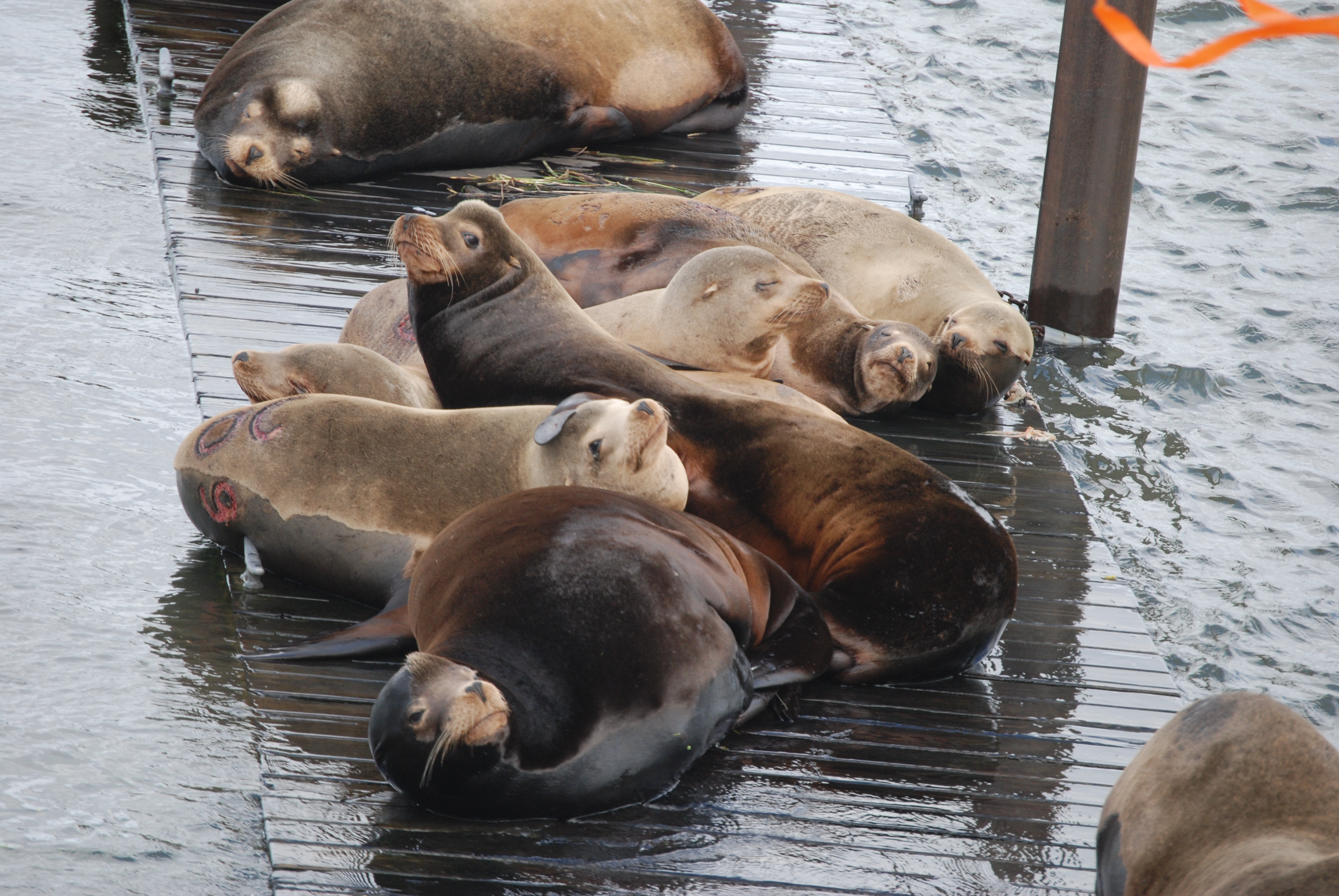
On Friday, May 4, my wife and I stopped at the East Moring Basin on the Columbia River in Astoria, Oregon, to see the sea lions who spend the daytime hours hauled out on one of the floating docks there. It’s always a treat to watch their antics and to hear the raucous roaring of competitive bulls mouthing off to anyone who might try to wriggle in and crowd their personal space. As expected we heard bellowing as soon as we arrived, but this time the sea lions had something serious to protest: an unfortunate herd-mate had been trapped and was being held down tightly and tormented by a group of strange and menacing two-leggers wearing orange raingear, one of whom pulled out a hot iron and repeatedly branded the restrained sea lion. As the victim struggled, acrid smoke from his burning flesh drifted for a hundred yards across the harbor.

The searing pain of the branding may have been temporary, but now the sea lion is branded in the figurative sense of the word as well, and his troubles are just beginning. With the numbers viciously burned onto the animal’s back, the Oregon Department of Fish and Wildlife thus has a clever way to recognize him. Later, they will decide whether or not to add him to their annual hit list of 92 sea lions they plan to kill if they reach the man-made dam that impedes the ancient migration route of spawning salmon.

It speaks volumes about the trusting nature of sea lions that they are willing to return to Astoria year after year. Since its establishment in 1811 as a hub for the booming, bloody fur trade, Astoria has been the scene of countless crimes against marine animals, including sea lions, who were killed along the Oregon coast by the thousands—exclusively for lamp oil.

Image

Charles M. Scammon—whaler, sealer, mariner and infamous discoverer and exploiter of the gray whale birthing lagoons in Baja California—devoted a chapter to sea lions in his book, The Marine Mammals of the Northwestern Coast of North America: Together with an account of the American Whale-Fishery. He begins that chapter with the lines, “Among the numerous species of marine mammalia found upon the Pacific coast of North America, none excite more interest than the sea lion;” Scammon goes on to describe an average day in the life of the pitiless sealers, and the last day ever for a group of sea lions. “On the south coast of Santa Barbara Island was a plateau, elevated less than a hundred feet above the sea, stretching to the brink of a cliff that overhung the shore, and a narrow gorge leading up from the beach, through which the animals crawled to their favorite resting-place. Several unsuccessful attempts had been made to take them; but, at last, a fresh breeze commenced blowing directly from the shore, and prevented their scenting the hunters, who landed some distance from the rookery, then cautiously advanced, and suddenly, yelling and flourishing muskets, clubs, and lances, rushed up within a few yards of them, while the pleading creatures, with lolling tongues and glaring eyes, were quite overcome with dismay, and remained nearly motionless. At last, two overgrown males broke through the line formed by the men, but they paid the penalty with their lives before reaching the water. A few moments passed, when all hands moved slowly toward the rookery, which had slowly retreated. This maneuver is called “turning them” and, when once accomplished, the disheartened creatures appear to abandon all hope of escape, and resign themselves to their fate. The herd at that time numbered 75, which were soon dispatched by shooting the largest ones, and clubbing and lancing the others, save for one young sea lion, which they spared to ascertain whether it would make any resistance by being driven over the hills beyond. The poor creature only moved along through the prickly pears that covered the ground, when compelled by his cruel pursuers; and, at last, with an imploring look and writhing in pain, it held out its fin-like arms, which were pierced with thorns, in such a manner as to touch the sympathy of the barbarous sealers who put the sufferer out of its misery with the stroke of a heavy club.”

Scammon ends his chapter with the prediction that the Pacific Coast sea lions “…will soon be exterminated by the deadly shot of the rifle, or driven away to less accessible haunts.” Today the few sea lions who have managed to hold on are again under attack, this time for the crime of daring to survive despite industrial scale over-fishing depleting their only food source.

End the “Lethal Take” of Columbia River Sea Lions

Sea lion Defense Brigade reports that a lot of young animals were seen in Astoria’s east mooring basin this weekend with fresh brand burns, and bleeding scars on their backs. ODFW claims this hot branding does not hurt sea lions, but the burns on their backs and the pain in their eyes tell a different story.

Please contact NOAA :Donna Wieting, and ask her to end the “Lethal Take” of the Columbia River sea lions for eating fish. Director, Office of Protected Resources
NOAA
Phone 301 713-2332 begin_of_the_skype_highlighting 301 713-2332 FREE  end_of_the_skype_highlighting
Fax 301 427-2520
Email: donna.wieting@noaa.gov
1315 East-West Highway,
Silver Spring MD 20910
Thank you, for taking action for the Columbia River sea lions.


littleboyc09


Killing wild animals spurs new debate

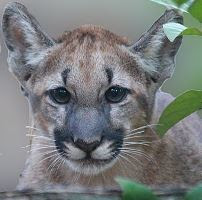
Slicing into a slab of chocolate cake on a picnic table at Hendricks     Park in south Eugene, Linda Gray said she wasn’t concerned about the possibility of a cougar roaming the area as she celebrated friend Betsy Priddle’s 71st birthday on Tuesday.

She was, however, upset about the fate of two cougars that were     trapped in the area and euthanized by the State Department of Fish and Wildlife, the first on March 11 and the second on Monday.

“If people go into areas where there are wildlife, they should expect to treat them with respect,” Gray asserted.

The cougars were euthanized largely because of a string of livestock     killings on a nearby property, where one man lost two goats and     three chickens over three consecutive nights. While landowners have     the right to kill animals on their property, state fish and wildlife     officials say they stepped in on behalf of people such as Gray and     Priddle who enjoy picnicking and hiking in the nearby park, some     with dogs or small children.

But Gray doesn’t see it that way, and on Tuesday offered alternative     solutions, beginning with preventing such attacks in the first     place.

“If you’re going to raise livestock in an area where there are     predators around, you need to protect your livestock,” she said.

A local wildlife advocate also questioned how the state has handled     the recent cougar incidents.

“I personally believe that this was a grave overreaction to set the     traps out to begin with,” said Brooks Fahy, executive director of     Predator Defense, a national wildlife advocacy group based in     Eugene. “There had been no complaints other than from this     individual” whose livestock was killed.

Fahy said the fish and wildlife department’s claims that it does not     relocate cougars due to potential territorial conflicts, spread of     disease and future livestock killings don’t necessitate killing an     animal. While relocation is difficult, he said cougars are not major     carriers of disease and that tales of repeated livestock killings     are purely “anecdotal.”

Fahy did agree, however, that adult cougars are typically unable to     adjust to captivity, as was the case with the second cougar, which     was trapped Friday and euthanized Monday after a state wildlife     veterinarian observed its behavior in captivity.

Fahy said he is concerned that even though Oregon lifted its bounty     on cougars in 1960 and has prohibited the use of packs of dogs for     hunting cougars and bears since 1994, the state’s annual cougar     killings continue to climb — citing fish and wildlife department     statistics, Fahy noted that 530 cougars were killed in Oregon last     year as a result of hunting and other causes, Fahy said.

“Cougars are being slaughtered in the state of Oregon on a historic     level,” he said.

The fish and wildlife department last year issued more than 55,000     hunting tags for cougars — up from 588 in 1994 — which accounted for     nearly 300 of last year’s cougar deaths, Fahy added. The department     says about 5,700 cougars currently reside in Oregon.

State officials say the increase in tags is directly linked to the     ban on hunting with hounds — since the dog packs had a higher     success rate than other hunting methods, the state says it can now     issue more tags with a relatively small increase in hunting     harvests.

But Fahy said the killing of large, dominant “trophy animals” could     be cause for even more conflict between cougars and humans.

“When you hammer a population, you end up with very young animals —     juveniles and sub-adults,” he said. “These are the animals that     stereotypically get into trouble, such as preying on livestock, or     even ending up in some of these (urban fringe) places, such as     Hendricks Park.”

Fahy acknowledged that the cougars’ close proximity to the park is     not ideal for either the animals or people, but said it’s not     uncommon for the transient animals to pass through the area.

“They’ve been there before,” he said. “Nothing’s happened.”

In the case of the recent cougar attacks, Fahy said, the man who     lost his chickens and goats could have taken more precautions to     protect his livestock, such as establishing an electric fence or     securing night housing — techniques of “basic husbandry,” he said.

He said he’s disappointed that what he sees as a lack of preparation     resulted in the death of two cougars — whose hides were offered back     to the livestock owner, John Schetzsle, per state law. Schetzsle has     said he plans to turn the hides into blankets.

“I find the whole thing grotesque,” Fahy said. “He’s going to     basically be rewarded for practicing poor husbandry.”

Schetzsle, who had secured his animals within a 5-foot-high fence     and constructed a small house for his goats last summer, had said he     believes the cougars got to his animals by scaling a nearby tree. He     could not be reached for further comment Tuesday.

But Schetzsle earlier this week said that he’s gathering friends     this weekend to build a stronger chicken coop, and that he plans to     add a door to his goathouse before bringing new goats to his small     farm in April. He’s using a boarded-up stable as a chicken coop in     the meantime.

Brian Wolfer, a state biologist for the department of fish and     wildlife, said Tuesday that his agency advises livestock owners to     take special precautions — such as locking animals up at night,     stationing a guard dog nearby and installing high fencing and a     motion light — but said the law doesn’t require such measures and     allows an owner to kill any predator that damages property.

Still, he added, eliminating one animal is only a temporary     solution.

“There are few situations where removing the cougar is going to be     the end of all problems,” Wolfer said. “When you remove that cougar,     another one will eventually take its place. If you don’t learn from     that experience and take some additional precautions, you’ll find     yourself in that same situation again.”

Indeed, a third cougar may still be in the area, having been caught     on a cougar cubtrail camera that was erected at Schetzsle’s residence by state     officials last week. Officials still have a trap on the premises in     hopes of capturing that animal, should it still be in the area — but     there was no word of the latest cougar being spotted or captured as     of Tuesday night.

Among Tuesday’s park users who said they hope the third cougar isn’t     captured and killed was 22-year-old Litisha Rollings of Springfield.

“These animals have souls. They’re intelligent beings,” she said.     “We put our habitat in their habitat — they’re going to mingle.”

Follow Kelsey on Twitter @kelseythalhofer. Email kelsey.thalhofer@registerguard.com.

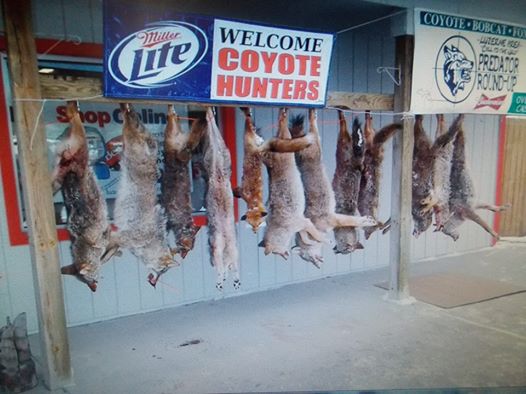
Welcome to Hell, Coyote Hunters

1795706_473627576096881_1329203140_n

Hundreds of killing contests have taken place all over the USA…Here is a description of a killing contest that just happened in Michigan — This pic and the description are on a public forum.

What is a “tagged coyote”? A tagged coyote is one that was previously trapped, marked in some way and then released, and killed for a prize.

“Just a few weeks ago the “Call of the Wild” Predator Round Up was held near our cabin in Luzerne Michigan. The hunt began at 7:00 p.m. Friday night and ran till 12 noon Sunday. Seventy three (73) hunters signed up comprising 33 different teams. Several teams used coyote dogs and others worked various “sets” while calling. The hunters with the dogs had the advantage, but the first “yote” turned in was by a father and son team who called the 29.7 pound female within range of a flat shooting 223” …..
“Ma Deeters (local bar/restaurant) was the starting point of the hunt, and the Best Hardware store was where the successful hunters displayed their success. There were around $1700.00 dollars in prizes with anyone bringing in a tagged coyote receiving a $1000.00 dollar bonus. Knight and Hale (game calls) donated many of the prizes handed out. First coyote, biggest, (41 pounds) ugliest, and longest awards were all given out at the culmination of the hunt. Two of the dog teams garnered most of the awards.
On Sunday afternoon there were eleven (11) coyote and one fox hanging on the game pole at the hardware store. There was an additional prize to any team that brought in the “trifecta” of predator hunting (a coyote, fox, and bobcat.) No one collected that award this year, but one team came close.”