Dog Left Out in March Must Fend Off More Than the Cold

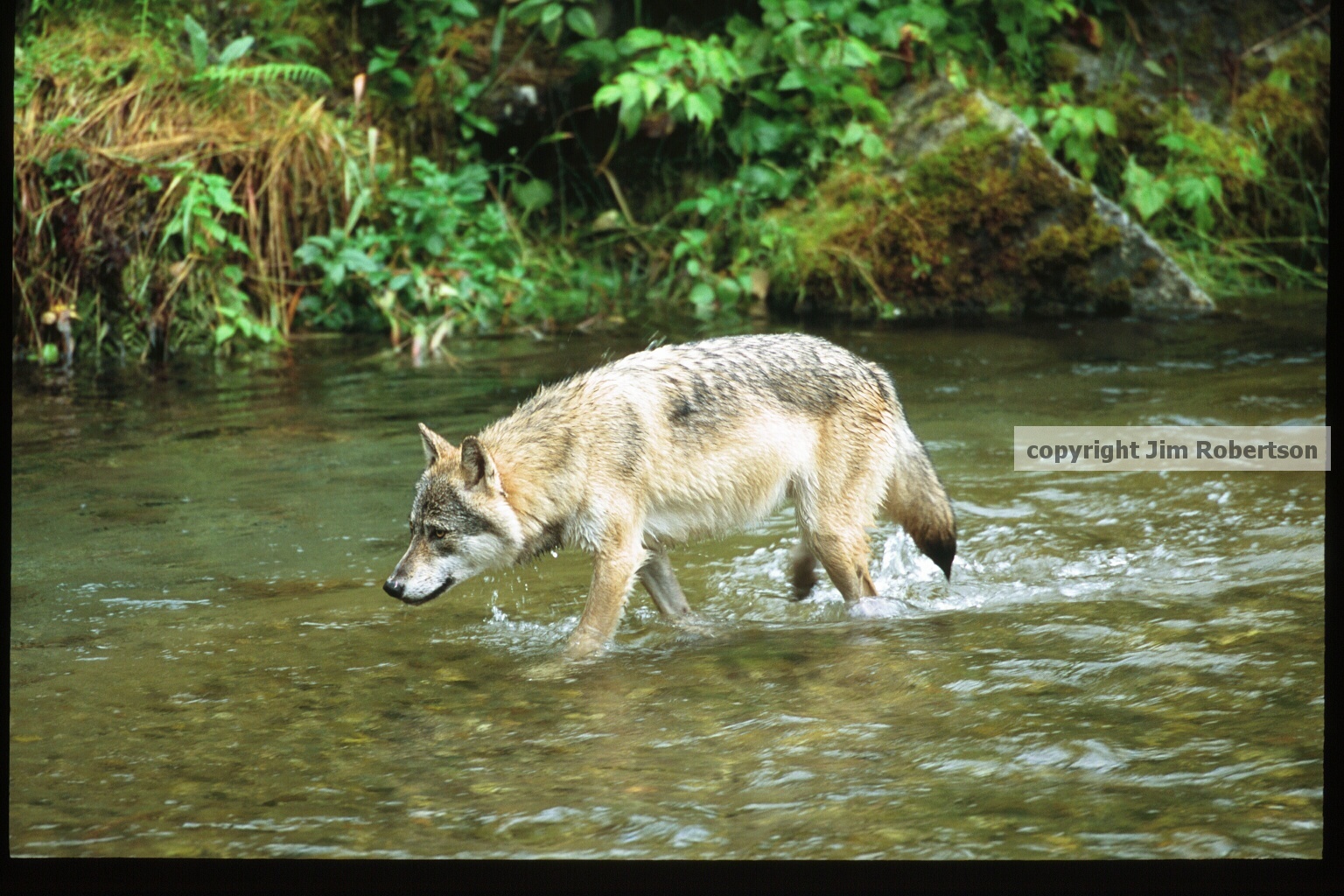
copyrighted wolf in water

One year after wolf attack, dog fends off cougar at Carlton home

One year after wolf attack, dog fends off cougar at Carlton home

[Automatic response? track down and kill the predators.]

by admin on Mar 6, 2014
By Ann McCreary

It’s been a tough year for Shelby, a wolf-husky hybrid dog owned by John Stevie of Carlton. In March 2013 the dog was attacked by a gray wolf just outside her home, and early Monday morning (March 3) she was attacked again — this time by a cougar.

The unlucky dog has been lucky enough to survive both attacks.

Stevie had let Shelby out at about 4 a.m. Monday and soon heard the dog crying, said Sharon Willoya, Stevie’s girlfriend.

“We both raced to the door and she came running in. She wouldn’t let us touch her at first because she was frightened. We finally got her calm and noticed she was bleeding,” Willoya said Tuesday (March 4).

The 68-pound dog had cuts on her shoulder and chest, and required more than a dozen stitches, Willoya said.

Stevie reported the attack, and Washington Department of Fish and Wildlife (WDFW) enforcement officers arrived with hounds a few hours after the attack. They tracked the cougar into a boulder field, but because it was a dangerous situation for the dogs, they left, said Capt. Chris Anderson, WDFW regional enforcement supervisor.

Wildlife officials returned Tuesday morning, found new tracks near Stevie’s home, tracked the cougar and treed it. The cougar, a healthy female, was shot and killed.

Willoya said wildlife officials found evidence that the cougar had “bedded down” not far from the house. “They think when Shelby came around the house, the cougar was there,” she said.

Stevie’s dog made news last year when she was attacked by a wolf on the deck of Stevie’s home at the foot of McClure Mountain. The dog received puncture wounds and lacerations to its head and neck in the attack.

Stevie subsequently took Shelby with him to Olympia, where Stevie testified before the Legislature in favor of a bill allowing citizens to shoot wolves that are attacking pets or livestock. Gray wolves are currently protected as an endangered species under federal and state law.

The cougar killed on Tuesday is the sixth cat shot by wildlife enforcement officers in the Methow Valley since December following attacks on domestic animals. At least four other dogs have been attacked, including a dog killed on Christmas day.

Cougars have also attacked cats, goats, sheep, chickens and calves.

Anderson said a hunter killed a cougar last week in the Pearrygin game management unit north of Winthrop. That brings the total number of cougars killed by hunters in the Methow Valley this winter to six.

Because of the high number of cougar incidents this winter, WDFW has issued special permits allowing hunters to use hounds to hunt cougars in the Methow Valley. Three permits have been issued for the Gardner game management unit, and two have been issued for the Pearrygin unit. Each permit allows one cougar to be killed.

So far, none of the special permit holders has taken a cougar, Anderson said.

“There are different theories bouncing around” about why the valley has seen so many cougar incidents, Anderson said.

“The general feeling is it’s probably because of the weird winter we’ve had,” Anderson said. “Normally we have cats that are visible because they follow the deer herds. Without snow the deer were really spread out and so the cats were spread out more, and that’s why people were seeing them in all parts of the valley.”
a

See more posts related to Cougars in the Methow Valley.

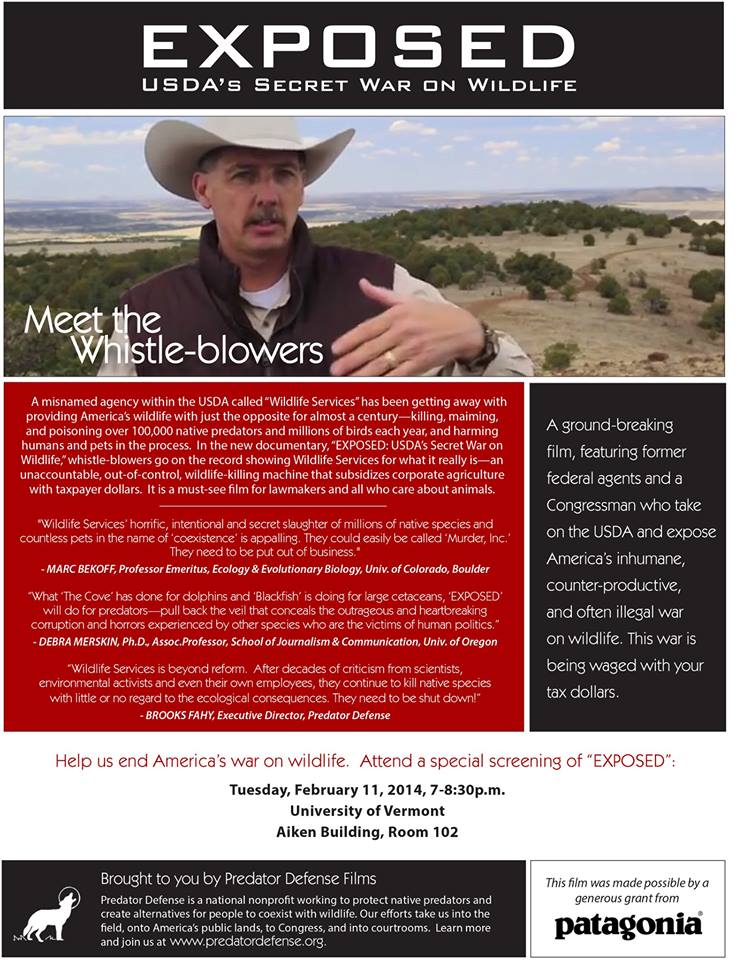
Interview on EXPOSED: The U.S. Secret War on Wildlife with Brooks Fahy

http://www.voiceamerica.com/episode/76044/exposed-the-us-secret-war-on-wildlife-with-brooks-fahy

February 24, 2014

Hosted by Eli Weiss

Wildlife Services-a barbaric, wasteful and misnamed agency within the US Department of Agriculture, has been having their way for almost a century, our government’s secret war on wildlife has been killing millions of native predators and birds as well as maiming, poisoning, and brutalizing countless non-targeted and endangered species, along with quite a few pets and seriously injuring people. Brooks Fahy, the man behind Predator Defense and the landmark film, “EXPOSED”, brings three former federal agents and a Congressman who blow the whistle on the atrocities committed under the guise of problem animal control, and proving Wildlife Services for what it really is: A barbaric, unaccountable, government sanctioned, out-of-control wildlife killing machine funded on our dime, which apparently thinks they will continue getting away with it. But, we can tell Congress to defund Wildlife Services, and after this program, you will.

http://www.voiceamerica.com/episode/76044/exposed-the-us-secret-war-on-wildlife-with-brooks-fahy

coyote contest kill

Repeal hunting season

http://journalstar.com/news/opinion/mailbag/letter-repeal-hunting-season/article_dd8c92cc-71e8-5539-b564-200adf5ce5dd.html

Letter, 1/7: Repeal hunting season

I was saddened and sickened to read the article “Two mountain lions killed, ending first season” (Jan. 4) concerning the murder of two mountain lions in Nebraska by individuals selected by the Nebraska Game and Parks Commission through a lottery and auction.

All Nebraska citizens who honor life and appreciate the beauty and majesty of nature that includes the animals that share our environment must join Sen. Chambers in his bid to repeal the ability of Game and Parks to set hunting seasons on cougars. I urge people to contact their senator and urge them to support Sen. Chambers’ effort and do everything possible to hinder the Game and Parks Commission until this is repealed.

Game and Parks officials stated their objective for allowing cougar hunting in the Pine Ridge is to provide hunters with opportunities while allowing a slight to moderate reduction in the mountain lion population. Guess what? It’s also legal for the unlimited murdering of cougars roaming through the Prairie Unit, which covers about 85 percent of Nebraska.

After reading how the first two animals were murdered, I shudder at what other “opportunities’” Game and Parks will come up with: the use of high explosives, automated weapons, stealth drones, mortars and the assistance of the NSA to target and murder these beautiful animals?

There is no place in our modern society for such barbaric and inhumane treatment of such beautiful animals. The magnificence of such animals is better visualized with a live animal rather than a rug on someone’s floor.

I beg people to support the repeal of this horrific activity. This is not hunting; there is no “sport” involved but the extermination of one of God’s most beautiful creatures.

Robert D. Randall, Lincoln

Hunting by any other name is still hunting

Photo Copyright Jim Robertson

Photo Copyright Jim Robertson

http://azstarnet.com/news/opinion/column/guest/gordon-douglas-hunting-by-any-other-name-is-still-hunting/article_e1a4bc49-0854-5519-b67d-9cfb26fa6d47.html

By Gordon Douglas Special to the Arizona Daily Star

It’s hard not to chuckle at how hard some people have to work to not say something. A great example is Gerry Perry’s Dec. 23 guest opinion, “Hunting benefits Arizona.”

He extols the virtues of “harvesting nature’s surplus” and “reconnecting with nature’s ecosystems in a meaningful way.” You’d almost think he was talking about catching apples falling from a tree or hiking a wilderness. What he’s desperately avoiding are the words shooting, killing, wounding or suffering. That “meaningful connection” he’s talking about is going into an ecosystem, finding an animal and killing it.

Even the use of the word hunting is basically a way to avoid describing the actual intent of the activity. Photographers, naturalists and those who enjoy observing wildlife all “hunt” for wild animals. What sets “hunters” apart is killing the animals once they find them.

He notes game may be killed for food, but does not acknowledge that many animals are not eaten but are killed for trophies, so the hunter can brag “I killed that,” or are just killed for the fun of it. Those of us who eat meat recognize it is necessary to kill animals for that purpose, but we call the place for that a slaughterhouse, not a chicken collection center or cattle aggregation area.

[Ok, here the article’s author lacks insight into his own complicity in killing farmed animals–he doesn’t have to eat meat. But read on; he makes some great points in the next few paragraphs…]

He correctly points out how hunters provide funding for wildlife management. What he doesn’t say is that through this funding mechanism hunters essentially control how wildlife is managed.

Public lands and their wildlife are operated as a shooting preserve for hunters. Rather than a responsibility of all Arizonans, game animals are looked at as the private property of hunters to be exploited to the maximum extent possible. Natural predators are usually reduced or eliminated, since the value of animals is measured in the number of targets and carcasses for hunters.

He lauds hunting as making it possible to bring back many species from near extinction, which is a mind-boggling reversal of reality. The species were nearly made extinct by hunting. Species are not saved by killing; they are saved by not killing. Animals can be saved for their intrinsic value, instead of bred to be slaughtered for pleasure. The endangered species act was not passed so we could shoot pandas.

A few other items carefully avoided in the piece are the number of people accidentally killed or wounded in hunting accidents, the number of children killed or wounded in accidents from hunting weapons carelessly left in homes, and the general gun carnage in our nation fueled in part by the fanatical resistance of many hunters to any sort of reasonable restrictions on guns of any type.

Hunting involves the use of lethal weapons, and that always carries a tragic price.

Much money is indeed spent on hunting, but this money would be spent in other ways if not for hunting. These other ways could well provide even more significant benefits to our state.

America has a centuries-old hunting tradition. In all likelihood that tradition will continue into the foreseeable future. But in the mean time, let’s stop playing word games, honestly face what we are doing, and recognize the costs as well as benefits.

Documentary Spotlights Wildlife Services’ Lethal Mass Killings

Activist discovered an “agency running amok and totally out of control” with no authority to answer to.
By   |      January 6, 2014

(Photo/Tom Ryburn via Flickr)

(Photo/Tom Ryburn via Flickr)


 Since its inception in 1931, the U.S. Department of Agriculture’s Wildlife Services has taken its mission “to improve the coexistence of people and wildlife” to heart, killing an estimated 3 million animals per year, which often includes endangered species such as eagles and household pets.

Though the agency does kill some species that are overpopulated and prey on livestock such as wolves, coyotes, mountain lions, and other wild carnivores, a new documentary from the Oregon-based nonprofit Predator Defense spotlights a darker side of the agency, hoping to spark public-demanded reform.

Brooks Fahy is the executive director of Predator Defense, the group behind Exposed: USDA’s Secret War on Wildlife. He says he heard stories about Wildlife Services officials brutally killing thousands of animals each year with poisons and aerial guttings for years, but never thought the agency actually was capable of such behavior until he launched his own investigation.

Fahy says what he discovered was an “agency running amok and totally out of control” with no authority to answer to. He believes the American public needs to know how their tax dollars are being inhumanely spent.

Lethal killings

Dubbed “criter assassins” by those opposed to the agency’s work, makers of the expose hope the documentary brings animal rights activists, environmentalists, politicians and the public together in order to stop the agency from continuing to use steel traps, wire snares, poisons, and snipers to kill wild animals in mass, unnecessarily.

Although calls for the agency’s reform may have started out as a concern about changes in the ecosystem, Democratic Rep. Peter DeFazio of Oregon says “Wildlife Services is one of the most opaque and obstinate departments” he has ever dealt with, including the Pentagon, which is why he is pushing for the agency’s reform.

“We’re really not sure what they’re doing,” DeFazio said. “I’ve asked the agency to give me breakdowns on what lethal methods they’re using. They can’t or won’t do that. We’ve asked them to tell us what goes into their poisons. They won’t say.”

DeFazio and John Campbell, a Republican from California, have teamed up and have tried to press for Congressional hearings regarding the agency’s work, as well as for the Agriculture Department’s inspector general to investigate Wildlife Services, but so far their efforts have been largely unsuccessful thanks to Wildlife Services corporate agriculture allies.

In response to the video, Carol Bannerman, public affairs specialist for Wildlife Services, told MintPress that some of the information provided is outdated, as the agency has changed in the last 20 to 40 years. And while Bannerman acknowledges that the agency largely uses lethal means to remove predator species, she says that the agency also does a lot of good work that is being overlooked.

Talking to the Sacramento Bee, William Clay, deputy administrator of Wildlife Services, said the agency attempts to use non-lethal control methods first, but “The problem is, generally when we get a call, it’s because farmers and ranchers are having livestock killed immediately. They are being killed daily. Our first response is to try to stop the killing and then implement non-lethal methods.”

However, Carter Niemeyer, a former Wildlife Services district manager who worked for the agency for 26 years, told the Sacramento Bee much of the agency’s work is excessive, scientifically unsound, and a waste of tax dollars.

“If you read the brochures, go on their website, they play down the lethal control, which they are heavily involved in, and show you this benign side,” Niemeyer said. “It’s smoke and mirrors. It’s a killing business. And it ain’t pretty.

“If the public knows this and they don’t care, I’m not going to lose any sleep over it. But they are entitled to know.”

Nuclear wildlife management

Though many lawmakers and activists including Andrew Wetzler, director of the land and wildlife program at the Natural Resources Defense Council, recognizes the agency does good work as well, Wetzler says the agency needs to be held responsible for its inhumane actions.

“We asked them about data,” he said, “How much do they use poison, where. How much do they spend renting helicopters to gun down coyotes and wolves,” but “The consistent answer we’ve gotten back … is: ‘We don’t know.’ There’s a severe lack of transparency.”

In the Predator Defense documentary, Rex Shaddox, a former special investigator for the Wyoming Sting Operation and a former Wildlife Services Trapper, explained that the USDA sells illegal pesticides to state Agriculture Department’s, who in turn sell the poisons to farmers and ranchers to kill coyotes.

Shaddox said poisons he worked with were all banned in the 1970s, such as Compound 1080 and DDT, and were not supposed to be in existence any longer, but the government was selling the pesticides “like a big huge drug operation.”

Although Bannerman says Compound 1080 has been largely replaced by sodium cyanide M-44 containers, Fahy says it is absurd to use a device that kills anything that investigates it, including people, and called Wildlife Services’ killing techniques a “nuclear approach to wildlife management.”

News of Wildlife Services lethal work may be shocking to the public, and largely absent from the mainstream media, but calls for the agency’s reform date back to the early 1960s, when scientists reported that eradicating certain species of animals was not leading to a balanced ecosystem.

In 1971 President Richard Nixon signed an executive order banning the use of poison for federal predator control, saying the public needed to learn to coexist with wildlife, but President Gerald Ford later amended the order to allow for the use of sodium cyanide.

As Fahy and others in the documentary pointed out, it’s not that the agency needs to incorporate more rules and legislation that dictates what trappers can and can’t do, they have to actually follow those laws.

Failure to follow federal law

Gary Strader is a former wildlife services trapper who currently works as a private trapper. He shared that on one occasion two mountain lions were shot from the air, which is a felony. A retired law enforcement officer, Strader said that government employees are not supposed to be committing any sort of crime, especially on taxpayer dollars, so he went to his supervisor.

Strader says he didn’t want to get anyone in trouble, but he wanted abuse of the law to stop. But after talking to his supervisor, Strader says he was treated poorly and within a few months, his job was eliminated.

“I’m not an animal rights activist,” Strader said, but Wildlife Services should have to abide by state laws, including checking traps every 24-hours so animals don’t languish in pain. “If the American public saw this and understood the brutality of this,” Strader says the practice would be ended almost immediately.

“I learned the hard way they lie from the top to the bottom,” Strader said. Shaddox agreed and added that while there are about 26 restrictions regarding the use of M-44, including a complete ban on using the poison on domestic animals, he said his supervisor often tested the poisons on dogs at city dumps.

“Most of top supervisors have total disregard for their own policy,” he said, adding that the goal is to keep the customer — the farmers and ranchers — happy above anything else.

Though Bannerman says the agency has improved in recent years, Fahy says the documentary was made not because there is just one individual who has an axe to grind. He said these employees have done things and witnessed things that are hard for them to live with.

“It isn’t he said, she said,” Fahy said. “There’s a tremendous amount of information out there. We have evidence … Wildlife Services doesn’t dispute our cases.”

Resurgence of hunting is “welcome, overdue”

[Some people actually agreed with the Time article, if you can believe that!]

http://democratherald.com/news/opinion/editorial/editorial-resurgence-of-hunting-is-welcome-overdue/article_f19d2988-642f-11e3-bcee-0019bb2963f4.html

A recent cover story in Time magazine made the case that hunting is on the verge of making a comeback.

If true, that would be welcome.

Interest in both hunting and fishing in the United States (and even in Oregon, despite the state’s rich outdoors tradition) has been declining for years.

Now, as the article in Time argued, we’re starting to see one of the results: Our forests and wildlands are packed with unsustainable numbers of wild animals — and the critters, starving for habitat, are starting to move in on more urban areas.

States and cities have adopted what appear to be extraordinary measures to deal with the overflow. Consider these examples cited by Time:

— The City Council in Durham, N.C., recently authorized bow hunting for deer inside the city limits to help deal with an outbreak of Lyme disease and an increase in the number of deer-vs.-vehicle collisions.

— Officials in San Jose, Calif. — yes, in the heart of Silicon Valley — now allow the hunting of wild pigs within the city.

— Rock Island, Ill. recently approved bow hunting in town, as long as it occurs on the city’s green spaces — golf courses, parks, cemeteries — or on public land.

The long-running shift in attitudes toward hunting (it dates, in some ways, to the release of the movie “Bambi“) has had exactly the result you would expect: The number of animals in our forests in some cases has reached historic highs. Consider, for example, white-tailed deer — in 1930, hunted nearly to the point of extinction. Today, estimates suggest, 32 million deer are in the United States — and a couple of million of them recently have been in your back yard, eating everything they can.

We have dramatically underestimated the important role hunters play in maintaining a balanced ecosystem. In retrospect, the results should have been obvious.

But the price we are paying for that failure, in some ways, isn’t as obvious: Damage from the nation’s 5.5 million feral pigs, for example, is estimated at $1.5 billion every year. The U.S. Department of Agriculture is considering a plan to encourage wild pig hunting.

It is true that the actions of some thoughtless vandals have hurt the image of hunting. Consider the incident last month in Oregon State University’s McDonald-Dunn Research Forest, in which poachers dumped a bull elk, wasting more than 250 pounds of meat. The elk’s antlers had been cut from its skull with a saw.

The people responsible for despicable actions like these are not hunters. They are criminals — but their actions tarnish the reputation of the sport, and likely have played some role in the decline of hunting.

Now, however, the table might be set for true hunters to reclaim their position as critical players in maintaining the balance that allows both animals and humans to thrive. (mm)

Mike McInally is the editor of the Democrat-Herald. He can be reached at 541-812-6097

1459861_559462450790007_563882710_n

Letter Annihilates “America’s Pest Problem”

The following letter from a friend and fellow blogger/photographer, Ingrid Taylar, completely annihilates Time Magazine’s recent anti-wildlife article, “America’s Pest Problem…

Coyote Photo©Jim Robertson

Coyote Photo©Jim Robertson

Dear Editor:

David von Drehle’s piece, “America’s Pest Problem,” barely touches on the crux of the issue which is our own exponentially growing population combined with our gluttonous appetite for land and resources, all of which present wild animals with fewer options. He describes our ecological role in heroic terms, without delving into the much more complicated morass of human intrusion. We encroach on wild spaces, sterilize formerly complex habitats with subdivisions and lawns, raze and trample forests to provide grazing lands for cattle, pollute water sources with our industrial production of food and materials, poison critical plants like milkweed out of existence for Monarch butterflies and bees, build roadways through critical migration corridors, produce trash to the degree that there is no feasible way to dispose of it all, plasticize the oceans, and so forth. But what conclusion does von Drehle derive? That we kill too rarely. It takes a lot of gall to argue for lethal methods against wildlife as a solution when we are, in fact, the most damaging and lethal ecological presence ourselves, literally altering our ecosystems and forcing other species to survive and seek out food sources within the realm of hazards and limitations we impose.

To present the issue as simplistically as David von Drehle does is lazy journalism. The piece ignores important environmental considerations while also leaving out the known problems with lethal control. He doesn’t grapple, for instance, with the paradox that despite unregulated and often brutal killing and trapping of animals like coyotes, their populations explode nonetheless. He ignores the biological principles which suggest that killing meso predators leaves gaping niches which are then filled by even more animals. He engages fear mongering over the presence of apex predators, not seeming to fully grasp that animals like wolves help balance our ecosystems more effectively than any human management plan. He doesn’t mention, for instance, the concept of trophic cascades, where healthy wolf populations lead to numerous benefits for plants and animals which now thrive because of this restored balance. At the same time, he leaves out information about state wildlife programs which actually work to keep deer abundant for hunting purposes, or which promote habituation by allowing hunting over bait. He makes little issue of the fact that populations of feral pigs in many cases were encouraged for sport hunting. These are but a few examples that point to a much murkier underbelly and even a deliberate complicity by humans in these problems.

There are success stories about urban and suburban coexistence with wildlife that don’t involve mass slaughter. Marin County in California is one such place, replacing lethal predator control with creative ideas about managing our lives, our needs, our farms and our lands in the context of a more compassionate, progressive and sound ethic toward wildlife. Von Drehle argues for an archaic, 19th century model of wildlife “management” which drastically underestimates what we can achieve through more thoughtful and advanced paradigms of understanding and conflict resolution. Von Drehle says it’s time for a new perspective on hunting and wildlife control in the 21st century. On this, I agree. What he misses, however, is that better models do exist and are being improved based on our increased scientific awareness of wild animals and their inherent value. Instead, he looks backward for answers, to an era and an ethic when killing and exploitation were the applied solutions for almost all issues involving wildlife. As a species and as individuals, we are much better than this. But you’d never know it from this article.

Snow Leopard Survival Threatened by Cashmere Industry

http://www.enn.com/top_stories/article/46440
From: Dr Charudutt Mishra, The Ecologist, September 19, 2013

As London Fashion Week concludes, Dr Charudutt Mishra explains how demand for cashmere is affecting Central Asian wildlife, and how enlisting the support of local people will be essential for the future of snow leopard conservation.

The mountains of Central Asia are where the endangered snow leopards live. The higher Himalayas, the Pamirs, the Tien Shan, the Altai, all remote and faraway, seemingly insulated from our consumerist lifestyles. Indeed, the main causes of the cat’s endangerment appear to arise largely from local activities – persecution in retaliation against predation on livestock, for instance. Understandable, as livestock continues to remain a precious resource for people in these climatically and topographically harsh mountain landscapes.

Living thousands of miles away, it is difficult to imagine that our daily choices, literally the clothes we choose to wear, are shaping the chances of survival – or extinction – of the snow leopard and several other species of the Central Asian mountains.

The surging global demand for cashmere, that wonderful soft and warm fibre, is compromising the survival prospects of the snow leopard, the saiga, and a host of other iconic species of the Himalayas and Central Asia. Yet, the same fashion industry is also bringing better livelihood opportunities for local people, our biggest partners and hope for wildlife conservation in these mountains. It sounds complex, and it is complex.

What exactly is going on, and what do we do?

In a recent paper I co-authored with my friend Joel Berger and our Mongolian colleague Buuveibaatar, we have tried to explore the complex pathways through which the largely Western demand for cashmere is affecting Central Asian wildlife. Cashmere is derived from the lightweight under hair of domestic goats, and the bulk of the global production comes from snow leopard landscapes of Central Asia.

Supplying the increasing global demand for cashmere is met with by increasing the goat population. So across large parts of Central Asia, we see an ongoing escalation of livestock populations, and changes in herd composition in favour of goats. Mongolia alone has seen an increase in its livestock population from approximately five million in 1990 to 14 million in 2010.

As domestic herds grow, they consume the bulk of the forage available in the mountain pastures, leaving behind inadequate food for the several species of wild herbivores that inhabit these mountains and arid zones that we have worked in. These include many wild relatives of livestock, such as the ibex, the blue sheep, and the argali that constitute an important genetic resource, in addition to being the natural prey species of the snow leopard and other predators such as the wolf.