Exposing the Big Game

Forget Hunters' Feeble Rationalizations and Trust Your Gut Feelings: Making Sport of Killing Is Not Healthy Human Behavior

Exposing the Big Game

Wildlife advocates see wolves as ‘best natural defense’ against chronic wasting disease

http://trib.com/news/state-and-regional/wildlife-advocates-see-wolves-as-best-natural-defense-against-chronic/article_9ab09c2c-03f9-57cb-bda7-4453a1ab7a39.html

  • BRETT FRENCH For the Star-Tribune
  • Apr 17, 2017

BILLINGS, Montana – Wolves are the perfect animal to help reduce the spread of chronic wasting disease among elk, deer and moose, wolf advocates told the Montana Fish and Wildlife Commission last week during the board’s meeting in Helena.

“And it doesn’t cost us anything,” said Marc Cooke, president of Wolves of the Rockies.

Cooke’s comment Friday was later endorsed by former Fish and Wildlife Commissioner Gary Wolfe, who was once the program leader for the CWD Alliance, which tracks and provides information on the fatal disease.

“I would have to agree that wolves can be an effective control,” Wolfe said. “They are the best natural defense Montana has.”

Legislature

The comments come as the Montana Legislature is considering Senate Joint Resolution 9, introduced by Sen. Mike Phillips, D-Bozeman, that would request a study of the potential impacts of and methods to prevent chronic wasting disease in Montana. The measure already passed the Senate and is now moving through the House.

Phillips also introduced SJ8, which would have asked Wyoming to discontinue artificial feeding of elk, a place where diseases like CWD could quickly spread. That resolution was tabled in the House Fish, Wildlife and Parks Committee after clearing the full Senate with a 50-0 vote.

Spreading

Meanwhile, the disease continues to spread in Montana’s neighbor to the south. In late March the Wyoming Game and Fish Department reported officials had detected CWD in a female mule deer found dead near the Pinedale airport in February, the first case of CWD found in Sublette County, which is home to 13 elk feedgrounds.

CWD map

“This deer was found in Deer Hunt Area 139, where CWD has not been previously discovered, and is not adjacent to any other positive CWD deer, elk or moose hunt areas,” according to a WDGF news release.

The discovery prompted the Sierra Club Wyoming Chapter and to issue a public plea this week to “begin phasing out winter feeding of elk to prevent the rapid spread of disease among elk densely concentrated on feed lines for months each winter,” the groups wrote in a press release.

“It is incumbent upon state officials, as well as managers of the National Elk Refuge in Jackson, to implement a realistic plan to phase out artificial winter feeding now,” said Roger Hayden, WWA executive director. “Once CWD reaches feedgrounds we likely will have a more serious problem on our hands. We need to act now.”

Elk fears

CWD was first discovered in Wyoming in 1985 when a mule deer in the southeastern corner of the state tested positive. Since then the disease, which affects the animals’ brains and is always fatal, has slowly spread north and west.

“Over the past 20 years surveillance data has shown an increase in prevalence and distribution of CWD in Wyoming, particularly in deer,” according to the WGFD. “CWD is now found across the majority of the state, with new detections suggesting continued westward spread of the disease.”

CWD has never been detected in wildlife in Montana, except in a captive elk herd that was destroyed. However, the disease has been discovered in the Dakotas and Canada, as well as Wyoming, which all border Montana.

Could wolves become an unexpected ally in protecting Montana’s most popular big game animals? That would be a hard reality to swallow for some hunters and hunting groups who have long opposed the large canines’ reintroduction to Yellowstone and spread into Montana.

EPA investigates Utahn’s poisoning – 4 years after device shot cyanide in his face

This is an archived article that was published on sltrib.com in 2008, and information in the article may be outdated. It is provided only for personal research purposes and may not be reprinted.
Published January 18, 2008

The U.S. Environmental Protection Agency has begun an investigation into the poisoning four years ago of a Vernal man who touched what he thought was a survey stake, only to get a blast of sodium cyanide to his face and chest.

The cyanide device, called an M-44, is used by the federal government to kill predators. The poisoning has left Dennis Slaugh with severe health problems, his wife, Dorothy Slaugh, said Thursday.

And it has reignited a campaign to ban all predator poisoning on federal lands.

EPA investigator Michael Burgin visited the Slaugh home Monday for a two-hour meeting, which Slaugh said she taped with Burgin’s knowledge. The special investigator was looking into why federal agencies did not follow up on the Slaughs’ original reports, she said.

Democratic Rep. Peter DeFazio of Oregon pushed for the investigation at the request of Predator Defense, a national wildlife advocacy group based in Eugene, Ore.

“He has been a really good ally trying to get these weapons banned permanently so no one will have to suffer the way my husband has suffered,” Slaugh said of DeFazio.

Dennis Slaugh and his brother were riding all-terrain vehicles on U.S. Bureau of Land Management land in Cowboy Canyon near Bonanza in 2003 when Slaugh noticed what he thought was a survey stake. He reached to brush it off and it fell over. When he picked it up, it exploded, sending a cloud ofgranules into his nose, mouth and eyes.

The M-44 device was spring-loaded to shoot poison into a predator’s mouth. The U.S. Department of Agriculture’s Wildlife Services Program is the only agency allowed to use the M-44 to poison coyotes and dogs to prevent livestock loss.

But when the Slaughs told the USDA and the BLM about their experience, the agencies denied responsibility and eventually informed them the statute of limitations on the family’s claims had run out.

“We were just asking for compensation. We’ve got medical bills. They just flat denied everything,” Dorothy Slaugh said.

On Monday, she said, Burgin told her that time on the claim would run out in May.

Cyanide clings to iron in the blood system and slowly depletes the heart and other muscles of oxygen.

Dennis Slaugh, 65, has extremely high blood pressure, difficulty breathing, vomits almost daily and can no longer work as a Caterpillar D8 driver for Uintah County because he is too weak to climb up into the machine’s rungs.

The couple, avid ATV riders and campers, have owned Mountain High Power Sports in Vernal for 35 years. “We’re fine, we’re OK. It’s just taken a lot out of him,” Dorothy Slaugh said.

Brooks Fahy, executive director of Predator Defense, said his organization started the push to ban all predator poisoning on federal lands in 1994, when a woman was poisoned while trying to resuscitate her dog after the animal bit an M-44 a USDA employee had set on her private property at the request of a tenant farmer.

DeFazio has been an ally since then, Fahy said.

In late November, DeFazio prodded the EPA with a letter that Fahy said was “instrumental” in finally getting federal action on the Slaughs’ claim.

The congressman is sponsoring a bill in the House to ban all predator poisons.

Workshop offers insight into hunting coyotes and other predators

“You’re hunting the animal that normally does the hunting,” Andrew Kenner of Jackson, Missouri, said. “They’re the top of the food chain for a reason.”

Kenner, who belongs to a Facebook group for predator hunters in Missouri, said coyotes can remember individual calls. If they see the hunter before he can shoot, Kenner said, coyotes will never respond to that call again.

“Whenever you see them, that’s about the only chance you will have,” Kenner said, “because after that, they will learn exactly what’s going on.”

Different techniques for calling coyotes, foxes and bobcats — from hand calls to electronic versions — will be one focus of a workshop from 5:30 to 7:30 p.m. Wednesday.

The workshop will also go over the limits and regulations for hunting coyotes and other predators. Camouflage and scent control will also be discussed.

The Missouri Department of Conservation is hosting the workshop to teach people how to call coyotes and other predators, such as foxes and bobcats, at the Missouri Department’s regional office in Columbia.

The workshop is free and open to anyone 11 years or older. To reserve a seat, call outdoor skills specialist Brian Flowers at 815-7901 ext. 2867 before the workshop begins. Openings are subject to availability.

About 60 people attended last year’s predator hunting workshop, and a similar turnout is expected Wednesday.

Flowers said predator hunting isn’t an activity where someone can go out and be successful quickly. It requires dedicating time to learning the ins and outs.

“It’s not something that is easy,” Flowers said. “I think that’s why folks want to seek out information and knowledge about it.”

 Regulating the predator population through hunting has environmental benefits.

Flowers said problems that can arise from an uncontrolled predator population include the spread of disease among the predator population, the displacement of predators into urban areas because of overcrowding and the attack of farmers’ crops and livestock due to a shortage of food.

Missouri residents must possess a small game hunting permit to hunt coyotes, foxes and bobcats.

The Department of Conservation encourages hunters to make use of the hides of predators they kill.

Kenner skins the coyotes he kills, and then gives the fur to someone who will tan it, or he tans it himself.

“Before you go on a coyote hunt, you want to have everything lined up in terms of what you’re going to do with the coyote,” Kenner said. “That way you’re not just shooting an animal and letting it lay.”

Supervising editor is John Schneller.

A Win for Alaska Wildlife

03 August 2016

New rule from U.S. Fish and Wildlife Service helps protect carnivores from aggressive hunting on national wildlife refuges in Alaska

Wolves, bears and other carnivores are too frequently threatened by government policies aimed at artificially increasing populations of moose, deer and other game species for hunting. In Alaska, even living on a national wildlife refuge could not prevent predators from being shot from a plane or killed in their dens in the name of boosting prey populations. Until today.

The U.S. Fish and Wildlife Service stood strong for iconic wildlife today with a new rule to conserve native carnivores on national wildlife refuges in Alaska. The rule forbids certain aggressive hunting practices like aerial gunning, trapping bears, killing mother bears and cubs, and killing denning wolves with pups. These tactics have no place on the 16 federally protected wildlife refuges in Alaska, which exist first and foremost to conserve species in their natural diversity. This is a huge win that will help protect the ecological integrity of these public lands, and ensure that our national wildlife refuges are managed for all wildlife.

Stand Strong with FWS

Special interests in Congress are already advancing measures to block this important new rule. Show your support by telling FWS you stand with their decision to protect iconic predators by preventing these inhumane killings.

Show your support »

Carnivores are critically important to wild lands, and help keep ecosystems in balance. Alaska’s national wildlife refuges span more than 76 million acres and encompass some of the largest and most remote wildlife habitats remaining in the United States. These vast areas are ideal for wide-ranging and large animals like wolves and bears.

Anti-wildlife representatives in Congress and Alaska’s state government have been fighting this rule since it was first proposed in January, and will surely continue to do so. We commend the Fish and Wildlife Service for finalizing this important rule, which upholds bedrock environmental laws like the National Wildlife Refuge System Improvement Act and the Wilderness Act. This action sends a clear message that science, not politics, governs our public lands.

Demanding Justice for Over 4,200 Dead Gray Wolves/Rallying Loudly Against Idaho’s Ongoing Wolf Slaughter

Spring 2016  newsletter from Predator Defense


It hurts tremendously to have to report ever-increasing kill numbers for gray wolves.  But these indefensible losses are the natural and predictable result of the political gamesman-ship that occurred five years ago when wolves were stripped of federal endangered species protection and management was turned over to state wildlife agencies.  Since 2011 over 4,200 wolves have been senselessly slaughtered by sport hunters and trappers alone.  Nowhere is the killing worse than Idaho, but Oregon recently took a very bad turn, removing protections for their fledgling population of around 100 wolves (see pg. 2).

Thankfully, we also have good news to report—a legal victory for wolves in Washington state, as well as two wolf protection lawsuits we’re part of in Idaho and Oregon.  In April we returned to Idaho for the fourth time in 12 months, meeting with attorneys and other activists to strategize a way to stop Idaho Fish and Game’s out-of-control killing program.  We also rallied against the wolf slaughter at the Idaho state capitol in February.  (See feature on pgs. 2-3.)

Speaking Out for Imperiled Grizzly Bears in Greater Yellowstone Ecosystem

As we went to press, the public comment period closed on a proposal to delist grizzly bears in the area around Yellowstone National Park.  Hunters are now chomping at the bit to buy a $50 license to kill a bear to adorn their wall and floor.

The delisting debate has been heated, but opposi-tion has been strong, with the majority

of the public and scientists against removing protections.  Over 63,000 people submitted comments to the U.S. Fish & Wildlife Service (USFWS).  We signed on to an official comment letter with 80 other environmental organizations urging USFWS to keep grizzly bears protected, and 58 top scientists joined Jane Goodall in an anti-delisting campaign.  We have all forcefully stated that grizzlies have not recovered, and the decision to …Hunting and livestock interests control 99% of wildlife policy.

The Wolf Wars

Over 4,200 gray wolves have been killed since federal protections were removed in April 2011.  The slaughter won’t stop until wildlife “management” policies reflect science and the public will, rather than the tiny minority— hunting and livestock interests.  Our work to raise awareness and demand change continues.

PREDATOR DEFENSE  |  Spring  2016  |  page 2

Oregon Takes Giant Step Backward, Delisting Wolves

Until recently, Oregon was thought of as a progressive state in terms of wolf “man-agement.”  While wolves were driven out over 50 years ago and never reintroduced, those who migrated to Oregon from Idaho in recent years were allowed to coexist.  As of March 2016 Oregon’s wolf population numbered around 100, a recovery that was considered a great start.  And contrary to what the agricultural interests expected, depredation on livestock decreased during the time the wolf population increased.

But Oregon’s “honeymoon with wolves” appears officially over.  When the population reached the benchmark established by the Oregon Wolf Plan, classifying it as Phase 2, hunting and livestock interests won the day.  Circumventing both best-available science and public will, the Oregon Fish & Wildlife  Commission removed state endangered species protection in November 2015.  In March 2016 Governor Kate Brown caved to special interests and signed the delisting bill (HB 4040) into law.  This delisting decision makes the future for Oregon wolves look increasingly grim.  If the current trend continues, Oregon could soon look a lot like Idaho and Montana, which have been wolf-slaughtering fields since 2011, with grisly sport hunting and trapping seasons.

While Oregon’s current wolf management plan does not permit hunting or trap-ping seasons, wolves can be killed if seen predating on livestock and in recent years ranchers have pushed their political clout.  The ink had barely dried on the Governor’s signature when wildlife agents in a helicopter gunned down a family of four from Oregon’s first established pack, the Imnaha. They killed legendary 10-year old alpha male, OR-4, his mate, and two yearling pups for allegedly preying on livestock on a rancher’s land.  Contrary to what the media and state wildlife officials say, nonlethal methods were not used correctly, nor were all the appropriate methods attempted.

The existing Oregon Wolf Management Plan is in early stages of being rewritten.  We will comment on the new draft as soon as the comment period opens.  We are also co-plaintiffs in the wolf protection lawsuit described below.

Wolves Win Legal Victory in Washington State

Wolves in Washington state were given reason to celebrate in December 2015, when a federal judge put a hold on a plan to kill more wolves to reduce livestock predation. The judge found that the federal agency proposing the killings (Wildlife Services) violated the law, which requires an Environmental Impact Statement. He also found their plan to be highly controversial and unlikely to work.

So Washington state is actually requiring that science be considered.  This is fab-ulous news!   We’re proud to have been co-plaintiffs in this important case, and we’d like to thank our friends John Mellgren and Andrea Rodgers at the Western Environ-mental Law Center for handling it so expertly.

Oregon Wolf Protection Lawsuit Filed; Idaho Soon to Follow

We have reason to hope that two new lawsuits in Oregon and Idaho will produce similarly positive results to Washington’s.  We are co-plaintiffs in a suit filed in February that challenges Wildlife Services’ authority to kill any of Oregon’s fledgling population of around 100 wolves.  We are contending that Wildlife Services failed to explain why killing wolves on behalf of livestock interests should replace common-sense, proactive and nonlethal alternatives, such as those already reflected in the Oregon Wolf Management Plan.  We have joined a similar lawsuit against Wildlife Services that will be filed in Idaho shortly.

As you likely know, Idaho is the nation’s biggest wolf-killing state.  Over 1,500 wolves have been slaughtered there by hunters and trappers alone since the 2011 delisting.  This does not include the scores slaughtered by state and federal predator control agencies.  Adding insult to this outrage, early this year federal agents secretly aerial gunned 20 wolves from helicopters in the Lolo Zone of Clearwater National Forest, one of the most pristine native predator habitats in the country.

Since Idaho is a state run amok in brutality against wildlife and denial of sci-entific reality, they can only be stopped if enough of us speak out and demand wholesale change incessantly, from now until we succeed.

We rallied in protest of Idaho’s ongoing slaughter at the state capitol build-ing in Boise on Feb. 15, 2016. Our numbers were not huge, but our voices were loud.  Over 70 people showed up during the course of the rally to demand an end to Idaho’s wasteful Wolf Control Board and the termination of the USDA Wildlife Services aerial gunning program.  We will also bring legal action soon, along the same lines as the wolf protection lawsuits described on pg. 2.

Alpha female mom and pup

Is hunting really a conservation tool?

A new UW-Madison study upends central notion about predator management

by

May 10, 2016

6:00 PM

– See more at: http://isthmus.com/news/news/wolf-hunting-study/#sthash.B9LfrolM.dpuf

Manmade problem led wolves to kill elk

http://trib.com/opinion/columns/lloyd-manmade-problem-led-wolves-to-kill-elk/article_163910e6-0a09-5f83-8e3d-e82bce14f0eb.html

By Jared Lloyd

A lot of noise has been made about the 19 elk killed last month by a pack of wolves in Bondurant. What has been lost throughout much of the coverage are the facts about what actually led to this extremely rare occurrence. Behind the headlines is a manmade story. To be able to understand what went down that night in Wyoming, these facts need to be understood.

To begin with, the elk in question were killed on a feedlot. Just like cattle, in Wyoming elk have feedlots as well. Picture anywhere between a few hundred to a few thousand “wild” elk standing around waiting to be fed. Wyoming has elk feedlots all over the place. Come winter, these feeding grounds shovel out bales of hay for the elk like they are livestock. Elk are heavily concentrated in these feedlots, fed all winter long, and have learned to just stand around waiting for their daily handouts.

So why does Wyoming feed elk in the first place? Is it because predators in the ecosystem are killing so many? No. Wyoming actually considers elk to be overpopulated. This practice was started in part to keep elk from competing with cattle back when predators across the Rocky Mountains were at their lowest numbers. In the absence of predators, elk populations exploded. Come winter, these animals would flood onto ranches in search of food, gorging themselves on stocks of hay.

So what has all this done to the elk? Quite simply, elk no longer act like elk. Given that these animals have grown up in a relatively predator-free environment for nearly 100 years, elk are now being forced to come to terms with the reality of predators again. And in order to survive, lesson number one is not to stand around in groups of a several thousand, in one place, for months on end waiting for handouts from humans.

So what did the wolves do? They committed what is known as surplus killing. Occasionally, when prey is so plentiful, predators will kill multiple animals in one go. Scientists state that when faced with a bonanza such as the feedlot provided, wolves may kill with the intention to return as often as that food is available.

More: http://trib.com/opinion/columns/lloyd-manmade-problem-led-wolves-to-kill-elk/article_163910e6-0a09-5f83-8e3d-e82bce14f0eb.html

copyrighted wolf in water

Alberta Wolf Kill and “Collateral Damage”‏

Besides the 1000 wolves at least 163 cougars have been killed, along with 38 wolverine, etc. It also demonstrates what happpens when you allow habitat degradation to occur.

http://www.raincoast.org/2015/01/alberta-wolf-slaughter/

Alberta slaughters more than 1,000 wolves and hundreds of other animals

WARNING:  THIS A DISTURBING ACCOUNT OF ANIMAL SUFFERING AND SLAUGHTER

Killing wolves for

Published on 2015 · 01 · 10 by Raincoast
Raincoast scientists Dr. Paul Paquet and Dr. Chris Darimont, along with colleagues at the University of Saskatchewan, have published the paper “Maintaining Ethical Standards during Conservation Crises” in the journal Canadian Wildlife Biology and Management.  It  addresses the ethics and science of the  Alberta wolf cull as published in Canadian Journal of Zoology, November 2014.
Download this paper: Brook et al 2015 CWBM
Download the press release
The wolf kill
For the last few years, Raincoast has been sounding the alarm about the slaughter of wolves at the hands of the Alberta government.  This slaughter is a consequence of Alberta oil and gas development, and other industrial activities, that have endangered caribou.  The Alberta government and its resource industries have transformed the caribou’s boreal habitat into a landscape that can no longer provide the food, cover and security that these animals need to survive.  Rather than address this problem, Alberta has chosen to scapegoat wolves that are using a huge network of new roads and corridors to reach dwindling numbers of caribou.
For a decade now, the Alberta government has hired hitmen and biologists to kill wolves, more than 1,000 of them, through aerial gunning from helicopters, poisoning with strychnine, and allowing them to be strangled with neck snares.  They also trap and collar wolves that become “Judas wolves,” leading the gunners to the pack.  After shooting all but the collared wolf, the collared wolf then leads the gunners to more wolves and then watches as they too are slaughtered.
Not just wolves
In addition to aerial gunning, strychnine is set out to poison wolves.  Many other species that incidentally eat the poison also die. We do not have a death toll for the additional animals that died from poisoning. Neck snares, another form of torture and suffering, are also permitted.  Internal Alberta government documents show that up until 2012, neck snares were the primary cause of death for 676 animals, in addition to the wolves, around the Little Smokey region in Alberta. Note caribou, the reason for the wolf cull in the first place, are dying as incidental deaths in neck snares.
Number of animals/species that have died incidentally in Alberta’s wolf kill (up to 2012) near the Little Smokey region, primarily in neck snares.  Numbers obtained from internal Alberta government documents.
Black bear 12
Caribou 2
Cougar 163
Deer 62
Eagle (bald and golden) 40
Fisher 173
Fox 3
Grizzly bear 3
Goshawk 1
Lynx 70
Moose 12
Otter 73
Owls 12
Small mammals (marten, mink, skunk, squirrel, weasel) 12
Wolverine 38
TOTAL 676
Calling it science
In 2014, 5 authors (3 from Alberta government, 1 from University of Montana, 1 from University of Alberta) published a paper in the Canadian Journal of Zoology (CJZ) called Managing wolves to recover threatened caribou in Alberta.  This paper describes, condones, and implements the use of aerial gunning and strychnine poisoning as acceptable methods to undertake their study on caribou survival. Neck snares are not included in the journal study methods, despite their known use for killing wolves in the Little Smokey Region.
A response to this paper was published in the journal of Canadian Wildlife Biology and Management in February 2015  by Raincoast scientists and colleagues called “Maintaining Ethical Standards during Conservation Crises“.
The above response addresses the issue of ethics and animal welfare in science. Research on animals in Canadian universities and papers published in the CJZ must meet ethical standards from an animal care committee (nationally, the Canadian Council on Animal Care). Poisoning and aerial gunning (using Judas wolves)  do not meet these criteria.  Below is the call for proposal from the beginning of the study with the statement that the lethal methods being employed were approved according to protocols 008 and 009.  Also below are protocols 008 and 009 that show such activities are not permitted.  The objective of these protocols (specifically 9) is to enforce the humane treatment of animals and ensure minimal stress. In the event that a wolf is injured during a study it describes how euthanasia must occur.  A gun shot is explicit to extreme cases in close range where a single shot to the head causes instant death.  To imply such permits allow a wildlife slaughter is dishonest, at best.
Huffington Post Articles
Additional files for download

Gray Wolf ‘Killfest’ Sparks Controversy

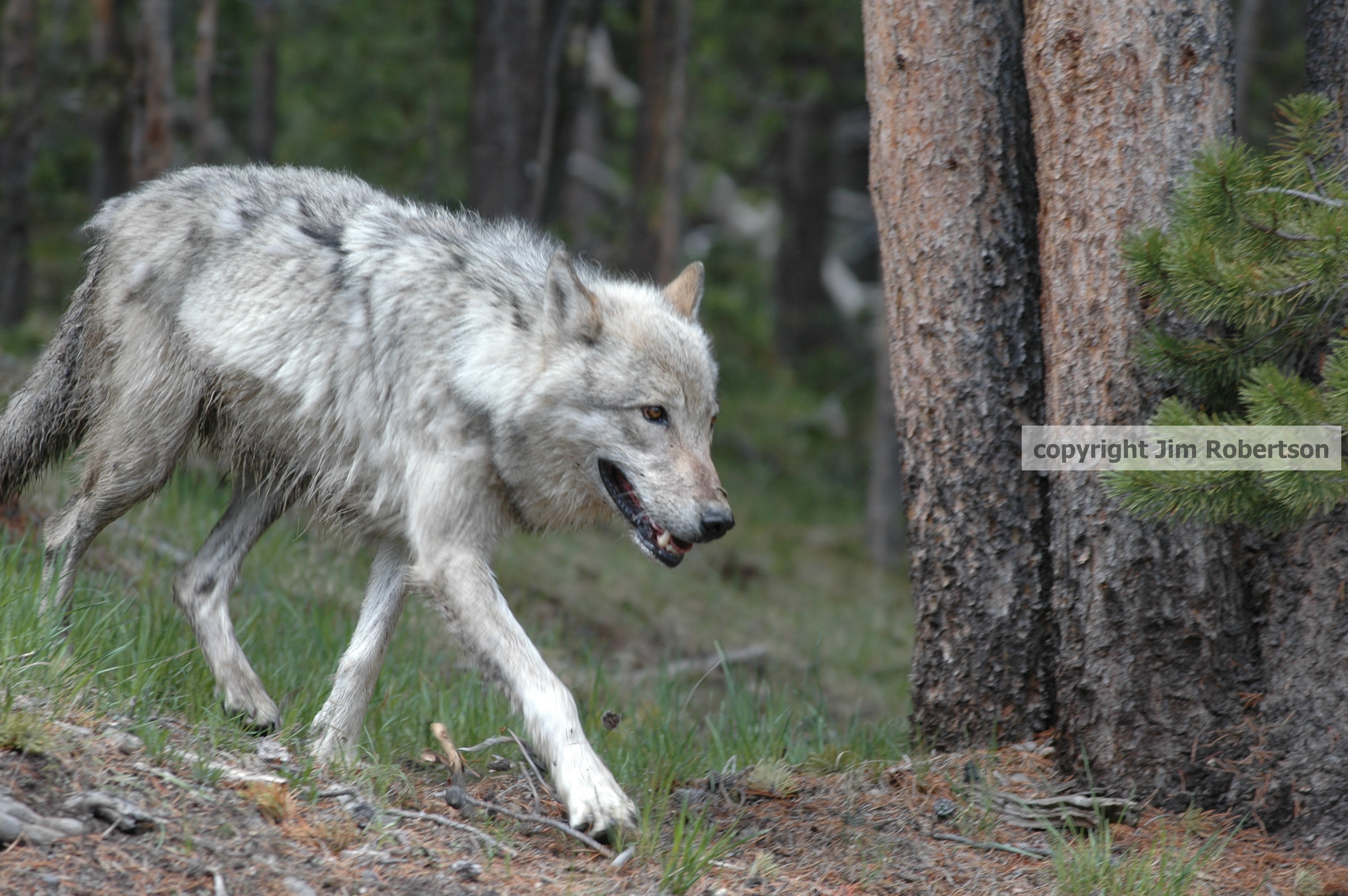
copyrighted Hayden wolf walking

http://www.natureworldnews.com/articles/10481/20141119/gray-wolf-killfest-sparks-controversy.htm#ixzz3JdMpSFCT

By Jenna Iacurci

Along with coyotes, weasels, skunks, jackrabbits, raccoons and European starlings, the endangered gray wolf should be weary after the federal Bureau of Land Management (BLM) granted permits for up to 500 hunters – some even as young as 10 years old – to compete on 3 million acres of land for three days beginning in January 2015 in a bid to see who can kill the most prey.

The competition, officially called the “predator derby,” prompted two lawsuits by environmental groups including Defenders of Wildlife and Wildearth Guardians, asking federal judges to put an end to this killing spree before it even has a chance to start.

“They’re treated like grass that needs to be mowed down,” Suzanne Stone, Idaho spokeswoman for Defenders of Wildlife who has been studying wolves for more than 30 years, told The Guardian.

“This has gone so far above and beyond what most people consider ethical, even hunters,” she added.

Are Wolves More Harmful Than Helpful?

The dispute between western ranchers and wildlife advocates has been an ongoing one the last several years, with little hope in sight of a compromise.

“The whole issue became very polarized,” added Mike Keckler, a spokesman for the Idaho department of fish and game.

Ranchers, particularly those a part of Idaho’s 240,000-head sheep industry, believe that taking out gray wolves is in their right to protect their livestock, as well as prevent competition with humans.

“[They are] a bunch of urbanites who don’t have any clue, don’t have the knowledge and wisdom and experience that we do,” Steve Alder, executive director of Idaho for Wildlife, which organized the derby, said of those opposed to the killings. “They don’t understand our lives, they don’t understand where meat comes from.”

Just last month ranchers in Catron County, N.M. were outraged to find that wolves are setting a record as the main killers of cattle this year. Catron County, which borders eastern Arizona, was one of the first areas where Mexican gray wolves – a subspecies numbering at a mere 83 individuals – were released as part of a recovery effort.

And while that’s all well and good for the wolves, ranchers are a little less than pleased.

“The negative effects to livestock producers caused by Mexican Wolves are a wide spectrum not addressed and/or ignored by the US Fish and Wildlife Service,” wrote Jess Carey, lead author behind a report on the impact of wolves in the area.

Carey also pointed out that over the course of the study, five ranches lost a total of 651 head of cattle valued at more than $382,000.

In another instance, a pack of six wolves roaming in Canada’s Elk Island National Park were killed after cows were “ripped open from one end to the other,” the National Post reported.

Such measures are deemed necessary by livestock owners are others who are trying desperately to protect their animals.

“If something isn’t done in the off-season, there will be next to nobody willing to put cattle back in there next summer, including myself,” added hunter Dan Brown, president of the Blackfoot Grazing Association.

It is pressure from hunters such as Brown that makes the situation of the endangered gray wolves especially prickly. The US Fish and Wildlife Service (FWS) in recent years has lifted protections for the animals in the western Great Lakes and the Northern Rockies, only to have them reinstated after backlash from wildlife advocates.

Why They Matter

Though they once nearly disappeared from the lower 48 states, today wolves including the gray wolf (Canis lupis) have returned to the Great Lakes, northern Rockies and Southwestern United States.

There are an estimated 7,000 to 11,200 gray wolves in Alaska, 3,700 in the Great Lakes region and 1,675 in the Northern Rockies, according to Defenders of Wildlife.

A wolf pack bedded down in Yellowstone National Park in March 2007.

(Photo : Reuters/Doug Smith/National Park Service) A wolf pack bedded down in Yellowstone National Park in March 2007.

But they weren’t always on an upsurge. These predators may have once spanned a whopping two-thirds of the United States, but by the mid 1930s their numbers dwindled due to hunting and trapping by humans. Not until just recently have they shown signs of recovery, with a lone gray wolf recently spotted at the Grand Canyon in Arizona, the first of its kind seen at the park in decades, offering conservationists a glimmer of hope for this beautiful species.

The comeback can be credited in part to the reintroduction program created in 1995 by the federal government.

Gray wolves actually play a key role in maintaining ecosystems, and aren’t always such a nuisance as many ranchers think. They help keep deer and elk populations in check, which can benefit many other plant and animal species. The carcasses of their prey also help to redistribute nutrients and provide food for other wildlife species, like grizzly bears and scavengers.

For now, gray wolves can be found roaming in the states of Oregon, Washington, Wyoming, Montana and Idaho, with the population in Wyoming recently restored to the endangered species list. In the remaining states, gray wolves are monitored, but federal protection is seen as non-essential, according to the FWS.

Not to Worry

But environmentalists may not even need to worry for the wolves’ wellbeing since Alder doesn’t even expect the derby to encounter wolves. C. lupis like to roam from the tundra to woodlands, forests, grasslands and deserts, so the fact that they travel across long distances may make these elusive animals difficult to catch.

What’s more, these animals aren’t even highest on hunters’ kill list.

“There are very limited numbers of people who go out looking specifically for wolves,” Keckler explained to The Guardian. “A lot of folks are concerned about the hunting of big predators like that, but we also have a very healthy mountain lion population in Idaho. We have a very healthy black bear population and they have been classified as big game just like wolves for many, many years.”

Regardless of this reassurance, environmental groups show no sign of letting up. The BLM has already received more than 56,000 comments after opening the derby plan to the public, only 10 of which were in support of the competition.

Read more: http://www.natureworldnews.com/articles/10481/20141119/gray-wolf-killfest-sparks-controversy.htm#ixzz3JdMItTPA