Exposing the Big Game

Forget Hunters' Feeble Rationalizations and Trust Your Gut Feelings: Making Sport of Killing Is Not Healthy Human Behavior

Exposing the Big Game

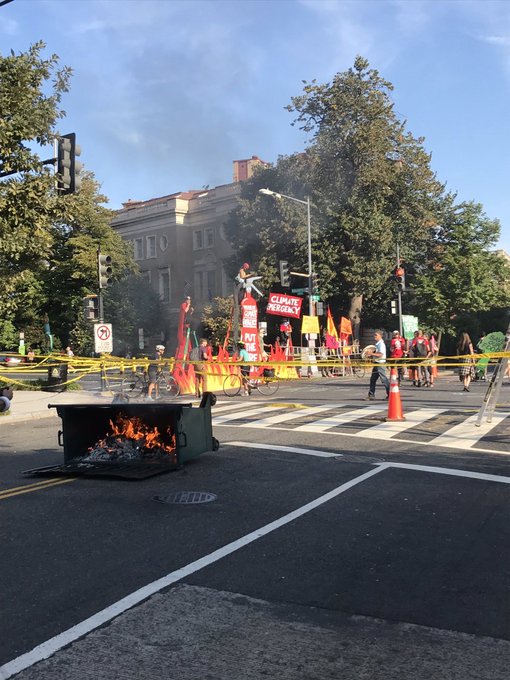
Climate change protests snarl DC traffic as bizarre scenes unfold in capital

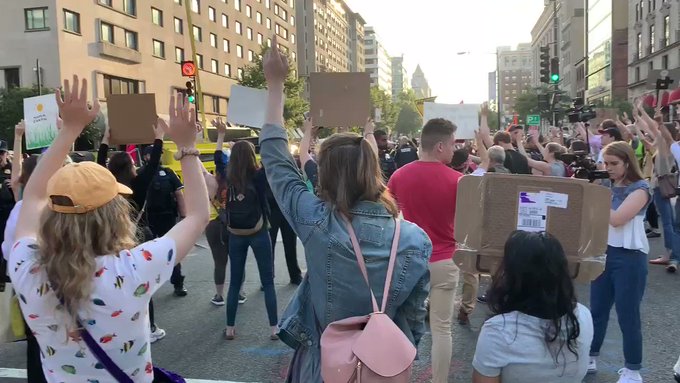
Climate activists demonstrating to coincide with the 2019 U.N. Climate Action Summit blocked intersections and snarled morning-commute traffic across Washington, D.C., Monday morning as they called on officials to take action on global warming.

The group, called “Shut Down D.C.,” has planned a week of activities to bring attention to climate change and convince national and international leaders to act. Monday’s continuation of the “Global Climate Strike” follows worldwide climate protests on Friday, including a demonstration in New York City led by Swedish teenager Greta Thunberg.

“Parents, workers, college students, and everyone who is concerned about the climate crisis will skip work and school and put off their other responsibilities to take action on the climate crisis,” the organization says on its website.

But the demonstrations across D.C. Monday morning also angered the city’s commuters as the scattered marches caused gridlock and detours. District of Columbia police reported making more than two-dozen arrests as of Monday afternoon.

D.C. blogger posted one photo of a mass of cars halted behind a line of protesters a few blocks northwest of Mount Vernon Square. The same blogger also tweeted a picture of a literal dumpster fire on Massachusetts Ave.

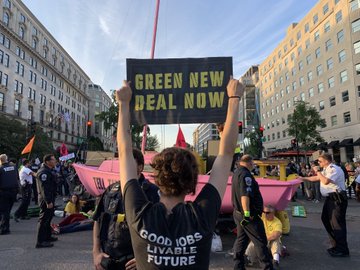
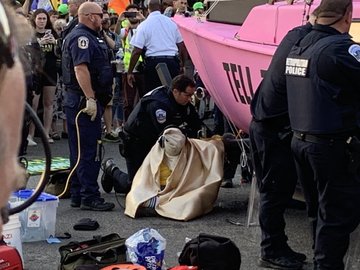
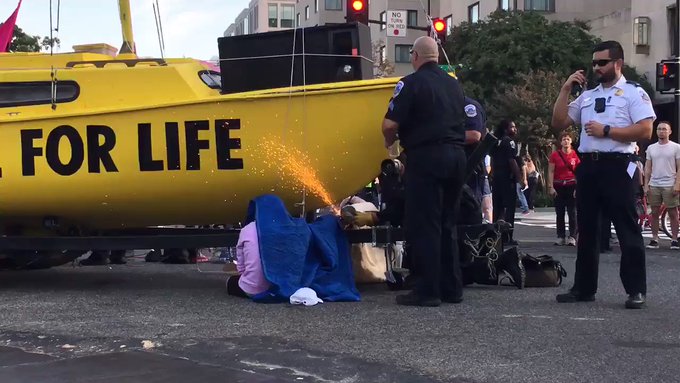
At another protest site, police were using a saw to cut protesters out of chains attached to a painted boat.

Another group of about 30 protesters blocked an intersection near Union Station, holding up a large mock pipeline that read “stop pipelines now.” Police stopped traffic about a block in each direction and were moving vehicles around the area demonstrators had occupied.

The “Shut Down D.C.” protesters read testimonials from anti-pipeline activists in Oregon before chanting, “Hey-hey! Ho-ho! LNG has got to go.” LNG is an acronym for liquified natural gas.

Protesters also adapted the famous song “When The Saints Go Marching In” for their purposes.
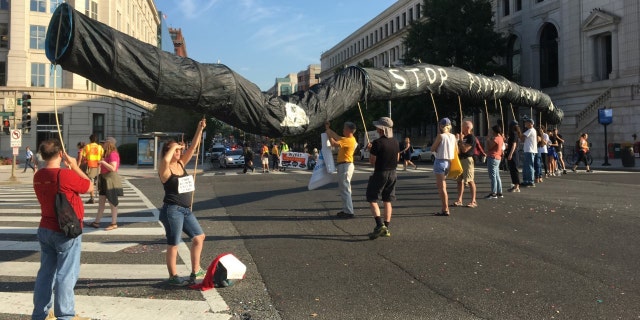
Sept. 23, 2019: Protesters hoist up a fake pipeline near Union Station in Washington, D.C. (Tyler Olson/Fox News) 

Sept. 23, 2019: Protesters hoist up a fake pipeline near Union Station in Washington, D.C. (Tyler Olson/Fox News)

“Oh how I’d love to live in that future — when the frackers go to jail,” they sang.

While some passersby seemed to back the “Shut Down D.C.” demonstrators, others were not so supportive. One woman walking by yelled at the demonstrators that there was a handicapped woman walking down the street because they’d blocked traffic. The protesters responded by saying people were dying because of the climate crisis.

“You tell that to the woman walking with the cane up the street,” the woman shot back.

At approximately 9:45 a.m., the Twitter account purporting to represent the “Shut Down D.C.” group claimed they were still blocking traffic at eight locations across the city, including Logan Circle and Dupont Circle.

Protester interrupts Jeff Bezos event to plead for ‘abused’ chickens

A protester interrupted a keynote interview with Jeff Bezos at Amazon’s re:MARS conference in Las Vegas last week to plead with the billionaire executive to help “abused” chickens.

The protester, identified as Priya Sawhney of Direct Action Everywhere, walked on stage to plead with the Amazon CEO about the welfare of chickens in factory farms.

“I am Priya Sawhney and I have been inside Amazon’s chicken farms where animals are criminally abused and I’m asking you today …” Sawhney said before security agents swarmed her and ushered her offstage.

“Jeff, please, you’re the richest man on the planet. You can help the animals,” Sawhney can be heard shouting from backstage.

Amazon does not own any chicken farms, but it does source chicken products from businesses that DXE has targeted with protests, such as Petaluma Poultry and Pitman Family Farms.

If Politicians Can’t Face Climate Change, Extinction Rebellion Will

A new movement is demanding solutions. They may just be in time to save the planet.

By David Graeber

Mr. Graeber is an anthropologist and activist.

 Extinction Rebellion members during climate protests in London last week.CreditFrank Augstein/Associated Press
Image
 Extinction Rebellion members during climate protests in London last week.CreditCreditFrank Augstein/Associated Press

On April 15, thousands of activists from a movement called Extinction Rebellion started occupying several sites in central London, shutting down major roads and demanding the country’s politicians take immediate, drastic action in the face of climate change.

For more than a week, the streets were awash with an infectious sort of hope. Beyond the potent symbol of popular power represented by their presence in the heart of the city, activists and passers-by had the chance to experiment with collective politics. Yes, there were camera-worthy stunts and impossible-to-ignore disruptions of business as usual. But people also assembled, broke into discussion groups and returned with proposals. If the government wasn’t talking about the climate, Extinction Rebellion would lead by example.

The action was the crest of a wave that arguably began with the high school walkouts over the climate that had been sweeping Europe since late last year, and it was remarkable for including thousands of citizens — many from small towns with no experience of radical politics — who were willing, sometimes even eager, to risk arrest.

Their demands were, and are, simple. First, that the government declare a state of emergency and “tell the truth” about the global situation — that thousands of species are in danger of extinction, that there is a very real possibility that human life itself may eventually follow. Second, that Britain set a goal to eliminate all carbon emissions by 2025, and third, that the specifics of this emergency program be worked out not from above, but through the creation of citizens’ assemblies.

Amid simmering public anger over dissatisfaction with government inaction on the climate, the protests changed the public conversation so quickly and so widely that politicians have been forced to take notice and meet with activists they could once have safely ignored.

The apparent paralysis of the forces of order in the face of what looked a lot like a nonviolent uprising merely echoes the paralysis of the government itself. For months now, Parliament has largely abandoned the business of government entirely, unable to resolve the question of how and whether Britain will leave the European Union, yet at the same time seemingly unable to seriously discuss, let alone legislate, anything else. But the squabbling and endless recriminations in Westminster are just a particularly farcical version of a global phenomenon. The world’s political classes are, increasingly, rendering themselves almost completely irrelevant in the eyes of their constituents.

Police officers on April 17 carrying away an Extinction Rebellion protester who was blocking Oxford Circus in central London. CreditNeil Hall/EPA, via Shutterstock
Image
Police officers on April 17 carrying away an Extinction Rebellion protester who was blocking Oxford Circus in central London. CreditNeil Hall/EPA, via Shutterstock

Nowhere is this more obvious than in the case of climate change. Scientists agree that humanity faces an existential threat. The global public overwhelmingly agrees with them. Young people even in rich countries like America and Britain, terrified of what the world will look like when they are in their 50s and the current governing elites are safely dead, are increasingly willing to embrace extraordinary measures. In both countries, more young people are questioning or rejecting capitalism itself.

To many of us, pretty much anything seems better than carrying on as usual, unto disaster. If ever a time called for grand visions, this is it. Yet politicians almost everywhere seem unable to think beyond the next election. The kind of vision in public works and collaboration that no more than a few generations ago created the United Nations, welfare states, space programs and the internet now seems inconceivable to the richest and most powerful governments on earth, even if the very fate of the planet depends on it.

The last 30 years or so have seen a kind of war on the very idea of visionary politics. Where ’60s rebels called for “all power to the imagination,” the consensus of the opinion makers who took over as those social movements sputtered has been precisely the opposite: The very idea of unleashing the human imagination on political life, we are consistently told, can lead only to economic misery, if not the gulag.

And as left and right both look to the past — the one toward midcentury welfare states and the other, darkly, toward xenophobia and nationalism — the collapsing center warns us to fear political passion of any sort. It’s all so much irrational “populism” — a term now used to tar anyone who objects that all key decisions affecting their lives should be made by technocrats trained in neoclassical economic theory. Yet the technocrats have so far proved utterly incapable of addressing the climate crisis.

If real passion and vision are necessary, they will have to come from outside the system. The activists who assembled and debated in London recognized that the goal of zero emissions in six years would require huge social and economic dislocation. But the very daunting nature of the task seemed to call out creative solutions.

These took many forms, from new mass transport systems to four- or even three-day work weeks, green industrial revolutions, spiritual awakenings and the replacement of the discipline of economics and its exhortations toward endless growth with a new science based on principles that rise to the challenges of a changing climate. Many of these ideas might seem ridiculous. Some no doubt are. But with scientists warning us we may have precious little time before rates of planetary warming lead to irreversible consequences, the one thing that seems clear is that refusal to engage in this kind of imaginative exercise is the real danger.

Threatened with irrelevance, some politicians have started to respond. In Britain, the opposition Labour Party under Jeremy Corbyn has now proposed that the first of Extinction Rebellion’s demands, a national state of climate emergency, be put to a vote in Parliament as early as Wednesday. Whether the motion is successful or not, it represents a previously difficult-to-imagine acknowledgment of the crisis.

It’s just barely possible that Britain, the nation that ushered in the Industrial Revolution and its explosive carbon emissions, might also be the first to make a serious effort to undo the damage.

But if the government can’t bring itself to do so, the people will have to. With any luck, they’ll be just in time to save the planet.

Extinction Rebellion want to get arrested to fight climate change

An Extinction Rebellion protester blocking Blackfriars Bridge, in London, November 2018.

London (CNN)Earlier this month a group of climate change activists stripped down to their underwear in British parliament and glued their hands to the glass of the House of Commons’ public gallery.

Why? To get arrested.
Extinction Rebellion, a grassroots environmental group based in the UK, is responsible for a series of stunts that deliberately break the law to highlight the threat of climate change.
Since launching last year they have caused disruption by holding a “Funeral for our Future” outside Buckingham Palace, which led to 14 arrests, poured200 liters of fake blood outside Downing Street, and brought London to a standstill by shutting down five bridges.
So far Extinction Rebellion has counted 222 arrests — and thousands have declared they are willing to be arrested, or even go to prison, to demand action on climate change.

Method to the madness

Extinction Rebellion claims their actions are based on research into how to use “non-violent civil disobedience to achieve radical change.”
An Extinction Rebellion protester, London, November 2018

They estimate that significant numbers of people will have to get arrested and cause disruption for the government to pay attention to their demands. These include the UK government declaring a climate change emergency, reducing greenhouse gas emissions to net zero by 2025 and starting a citizen’s assembly.
“People making decisions have to pay attention to a mass of people that come out on to the streets to demand action in the face of this crisis we are in,” said Roman Paluch-Machnik, an Extinction Rebellion activist who has been arrested more than once.
“You put the police in a dilemma,” explained Nuala Gathercole Lam, another protester. “If you have got thousands of people refusing to move, they either have to let you do it, which is hugely economically disruptive, or they have to arrest you.”
According to the group, research shows that non-violent uprisings involving 3.5% of the public participating in acts of civil disobedience force a political response because they cannot be ignored.
“Every non-violent uprising since 1900, if it achieves that threshold, succeeds in its aims,” said Paluch-Machnik. “One of our main principles is to get this 3.5% mobilized.”
That would need about 2 million people to get involved in the UK.

Willing to get arrested

Almost 10,000 people worldwide have signed up as “willing to get arrested,” as of April 8, 2019, according to the group. Around 3,000 are based in the UK.
Of those people, over 80% are also “willing to go to prison.” The group holds prison workshopsand training sessions to prepare people for what to do if they end up at a police station.
Pictured, a protest outside Downing Street, March 2019.

“Nothing has been achieved after 30 years of regular environmental campaign,” said Paluch-Machnik. “People are so motivated by what is happening right now because there is not really another option.”
“I’ve always been very worried about continuous news about the government not addressing the situation,” said Alanna Byrne, an activist for Extinction Rebellion. “I felt very isolated in the way that I felt.”
Along with 25 others, Paluch-Machnik, Lam and Byrne have quit their jobs to work for Extinction Rebellion full time.

How far are you willing to go to demand action?

Since the UN Intergovernmental Panel on Climate Change (IPCC) warned last year that the planet only has 11 years before it reaches disastrous levels of global warming, Extinction Rebellion isn’t the only group to launch radical climate activism.
Extinction Rebellion activists threw 200 liters of fake blood outside Downing Street in March 2019.

School students around the world have been skipping school to demand that world leaders take action on climate change.
The movement has spanned more than 100 countries and 1,500 cities, with teenagers missing out on their education to show how worried they are about the threat to their future.
In response to critics, who say Extinction Rebellion is causing unnecessary disruption and wasting police time, the activists say the “climate and ecological emergency” demands their actions.
“I think that any suffering that is caused as a result of a few hours sitting in a traffic jam is incomparable to what is going to happen in a few years” said Paluch-Machnik.
London’s Metropolitan Police Service told CNN that it is aware of a number of Extinction Rebellion demonstrations and protests planned over the coming weeks, and that “Appropriate policing plans are in place.”
It added: “We will always provide a proportionate policing plan to balance the right to a peaceful protest, while ensuring that disruption to communities is kept to a minimum.”
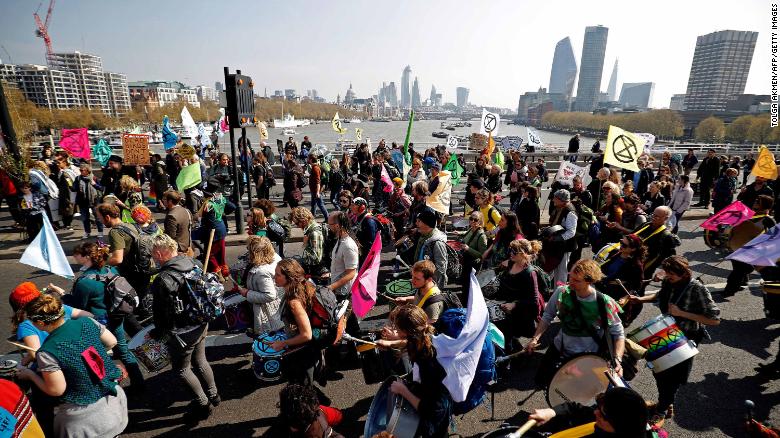
This Monday, the group plans to shut down London in their biggest action yet. They plan to meet at five London locations and block traffic by playing music, hosting discussions and refusing to move from the street.
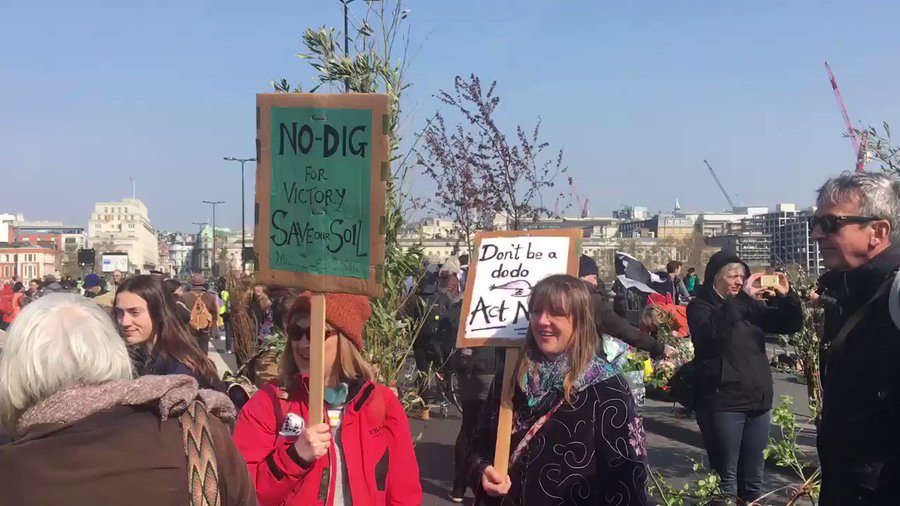
Demonstrators blocked Waterloo Bridge by bringing trees and solar panels.
Extinction Rebellion  demonstrating on Waterloo Bridge, London, April 15, 2019.

The group says hundreds of people have taken time off work to camp for as long as it takes get their demands heard by the government. Read more coverage of the protest.