Captain Paul Watson and Pamela Anderson Praise Newly Elected Canadian Prime Minister Justin Trudeau

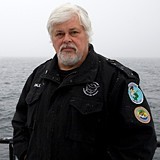
Pamela AndersonPamela AndersonSea Shepherd Conservation Society Founder Captain Paul Watson and actress/activist Pamela Anderson have written a congratulatory letter to Canada’s newly elected Prime Minister Justin Trudeau, referring to his election as akin to “a warm return of spring after a bitterly long winter.” Captain Watson and Anderson, both native Canadians, have a history of working together on international conservation issues, including the Canadian seal hunt.

Prime Minister Trudeau was recently elected after former Prime Minister Stephen Harper’s many years of discounting the importance of environmental protection. Captain Watson and Anderson address the immediate need to not only “repair the damage that has been done” to fisheries, oceanic ecosystems and the environment, but to also “protect the ecological heritage of the far north.”

Anderson, who became chair of Sea Shepherd’s Board of Directors earlier this week, is a long-time Sea Shepherd supporter, and dear friend of Captain Watson. She has not only dedicated her time and resources to protecting human and animal rights, and environmental conservation, but she has also bravely fought alongside Sea Shepherd defending marine species on the frontlines.

Now, the Canadian people and moreover, the world, are hopeful Canada will play a greater role in protecting the environment, allowing for a brighter future for all. Sea Shepherd and the Pamela Anderson Foundation extend their interest, commitment and resources to partner with Prime Minister Trudeau’s new administration for the greater good.

PDFPaul Watson and Pamela Anderson’s Letter

https://www.rt.com/news/325023-pamela-anderson-kremlin-meeting/

Captain Paul Watson with a seal in front of the Sea Shepherd IICaptain Paul Watson with a seal in front of the Sea Shepherd

Japan is accused with “Crime Against Nature”

Japan is accused with “Crime Against Nature”

http://www.albanydailystar.com/science/japan-is-accused-with-crime-against-n
ature-12242.html

After a judgment by an international court pressured Japan to stop hunting
whales in Antarctica for a year, the country is scheduled to send whaling
ships there again .A Japanese whaling fleet set sail for the Antarctic on
Tuesday, on a mission to resume the slaughter after a one-year pause, with
environmentalists slamming the move as a “crime against nature”.Government
officials and families of crew members stood on the quayside and waved as
ships—at least one fitted with a powerful harpoon—left a southern port,
television footage showed.

Despite a worldwide moratorium and opposition from usually-friendly nations
like Australia and New Zealand, Japan persists in hunting whales for what it
says is scientific research

“Two whaling ships departed from Shimonoseki with a Fisheries Agency patrol
boat this morning, while the factory ship also left another port to form a
fleet,” an agency official told AFP. “A fourth whaler already left a
northeastern port yesterday to join the fleet.”

Tokyo claims it is trying to prove the whale population is large enough to
sustain a return to commercial hunting, and says it has to kill the mammals
to carry out its research properly. However, it makes no secret of the fact
that the animals’ meat ends up on the dinner table or served up in school
lunches.

In 2014, the United Nations’ highest court, the International Court of
Justice (ICJ), ruled that Japan’s annual Southern Ocean expedition was a
commercial hunt masquerading as science to skirt the moratorium.
In response, Japan’s 2014-15 mission carried out only “non-lethal research”
such as taking skin samples and doing headcounts.

Large-scale whaling in Japan began after World War II, when meat was scarce,
according to the Whale and Dolphin Conservation. The Japanese government
heavily subsidizes the industry, although, the organization says, demand for
whale meat has fallen significantly over the past few decades.

Japan is not the only country with an active interest in whaling

Although an international moratorium on whaling was put into effect in 1986,
Iceland and Norway continue commercial whaling. Whale hunting for research
is regarded as separate from commercial whaling and is unaffected by the
moratorium.

Patrick Ramage, the whale program director at International Fund for Animal
Welfare in Yarmouth Port, Massachusetts, said minke whales were historically
considered too small to be commercially viable for whalers. Many countries
have “worked their way down from the blue whale through the fin whale,
humpback whale and other species. It’s now the little guy — minke whale —
that Japan is targeting.”

Australia took Japan to the United Nations International Court of Justice in
The Hague over its Antarctic whaling activities. Last year the court ruled
in favor of Australia and ordered Japan to halt its special permit program
in the Antarctic, known as JARPA II. The court, which found that Japan was
using its scientific research program to disguise commercial whaling, said
that JARPA II involved the killing of 3,600 minke whales over several years
and that “the scientific output to date appears limited.”

Japan halted its whaling operations in Antarctica because of the court’s
decision. But rather than let its Antarctic whaling operation fade away,
Japan has apparently reinvented it with a program called the New Scientific
Whale Research Program in the Antarctic Ocean (PDF), which it plans to
launch on Tuesday.

An IWC representative, who requested anonymity because the person was not
authorized to speak with the media, said that when the commission’s
scientific committee reviewed Japan’s newly named plan, “they didn’t agree
whether the research Japan was proposing required lethal research or whether
you could do it using nonlethal methods, for example, DNA.”

But the government has said for months it intended to resume butchery in the
current season, which runs to around the end of March.

The announcement Monday that the hunt was to begin drew condemnation from
around the world

Claire Bass, executive director for Humane Society International, said Japan
had chosen to ignore the “universal opposition” represented by the ICJ
ruling.

“Once again we have Japan’s whaling fleet setting sail to commit a crime
against nature,” she said in a statement, stressing “Japan’s long history of
whale persecution”.Other conservationists called for another legal
challenge.But consumption has dramatically declined in recent decades, with
significant proportions of the population saying they “never” or “rarely”
eat whale meat.

Atsushi Ishii, an expert on international relations at Japan’s Tohoku
University, said Japan’s refusal to give up the Antarctic mission despite
censure by the international court is largely due to a small group of
powerful politicians.

“Why resume whaling? Because a group of pro-whaling lawmakers don’t like the
image that they succumbed to pressure from Sea Shepherd,” he told AFP,
referring to an environmental group that has repeatedly clashed with
Japanese whaling missions.Sea Shepherd Australia said Monday it would follow
the latest mission, which Japan said would aim to kill a total of 333 minke
whales—some two-thirds under previous targets.

Tokyo said in response that it would try to secure the safety of the 160
crew members by sending patrol boats to guard the fleet and strengthening
“self-protection measures.”The International Fund for Animal Welfare and the
Australian Marine Conservation Society said a panel of legal experts asked
to consider Japan’s latest whaling mission had found it broke international
law.

“The panel concluded that Japan’s new whaling programme violates
international law and that Australia or other countries still have options
to challenge Japan’s actions before international courts,” said chair and
Australian National University professor Donald Rothwell.

Japan has hunted whales for centuries, and their meat was a key source of
protein in the immediate post-World War II years when the country was
desperately poor. Japan began its so-called scientific whaling practices in
1987, a year after an worldwide whaling moratorium took effect. A protester
in 2008 sits on a Japanese flag covered in red blood outside the Japanese
consulate in Melbourne, Australia, to protest whale hunting.

Sea Shepherd, a conservation group that sent boats annually to disrupt
whaling activities by Japan warned Tokyo that returning to hunt whales will
be illegal. It was Australia which brought the case against Japan to the
International Court of Justice and is clearly not happy with Japan’s
decision to continue its hunt. Japan accuses opponents of being emotional
about the mammals and disregarding what it says is evidence to support its
position.

The country’s officials have said many times that most whale species aren’t
endangered, and noted eating whale is part of its culture. Greenpeace along
with Dolphin & Whale Action Network, Friends of the Earth and twelve other
animal rights and environmental groups issued a joint statement calling on
Japan to stop its whaling operations.

Lion kills safari guide in home of Cecil the lion

Sea Shepherd anti-whaling ship Bob Barker refused entry to Faroe Islands
http://www.theguardian.com/environment/2015/aug/25/sea-shepherd-anti-whaling-ship-bob-barker-refused-entry-to-faroe-islands
“Denmark’s autonomous Faroe Islands announced on Monday that they had
refused entry to a ship carrying 21 activists from the militant
conservation group Sea Shepherd who were trying to disrupt traditional
whale hunts.”

Lion kills safari guide in home of Cecil the lion
http://www.grindtv.com/wildlife/lion-kills-safari-guide-in-home-of-cecil-the-lion/#hauJp2eYyzyK24r3.97
“Quinn Swales, 40, a fully qualified and experienced Zimbabwean
professional guide, was leading a group of tourists on a photographic
safari when a male lion unexpectedly charged the group, according to
Camp Hwange Zimbabwe, the company for which he worked.”

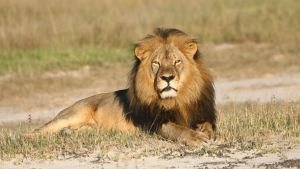
AP_Cecil_mm_150730_16x9_992

Safari Club International Awards by Captain Paul Watson

Sea Shepherd Conservation Society

Safari Club International has some 50,000 members, 150 chapters and collects $3.17 million in membership dues each year. It raises another 7 million from their annual convention. But what is truly despicable about this organization is that it encourages slaughter through awards.

SCI’s record book system ranks the biggest tusks, horns, antlers, skulls and bodies of hunted animals. Hunters are rewarded with trophies for completing a “Grand Slam”. There are 15 “Grand Slams”. The ones that cover Africa are:

1. “The African Big Five Club” African lion, African leopard, African elephant, African buffalo and an African rhinoceros.

2. “Dangerous Game of Africa” requires a minimum of five from the African lion, African leopard, African elephant, African rhinoceros, African buffalo, hippopotamus and Nile crocodile.

3. “African 29” African lion, leopard, elephant, rhinoceros, buffalo, and a small cat, eland, bongo,kudu, nyala, sitatunga, bushbuck, sable antelope, roan antelope, oryx/gemsbok, waterbuck,lechwe, kob or puku, reedbuck or rhebok, wildebeest, hartebeest, mamalisc, impala, gazelle, pygmy antelope, springbok, dik-dik, bush duiker, forest duiker, nubian ibex, aoudad, hippopotamus, and wild pig.

4. “Cats of the World” minimum of four of: lion, leopard, cheetah, jaguar, cougar, lynx, cougar or puma, serval, carcal, African golden cat or bobcat.

There are dozens of other reward categories where members can buy special gold and bejewelled pins for the number of kills they rack up.

There is also the “Global Hunting Award” that requires the killer to have hunted 6 continents to receive a diamond award, a minimum of 17 native in Africa, 13 native or introduced in North America, 4 native or introduced in South America, 6 native or introduced in Europe, 6 native to Asia and 4 introduced in the South Pacific, for a total of 50 animals.

There is the “Hunting Achievement Award” that requires a minimum of 125 animals, or 60 if hunting with a bow.

And for women they have the “Diana Award”, given to women who “have excelled in international big game hunting”.

And finally there is the obscenely named “World Conservation & Hunting Award” given to hunters who have killed on six continents and have killed more than 300 species. This “esteemed” award goes to the killer who has taken all 14 “Grand Slams”, the 23 “Inner Circles”, “Pinnacle of Achievement” (fourth) and the “Crowning Achievement Award”.

It is this award system that is driving thousands of wealthy primarily white men and a few women to spend millions of dollars stalking animals around the world for the sole purpose of killing the in the name of vanity and self-glorification.

See the SCI hit lists here:

http://1drv.ms/1P6RIP2

See More

— with Darlene Robinette and 48 others.

Alice Susan Harding's photo.

Don’t Allow Whales to be Slaughtered off the Washington Coast!

Don't Allow Whales to be Slaughtered off the Washington Coast!

The National Marine Fisheries Service (NMFS) is considering an appalling plan to allow gray whales to be slaughtered off the Washington coast. Allowing a hunt would set a dangerous precedent that undermines the global moratorium on whaling.

Please submit your public comment opposing the hunting of gray whales off the coast of Washington.The risks of a hunt are significant. Proponents suggest that “only a few” whales will be killed for subsistence and cultural reasons. But even one whale is too many, regardless of who hunts them. Scientific evidence makes it clear these magnificent, sentient creatures are under grave threats from far too many sources.

The threats to gray whales are vast — from navy sonar and other underwater noise, to climate change, ocean acidification, ship strikes and pollution. The impact of this hunt on delicate gray whale populations has the potential to be huge. Not to mention, there are only a few individuals left in some populations, and there is a virtual certainty that whales from these populations will be killed because it’s nearly impossible to tell the difference between them during a hunt.

Please sign the petition today to submit your public comment to NFMS opposing the hunting of gray whales off the coast of Washington.

PETITION CLOSED

This petition is now closed. You can still make a difference in the Care2 community by signing other petitions today.

BROWSE PETITIONS ▸

Don’t Allow Whales to be Slaughtered off the

25,053

30,000

we’ve got 25,053 signatures, help us get to 30,000 by July 31, 2015

The National Marine Fisheries Service (NMFS) is inappropriately considering allowing gray whales to be slaughtered off the coast of Washington. Pierced with harpoons and riddled with numerous bullets, these magnificent creatures will suffer extreme pain if NMFS permits the hunt.

The hunt threatens not only a recovering population of Eastern North Pacific gray whales, but the few remaining individuals left in the endangered Western North Pacific and also the Pacific Coast Feeding Group populations. There is a very strong chance that whales within these smaller groups will be killed because it is virtually impossible to tell the difference between the populations, particularly given that hunts are often chaotic and conducted in tumultuous ocean conditions.

There is far too much scientific uncertainty about the impact a hunt would have on gray whales and the environment. Additionally, NMFS is not adequately considering the cumulative impacts of all the other threats to gray whales – such as navy sonar and other underwater noise, climate change, ocean acidification, oil and gas development, ship strikes and pollution.

The proposed hunt in Washington is just the first step toward a dangerous precedent that would undermine the global moratorium on whaling. Whale watching is a meaningful and economically lucrative alternative that helps maintain the gray whale’s iconic role in numerous cultures.

Gray whales have been known to migrate up to 22,000 kilometers, nearly 14,000 miles, crossing the jurisdictions of multiple countries. So this is an issue of international concern.

Please sign this petition to submit your official public comment opposing the hunt of gray whales and requesting that NMFS deny any permits to hunt gray whales in Pacific Coast waters.  less

The National Marine Fisheries Service (NMFS) is inappropriately considering allowing gray whales to be slaughtered off the coast of Washington. Pierced with harpoons and riddled with numerous bullets, these magnificent creatures will suffer extreme pain if NMFS permits the hunt.

The hunt threatens not only a recovering population of Eastern North Pacific gray whales, but the few remaining individuals left in the endangered Western North Pacific and also the Pacific Coast Feeding Group populations. There is a very strong chance that whales within these smaller groups will be killed because it is virtually impossible to tell the difference between the populations, particularly given that hunts are often chaotic and conducted in tumultuous ocean conditions.

There is far too much scientific uncertainty about the impact a hunt would have on gray whales and the environment. Additionally, NMFS is not adequately considering the cumulative impacts of all the other threats to gray whales – such as navy sonar and other underwater noise, climate change, ocean acidification, oil and gas development, ship strikes and pollution.

The proposed hunt in Washington is just the first step toward a dangerous precedent that would undermine the global moratorium on whaling. Whale watching is a meaningful and economically lucrative alternative that helps maintain the gray whale’s iconic role in numerous cultures.

Gray whales have been known to migrate up to 22,000 kilometers, nearly 14,000 mil… more

Arctic Drilling Is Not Just Wrong—It’s Crazy!

1979851_303991166423363_1363126940602880439_n

Saturday we participated in a Sea Shepherd volunteer garbage clean-up at Cannon Beach, a stretch of the Oregon coast noted for its nesting pelagic birds on scenic Haystack Rock. Haystack is one of the few sites on Earth where you can see fledgling murres, pigeon guillemots, puffins and cormorants, etc. take their first flights without intruding on some remote, fragile location like the arctic

Being the birthplace of so many vast flocks of seabirds, the arctic is supposed to be remote, but now, because of climate change, the Arctic Ocean is becoming more and more accessible to people most of whom have nothing but bad intent, like those at Shell Oil, who’s planning to drill for oil in the Arctic’s Chukchi Sea in a matter of days. In 1980, before most scientists even understood about global warming, Canadian naturalist John Livingston wrote a book, Arctic Oil: the Destruction of the North? about the risks to wildlife and nature inherent in drilling for oil in such an environment.

From Arctic Oil, “In winter, vast flocks of murres from the arctic islands drift south on prevailing currents to waters off Newfoundland, where they find themselves on or adjacent to major shipping lanes between North America and Europe. The concentration of murres often coincides with the concentration of oil. If a bird’s wings are oiled, they cannot fly, and if food is not immediately available, it will starve. Or, if its body is even slightly oiled, its feathers will lose their insulating properties and the bird will succumb to exposure in icy waters. Some birds, on the other hand, do make it to shore, where they attempt to preen their feathers clean. These will often die of starvation before they can take to the air again, or will perish from the toxicity of the oil swallowed during the preening process.

“It is impossible to know how many murres, eider ducks and other sea birds have been destroyed in this way over the years.”

In one spill off the British coastline, “160 kilometers had been oiled; it was estimated later that 25,000 sea birds died. It was a good ten years before the local biological system appeared to have healed.

“The record of accidental spills is cause not for mere concern but for raw fear. Oil tankers have become very large and numerous. At more or less regular intervals one of them cracks up.

“There seems no option but to expect that there will be more such events as super-tanker traffic intensifies on the high seas of the world. Year-round shipping, under all conditions, is being seriously proposed for the Northwest Passage. Accidents are wholly unpredictable as to timing and location, but entirely predictable in a sense of probability.

And on drilling Livingston writes, “In the high arctic islands, unfortunately, and in the Beaufort Sea and the Mackenzie Delta there are zones of ‘abnormally high’ geostatic pressure, which of course heightens the possibility of accident…The first such event in the Canadian arctic…took two weeks to shut off the gushing gas [natural—mostly methane.] A month later the well blew out of control again; this time it could not beDeepwater-Horizon-CDVIDS shut down until more than a year after the initial explosion. During that time it lost gas at the rate of 85,000 cubic meters per day. Five months after the Drake Point well blew out, another Pan Arctic well, this time on King Christian Island, went out. This one lost gas at about 2.8 million cubic meters per day, and, unlike the Drake Point gas jet, this one was on fire. The gigantic flame was finally extinguished three months later.

“Leaving to one side for the moment the sheer mechanical difficulty of dealing with a blow-out under the ice, or on the sea floor, or on the permafrost, the possible consequences for wildlife such as sea birds, even on the open arctic water, are hair-raising. (Of course a blow-out of Campeche massiveness would not be required; a much lesser spill, or even the accumulated effect of ‘normal’ leakage, could create havoc in the high arctic waters.)

“The critical question seems to be this: in certain knowledge of the undeniable risk, is the risk worth taking?”

Drilling for oil in the arctic is not just dead wrong, as Al Gore recently stated, “It’s crazy!” And he wasn’t even talking about global warming at the time.

11214207_829677830435133_118593585578390559_n

Paul Watson Asks us to Redefine Intelligence

http://upliftconnect.com/humans-arent-intelligent-creatures-planet/

Cetologists observe, document, and decipher evidence that points to a profound intelligence dwelling in the oceans. It is an intelligence that predates our own evolution as intelligent primates by millions of years. – Paul Watson

I had a profound experience while kayaking in Hawaii this past winter with friends. We were visited by a whale and there is no doubt that this majestic being was coherent, aware of us, and enjoying our company as much as we were enjoying his. We put our snorkeling masks on and jumped in and could easily see the whale gently make eye contact with each of us. With one thrust of his tail he could have left in an instant but he stayed with us for over an hour.  A mammal with a brain bigger than ours and complex migration songs that change every year, I couldn’t help but wonder what kind of thoughts could be going through his mind. The recent piece by  Dawn Agnos on UPLIFT about a conversation with a horse shows that emotional intelligence and empathy are a language that many animals understand. It was only recently that terms like emotional intelligence emerged and it is interesting to consider that there are many different kinds of intelligence.  Paul Watson of Sea Shepherd makes a good argument in a recent Facebook post that perhaps humans concept of intelligence is anthropocentric and lacking in breadth.

Screen Shot 2015-05-07 at 9.43.23 PM

Watson starts early in his essay with the bold assertion that, “Biological science is provoking us to shatter our image of human superiority.” Though indigenous wisdom has always considered humans a part of the circle of life rather than above it, that sentiment has almost been completely destroyed by generations of colonial indoctrination. The very roots of colonial indoctrination not only conclude that humans are superior to all other life forms, it also considers some humans as superior to others. Social Darwinism, a myth, was an effort to use science to validate the behavior of employing superior weaponry to oppress other humans. Though we owe much respect to western science we must also understand the cultural and religious backdrop from which this discipline emerged. We must also be willing to explore the assumptions within science if we are to evolve it.

Rupert Sheldrake attempted to do this during a TED Talk entitled, The Science Delusion and his presentations was banned. This is not to say that Sheldrake is right and all of science is wrong, that is too simplistic. It is merely an opportunity to open a dialogue about assumptions within science that the scientific community may or may not be willing to consider. I mention it in the context of considering the humble notion that humans may not posses the highest form of intelligence on the planet. If for no other reason than amusement, just open your mind and consider…

Mammals like us, who have been on the planet a whole lot longer than us, who also have larger brains than us, is interesting to reflect on. We humans pride ourselves on technology, on creating tools, gadgets and machines. Of course it is easy to consider that intelligence is based on technology. Then there is the idea of emotional intelligence which acknowledges a form of intelligence which is internal, can not be easily measured empirically but plays a major role in the success of an individual. Intuition, compassion, empathy are usually considered feelings, but these are skills, non-physical tools that we can use to ascend the social ladder. Meditation could also be considered a non-physical tool that changes our biology, reduces stress and opens the mind. We may be at the very beginning of understanding that tools do not need to be physical or easily measurable by traditional science in order to be valuable.

We willingly accept the idea of intelligence in a life-form only if the intelligence displayed is on the same evolutionary wavelength as our own. Technology automatically indicates intelligence. An absence of technology translates into an absence of intelligence.

Dolphins and whales do not display intelligence in a fashion recognizable to this conditioned perception of what intelligence is, and thus for the most part, we are blind to a broader definition of what intelligence can be.

Evolution molds our projection of intelligence. Humans evolved as tool-makers, obsessed with danger and group aggression. This makes it very difficult for us to comprehend intelligent non-manipulative beings whose evolutionary history featured ample food supplies and an absence of fear from external dangers.  – Paul Watson

Again it is important to recognize how this attitude has not only been applied to animals, but also to indigenous people historically. How we define intelligence is restricted to our definition of intelligence. Are we willing to broaden our definition of intelligence?

Intelligence can also be measured by the ability to live within the bounds of the laws of ecology — to live in harmony with one’s own ecology and to recognize the limitations placed on each species by the needs of an ecosystem. Is the species that dwells peacefully within its habitat with respect for the rights of other species the one that is inferior? Or is it the species that wages a holy war against its habitat, destroying all species that irritate it? What can be said of a species that reproduces beyond the ability of its habitat to support it? What do we make of a species that destroys the diversity that sustains the ecosystem that nourishes it? How is a species to be judged that fouls its water and poisons its own food? On the other hand, how is a species that has lived harmoniously within the boundaries of its ecology to be judged?  – Paul Watson

Watson gets very in-depth and cites the research which compares cranial capacity, and brain complexity between humans and sea mammals. At the very least this information is humbling. Paul Watson has given us a lot to think about, but probably the greatest gift in his essay can be summarized by this quote:

It’s not enough to understand the natural world, the point is to defend and preserve it. – Edward Abbey

Watson is not merely a philosopher, he puts his words and beliefs into action. For 35 years, Captain Paul Watson has been at the helm of the world’s most active marine non-profit organization – the Sea Shepherd Conservation Society. I highly recommend reading the entire essay which is available here.

To even consider that we are not superior to other species is delightfully humbling. It can restore a child-like sense of awe for life which also inspires a desire to preserve our environment. Our tools are wonderful, our science is also wonderful, but it should be used to celebrate and elevate all of life.  We must consider that the unconscious, disrespectful use of our tools and science can create unimaginable destruction for ourselves and other species. A healthy future includes humans who are aware of this and who live within the bounds of their ecosystem. We have the ability to create worlds or destroy ourselves. How do you want to live your life?

WORDS BY JACOB DEVANEY

An Egregious Mass Murder in the Faroes Islands This Morning

Captain Paul Watson's photo.

20 to 30 dolphins were viciously slaughtered within the last hour on the beach at Havannasund on Vidoy Island.

The police mobilized quickly to block off a tunnel to the island and to set up a restricted zone to keep people away from the killers as the blood coloured the water a deep red and the screams of dying dolphins echoed across the beach, as laughing and cheering Faroese whalers splattered themselves with hot blood in a perverse orgy of sadistic lust.

The police closed the tunnel to the island to prevent anyone from reaching Havannasund.

The police are aggressively assisting the dolphin killers.

The Brigitte Bardot was unable to reach the location in time. The dolphins had been quickly spotted and driven with stones and bang poles onto the beach where their drooling killers waited with their knives eager to extinguish the lives of these gentle creatures.

The Faroe Islands continue to encourage the barbarity of slaughtering dolphins with the full complicity of the government, the media, the police with new authoritarian special laws and now the Danish government and the Danish Navy.

The Faroese have decided to pull out all stops in their defense of this savage cultural obscenity.

It appears that many people in the Faroes are so traditionally and morally bankrupt that they can only find identify in the bloody ritualized culture of sadistic slaughter, as if to proclaim to the entire world that they, the Faroese require blood sacrifices to illustrate their lack of complete lack of empathy and morality. It is their way of spitting in the face of common human decency by declaring their uniqueness in the only way that has any meaning for them – the deliberate and prideful infliction of suffering and death to innocent, intelligent, self aware, socially complex sentient beings.

With the power and force of the Kingdom of Denmark defending their little backwater vassal entity in the Islands of Sheep, the whalers are intent to cowardly continue killing, believing they have God on their side (“Gott mit us”) and knowing they have the politicians in their pockets.

Captain Paul Watson on LA Talk Radio June 10th

Join our host Captain Paul Watson on LA Talk Radio June 10th for Sea Shepherd updates. We have my vegan pal and a great leader of the animal rights movement, and co-founder of SAEN, (Stop Animal Exploitation NOW!), Michael Budkie with breaking lab animals news. Join us, Yana Rusinovich, Paul’s wife and our Vegan corespondent and Ambassador of Galgos Ethique Europe, Shane Barbi of Barbi Twins and Jungle Jana, Wed, 11am http://www.latalkradio.com/Oceans.php, on State of the Oceans!

>Michael Budkie, A.H.T., http://www.animalliberationfront.com/…/In…/MichaelBudkie.htm) is the co-founder and Executive Director of Stop Animal Exploitation NOW! (SAEN), that works exclusively on the animal experimentation issue by successfully terminating research projects, forcing the USDA to take legal action against laboratories, and coordinating release of animals into sanctuaries. After witnessing the atrocities of animal experimentation during his education, he successfully ended a head injury experiment on cats at the University of Cincinnati that launched his career leading to positions with several national organizations before he co-founded SAEN in the mid-1990s. He has been published and he travels extensively, appearing on TV and radio programs to expose the truth about animal experimentation. For more about SAEN and Michael’s amazing work for animals go to: http://www.SAENonline.org twitter: https://twitter.com/SAENonline Facebook: https://www.facebook.com/officialSAEN

> Yana Rusinovish, Captain Paul Watson’s wife, is our “State of the Oceans” International Vegan host; Yana is a devoted vegan and avid animal activist that is a proud member of L214 http://www.l214.com/, The association L214 Ethique et Animaux , which is a French (non-profit) association for animal protection, governed by the 1901 Law. It was founded in 2008 by the collective “Stop Gavage” for the abolition of foie gras, which now continues its actions within L214.It is devoted to the welfare of the animals used to be consumed (meat, milk, eggs, and fish), putting into question the links between society and animals.
Yana is also the official ambassador for Galgos Ethique Europe https://www.facebook.com/galgos.ethiqueeurope
http://www.galgos-ethique-europe.eu/
Yana’s vegan group; VeganPower; informative tips and delicious recipes
https://www.facebook.com/groups/730532836982737/
http://about.me/yanarusinovich
twitter; @YanaRusinovich

>Jana Jungle; host
https://www.facebook.com/pages/Jani-Schulz/405645412815106
twitter: @RainforestRadio.

>Barbi Twins; hosts https://www.facebook.com/thebarbitwins?fref=ts
twitter: @Barbi_Twins

"'Join

"'Join

Paul Watson: Costa Rica Trying ‘To Imprison Me For Saving Sharks’

https://www.thedodo.com/paul-watson-costa-rica-petition-1133526041.html

Thank you — 20,000 signatures in just three days is a good start. I need your help to send a strong message to the Costa Rican government that the continued pursuit of the bogus charge against me needs to stop; this is a politically motivated charge.

In 2002, at the request of Guatemalan authorities, Sea Shepherd stopped an illegal shark-finning operation by a Costa Rican-flagged fishing boat well inside the territorial waters of Guatemala. The boat was not damaged and no one was hurt. The entire confrontation was filmed by Rob Stewart as he was making the film “Sharkwater.”

The Sea Shepherd vessel Farley Mowat had two independent film crews and 35 crewmembers onboard as witnesses. The fishing boat with eight fishermen and without cameras presented no evidence backing up their charges. When I arrived in Costa Rica, I was charged with eight counts of attempted murder. We presented our witnesses and our video evidence to the court. The charges were dismissed and I was given clearance to depart from Costa Rican waters; I did so, and heard nothing more about this incident until 10 years later, when I landed in Germany in 2012. There, in Frankfurt, I was detained on a Costa Rican warrant for the charge of alleged “shipwreck endangerment.”

No one was injured nor was property damaged, and yet Japan and Costa Rica managed to place me on the INTERPOL Red List — a list meant for serial killers and war criminals. Japan wants me for alleged “conspiracy to trespass on a whaling ship.”

The government’s own charge contradicts itself; the official accusation states that the incident took place in international waters, yet the same accusation gives the exact coordinates at which the incident took place, and that position is well within the territorial waters of Costa Rica.

You have to wonder why a government that conveniently lost the evidence for the trial of the narco-poacher killers of sea turtle conservationist Jairo Mora Sandoval is spending so much money and making such an effort to imprison me for saving sharks from poachers?

If you have not already done so, please take a few moments to sign and share the petition at the link below for me, provided in both English and Spanish. It will be presented to the government of Costa Rica.

Thank you, Merci, Gracias and Mahalo.
— Captain Paul Watson

Please sign and share the petition here.