Some People Simply Like to Kill Other Animals

In the title of an October 2nd post to his blog column in Psychology Today, University of Colorado evolutionary biology professor Marc Bekoff, PhD, asked, “Do Some People Simply Like to Kill Other Animals?”

The answer seems to me a foregone conclusion.

Bekoff writes, “Many know that Mark Zuckerberg, founder of Facebook, made a pledge in May 2011 only to eat meat he hunted so that he could be ‘thankful for the food I have to eat.’ Of course, it’s not obvious that he has to eat other animals… Surely, in the arena of who, not what, winds up in our mouth, Mr. Zuckerberg and others are not my moral compass. It’s always good to remember that a significant percentage of the food we eat was once sentient beings who cared deeply about what happened to them and to their friends and family. They should be referred to as “who” not “that” or “what.” So, when someone wants to talk about a meal it’s a matter of who’s for dinner, not what’s for dinner.”

His post included the subheading, “‘Ethical hunting’ raises numerous difficult and sticky issues,” about which Bekoff states, “I see no reason to kill other animals for a meal that isn’t needed. Every time I read an essay about “ethical hunting” it makes me reflect on a number of different and challenging issues. One that comes up time and time again is that maybe some people simply like to kill other animals and then offer a wide variety of excuses about their lust for blood (consider also the unrelenting war on wildlife including the wanton killing of wolves, the man who used a trapped wolf for target practice…)”

Sea Shepherd’s Captain Paul Watson backs up the assertion that some people enjoy killing other animals, “Behind all the chit-chat of conservation and tradition is the plain simple fact that trophy hunters like to kill living things.”

But no one makes the case as clearly as hunters themselves. One anonymous thrill-killer recently posted the following shocking admission to an animal advocacy site: “What i like to do as a hunter is go in the woods and kill everything possible and let my dogs chew on it. I once shot a deer and it layed in the creek and i had to shoot it again in the head while it was crying and it kicked me lol when i stuck my knife in its belly so my brother cut its throat it was soo funny. Me and my uncle was guttin one he told me to hold its head and when i did he pushed on its belly and made it bahh at me and scared the crap out of me haha. Hunting is awesome like when you see a herd of deer and just start firing right in the middle and then go and see how many different blood trails there are.”

Prairie dog hunting is a popular “sport” that can in no way be defended as “ethical” or necessary for subsistence (people don’t eat them). Private ranches offer “sportsmen” the chance to kill prairie dogs to their heart’s content—for a fee. The following is an ad for a typical prairie dog hunting excursion: “We approach the edge of a prairie dog town and set up and shoot for an hour or two or until the prairie dogs start getting scarce, then we pull up and drive over the hill and continue prairie dog hunting…after you get tired of the carnage, it‘s also fun to try shots over 1000 yards.”

Note that the ad uses the word “fun,” laying to rest any doubt that they enjoy the killing. So, why shouldn’t people be allowed to have their fun? Beyond the obvious answer that their animal victims are not enjoying this “sporting” behavior, society at large should discourage this kind of conduct for public safety reasons.

Keith Hunter Jesperson’s history of aggression toward animals began when he was only six. An avid hunter and part-time serial killer, Jesperson got his first taste of killing living beings by bashing in the heads of gophers. He discovered that he enjoyed it. Later, while living with his parents in a mobile home park in Washington State, he started killing larger animals. He would beat stray dogs and cats to death with a shovel, strangle them with his bare hands, or shoot them with his BB gun. His proud father bragged to others about how Keith had gotten rid of the stray cats and dogs in the trailer park.

“All this did is spawn in me the urge to kill again,” Jesperson told an interviewer. “I began to think of what it would be like to kill a human being. The thought stayed with me for years, until one night it happened. I killed a woman by beating her almost to death and finished her off by strangulation,” he said.

Keith Jesperson is by no means the first hunter to go on to become a serial killer of humans. As long as we enshrine hunting in books, magazines, cable TV shows and acts of Congress, there will always be people wanting to expand their species hit list to include our own.

Text and Wildlife Photography ©Jim Robertson

The Feeblest Rationale for Hunting Yet

The Feeblest Rationale Yet

Dear Editor,

As I read the letter, “Not Fair to Hunters,” in last week’s MV News, I experienced a major WTF (ie: what the fuck?) moment at the line, “Even those who do not hunt should respect its place in the human psyche.” Of all the feeble rationalizations for hunting you hear these days, suggesting that it helped shape the human psyche in some respectable way is the feeblest yet!

Homo sapiens hasn’t proven to be a very kind-hearted species in terms of our treatment of others over the ages, and the act of slaying animals has done nothing to cultivate our moral evolution. To quote Sea Shepherd’s Captain Paul Watson from his foreword to my book, Exposing the Big Game, “The cruelty and destruction that humans have inflicted upon each other is surpassed only by the cruelty and destruction humans have inflicted upon the nonhuman citizens of this world.”

I devoted an entire chapter of my book to peering “Inside the Hunter’s Mind” and let me tell ya, it’s a dark and disturbing place down there.  Here are some of the startling things I discovered…

Hunters’ self-interests are consistently placed far above those of their animal victims, whom they depersonalize and view as objects rather than individuals. Reducing living entities to lifeless possessions and taking trophies of their body parts—without the slightest hint of guilt, remorse or other higher sentiment—is standard practice for the sport hunter…and the serial killer.

And like a serial killer, the sportsman keeps his malignant, murderous obsession concealed within the hollow confines of his psyche…until the next hunting season.

Text and Wildlife Photography ©Jim Robertson

Obama: “Ryan is a Decent Man”

In his first remarks on Paul Ryan, President Barack Obama said, “I know him. I welcome him to the race. Congressman Ryan is a decent man,” but has “wrong vision for America” (especially for our wildlife, I would add).

When I read that Obama gave Ryan the dubious distinction of being “a decent man,” I had to wonder if our Commander in Chief has been reading my blog—in particular, a post I made back in early June, entitled…

He Was a “Decent” Man

Posted on June 9, 2012

Nobody is all good or all bad all of the time. Like the universe, people are multi-dimensional. Some of the most “decent” people I know are hunters. [well, not including bowhunters].These folks, who are inarguably unkind to animals during hunting season, are often as friendly and neighborly as you please to their fellow people. I have to assume there was some major peer pressure involved in their decision to start hunting as kids. And they must be doing some heavy compartmentalizing to keep it up as adults.

One of the most memorable and symbolic scenes in the movie, The Silence of the Lambs, is when Clarice Starling (Jodie Foster’s character) tells Hannibal Lecter of a traumatic experience she had while staying at a relative’s sheep ranch in Montana. She was awakened before dawn by the screaming of the lambs her uncle was slaughtering. When Lecter questioned the rancher’s morality, she quickly replied, “He was a very decent man.” No doubt the sheep would not agree. Somehow people who are capable of extreme cruelty can also have a convincingly “decent” side.

Ordinarily well-thought-of people can turn ugly and unkind when taking part in unnaturally cruel activities, where cruelty is the norm rather than the exception. One of the known coping mechanisms for workers in slaughterhouses is to objectify and demean animals as unworthy of consideration. Not only can people in these situations become indifferent towards “lowly” animals, they frequently turn sadistic. They can come to be obsessed with cruelty, taking pleasure in causing animals increased suffering.

Ten years before Jack the Ripper, nineteenth century French serial killer, Eusebius Pieydagnelle, developed such an obsession while growing up across the street from a butcher shop. He told police, “The smell of fresh blood, and appetizing meat, the bloody lumps–all this fascinated me and I began to envy the butcher’s assistant, because he could work at the block, with his sleeves rolled-up and bloody hands.” [Interestingly, Paul Ryan boasted, “I butcher my own deer, grind the meat, stuff it in casings and then smoke it”—not to get high of course, that rush must come from the killing.]

In spite of his respectable parents’ opposition, young Eusebius became an apprentice at the butcher shop where he wounded cattle and drank their blood. But the greatest excitement for him came when he was allowed to kill an animal himself: “…the sweetest sensation is when you feel the animal trembling under your knife. The animal’s departing life creeps along the blade right up to your hand. The mighty blow that felled the bullocks sounded like sweet music to my ears.” Shocking words from someone who was always thought of as a “decent man.” …

The media depicts Paul Ryan’s chosen hobby, bowhunting, as “quaint,” “folksey” or “outdoorsy,” but if the animals—whose bodies his arrows tear in to—had anything to say about it, they’d ask him: “Where’s your sense of decency?”

Wildlife Photograhy Copyright Jim Robertson

The Serial Killers Named Buffalo Bill

It puts the lotion on its skin, or else it gets the hose again.”

That haunting line was made famous by the serial killer, Buffalo Bill. Not the historic character credited with the serial murder of tens of thousands of gregarious and benign bison, including 4,120 in one eighteen month period alone. No, it was uttered by the other famous (though in this case, make believe) multiple murderer of the same name: the nemesis in the story, The Silence of the Lambs.

Like his namesake, the old west bison slayer (forever immortalized with towns named after him and museums devoted to his memory), the fictional “Buffalo Bill” made a habit of objectifying his victims, using the pronoun “it” to depersonalize them in order to avoid any stirrings of conscience that might drift by. Both Buffalo Bills thought those they killed were beneath them and therefore unworthy of their concern.

The fictitious “Bill” was modeled in part after the real-life serial killer, Ed Gein, who, like most sport hunters, made trophies and souvenirs from his victims’ bones and skin.

It seems whether their victims are human or non-human animals, objectification and depersonalization play major roles in the psyches of hunters and/or serial killers.

Taking Trophies

“You’re the last one there…you feel the last bit of breath leaving their body. You’re looking into their eyes and basically, a person in that situation is God! You then possess them and they shall forever be a part of you. And the grounds where you killed them become sacred to you and you will always be drawn back to them.”

The words of a hunter triumphantly reliving his conquest?

Well, if by hunter you mean a person who stalks and kills an innocent, unarmed victim, then yes.

The quote is from serial killer Ted Bundy, as he sat on death row and mused over his murders to the authors of The Only Living Witness. It seems that, whether the perpetrator is engaged in a sport hunt or a serial kill, the mentality is roughly the same.

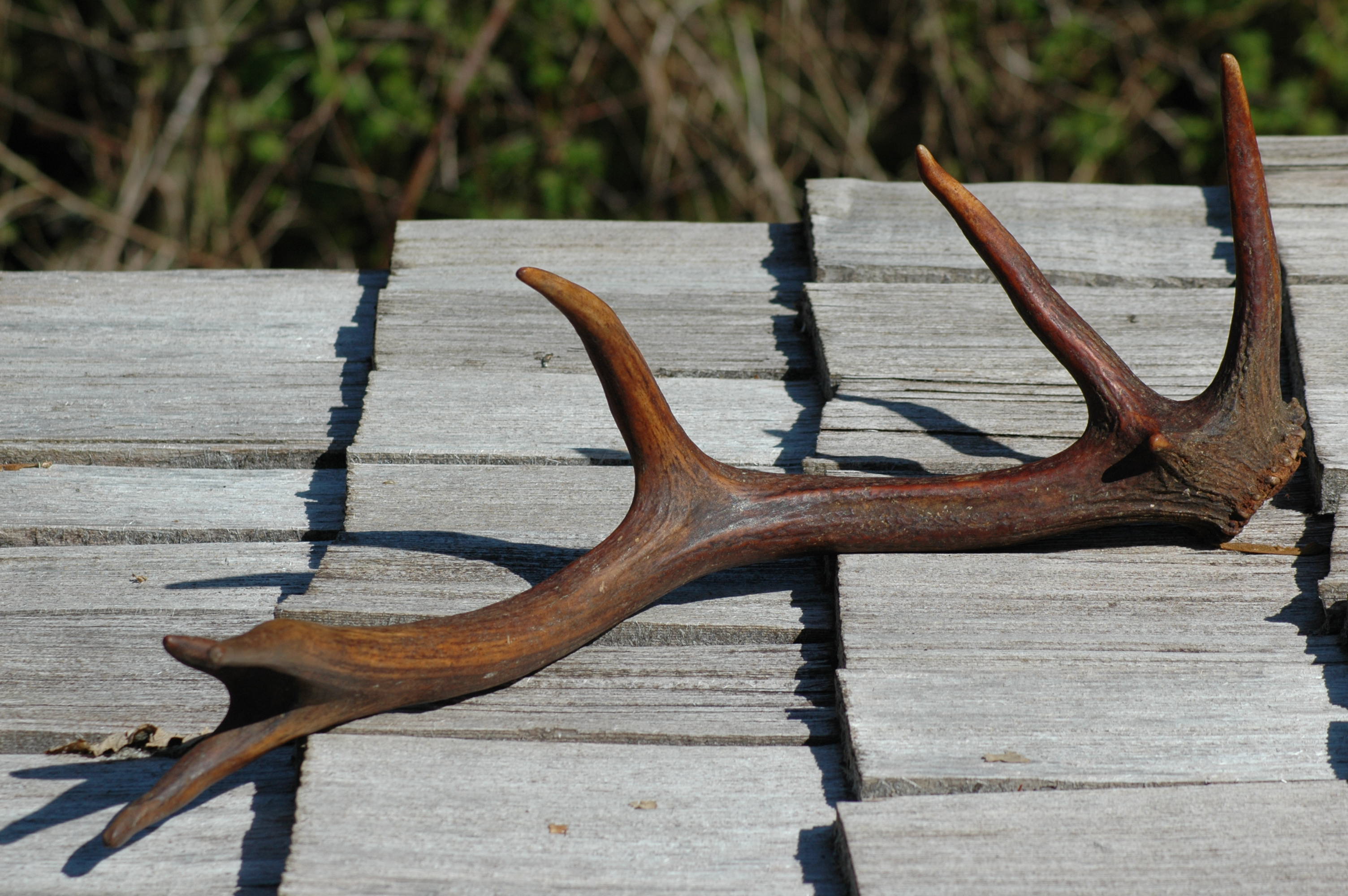
Try as I might, it’s a mindset I really can’t relate to. But this quote helped answer a question I’ve been pondering since I came across a freshly shed elk antler on a hike in the forest behind my place. It was thrilling to find a tangible sign of such a proud and noble soul, willingly discarded to make way for this year’s even larger adornment. I’ve experienced a similar feeling of exhilaration many times before when capturing images of wildlife with my camera. The key component for me is the knowledge that the animal is still roaming free.

Image

I hung the keepsake over my doorway. It serves as a reminder that the bull elk made it through another season alive. Conversely, when a hunter proudly displays a “rack” of antlers, they are the result of a killan animal’s life was taken so they could claim their trophy.

So why can’t hunters be satisfied with finding a naturally shed horn?

Clearly, they are after more than just a souvenir or symbol of a beautiful living creature. There’s something sinister about their motive—something akin to what drives a trophy-taking serial killer.

For the likes of Ted Bundy, a memento such as a pair of panties or a Polaroid photo helps them to recall the heightened state of arousal they felt while slaying their prey. As with the serial killer, the ultimate goal of a hunter is to play God over a helpless victim and to possess not just their image or their antler, but their very being.