Exposing the Big Game

Forget Hunters' Feeble Rationalizations and Trust Your Gut Feelings: Making Sport of Killing Is Not Healthy Human Behavior

Exposing the Big Game

The Long History Of Murdered Animal Rights And Environmental Activists

Regan Russell and other activists killed

ActivismAnimal RightsArticlesEnvironmentFeaturedFeatured ActivistsLatest

 Brandon Kirkwood  0 CommentsActivistskilledmurderSpread the love

With the recent passing of Regan Russell who died when run over by a slaughterhouse truck at a vigil in Canada, a long horrible chain of violence has been added to.

Below is a timeline of vegan activists who died speaking out for the animals.

When possible I have posted pictures of the slain individuals so they can be more than just words on a page.

1976, January 6th: William Sweet, LACS member Anti-hunting activist, Murdered after an altercation with a man who was shooting birds. His murderer was jailed for life but was later released.

1985 October 7th: Fernando Pereira a Greenpeace photographer was murdered by the French Secret Service when the vessel “Rainbow Warrior” was sunk by two explosions in Auckland Harbor, New Zealand.


The Photographer Fernando Pereira (right) and Rongelap Islander Bonemej Namwe ride ashore in the ‘bum bum’. Born on Kwajalein, Namwe, 62, has lived most of her life on Rongelap. The Rainbow Warrior is in Rongelap to assist in the evacuation of islanders to Mejato. Rongelap suffered nuclear fallout in 1954, making it a hazardous place for this community to continue living in. Eyes of Fire: p49
Mediavine

1988, December 22nd: Chico Mendes an anti-deforestation activist was murdered in his own home after an assassination order by a cattle rancher. He was the 19th Brazilian rainforest activist murdered that year. 

1991, February 9th: Mike Hill an 18 year old hunt saboteur was deliberately run over and killed during a meet of the Cheshire Beagles. Death is deemed “accidental”. No charges are brought against the driver Allan Summersgill. 

1993, April 3rd: 15-year-old hunt saboteur, Tom Warby, is deliberately run over and killed by a fox hunter as other huntsmen stand and laugh, proclaiming a “victory”. The driver, Alan Ball, is not prosecuted. 

Microsoft

Mediavine

1995, February 1st: Jill Phipps was a 31-year-old British activist and mother, who was crushed to death under the wheels of a veal transporter truck carrying live animals for export at a protest at Coventry airport. The Crown Prosecution Service decided not to bring any charges against the driver.

1995, March: Dr. Karel Van Noppen was a Belgium veterinarian who was assassinated in 1993 by hitmen after exposing mafia connections to the meat industry. Dr. Van Noppen was the victim of a powerful, international mafia who violently imposing its rule on the meat business, ruthlessly bullying anyone daring to stand in its way. In 1995, a few days before his murder, Van Noppen was explicitly threatened by people linked to the “hormone black mafia” underworld.

Dr. Karel Van Noppen
Mediavine

1998, September 17th: David “Gypsy” Chain was an American eco-activist who was crushed to death after an irate logger fell a tree on him in California’s redwood forest. On September 17, 1998, the 24-year-old environmental activist was crushed to death by a falling tree at the Headwaters Forest in Northern California.

Activists from Earth First! accused loggers of deliberately cutting down trees in their direction, part of escalating violence against activists condoned by the Pacific Lumber Company and the Humboldt County Sheriff’s Department.

Gypsy was part of an action to stop PL from destroying one of the last ancient redwood forests in the world.

The logging operation was illegal as a survey had yet to be done for the marbled murrelet, an endangered species of bird. PL attempted to portray the death as a “freak accident” and even tried to blame the victim as well as Earth First! According to PL spokesperson, Mary Bullwinkle:https://tpc.googlesyndication.com/safeframe/1-0-37/html/container.html

Mediavine

“Despite all our precautions, a trespasser was apparently killed by a falling tree at one of our logging sites on our private property.”

On September 18, Earth First! released a videotape revealing that loggers not only knew that demonstrators were in the area, but were angrily threatening them shortly before Gypsy was killed.

A logger shown shouting profanities and threats was, according to Earth First!, the very same logger who felled the tree that struck David. The video also showed activists scrambling up a steep hillside to escape falling trees. According to a witness statement:

“Gypsy’s death is not an isolated incident of violence. In the last several months trees have been intentionally felled at nonviolent activists at the Luna tree sit and in the Mattole watershed in Humboldt County. This is part of an escalation of violence against nonviolent forest defenders in the Northwest and all over the world.”

On September 18, the Humboldt County Sheriff’s Department issued preliminary findings concluding that the death was “accidental”. According to an Earth First! activist speaking at a press conference, “Police have routinely refused to file charges against anybody who assaults a forest activist.” In 1999, Mr. Chain’s parents filed a wrongful death lawsuit against PL. The company settled out of court in October of 2001, just three days before the trial was set to begin.

A collage of David “Gypsy” Chain made by a morner
Mediavine

2003: Animal rights activist Jane Tipson is murdered in an alleged contract killing after protesting against the construction of a dolphin aquarium in St Lucia. To this day, her killers have not been found or prosecuted.

2005: 73-year-old anti-deforestation campaigner, Dorothy Stang, is approached in the Amazon by 2 armed men working on behalf of an animal agriculture organization. Asked if she has any weapons, she produces her Bible and says that’s all she has. She is shot in the stomach, then fatally shot 5 more times as she lays on the ground.

Dorothy Stang

https://tpc.googlesyndication.com/safeframe/1-0-37/html/container.html

Mediavine

2006: Joan Root, a conservationist, and activist against poaching and illegal fishing is murdered by 4 gunmen in her own home. To this day, her killers have not been found or prosecuted.

Joan Root and Alan Root

2010, May 12th: Elvio Fichera a volunteer for the Association of Abandoned Animals was murdered while trying to serve a warrant with police on Renzo Castagnola for cruelty to animals. Renzo Castagnola shot Elvio dead.

Elvio Fichera

More: https://vegannewsnow.com/2020/06/24/regan-russell-history-activists/

May 12, 2010: Paola Quartini, animal activist for LIPU (Italian League for Bird Protection – UK) from Genoa, Italy was murdered whilst trying, with police, to serve a warrant on Renzo Castagnola for cruelty to animals. Renzo Castagnola shot him dead.

2011: Two anti-deforestation activists, Jose Claudio Ribeiro da Silva and Maria do Espirito Santo, are shot dead by hired thugs, after years of constant death threats from cattle ranchers. The main suspect is acquitted. No other prosecutions.

https://tpc.googlesyndication.com/safeframe/1-0-37/html/container.html

Mediavine

2013: Jairo Mora Sandoval, a sea turtle activist, is bound, beaten, then fatally shot in the head by sea turtle poachers, after being kidnapped along with 4 other activists.

2020, June 19th: Regan Russell, an activist with the Animal Save Movement was murdered by a slaughterhouse truck driver that by all accounts did so on purpose.

Regan Russell

https://tpc.googlesyndication.com/safeframe/1-0-37/html/container.html

We remember our fellow fallen friends by continuing on with the activism they died for. Any single one of their deaths could easily have been ours and that’s one reason their deaths hit so hard.

Every time we go to a vigil, protest, shutdown, undercover investigation, or any form of protest we place our lives at risk so that we can help change the world.

Never forgetting those who have sacrificed everything for a more just and equal world is the least we can do but it’s even better if we remember on the days we are too tired, or sick to go to an event.

In the end we are all brothers and sisters in this together fighting for what’s right. We are all in this together.

Help Vegan News continue to get the news that matters to our community and help us move forward in these hard times.

You can help us continue creating and telling the stories of animals and activists by becoming a Patreon supporter at: https://www.patreon.com/vegannews

Or with a one time donation through:

Venmo: @VeganNews

CashApp: @VeganNews

Paypal: PayPal.Me/vegannewsHelp keep Vegan News Independent by becoming our Patron!

‘My life ended’ Friday: Regan Russell’s supporters want justice, Bill 156 overturned

‘I’ll fight it the rest of my life,’ says Regan Russell’s husband, Mark Powell

Samantha Craggs · CBC News · Posted: Jun 26, 2020 12:55 PM ET | Last Updated: June 26

https://www.cbc.ca/news/canada/hamilton/regan-russell-1.5627216

Regan Russell, says friend Julie Maue, “taught me how to have long friendships. How lucky am I?” (Agnes Cseke)

As far as Mark Powell is concerned, his life ended last Friday when his wife, Regan Russell, was hit and killed by a transport truck during a Burlington animal rights protest.

Now he’ll spend the rest of his days, he says, trying to get rid of the bill that haunted her.

Powell, a west Hamilton contractor, says there’s been an international outpouring over Russell’s death, from artwork to YouTube tributes, and it’s helped make the grief a little lighter. His wife was deeply rattled by Bill 156, which creates “animal protection zones” that prohibits animal rights activists from “interfering or interacting with the farm animals in the motor vehicle.” 

He’s hired a lawyer for two reasons: to see justice in her death, and to try to get the new bill repealed. 

“I’ll fight it the rest of my life,” he said. “My life ended on Friday, so for as long as I’m left here, we have to pick up the torch, and we have to fight things like Bill 156.”

The notion of Russell having a legacy is comforting to Powell and others who knew her. The 65-year-old activist often protested in front of Fearman’s Pork Inc. as part of Toronto Pig Save. The group gives a last gulp of water to pigs packed into hot trailers, moments before they’re slaughtered.

That’s what she was doing at 10:20 a.m. June 19. Somehow, witnesses say, she ended up being hit by the transport truck.

Regan Russell (left) and Katherine Wightman are shown as young models in the photo on the left. In the more recent photo, Russell is on the right. “I’ve lost my right arm,” Wightman says. (Katherine Wightman)

Halton Regional Police Service said Thursday that the collision reconstruction unit is doing a “thorough investigation.” 

“A determination on charges will be made by the collision reconstruction unit once the investigation is complete,” said Const. Steve Elms in an email. “At that time, investigators will issue a media release to update the community.”

Russell was also a women’s rights and Black Lives Matter supporter and attended a rally days before her death, says close friend Katherine Wightman. She believed strongly, Wightman says, that all beings are equals, and that informed her activism.

Russell often posted her thoughts on Facebook, most recently about Bill 156. “Bill 156 has passed,” she wrote on the day before she died. “Now, any time an animal is suffering on a farm in Ontario, no one, not even an employee, has the right to expose it.”

Animal rights activists have been rallying against the Security From Trespass and Protecting Food Safety Act, 2019  since January. 

The bill was introduced in the Ontario legislature late last year. Agriculture Minister Ernie Hardeman said it’s in response to complaints from farmers about animal rights groups trespassing on their private property. 

Friends and community, including Russell’s parents and husband, gathered for a vigil last weekend. (Jo-Anne McArthur / We Animals)

The bill, he said, is a “bio-security” measure. It increases the fines for anyone caught trespassing on farms or food processing plants, and makes it illegal to gain access to a farm under “false pretenses,” which effectively makes undercover filming an offence.

The Ontario Federation of Agriculture rallied support for the bill, saying it “protects our farms, families, livestock and food supply” from increasingly aggressive tactics from animal rights groups.

“Ontario farms have come under increasing threat from trespassers and activists who illegally enter property, barns and buildings, breaching biosecurity protocols,” president Keith Currie said in a June 12 media release

“Once peaceful protests have now escalated to trespassing, invasions, barn break-ins, theft and harassment.”

There’s precedent, however, to what Powell is considering. In Idaho, Iowa and Utah, courts have struck down similar “Ag-Gag” laws as being unconstitutional. That’s led Ontario animal rights activists to consider whether Ontario’s law could be struck down in court.

“She was dynamic,” friend Julie Maue says of Russell. “She was confident. She always made you feel like you were as beautiful as her.” (Toronto Pig Save)

Powell has retained Anandi Naipaul at Ross & McBride LLP. Russell’s family has also launched a fundraising campaign “to continue Regan’s work and assist the family.”

Powell says it’s the best way he knows to honour his wife’s life. Russell’s activism began when she was 24, he says, and living in Winnipeg. She made her own sign that said “Stop the seal hunt” and stood outside a downtown government building on a frigid winter day. After several hours, she thought she’d instigated some change.

“She went home, freezing cold,” Powell said. “She took a hot bath and thought, ‘There, that’s done. What’s next?'”

Russell was born and raised in Hamilton, Powell said, and moved to Moose Jaw and then Winnipeg. In Winnipeg, she became a model, an occupation that continued until 2002. She also enjoyed spending time with the family’s seven rescue cats, which Russell warned Powell about when they started dating. 

“She said, ‘You have to understand there will be cats, plural,'” he recalled. “I accepted that, and it’s grown to a family of seven cats.”

Animal activists embrace at the scene on June 19. (Andrew Collins/CBC)

In 1985, Powell says, she read Animal Liberation: A New Ethics for Our Treatment of Animals by Peter Singer, which changed her life, and she became vegan. She gave her dad Bill, now 89, the book, and he became an animal rights activist too. The pair protested together at Marineland, Powell says, and also at a 2017 Bill Cosby show in Hamilton.

Wightman met Russell as a teenage model in Winnipeg, and “she was instantly like a big sister.” The pair talked on the phone as often as five times a day. Wightman called Russell’s cell phone on June 19, not knowing Russell had died until Powell answered it and told her. 

Now, “it feels like I’ve lost my right arm,” Wightman said. Their last conversation, she said, was about Bill 156. “She said, ‘I am so tired. Do you realize now the work that lies ahead of me?'”

If there is a bright spot, she said, it’s that “the word has become global about who she is and what she stood for.”

Russell’s friend Julie Maue says the last time she saw her friend, they went to the office of Hamilton West-Ancaster-Dundas MPP Sandy Shaw to talk about Bill 156. Russell, Maue says, was compassionate, intelligent and logical.

Watch

Activist killed after being struck by vehicle during Burlington pig plant protest

  • 8 days ago
  • 0:54

A animal activist protest in Burlington has turned deadly after Halton police say a vehicle struck and killed one of the activists. 0:54

“She was dynamic,” Maue said. “She was confident. She always made you feel like you were as beautiful as her.”

Anita Krajnc, founder of the Save movement, says Russell’s death has inspired vigils in multiple countries. She wants to keep the momentum going.

Krajnc made headlines at the Burlington plant in 2016 when she was charged with mischief for giving water to pigs. She was ultimately found not guilty after a lengthy trial that included slaughterhouse footage and testimony from a variety of experts. Russell attended the trial.

“I wake up multiple times a night, and I’m instantaneously thinking about her,” Krajnc said. Then “I go online and I watch the vigils.”

“I believe that site where Regan was killed, there will one day be a plant-based facility. I truly believe that.”

Why these meatpacking workers fear for their health and safety amid COVID-19

Jun 24, 2020 6:40 PM EDTBy —

Fred de Sam Lazaro53commentsShareShare on FacebookShare on TwitterTranscriptAudio

https://www.pbs.org/newshour/show/why-these-meatpacking-workers-fear-for-their-health-and-safety-amid-covid-19

Many U.S. meatpacking plants shut down this spring due to coronavirus outbreaks. Nationwide, more than 27,000 workers have become infected, and nearly 100 have died. But in late April, President Trump ordered the facilities to stay open, deeming them critical to preserving the nation’s meat supply. Special correspondent Fred de Sam Lazaro reports on the experiences of some of these workers.

Read the Full Transcript

  • Judy Woodruff:It has been nearly six weeks since production resumed in most meatpacking plants across the country. Many were shut down amid coronavirus outbreaks. More than 27,000 workers have become infected, and 99 have died.In late April, President Trump ordered plants to reopen or remain open, calling them critical infrastructure to preserve the nation’s meat supply.Special correspondent Fred de Sam Lazaro returns to one community in Minnesota where a pork processing plant is back online.
  • Fred de Sam Lazaro:Here in the Fabled Valley, the Jolly Green Giant stands tall and now even masked, but it’s actually pork, not peas, that reigns.The huge meat processing plants are now nearly back at full capacity. But things are not exactly jolly.
  • Woman (through translator):We’re still going to have to keep working in fear, but we know that we need to continue working. We have no option.
  • Fred de Sam Lazaro:In Worthington, Minnesota, population 13,000, the JBS factory was shuttered by a COVID outbreak that sickened hundreds of its 2,100 employees.The effect was felt across this region, mostly at first among hog farmers in late April. Hundreds of thousands of their animals had to be euthanized.
  • David Bullerman:It’s devastating. I’d like President Trump to invoke the Defense Production Act of 1950. We need to get these plants open today.
  • Fred de Sam Lazaro:Echoing farmer Dave Bullerman’s plea, industry executives warned, the nation’s meat supply was threatened, a claim some analysts now say was exaggerated, noting that, in April, there were record pork exports to China.
  • President Donald Trump:I should be signing that over the next hour or so.
  • Fred de Sam Lazaro:But, on April 28, President Trump did order meatpacking plants to reopen and remain open, declaring them critical infrastructure.
  • President Donald Trump:Taking the liability, which frees up the entire system.
  • Fred de Sam Lazaro:The president said his move shielded companies from liability if their workers got sick.Back in Worthington, community organizer Jessica Velasco says the plight of workers never seemed a priority.
  • Jessica Velasco:Folks started talking about the hog farms that were losing money. The bigger issue than was them euthanizing all those poor hogs.The conversation should have been, how can we support both the JBS employees and the hog producers?
  • Fred de Sam Lazaro:She says the employees, predominantly refugees and immigrants, remain largely invisible and fearful. She says many lost trust in the company because of the way it acted as more and more workers fell ill, leading the plant to shut down.Rafael, like all workers we spoke with, asked to remain ANONYMOUS.
  • Rafael (through translator):They told the workers not to worry, everything was OK. To be honest, they were not prepared at all. Nothing was OK. That’s where many became scared, and it was kind of you either work or you don’t eat situation.
  • Fred de Sam Lazaro:Rafael says he decided to quit because of a health condition that leaves them vulnerable to COVID. These three workers returned.
  • Man (through translator):Everyone feels scared. Everyone feels like we do here.
  • Fred de Sam Lazaro:JBS declined our request for an on-camera interview. It did send a video — parts of it time-lapsed — of improvements made at another plant in Greeley, Colorado, where several workers died.JBS has put some older COVID-vulnerable workers on paid furlough, and, among other steps, now requires employees to wear masks and face shields. And it installed barriers between workstations. Workers told us it feels safer, but not safe.
  • Steven:Personally, I think that they should make it mandatory for employees to get tested, so that we know who has it and who does not.
  • Fred de Sam Lazaro:The company says it tests employees who show symptoms and takes employees’ temperature when they arrive.That’s no comfort to Anna, who survived a painful COVID infection just before the plant closed.
  • Anna (through translator):They took mine, but it never showed a temperature. But I was already very sick. I didn’t show the symptoms.
  • Fred de Sam Lazaro:Most people like her have no choice but to return to work, she says.
  • Anna (through translator):We have family that we need to raise. We don’t have savings so we could just stay home.
  • Fred de Sam Lazaro:Meatpacking has long attracted new immigrants who have few options. It is an intensely tough environment, as even this JBS job posting seems to warn, standing 10 hours a day, doing repetitive tasks in very high temperatures or very low temperatures, with unpleasant odors.It’s something labor historian Peter Rachleff says most Americans avoid.
  • Peter Rachleff:The work force in meatpacking has almost always been people who are within one generation of having lived in agriculture, people who are able to work in that kind of blood and guts kind of environment.
  • Rev. James Callahan:If it was not for the immigrant community, this community would just fold up and die.
  • Fred de Sam Lazaro:Father James Callahan says immigrants sustain much of Worthington’s economy today, but he says this small town is not immune to the rancorous immigration debate, recalling comments he’s heard since the pandemic began.
  • Rev. James Callahan:Blaming the immigrant community for the spread of the virus, blaming people from the Asian communities for carrying it, I mean, a woman who said to me she was never going to eat in a Chinese restaurant again. I mean, how absurd is that?
  • Fred de Sam Lazaro:Are you finding a lot of that?
  • Rev. James Callahan:Not a lot, but enough where it becomes disturbing.
  • Fred de Sam Lazaro:He worries that meatpacking plants in Minnesota and elsewhere continue to see coronavirus spikes. So far, Father Callahan has presided over funerals in three-COVID related deaths of JBS workers, two of them since the plant reopened.For the “PBS NewsHour,” this is Fred de Sam Lazaro in Worthington, Minnesota.

Watch the Full EpisodePBS NewsHour from Jun 24, 2020By —

Fred de Sam Lazaro

Fred de Sam Lazaro is director of the Under-Told Stories Project at the University of St. Thomas in Minnesota, a program that combines international journalism and teaching. He has served with the PBS NewsHour since 1985 and is a regular contributor and substitute anchor for PBS’ Religion and Ethics Newsweekly.

Understanding Euthanasia: When Life and Words Become Worthless

Animals subjected to “euthanasia” often die by carbon dioxide poisoning, ventilation shutdown, and other mass-killing techniques that prolong suffering for minutes, even hours.Reading Time: 4 minutes

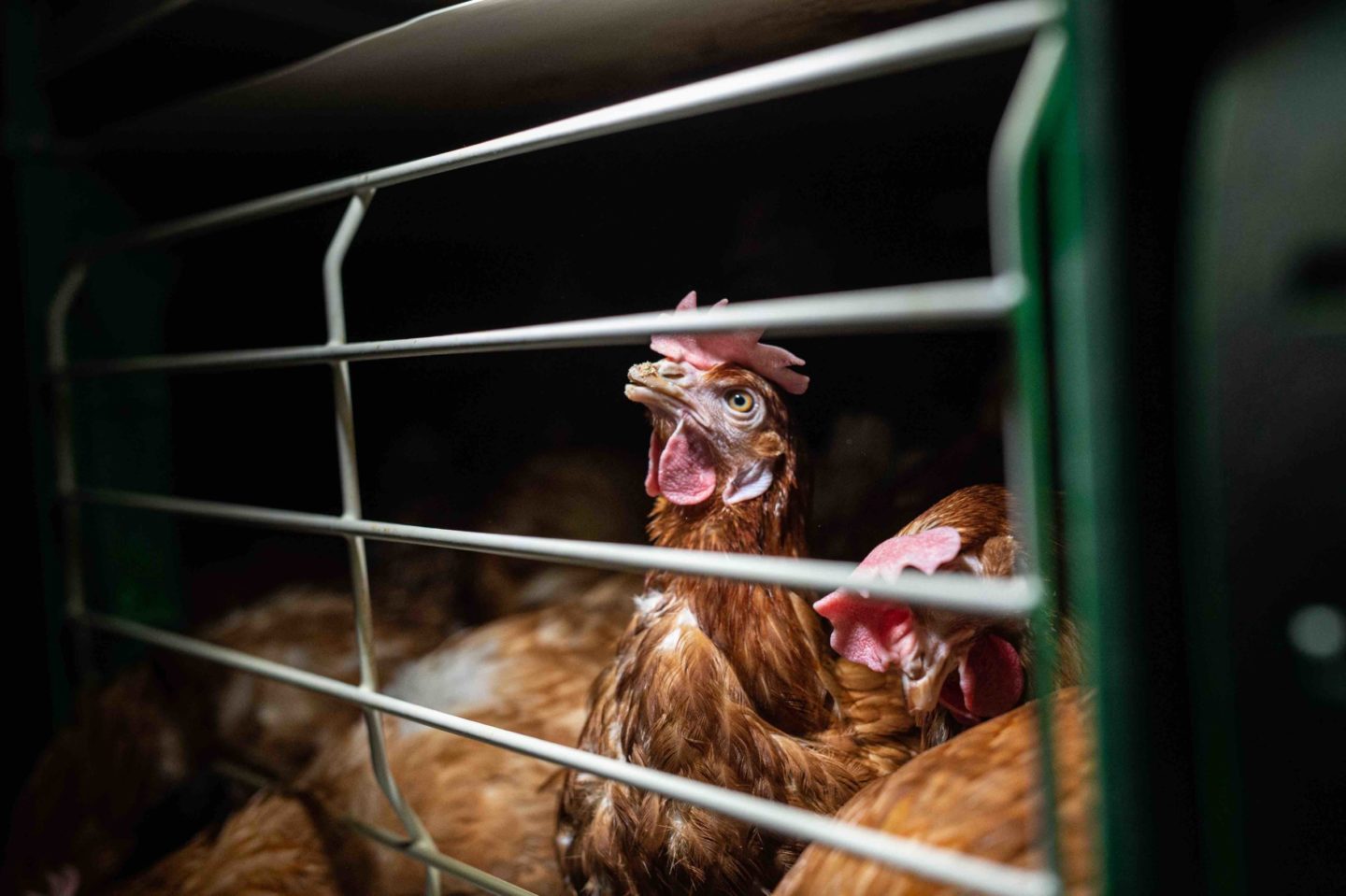
hen cage animal
Jo-Anne McArthur/Animal Equality

The American Veterinary Medical Association’s Guidelines for the Euthanasia of Animals rightly defines euthanasia as a “good death.” But the Guidelines make all kinds of exceptions for situations in which the inhumane killing of animals—a very bad death—may be considered “euthanasia.”

People take their beloved companion animals reluctantly to the veterinarian to be euthanized, not to get rid of an inconvenience or for some other selfish purpose, but because their pet’s suffering is profound, cannot be alleviated, and will only worsen. Euthanizing a hopelessly suffering nonhuman animal or human being is an act of mercy. In such cases, the decision-makers implicitly understand the true meaning of euthanasia. The sufferer is not going to die slowly and painfully with an infusion of, say, carbon dioxide gas (CO2), or be baked to death “humanely,” as described in “How to Kill Half a Million Chickens at Once” and in “Pigs Roasted Alive in Coronavirus Mass-Extermination, Probe Uncovers” where the investigators errantly refer to the killings as “euthanizing.”

This verbal corruption confounds our discourse when, instead of a companion animal or human sufferer, the subject is a chicken, a pig, a turkey, or a mouse on a farm or in a laboratory. In these settings, the individual is one of the hundreds, thousands, or millions of captive individuals who exist solely for human use. They are born to be harmed—injured, infected, killed—for human “benefit.” When the researcher or the farmer decides in the interest of expedience to kill them, by whatever means, the term that is used to characterize the procedure is “euthanasia.”

An example appears in the Iowa State University College of Veterinary Medicine publication, Water-Based Foam for Poultry Depopulation, which cites the American Veterinary Medical Association (AVMA) in support of the mass-suffocation of poultry under rolling carpets of chemically irritating fire-fighting foam:

Euthanasia of large numbers of birds in a quick, efficient manner with welfare consideration. The process is used to control disease spread or end the suffering of dying birds during a disease outbreak or natural disaster situations.

Though decades of research have confirmed that exposure to CO2 gas causes pain, panic and slow suffocation in mammals and birds, who will desperately seek to escape a CO2-filled chamber, the AVMA Guidelines 2020 equivocate, as in this directive for killing small animals in experimental settings:

In addition to humane outcomes, an important consideration in the choice of method for euthanasia of laboratory animals is the research objectives for the animals being euthanized.

For small animals like mice and rats in laboratories: Carbon dioxide, with or without premedication with halogenated [inhaled] anesthetics, is acceptable with conditions for euthanasia of small rodents.

In other words, a “humane outcome”—a manner of death that is painless, swift, and compassionate—may be sacrificed to “research objectives” and still be called “euthanasia,” and even absurdly at times, “humane euthanasia.”

Appallingly, the AVMA has fostered a language of impunity for agribusiness and the animal research industry to the point of elevating, in public and industry discourse, the opposite of what euthanasia and humane treatment literally mean. This fraudulent usage is a perfect example of Orwellian “newspeak,” which Merriam-Webster defines as “propagandistic language marked by euphemism, circumlocution, and the inversion of customary meanings.”

It’s easy for the public and for animal advocates to get lulled into a sense of complacency when all around us the authorities use terms like “euthanasia” to not only characterize but endorse the mass killings of farmed animals and animals in laboratories by asphyxiating, baking, or engulfing them in deadly chemicals with fire-fighting foam. Animals subjected to the cruelties of carbon dioxide, fire-fighting foam, and ventilation shutdown can take up to ten minutes, even hours, to die while struggling together in agony; and many survive these automated, crude procedures only to be trashed, buried or bulldozed, alive.

Where does this leave us—the animal advocacy community—in confronting the massive, unrelenting, painful carnage of living, breathing beings? Do we ignore it because the problem is too big for us to change? Do we justify our position because, as even animal advocates have said on occasion, fraught with frustration that can degenerate into apathy, “They’re going to die anyway”?

Of course, we’re all going to die, but when it comes to our own species and our beloved companion animals, we do not invoke our mortal fate as an excuse for abuse. The conundrum in the case of laboratory animals and farmed animals isn’t simply that they are “going to die anyway.” It’s that they are going to die inhumanely in a slaughterhouse or as part of an experiment, or in the inhumane circumstances that surround slaughter and experimentation—transportation, neglect, rough handling, overwhelming stress, fear, and learned helplessness.

There is no quick or easy answer because if there were, animal advocates would champion it. But this much we know: Silence and euphemisms like “euthanasia” are not the answer. We may be uncomfortable with a problem that is so immense and seemingly intractable, but we need to speak up—and speak accurately—even if we feel we’re shouting in the wind.

As animal advocates, we cannot allow animal exploiters to define the conversation for us, lull us into false rhetoric, or determine how we regard animals. Succumbing to these pressures, we degrade the lives of the animals down to the level at which the exploiters abuse them. By submitting to linguistic subterfuges, we accommodate virtually any mistreatment of animals as acceptable. This is the moral downslide that allows agribusiness and animal researchers to inflict pain, torment, and death on animals unfazed. It’s the type of “convenience” that debased language facilitates. As advocates for animals, let us not call the brutal mass-extermination of innocent, defenseless creatures for the sake of human convenience, “euthanasia.”

For the animals’ sake, we cannot let ourselves, or the public, be “put to sleep.”

Karen Davis, PhD is the President and Founder of United Poultry Concerns, a nonprofit organization that promotes the compassionate and respectful treatment of domestic fowl including a sanctuary for chickens in Virginia. She is the author of numerous books, essays, articles, and campaigns advocating for these birds. Her latest book is For the Birds: From Exploitation to Liberation: Essays on Chickens, Turkeys, and Other Domesticated Fowl (Lantern Books, 2019).

Barbara Stagno is the President and Founder of Citizens for Alternatives to Animal Research & Experimentation (CAARE). Since 1995, Barbara has worked to oppose the exploitation of animals, especially the use of animals in experiments. She founded CAARE in 2014 to disseminate information about the power of emerging science to end the use of animals in research, while also raising awareness of their immense suffering. Before starting CAARE, Barbara was a campaign director for a national animal protection organization.

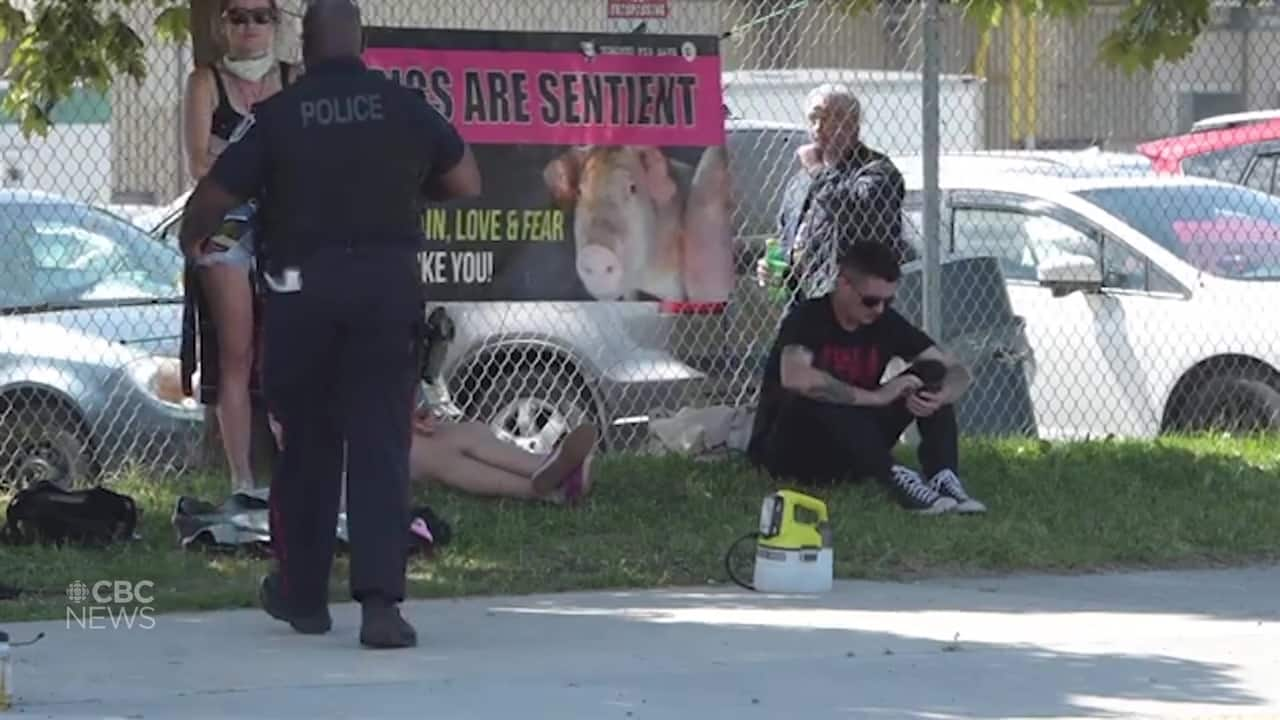
Protester dead in Burlington after being struck by transport truck at pig slaughterhouse

Halton Regional Police are investigating a pedestrian fatality in Burlington Friday after a protester was reportedly struck and killed by a transport truck outside the slaughterhouse.

The incident occurred outside the Fearmans Pork meat processing facility at Appleby Line and Harvester Road.

There are reports the protester — a woman — was trying to feed the pigs inside the transport truck while it was still moving when she was struck and killed.

Animal rights protesters have a long history of protesting at Fearmans.

The events’ declared purpose is to bear witness to the animals arriving for slaughter and reduce the disconnect people have with the food they have on their plate.

“This is so tragic, so heartbreaking,” said Geena Morrison, who has participated in pasts protests outside the plant. “I’m in tears.”

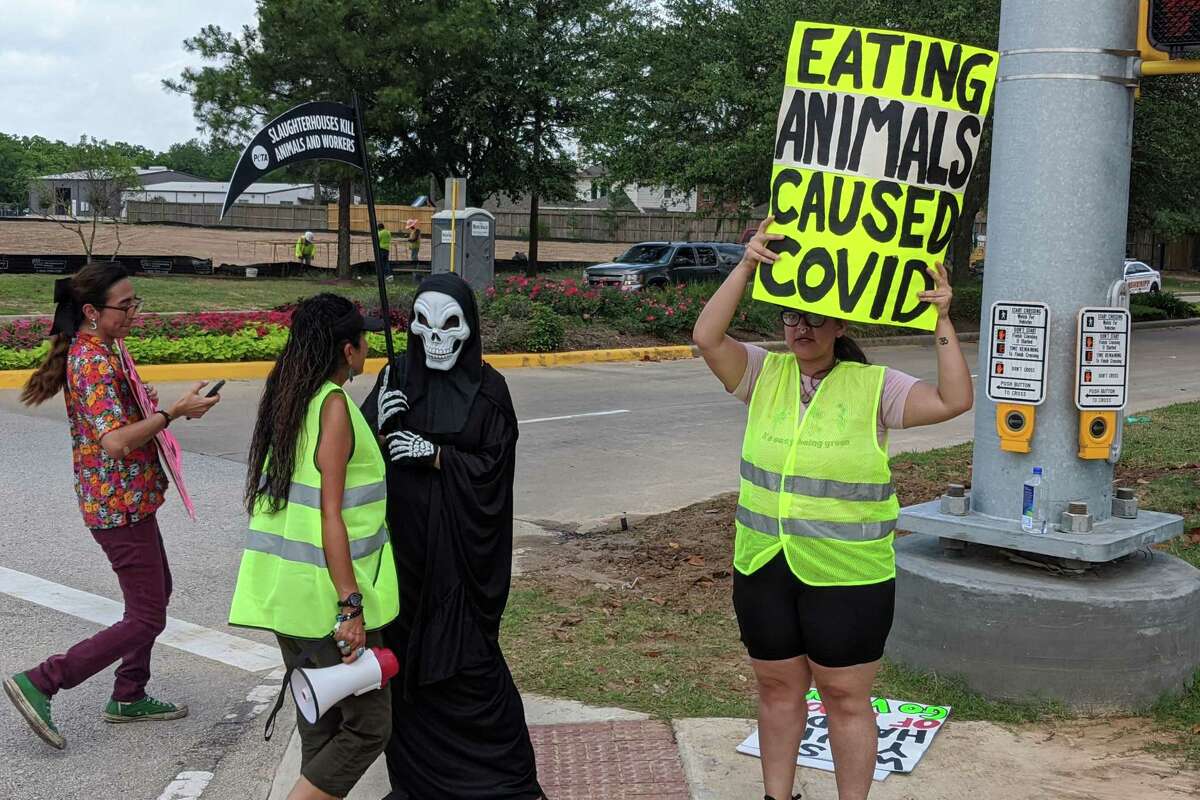
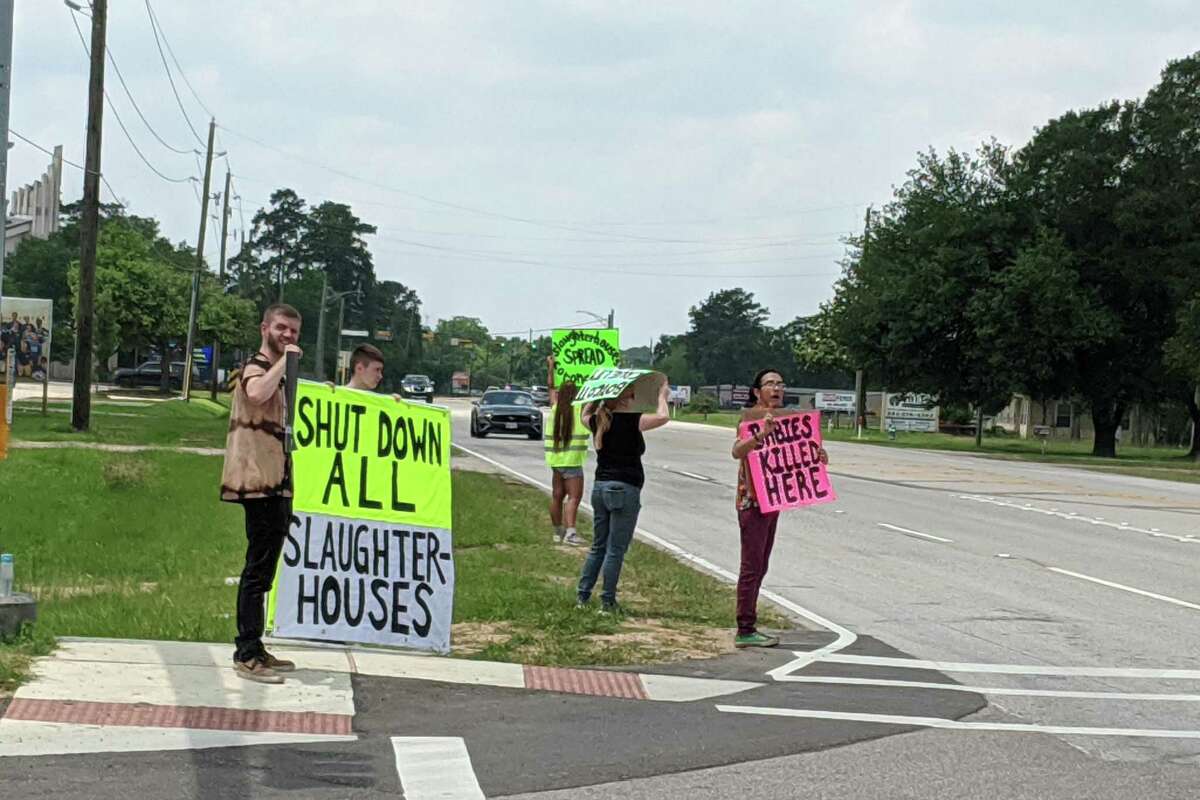
Vegan activists protest Spring meat processing center amid COVID-19 pandemic

Around a dozen protesters were camped out at the intersection outside the Fisher Ham and Meat Co. headquarters in Spring on Friday, demanding the meat processing facility be shut down amid the coronavirus pandemic.

Dani Alexander, one of the organizers of the event, called factory farms and slaughterhouses breeding grounds for new strains of dangerous bacteria and viruses, likening the spread of coronavirus from animals-to-humans to diseases such as bird flu and swine flu.

https://www.houstonchronicle.com/neighborhood/spring/news/article/Vegan-activists-protest-Spring-meat-processing-15273855.php#photo-19419456

Doctors Protest Continued Operation of Smithfield Foods Slaughterhouses In Virginia

Doctors to Protest Continued Operation of Smithfield Foods Slaughterhouses In Virginia

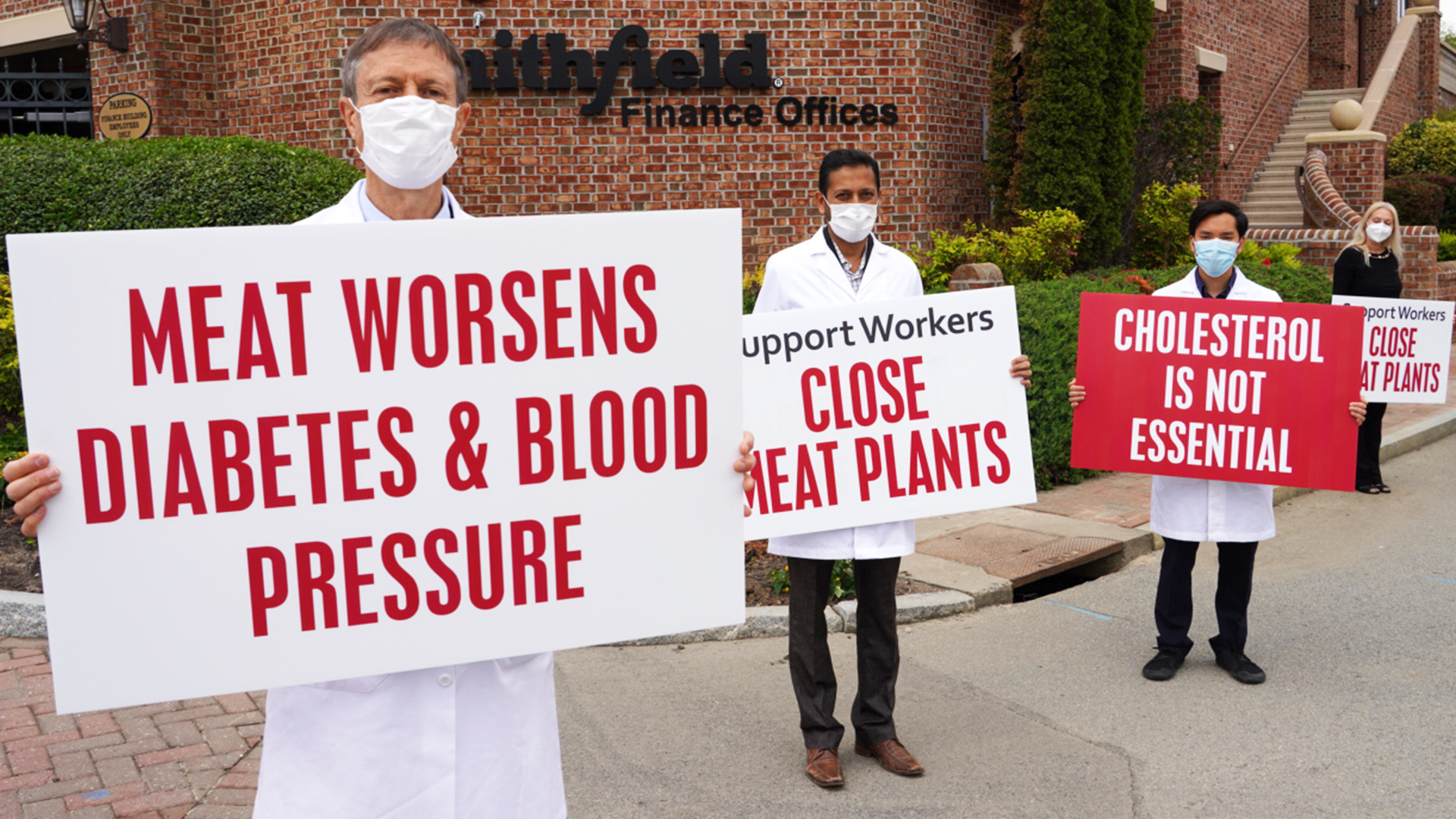
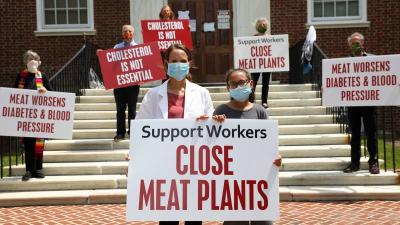
SMITHFIELD, Va.—Doctors with the Physicians Committee for Responsible Medicine called for the closure of meatpacking plants during a demonstration on May 14. The doctors will held signs reading “Support Workers, Close Meat Plants,” “Meat Worsens Diabetes & Blood Pressure,” and “Cholesterol Is Not Essential.” They maintained social distance while protesting outside of Smithfield Foods Headquarters, 200 Commerce Street, Smithfield, VA 23430, at the corner of Commerce Street and Luter Drive.

“Keeping Smithfield plants open harms the health of workers, the surrounding community, and consumers—all to line the pockets of the meat industry,” says Neal Barnard, MD, FACC, president and co-founder of the Physicians Committee for Responsible Medicine.

More than 15,500 meat plant workers are infected with COVID-19, and at least 60 have died. With workers lined up in close proximity, viruses are easily spread within the slaughterhouse environment. Although studies show that infectious viruses easily survive during refrigeration and freezing, meat companies do not routinely test the extent to which meat products are contaminated with the virus.

Meat consumption raises the risk for many of the underlying medical conditions—diabetes, hypertension, obesity, and chronic obstructive pulmonary disease—that can make COVID-19 infections more deadly. A recent study found that regular consumption of processed meat, red meat, or poultry increases the risk for cardiovascular disease. Research also links red meat, poultry, and fish to an increased risk for diabetes.


Media Contact

DONNA STEELE

202-527-7342

dsteele@pcrm.org

Founded in 1985, the Physicians Committee for Responsible Medicine is a nonprofit organization that promotes preventive medicine, conducts clinical research, and encourages higher standards for ethics and effectiveness in education and research.

More on COVID-19

US coronavirus hotspots linked to meat processing plants

https://www.theguardian.com/world/2020/may/15/us-coronavirus-meat-packing-plants-food

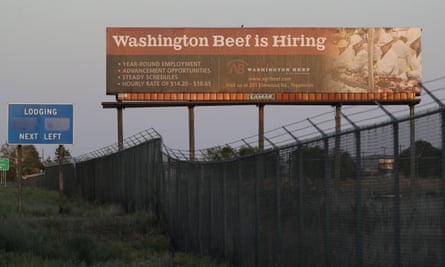
A billboard advertises job hiring at Agri Beef’s plant in Toppenish, Washington. Donald Trump last month declared such plants to be critical to the US economy.
A billboard advertises job hiring at Agri Beef’s plant in Toppenish, Washington. Donald Trump last month declared such plants to be critical to the US economy. Photograph: Ted S Warren/AP
Published onFri 15 May 2020 07.45 EDT

Almost half the current Covid-19 hotspots in the US are linked to meat processing plants where poultry, pigs and cattle are slaughtered and packaged, which has led to the virus spiking in many small towns and prompted calls for urgent reforms to an industry beset by health and safety problems.

At least 12 of the 25 hotspots in the US – counties with the highest per-capita infection rates – originated in meat factories where employees work side by side in cramped conditions, according to an analysis by the Guardian.

In Nebraska, five counties have outbreaks linked to meat plants including Dakota county, where about one of every 14 residents has tested positive – the second-highest per capita infection rate in the US. As of Thursday, the Nebraska counties of Dakota, Hall, Dawson, Saline, and Colfax accounted for almost half the state’s 9,075 positive cases, according to data tracking by the New York Times.

Meat processing plants seem to have emerged as incubators for the coronavirus, which has spread rapidly among workers unable to perform physical distancing.

The virus spreads among people in close contact for a prolonged period. It is mostly transmitted through tiny droplets from an infected person’s nose or mouth when they cough, sneeze or talk.

On Wednesday, a fourth US agriculture department (USDA) food safety inspector died, this time in Dodge City, Kansas. The city is located in Ford county, where one in 28 residents is infected – the 11th-highest rate in the US. In Kansas, outbreaks in four of the hardest-hit counties are linked to large meatpacking plants.

Almost 300 inspectors, who have struggled to get access to adequate protective gear, are off sick with Covid-19 or under self-quarantine due to exposure, said the USDA, which regulates about 6,500 plants, including 300 or so factories with more than 500 employees.

The deregulation of slaughterhouses and meatpacking plants over the past two decades has increased output and profits at the cost of health and safety, according to advocates .

Even before the pandemic, the industry was riddled with “serious safety and health hazards … including dangerous equipment, musculoskeletal disorders, and hazardous chemicals,” according to the Occupational Safety and Health Administration.

“The pandemic has shone a light on the meat industry where for years workers have been exploited in these plants including being penalized for not showing up even when they are sick or injured. Even now, it’s taken plants to be shut down for companies to provide protective gear for workers,” said Tony Corbo, a senior lobbyist at the not-for-profit Food & Water Watch.

At least 30 plants have suspended operations over the past two months, and scores more have reduced operations amid a growing public outcry about working conditions for mostly migrant workers.

But many are now starting to reopen – a move encouraged by Donald Trump, who, in an attempt to fend off unrest about meat shortages in supermarkets, last month declared meat processing plants to be critical infrastructure.

In Nobles county, Minnesota, almost 500 workers at a large Brazilian-owned JBS pork plant have tested positive. The outbreak rapidly spread through the county, with 1,291 confirmed cases as of Wednesday compared with just a handful in mid-April. About one in 17 people in the county have now tested positive, though the infection is now slowing.

The Nobles plant reopened last week after two weeks closed. It has reportedly introduced a host of safety measures, including face shields for those working in close proximity.

Congress will vote on Friday on another Covid-19 rescue package, which includes mandatory health and safety regulations for all essential workers, including meat processing and care-home staff.

At least 4,500 Tyson workers have caught COVID-19, with 18 deaths. The meat giant still doesn’t offer paid sick leave, as the industry blames workers for outbreaks.

Workers leave the Tyson Foods pork processing plant in Logansport, Indiana, on May 7, 2020 (Michael Conroy_AP Photo
Workers leave the Tyson Foods pork-processing plant in Logansport, Indiana, on May 7. 
Michael Conroy/AP Photo
  • At least 4,585 Tyson workers in 15 states have been diagnosed with COVID-19, and 18 have died.
  • Tyson has announced improved safety measures and relaxed attendance policies, but it still does not offer full paid sick leave for workers, instead offering short-term disability that is 90% of workers’ pay.
  • Some politicians and meat-industry insiders have blamed the actions and “living circumstances” of employees — many of whom are immigrants — for plants becoming coronavirus hot spots.
  • Visit Business Insider’s homepage for more stories.

Some meat-industry insiders and politicians are blaming employees for meat-processing plants becoming coronavirus hot spots.

Meanwhile, workers say their employers failed to keep them safe. And despite new safety policies, meat-industry giants including Tyson still do not provide full paid sick leave.

An analysis by Business Insider found at least 4,585 cases of COVID-19 and 18 deaths linked to Tyson. The cases span meat-processing plants in 15 states, according to data from state and local governments, the Midwest Center for Investigative ReportingThe Counter, and local news publications.

Tyson has highlighted the new steps it’s taking to protect workers, including taking temperatures, requiring face masks, instituting additional daily deep cleanings, and installing workstation dividers. The company says it has relaxed its attendance policy and waived the waiting period to qualify for short-term disability, as well as the copay, coinsurance, and deductible costs for COVID-19 testing.

However, Tyson still does not offer full paid sick leave; instead, it offers short-term disability. Until the end of April, Tyson’s short-term disability covered only 60% of pay. On April 29, the company said it raised short-term disability coverage to 90% of normal pay until the end of June.

A Tyson representative told Business Insider that the company increased its short-term disability pay as “another way of encouraging team members to stay home when they are sick.”

The Centers for Disease Control and Prevention has encouraged meat-processing plants to make it easier for workers to take paid sick leave to prevent the spread of the coronavirus. Progressive organizers have argued that the lack of paid sick leave makes certain groups even more vulnerable, especially during the coronavirus pandemic.

“We see expanding access to paid sick leave, and family and medical leave, as an economic-justice issue,” said Nicole Regalado, the deputy director of the American Civil Liberties Union’s liberty division. “It’s also a women’s rights issue and a racial-justice issue.”

Some people are blaming meat-processing workers for their own illnesses

Tyson Foods coronavirus
A worker at a Tyson Foods plant in Rogers, Arkansas, on April 24. 
Tyson Foods

According to the Midwest Center for Investigative Reporting, there were at least 12,500 COVID-19 cases and 51 deaths in the meatpacking industry across the US as of Sunday.

Experts told Business Insider last week that meat-processing plants were the next coronavirus hot spots, as many of the largest clusters of COVID-19 cases have been linked to slaughterhouses.

As the number of COVID-19 cases has skyrocketed, some politicians and meat-industry insiders have blamed workers.

More than half of frontline workers in the meat-processing industry are immigrants, according to the Center for Economic and Policy Research. People of color also make up the majority of the meatpacking workforce: 44% of meatpackers are Latino and 25% are black.

South Dakota Gov. Kristi Noem said in an interview with Fox News in April that Smithfield employees at a Sioux Falls meat-processing plant were not getting sick at work but at home, “because a lot of these folks who work at this plant live in the same community, the same buildings, sometimes in the same apartments.”

At least 783 workers from the Smithfield plant have been diagnosed with COVID-19, and two have died.

In late April, a Smithfield representative echoed Noem’s comments, telling BuzzFeed News that the plant’s “large immigrant population” in which “living circumstances in certain cultures are different than they are with your traditional American family” contributed to the hundreds of COVID-19 cases.

A Smithfield representative told Business Insider that the BuzzFeed News article “is in no way, shape or form representative of our position on this topic.”

“They come from all over the world and speak dozens of languages and dialects. Our position is this: We cannot fight this virus by finger-pointing,” the representative said. “We all have a responsibility to slow the spread. At Smithfield, we are a family and we will navigate these truly challenging and unprecedented times together.”

Politico reported last week that Alex Azar, the health and human services secretary, said on a call in late April that clusters of COVID-19 cases in the meat-processing industry were more heavily linked to “home and social” aspects of employees’ lives, not the conditions in plants.

Last week, while discussing the legality of Wisconsin’s stay-at-home order, Wisconsin Supreme Court Chief Justice Patience Roggensack sparked backlash after saying a cluster of COVID-19 cases was tied to a JBS meat-processing plant and its workers, not “regular folks.”

Workers and unions representing employees of meat-processing plants have pushed back, saying employers failed to take the necessary precautions to keep employees safe. Bill Marler, an attorney, recently told Business Insider that America’s response to clusters in meat-processing plants had been influenced by who has become ill.

“If that was a grade school full of white kids, we’d all be freaking out,” Marler said of the Smithfield plant in Sioux Falls.

President Donald Trump signed an executive order in April demanding that meat-processing plants stay open to prevent meat shortages. Experts have said that with pork and beef production plunging by 35% because of plant closures, shortages and price inflation are nearly guaranteed in the coming months.

Tyson warns more meat plant closures are coming

New York (CNN Business)Tyson warned Monday that it expects more meat plant closures this year.

The company also said it will continue producing less meat than usual, as workers refrain from coming to work during the coronavirus pandemic.
“We have and expect to continue to face slowdowns and temporary idling of production facilities from team member shortages or choices we make to ensure operational safety,” the company said in a statement discussing financial results from the first three months of this year.
“We will not hesitate to idle any plant for deep cleaning when the need arises,” CEO Noel White added during an analyst call Monday.
The meat processor has shuttered a number of plants in recent weeks as workers fall ill with Covid-19. It’s warned that if the closures continue, America’s food supply will suffer.
“There will be limited supply of our products available in grocery stores until we are able to reopen our facilities that are currently closed,” Board chairman John Tyson warned in a full-page ad that appeared recently in newspapers across the country.

The Trump administration wants plants to reopen

Tyson warned that more disruptions are ahead.

In an executive order signed last week, the president gave Secretary of Agriculture Sonny Perdue the power to invoke the Defense Production Act to force companies to keep their plants open. The order, however, has not led to a widespread reopening of meat production plants.
In a statement responding to the directive, Smithfield lauded the decision but noted that it is “evaluating next steps to open its currently shuttered facilities and will make announcements when it is ready to resume operations in each location.”
The day after the president signed the order, JBS USA announced it would partially reopen its pork production facility in Worthington, Minnesota — but only to euthanize hogs that won’t be processed because of bottlenecks in the supply chain.
“While our focus is on getting the Worthington facility back to work on behalf of our team members producing food for the nation, we believe we have a responsibility to step up when our producer partners are in need,” Bob Krebs, President of JBS USA Pork, said in a statement. “None of us want to euthanize hogs, but our producers are facing a terrible, unprecedented situation.”
The National Pork Producers Council also praised the order but acknowledged that hogs will still go to waste.
“While getting pork packing plants back online is foundational, the tragic reality is that millions of hogs can’t enter the food supply,” the council said in a statement, adding “we need coordinated partnership between the industry and federal, state and local authorities to euthanize pigs.”
The pandemic has halved the amount of pork processing capacity in the country, according to the company.
The challenge for Tyson: While meat processing plants have ground to a stop, consumer demand for meat is up.
Tyson (TSN) reported selling 2.7% more more beef by volume in the first three months of the year compared to the same period in 2019. Pork sales popped 2% by volume, while chicken sales fell 1.5%, partially because of restaurant closures due to the pandemic.
Overall, retail sales are up about 30% to 40%, White estimated. In food service, he added, sales have fallen about 25% to 30%