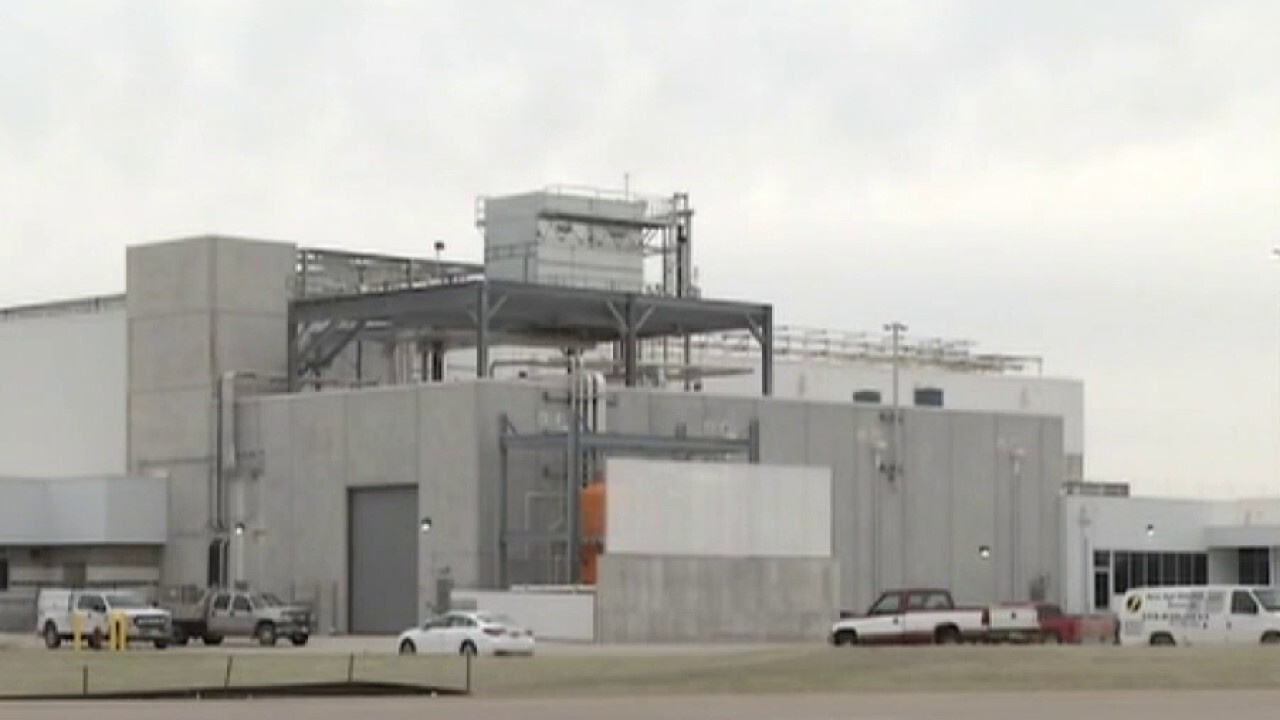
Almost 900 workers at a Tyson Foods plant in Indiana have tested positive for the coronavirus, according to a report on Wednesday.
The plant, located in Logansport, Ind., has seen 890 of its 2,200 employees test positive in just under a week — which is more than 40 percent of its workforce. It’s one of several Tyson plants across the country that have voluntarily closed due to virus outbreaks.
County officials have been working with Tyson, the largest U.S. meat supplier, in developing a plan to reopen, according to Indianapolis’s WISH-TV.
Case County Commissioner Ryan Browning said that plan has been expedited after President Trump signed an executive order on Tuesday, ensuring meat processing plants would stay open during the coronavirus pandemic.
The businesses are now declared as “critical infrastructure” under the Defense Production Act.
“So there is some worry there that might force them to flip a switch and go but we are continuing with our plan,” Browning told the station.
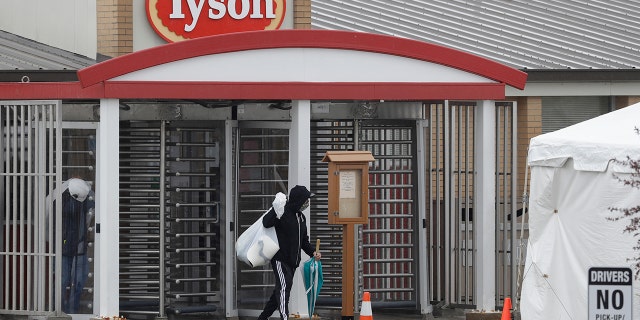
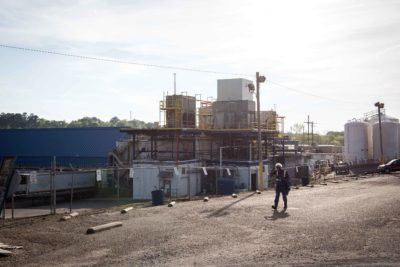
A Tyson Fresh Meats plant employee leaves the plant, April 23, in Logansport, Ind. The plant will temporarily close its meatpacking plant in north-central Indiana after several employees tested positive for COVID-19. (AP Photo/Darron Cummings)
Pork processing offers workers little personal space, who typically work in a close-quarter environment, WISH-TV reported. The virus is known to spread from person-to-person within six-feet, through respiratory droplets in the air, according to the Centers for Disease Control and Prevention.
Tyson released a statement regarding the safety of its employees.
“We’ve been screening worker temperatures, requiring protective face coverings and conducting additional cleaning and sanitizing. We’ve also implemented social distancing measures, such as workstation dividers and more breakroom space,” it said, according to the station.
Health officials reported 1,283 coronavirus cases in the county as of Tuesday. The peak number of cases is expected to hit in the next two weeks.
Indiana has seen more than 17,835 coronavirus cases and at least 1,114 deaths from the virus, as of early Friday, according to data from Johns Hopkins.
Raul A. Reyes is an attorney and a member of the USA Today board of contributors. Follow him on Twitter @RaulAReyes. The opinions expressed in this commentary are solely those of the author. View more opinions on CNN.
(CNN)Get back to work, says President Trump. He might as well add: even if it might kill you.
Raul A. Reyes
Tuesday, he used the Defense Production Act to order meat and poultry processing plants to stay open, despite the coronavirus pandemic. He declared them “critical infrastructure” in an executive order designed to avoid shortages of beef, pork and chicken.
“We’re working very hard,” Trump said, “to make sure our food supply chain is sound and plentiful.”
Given that meat processing plants are Covid-19 hotspots, this order is the height of irresponsibility and cruelty. It endangers the health of some of America’s most vulnerable workers, many of whom are Latino, African American and immigrants. It prioritizes corporate interests over workers’ lives.
Across the country, meatpacking plants have been closing as their employees have gotten sick. Smithfield Foods closed its pork processing plant in Sioux Falls, South Dakota, this month after more than 600 workers tested positive for coronavirus. Last week, Tyson Farms shut down its biggest pork processing plant in Waterloo, Iowa, after more than 180 workers tested positive.
Mayor: Closing Tyson plant was ‘best course of action’ to support workers04:13
The employees at such plants work under extremely difficult, hazardous conditions. They often work shoulder to shoulder, receiving and killing animals and butchering them for sale. It is grueling, repetitive work that many Americans would shudder at doing, especially given the risk of injury and the low pay.
In 2017, employees at meat plants earned on average about $15 an hour plus benefits, while employees at chicken plants earned on average about a dollar less per hour. The think tank New American Economy estimates that nearly half of this workforce is made up of immigrants, and many are people of color.
Trump’s order may well amount to a death sentence for workers in meatpacking plants, who have little choice but to continue to work to provide for their families. In Iowa, for example, citing Iowa state data, The Gazette reports that African Americans and Latinos have disproportionately high rates of coronavirus as a result of their work in meatpacking plants when compared with US Census Bureau figures on their relative representation in the state: While Latinos are 6% of Iowa’s population, they account for 17% of the state’s confirmed coronavirus cases. African Americans are 3% of the state’s population, yet they are 9% of the state’s coronavirus cases.
These are the people the President wants to continue working for the benefit of American consumers. How unsurprising that the President, who has shown unprecedented cruelty and disdain for immigrants and minorities, now expects them to risk their lives so we all can have an uninterrupted food supply.
Recall, for one example, that last year, Trump ordered massive sweeps of food processing plants in Mississippi, resulting in hundreds of arrests of undocumented workers, as well as devastated communities.
The way Trump rolled out this executive order is especially telling. He told reporters he was working with Tyson Foods — as opposed to health and workplace safety experts. The order was developed in consultation with corporate industry leaders.
“We’re going to sign an executive order today, I believe, and that’ll solve any liability problems,” Trump said on Tuesday.
How meat plant closures could impact consumers02:46
While his executive order states that employers will follow guidelines from the US Centers for Disease Control and Prevention and the Occupational Safety and Health Administration, his main concern seems to be for corporate bosses, not for employees or public health. And does anyone think that the President would be comfortable ordering white-collar professionals to stay at work, despite significant health risks of Covid-19 transmission?
That Trump was reluctant to invoke the Defense Production Act to expedite the production of personal protection equipment (PPE) for health care workers, and is now invoking the act in a manner that could truly harm meat plant workers, speaks volumes.
The president and CEO of the North American Meat Institute told the website Vox that meat processing plants are completely disinfected every night after the last shift, and that workers are required to wear masks and face shields when the plants can obtain them.
Separately, Dean Banks, the head of Tyson Foods, told CNN’s Erin Burnett that “we’re doing everything we can to make sure we take care of our team members.” Banks said that his company was “extremely early in providing as many protective measures as we could possibly imagine.”
Yet if conditions were safe, employees would not be staging walkouts and protesting at meat plants over working conditions.
There is no doubt that the meat processing sector is facing a serious threat from the coronavirus pandemic. The United Food and Commercial Workers international Union noted that plant closures have resulted in a 25% decline in pork slaughter capacity and a 10% reduction in beef slaughter capacity.
But the union also estimated that 20 meatpacking and food processing union workers have died from the virus so far, and that 6,500 union workers are sick or have been exposed to the virus. So safeguarding our food supply needs to begin with safeguarding workers on the food supply chain. A thoughtful response to this situation would be to prioritize worker safety, not corporate input.
Trump should be ordering the meat processing industry to comply with the highest standards of social distancing and safety, or else face fines and criminal liability. Instead he is protecting the industry at the expense of its workers.
Like so many other aspects of his administration’s coronavirus response, Trump’s latest executive order is profoundly misguided and negligent. Meat processing plant employees are not expendable — and should not be forced back into dangerous working conditions.
Share this with EmailShare this with FacebookShare this with Twitter
Image copyrightEPA
Image captionClosures of meat processing plants quickly affect the food supply chain
US President Donald Trump has ordered meat processing plants to stay open to protect the nation’s food supply amid the coronavirus pandemic.
He invoked a Korean War-era law from the 1950s to mandate that the plants continue to function, amid industry warnings of strain on the supply chain.
An estimated 3,300 US meatpacking workers have been diagnosed with coronavirus and 20 have died.
The UN last month warned the emergency threatened global food supply chains.
Twenty-two US meatpacking plants across the American Midwest have closed during the outbreak.
They include slaughterhouses owned by the nation’s biggest poultry, pork and beef producers, such as Smithfield Foods, Tyson Foods, Cargill and JBS USA.
“Such closures threaten the continued functioning of the national meat and poultry supply chain, undermining critical infrastructure during the national emergency,” says Tuesday evening’s executive order, invoking the 1950 Defense Production Act.
“Given the high volume of meat and poultry processed by many facilities, any unnecessary closures can quickly have a large effect on the food supply chain.”
The order designates the meatpacking plants as part of critical infrastructure in the US.
A White House official told US media it will work with the Department of Labor to issue guidance for vulnerable workers, such as over-65s and those with chronic health conditions, to stay at home.
Like lambs to the slaughter?
Analysis by Jessica Lussenhop, BBC News
The leadership of large meatpacking companies have faced tough questions over whether they did enough to prepare for the pandemic and protect workers.
On top of the fact that production lines necessitate that workers stand very close together, most are low-income, hourly workers.
Many are immigrants living paycheque to paycheque, like the ones at a Sioux Falls, South Dakota, pork plant who told the BBC that despite the risk, they have no choice but to go to work if plants are open.
Without strict adherence to safety guidelines – which are not currently being deemed “mandatory” by the Occupational Safety and Health Administration – it’s not hard to picture new outbreaks at factories, or resurgences of the virus in factories that shuttered but reopen prematurely.
All of this could leave these employees trapped in the same impossible choice they were in when the virus first began spreading in factories in late March: risk my health or lose my job.
What does the meat industry say?
John Tyson, chairman of Tyson Foods took out full-page ads on Sunday in the Washington Post and New York Times to warn “the nation’s food supply is breaking”.
“As pork, beef and chicken plants are being forced to close, even for short periods of time, millions of pounds of meat will disappear from the supply chain,” he wrote.
“As a result, there will be limited supply of our products available in grocery stores until we are able to reopen our facilities that are currently closed.”
He said millions of cattle, pigs and chickens will be euthanised because of slaughterhouse closures, limiting supplies at supermarkets.
Pork production has borne the brunt, with daily output slashed by at least a quarter.
Tyson – which employs some 100,000 workers nationwide – has suspended operations at its pork plant in Waterloo, Iowa.
Smithfield Foods shut down production at its plant in Sioux Falls, South Dakota, after an outbreak infected hundreds of employees.
What do the unions say?
The United Food and Commercial Workers International Union (UFCW), the largest US meatpacking union, demanded the Trump administration compel meat companies to provide proper protective equipment and ensure daily coronavirus testing for slaughterhouse workers.
“While we share the concern over the food supply, today’s executive order to force meatpacking plants to stay open must put the safety of our country’s meatpacking workers first,” said the union.
The UFCW said the White House order would provide legal cover to companies in case employees catch coronavirus at work.
“We’re working with Tyson,” Mr Trump told reporters in the Oval Office earlier on Tuesday. “We’re going to sign an executive order today, I believe, and that will solve any liability problems.”
Richard Trumka, the president of the AFL-CIO union, said: “Using executive power to force people back on the job without proper protections is wrong and dangerous.”
So far in April, the U.S. Department of Agriculture has issued waivers to 15 chicken slaughterhouses, allowing them to speed up the rate of killing from 140 birds per minute to 175 birds per minute—about three birds per second. Photo by Blickwinkel/Alamy Stock Photo
The federal government has handed out a record number of waivers this month for chicken slaughterhouses to dial up the already dangerous speeds at which they kill birds. The development not only raises animal welfare concerns, but it comes at a time when slaughterhouses have emerged as major clusters for the spread of the coronavirus because of their cramped, unsanitary working conditions—conditions that line speed increases will only worsen.
So far in April, the U.S. Department of Agriculture has issued waivers to 15 chicken slaughterhouses, allowing them to speed up the rate of killing from 140 birds per minute to 175 birds per minute—about three birds per second. This is a significant increase in the waivers issued each month since the new program went into effect in 2018, and it adversely affects millions more animals. In the period between January and March this year, the agency only issued a single waiver.
The USDA’s decision came just weeks after a coalition of groups, including the Humane Society of the United States, sued the agency in February for allowing the increase in line speeds. We are concerned because slaughtering animals at this rate increases suffering for birds in their final moments, creates even more dangerous conditions for workers and compromises the health and safety of consumers.
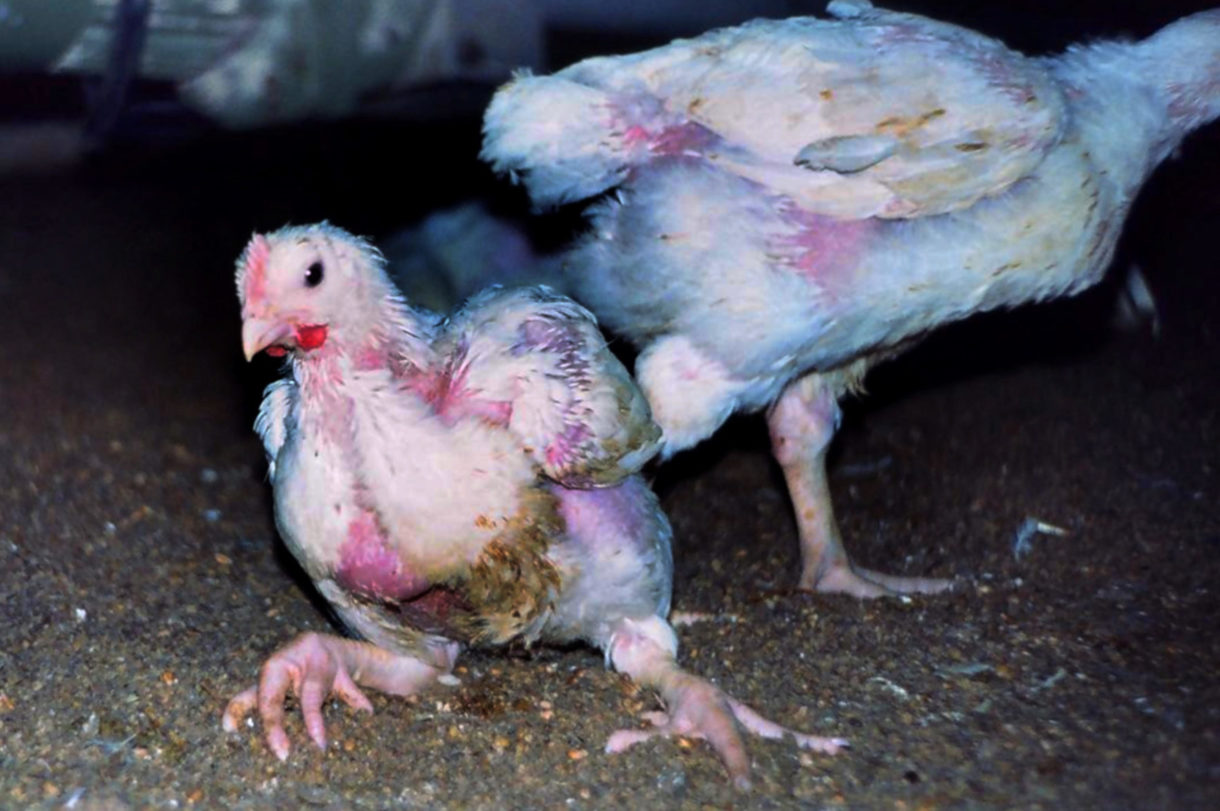
At such high speeds, workers struggling to keep up with the rapidly moving slaughter lines grab the chickens and slam them into shackles, injuring the animals’ fragile legs. Some birds miss the throat-cutting blade and enter the scalder—a tank of extremely hot water—alive and fully conscious, resulting in a terrible death.
In recent weeks, slaughterhouses have also been in the news for their role in exacerbating the coronavirus pandemic. A South Dakota pig slaughterhouse has been linked to nearly 900 cases of the disease, making it the single largest cluster in the entire country. At least 2,700 cases have been tied to 60 meatpacking plants in 23 states, and at least 17 workers in these plants have died. Some slaughterhouses, such as the one in South Dakota and Tyson’s largest U.S. pig slaughterhouse, have finally shuttered their doors, but many remain open even after workers have tested positive for the virus.
These slaughterhouses are also dangerous for the communities where they are located. A USA Today analysis found that counties with some of America’s largest beef, pork and poultry processing plants have coronavirus infection rates higher than those in 75% of other U.S. counties.
With all this evidence, it is mindboggling that the USDA is giving out more waivers, choosing to help fatten the bottom lines of corporate interests over animal welfare, food safety and the safety of the agency’s own inspectors and slaughterhouse employees.
Last week, our legal team warned the USDA that we would amend our lawsuit and take steps to seek a quick ruling following the increased waivers, and the agency now appears to have relented slightly. Yesterday, a spokesperson for the USDA told a Bloomberg reporter that it has “stopped accepting additional requests” from chicken slaughterhouses to operate at higher speeds.
But this is not good enough—we are asking that the agency revoke all of the waivers it has already issued. Our federal government should never prioritize industry profits over animal welfare, worker safety and public health, and especially not in the midst of a global pandemic.
A parade float encourages residents to stay strong in High River, Alta., March 27, 2020, amid the worldwide COVID-19 pandemic. Health officials said that as of Friday, 358 cases in High River and elsewhere in the region were linked to the nearby Cargill facility.
JEFF MCINTOSH/THE CANADIAN PRESS
High River has become a hot spot for COVID-19 in Alberta, with hundreds of infections, including staff at a long-term care home, tied to one of Canada’s largest slaughterhouses.
Health officials said that as of Friday, 358 cases in High River and elsewhere in the region were linked to the Cargill facility. Many of the workers at the Cargill Ltd. plant are new immigrants or temporary foreign workers, whose jobs and shared living spaces make them especially vulnerable to infection. At least one worker is on a ventilator, the union for the plant says, and others are struggling with serious illnesses.
Cargill is a major employer in High River, a bedroom community of roughly 13,000 people located a half-hour drive south of the Calgary city limits. About 2,000 people work there and the facility supplies about 40 per cent of the beef processed in Western Canada.
Foothills County now has more cases than Edmonton, a city with more than 10 times the population. The province’s Chief Medical Officer of Health has said that infections quickly spread among large households, and a local settlement agency said that temporary foreign workers often live together in large groups.
The Seasons High River retirement home, which includes nursing care, said five staff members tested positive but no residents have been infected. Four of the infected staff live with Cargill workers.
Thomas Hesse, president of United Food and Commercial Workers Local 401, said many of the plant’s employees are either temporary foreign workers or new Canadians, for whom English is a second language, though he didn’t know how many would fit into those categories. He said some workers who have contracted COVID-19 are in serious condition, including one who is in an induced coma and on a ventilator in a Calgary hospital.
Mr. Hesse said North American meat-packing facilities “are designed around efficiency and social proximity, not social distancing.”
“The lines are arranged in highly efficient ways and workers stand shoulder to shoulder, wielding knives. It’s loud, it’s slippery, it’s wet and there’s blood everywhere, especially on the slaughter side [of the operation],” he said, adding, “The plant hallways and lunch rooms and bathrooms are a certain size and they’re not rebuilding the plants to confront COVID.”
The union and Alberta’s Opposition New Democrats have called for the plant to be temporarily shut down to get a handle on the outbreak, but so far that hasn’t happened.
A Cargill worker, who has been recovering at home since he and his spouse became sick and tested positive for COVID-19, said he is afraid to return without assurances from the company that the plant is safe. The Globe and Mail agreed not to identify the worker, who is worried that speaking publicly would jeopardize his job.
Employees at the plant work in close quarters as they slaughter 4,500 head of cattle a day.
“How can they change the process? For us, we are doing sometimes 330 [heads of cattle] an hour – you can imagine that,” he said.
“There are some work stations that [are] too close.”
Jon Nash, president of Cargill Protein, a division of Cargill Inc., said in a statement that the company has scaled back operations and put in several measures to curb the outbreak, including staggering shifts, increasing distance between workers, checking employees’ temperature, providing face masks, prohibiting visitors and increasing cleaning. The company said some workers have taken unpaid leave.
Minneapolis-based Cargill Inc. – which also makes and trades grain, processes other types of meat and operates other agriculture-related businesses – is one of the largest privately held companies in the world and employs 160,000 people in 70 countries, according to its website. It has 8,000 workers in Canada, where it has operations in six provinces.
The High River facility is one of several suppliers of ground beef for McDonald’s Canada.
“At this time, Cargill has assured us that they are confident in the resilience of their supply chain and will continue to meet our current demand for beef,” McDonald’s Canada said in an e-mailed statement Sunday.
Fariborz Birjandian, chief executive officer of the Calgary Catholic Immigration Society, which operates Foothills Immigrant Community Services in High River, said his agency is working with Cargill staff who have become infected or are required to self-isolate. He said it’s common for temporary foreign workers to live with half a dozen or more people in a single unit.
“Temporary foreign workers come here to make money and send it back home, so they are trying to minimize their costs by sharing rooms,” he said.
“That makes them very vulnerable. … If one of them is infected, then the rest will be infected.”
Mr. Birjandian said he hopes the Cargill outbreak serves as a wake-up call to other such facilities in an industry that relies heavily on temporary foreign workers or new immigrants, including resettled refugees.
Ontario-based Seasons Retirement Communities, which operates long-term care homes across the country, including in High River, said of the five staff members who have tested positive for COVID-19, four live with someone who works at the plant. CEO Mike Lavallée said in a statement that no residents have tested positive.
Mr. Lavallée’s statement said the High River facility has implemented a series of measures including daily health screenings for all residents, staff and visitors.
Alberta recorded 2,803 cases of COVID-19 as of Sunday and 55 deaths. One of those deaths was in High River: a man in his 70s at a long-term care home attached to the local hospital.
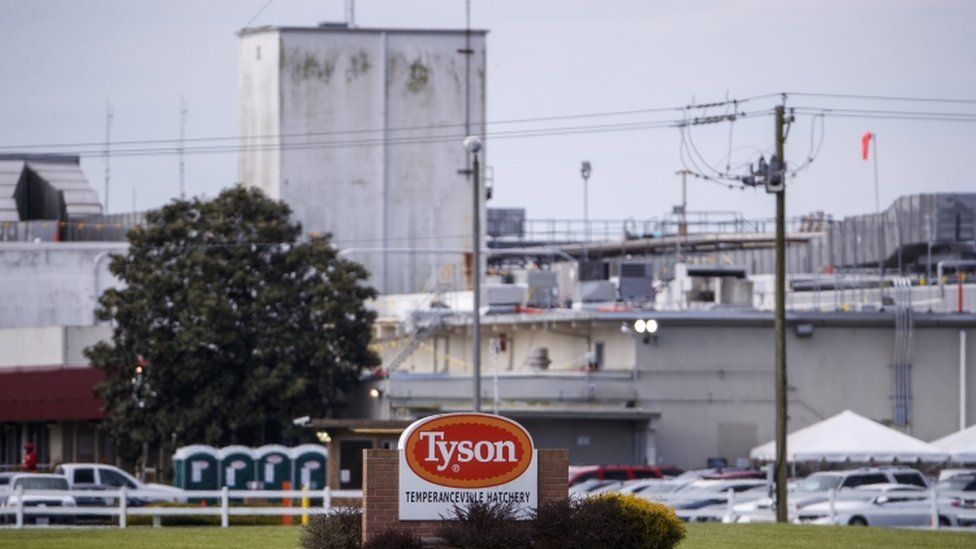
In Georgia, three employees at a Tyson Foods plant have died from coronavirus, and several others are sick or in quarantine, according to the Retail, Warehouse and Department Store Union.
“Workers debone chickens elbow to elbow with no access to masks. They work at speeds of upwards of 80 chickens per minute,” the Union said.
It accused Tyson of delaying distribution of personal protective equipment to workers, and implementation of measures such as social distancing protocols, protective barriers and staggered start times and breaks. CNN has reached out to Tyson Foods for comment.
And in South Dakota, more than half of the 143 new cases of coronavirus in the state are linked to the Smithfield Foods plant, one of the nation’s largest pork processing facilities, the state’s health department said.
CNN’s Wes Bruer, Nicole Chavez, Jay Croft, Dakin Andone, Jason Hanna, Jamiel Lynch, Joe Sutton and Andy Rose contributed to this report.
Cases reported in Colorado, South Dakota, Pennsylvania
‘You cannot make sacrifices like this with people’s lives’
We’re tracking the latest on the coronavirus outbreak and the global response. Sign up here for our daily newsletter on what you need to know.
There’s been a spike in coronavirus cases at meat plants in the U.S., with hundreds of reported infections in just the last week. That’s adding to questions over the fragility of the food-supply chain and raising concerns over worker safety.
As many as 50 people at a JBS SA beef facility in Colorado’s Weld County tested positive, adding to more than 160 cases at a Cargill Inc. meat-packaging plant in Pennsylvania, union officials said on Friday. South Dakota Governor Kristi Noem on Friday reported 190 cases at a Smithfield Foods Inc. pork facility, the Associated Press said. The Cargill and Smithfield plants are being shuttered, while JBS said it will continue operations.
Workers are also starting to die. Two more deaths were reported by union officials on Friday, one at the Greeley, Colorado meat plant and one in Pennsylvania. Both those facilities are owned by JBS SA, the world’s top meat producer, which didn’t confirm the deaths.
“As our communities and our country collectively face the coronavirus challenge, JBS USA has had team members impacted by COVID-19,” the American unit of the Brazilian meatpacker said in an emailed statement. “We are offering support to those team members and their families. Out of respect for the families, we are not releasing further information.”
Employees work on pig carcasses at a pork processing facility in Missouri, U.S.
While it’s unclear whether the deaths and other cases have anything to do with the workplaces, the news exposes the vulnerability of global supply chains that are needed to keep grocery stores stocked after panic buying left shelves empty. President Donald Trump and Vice President Mike Pence both addressed the sudden jump in cases at meat plants when speaking to reporters on Friday.
Pence said as many as 300 people have been “impacted” by the coronavirus at the Colorado meat plant. It’s unclear what that figure was referring to, whether it was people who have been quarantined, or possible cases.
Trump also referred to the outbreak at Colorado meat plants on Friday. Neither Pence nor Trump specified exactly which plant they were talking about. Greeley is about 65 miles northeast of Denver.
“We’re looking at this graph where everything’s looking beautiful and is coming down and then you’ve got this one spike. I said, ‘What happened to Denver?,’” Trump said. “And many people, very quickly.”
Plants across the U.S. are starting to reduce output or idle as cases spread from the main cities to rural America. Laborers have, in some cases, staged walk-outs to protest working conditions. In meat plants, stations on processing lines can be close together, creating challenges for social distancing. Workers share break and locker rooms.
The deaths reported Friday bring the total reported for JBS employees to three. On Tuesday, the Retail, Wholesale and Department Store Union, which represents thousands of poultry workers, said two of its members working at a Tyson Foods Inc. plant in Camilla, Georgia, died from the virus.
Smithfield said it will close its South Dakota plant for three days. The company will suspend operations in a large section of the plant on April 11 and completely shutter on April 12 and April 13. The facility has 3,700 employees.
Deep Cleaning
During the suspension, “essential personnel will repeat the rigorous deep cleaning and sanitization that have been ongoing at the facility and install additional physical barriers to further enhance social distancing,” Smithfield said in a statement. “Employees will be paid for any previously scheduled hours during the temporary closure.”
The Cargill plant is located in an area where there are large manufacturing plants and a large influx of people coming in from New York City. Those were among factors that contributed to a high number of cases in that region of Pennsylvania, it’s not a Cargill-only issue, said Wendell Young IV, president of Local 1776 of the United Food & Commercial Workers. The Minneapolis-based company declined to comment on the number of cases at the facility that employs 900 people.
A farmer feeds cattle in a barn at a dairy farm in Illinois, U.S.
“We’ve taken extra steps to focus on safety,” said Jon Nash, head of Cargill’s North American protein business. The company is implementing temperature testing, providing and encouraging employees to wear face coverings, doing enhanced cleaning and sanitizing, among other measures, he said, while also citing temporary wage increases, bonuses and waiving co-pays for Covid-19 testing.
“Our facility will re-open as soon as is it is safe to do so.”
JBS said there were 36 employees who work at the Greeley plant with the virus, fewer than the 50 positive cases reported by the local union. JBS also confirmed “increased absenteeism” at the beef production facility.
The company said it was working in partnership with the U.S. federal government, Colorado Governor Jared Polis and Senator Cory Gardner to secure Covid-19 tests for all team members at the Greeley plant, which it’s aiming to complete through Monday. JBS will also “further enhance previously announced deep cleaning efforts at the facility,” it said in a statement, while adding it planned to continue operations.
The Greeley plant employs more than 3,000 workers, according to the JBS website.
Meanwhile, the local union sent a letter to Governor Polis along with company and county officials demanding that the Greeley plant be shut down for at least a week for “extensive and repeated deep cleanings.” The union asked that employees be paid regular wages during the shutdown, and that upon re-opening workers receive an additional $3 per hour as “hazard pay” on top of usual hourly rates.
“You cannot make sacrifices like this with people’s lives,” Kim Cordova, president of Local 7 of the United Food & Commercial Workers Union, said by telephone. “People can live without beef.”
The COVID-19 crisis has shown us that we not only need to end wildlife markets all over the world, but we need a new conception of our relationship with the non-human, whether it is the animals with whom we share this world, or the natural habitat and wild spaces that sustain all life on the planet. Photo by Trevor Mogg/Alamy Stock Photo
I appeared today on MSNBC’s Morning Joe to speak about the COVID-19 crisis and wildlife markets with Humane Society International’s Peter Li and our colleague Gene Baur of Farm Sanctuary. Together, we made the case for an immediate end to wildlife markets all over the world, and described the filth, cruelty, lawlessness and pandemic risk that make these markets so wrong for the twenty-first century. Peter, a professor of political science at the University of Houston, grew up in China, and has seen these markets at first hand. And Gene, a pioneering figure in American farm animal protection work, reminded the audience that humanity’s massive factory farms represent a public health threat that is also deserving of our scrutiny in the current hour. While the COVID-19 pandemic resulted from a wildlife market and the global wildlife trade, the worldwide intensive confinement of farm animals—particularly chickens and pigs—has allowed viruses such as bird flu to multiply and mutate into contagious and deadly forms.
We’re in increasingly good company in our indictment of wildlife markets and other points of vulnerability. Last week, Anthony Fauci weighed in powerfully on the subject, while today, in an interview published in the Guardian, Elizabeth Maruma Mrema of the United Nations Environment Program, who is the active executive secretary of the UN Convention on Biological Diversity, supported the closure of such markets, too. I appreciated Mrema’s attempt to draw a big-picture perspective, one that resonates deeply with our work at the Humane Society of the United States and Humane Society International.
Like Mrema, Peter, Gene and I were trying to get across a simple but deeply urgent precept, that we need a new conception of our relationship with the non-human, whether it is the animals with whom we share this world, or the natural habitat and wild spaces that sustain all life on the planet.
In the current crisis, we’re doing all that we can to support those seeking to help animals. We’re making grants to local societies working under duress, thanks to the generosity of the Lewyt Foundation and other friends. We’re arranging for the purchase and shipment of needed pet food and supplies to remote communities like those in western Alaska and supporting direct care and services through our Pets for Life program and through Remote Animal Veterinary Services. We’re providing needed resources for keeping animals safe during the pandemic, both for the animal sheltering sector and for the general public. We’re supporting our own animal care facilities in their essential operations. We’re pressing for the inclusion of animals in the formulation and implementation of COVID-19 Response Orders. And we’re pushing hard on our public policy goals concerning live animal markets, wildlife trade and trafficking, and related issues.
If you are involved as a donor or friend of the HSUS and its affiliates in this critical time, you have a right to see us fully visible and engaged in the work of helping animals. And you will. We’re giving it everything we’ve got, and we’re doing so with the resources, the energy and the dedication to mission that your commitment and support make possible.
As meatpackers rush to meet demand, their employees are starting to get COVID-19. But some workers say they’re going to work ill because they don’t have paid sick days and can be penalized for staying home.
A Koch Foods plant in Morton, Mississippi. (Rory Doyle for ProPublica)
ProPublica is a nonprofit newsroom that investigates abuses of power. Sign up to receive our biggest stories as soon as they’re published.
Here’s what has happened in the meatpacking industry in the last week alone:
A federal food safety inspector in New York City, who oversaw meat processing plants, died from the illness caused by the novel coronavirus.
A poultry worker in Mississippi, employed by America’s third largest chicken company, tested positive for the virus, causing a half-dozen workers to self-quarantine. Another worker in South Dakota, employed by the world’s largest pork producer, also tested positive.
In Georgia, dozens of workers walked out of a Perdue Farms chicken plant, demanding that the company do more to protect them.
And Tyson Foods told ProPublica on Friday that “a limited number of team members” had tested positive for the disease.
As COVID-19 makes its way across the country, leading to panic grocery buying in state after state, the stresses on the nation’s food supply chain have ratcheted ever higher. But in industries like meatpacking, which rely on often grueling shoulder-to-shoulder work, so have the risks to workers’ health.
In interviews this week, meat and poultry workers, some in the country without authorization, noted with irony that they have recently been labeled “essential” by an administration now facing down a pandemic. Yet the rules of their workplaces — and the need to keep food moving — pressure them to work in close quarters, even when sick.
And it’s unclear how federal regulations that traditionally protect workers from harm in their workplaces will address a potentially deadly coronavirus.
“They are listening about social distancing on the TV and some of them try to practice it in their home, but when they go to work, they can’t do it,” said Father Roberto Mena, who ministers to many poultry workers at St. Michael Catholic Church in Forest, Mississippi.
Many of the nation’s meatpackers declined to respond to specific questions about how they’ve dealt with infected workers or what they’ve done to try to mitigate the spread of COVID-19 in their plants. Or they offered vague assurances that workers are being protected.
So far, only two meatpacking companies — Tyson Foods and Cargill — have announced companywide temperature checks to screen employees for signs of the virus. Two more say they have begun rolling them out.
But except for unionized plants, meat and poultry workers rarely get paid when they’re sick. At many companies, including Tyson, workers receive disciplinary points for calling in sick. Because points lead to termination, workers told ProPublica, they and some of their colleagues have continued to work even when sick, despite the coronavirus.
“We are all afraid,” said Maria, who works on the evisceration line at a Tyson plant in Arkansas and asked to be identified by her first name. “The problem is if people feel sick, they’re not going to say anything because they need the money. They don’t want the points.”
An employee returning to his vehicle in the Koch Foods parking lot. (Rory Doyle for ProPublica)
In an email, Tyson said it had recently altered its policies to allow workers who contract the coronavirus or exhibit symptoms to apply for short-term disability without a waiting period. “This is an evolving situation and we’re continuing to consider additional measures to support our team,” spokesman Worth Sparkman said. “We don’t want team members who feel sick to come to work.”
Tyson announced this month it was “eliminating any punitive effect for missing work due to illness.” But Maria said that at her plant, nothing had changed.
Despite the “essential” role meat and poultry workers play in the food chain, the sick-time bill signed by President Donald Trump last week doesn’t cover most meat and poultry workers because it exempts companies with more than 500 employees.
The uncertain economy, with millions of people filing jobless claims last week, is adding to the tension.
At Koch Foods in Mississippi, Ramirez, an undocumented Guatemalan immigrant who asked to go by his last name, said a woman who worked near him showed up for her shift last week with a heavy cough. But after she told her supervisor, he said, she was told she couldn’t come back. The message was clear, he said. So, when he started feeling sick a few days later, he simply kept quiet and continued working.
“People are worried,” Ramirez said, that if they say they are sick, “they’ll fire us.”
Going to the doctor is not an option, he said, because he doesn’t have health insurance and fears it could expose his immigration status.
Koch Foods didn’t respond to calls and emails asking about its policies for sick workers.
Even before the coronavirus, the meat industry had complained of a labor shortage as low pay and harsh conditions collided with a tight labor market, tighter borders and dramatic reductions by the Trump administration in the number of refugees, who make up the backbone of many plants’ workforce.
While there’s no evidence that the coronavirus can be transmitted through food, workers say they fear it could spread among them, even though they wear butcher coats and latex gloves, and the plants are sanitized every night.
If it does, it could take out a critical cog in the nation’s food supply chain just as it struggles to keep up with increased demand, workers and their advocates said. Grocery meat sales, excluding deli meat, surged a staggering 77% for the week ending March 15, according to one industry analysis.
To meet the demand, companies have been scrambling, adding additional weekend shifts and changing lines to produce whole birds and bigger cuts of beef. Under pressure from unions and wage increases at supermarkets and warehouses, some companies like Cargill and National Beef have announced temporary $2 per hour bonuses for the next several weeks to retain their workers and reward them for sticking through difficult times.
Company executives havesaid that the empty shelves aren’t a sign of a food shortage and that they’re capable of meeting the surge, aided in part by lower demand from restaurants that have been ordered to close.
“Our primary focus is to keep our plants running so that we can feed America,” Tyson’s president, Dean Banks, said on CNN. “We’re running the plants as hard as we can.”
And some analysts note that even if an outbreak of the virus forced a plant to close, the industry — with more than 500,000 employees at 4,000 slaughterhouses and processing plants across the country — is big enough to absorb the loss.
Tim Ramey, a retired food industry analyst, said “there could be significant disruptions” in a company’s output if an outbreak occurred. But supermarkets and restaurants buy meat from many suppliers, he said, and another plant could pick up the slack.
“There are plenty of ways you could have risk to the worker supply,” Ramey said. “I doubt that would be enough to disrupt the food supply.”
But no one knows what would happen if multiple plants suffered outbreaks.
The closest precedent may be immigration raids, which have temporarily shuttered meat and poultry plants periodically overthelast25years. For months after, those plants struggled to find new workers and ramp up to speed. But the supply lines continued to feed America.
Some immigrant workers caught up in those raids now marvel that the country is leaning on them. Last summer, after finishing his shift pulling the guts out of thousands of chickens, Ramirez flipped on his TV and watched in shock as immigration agents descended on central Mississippi, rounding up hundreds of his coworkers in the Trump administration’s biggest immigration sting.
In the weeks that followed, Ramirez watched the three children of a friend who’d been detained and hunkered down at home, fearing he could be next. It was easy to feel disposable, he said, especially when Trump praised the raids as “a very good deterrent.”
Now, when Ramirez watches the news, Trump is calling workers like him “critical,” telling them, “you have a special responsibility to maintain your normal work schedule.”
“I don’t understand, if they have a big need for all of the workers,” Ramirez asked, “why aren’t they worried about us?”
The slaughtering of chickens, hogs and cattle has become increasingly automated in the last few decades. But several tasks on the disassembly line still have to be done by hand. In poultry plants, in an area known as “live hang,” workers in a small, black-lit room crowd around a trough grabbing live chickens by their feet and hanging them on shackles.
In another area known as “debone,” workers stand side by side cutting raw chicken into breasts and tenders, so close that they occasionally cut coworkers with their knives.
In pork plants, workers are so packed together that a little over a decade ago, two dozen workers at a Minnesota factory developed a neurological illness from inhaling aerosolized pig brains that drifted from a nearby station that was making an ingredient used in stir-fry thickeners.
So even as everyone from the president to SnoopDogg are urging people to stay home and avoid groups of more than 10 people, meat and poultry workers are required to do the opposite.
ProPublica asked the nation’s largest meat companies what they were doing to try to achieve social distancing. Cargill, which produces billions of pounds of beef and turkey for supermarkets and restaurants each year, was the only company that said it was doing anything other than staggering start and break times. Daniel Sullivan, a spokesman for the Minnesota-based meatpacker, said it had increased spacing in its factory work areas and put up partitions in its cafeteria.
How the Meat Industry is Responding to the Coronavirus
Temperature Checks
Extra Pay
Paid Sick Time
Disciplinary Points
Social Distancing
Other Measures
JBS/Pilgrim’s Pride
Set up “triage stations” to screen workers for temperature and symptoms. But unclear if all workers are tested.
$600 bonus for UFCW members
No answer
No answer
Staggered start and break times
Tyson
Yes
No
No, but can receive short-term disability if sick from COVID-19 or exhibiting symptoms
Eliminating penalties for missing work due to illness
Separating, sending home workers with respiratory symptoms
Waived copays for doctor visits and 5-day waiting period for short-term disability
Cargill
Yes
$2 per hour increase + $500 bonus
14 days if sick from COVID-19 or can’t find child care. Others receive paid sick time based on seniority and union contracts.
No penalties for missing work due to illness
Increased spacing in factory, staggered break schedule, partitions in cafeteria
Smithfield
No answer
No answer
During quarantine if test positive for COVID-19, unclear for others
No answer
No answer
Hormel
No answer
$300 bonus, $150 for part-time workers
“Extended” but didn’t explain what that means
No answer
No answer
Waived waiting periods for certain benefits
National Beef
No answer
$2 per hour increase
2 weeks if required to quarantine, unclear for others
No answer
No answer
Waived copays for medical care related to the coronavirus
Perdue Farms
Starting to roll out
$1 per hour increase
2 weeks if required to quarantine, unclear for others
No penalties for missing work due to quarantine
No answer
Providing employees with chicken products
Sanderson Farms
No answer
No answer
2 weeks if showing symptoms of COVID-19 or required to quarantine, unclear for others
No answer
No answer
Koch Foods
No answer
No answer
No answer
No answer
No answer
Sources: ProPublica research, company websites and the United Food and Commercial Workers.
The evisceration line where Maria, the Tyson employee, works doesn’t have as many people as other parts of the factory because it is heavily automated. But she said that because workers can’t leave the line unless it’s an emergency, she regularly encounters large crowds as everyone rushes to the bathroom during breaks. The company has placed hand sanitizers at the entrance, she said, but inside the plant, the bathrooms don’t always have paper towels.
As COVID-19 cases at the plants become public, workers fear it’s only the beginning.
On Monday, Sanderson Farms, the nation’s third largest chicken company, said an employee at its McComb, Mississippi, plant had tested positive for the virus. Sanderson said the employee’s work area was contained to one small processing table. In response, the company notified its workers and sent six other employees in the work area home to self-quarantine with pay.
The company did not respond to calls or emails seeking additional information.
On Thursday, a worker at pork producer Smithfield Foods’ plant in Sioux Falls, South Dakota, tested positive. The company told the Argus Leader that the employee’s work area and all common areas were “thoroughly sanitized.” But it did not say anything about workers who might have come in contact with the employee.
There have been even fewer details about the federal food safety inspector who died. U.S. Agriculture Secretary Sonny Perdue said in a statement that he was “terribly saddened to hear” that one of the department’s employees had passed away due to the coronavirus and thanked “those working on the front lines of our food supply chain.” But the department did not specify which plants the inspector had worked in or what had been done to alert or quarantine others the inspector may have been in contact with.
Paula Schelling, a union representative for the nation’s food inspectors at the American Federation of Government Employees, said the USDA’s Food Safety and Inspection Service needs to do more to protect its front-line workers.
“FSIS is doing nothing to provide any protection for any employee who is out in the field,” she said. “They are just saying, ‘We are following the CDC guidelines.’ What does that mean to us?”
“People are worried,” a Koch Foods worker said. (Rory Doyle for ProPublica)
Concerns that meat companies aren’t being forthcoming have already led to increased anxiety at several plants. Workers who walked out of the Perdue plant in Georgia said the unrest started because supervisors dismissed concerns that some employees were continuing to work despite being in contact with people who had the coronavirus.
“We’re not getting nothing,” Kendilyn Granville told a TV news reporter outside the plant Monday night. “No type of compensation, no nothing, not even no cleanliness, no extra pay — no nothing. We’re up here risking our life for chicken.”
Perdue spokeswoman Diana Souder said that after speaking with managers, the majority of those who walked out returned to work.
“We know that many are feeling anxious during these uncertain times and we’re doing everything we can to take good care of our associates while continuing to produce safe and reliable food,” she said.
Typically, when workers feel unsafe, they can complain to the Occupational Safety and Health Administration. But it’s unclear how OSHA will respond to complaints related to the coronavirus. The agency, which has seen its ranks depleted under the Trump administration, has issued guidance for employers. But there is no specific standard related to the virus, and the agency has not said how it might interpret its general duty clause, which requires employers to keep their worksites free from recognized hazards that might cause death or “serious physical harm.”
Employers are only required to notify OSHA when an employee is hospitalized, suffers an amputation or is killed at work. But under a patchwork of rules, some employers might have to notify their state and local health departments.
As cases started to pop up this week, some employers began offering additional pay. Perdue said it would provide all hourly workers a $1-per-hour raise for the next several weeks. Hormel, the maker of Spam, said it would offer a $300 bonus for full-time workers and $150 for part-time associates.
On Thursday, the United Food and Commercial Workers, which represents 250,000 food processing workers, said it had negotiated additional pay and benefits increases, including a $600 bonus in May for its members at the nation’s second-largest meatpacker, JBS, which includes Pilgrim’s chicken. JBS spokesman Cameron Bruett did not answer whether the company would match that for nonunion employees.
Several large meat and poultry companies, including Tyson, Smithfield, Sanderson and Koch, have not announced raises or bonuses.
On Friday, Perdue told ProPublica it was starting to roll out temperature checks at its plants. And Bruett said JBS had set up “triage stations” outside plants to screen employees for temperature and symptoms. But it’s unclear if all employees will be tested or only those exhibiting symptoms.
Meanwhile, Venceremos, a group advocating for poultry workers in northwest Arkansas, has started a petition asking that Tyson and other processors provide paid sick leave for workers as the coronavirus begins to spread to rural America.
“Everyone is realizing that they are essential and have been essential to the country,” said Magaly Licolli, one of the group’s leaders. “And now it’s time that everybody should demand fair rights for them. That’s what we’ve been arguing all this time. They are the ones that provide for the country.”
Do you have access to information about how businesses are protecting — or not protecting — workers from the coronavirus that should be public? Email michael.grabell@propublica.org. Here’s how to send tips and documents to ProPublica securely.
During the 2019 Kaporos, an annual ritual slaughter that takes place in the days leading up to Yom Kippur, several teams of animal rights activists in New York City rescued 211 chickens who were hours away from being killed in makeshift slaughterhouses erected in Hasidic Jewish neighborhoods in Brooklyn. The rescues were organized by the Alliance to End Chickens as Kaporos and Long Island Orchestrating for Nature (LION).
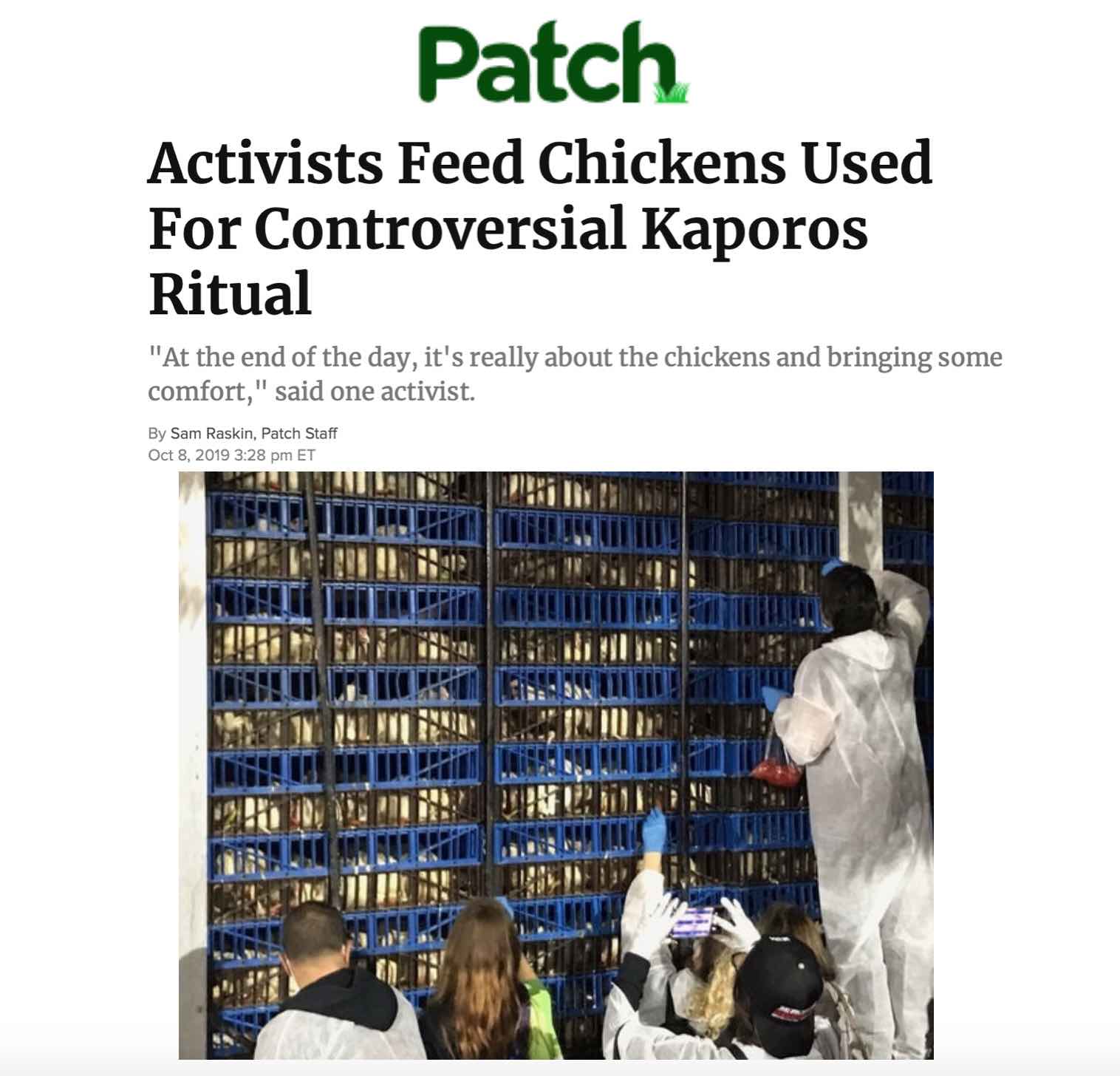
The activists brought the chickens to a triage center where they provided them with food, water and, in some cases, acute medical care, before transporting them to farm animal sanctuaries around the country. Eight chickens were taken to veterinarians for emergency surgery due to broken wings and other life-threatening injuries.
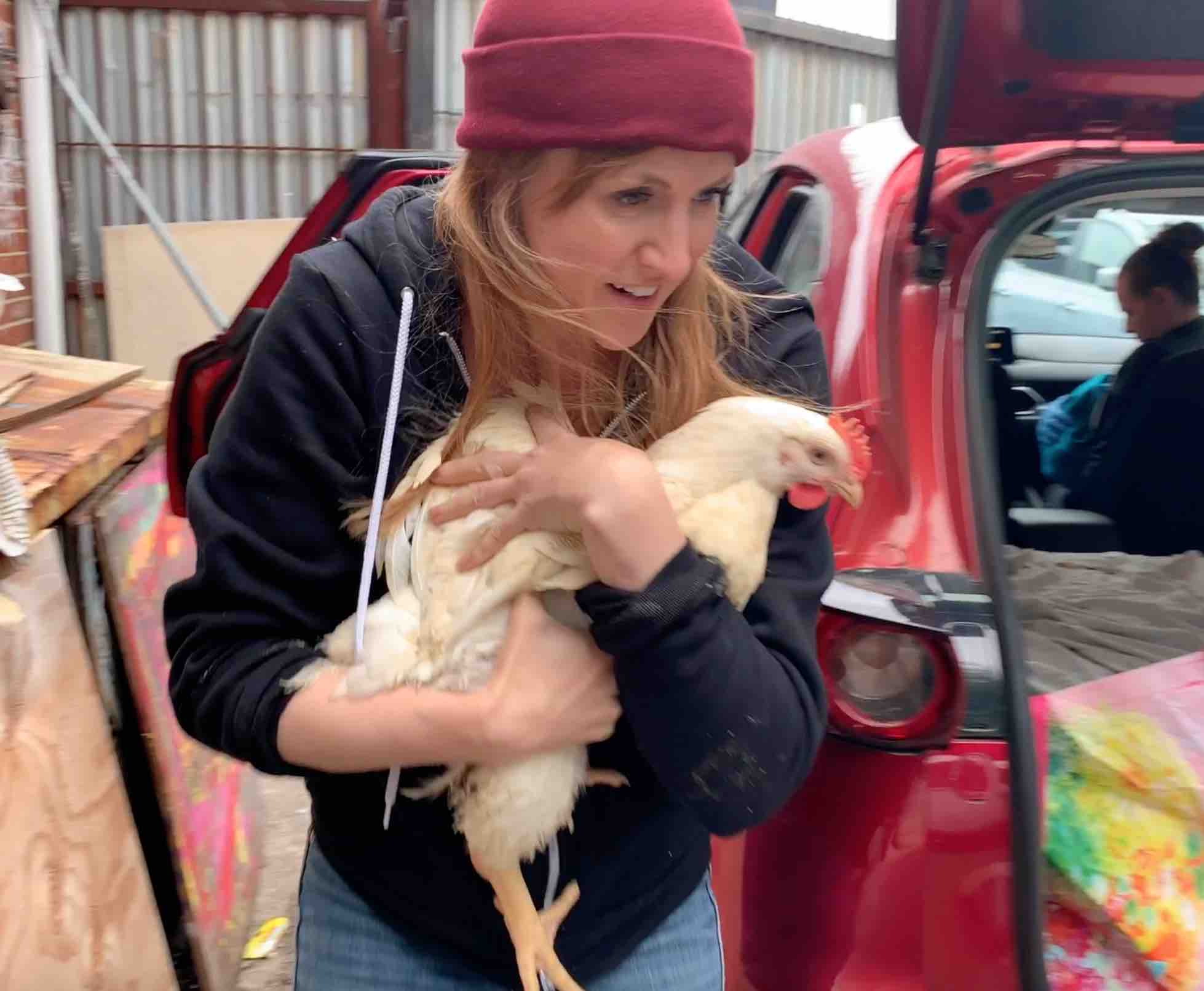
Jill Carnegie with the Alliance to End Chickens as Kaporos transports a rescue to the triage site.
Jill Carnegie, the Campaign Strategist for the Alliance to End Chickens as Kaporos and an organizer of the rescues, said that the number of chickens who activists rescued was determined by the space available in farm animal sanctuaries: “We spent several months securing quality homes for the chickens. Since Cornish Cross birds are some of the most genetically-altered animals, they require specialized care. Each year, we can only rescue the number of chickens we can confirm homes for to avoid a potentially catastrophic scenario; we put in many hours of placement work so that we can save as many lives as possible. We wish we could have saved more.”
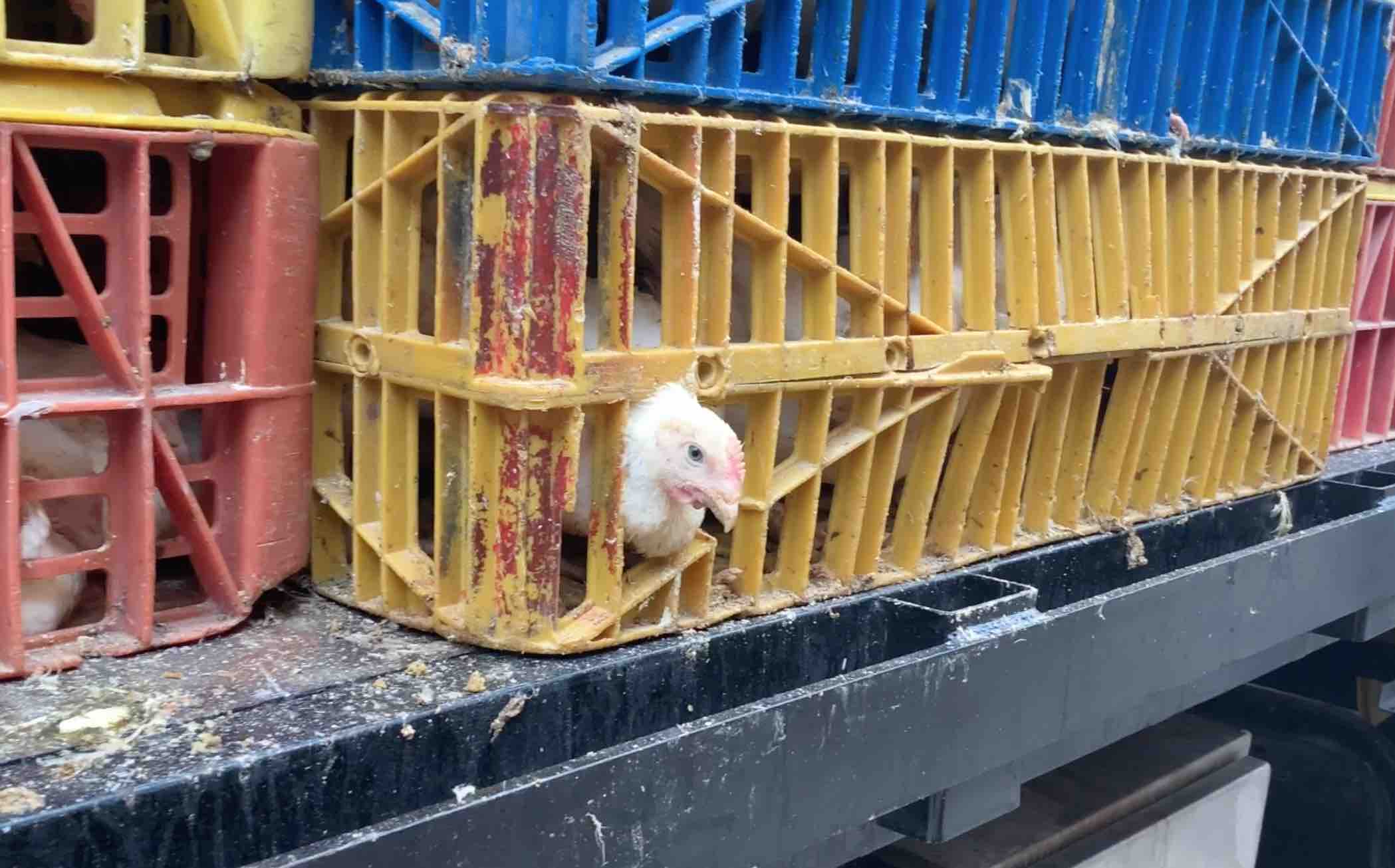
Activists estimate that over 100,000 chickens are trucked into the city and stored in crates on the street for up to several days with no food or water
With an estimated 300,000 Hasidic Jews in New York City, activists believe that well over 100,000 chickens are used and killed each year. During Kaporos in 2019, thousands of chickens died of hunger, thirst, sickness and heat exhaustion in the crates where they were being stored before the ritual even began.
During Kaporos, hundreds of activists provide watermelon and water to thousands of chickens stacked in crates on the streets of Crown Heights, Williamsburg and Borough Park in Brooklyn, New York
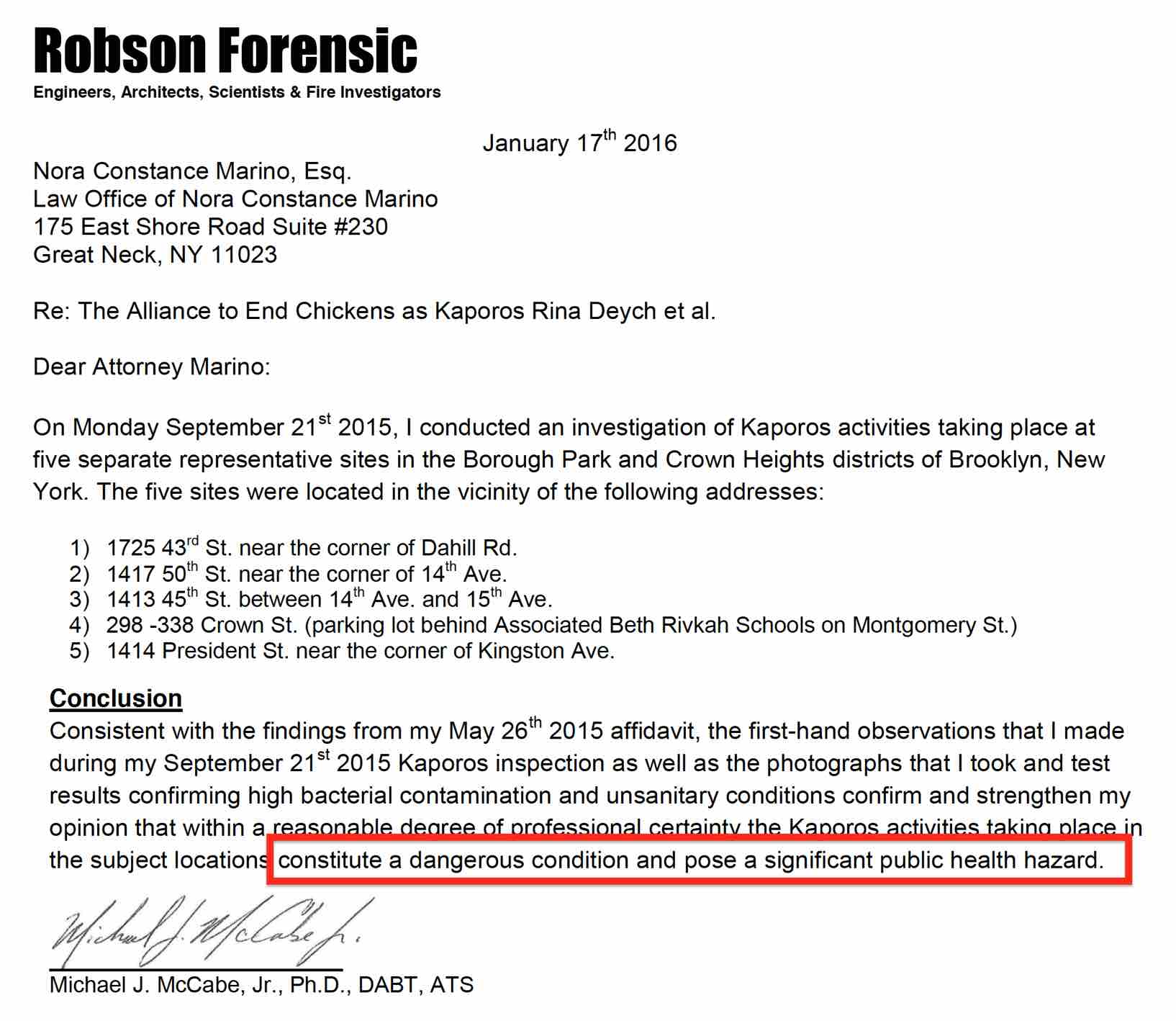
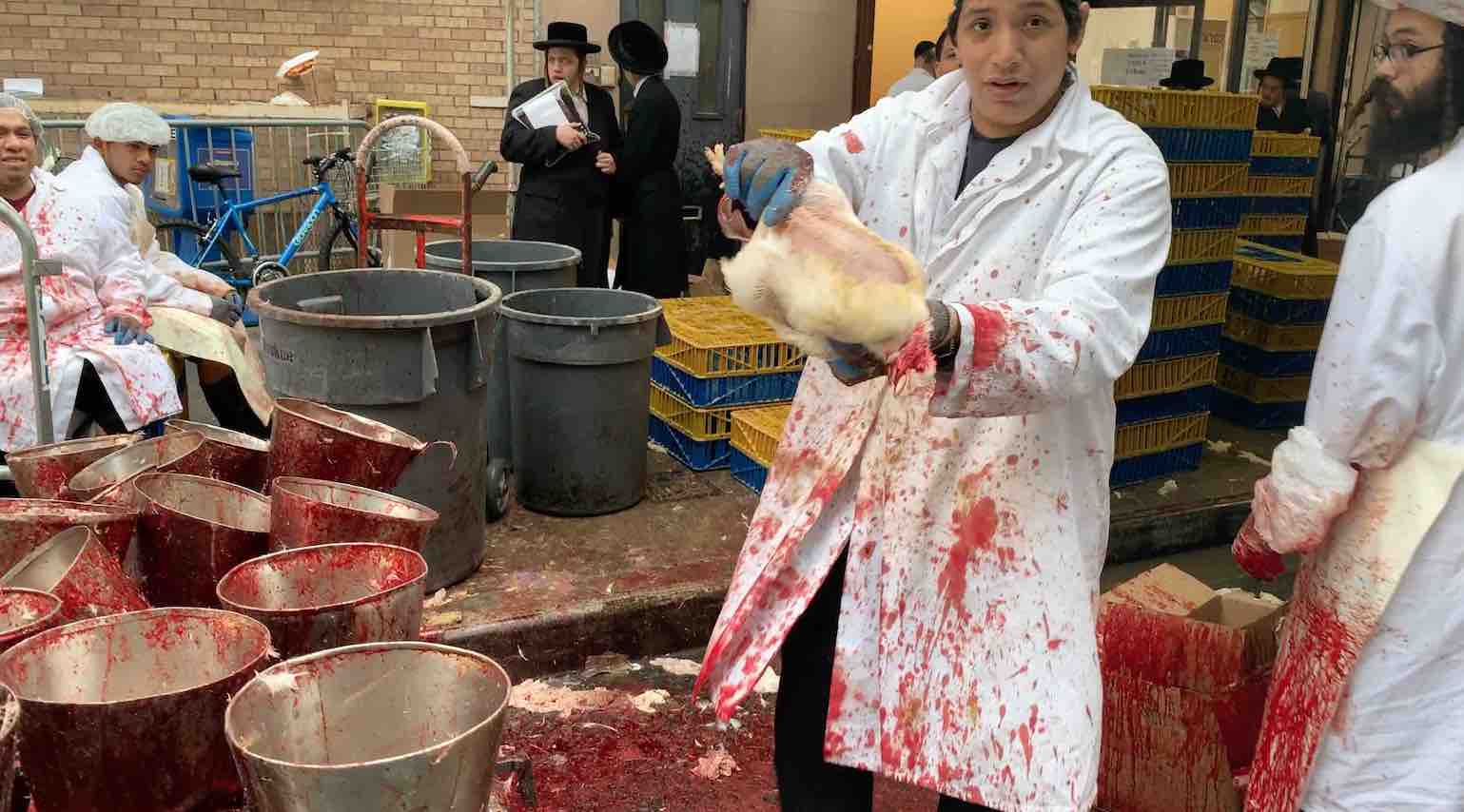
During Kaporos, practitioners swing six-week old chickens around their heads while reciting a prayer to symbolically transfer their sins to the animal. The vast majority of the chickens are then killed in open-air slaughterhouses, leaving the streets contaminated with their blood, body parts, feces and feathers. In 2015, an attorney suing the City on behalf of area residents hired a toxicologist to test the contaminants. In his report, Dr. Michael McCabe concluded that Kaporos “constitutes a dangerous condition and poses a significant public health hazard.”
Mayor de Blasio’s Health Commissioners have refused to address a toxicology report that outlines the risk posed by the mass slaughter of over 100,000 animals on public streets during Kaporos.
Advocates have, on multiple occasions, sent the toxicology report to Dr. Demetre Daskalakis, the head of Infectious Disease Control at the NYC Department of Health, and to Drs. Oxiris Barbot and Mary Bassett, the City’s current and former health commissioners. Activists speculate that they have refused to acknowledge the correspondence because they could be liable if and when a disease outbreak does occur. Nora Constance Marino Esq., the attorney, argued the case to the State’s highest court — Court of Appeals. In their ruling in 2018, the six judges wrote that city agencies have discretion with respect to the laws they choose to enforce.
During Kaporos, over 100,000 chickens are slaughtered on public streets in residential neighborhoods in Brooklyn, exposing area residents to E. coli, campylobacter and many other pathogens and toxins
In recent years, resistance to the use of live chickens has been building in the Hasidic Jewish communities. In discussions with animal protection advocates, many Kaporos practitioners have acknowledged that the mass commercialization of the ritual has led to systemic abuses that violate “Tza’ar ba’alei chayim,” a Jewish commandment that bans causing animals unnecessary suffering.
“As long as this cruel ritual slaughter takes place, we will continue rescuing as many of the victims as we can before they are slaughtered,” said Jill Carnegie. “One day, the use of live animals for the ritual will come to an end, either because the Department of Health decides to enforce its own laws in order to prevent the spread of an infectious disease or, more likely, because a disease outbreak occurs.”




/arc-anglerfish-tgam-prod-tgam.s3.amazonaws.com/public/TWBAB553KJMSPKOF2HTQZ3V77Q.jpg)

 Exposing the Big Game