Australia is burning. The bushfires have devastated the continent since September and continue to ravage the country at an alarming pace. Photos and videos of charred animals—unable to escape the overwhelming blazes—have gone viral.
One inane tactic that officials have come up with to combat the problem includes shooting up to 10,000 thirsty camels from helicopters, just because they drink large amounts of water.
MORE THAN A BILLION ANIMALS HAVE ALREADY DIED, AND AUSTRALIAN OFFICIALS WANT TO ADD THOUSANDS MORE INDIVIDUALS TO THE DEATH TOLL—INDIVIDUALS WHO ARE JUST AS MUCH RESIDENTS OF SOUTH AUSTRALIA AS ITS HUMAN INHABITANTS AND WHO ARE JUST AS DESERVING OF MAKING IT OUT OF THE AUSTRALIAN FIRES ALIVE.
In the video below, a bystander recorded dozens upon dozens of dead, burned animals scattered along roads:
This Is Climate Change, and We Must Take Action Like Never Before
Many blame climate change for exacerbating the wildfires, which have burned more acres than recent Amazon rainforest and California fires combined. Around the world, prolonged heat and drought have extended seasonal wildfire periods.
All the while, the U.N. has stated that meat consumption must decrease by as much as 90% in order for us to avoid the most catastrophic effects of climate change. To put it in perspective, the carbon emissions from all of the world’s planes, trucks, ships, and cars are equivalent to the emissions from animal agriculture!
WIRED
✔@WIRED
Kangaroos hop uphill in smoky New South Wales to escape the smoke and raging fires in Australia. The country’s bushfires have scorched millions of acres, putting millions of people and animals at risk.
We can (and must) fight climate change. By far, the easiest way is for people to stop eating animals and go vegan right now. It requires zero governmental initiative or promises from some giant corporation. It only involves choosing to leave animals out of the shopping cart on that trip you’re already making to the grocery store.
GOING VEGAN CAN HELP PREVENT ANIMALS FROM BEING BURNED ALIVE IN A WILDFIRE OR BEING SLIT ACROSS THE THROAT IN A SLAUGHTERHOUSE.
It’s estimated that, at a minimum, about 800,000 million animals have been killed in Australia’s fires. This is about the same number of land animals who are horrifically slaughtered every few days just so that people can eat their flesh.
No matter if it’s a kangaroo trapped in a barbed-wire fence after running from a scorching fire or cows screaming for their lives as they’re hoisted up by chains to bleed out from their wounds, every one of these animals feared for their lives and did all that they could to stay alive.
The Best Time to Go Vegan Was Yesterday—the Next-Best Time Is Right Now
Many of us feel relatively powerless when facing mass extinctions, rising sea levels, and record-breaking fire seasons, but we actually have a great deal of power to change things if we harness it.
This is exactly why being vegan isn’t some fad diet. It’s a revolutionary action. It’s us exclaiming, “We will not let this planet and countless sensitive animals die on our watch!”
Join the vegan movement today and ask everyone you know to do the same. The Earth itself depends on it.
Last week’s ICE raids on chicken slaughter plants in Mississippi raise an issue that traditional media like to ignore. Undocumented immigrants keep the US in cheap meat.
Few to no Americans want slaughterhouse jobs like knockers, stickers, bleeders and tail rippers. In fact, when Smithfield’s slaughterhouse in Tar Heel, NC, offered inmates work release to work at the local slaughterhouse, the inmates said they would rather stay in their cells. Think about that.
A 2008 ICE raid on the Iowa-based slaughterhouse Agriprocessors wiped out almost the whole work force: 296 Guatemalans, 93 Mexicans, two Israelis, and four Ukrainians were arrested. Initial charges against Agriprocessors included harboring illegal aliens, use of child labor, document fraud, identity theft, physical and sexual abuse of workers, unsafe working conditions, wage and hour violations, and shorting workers’ pay.
According to the search warrant, 1,000 discrepancies between worker names and Social Security numbers occurred in three years. There was even a methamphetamine production plant existing within the slaughterhouse, sanctioned by management. Barack Obama, then an Illinois senator, weighed in on the situation during a campaign stop in Davenport, Iowa. “They have kids in there wielding buzz saws and cleavers. It’s ridiculous,” he said
Undaunted after the raid, recruitment firms hired by Agriprocessors canvassed homeless shelters, bus stations, chapel services, and other slaughterhouses, and ran ads in Spanish-language newspapers and on Mexican radio stations in the Rio Grande Valley to replenish the workforce. One recruitment firm, Labor Ready, says it recalled 150 workers, days after placing them, over Agriprocessors’s “safety conditions.”
Years ago, meatpackers JBS Swift, Tyson Foods and Gold’n Plump began hiring Somalis, fleeing civil war, for their slaughterhouse workers. Sudanese and Pacific Islanders also became popular slaughterhouse employees. Employees fleeing poverty and violence, like those from Central American, are willing to accept low wages and no on-the-job protections or worker rights.
Are conservatives who deplore immigrants ready to give up the cheap meat immigrants make possible? Are progressives and clergy who “love” immigrants okay with jobs with no security that regularly cause workers to lose their hands—to keep Americans in cheap meat? (We won’t even talk about what happens to the animals under these conditions.)
Ten years ago, a Texas AgriLife Research study of 5,005 dairy farms estimated that the US economy would suffer an $11 billion loss with the loss of foreign workers. Since then, that number has only grown.
Are Big Food corporations—and the lawmakers who serve them—ready to pay real wages to workers and stop hiring undocumented immigrants while bashing them? Are Americans addicted to cheap meat ready to see how their eating habits support the exploitation of undocumented immigrants? No talk about undocumented immigrants is honest if it leaves out the fact that US slaughterhouses are balanced on their backs.
Brandon Judd says the individuals were released in order to take care of their children. He says they will still most likely be put through the deportation process.
Almost all of the Mississippi chicken plants raided by Immigration and Customs Enforcement (ICE) officials on Wednesday were “willfully and unlawfully” employing people without proper work documentation authorizing them to hold jobs in the U.S., according to unsealed court documents.
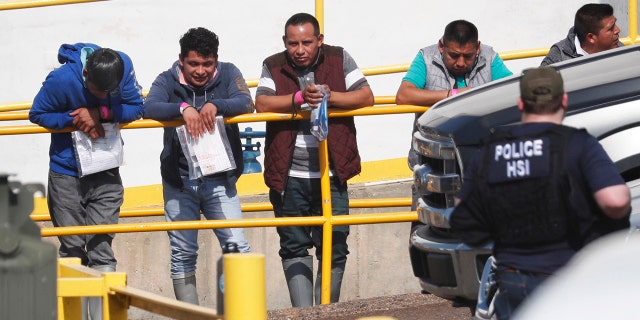
Federal investigators who executed the raid on seven plants in all arrested 680 people, drawing in part on informant information — in what’s been described as the largest immigration raid in a decade. (Roughly 30 of those arrested were released on humanitarian grounds, while another 270 were released after being processed by ICE, the U.S. Attorney’s Office for the Southern District of Mississippi said Thursday.)
Handcuffed workers await transportation to a processing center following a raid by U.S. immigration officials at Koch Foods Inc., plant in Morton, Miss. U.S. immigration officials raided several Mississippi food processing plants on Wednesday and signaled that the early-morning strikes were part of a large-scale operation targeting owners as well as employees. (AP Photo/Rogelio V. Solis) (AP)
An informant posing as a worker at the latter of two chicken processing plants, PH Food Inc. in Morton and A&B Inc. in Pelahatchie, told Homeland Security investigators that both are owned by a Chinese man from California, Huo You Liang, more commonly referred to as Victor by his employees in Mississippi. The informant contended that Victor, as well as managers at other plants, did not follow state regulations which require employers to utilize E-Verify, a federal electronic verification system, to validate the authenticity of work documents including identification, Social Security numbers and tax information.
“The payroll companies as well as PH Food Inc. and A&B Inc. do not verify the authenticity of their documents,” the informant told investigators, according to court documents, allowing employees to use their real names supported by fake documents to get hired.
Another informant at PH Food said that the majority of the 240 employees at PH’s plant as well as 80 employees at A&B’s plant employed many Guatemalan immigrants lacking in proper work authorizations and documentation.
In addition, investigators gathered evidence from electronic monitoring bracelets from migrants who had previously been arrested for immigration violations — thus barring them from employment in the U.S. — and noted that all seven raided plants employed these immigrants illegally.
Three members of the House Oversight Committee Friday sent a letter to Attorney General William Barr and Acting Secretary of Homeland Security Kevin McAleenan asking that, among other things, documents and information be turned over showing whether the companies involved in the Mississippi raids would be facing criminal charges or other fines and penalties for hiring illegal immigrants.
The letter, signed by panel chairs Rep. Elijah Cummings, D-Md., Bennie Thompson, D-Miss., and Rep. Jamie Raskin, D-Md., requested documents on “whether any owners, employers or individuals otherwise responsible for hiring at targeted worksites were charged and the nature of those charges.”
“It appears that these DOJ and ICE enforcement actions are targeting only immigrant workers and not their employers,” the letter said.
Bringing criminal charges against companies that illegally hire workers is difficult because prosecutors must prove that the employer did so knowingly, a claim easily rebutted via claims of being duped by fraudulent documentation.
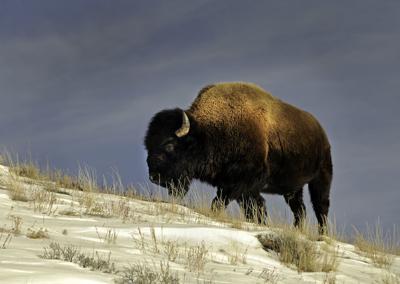
A bison feeds on a hillside in Yellowstone National Park. Last week, 23 of the animals were trapped and will be sent to slaughter as part of the annual effort to thin the park’s herd.
Bozeman Daily Chronicle file
Yellowstone National Park trapped 23 bison early March 13, taking advantage of a large group that migrated north in search of food.
Yellowstone spokeswoman Linda Veress said in an email that the 23 were part of a group of about 500 bison that moved north of Mammoth Hot Springs. About 300 were spotted near the park’s Stephens Creek Capture Facility, a set of corrals on the west side of the Yellowstone River near Gardiner, Mont., where bison are trapped.
The park ordered an area closure around the capture facility last week, a move that comes each year just before trapping begins.
Shipment to slaughter for the 23 bison will likely come this week, Veress said. Meat from slaughtered bison is distributed to Native American tribes. More complete numbers on bison removals will be posted to the Interagency Bison Management Plan website later this month, Veress said.
The capture of the bison comes as the window for trapping narrows. Park officials typically don’t capture bison beyond March. This year’s relatively late start could have consequences for managers’ attempts to remove between 600 and 900 bison from the population between hunting and shipments to slaughter.
Biologists estimated there were about 4,500 bison in Yellowstone late last summer. The removals are meant to either slightly reduce the population or keep it stable.
Bison migrate out of the park each winter in search of food, which is when they become vulnerable to hunters from seven tribal nations and the state of Montana. The migration is completely dependent on weather forcing the bison out of the park’s interior. Until this month, this winter was one of little bison movement, making things tough on hunters whose seasons ended early in the year.
The migration appeared to begin in the last two weeks. One group of animals crossed into the state last week, where they were met by gunfire. A total of 16 were killed, said Mark Deleray, regional supervisor for Montana Fish, Wildlife and Parks. Two died inside the park borders where hunters can’t retrieve them.
Deleray said he is working to gather harvest data from the various Native American tribes who hunt bison on the outskirts of the park, but acknowledged that the numbers are likely low. None of FWP’s 80 regular tags were filled. Deleray said he’s still waiting to hear on the state’s five backcountry tags.
Bison trapping began much earlier last year, with 96 captured over a few days in mid-February. By this time in 2018, the park had already sent more than 300 bison to slaughter.
Park officials are still holding 79 bison in two specialized pens at Stephens Creek for a brucellosis quarantine program. Quarantining bison is meant to provide live animals to enhance other wild herds or establish new ones, and officials and some bison advocates hope it will eventually prove a viable alternative to slaughter.
One of the US’s most dangerous industries is becoming even more hazardous for workers, as animal welfare and consumer safety are also put on the line. The federal government is allowing more and more slaughter plants to kill animals at increasingly dangerous rates.
At the end of September, the Trump administration announced that the Food Safety and Inspection Service (FSIS) of the United States Department of Agriculture (USDA) would be granting waivers allowing chicken slaughter plants to operate at higher kill speeds — going from a staggering 140 birds killed per minute (or more than two birds every single second) to 175.
This misguided decision benefits only the profit-driven meat industry. It does so at the expense of millions of animals, workers and consumers.
Four waivers have recently been granted to chicken plants that will join 20 already killing as many as 175 birds each minute. A gut-wrenching new undercover investigation by my organization, Compassion Over Killing (COK), reveals high-speed horrors behind the closed doors of one of those initial 20 plants, and why these waivers must come to a screeching halt.
Reckless High-Speed Slaughter Exposed
Marking the second time in just three years that a COK investigator has exposed the alarming consequences of high-speed slaughter, this heartbreaking hidden-camera footage was filmed inside Amick Farms in Hurlock, Maryland.
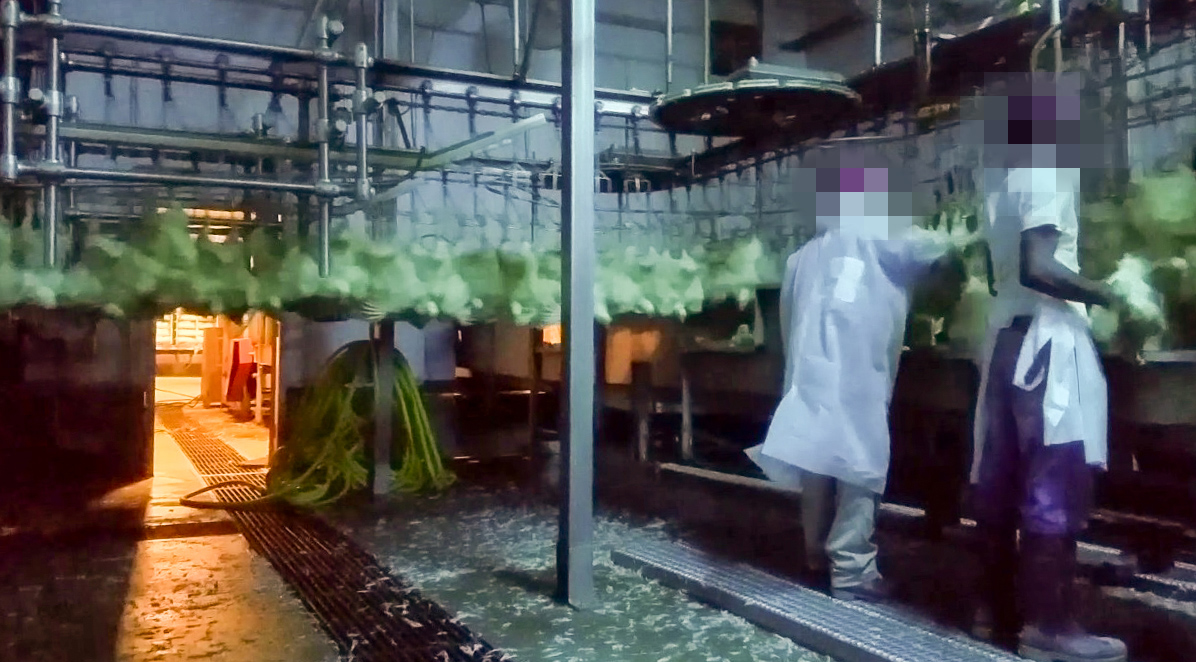
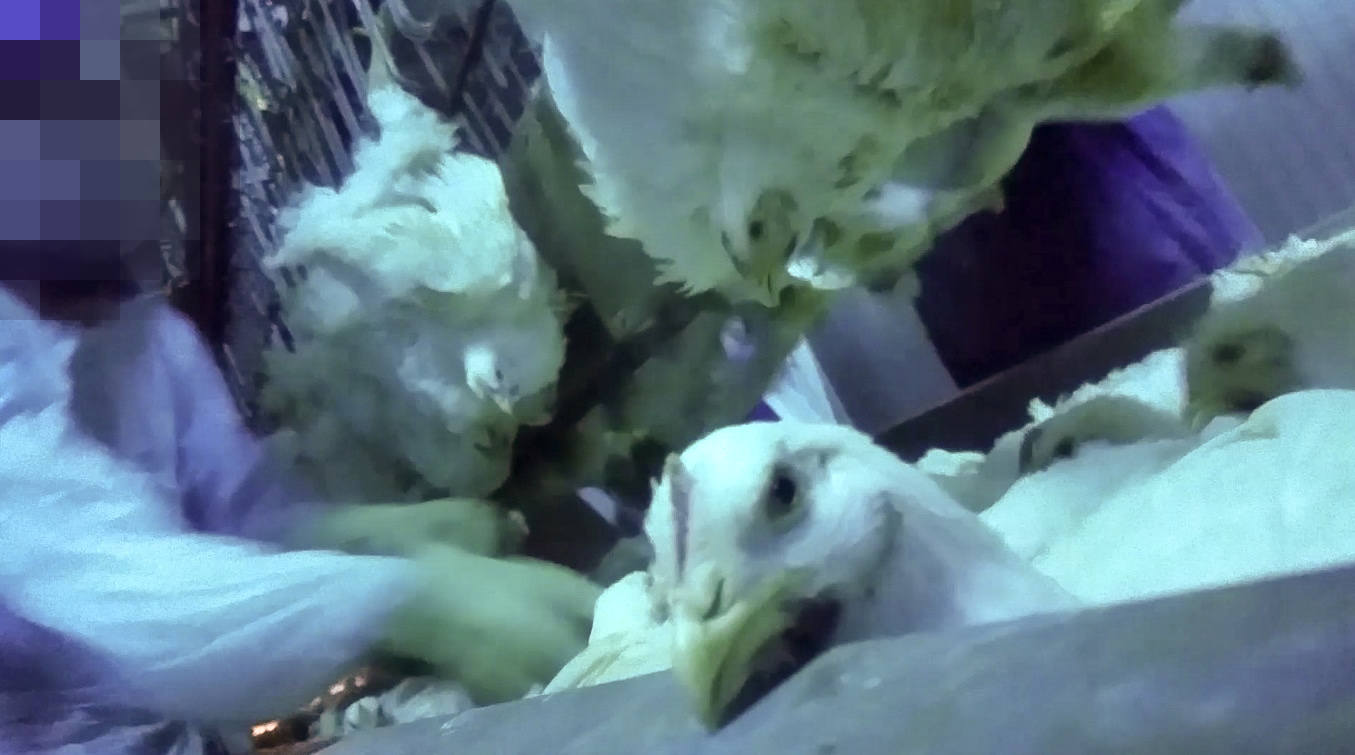
COK’s investigator documented workers punching, shoving or throwing birds down the hurtling line; birds slowly drowning in electrified stunning baths during equipment breakdowns; and “red birds,” chickens who were not fully bled out before entering the scalding tank — evidence that they entered the tank while still alive.
Don’t miss a beat
Get the latest news and thought-provoking analysis from Truthout.
Your Email
“Birds can be seen — still hanging from the shackles — in the water bath. … It is likely that the birds would have experienced prolonged, possibly painful electrical shock while they died of drowning,” said Dr. Sara Shields, a farm animal behavior and welfare specialist at Humane Society International, in an expert statement in response to COK’s footage. “This situation is totally unacceptable from an animal welfare perspective.”
Birds are moved quickly down the line.COMPASSION OVER KILLINGA panicked bird is roughly grabbed on the quickly moving line.COMPASSION OVER KILLING
COK submitted its video evidence to local authorities as well as to FSIS, urging the agency to revoke increased line speeds at Amick Farms and other high-speed plants, and stop issuing any further waivers. Though the criteria for receiving a waiver specifies that plants “must be able to demonstrate that … faster line speeds will maintain or improve food safety,” among other requirements, COK’s new investigation has shown that faster lines lead to enormous animal suffering.
Amick Farms responded to The Washington Post’s coverage of the investigation, neglecting to take any real responsibility for the cruelties happening behind the doors of its slaughterhouse.
At current rates of 140 birds slaughtered per minute at most plants, birds are already enduring horrific suffering. In addition, workers, who must keep up with the fast-paced assembly line environment, are forced to take inhumane shortcuts. Yet, with the government’s recent announcement, we’re moving quickly backward from bad to much worse.
Other COK investigations have documented birds being improperly shackled, dumped onto the conveyor belt and being roughly handled by workers struggling to keep up with rapidly moving lines. Birds suffer during this short and tragic journey to the kill line — already having endured severely overcrowded and filthy conditions on factory farms where they were bred for unnaturally rapid growth.
After these birds spend their lives standing, eating and sleeping in their own waste (often causing painful ammonia burns on their skin) and possibly even having their legs collapse under the unnatural weight of their own genetically manipulated bodies, the life of a “broiler” chicken farmed for food culminates in the horror of painful slaughter.
In addition to the obvious cruelty toward farmed animals in the final moments of their short lives, high-speed slaughter lines also pose grave danger to workers. Many employees at slaughter plants are already vulnerable undocumented workers exploited in one of the nation’s most dangerous industries to work. Even at current line speeds, they’re often denied bathroom breaks to keep up the pace at all costs, and can suffer painful medical issues and severe injuries — even amputations.
But instead of taking pause to address the dangers of this reckless program, the USDA is expanding it — and not just for chickens.
The Public Speaks Out Against High-Speed Pig Slaughter
In late 2015, a COK undercover investigator worked at Quality Pork Processors (QPP) in Austin, Minnesota, a pig slaughterhouse that exclusively supplies to Hormel, the maker of SPAM and other pork products. Held up as a model plant for the USDA’s high-speed pig slaughter program — the Hazard Analysis Critical Control Point-Based Inspection Model Project — QPP kills approximately 1,300 pigs every hour.
The terrifying truth revealed in undercover footage paints a picture very much like the horrors seen at Amick Farms: pigs being beaten, shocked and dragged to the kill floor. Many were also improperly stunned, possibly leading them to enter the scalding tank alive — just like the “red birds” documented at Amick. In this fast-paced environment, pigs covered in feces or pus-filled abscesses were also seen processed for human consumption — all with a USDA inspection seal of approval.
In April 2018, Compassion Over Killing’s former investigator, now out from behind the camera after his work at QPP and other slaughterhouses, delivered a quarter-million signatures to the USDA demanding it to end its regressive high-speed pig slaughter program.
Yet the USDA continues to frame its high-speed program as a “modernization” of the meat industry. There’s nothing modern about reducing already minimal protections for consumers, animals and workers.
Though animal organizations and workers’ rights advocates alike are fighting these reckless speed increases, and the USDA has received more than 83,000 comments regarding this program — many opposed to it — the enormous lobbying power of the National Chicken Council continues has put pressure on the USDA to eliminate speed caps altogether. The USDA has denied a countrywide increase so far, but there’s little stopping the agency from granting waivers for individual slaughter plants across the United States.
To stand in solidarity with exploited workers, tortured animals and unknowingly duped consumers, the easiest solution is to leave these cruelly mass-produced animal products off our plates. By voting with our dollars and avoiding these products altogether, we show the USDA, National Chicken Council and huge corporations running these plants that we do not support these cruel practices that harm human and non-human animals in the name of profit.
Allowing slaughterhouses to run their kill lines at even faster speeds is a reckless decision by this administration that will lead to increased animal suffering, continued worker exploitation and compromised food safety. Tell the USDA: Not so fast. Take action and sign the petition at HighSpeedHorrors.com.
This article was produced by Earth | Food | Life, a project of the Independent Media Institute, and originally published on Truthout.
There is a tendency for some of us who wish to promote veganism—a way of living which excludes the use of animals for food, clothing and other exploitation— to cushion the call to action with a warning/acknowledgement/suggestion that it is a difficult thing to do.
While this is surely the case for some people, for others, including me, it has happened quickly and painlessly when the time was right. To set the stage for interested seekers to expect hardship invites failure or a refusal to even try.
For someone who still really wants to eat animals and their secretions, or still wants to wear a fur coat or a silk shirt, but resists for health or moral reasons understood but not felt, it is certainly hard to do. They have to exert Willpower to resist things they still desire, and this almost inevitably leads to a failure to maintain the “sacrifice”. Someone who gives up meat for “health reasons” very often reverts, occasionally or permanently.
But for someone who has internalized the horror and immorality of subjecting other feeling beings to abuse and slaughter, and who simply refuses to, simply cannot—just won’t— be a part of this any longer, there is no feeling of deprivation, and no enticement which can make them go back to participating in these injustices.
I call this Won’tPower, and in contrast to WillPower, it is effortless to maintain.
Let me tell you what pushed the button in my being and changed my life in an instant.
At the time, I subscribed to the Los Angeles Times newspaper. I sat down one morning and turned to the feature section, and began reading a human-interest story about a man who had become very bitter about life due to some tragic personal experiences. He had become very hard-hearted.
He somehow got a job in a slaughterhouse, killing lambs—baby sheep— as they came by in procession, he took their just-beginning lives with a knife.
One day, a particular lamb passed his station, and he stabbed as before. But before this lamb could fall, mortally wounded, she turned and tenderly licked her own blood from her killer’s hand.
The man broke down, had an instant change of heart, his bitterness melted, he left and became a minister, enriching lives instead of ending them.
I folded the paper, set it down, and have never looked back, except to regret that I had not saved the article!
It is important to note that I had already been thinking about the morality of eating animals, primarily due to my experience of having my first dog as an adult, with all the revelations that living with another species brings, and having met someone’s “pet” turkey, who had expressed as much interest in me as had their Great Dane dog. In other words, the time was right for me, much as the time has to be right to change any ingrained habit, whether it’s smoking, drinking or anything else.
So if you have been wrestling with the ethics of consuming and wearing animals, if you are torn, keep wrestling. Keep thinking and considering. Keep the internal quest alive. When it coincides with the thing—your own personal newspaper article—that pushes your moral button, you may find that it is the easiest and most satisfying thing you have ever done.
Yellowstone National Park shipped 20 of America’s last wild bison to slaughter yesterday morning. Twenty-five bison were captured Friday in the Stephens Creek bison trap, located inside the world’s first national park. After being confined in the trap for five days, 20 of the bison were handed over to the Confederated Salish and Kootenai Tribes, who are required to slaughter them under a controversial agreement between the tribes and the Park. Five bison remain locked in the trap as of Wednesday afternoon.
Nearly three hundred wild bison were rounded up at Wind Cave National Park, SD, for the annual cull in 2005. Photo credit: National Parks Service
Yellowstone plans to slaughter between 600 and 800 bison this winter, according to park spokesman Al Nash. “We’re going to seek opportunities to capture any animals that move outside the park’s boundaries,” he said. Yellowstone has set a “population target,” or objective, of 3,000 to 3,500 animals.
The current buffalo population numbers approximately 4,400 (1,300 in the Central Interior and 3,100 in the Northern range). The Central Interior subpopulation also migrates north into the Gardiner basin and has not recovered from the last Park-led slaughter in 2008 that killed over half of the Central Interior buffalo. The government’s “population target” makes no distinction for conserving subpopulations in this unique buffalo herd.
Each year, officials execute the Interagency Bison Management Plan that forcibly prevents wild bison’s natural migration with hazing, capture, slaughter, quarantine and hunting. Photo credit: Buffalo Field Campaign
According to Dan Brister, Executive Director of Buffalo Field Campaign (BFC), “This number was politically derived to limit the range of wild buffalo and has no scientific basis. It does not reflect the carrying capacity of the buffalo’s habitat in and around Yellowstone National Park.”
This is the first time Yellowstone has turned bison over to the tribes under the slaughter agreements. According to James Holt, a Nez Perce Tribal Member and a member of BFC’s board, “It is disheartening to see tribes support these activities.”
“Buffalo were made free, and should remain so,” Holt said. “It is painful to watch these tribal entities take such an approach to what should be the strongest advocacy and voice of protection.”
“It is one thing to treat their own fenced herds in this manner, it is quite another to push that philosophy onto the last free-roaming herd in existence,” Holt continued. “Slaughter Agreements are not the answer.”
Buffalo fall through ice during a hazing operation in 2006. Photo credit: Buffalo Field Campaign
Brucellosis is the reason used by Yellowstone to justify the slaughter of wild bison. There has never been a documented case of wild bison transmitting the livestock disease to cattle. Other wildlife, such as elk, also carry brucellosis and are known to have transmitted it, yet they are free to migrate, and even commingle with cattle with no consequence.
Year after year, Yellowstone and Montana officials executing the ill-conceived Interagency Bison Management Plan forcibly prevent wild bison’s natural migration with hazing, capture, slaughter, quarantine and hunting. Millions of U.S. tax dollars are wasted annually under activities carried out under the IBMP.
The wild bison of the Yellowstone region are America’s last continuously wild population. Like other migratory wildlife, bison cross Yellowstone’s ecologically insignificant boundaries in order to access the habitat they need for survival. During 2007-2008 more than 1,300 wild bison were captured in Yellowstone National Park and shipped to slaughter.
A dead bison is lifted off the ground near Gardiner, MT, April, 2011. Photo credit: Stephany Seay/ Buffalo Field Campaign
Nearly 7,200 wild bison have been eliminated from America’s last wild population since 1985. Bison once spanned the North American continent, but today, fewer than 4,400 wild bison exist, confined to the man-made boundaries of Yellowstone National Park and consequently are ecologically extinct throughout their native range.
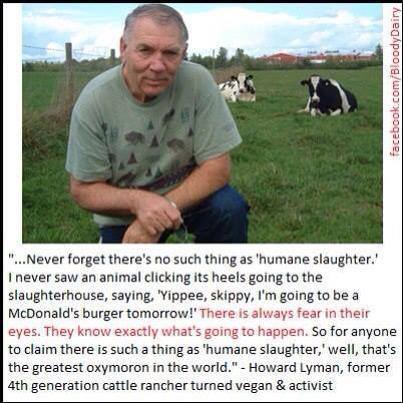
After forty-some years in the business, fourth generation Montana cattle rancher Howard Lyman finally saw the light. Now, the author of the bestselling books, Mad Cowboy: Plain Truth from the Cattle Rancher Who Won’t Eat Meat and No More Bull: The Mad Cowboy Targets America’s Worst Enemy: Our Diet, spends his days promoting veganism.
For the sake of our health and humaneness, for the planet and for the wolves, adopting a cruelty-free vegan lifestyle is a challenge we all must face together. As Mr. Lyman tells us: ”The question we must ask ourselves as a culture is whether we want to embrace the change that must come, or resist it. Are we so attached to the dietary fallacies with which we were raised, so afraid to counter the arbitrary laws of eating taught to us in childhood by our misinformed parents, that we cannot alter the course they set us on, even if it leads to our own ruin? Does the prospect of standing apart or encountering ridicule scare us even from saving ourselves?”
TAKE ACTION to Stop Government Plans to Vaccinate & Slaughter Wild Buffalo! A bull bison roars to be heard among the herd. Photo by Kim Kaiser. Click image for larger view.
No buffalo have been killed by hunters since our last Update. Temperatures have dropped into the negatives, snow has fallen, Hebgen Lake is now frozen, and the few wild buffalo that are in Montana are keeping themselves safe from hunters for now. As we promised last week, we have some very important Take Action items for you on two major threats to wild buffalo. Visit the links below to take action and to learn more. BFC has also just produced a new video from our footage of the recent Interagency Bison Management Plan meetings. See and hear for yourself what the agencies are saying. Please do what you can to share our alerts and video widely! 1. Montana Department of Livestock Plans to Capture, Vaccinate & Slaughter Wild Buffalo
Urge Congress to Stop the DOL’s Plans by Cutting Off Funding for the Interagency Bison Management Plan
Contact Montana Governor Steve Bullock to Stop the Department of Livestock Before they Start!
2. Yellowstone National Park Enlists Tribes to Slaughter Wild BuffaloUrge the National Park Service to Rescind Buffalo Slaughter Contracts and to Pull Yellowstone Out of the IBMP
Thank you so much for taking the time to raise your voice for America’s last wild buffalo! Please spread the word to save these herds!
Wild is the Way ~ Roam Free! * NEW BFC Video: DOL Reveals Intent to Capture Wild Buffalo in the Hebgen Basin
The last wild buffalo populations are currently estimated at fewer than 4,600 individual animals, living in and around Yellowstone National Park. Wild bison are ecologically extinct throughout their native range in North America.
2013-2014
Total Buffalo Killed: 54
Government Capture:
Buffalo Released from Capture:
Government Slaughter:
Held for Government Experiment:
Died In Government Trap:
Miscarriage in Government Trap:
State Hunt: 3
Treaty Hunts: 51
Unknown Hunts:
Quarantine:
Shot by Agents:
Highway Mortality:
Cause of Death Unknown:
Total Killed in Previous Years
2012-2013: 261
2011-2012: 33
2010-2011: 227
2009-2010: 7
2008-2009: 22
2007-2008: 1,631
Total Killed Since 2000: 4,310
*includes lethal government action, trap-related fatalities, quarantine/experiments, hunts, and highway deaths