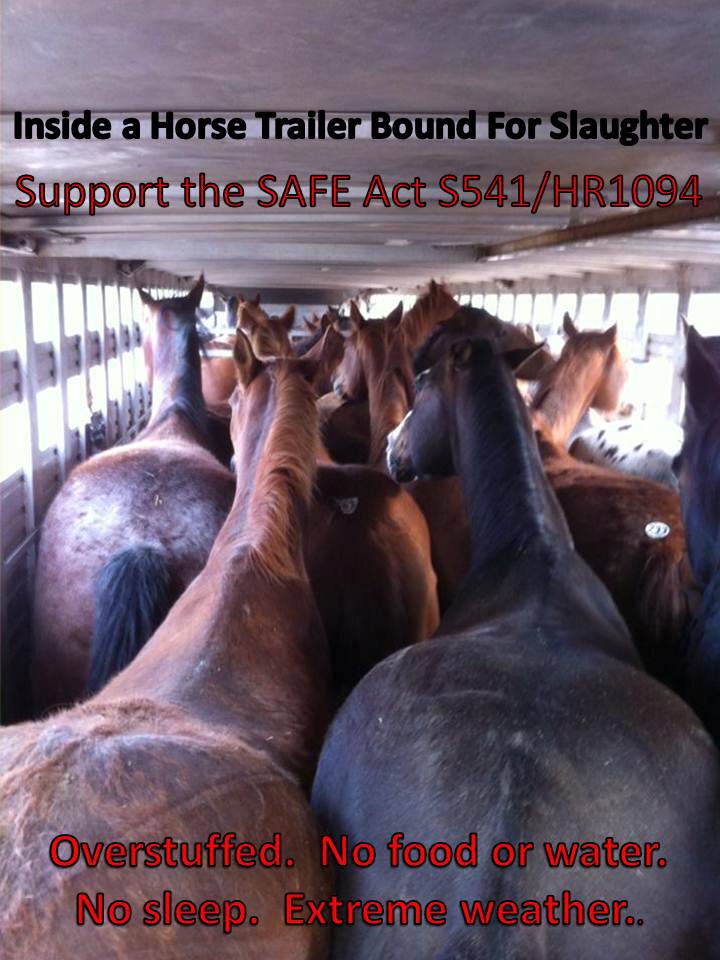
After All Horses Have Done For Us…
Image
22

The following are my answers to interview questions posed by a journalism student who so was moved after reading my book, Exposing the Big Game: Living Targets of a Dying Sport, that she decided to undertake a project on the psychology of hunting…
1. Have you come into contact with anyone (especially hunters) who has stated that your book changed their view on the game of hunting and the mistreatment of animals?
Answer: Yes, I’ve heard from several non-hunters who have thanked me for exposing the truth about big game hunting. No longer ambivalent about the unnecessary cruelty of sport hunting, they are now active anti-hunters.
But I have yet to meet a hunter introspective enough to allow anything to change their inbred, imbedded views on killing wildlife.
2. Have you received any ‘backlash’ since publishing this book?
Answer: For what, for urging hunters and trappers to be more compassionate to our fellow beings? No, and they haven’t received any backlash from me for tormenting and killing my friends the animals (aside from my book and blog).
Deep down hunters and trappers know what they are doing is wrong; they just hope we’ll continue to let them get away with it.
3. Are you friends with anyone who avidly hunts? Do any of your family members hunt?
Answer: Unfortunately.
4. In the beginning of the book, it states that you have always been a man of compassion towards animals. Why do you think that spreading the word of being kind to animals is important?
Answer: I’m going to answer that question with another question, a couple of other questions, actually: Why did the emancipators think freeing the slaves was important? My grandmother and great aunts were suffragettes, why did they fight for women’s right to vote? Why did people push to ban kiddie porn or crush videos? Why? Because speaking out for innocent victims of exploitation is the right thing to do.
5. What do you say to those who hunt for food and not sport? Many hunters believe that it is more humane to hunt for food than it is to buy meat from a slaughter house.
Answer: First of all, most people who claim to hunt for food not sport are living far above the poverty level. They are not starving and they don’t need to kill animals to survive. They do it because they want to—it’s “fun.” In many cases they spend far more on the hunt than it would cost them to get their food from the markets where they buy their beer, tobacco and Twinkies. They can boast all they want about “using the meat”—hell, even wolf or cougar hunters will claim that they plan to eat what they kill—but they’re just trying to make their trophy hunt seem palatable to the unwary public.
And the claim that hunting is more humane than what cows go through is exaggerated at best. While there’s absolutely no denying that what cows at the slaughterhouse are forced to endure is appallingly cruel, hunters conveniently forget that the animals they stalk are stressed out from the time they hear the first gunshots fired by someone sighting in their rifles for hunting season.
The myth of that “good clean shot” is a grim fairytale in most every case. Hunters expect to have to track down and finish off an animal they’ve shot or impaled with an arrow. In reality, “game” animals probably suffer longer than those at the slaughterhouse (though this is in no way meant to condone factory farming).
When it comes right down to it, hunters don’t give a shit about being humane, or they’d quit eating meat and join the millions of people who are living proof that human beings can live longer, healthier lives if they swear off flesh foods and get their nutrients from the plant kingdom.
Text and Wildlife Photography ©Jim Robertson, 2013. All Rights Reserved
“Love the country, hate the people.” I heard that thought first put into words by Sea Shepherd’s Captain Paul Watson and I’ve never forgotten it—no doubt because I’ve so often shared that sentiment myself.
Captain Watson was referring to coastal New Brunswick, Canada (where he grew up) and the type of people who club seals to death without a second thought. I have had the same kind of reaction many times over the years I’ve spent living in rural America, especially this time of year when camo-clad, orange-vested A-holes troll up and down the roads hoping some hapless deer or elk will step out of the lush, verdant forest and into their kill zone.
I had another kind of love-the-country, hate-the-people moment just yesterday during a walk with my wife and our dog on a dike that doubles as a narrow road bordering a river when a small, rattletrap freight truck pulled out of the driveway at a neighbor’s property. Unaware of the insidious, horrific evil the occupants of the vehicle had just been involved in, I raised my hand in friendly greeting (hoping they might stop so I could tell them their rig was leaking oil profusely).
Never again will I give someone driving by the benefit of the doubt. They waved back exaggeratedly and wore overstated smirks that bordered on malevolent. As it turns out, I’m glad they kept on going. When they passed by we noticed the cartoon drawings of a happy cow and pig and the name of their business, “Patriot Packing,” that were hand-painted on the back of the truck.
We knew instantly what kind of vehicle it was—a mobile slaughter service. Travelling abattoirs are an increasingly popular method among ruralites for killing the cows they supposedly took great care in raising. My wife then remembered she had heard cows bellowing (like they do when their young are taken away) and the sound of a power saw, but hadn’t put two and two together.
Touted as a more humane alternative to factory farming and conventional slaughterhouses, the down-home practice of “growing” your own cows is deceitful and in its own way horrendously cruel—especially when herd mates are forced to bear witness to such butchery right in front of them in their own pasture.
Though it’s an accepted part of country living for people to embrace or personally partake in the butchering of animals, it can hardly be called a “way of life;” it’s more a way of death—a culture based on killing.
Holocaust survivor and founder of Farm Animal Rights Movement (FARM), Alex Hershaft, made this recent fitting statement:
“I see a striking parallel between the deceptive bucolic images of pigs cavorting in green meadows on Farmer John’s murals and the cynical inscription ‘Work makes you free’ over the gate to Auschwitz.
“And, I do see a striking parallel in the mindsets of both sets of oppressors: their self-image as upstanding members of their communities, their abject objectification of their victims, their callous use of cattle cars for transport, their continuous refinement of killing line technology, their preoccupation with record keeping and cost-effectiveness, their eagerness to hide and masquerade their horrendous deeds.”
Author Farley Mowat, another selfless Canadian animal advocate in league with Captain Paul Watson, ultimately came around to the “love the country, hate the people” sentiment in A Whale for the Killing. The 1972 book is an autobiographical account of Mowat’s moving to Newfoundland because of his love for the land and the sea, only to find himself at odds with herring fishermen who made sport of shooting at an 80-ton fin whale trapped in a lagoon by the tide. Although he had started off thinking folks around there were a quaint and pleasant lot, he grew increasingly bitter over the attitudes of so many of the locals who, in turn, resented him for “interfering” by trying to save the stranded leviathan.
Mowat writes, “My journal notes reflect my sense of bewilderment and loss. ‘…they’re essentially good people. I know that, but what sickens me is their simple failure to resist the impulse of savagery…they seem to be just as capable of being utterly loathsome as the bastards from the cities with their high-powered rifles and telescopic sights and their mindless compulsion to slaughter everything alive, from squirrels to elephants…I admired them so much because I saw them as a natural people, living in at least some degree of harmony with the natural world. Now they seem nauseatingly anxious to renounce all that and throw themselves into the stinking quagmire of our society which has perverted everything natural within itself, and is now busy destroying everything natural outside itself. How can they be so bloody stupid? How could I have been so bloody stupid?’”
Farley Mowat ends the chapter with another line I can well relate to: “I had withdrawn my compassion from them…now I bestowed it all upon the whale.”
 Exposing the Big Game