Missouri’s first black bear hunting season will begin in February.
The framework for the season, which will allow black bear hunting in the state’s southern regions for Missouri residents only, was approved Friday by the Missouri Conservation Commission.
Missouri residents submitted a slew of negative comments to the state after the commission’s decision to approve the regulatory framework in September.
Out of 1,059 public comments, 1,013 — 96% — were generally opposed to the season, according to Mike Hubbard, resource science supervisor for the commission.
A majority of public comment suggested the hunting season was “cruel and unnecessary.” Residents also cited concerns about the stability of the black bear population in the event of a hunting season.
“I have no in-depth knowledge about the science, but understand that the black bear population is still only beginning to recover and must receive full protection from human intervention/slaughter,” Paulette Zimmerman, a retired English teacher and conservationist, said.
Zimmerman said that black bear species contribute to the overall health of the ecosystem and do not simply exist for human use.
In 2010, the MDC instituted a study to monitor the growth of the black bear population and understand its habitat. This study evolved into a multi-faceted bear management plan that aims to educate the public about black bears and minimize human-bear conflicts.
“There is a variety of different emotions that come up when you talk about black bear management,” an MDC furbearer biologist and leader of the bear management research project, Laura Conlee, said.
Conlee explained that the bear management task force has encouraged public input on the bear hunting season through open houses in 2019 and commenting periods in 2020, which were used to inform the proposal.
Since the conservation department’s initial bear management plan was launched in 2008, the population has been rapidly growing to reflect 350 bears in 2012 (including cubs) and approximately 540 to 840 bears in 2019, the Missourian has reported.
Conlee noted that by 2029, the black bear population in Missouri should double if the growth rate remains constant.
Some critics of the bear hunting season question just how voluminous the population is.
“It would be a real thrill for me to spot an example of Ursus americanus in the forests of Missouri,” 72-year-old wildlife enthusiast Terry Ganey said, stating his opposition to the hunting season.
Ganey explained that in all his years of hiking, fishing, camping and canoeing in the Missouri wild, he has yet to lay eyes on one of the state’s black bears.
Conlee said the discussion around a bear hunting season evolved from the MDC’s mission to provide recreational opportunities for Missourians.
“When the population reached a sustainable level, we planned to look to establish a hunting season,” Conlee said.
Bear quotas and hunting permits will be informed by the population, Conlee said, explaining that the population model allows furbearer biologists to understand how the harvest impacts the population and make recommendations based on existing data.
Conlee said the hunting season is not intended as a trophy hunt, but as part of the MDC’s plan to monitor Missouri’s black bear population.
Conlee also noted that hunters are required to utilize commonly edible portions of the bears, for example, their muscle meat. The MDC will develop educational resources to help guide hunters in utilizing parts of the bear resourcefully, Conlee said.
Missouri State Director for the Humane Society, Amanda Good, worries that the season will become a trophy hunt.
The hunt, she said, “is contrary to the duty to protect and conserve Missouri’s wildlife.”
by Jim Robertson President, Committee to Abolish Sport Hunting
I could begin this historical overview with the Big Bang and the spreading out of all matter throughout the once-empty universe, followed by the resultant formation of stars and the planets which took up orbit around them, but for the sake of promised brevity, I’ll skip ahead a few billion years and focus on the fully-formed, sufficiently-cooled Earth. And as far as the ongoing human-driven extinction spasm, our story must skip on to the final few moments of a12-hour timescale.
If you’re with me so far, we’re talking about the arrival of the most cunning, ruthless, self-aggrandizing. overly-intelligent primate species ever to reach the dead-end at which we now find ourselves, thanks to hunting. Hunting and meat-eating in general.
Evolution is the process through which dinosaurs sprouted wings and gave rise to birds, horses grew from equines the size of miniature ponies to mustangs (while controlled breeding spawned thoroughbreds and behemoth Clydesdales—and actual miniature ponies) and wolves led to dogs (resulting in pugs, poodles and Great Pyrenees).
Meanwhile, primates evolved from tree shrews not long (well, a couple of million years) after the extinction of the (un-feathered) dinosaurs some sixty-five million years ago, branching out and diversifying over time to become plant-eating specialists in their chosen niches.
Humans and their direct fore-bearers were the only primates to follow the path of carnivism and become full-time predators of everyone else they came across, including other species of primates and hominids—many of whom were likely hunted to extinction early on in human evolution. No one can say which was the first species that humans wiped off the face of the planet, or when. Chances are it was another primate, somewhere between 100,000 and a million years ago.
No doubt any other hominids around at the time were hunted down and killed as competition. Homo Sapiens may not have always eaten their conquests, but modern-day trophy hunters often don’t bother to eat their kills either.
Other species hunted to extinction partly for hubris or bragging-rights included mammoths, mastodons and any other relative of today’s elephants, as well as any early rhino or hippo human hunters could get their spears into.
Early species of giant armadillo and beaver, cave bear, camel, horse and ground sloth were all wiped out when pioneering pedestrians stumbled onto this continent full of unwary mega-fauna who had never met humans before and found their horns, hooves or bulk were no match for the weaponry of these new super-predators. This “American blitzkrieg” (as Jared Diamond, author of The Third Chimpanzee, Collapse and Guns, Germs and Steel labeled it) marked the tragic, catastrophic end of 75% of North America’s indigenous large mammals, including the American lion, dire wolves and saber-toothed cats—none of whom were prepared for humans’ hunting tactics.
Even back in the Pleistocene, so-called “modern” humans (not the ones of today’s world, glued to their smartphones), armed only with primitive weapons, quickly wiped out the noble mega-fauna that had taken millions of years to evolve.
The Pleistocene was a time of great diversity of life—it was in fact the most diverse period the Earth has ever known—but a few centuries after our species were on the scene they had already hacked away at Nature’s masterpiece and started an unparalleled extinction event. It was the first time that one intelligent species was responsible for eternally snuffing out so many of its larger-bodied brethren. No other species had caused the kind of damage as did this cleverly destructive, self-centered, weapon-wielding primate.
Early in pre-human evolution, bipedalism became a necessity for primate-predators, if only to free up a couple of appendages to carry clubs and spears—followed by bows, rifles and harpoon cannons. It seems our species never took the time (until now?) to look back to their earliest days of living by plant-eating. But, if a 500 lb gorilla can, surely the human primate can survive without animal flesh.
One of our species’ closest relatives is the orangutan, a highly intelligent primate who, like the gorilla, wouldn’t be caught dead eating meat. Both species are among the most critically endangered animals on Earth, hunted (poached) nearly to extinction outside zoos or other captive situations.
Human beings are one of four currently living species of “great” apes, including gorillas, chimpanzees and orangutans. Only one of those species is grossly (morbidly) overpopulated and routinely eats the flesh of other animals to excess. Care to guess which one? (No fair peaking at the shiny front cover of the grocery store ads that magically end up in your mailbox or the ubiquitous golden arches on the street corner.) Of course, it’s the humans. It’s interesting that the USDA still places meat and dairy in their essential food pyramid, when no other primate really needs those things. Hmm, it seems that the government is wrong about that. Do you suppose? Perhaps they need to take another look at that in context of the situations the world now faces.
The only one of our closest ape cousins still clinging to existence on the planet who has been observed to step out of the plant eating regimen of the monkeys, non-human great apes and other primates are the chimpanzees, who, while normally peaceful plant-eaters, will on rare occasions venture out on violent forays, killing and eating monkeys or other hapless creatures they come upon. Once a kill is made, the real excitement begins for the chimps, who loudly advertise their blood lust with whoops and screams, proclaiming their conquest.
Therein lies a grim parallel and exposes the roots of modern human’s sport hunting behavior.
Continuing on our rapid flash forward, we enter the European Middle Ages and a period when animals were farmed to feed the peasantry, while hunting became a sport reserved for the “elite.” Wolf trapping, sometimes practiced by lower castes, was smiled upon by the royalty since it took out the competition for their prized game species: stags, elk and other horned “lordly game” creatures, as Teddy Roosevelt would later dub them.
Speaking of Teddy, let’s skip ahead to Roosevelt’s era. After Europeans had made it their task to “settle” the New World, they infamously hunted the plains bison to near extinction in the 1800’s. During that same period, over-zealous hunters completely killed off the once amazingly abundant passenger pigeon and Eskimo curlew (both killed en mass and sold by the cartload for pennies apiece), the Carolina parakeet (the only parrot native to the U.S.), the great auk (a flightless, North Atlantic answer to the penguin) and the Steller’s sea cow (a Coastal Alaskan relative of the manatee). Of sea cows, the 19th Century German zoologist Georg Wilhelm Steller wrote in his journal that this peaceful, plant-eating herd animal showed “…signs of a wonderful intelligence…an uncommon love for one another, which even extended so far that, when one of them was hooked, all the others were intent upon saving him.”
Meanwhile, elk, bighorn sheep, wolves, grizzly bears and prairie dogs—once hunted, trapped and poisoned down to mere fractions of their original populations—continue to be targeted today. And when certain species, such as black bears, Canada geese and coyotes prove to have adapted to the human-dominated world, they are hated, hunted and trapped with a vengeance.
In the words of the Fund For Animals founder, Cleveland Amory, “Theodore Roosevelt…could not be faulted for at least some efforts in the field of conservation. But here the praise must end. When it came to killing animals, he was close to psychopathic.” Dangerously close indeed (think: Ted Bundy).
In his two-volume, African Game Trails, Roosevelt lovingly muses over shooting elephants, hippos, buffaloes, lions, cheetahs, leopards, giraffe, zebra, hartebeest, impala, pigs, the less-formidable 30-pound steenbok and even a mother ostrich on her nest.
But don’t let on to a hunter what you think of their esteemed idol, because, as Mr. Amory wrote in his book, Mankind? Our Incredible War on Wildlife “…the least implication anywhere that hunters are not the worthiest souls since the apostles drives them into virtual paroxysms of self-pity.” Amory goes on to write, “…the hunter, seeing there would soon be nothing left to kill, seized upon the new-fangled idea of ‘conservation’ with a vengeance. Soon they had such a stranglehold [think: Ted Nugent] on so much of the movement that the word itself was turned from the idea of protecting and saving the animals to the idea of raising and using them–for killing. The idea of wildlife ‘management’–for man, of course–was born.”
Almost without exception, state and federal wildlife “managers” are hunters themselves. Being both delegates and lackeys for the hunting industry, they would have us believe the preposterous party line that hunting helps animals—that they won’t continue to live unless we kill them. This is particularly outrageous in light of how many species have been wiped off the face of the earth, or nearly so, exclusively by human hunting.
Nowadays, hunting season is like a bunch of weapon-wielding, over-sized pre-schoolers on an Easter egg hunt creeping around the back-roads hoping a deer will jump out in front of them and stand still long enough for them to get a shot off. It doesn’t even have to be a good, clear shot, either. I’ve heard hunters bragging about taking a few “sound shots” at whatever they heard in the bushes, as if blasting their noisy rifles is the main reason to be out there (never mind the target).
But, it’s never quite as satisfyingly thrilling for them as making an actual kill, the carcass of which they are fond of displaying on the hoods or in the open beds of their brand new $60,000 pickup trucks.
“Survival” of the fittest? Don’t even get me started…
This article includes excerpts from the book, Exposing the Big Game: Living Targets of a Dying Sport
By Jason ZimmermanPublished: Nov. 20, 2020 at 7:05 PM PST|Updated: 17 hours ago
GRAND CHUTE, Wis. (WBAY) – On the eve of the gun-deer season, while hunters were stocking up on last-minute items, meat processors were also preparing for what might be a busier weekend than recent years.
As soon as the sun rises, hunters across the state will begin this year’s deer harvest. Because of the COVID-19 pandemic, participation is likely to be a lot higher.
It was a busy Friday night at stores like Niemuth’s Southside Market in Appleton.
“A lot of people shopping, both Thanksgiving and deer hunting. Food is going out great. We got some good Wagyu steaks, a lot of good steaks going out for deer camp. The hot pickles for the Bloody Mary’s,” Richard Niemuth said.ADVERTISEMENThttps://77aa5539aa6ec22d993a5e4a8dc9767b.safeframe.googlesyndication.com/safeframe/1-0-37/html/container.html
Local meat processors wanted to make sure they’re ready for the crowds this weekend.
John Haen, co-owner of Haen Meats, says he already saw a surge in business during the recent bow hunt.
“COVID, I think a lot more people are spending time outdoors enjoying nature and taking part in the hunt that maybe that didn’t in past years, so something to do.”
In the back parking lot of Haen Meats, trailers are set aside for the harvest. They’re expected to fill up.ADVERTISEMENThttps://77aa5539aa6ec22d993a5e4a8dc9767b.safeframe.googlesyndication.com/safeframe/1-0-37/html/container.html
“During the gun season we do process a large amount of deer, but we do get to a point where we do get full, so we’ll cut as many as we can until we get to that point and then after that we just accept boneless venison because that’s something we can keep frozen,” Haen said.
Last year’s harvest was down by about 50,000 deer, but hunting license sales were up this year and it’s more likely we will see a spike.
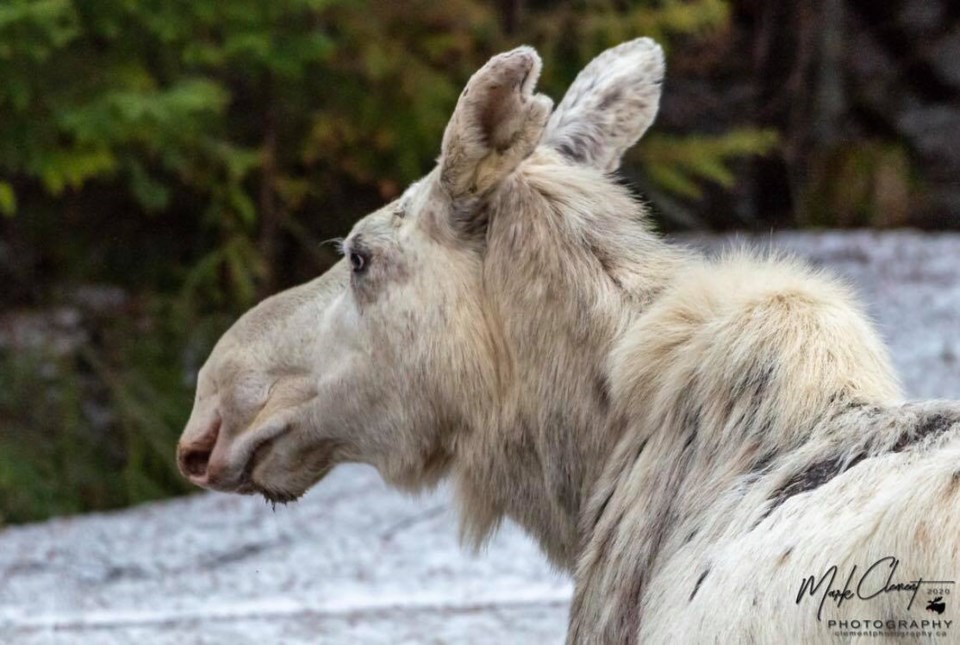
A white moose was shot and killed near Foleyet the week of Oct. 26. The Ministry of Natural Resources and Forestry is looking for the people responsible. Marc Clement Photography photo
The reward for information about a white moose killed near Foleyet now sits around $8,000.
The news about a white cow moose, that was killed and harvested on Nova Road sometime during the week of Oct. 26, sparked social media outrage. It also prompted Flying Post First Nation member Troy Woodhouse to offer a $1,000 reward that would lead to an arrest or encourage people involved to turn themselves in.
In less than a week, the initial amount has increased thanks to individual donations and offers from Missinaibi Drilling, and The Gordon and Patricia Gray Animal Welfare Foundation.
“It was nice to see that there are people in the community that care about the spirit moose,” Woodhouse said. “It’s very heart-warming to see that issue of the spirit moose has gained some traction and some people want to help out in these tough financial times … Hopefully, it leads to an arrest or someone coming forward about the crime.”about:blank
The drilling company offered to match Woodhouse’s reward, while the animal welfare foundation has offered $5,000.
“We’re very much against this kind of activity, illegal hunting, and we know how important (Indigenous) traditions are, so just agreed to do that,” said Gordon Gray. “We do everything we can in our foundation to support the wild being of wildlife.”
The Ministry of Natural Resources and Forestry (MNRF) is investigating the incident.
It is illegal to hunt and harvest predominantly white-coloured moose in wildlife management units 30 and 31.
Kowalski said white-coloured moose are not a separate species, and their colour may be caused by a recessive gene that occurs within the broader moose population.
If you have any information about the incident, call Crime Stoppers at 1-800-222-TIPS (8477) or visit P3tips.com.
If your information leads to an arrest, you could earn up to $2,000 in cash. You will remain anonymous and not have to testify in court.
New York State has seen a surge in people seeking licenses for trapping and big-game hunting as they find new ways to spend their free time amid the novel coronavirus pandemic, officials said.
The state’s Department of Environmental Conservation said an online hunter education course has contributed to the consistent spike in the number of people purchasing licenses, as the agency continues to see an increase in licensees, a spokesperson told Fox News in an email Monday.
In September, the DEC reported that sales for its hunting and trapping licenses had tripled on opening day alone compared to the previous year’s opening day sales.
Meanwhile, license sales this year were “more than double on the second day and nearly double the first two weeks,” a September press release states. And so far, interest has not waned, the DEC said Monday.
On this year’s opening day alone, the DEC made $922,444 in sales, while it reported $347,103 in sales on the same day in 2019. And in the first two weeks, sales topped $6.2 million, compared to the estimated $3.5 million during the same time last year, according to the release.
“With New Yorkers looking for more ways to enjoy the outdoors during the COVID-19 pandemic, we are seeing tremendous interest in outdoor recreation and in the sports of fishing, hunting, and trapping, including record sales of big game hunting and trapping licenses. New York is home to some of the best hunting and fishing opportunities in the nation,” said DEC Commissioner Basil Seggos in an emailed statement.Video
Seggos attributed the uptick to the ability for applicants to take safety and education courses and purchase licenses online and from home. As of Tuesday, approximately 500,000 hunters are licensed in New York State, she said.
The DEC urges hunters to use caution and act as if every gun is loaded. It asks that hunters keep their firearms pointed in safe directions, “keep their fingers off the trigger and outside the trigger guard until ready to shoot,” and keep aware of what is beyond the target.
WASHINGTON, D.C.— Today the U.S. Fish & Wildlife Service finalized a rule removing protections for all gray wolves in the lower-48 states except for a small population of Mexican wolves in Arizona and New Mexico.
The rule, proposed last year, outraged Americans, with approximately 1.8 million comments submitted by the public opposing delisting. Additionally, 86 members of Congress (in both the House and Senate), 100 scientists, 230 businesses, and 367 veterinary professionals submitted letters opposing the wolf delisting plan. Today Dr. Jane Goodall released a video in response to the decision. Even the scientific peer reviews commissioned by the Fish and Wildlife Service itself found that the agency’s proposal contained numerous errors and appeared to come to a predetermined conclusion, with inadequate scientific support. Despite this public and scientific outcry, the rule issued today removes all federal protections from gray wolves.
The following are statements from a coalition of organizations that work toward wildlife conservation:
“This is no ‘Mission Accomplished’ moment for wolf recovery,” said Kristen Boyles, Earthjustice attorney. “Wolves are only starting to get a toehold in places like Northern California and the Pacific Northwest, and wolves need federal protection to explore habitat in the Southern Rockies and the Northeast. This delisting decision is what happens when bad science drives bad policy – and it’s illegal, so we will see them in court.”
“Wolves are too imperiled and ecologically important to be cruelly trapped or gunned down for sport,” said Collette Adkins, Carnivore Conservation Director at the Center for Biological Diversity. “The Trump administration is catering to trophy hunters, the livestock industry and other special interests that want to kill wolves. We’ll do everything we can to stop it.”
“The decision to remove critical protections for still-recovering gray wolves is dangerously short-sighted, especially in the face of an extinction crisis. We should be putting more effort into coexistence with wolves instead of stripping critical protections still needed for their full recovery. The science is clear that we need to be doing more to protect nature and wildlife, not less.,” said Sierra Club Executive Director Michael Brune.
“We are disappointed in the U.S. Fish and Wildlife Service’s final determination to remove federal protections for the gray wolf in the lower 48 states,” states Angela Grimes, CEO of Born Free USA. “With current gray wolf habitats spanning states that are hostile towards the species, gray wolves still teeter on the verge of recovery. Delisting this American icon appeases a small percentage of the American public and will surely damage the viability of future populations.”
“Without the protections afforded by the Endangered Species Act, gray wolves would never have recovered in the places where they are now,” said Leda Huta, Executive Director of the Endangered Species Coalition. “By removing protections across the country, the Trump Administration is abandoning efforts to restore this iconic American species to millions of acres of wild habitat.”
“Protecting and restoring the iconic call of the wolf is our duty to not only the populations of wolves that continue to be persecuted to this day, but to the ecosystems that depend upon them. Removing protections for wolves under the Endangered Species Act ensures that these much-maligned creatures will continue to struggle for their rightful place in the natural world, ” stated Louie Psihoyos, Founder and Executive Director of Oceanic Preservation Society. “As we confront the 6th Mass Extinction, we must work to defend every living component to maintain nature’s complex and delicate balance.”
“Wolves are just beginning a tentative recovery in states like Washington, Oregon, California, and Colorado, and the howl of the wolf is completely absent from their natural habitats in states like Nevada and Utah,” said Erik Molvar, a wildlife biologist and Executive Director of Western Watersheds Project. “Removing Endangered Species Act protections before wolf populations are secure, and before their recovery is complete, is ecologically irresponsible.”
“By turning over gray wolf management to the states, the Fish and Wildlife Service is relying on local management regimes that often undermine gray wolf recovery efforts,” said Cathy Liss, president of the Animal Welfare Institute. “Many of the states’ wolf management plans are vague and unenforceable, lack sources of funding, and prioritize recreational hunting interests over the maintenance of viable wolf populations. Gray wolves are apex predators who play a vital role in ecosystems, contribute to a multibillion-dollar outdoor tourism industry, and are a beloved symbol of our nation’s wildlands.”
“Where wolves are unprotected, they are mercilessly persecuted, as we’ve already had a glimpse of in Wyoming, Idaho, and Montana, ” said Lindsay Larris, Wildlife Program Director at WildEarth Guardians. “Now they are defenseless across their range, which is bad news for wolves, but good news for people who want to shoot and trap them. The Trump administration is once again destroying our shared natural resources for the interests of a few.”
“Stripping protections for gray wolves is premature and reckless,” said Defenders of Wildlife President and CEO, Jamie Rappaport Clark. “Gray wolves occupy only a fraction of their former range and need continued federal protection to fully recover. We will be taking the U.S. Fish and Wildlife Service to court to defend this iconic species.”
“If we want to save wolves, we need a national plan, if not a continental one,” said Environment America’s Conservation Program Senior Director Steve Blackledge. “Wolves need plenty of space to roam, and it just doesn’t make sense to create arbitrary boundaries for them. Do we really want to lose the hearty howl of the gray wolf on our watch?”
“You cannot have a national wolf recovery without putting forward a national wolf recovery plan. This still has not happened, so eliminating federal protections for gray wolves is a huge setback in recovery efforts,” said Sylvia Fallon, Senior Director, Wildlife for the Natural Resources Defense Council. “Wolves are still missing from much of their remaining habitat in the West and throughout the Northeast. As we face a biodiversity crisis of global proportions, now is the time to restore species to the landscape – not dial back efforts. Unfortunately, the Trump Administration has decided on the exact opposite.”
“The many threats that caused wolves to become endangered still exist,” said Nancy Warren, Executive Director National Wolfwatcher Coalition. “States have shown over and over again, that wolf management is based on politics rather than science. The cumulative effects of interpack strife, aggressive hunting and trapping practices, legal and illegal killings, car collisions and disease impact not only wolf populations but also the social structure of packs well beyond the extent of each individual threat.”
“Once large carnivores lose federal protections, the states often open liberal hunting and trapping seasons, purposely depleting populations,” said Garrick Dutcher, Research and Program Director for Living with Wolves. “History shows this to be especially true for the gray wolf, whose recovery is underway, but nowhere near complete. There is no biologically sound reason to lessen or remove protections for wolves.”
“The return of the wolf reflects more fully functional and wild ecosystems,” said Wolf Conservation Center Executive Director, Maggie Howell. “While we agree that wolves cannot be recovered everywhere they used to be found, there is still plenty of suitable habitat left in areas where wolves have yet to recover. Vast swaths of existing, highly suitable habitat in the Southern Rockies, parts of West, and the Northeast will now remain forever impoverished by reduced biological diversity and impaired ecosystem health.”
“Wolves are only recovered in 15% of their range at best,” stated Camilla Fox, Founder and Executive Director of Project Coyote. “Only anti-wolf bias, and certainly not credible science, would conclude that 15% constitutes a significant portion of wolves’ historic range. This completely contravenes the notion of evidence-based policy or science-based wolf recovery.”
“Given that gray wolves in the lower 48 states occupy a fraction of their historical and currently available habitat, the Fish and Wildlife Service determining they are successfully recovered does not pass the straight-face test,” said John Mellgren, an attorney with the Western Environmental Law Center. “On its face, this appears to be politically motivated. While the Trump administration may believe it can disregard science, the law does not support such a stance. We look forward to having a court hear our science-based arguments for why wolves desperately need Endangered Species Act protections to fully recover.”
“Restoring endangered species is much more than a minimum population numbers game”. stated David Parsons, Carnivore Conservation Biologist at The Rewilding Institute. “The first purpose of the ESA is to restore ecosystems that are critical to the recovery of endangered species. Gray wolves are keystone species in their ecosystems, and removing their protection under the ESA will forever preclude them from re-inhabiting significant areas historically occupied habitats, leaving these areas ecologically impoverished.”
“Until all wildlife voices are weighted equally and the state agencies inhumane and unscientific management plans are changed to reflect real Wisconsin values on wolf conservation and independent research, then the wolf hasn’t truly recovered. Endangered species conservation begins and ends with managing and educating people. Delisting would essentially throw the wolf back into the hands of the very same attitudes and practices that caused their extinction in Wisconsin,” said Melissa Smith, director of Great Lakes Wildlife Alliance and Friends of the Wisconsin Wolf & Wildlife.
“Entrusting states with gray wolf management is a brutal and failed experiment,” said Kimberly Baker, Executive Director of the Klamath Forest Alliance. “Idaho serves as a horrific example, where 60% of the state’s wolf population, including dozens of pups, were exterminated in a single year, destroying decades of wolf recovery efforts.”
“Delisting will cause wolves to fall prey to the whim of state governments, led by boards disproportionately represented by hunting/trapping interests,” said Karol Miller, President of The 06 Legacy. “This conflict of interest is without consideration of the positive role of wolves or the need for sufficient populations to fulfill their role as a critical keystone species in a healthy ecosystem.”
“The northeast has been totally ignored by state and federal governments despite the fact that it contains tens of thousands of square miles of potentially suitable wolf habitat, abundant prey, and is as near as sixty miles to existing wolf populations in Canada,” according to John Glowa, President of The Maine Wolf Coalition, Inc. “Furthermore, recent evidence indicates that wolves have returned to the region. This keystone predator is an essential part of the ecosystem in the northeast where deer populations are exploding and where moose are lacking natural predators. Stripping federal protection will doom natural wolf recolonization and will ensure that the ecosystem is never returned to its natural state.”
“Wolves are one of the most highly persecuted species in North America, and the humans that came before us did a remarkable job of eliminating these carnivores from our landscapes,” said Wildlands Network Conservation Director and Interim Executive Director Greg Costello. “We now recognize the ecological need for wolves, and must continue to uphold the inherent right of this species to coexist in the world.”
“The U.S. Fish and Wildlife Service has once more shown its blatant disregard for the values of the majority of Americans who care deeply about wolves and don’t want to see them killed for the pleasure of a few trophy hunters,” said Sara Amundson, President of Humane Society Legislative Fund. “ This politicized decision by the Trump Administration throws away decades of science-based recovery efforts and is based on the same fearmongering and hate that caused the extirpation of wolves a hundred years ago. We’ll never give up fighting to secure their permanent protection from such wanton cruelty and destruction.”
“Wolves are among the essential wildlife for healthy, resilient ecosystems, especially during these times of chaotic climate change. In addition, wolves are also valued by many Americans for their intrinsic worth as co-inhabitants of the Earth’s wildlands.” Kim Crumbo, Wildlands Coordinator, The Rewilding Institute.
“Removing protections for gray wolves amid a global extinction crisis is short-sighted and dangerous to America’s conservation legacy,” said Bart Melton, Wildlife Program Director for the National Parks Conservation Association. “Rather than working alongside communities to support the return of wolves to parks and surrounding landscapes including Dinosaur National Monument, North Cascades and Lassen National Forest, the administration essentially today said, ‘good enough’ and removed Endangered Species Act protections. The Fish and Wildlife Service’s proposal ignores the requirements of the Endangered Species Act, science, and common sense.”
“The gray wolf is a keystone species that plays a critical role in maintaining healthy ecosystems across its historic range,” said Danielle Kessler, U.S. Country Director for the International Fund for Animal Welfare. “Wolf populations are far from recovered in much of their native territory. Removing federal protections now and placing wolves in the hands of state managers only threatens already fragile gains. No state has the breadth of vision to oversee recovery efforts for species that range beyond its boundaries. For the sake of our shared environment, as well as the health and survival of gray wolves themselves, federal protections remain essential for this iconic American species.”
“Howling For Wolves is adamant in our opposition to wolf trophy hunting and trapping. We have witnessed how wolf hunting and trapping harms the wolf population. Human wolf killing destroys the individual wolf, which is a magnificent and social animal, and these killings cause other secondary wolf deaths. Research shows that human wolf killing disrupts wolf packs, causing unstable and unpredictable effects including increased wolf-livestock conflicts,” said Howling For Wolves President and Founder Dr. Maureen Hackett.
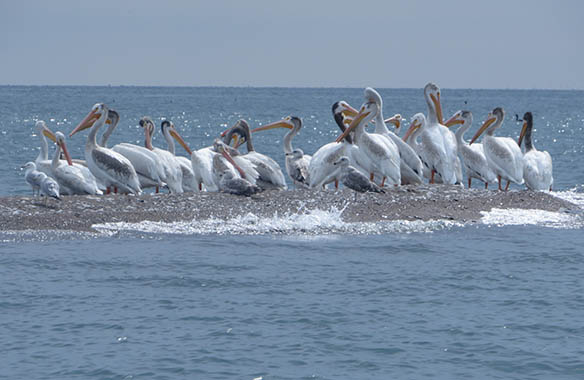
The American white pelican is so called to distinguish it from the distinctively different Eurasian white pelican, but it nests in Canada’s three prairie provinces and the westernmost part of Ontario.
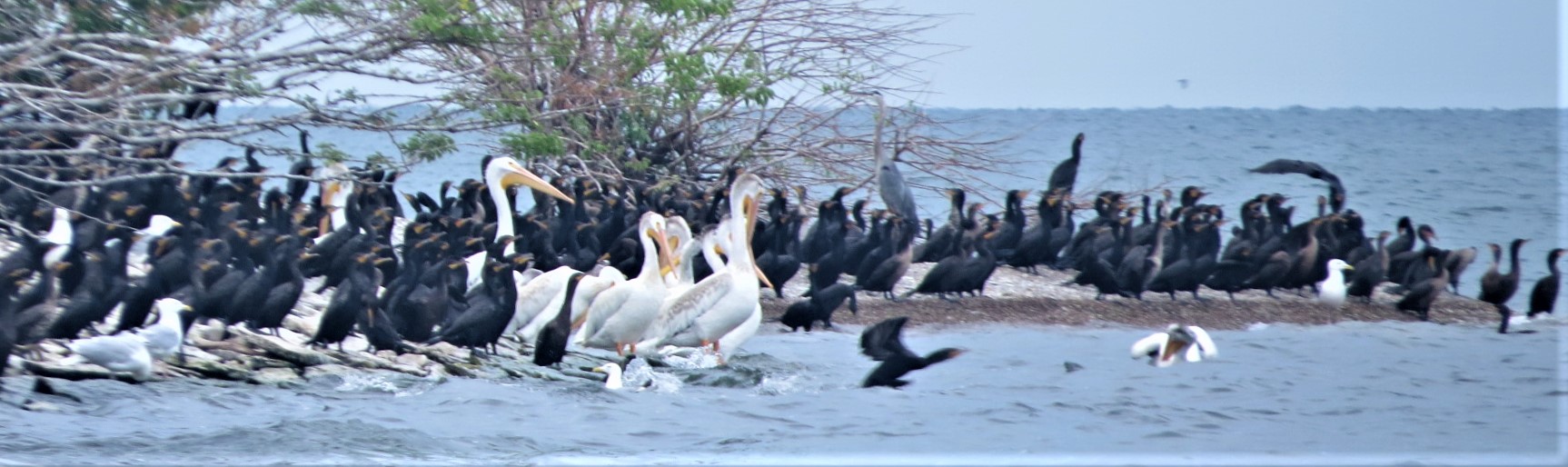
You may recall from prior blogs that we have been trying to prevent the shooting of thousands of nesting double-crested cormorants on Middle Island by Parks Canada, a federal agency. Middle Island is the southernmost land belonging to Canada, a little over 100 yards from the U.S. border in the middle of the southwest end of Lake Erie. It is 46 acres, uninhabited, and part of Point Pelee National Park, the main part of which is on the mainland, over 20 miles away. The island is closed to visitors all spring and summer, ostensibly to protect the colonially nesting birds there – double-crested cormorants, great blue herons, black-crowned night-herons, and great egrets, plus herring and ring-billed gulls and Canada geese.
Each spring since 2008, except for this year, when boating was halted to reduce infection by COVID-19, thousands of these birds have been shot by Parks Canada staff (and more recently, shooters from First Nations) based on claims that the killing must take place in order to protect “at risk” vegetation on the ground. Even though the plant species of are common in the U.S., which starts about 100 yards to the south of the island, Ontario lists the plants as “threatened” under the provincial Endangered Species Act.
The cormorants change the vegetation dynamics mainly by accumulation of their excrement. Vegetation that can withstand the high nitrogen load from the guano survives while other vegetation does not. As our colleague James Kamstra points out in his evaluation of the Middle Island vegetation, island climates are mercurial due to harsher conditions and plant species thrive and then disappear with the changing conditions.
I have gone with my Canadian colleagues each spring to monitor the cull, and I have been saddened to see the huge degradation of the colony, with ever fewer of various species, not just cormorants. There is a ghost forest emptied of birds where once there was so much life, vibrancy, and activity.
In these last few years, we have also seen Parks Canada activity prevent American white pelicans from using the island. That the pelicans were there at all was a surprise as they were previously designated as a “rare vagrant” in the region, with their nearest nesting site in the northwest corner of the province, roughly 700 miles away. Yet, there they were, in the nesting season.
Because Parks Canada has not allowed them on Middle Island (ironically called a bird sanctuary), the pelicans have tried other islands nearby, first on a low-lying island where high waters washed the nests away, but lately with success on Big Chicken Island, really just a small, treeless sandbar, and Middle Sister Island, about nine acres, privately owned by Americans, uninhabited, and, most importantly, treed. The latter nesting proved that the pelicans, which typically nest in the company of cormorants on treeless islands, can nest on habitat similar to Middle Island, but for Parks Canada’s gunmen.
Because of the pandemic and a ban on boating during the time of the cull, Parks Canada’s annual cormorant slaughter did not happen. This spring, the cormorants, pelicans, and all wildlife on the island, were, for the first time in a dozen years, left in peace. The island is still out of bounds to Canadian taxpayers, until September, but we decided to investigate the status of the colony offshore from Middle Island and, on July 23, Liz White, Vicki Van Linden, and I travelled more than 20 miles across the water to see if we could find young pelicans on Middle Island.
Yes! We were pleasantly surprised and elated. We saw lots of them, both adults and fully grown youngsters, in company with cormorants on the shore and on a nearby exposed sandbar. It was not proof that they nested on the island itself, but indicative. We also travelled to two other islands in the area, Hen and East Sister. As we neared Hen Island, we observed white pelicans on the dock. Hen Island is owned by Americans, who use it as the base for the Quinnebog Fishing Club, complete with a hotel like central building, lawn, retro-decorated club house, and docks and has been unused due to the pandemic. On East Sister Island, we saw flocks reaching 50 birds in number. Again, because of the pandemic, the island had been undisturbed.
Why do we care? Because the pelican, no less than the plants, is a threatened species under provincial legislation, making it illegal to disturb their nesting sites. They and cormorants habitually nest together. Parks Canada can’t cull cormorants without disturbing the nesting pelicans. Aside from the gun shots, which cause massive number of birds to flee the island, their very presence would negatively impact the pelicans. Parks Canada cannot have it both ways. They cannot argue to necessity of protecting “at risk” vegetation while not protecting “at risk” pelicans.
Drawing by Barry Kent MacKay.
Less than a week later, the Ontario government did something no other government on the continent has done, and turned the virtually inedible cormorant into a “game bird” whose meat can be wasted. An open season starts this September 15, with a bag limit of 15 birds per day. Originally Ontario wanted the killing season to go most of the year, so we’ve won a major concession, as I will discuss in a future blog.
Keep Wildlife in the Wild, Barry
Barry Kent MacKay Director of Canadian and Special Programs
Descrease article font size-AIncrease article font sizeA+
The province of Ontario is introducing an annual fall harvest of the double-crested cormorant as a step to protect fish stocks and natural habitat.
In Fenelon Falls on Friday morning, John Yakabuski, Minister of Natural Resources and Forestry, announced that the hunting season will run annually from Sept. 15 to Dec. 31, beginning this year.
Yakabuski says Ontario has a healthy and sustainable cormorant population. The fish-eating bird — which consumes up to a pound a fish a day — is known for its droppings called guana which can kill trees and other vegetation in which they nest and roost. They are notorious for destroying traditional nesting habitats of other colonial waterbirds.
“We’ve heard concerns from property owners, hunters and anglers, and commercial fishers about the kind of damage cormorants have caused in their communities, so we’re taking steps to help them deal with any local issues,” Yakabuski said. “In large amounts, cormorant droppings can kill trees and other vegetation and destroy traditional nesting habitats for some other colonial waterbirds, so it’s critical that we take action to strike a healthy balance in local ecosystems.STORY CONTINUES BELOW ADVERTISEMENT
Following public consultations, the province has made changes to its initial proposal so as not to interfere with waterway users and other migratory birds.
“We listened to those who provided comments about the cormorant hunting proposal, and as a result, we are introducing only a fall hunting season to avoid interfering with recreational users of waterways and nesting periods for some migratory birds,” Yakabuski said. “We have also reduced the maximum number of cormorants a hunter can take to 15 a day, which is a similar limit to one for federally regulated migratory game birds such as mourning doves, snow and Ross’s geese, rails, coot and gallinules.”
Laurie Scott, MPP for Haliburton-Kawartha Lakes-Brock, says cormorants have been a growing problem on Sturgeon Lake and Balsam Lake in her riding. “They have covered islands with their guano, killing trees and vegetation,” Scott said.
“We’re listening to local residents who have voiced their concerns and asked for additional tools to address the issue.”TWEET THIS
Last year, the ministry and partner agencies surveyed cormorant colonies across the Great Lakes and select inland lakes in Ontario. Based on nest count surveys, the province says there are an estimated minimum of 143,000 breeding cormorants in 344 colonies across the province.
The province says combined with historical data, trends suggest that cormorant populations are increasing in Lake Ontario, Lake Erie, and Lake Superior and are stable on the St. Lawrence River and Lake Huron.STORY CONTINUES BELOW ADVERTISEMENThttps://8f291139c8c942b58d8e426919dedfa0.safeframe.googlesyndication.com/safeframe/1-0-37/html/container.html
“Growing up in North Bay and spending many summers fishing on Lake Nipissing, I have seen firsthand the issues that cormorants have caused in some local areas,” said Mike Harris, parliamentary assistant to Yakabuski.
“A new fall hunting season will help communities manage cormorant populations where they have negatively impacted natural habitat and other waterbird species.”
The Ontario Federation of Anglers and Hunters applauds the bird harvesting announcement.
“We are pleased to see a provincial government finally take action to control overabundant cormorant populations to help protect Ontario’s ecosystems,” said executive director Angelo Lombardo. “We are encouraged to see that the MNRF has made adjustments to the original proposal in response to concerns expressed by the OFAH and others.”
The Ontario Commercial Fisheries’ Association echos the sentiment.
“We strongly support the government’s decision to introduce a fall hunting season, which will help to control damaging cormorant populations,” said Jane Graham, executive director. “Our position has not been to seek the extinction of cormorants from Ontario but for the management of cormorants to promote a balanced ecosystem, which is in the best interests for all Ontarians.”
The province says hunters will be responsible for appropriately identifying their target and ensuring they are harvesting only double-crested cormorants. Cormorants can be consumed but if not, the province says the harvested birds must be disposed of properly.
As mountain lion sightings in the region increase, there has been talk about allowing more hunting to thin their numbers. Your take?
To say I’m an avid user of open space is like saying that Boulder leans left. I’m running, climbing or cycling in the hills above Boulder at least five days a week, frequently every day of the week. I’ve been doing it for more than a quarter of a century, on every day of the year.
I’ve seen deer that are so used to humans that I’ve run within six feet of them, almost close enough to pat them on the back. On Green Mountain, in the darkness of a very early morning, I once followed a bear up the Amphitheater Trail until it eventually detoured off the trail.
In all that time, I’ve still never seen a mountain lion. How cool would it be to see a lion? A lion! People travel to Africa to see lions, yet we have them right here. One of the greatest benefits of living where we do is being close to so much wildlife.
Mountain lions and bears are large, powerful, and very dangerous if they attack, but they very rarely attack humans. There have been three Colorado fatalities from mountain lions in more than 100 years of record keeping. Lions seem to instinctively know that humans aren’t prey.
We already have to hunt elk and deer to help control their populations, mainly because we’ve driven away their predators. Hunting lions would just exacerbate the problem and we’d then have to kill more deer. Killing will just lead to more killing.
While hunters are generally quite safe, with fewer than 1,000 shooting accidents per year in the U.S. and fewer than 75 deaths, those 75 deaths per year are seven times the number of U.S. deaths by mountain lions in the last 50 years combined. It is 350 times more likely that someone will be killed by a hunting accident than a cougar.
Possibly the overall risk to humans would increase if we had hunters in our open space. Hunting lions would be a mistake.
Bill Wright, billwright510@gmail.com
I admit I know little about hunting. I do know that we humans chose to settle in mountain lion territory and not the other way around, though, so I’m inclined to err on the side of minimal human intervention in mountain lion populations, if possible.
One of the only predators that can naturally thin the mountain lion population is the wolf, which humans eradicated from Colorado in the 1940s. When wolves were reintroduced into Yellowstone, the overall health of the ecosystem improved because wolves go after the weaker, sicklier animals.
Human hunters tend to look for the healthier specimens, meaning that while recreational hunting may help with overpopulation, it doesn’t necessarily improve the health of the population. This fall, there will be a statewide ballot initiative to reintroduce gray wolves into Colorado by 2023. It will be the first time in the United States that voters will be able to decide on wolf reintroduction.
I don’t know how effective wolf reintroduction will be at stemming mountain lion excursions into Front Range communities, but making efforts to restore the natural predator-prey relationships that existed long before we came to this land feels right and just. Simply issuing more mountain lion hunting licenses seems unlikely to stem the problem of mountain lions coming into populated areas.
My understanding is that some mountain lions develop the habit of coming into populated areas because they’ve learned that they can find food more easily in those areas, but presumably we’re not talking about allowing mountain lion hunting within city limits, so how do we know that the hunters will be killing the problem lions?
Hunting is a blunt instrument for dealing with a minor problem. There have been just 27 fatal mountain lion attacks on humans in the entire United States in the last 100 years. We have bigger problems to deal with right now.
Jane Hummer, janehummer@gmail.com
I have had only one encounter with a mountain lion in my life. It was here in Boulder on Mount Sanitas. One day a week, usually on Tuesdays, I hike Sanitas Trail around 5 a.m. It is a great workout, and I do it year round.
One July morning a few years back, I arrived at the trail head and started my trek. It was still dark and my headlamp was blazing the way. As I approached the saddle in the west ridge just before the first false summit, I saw them.
Two gigantic eyes, smack in the middle of the trail, staring back at me about 20 feet away. It took me a minute to realize what I was looking at, but then, with the help of my head lamp, I could make out the lion’s face, the ridge of his back, and its tail. I froze, then cursed, and then remembered back to my mountain lion training; which fully consisted of one four-minute song from Boulder’s own Jeff and Paige. Thanks Boulder Open Space and Mountain Parks for that training!
All right, so after freezing and cursing, I took off my pack and made myself look big. To my surprise, the mountain lion didn’t move. It just stood there staring at me.
Honestly, I was surprised because I thought that as soon as this big guy caught wind of me, off, he would go. But no! We were locked in a staring contest. “Damn it!” I thought. I really wanted to get a workout in and this dude is standing in my way. What to do next?
Since my presence alone wasn’t enough to budge this lion, I had to do something else. Yelling and harassing him was next move. I start yelling and banging my hands together. “Yes! that worked! He moved!” I thought. But, my joy was short lived because he had just moved onto the ridge about 10 feet above me. Now he had the high ground. I was doubly screwed.
After about five minutes of playing this game, another hiker (a tourist) came up behind me. What’s going on?” he asked. “There is a mountain lion right above the trail. Can’t you see it?” I said.
“No” said the tourist (he was not wearing a headlamp and it was still dark). “Is it safe to go?” he said. “I think,” I said, “You go first.”
So, off we went, me and the tourist, directly under the mountain lion. The tourist placed strategically between me and the lion and the mountain lion’s big, glowing eyes staring down at us. Having made the trek often and in better shape, as soon as I cleared to a safe area, I was gone. I never heard a scream, so I assume the tourist returned unscathed.
My take: Lion populations fluctuate with the availability of prey. Let them be; it’s their habitat. As for me, I am always looking for early morning hiking partners, preferably slightly slower than me.
My email is below, feel free to reach out to me if you are up for it.
LITTLE ROCK — If you’re looking for an extra opportunity to put some meat in the freezer this fall, feed needy Arkansans and help control urban deer populations, now is the time to start planning.
Russellville is included in the areas open for the hunt.
Urban archery hunts are more than an added opportunity for hunters, they’re a sound technique to manage deer populations where they have become too abundant and have caused conflicts with people.
Ralph Meeker, the deer program coordinator for the Arkansas Game and Fish Commission, says certain wildlife populations have flourished in the last five decades, but there can be a downside. Each year, deer cause thousands of dollars in damage to people’s landscaping and present a danger to motorists in rural neighborhoods.
Archery hunter in tree stand”All wildlife have what is called ‘social carrying capacity,’” Meeker said. “That’s the density of a wildlife population where they begin to become a nuisance or danger. A few areas in Arkansas that have high populations of people in relatively rural settings have reached this threshold, so the AGFC works with those cities and towns to find solutions.”
Urban hunts are one of the best tools wildlife managers can use to reduce these populations without more expensive techniques such as sharpshooters.
Hunting is the most efficient means we have to control deer populations,” Meeker said. “We have hunters who want to help, and the harvest helps control the deer’s numbers.”
Even deer that are not harvested will scatter back to surrounding wildlife habitat once the added hunting pressure is apparent.
“These hunts allow hunters to enjoy their sport while offering an important service to the public and contribute to needy Arkansans throughout the state,” Meeker said. “All hunters must donate their first adult deer harvested to Arkansas Hunters Feeding the Hungry.”
Meeker works with the Arkansas Bowhunters Association and city officials to coordinate the hunts throughout the state. Hunters who participate in the hunts must attend an orientation where they must pass a proficiency test with the archery equipment they intend to use during the hunt. An orientation fee is collected, which covers the insurance policy for the hunt most cities require.
Meeker says the added attraction of an early September hunt also helps drive people to participate.
“Urban hunts open Sept. 1, so they’re the best chance an Arkansas hunter has at getting a buck in velvet, which is on some hunter’s bucket lists,” Meeker said. “Early season hunting isn’t for everyone, but the hunts continue all the way through the end of February for some locations, giving hunters plenty of time to harvest an urban deer.”
Bowhunting qualifierAll urban hunts follow stringent guidelines to ensure the safety of hunters and local landowners is maintained, some of these guidelines differ from hunt to hunt. In addition to orientations and shooting proficiency tests, all hunters must have passed the International Bowhunters Education Program course to participate.
Deer harvested during urban hunts do not count toward a hunter’s seasonal limit. There are no limits to the number of deer that can be harvested in urban hunts and all antler restrictions are lifted. All deer harvested must still be checked to the appropriate urban deer zone.
OVERSET FOLLOWS:Additional hunting areas are Fairfield Bay, Cherokee Village, Horseshoe Bend, Heber Springs, Helena/West Helena, Hot Springs Village, Bull Shoals, and Lakeview.


 A white moose was shot and killed near Foleyet the week of Oct. 26. The Ministry of Natural Resources and Forestry is looking for the people responsible. Marc Clement Photography photo





 Exposing the Big Game