Exposing the Big Game

Forget Hunters' Feeble Rationalizations and Trust Your Gut Feelings: Making Sport of Killing Is Not Healthy Human Behavior

Exposing the Big Game

Rhino Hunt Auction Winner Fears for His Safety

11140266_10152676869137554_1328208644784607162_n

http://www.usatoday.com/story/news/nation/2014/01/16/us-rhino-hunt-auction-winner-fears-for-his-safety/4517427/

Marie Saavedra, WFAA-TV, Dallas-Fort Worth 6:07 a.m. EST January 17, 2014

A man who paid $350,000 for the right to hunt an endangered African black rhino says he fears for his safety

DALLAS — A U.S. man who paid $350,000 for the right to hunt an endangered African black rhino says he fears for his safety.

Corey Knowlton said that after being revealed as the winner of a controversial Dallas Safari Club auction, he’s received death threats — so many that he says local law enforcement and the FBI are now working to keep them safe.

STORY: Black rhino hunting permit auctioned for $350,000

Knowlton, who has hunted around the world, said there has been a lot of anger and some confusion.

He leads expeditions for both everyday Joes and billionaires looking to hunt, and has been a fixture on The Outdoor Channel. His Facebook page is filled with photos of large deer he’s tracked and killed — wild boar, a bear, even a massive shark.

The Safari Club auctioned the permit to raise money for efforts to protect the black rhino.

Knowlton said his goal was to support conservation efforts for the black rhino. That’s where the money from his bid will go.

But critics feel that the chance to kill one is no kind of reward — and they’re letting him know it.

Still, Knowlton said the hunt is well-managed, and insists he will be targeting an aggressive older male that he says is terrorizing the rest of the herd, and would already be a target.

He said this is a challenge he welcomes.

“I’m a hunter. I want to experience a black rhino. I want to be intimately involved with a black rhino,” Knowlton said. “If I go over there and shoot it or not shoot it, it’s beyond the point.”

He said the death of this black rhino is inevitable.

“They are going to shoot those black rhinos … period. End of story,” he said.

Contributing: The Associated Press

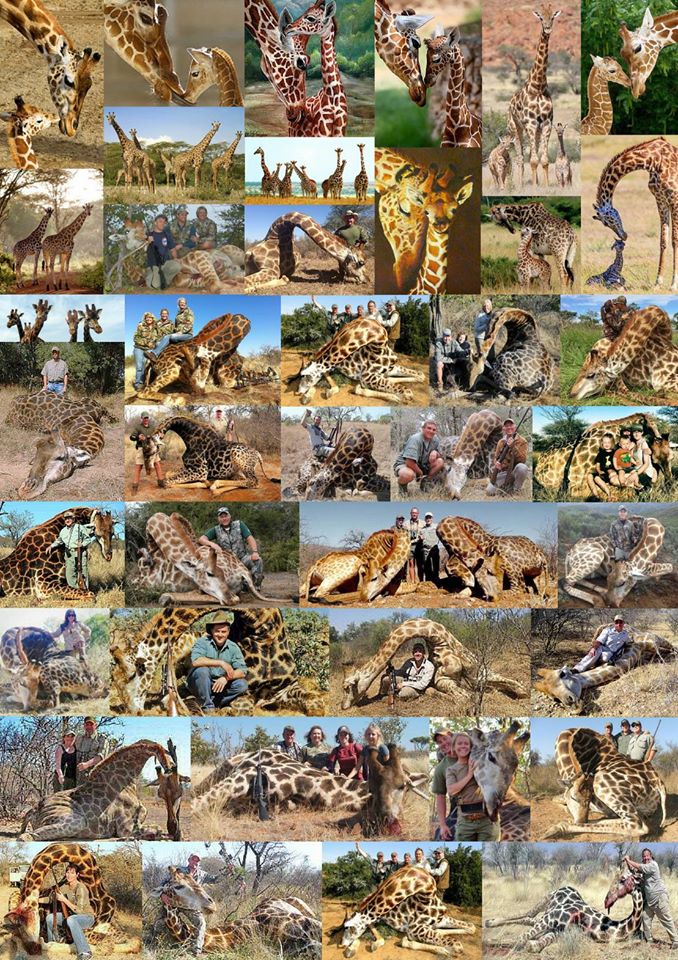
Footage of Rebecca Francis killing a giraffe in Africa

From Change.org

Apr 20, 2015 — This video shows Rebecca Francis hunting the giraffe from the picture. Although she made a rebuttal to Ricky Gervais last week, the video shows just had deceptive she was being.
https://www.youtube.com/watch?v=RmkslPmo1vU&feature=youtu.be

Footage of Rebecca Francis killing a giraffe in Africa
Here is footage of the hunt in which Rebecca Francis kills a giraffe with a bow and arrow in Africa which has caused outrage. Francis like all trophy hunters has claimed she killed the animal to feed local…

Elephant kills professional big game hunter in Zimbabwe

10671222_10202527690853624_1897035803926677117_n

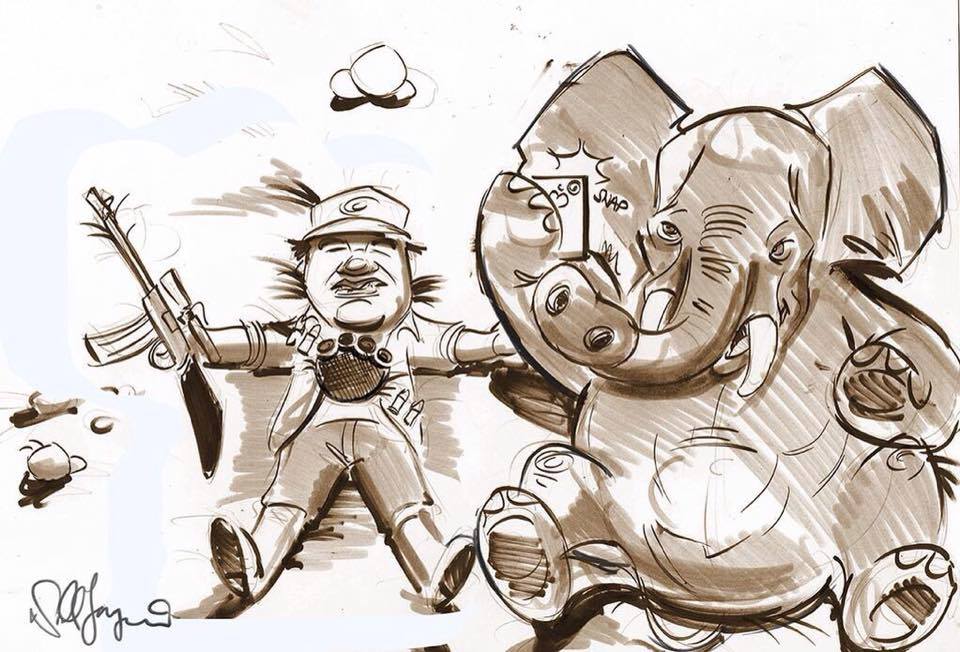
Professional hunter tracking a lion for American client crushed to death by young bull elephant in Zambezi Valley

By Peta Thornycroft, Johannesburg

17 Apr 2015

A young bull elephant killed professional hunter Ian Gibson early on Wednesday as he tracked a lion for an American client in a rugged part of north-east Zimbabwe.

Mr Gibson, 55, one of Zimbabwe’s best known big game hunters, died scouting for prey in the Zambezi Valley after a young bull elephant charged, then knelt on him and crushed him to death.

“We don’t yet know the full details of how ‘Gibbo’ as we called him, died, as the American client and the trackers are still too traumatised to give us full details,” said Paul Smith, managing director of Chifuti Safaris’ which employed Mr Gibson for the hunt.

The American hunter was on his first trip to Zimbabwe, and only has one leg, but was “fit and strong” and had already shot a leopard. Mr Gibson was scouting for lions when he encountered the elephant.

Mr Gibson’s trackers said the young bull had been in a musth period, which means it was producing much more testosterone then usual.

“We know ‘Gibbo’ shot it once, from about 10 yards away, with a 458 [rifle]. He would never have fired unless he had no alternative. He was a hunter, yes, but he was also a magnificent wildlife photographer and conservationist.

“He was so experienced and this is a most unexpected tragedy.” …

Mr Smith said the young bull elephant appeared not to be a natural target for any hunter as its tusks were too small.

“In most years someone is usually killed on a hunt somewhere in Africa, and that is why it is called ‘dangerous game hunting‘ but we are very shocked that it was ‘Gibbo’,” said Mr Smith.

Mr Gibson began his wildlife career in Zimbabwe’s department of national parks, but left to become a hunter about 25 years ago.

He was well-known in the US, where the Dallas Safari Club is paying his funeral expenses.

More: http://www.telegraph.co.uk/news/worldnews/africaandindianocean/zimbabwe/11546066/Elephant-kills-professional-big-game-hunter-in-Zimbabwe.html

Men and Women Who Hunt Animals Are “Equally Vile”

http://www.usmagazine.com/celebrity-news/news/ricky-gervais-men-and-women-who-hunt-animals-are-equally-vile-2015184#ixzz3XmWp7ZFo

Ricky Gervais Says Men and Women Who Hunt Animals Are “Equally Vile” AfterPoacher-Hunters-6 Rebecca Francis Claims He’s Targeting Women

Celebrity News Apr. 18, 2015 AT 1:20PM

He’s just getting started. Ricky Gervais continued to slam hunters following his buzzed-about spat with Eye of the Hunter co-host Rebecca Francis. His new comments are in

“We need to stamp out this terrible sexism in the noble sport of trophy hunting,” he tweeted on Friday, April 17. “The men & women that do it are EQUALLY vile &  worthless.”                                  [except for the woman in the photo above–she hunts poachers.]

The British comedian-actor, 53, was appalled earlier this week when he saw a photo of Francis lying down – and smiling – next to a dead giraffe she just killed. “What must’ve happened to you in your life to make you want to kill a beautiful animal & then lie next to it smiling?” he wrote via Twitter on April 13.

PHOTOS: Celebs and their pets

Francis began to receive death threats following Gervais’ post, which has garnered over 30,000 retweets. On April 14, Francis released a statement saying she preserved the animal by providing locals with its meat. On Friday, she gave a second statement to Hunting Life.

“Ricky Gervais has used his power and influence to specifically target women in the hunting industry and has sparked thousands of people to call for my death, the death of my family and many other women who hunt,” she said, via The Telegraph. “This has evolved into an issue about the morality of threatening human lives over disagreeing with someone else’s beliefs. It shocks me that people who claim to be so loving and caring for animals can turn around and threaten to murder and rape my children.”

PHOTOS: Celebs fight back on Twitter

Gervais, however, doesn’t seem to be backing down. He’s continued to show his love for animals all week. “Enjoy the lovely weather and don’t leave your dog in the car. Have a great day,” he tweeted on April 17. On Friday, he gushed about his adorable “furry bagpipe” cats and snapped a selfie with his “new duck friends” near a lake.

Read more: http://www.usmagazine.com/celebrity-news/news/ricky-gervais-men-and-women-who-hunt-animals-are-equally-vile-2015184#ixzz3XmRYOAMn
Follow us: @usweekly on Twitter | usweekly on Facebook

Also See: http://www.huffingtonpost.com/2015/04/17/vet-kristen-lindsey-kills-cat-with-arrow_n_7090630.html

US Government Approves Dallas Safari Club’s Rhino Import Permit for Trophy Hunter Corey Knowlton — Petition

1017393_10202261526713538_1876940690_n

US Government approves Dallas club’s rhino import permit

DALLAS (AP) — The US government will allow a Texas man to import the trophy of an endangered black rhinoceros should he kill one in Africa as part of a conservation fundraiser.

The US Fish and Wildlife Service said Thursday that importing a carcass from Namibia meets criteria under the Endangered Species Act of benefiting conservation.

Corey Knowlton bid $350,000 last year in a Dallas Safari Club auction billed as a fundraising effort to save the black rhino.

In a letter to the agency in December, the club’s executive director, Ben Carter, said the money raised from such auctions is “critical to supporting the Namibian government in their efforts to stem the tide of commercial killing of these animals.”

Since publishing the initial request in November, the US Fish and Wildlife Service received more than 15,000 comments, as well as petitions with about 152,000 signatures demanding that it be denied. PETA said Thursday that it will file a lawsuit.

The hunt was postponed and Knowlton’s money kept in escrow while the agency deliberated over the permit application.

Dallas Safari Club spokeswoman Jay Ann Cox could not immediately confirm Thursday whether a date has been set for the hunt.

The agency also is allowing Michael Luzich, a Las Vegas investment manager, to import his black rhino trophy. Namibia directly sold him a hunting permit.

Luzich has received far less scrutiny than Knowlton, who said last year he hired full-time security because he’d received death threats once his name became public knowledge.

Full story at http://fwbusinesspress.com/fwbp/article/1/9432/Breaking-News/US-government-approves-Dallas-clubs-rhino-import-permit-.aspx

                           ________________________________

http://www.thepetitionsite.com/takeaction/804/950/521/?cid=FB_TAF

The federal government in the US has confirmed that permission has been granted to Trophy hunter Corey Knowlton

Once again we are shown proof that money is power in the United States of America, with permission being granted to Trophy hunter Corey Knowlton to import the trophy of critically endangered black Rhino from Namibia for which he paid 350,000 dollars. This must be stopped before precedent is made and all wealthy people become entitled to be above international law.

http://www.thepetitionsite.com/takeaction/804/950/521/?cid=FB_TAF

How Hunting is Driving “Evolution in Reverse.”

—Wildlife Photography ©Jim Robertson

—Wildlife Photography ©Jim Robertson

Some of the most iconic photographs of Teddy Roosevelt, one of the first conservationists in American politics, show the president posing companionably with the prizes of his trophy hunts. An elephant felled in Africa in 1909 points its tusks skyward; a Cape buffalo, crowned with horns in the shape of a handlebar mustache, slumps in a Kenyan swamp. In North America, he stalked deer, pronghorn antelope, bighorn sheep and elk, which he called “lordly game” for their majestic antlers. What’s remarkable about these photographs is not that they depict a hunter who was also naturalist John Muir’s staunchest political ally. It’s that just 100 years after his expeditions, many of the kind of magnificent trophies he routinely captured are becoming rare.

Elk still range across parts of North America, but every hunting season brings a greater challenge to find the sought-after bull with a towering spread of antlers. Africa and Asia still have elephants, but Roosevelt would have regarded most of them as freaks, because they don’t have tusks. Researchers describe what’s happening as none other than the selection process that Darwin made famous: the fittest of a species survive to reproduce and pass along their traits to succeeding generations, while the traits of the unfit gradually disappear. Selective hunting—picking out individuals with the best horns or antlers, or the largest piece of hide—works in reverse: the evolutionary loser is not the small and defenseless, but the biggest and best-equipped to win mates or fend off attackers.

When hunting is severe enough to outstrip other threats to survival, the unsought, middling individuals make out better than the alpha animals, and the species changes. “Survival of the fittest” is still the rule, but the “fit” begin to look unlike what you might expect. And looks aren’t the only things changing: behavior adapts too, from how hunted animals act to how they reproduce. There’s nothing wrong with a species getting molded over time by new kinds of risk. But some experts believe problems arise when these changes make no evolutionary sense.

More: http://www.newsweek.com/how-hunting-driving-evolution-reverse-78295

A Fallen Tradition is “Suffering”: MN Hunters’ Deer “Harvest” too High

Lawmakers to DNR: We want more deer up north

A panel of Minnesota lawmakers Wednesday told state wildlife officials they wanted to see more deer in the woods, especially up north.

A House committee hearing room served as the setting for what amounted to a stern talking-to by lawmakers echoing a refrain among many of the state’s half a million deer hunters: Deer populations in many areas have fallen unacceptably low, and the quality of a fall tradition is suffering.

“The deer hunters out there understand,” said Rep. Tom Hackbarth, R-Cedar, who chairs the Mining and Outdoor Recreation Policy Committee and is one of a number of deer hunters on the panel. “They go out there year after year. We know what’s going on, and we’re not seeing the deer. … What’s the problem? How did we get here? … I sat in the stand for five days and didn’t see a doe in the woods. We’ve got huge problems.”

Officials from the Department of Natural Resources got the message.

“Certainly, what we’ve heard is the harvest levels are unacceptable,” Steve Merchant, wildlife and populations manager for the DNR, told the committee.

When viewed over a century of data, the roughly 140,000 deer killed by hunters in the fall isn’t a small number. As recently as 1972, the deer population was so low that no hunting was allowed. But populations rebounded dramatically, and between 1990 and 2010, many years saw more than 200,000 deer taken.

However, the total harvest has fallen steadily since 2010. To protect the declining population, the DNR enacted strict regulations this fall, and the 2014 harvest was the lowest in two decades.

The state’s largest deer hunting advocacy group, the Minnesota Deer Hunters Association, wants to see the harvest rebound to 225,000 by 2019, Craig Engwall, the group’s executive director, told lawmakers. “With conservative seasons and good weather, we think we can achieve that,” he said.

That number prompts unease among DNR officials, who for several years sought 200,000 as a “sweet spot” for the total harvest but say severe winters have suppressed the population. While DNR Commissioner Tom Landwehr has publicly stated deer numbers should be allowed to increase in much of the state, the agency has blamed the back-to-back severe winters of 2012-2013 and 2013-2014 for populations plummeting in northern parts of the state.

Brooks Johnson, president of Minnesota Bowhunters Inc. and one of the DNR’s loudest critics, told lawmakers that DNR officials have “manipulated” data to justify a “hidden agenda” of shrinking the deer population beyond what was called for a decade ago, when concerns over an overabundance of deer prompted the state to loosen hunter rules to allow more animals to be shot. “Allowing the DNR to constantly alter numbers destroys all credibility moving forward,” Johnson said.

His allegations drew sharp skepticism from several lawmakers. Merchant and DNR Wildlife Section Chief Paul Telander said indeed the agency had wanted to swiftly reduce numbers in northern forests, where deer numbers had grown to levels where they were over-browsing on young trees and threatening to prevent the state from receiving accreditation for sustainable forest management.

It’s unclear whether legislation with wide support will emerge. Several lawmakers said they would support requiring the DNR to draft a statewide deer plan similar to its plans for ducks, pheasants, ruffed grouse and other game. Others suggested a wider “audit” of the way the DNR models deer populations, similar to a process Wisconsin underwent several years ago.

Other lawmakers said putting the DNR on the hot seat was all that was needed.

“I don’t think legislators know enough about wildlife to come up with legislation,” said Rep. Tony Cornish, R-Vernon Center. “I think the whole point was to put a fire under the DNR to tell them to get something done, and we did that.”
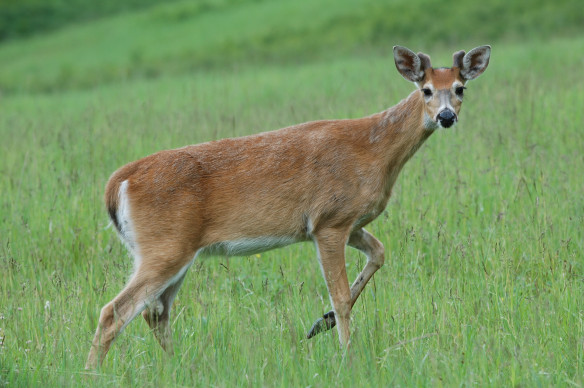
Wildlife Photography ©Jim Robertson

Wildlife Photography ©Jim Robertson

Mutants Are Breeding African Animals to Be Hunted

It’s easy to spot Columbus. He’s not only the biggest and strongest gnu among the dozens grazing on a South African plain, he also sports a golden-hued coat, a stunning contrast to the gray and black gnus around him.

Finding Columbus in the wild would be a stroke of amazing luck. More than 99.9 percent of all wild gnus, also called wildebeest, from the Afrikaans for “wild beast,” have dark coats. But this three-year-old golden bull and his many offspring are not an accident. They have been bred specially for their unusual coloring, which is coveted by big game hunters.

These flaxen creatures are the latest craze in South Africa’s $1 billion ultra-high-end big-game hunting industry. Well-heeled marksmen pay nearly $50,000 to take a shot at a golden gnu — more than 100 times what they pay to shoot a common gnu. Breeders are also engineering white lions with pale blue eyes, black impalas, white kudus, and coffee-colored springboks, all of which are exceedingly rare in the wild.

“We breed them because they’re different,” says Barry York, who owns a 2,500-acre ranch about 135 miles east of Johannesburg. There, he expertly mates big game for optimal — read: unusual — results. “There’ll always be a premium paid for highly-adapted, unique, rare animals.”

Left: A standard lion. Photographer: Getty Images
Right: Letsatsi, the white lion. Photographer: Arno Meintjes/Getty Images

This kind of selective breeding to create exotic animals has raised howls from conservationists and more traditional hunters, who dismiss the practice as little more than creating mutants for profit. “These animals are Frankenstein freaks of nature,” says Peter Flack, a hunter and conservationist and former chairman of gold mining company Randgold Resources. “This has nothing to do with conservation and everything to do with profit.”

No one disputes that there’s money to be made in rare big game. Africa Hunt Lodge, a U.S.-based tour operator, advertises “hunt packages” to international clients traveling to South Africa that include killing a golden gnu for $49,500, a black impala for $45,000, and a white lion for $30,000. For the money, hunting tourists typically get a seven- to 14-night stay in a luxury lodge, gourmet food with an emphasis on meat dishes, and hunting permits. (Taxidermy costs extra.)

Operators don’t guarantee kills, yet to leave hunters disappointed is generally seen as bad business, says Peet van der Merwe, a professor of tourism and leisure studies at South Africa’s North-West University. Killing lions was the biggest revenue generator for the country’s hunting industry in 2013, followed by buffalo, kudu, and white rhinos.

As the hunting industry has grown, so have the numbers of large game animals that populate South Africa’s grasslands. In other parts of Africa, including Kenya and Tanzania, the opposite has been true: Large mammal populations have been decimated as farms and other human activities encroached on wild areas. But South Africa is one of only two countries on the continent to allow ownership of wild animals, giving farmers such as York an incentive to switch from raising cattle to breeding big game. ‘‘My first priority is to generate an income from the animals on my land, but conservation is a by-product of what I do,” York says.

Left: A standard golden impala Photographer: Villy Yovcheva/Getty Images
Right: A White Flanked Impala at Phala Phala Wildlife in Bela Bela Source: Phala Phala Wildlife

At 66, York has been involved in breeding and hunting for decades. After he emigrated from his native Zimbabwe in 1980, he bred prize cattle for beef in South Africa’s northern grasslands. He also organized hunts, which gave him the occasion to see his first golden gnu in 1986, when a client killed one. “It was the most beautiful animal I had ever seen,” he says.

In 2007, York bought a farm in Limpopo Province that had previously been used for crops. His plan was to raise beef cattle. That turned out to be a costly mistake. The cows languished, unable to gain weight and poorly adapted to the ticks and other pests prevalent on the hot plains. York found himself shelling out a steady stream of cash for expensive vaccines and veterinary fees. At that rate, “I’d be broke in a year or two,” he says.

York recalled the beautiful golden gnu he had seen more than 20 years earlier and hatched a plan. He figured that, as a native species, gnus were better adapted to the South African grassland than cattle. He would be able to sell them for both hunting and meat, and if he could breed some with exotic coloring, they would command a premium.

His timing was good. The switch coincided with a rise in popularity of big game hunting, and prices for rare variants were soaring. Since 2005, the average price at auction for a golden gnu has more than quadrupled to 404,000 South African rand ($33,000).


Barry York Photographer: Dean Hutton/Bloomberg

Today, York has roughly 600 gnus. He keeps the best — the most fertile and beautiful, with the biggest horns — for breeding. The next tier goes to auction, mostly for sale to other breeders. Animals that don’t make the grade for breeding are sold to hunting ranches, which are typically bigger and more scenic than York’s, giving hunters the feel of the wild African bush.

More: http://www.bloomberg.com/graphics/2015-hunting-mutant-big-game-in-south-africa/