Exposing the Big Game

Forget Hunters' Feeble Rationalizations and Trust Your Gut Feelings: Making Sport of Killing Is Not Healthy Human Behavior

Exposing the Big Game

Trump administration to ease rules for hunting bears and their cubs in Alaska

2:02 a.m.

The National Park Service is rolling back Obama-era regulations that banned hunters in Alaska’s national preserves from using food to lure black and brown bears out of their dens.

The new rules will also let hunters use artificial light to attract black bears and their cubs, shoot caribou from motorboats, and hunt wolves and coyotes during the denning season, the Anchorage Daily News reports. The Obama administration enacted the regulations in order to prevent the destabilization of Alaska’s ecosystems.

This change is “amazingly cruel,” Jesse Prentice-Dunn, policy director for the Center for Western Priorities, told The Guardian, and is “just the latest in a string of efforts to reduce protections for America’s wildlife at the behest of oil companies and trophy hunters.”

Several Native American tribes criticized the original rule, opposing it due to rural Alaskans needing wild food sources. Sen. Dan Sullivan (R-Alaska) cheered the reversal, saying it was necessary “not only as a matter of principle, but as a matter of states’ rights.” Catherine Garcia

Gardiner landowner sues feds to stop bison hunt north of Yellowstone

SALE! SIGN UP AND GET 90% OFF
Bison bones
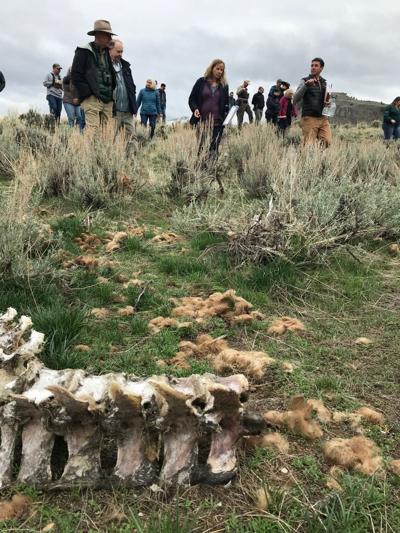
A backbone and scattered chunks of fur are all that remain of a bison killed by hunters near Beattie Gulch, one of two popular bison hunting areas north of Gardiner and Yellowstone National Park.

A Gardiner-area landowner is suing the National Park Service and U.S. Forest Service to halt the hunting of bison just outside Yellowstone National Park’s northern border, saying the agencies have failed to analyze the consequences of the hunt as required by law.

“The Park Service and Forest Service have never analyzed the impacts of hunting on private property owners, neighbors, and visitors” through the appropriate environmental process required by law, stated the complaint by Bonnie Lynn and Neighbors Against Bison Slaughter, which shares her address.

Lynn is seeking a permanent halt to any future bison killing within a mile of her home and rental cabins as well as a temporary restraining order to stop the hunt this winter.

The lawsuit argued that rather than address the situation, “the Federal Agencies have foisted the dangerous and concentrated impacts of bison hunting onto a small group of private property owners, neighbors, and visitors.”

The complaint specifically focuses on Forest Service land known as Beattie Gulch, which is just across the road from Lynn’s residence. Each winter and spring, as bison migrate out of Yellowstone in search of forage, tribal and state hunters concentrate at the pinch point to kill the big ungulates.

In the most extreme case, 389 bison were killed on the land in the winter of 2016-17, the majority of them by tribal hunters exercising their treaty rights. Bison gut piles, legs and other remains are often left behind after the hunts, attracting predators such as bears and wolves as well as scavenger birds.

The second complaint, filed by Lynn and L&W Construction LLC, is seeking $500,000 from the federal government claiming that because predators and birds have sometimes spread the carrion to her property it is a taking of her property rights, physically occupying her land, without just compensation. Bison are known carriers of brucellosis, a disease that can cause undulant fever in humans.

Lynn’s two complaints were filed Tuesday in a District of Columbia federal court. One of the attorneys representing her is former Montana U.S. House candidate Jared Pettinato.

The Next Yellowstone: A Hunter’s Paradise

  OCT 23, 2019

In northeastern Montana, a controversial group of millionaires and billionaires is trying to build a privately-funded national park. The group is purchasing ranches, phasing out the cattle, and opening the land up to genetically pure bison and other wildlife.

It’s called American Prairie Reserve. But as we’ve heard in our series, “The Next Yellowstone,” most long-time locals are bitterly opposed to the idea. Still, there are some supporters.

This story was supported by the Pulitzer Center on Crisis Reporting. Listen to the full documentary here.

PARTS: How Big Money Is Building A New Kind Of National Park | A Privately-Funded Park For The People | Save The Cowboy, Stop The American Prairie Reserve |  A Hunter’s Paradise | The Bison Is A Symbol Of God

I find myself in Justin Schaaf’s black Toyota Tundra heading down a two-track dirt road. Schaaf, 27, looks like a high school linebacker. His head is shaved and he’s wearing cargo pants. He’s taking me to one of his favorite hunting spots. While he works as a train conductor for the local railroad, his passion is hunting.

“If I’m not hunting I’m thinking about hunting and planning hunts, and when I’m sitting in the motel for work or when I’m sitting at home in the recliner I’m looking at maps, looking at Google Earth,” he says.

He’s always trying to find the perfect place to hunt.

As the road peters out, Schaaf pulls over. We grab some water and begin hiking in. It’s not big game hunting season yet, so we’re just scouting.

“We’re hoping to see some elk. Definitely some bighorn sheep. I have seen some pretty good mule deer in here,” he says.

We climb over sweet clover and sagebrush. This seems like an easy place to get lost but I’m not worried because Schaaf has lived in eastern Montana all his life. His great-great grandparents homesteaded just a few miles south of here near the Musselshell River. They lasted about 40 years before quitting and heading into town.

“They didn’t have enough land to support the ranching that you need and I don’t think the farming was cutting it at all,” he says.

It was a fate suffered by a lot of homesteaders out here. They couldn’t produce enough food or money to survive. As eastern Montana’s population continues to decline, Schaaf thinks it’s time to try something different.

“Is a little shot of tourism, capitalizing on hunter dollars, bringing more hunters into this area, will that make the difference?” he asks.

He thinks it might. After all, Schaaf is a young guy who stayed in eastern Montana precisely because of this wild country in his backyard.

“I can make more money in other places but it’s the outdoors, being able to pull my pickup up here and not talk to anyone and go for a hike all day long, that keeps me here,” he says. “Opportunity to just roam, I think, is enticing to young people.”

So-called rural recreation counties are growing faster than counties that don’t have a lot of hiking, hunting and fishing opportunities, according to the non-profit Headwaters Economics.

And here’s an important point: unlike a traditional national park, American Prairie Reserve allows hunting.

We don’t spot any wild bison. They’re mostly confined to privately-owned reserve lands north of us. But we do see a big herd of elk, about 45 cows and calves.

“That’s a crapload of elk,” Schaaf says.

It’s getting hot and the hike is grueling. We stumble up steep ravines and past stands of ponderosa pine. Schaaf says he understands that American Prairie Reserve is funded by rich people, some who made millions helping finance industries that degrade the environment.

“I do worry where that money comes from,” he says. But dirty money doesn’t just come from the private sector. He points to the Land and Water Conservation Fund, a federal program that takes royalties from offshore oil and gas drilling and pumps it back into parks and public lands.

“It’s helped my kid’s playground and it’s provided hunting opportunities for me,” Schaaf says.

More: https://www.kunc.org/post/next-yellowstone-hunters-paradise#stream/0

Zimbabwe slates proposed US anti-trophy hunting law

by Staff reporter
7 hrs ago | 157 Views
Trump’s sons
GOVERNMENT is disturbed by moves by the United States to frustrate wildlife trophy hunting in Zimbabwe and is engaging Washington over the matter, a senior official said yesterday.

The United States is in the process of promulgating an anti-trophy hunting law called ‘Cecil Act’ purportedly inspired by the killing of Cecil the lion at Hwange National Park by an American millionaire dentist, Walter Palmer, in 2015. The killing of the globally famous lion sparked worldwide outrage.

The Permanent Secretary in the Ministry of Environment, Tourism and Hospitality Industry, Mr Munesu Munodawafa, revealed Government’s frustrations at Matopo National Park during the launch of the country’s Rapid Response Guide (RRG) toolkit on wildlife crimes yesterday.

A local non-governmental organisation that advocates for protection of animals, Speak for Animals, spearheaded the formulation of the toolkit with the involvement of stakeholders in various Government departments.

Mr Munodawafa said the US congress recently invited Government to make its presentation on the proposed law and Harare is still negotiating with Washington to understand its implications.

“The background of the law is that there was a lion called Cecil which was shot in Hwange National Park under circumstances that are well documented. Now what has since happened is that the American government is coming up with what they call the Cecil Act. The long and short of what is happening is that they are saying we need to protect certain species and for that to happen the effect of the law will be to prohibit the movement of trophies to America whether by airplanes going to America or even to prohibit the American hunters from coming here. That would be the effect of that law,” he said.

Mr Munodawafa said Zimbabwe’s tourism industry thrives on wildlife conservancy and the proposed law would negatively affect conservation efforts. He said the country benefits from controlled trophy hunts as revenues generated are used for anti-poaching mechanisms. Mr Munodawafa said if the Cecil Act sails through, the country would regress on progress it has made in fighting wildlife crimes as Government cannot fund conservation efforts from its coffers.

“On average the operational budget, just the operational budget for national parks, is plus or minus US$30 million and that money has been coming in from various activities like sport hunting. That is why we even fight the issue of the ban on ivory trade. If you look at it, ivory has been banned, trading in live elephants has effectively been banned, now they are moving to cut off trophies for buffaloes, for lions, for anything they are closing all the sources of revenue,” he said.

Speaking at the same event, acting deputy Prosecutor General Mr Innocent Mutsonziwa said it was curious that the Cecil law is being crafted after an American sparked global outrage by killing the famous lion.

“The law which is being crafted to deprive Zimbabwe and other African countries of benefiting from their wildlife is coming from the same country where that person (who killed Cecil) came from. So, as a thinker you must think big and say what was the plan. Was it just a coincidence or it was a well-planned thing that we do this and after so many years then we tie this country down so that it doesn’t develop? It can’t use its resources. These are things that those with huge imaginations should think about,” said Mr Mutsonziwa.

President Mnangagwa recently revealed that the country is considering pulling out of the Convention on International Trade in Endangered Species of Wild Fauna and Flora (CITES) as it prevents Zimbabwe from benefiting from ivory stocks worth US$600 million.

https://bulawayo24.com/index-id-news-sc-national-byo-171789.html

Patricia Randolph’s Madravenspeak: Wisconsin’s bear hunt is overkill as species face annihilation

  •  4 min to read
https://madison.com/ct/opinion/column/patricia-randolph-s-madravenspeak-wisconsin-s-bear-hunt-is-overkill/article_65827d44-a642-531d-a995-92cf61d1409b.html
“Frankly, I thought we would be a little more evolved as a species by now.” — Jim Robertson, author of “Exposing the Big Game: Living Targets of a Dying Sport”

In a Sept. 16 “Democracy Now” segment, Amy Goodman highlighted the Trump administration’s continuing assault on our public lands, opening the Alaskan National Wildlife Refuge (ANWAR) to drilling leases: “The plan calls for the creation of landing strips, drill pads, pipeline supports, a seawater treatment plant, 175 miles of roads and other infrastructure in Alaska’s north coast.”

Goodman’s guest, Subhankar Banerjee, a professor of art and ecology at thee University of New Mexico, referenced the United Nations’ frightening report on the annihilation of species on earth: “…as I see it, (it) is a bigger crisis than the climate crisis, that is unfolding before us — the media has miserably failed to inform the public — which is the crisis of extinction … the scientists call it ‘biological annihilation.’ Earlier this year, the United Nations IPBES released what is considered, for some of us, the grimmest warning of human history, that 1 million species on Earth, which is about more than 50% of the documented species on the planet, face extinction, many within decades … since 1970, globally, monitored populations of vertebrates, which includes birds, fish, mammals, amphibians and reptiles, have declined, on average, in population 60%.”

The bear hunt continues into its third week of five, Sept. 4-Oct. 8. Most of the 3,835 bears (plus agricultural tags) have been killed either by the dogs, or the men, women and children who enjoy killing bears. At $49 per bear, it is a cheaper rug than from Walmart. It is likely to be a small rug since most of the bears killed are less than a year-and-a-half old, but there is that thrill, adrenaline rush, selfie with the carcass and trophy to take home. Little bear cubs hide in a tree watching their mother be killed. The mother bear may return from running killers away from her cubs to find her cubs killed or disappeared. Little bear orphans need their mothers to teach them how to den and need mother bear’s warmth in the first winter during the human-caused dip of polar vortexes.

The bear kill is a more than $1 million dollar business for the DNR’s recruitment and retention of more wildlife killers in hunting courses across our school systems and state. But if we had a democratic structure for governing our wildlife, each of the 5.7 million citizens of Wisconsin could throw in 50 cents each and come up with over $2.5 million to save our bears and wildlife killed in traps.

Structural revolution to democratic funding will not happen under Republican cruel rule. It has not been a priority for either party. It will require public awareness and intensive pressure, urgently needed and sadly lacking.

To add to the mayhem in the woods, out of sight, the bow hunting season on deer started Sept. 14. The nine-day “traditional” deer kill was an endurance test for those of us who live with wildlife in rural areas. Now archery and crossbow killing persist through Jan. 5, 2020. Extended bow hunting seasons continue in 22 counties through Jan. 31.

Overkill is an understatement.

Wisconsin legislators and the DNR promote unregistered, unlimited bear baiting and bear hounding in our public lands July 1-Aug. 31 continuing now throughout the five-week kill.

According to Wolf Patrol, which monitors the bear hounding: “In Wisconsin, 95% of legally killed black bears are taken with the aid of bait and/or dogs. An estimated 4 million gallons of bait and 15,000 bear hounds are dumped annually in Wisconsin to attract and chase bears. And it’s not just baiting that is allowed, but as many baits as a hunter wants to use, all with no requirement for any hunting license or registration, preventing conservation officers from assuring that bear baits in our national forests are in compliance with even the minimal requirements.”

Killers from other states, or in-state, do not have to be licensed to run packs of dogs — exhausting bears, running mothers away from cubs for hours or days — just when bears should be eating every day to put on weight for winter hibernation.

An Aug. 2017 Wisconsin Public Radio segment discussed that “new research shows bear bait makes up more than 40 percent of a black bear’s diet in northern Wisconsin, and bait could be playing a role in the high density of bears up north, researchers say.” Attempts to ban chocolate in bait, which has killed bears in neighboring states, were defeated by hunters at the annual DNR election and vote in April.

The Wolf Patrol is clamoring for restraint, having reported many non-compliant bait piles and hunters with not six dogs, but 30 dogs in 10 trucks, running bears day and night in unlimited abuse:

“It’s time for Chequamegon-Nicolet National Forest officials to bring an end to bear baiting and hound training in Wisconsin, where it’s (wreaking) havoc on wildlife and causing conflicts with wolves and other forest users. Nowhere else in the country are bear hunters allowed to dump as much bear bait as they desire, and chase the bears it attracts, 24 hours a day, seven days a week.”

Action Alert:

Please send the links to Madravenspeak bear columns to Gov. Evers and tell him that it is time for a first-time democracy in funding and fair, proportionate non-hunter participation in decisions to protect our wildlife.

Silence and inaction are complicity in this cruelty.

Over 650,000 citizens have signed a petition against drilling in the Arctic National Wildlife Refuge. You can sign here: https://www.change.org/p/no-drilling-in-the-arctic-national-wildlife-refuge?signed=true

Attend the world premiere of “Anthropocene: The Human Epoch,” sponsored by the Nelson Institute. from 7-9 p.m. on Sept. 25 at the Marquee Theater in Union South on the UW-Madison campus.

That Dog Still Don’t Hunt

The other day I shared this recent photo of Honey and Caine with my sister and she asked, “What are they hunting?” I thought about answering “They’re just playing” (which is of course what humans do when they “hunt” nowadays). They aren’t doing it to survive. Both human hunters and pets can go back to their cozy homes or shacks and eat their fill, while natural predators have to hunt or starve.

People have corrupted the word “hunt” just like they perverted “stalk.” (Except Euell Gibbons, who used it jokingly in his book title, Stalking the Wild Asparagus. But then he used to think pine trees were edible.)

How anyone can still subscribe to the agenda-driven assertion that non-human animals don’t experience life every bit as—if not more—richly as our species, is beyond me. All of the other animals we share the world with—dogs, cats, pigs, cows, horses, rabbits, parrots, pigeons, turkeys, turtles, deer, elk, mink, salmon, or moose–have each evolved the wits and sensations needed to survive, or they surely wouldn’t be with us now.

Regardless of what you believe about whether animals should have rights, we humans don’t have the right to make them suffer. Any attentive dog owner knows that their best friend can go through a full spectrum of emotions, from fear and sorrow to love and joy—on any given day.

(And Caine says, “Yeah, and that goes for cats too.”)


7 REASONS WHY THIS LIFELONG TEXAS HUNTER WENT VEGAN

VegNews.TexasVegan

Jack Castle refuses to pass on the tradition of killing animals to his three sons after realizing that all animals deserve to be treated equally.

https://vegnews.com/2019/6/7-reasons-why-this-lifelong-texas-hunter-went-vegan


284 Shares    

Fourth-generation Texan Jack Castle was a hunter for decades, learning the tradition from his father, who owned a large cattle business in Texas and Montana. Together, they travelled the world hunting for birds and big game, and Castle went on to run his own 900-acre cattle ranch where he continued to slaughter cows for food. Today, he’s a vegan and a shining example that even the manliest of hunters and meat-eaters can make a lifestyle change for the better. Castle put his former cattle ranch property into conservation to benefit the surrounding wildlife, and he now challenges other hunters to go vegan by inviting them to his home for lavish, six-course “Hunters Dine Vegan” dinners. Because there’s nothing quite as powerful as the conversion of the most unlikely of the unlikely, here are seven reasons why Castle made the decision to let go of hunting and ranching and go vegan for the animals.

1. He didn’t want to support factory farms.
“I was startled to learn of animal factory farms,” Castle told VegNews. “That’s how I began to understand animals differently. Those animals live in a severe state of misery. There is nothing majestic about breeding animals in filth, steel, and cement and putting them in cages for their entire lives. Understanding this treatment of animals bridges the connection to what we put on our plates and then to their land, true nature, and hunting. That is what did it for me.”

2. He realized that killing animals for sport was irrational.
“When I hunted birds and big game it was for sport and I normalized it,” Castle said. “Now, the power not to kill is a greater power. The power to withdraw from hunting is power. I have a need to be a caretaker and to be a steward of the land. I have always loved animals, but I was a sport hunter and I was not emotional. I rationalized it as a challenge. But now I wish to awaken other hunters to feel what I will forever feel. It is very gratifying.”

3. He saw a greater appreciation for all life.
“I treat all animals equally now,” Castle said. “When I look an animal in the eyes, I see their soul; I am looking into their eyes and reconnecting with them very differently. I have always loved wildlife, but now I am more connected, more in love. Being vegan gives me a greater appreciation for life, really. I love the animals more. And it has made me realize that animals have the same emotions as me—the need to feel pleasure, to play, to care for family.”

4. He realized the animals on his plate were no different than his cats and dogs.
“I am already guilty of disturbing animals’ lives before, from eating them to hunting them,” Castle said. “Putting a steak on a plate is paying someone else to kill the animal and bring it to you wrapped in plastic. The tragedy of factory farms can be stopped with one choice and that is to eliminate meat, dairy, and eggs from your plate and go with—as my wife says—phytonutrient-dense foods packed with fiber. And those are not in animal tissue. These factory-farmed animals deserve equality and should be treated the same as our cats and dogs, at minimum. Love and respect has no boundaries.”

5. His wife, simply put.
“The passion and love my wife Shushana Castle [who is a vegan advocate and author] shows every day for the animals and for our earth inspires me,” Castle said. “She taught me to respect all life without judgment. She helped me accept that the pig, the cow, the chicken, all living beings deserve the same respect as our family dogs. That love has no boundaries and equality extends to the caged and wild animals, too.”

6. He wanted to nurture animals’ natural habitat and transform his ranch into a wildlife sanctuary.
“From this newfound awareness, I extended my love for nature and wildlife to the ranches, so I created a sanctuary for wildlife,” Castle said. “The lands are vastly enhanced with enlarged lakes, streams, and ponds from underground water and the animals feel safe and protected. My lands are now a safe haven for the animals. They intuitively know when it’s hunting season and now they flock to the land for safety. This new relationship with all the big game and birds has intensely given me so much fulfillment. Sometimes big game stares at me. It’s the other way around now. We look into each other’s eyes and I feel like I can see their soul.”

7. A vegan diet gave him endless energy.
“It’s total fulfillment not participating in the suffering of animals, not taking away life,” Castle said. “We live in nature, so it’s my duty to renew the earth the best I am able. I have a lot of energy from dropping all the meat and dairy from my meals. Making a contribution of peace in a caring manner, to not kill for a sport, just feels right.”

Chavit Singson kills lion on birthday

ABS-CBN News

Posted at Nov 21 2013 11:27 PM | Updated as of Nov 23 2013 01:35 AM

MANILA (UPDATED) — Photos of former Ilocos Sur Governor Luis “Chavit” Singson with a lion he shot dead during a hunting expedition in South Africa are drawing flak online.

The photos, which were initially published in June on the website of the Philippine Times of Southern Nevada, show Singson posing beside a male lion and an antelope that he shot at the Kalahari Desert as he celebrated his birthday.

A screenshot of the Philippine Times of Southern Nevada online newspaper featuring Ilocos Sur Gov. Chavit Singson’s safari tour.

According to the report, Singson went to the Kalahari Desert, which extends 900,000 square kilometers and covers much of Botswana and parts of Namibia and South Africa, to hunt wild animals.

Singson, like all other hunters, waited for about a year to get his shooting license, it said.

“His hunting rifle took down a male lion and an antelope, highly valued targets. Needless to say, he couldn’t be happier. His feats were celebrated in his birthday bash in Spear Safari, also in the savannah. An image of his prized catch is printed onto his cake, making the celebration go down in history as one of the most memorable,” the report said.

On micro-blogging site Twitter, some netizens reacted negatively to the photos.

Meanwhile, an online petition at Change.org is asking Singson and his family to stop hunting wild ducks.

The petition, which has so far garnered over 600 signatures, started after photos of Singson and his daughter, Richelle, hunting wild ducks in Ilocos Sur went viral online early this month.

The Wild Bird Club of the Philippines said the Singsons have “shown a blatant disregard for our country’s wildlife laws and the welfare of our wildlife by advocating the hunting of protected species and posting photos of their father-daughter hunting spree on Facebook and Instagram.”

“We ask former Gov. Chavit Singson and his daughter Richelle Singson to stop promoting, advocating, and practicing hunting of Philippine wildlife. We hope they will instead promote the protection and conservation of wildlife and their habitat,” the group said.

ABS-CBN News Channel tried to contact the former governor to get his reaction but he has not been answering the calls.

More Maine women likely to take up moose hunting

More Maine women likely to take up moose hunting

While the ranks of male hunters at Saturday’s lottery far outnumbered those of women, observers say with the continued growth in the number of female hunters in Maine, many are sure to migrate toward the fall hunt of the state’s largest big-game animal.

SCARBOROUGH — Kelly Lamoreau cheered and reached for the sky when she heard her name drawn at the Maine moose lottery Saturday at Cabela’s. In many ways, she was celebrating more than her third moose permit in 15 years.

A hunter of 21 years, Lamoreau was not only one of the 2,770 permit winners announced at this year’s lottery (some of the 2,820 who will receive permits), she is part of what may be a growing number of big-game female hunters stalking moose. While the ranks of male hunters at the lottery far outnumbered those of women, observers said with the continued growth in the number of female hunters in Maine, many are sure to migrate toward the fall moose hunt.

Christi Holmes and her 5 year-old Brittany, Argos, in February. Holmes started Maine Women Hunters on Facebook. Jill Brady/Staff Photographer

“I think so. I know a lot of women who want to hunt. I think more will start to hunt moose,” said Lamoreau, 45, of Windsor. “It gives you confidence. I have confidence in myself. I don’t think it’s just a man’s sport anymore. I hope more women try moose hunting.”

Since 2010 the number of licensed female hunters in Maine has increased every year – from 17,078, or 9.6 percent of all hunters, to 21,178 women, or 13.3 percent of all hunters in 2017 – the last year for which the state has data, according to the Maine Department of Inland Fisheries and Wildlife.

The state applications for moose permits only require a hunter’s hometown, and not the person’s gender, so there is no way to know how many of the nearly 52,000 moose permit applicants this year were woman. But when Inland Fisheries and Wildlife Commissioner Judy Camuso read the first 100 names of the lottery winners Saturday afternoon – dozens were women’s names, such as Barbara, Ashley, Susan, Sandra, Theresa, Bernadette, Michelle and Rachael.

There will be 2,820 moose hunting permits given out this year. Of those, 50 went into a separate lottery for Maine Registered Guides, and 2,770 were announced Saturday. Of those, 2,546 went to residents, and 224 went to nonresident hunters.The moose lottery costs $15 to enter. Once drawn, a resident moose permit costs $52, while a nonresident permit is $585.

This year’s 2,820 permits were an 11 percent increase from 2018, when 2,523 permits were allocated. That followed a four-year stretch when permits were cut by 49 percent because of the winter tick parasites that have hurt the statewide moose population, which is estimated between 50,000 and 70,000 by state biologists.

The fall moose hunts spans from September through November in different parts of the state. It is held in the northern tip of Maine, eastern and Down East Maine the third week of September; virtually everywhere in Maine the third week of October; in northern Maine again the last week of October; and in just two hunting districts in central and western Maine throughout November.

This year’s lottery drew a crowd of around 1,000 that spilled out of a large tent.

Registered Maine Guide Ron Fournier, who is also director of the state’s 4-H camp at Bryant Pond, said as he looked around that the crowd was clearly mostly men. But Fournier has guided more women hunters in the past several years and believes it is only a matter of time before more turn to moose hunting.

“I’d say among the women hunters, about 40 percent want to hunt moose. It’s a minority,” Fournier said. “Moose hunting is a huge time commitment, and there are a lot of barriers. You need a week off. You have to haul it out of the woods. With turkey hunting, you can go near where you live before work.”

Master Maine Guide Bill Finney, owner of the Patten Hunting Lodge,  has guided moose hunts north of Baxter State Park since the modern-day hunt first began in 1980. He also sees more women drawn to moose hunting, albeit slowly. In the past eight years, Finney had two female hunters who won moose permits stay at his camps. They were there on their own. One was a single mother from Maine and another was a woman from Michigan who came from a hunting family.

“There are more introductory programs for new hunters at places like L.L. Bean and Bass Pro Shop (which also sells hunting gear) and in wilderness areas,” Finney said.

And many Maine women at the lottery Saturday believe the ranks of female hunters here will continue to grow without a doubt, and one day that will be reflected at the moose lottery.

Jess DeWitt of Ellsworth, a hunter of 23 years, already was drawn in 2011, and many members of her family win permits. But she was hoping to hear her name announced again so she could do that “happy dance.” It was.

DeWitt, 38, said she’s seen more female hunters in the past eight years and thinks more will start moose hunting. She also believes more will pick up the outdoor activity – and her fiance agreed.

“A lot of her friends are curious about it. We’ve taken a half dozen to look for moose on the Stud Mill Road,” said Jason Crossman, also of Ellsworth.

Paula Billings of Wiscasset, who started hunting three years ago and got her first deer last fall, took it up after years of being a “hunter’s widow” because she enjoys being outdoors with her husband, Chuck. Saturday she was hoping to win her first moose permit

Paula Billings was one of two women in a hunting group of 11 who were after a moose permit.

“I really like being in the outdoors with him, and I really like being outdoors – period,” Billings said.

Female hunter says she turned rare black giraffe into ‘decorative pillows’ [How Serial Killer-ish]

[How Serial Killer-ish.]…
Female big game hunter Tess Talley broke her silence Friday, telling CBS News that she turned a rare black giraffe she bagged in 2018 into decorative pillows and a gun case. She added the 2,000 pounds of giraffe meat was "delicious."

Female big game hunter Tess Talley broke her silence Friday, telling CBS News that she turned a rare black giraffe she bagged in 2018 into decorative pillows and a gun case. She added the 2,000 pounds of giraffe meat was “delicious.”

26

An American hunter who was savaged on social media for her 2018 photo showing her and her prized kill – a rare black giraffe – is breaking her silence.

As TheHill.com reports, the female hunter, Tess Talley, told CBS in an exclusive interview that her African big game hunting is her beloved hobby that actually helps with conservation efforts.

“It’s a hobby, it’s something that I love to do,” Talley said in the CBS interview Friday. “I am proud to hunt, and I am proud of that giraffe.”

As for the black giraffe in the now infamous photo, Talley said she bagged the long-necked beast on a “conservation hunt” designed to manage area wildlife in South Africa.

She has since turned the pelts of the giraffe into decorative pillows and a gun case. She also described the giraffe meat as “delicious.”

Still, she shouldn’t look for much understanding, especially on social media.

Talley told CBS her since-deleted Facebook post last year when she bagged he giraffe generated a global backlash.

In the post, Talley told the particulars of her kill: The rare black giraffe was more than 18 years old and weighed over 4,000 pounds. She added that she “was blessed to be able to get 2,000 lbs of meat from him.”

Re-emerging in the CBS interview brought a new rebuke for Talley, as the network reached out to the humane society.

Kitty Block, president and CEO of the Humane Society of the United States and Humane Society International, responded to CBS with a statement that said trophy-hunting of giraffes showed “sheer and arrogant disregard for the imperiled status of an iconic species.”