Exposing the Big Game

Forget Hunters' Feeble Rationalizations and Trust Your Gut Feelings: Making Sport of Killing Is Not Healthy Human Behavior

Exposing the Big Game

WWF Supports Sport Hunting

LION 28

WWF Supports Sport Hunting

WWF Supports Sport Hunting – The International Marches For Elephants and Lions was a game changer around the world in that they created an incredible amount of awareness about wildlife sport hunting – and the people and groups who support it as a so-called viable means of animal conservation. Anyone with a brain knows that this argument is as old as the hills and does not pass the muster test. It is reminiscent of their claim that their “sport” is good for local economies – just not true! These hunters cry “crocodile tears” for the animals they murder – as they claim to love their victims.

Bradley Bergh – a former supporter of WWF has written a fabulous letter to WWF and he has kindly given me permission to share in on A Beating Heart.

Guest Writer – Bradley Bergh
Brad

WWF Supports Sport Hunting

It has just come to my attention that your organisation supports “sport” hunting as a viable means of wildlife conservation.

I recently read one of your quotes:

“WWF would not openly be supporting the sustainable use of wildlife for the hunting industry as a method for conservation if it did not work.”

I regret that I cannot agree with this. I am not saying this as a knee jerk, emotional reaction. I have been keeping an eye on the hunting industry for some years now and I’m afraid there is no way I can continue to support an organisation that supports hunting for any reason other than ‘survival’. I also don’t believe WWF can know for certain whether it is “a method of conservation that works”.

The “Retiring” King Of Spain With His Kill
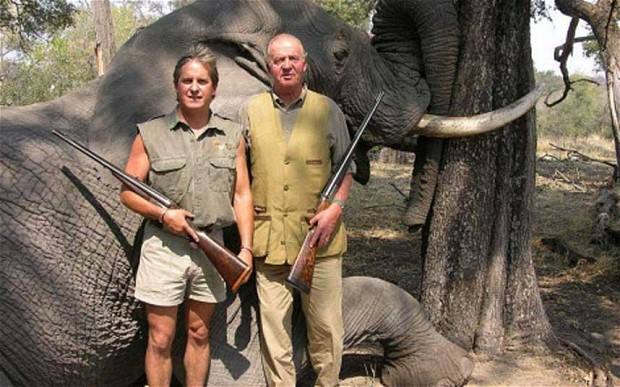
SHAME - KINGH OF SPAIN

I would like to know why I should continue to support your organisation in light of what I have just learnt. Please don’t give me the usual tired justification of how hunters “protect” wildlife against poachers or that hunting brings in “foreign revenue” and “creates sustainable jobs”.

In the first place, in the scores of barbaric video material I have viewed of international “professional sport hunters”, I have yet to observe one hunter that shows any inkling of bravery. They are always surrounded by other “professional sport hunters” who are also armed with heavy calibre, high powered rifles ‘just in case’ things don’t quite go according to plan.

A hunter who hunts with a spear or a knife could be called brave but can we really call the (generally) overweight, privileged business people who feature in these hunting videos (and have to be driven to within striking distance of their prey because they are so unfit) courageous? Please explain how hunters are contributing to the preservation of wildlife and biodiversity or helping to reduce the poaching in this country.

Then there is the argument of job creation and foreign revenue. The usual neo-liberal economic model that involves the enrichment of an elite few, coupled to minimum wages for everyone else. The amount of foreign revenue that flows into South Africa is vague and unsubstantiated and I would really like to hear a factual explanation (rather than the speculative/aspirational version provided by the Department of Environmental Affairs) as to how this income really contributes to building an equitable, humane and sustainable economy.

Most of the wealth in this country is in the hands of a minority and continues to be so as the wealth inequality gap grows ever wider. If WWF is really impartial about this they should do a proper, holistic investigation which examines all the complex factors involved. The hunting industry is merely perpetuating the same business model that many other industries practice in this country which are neither interested in human or animal rights nor the preservation of the environment.

Please don’t respond to this with a whole bunch of academic mumbo-jumbo. I am myself busy with a Master’s in Sustainable Development and am experiencing, first-hand, the enormous limitations of academic study in solving complex problems. I would like to incorporate some of this in my thesis next year but I doubt I will get very far because the little contact I have had with the hunting industry always seems to illicit the same response that resonates with gun ownership lobbyists in the USA – “if you want me to give up my firearm, you will need to pry it from my dead fingers”! I am pretty sure many at WWF know what I am talking about as I have seen how some of the hunting industry players speak and behave.

Perhaps WWF is trying to “constructively engage” with the hunting industry but I do not believe “asking them nicely” is going to change the way they operate. The industry is also inadequately policed as illustrated by the widespread use of canned hunting that is currently taking place in this country. No one really knows what happens out there on those hunts unless the hunter decides to post his video on the internet to brag about it.

Bow hunting is banned in South Africa but look at all the examples of bow kills below. I have the same argument of the SASSI grading system of sustainable fish – the fishing methods may be a bit more “sustainable” but unless the person responsible for the grading is on those boats they have no idea how those fish are really caught and how many other sea animals are killed with clubs and shotguns by fisherman “protecting” their catches. Getting all the role players in the industry to “fill in forms” is no guarantee whatsoever that this is how they operate.

I’m unable to see how we can call ourselves a civilized nation while we continue to condone this. This is not the way advanced societies behave. On the one hand we rant and rave about the number of Rhinos poached each year and on the other hand we allow sport hunters to kill them for pleasure.

The only difference I can see between the two is where the money flows to. I understand WWF has large corporate sponsors and your organisation has to be careful not to offend them but we have to find a way to break the stranglehold corporations have on this country and the world. The first step is to break the financial ties that lead to a conflict of interests.

I have seen how badly many of the animals are killed. The entire system is so complex I am not convinced any study can ascertain the full impact of allowing this to carry on. We continue to allow certain industries to operate in this country (no matter how environmentally destructive those operations may be) because we want to preserve the jobs. What use will jobs be to us once our ecosystem is irreversibly degraded?

I don’t believe anyone working in your organisation truly agrees with sport hunting. In your hearts you know killing for pleasure is barbaric and cannot be justified either economically, morally or for conservation. I cannot help wondering if you have taken this position to keep a large corporate donor happy and I sympathise with your predicament if that is the case.

It takes courage to stand up for what you truly believe in. This is not a choice that involves a colour or taste preference which are merely matters of opinion. An evolved society simply doesn’t allow its members to choose whether or not they can exploit other living creatures for pleasure or entertainment.

WWF should not make it easy for hunters to indulge their addiction to the adrenalin rush of killing! If we want to create just, equitable and humane societies it has to start with the way we treat animals. If we don’t, I cannot see how we can ever expect to achieve it among ourselves.

Just because something is “legal” doesn’t make it ethical. There are more examples of this than I care to mention – including here in South Africa.

Yours faithfully,

Bradley Bergh

A concerned citizen and former WWF donor!

Bradley is meeting with the SA CEO of WWF in June.

PS: “We hunt because we love these animals” – says one hunter. Please explain this to me!
How Many Wolves are in Montana? Just Ask the Hunters

FWP looks to new technique to document wolf population size By TOM KUGLIN Independent Record Helena Independent Record
June 19, 2014 6:00 am  • 

Researchers from Montana Fish, Wildlife and Parks and the University of Montana estimate the state’s wolf population at more than 800 using a new statistical technique.

Researchers conducted a study of the new technique from 2007 to 2012. The new method, called patch occupancy modeling, uses deer and elk hunter observations coupled with information from radio-collared wolves. The statistical approach is a less expensive alternative to the old method of minimum wolf counts, which were performed by biologists and wildlife technicians. The results of the study estimate that for the five-year period, wolf populations were 25-35 percent higher than the minimum counts for each year.

“The study’s primary objective was to find a less-expensive approach to wolf monitoring that would yield statistically reliable estimates of the number of wolves and packs in Montana,” said Justin Gude, FWP’s chief of research for the wildlife division in Helena.

Counting predators in remote and forested areas is notoriously difficult and expensive. FWP submits a required yearly wolf report to the U.S. Fish and Wildlife Service based on the exact number of wolves observed through tracking by FWP wolf specialists. Biologists track wolves with on-the-ground and aerial surveys, radio collaring and denning confirmation. The minimum count has hovered around 625 for the last three years.

According to a 2012 article in Population Ecology authored by FWP and university researchers, wolf numbers remained small in the initial stages of recovery in the early 1990s, and tracking the minimum count of wolves in Montana meant only a few packs in isolated areas. In 1995, when the U.S. Fish and Wildlife Service reintroduced wolves into Yellowstone National Park and central Idaho, the minimum wolf count in Montana was 66.

With minimum counts now nearly 10 times greater, it’s more difficult to assess the minimum number of wolves. The traditional field methods yield an increasingly conservative count and well below actual population sizes, according to the article.

“It takes a lot of people and time, and the budget has gone down with delisting,” Gude said. “It’s getting more and more difficult to keep up, and we felt like we’re getting farther and farther away with the minimum count.”

In two years, FWP’s requirement to provide a yearly minimum count to the Fish and Wildlife Service expires. That expiration opens the door for state officials to use other means to estimate the state’s wolf population.

The agency plans to do both the required minimum count and the patch occupancy modeling for the next two years. After the expiration, FWP plans to transition to the new techniques and adjust field methods of gathering data accordingly, said Ron Aasheim, FWP administrator.

“Certainly there have been people out there who said we have significantly more wolves than the minimum count,” he said. “If anything, this verifies that was a minimum count and we don’t have exact numbers; we have trend counts but this gets us closer to the actual number. The more information we have the better.”

Using hunter observations during the five-week general hunting season has the immediate benefit of cost savings and accounts for those wolves not verified in the annual counts. The technique is very similar to wolf counting methods used in the upper-Midwest, which has already withstood court challenges, Gude said.

“This new approach is not only good science, it’s a practical way for Montana to obtain a more accurate range of wolf numbers that likely inhabit the state,” he said.

Using the public to count wolves has its drawbacks as biologists consider public sightings less reliable than those of professionals. Given the sample size of around 2 million deer and elk hunter days and 50,000 to 80,000 hunters interviewed in FWP’s annual telephone survey, researchers believe the sample provides a diverse observation of Montana’s hunting districts and provides an accurate picture of wolf occupancy.

Based on the study, FWP and university researchers estimated the areas occupied by wolves in packs using the hunter observations, then the number of wolf packs by dividing the occupied area by average territory size, and finally they multiplied the number of packs by the average pack size to get an estimated population. In 2012, the minimum count for wolves was verified at 625 and 147 packs. The statistical technique estimated 804 wolves in 165 packs inhabit Montana.

The study further estimated that 18, 24 and 25 percent of Montana was occupied by wolves in 2007, 2008 and 2009, respectively.

In addition to wolves living in packs, various studies have documented between 10 and 15 percent of wolves living alone.

The Rocky Mountain Elk Foundation threw its support behind the study with a $25,000 grant.

“The bottom line is you can’t have true effective wolf management if you don’t know how many wolves are really out there and where they live,” said David Allen, RMEF president and CEO. “This grant funding will help to better determine that.”

Defenders of Wildlife was still looking at the research and was not ready to comment on the merits of the science, said Erin Edge, Rockies and Plains associate for Defenders.

Wildlife program coordinator for the Greater Yellowstone Coalition Chris Colligan said his organization supports using the best available science, but planned to keep an eye on the use of the new techniques.

“We want to make sure it’s accurate and they’re making sound decisions for management,” he said.

The research has been peer reviewed, but GYC has questions about the accuracy of using hunter observations and the ability of that data to apply on a small scale to create individual quotas for hunting districts, Colligan said.

“Self-reporting of wolves has its downsides,” he said. “There’s concerns about bias in hunters reporting wolves when they’re not present. It also diminishes the need for biologists on the ground, which is a valuable resource.”

Gude cautioned that future statistical approaches need to include wolf harvest locations and how hunting and trapping influence where wolves choose to live.

“Perhaps the best future use of these statistical methods won’t necessarily only be for monitoring and keeping tabs on wolf population numbers, but to better inform the complicated decisions that accompany the public harvest and management of wolves,” he said.

Why Would Anyone Hunt Elephants? GQ Tries To Defend Those That Do

By Jenny Kutner

In a recent piece for GQ, writer Wells Tower attempts to answer10304338_10204008161985492_2584105410340479966_n a simple question with a story that’s as long as it is powerful: “Who wants to shoot an elephant?” As it were, that’s not actually the question Tower ends up asking; it’s pretty easy to find the people who want to shoot elephants, as the journalist did in order to write his story. What Tower really gets at is why anyone would want to shoot an elephant, or how people think they can justify it. Try as they might, they can’t.

And oh, do they try. Robyn Waldrip and her husband, Will, allowed Tower to accompany them on an eight-day safari last summer, during which time they explained to the writer why they feel that hunts like theirs can be justified. Waldrip’s trip was arranged solely so she could kill an elephant and bring parts of its broken-down body back to her home in Texas, where she’ll keep them as a trophy. But that’s okay, she and her husband explained, because it actually does good for the environment, and even for the elephants themselves:

Perhaps out of a kind of kindred impulse, Will and Robyn Waldrip are quick to point out the violences elephants have inflicted on the local landscape. … While he has no reservations about Robyn shooting the elephant, [Will] is doing, I think, some version of the hunt-justifying psych-up going on in my own head. He wants to feel like it’s a good deed his wife is doing out here, a Lorax-ly hit in the name of the trees. …

[And] counterintuitively, even in the presence of an active bullet-tourism industry, Botswana’s elephant population has multiplied twentyfold, from a low point of 8,000 in 1960 to more than 154,000 today. These healthy numbers … mirror elephant populations in other African countries where hunting is allowed. … Kenya, on the other hand, banned elephant hunting in 1973 and has seen its elephant population decimated, from 167,000 to 27,000 or so in 2013. Some experts predict that elephants will be extinct in Kenya within a decade.

There is a confused correlation going on here, which Tower himself points out: legalized hunting incentivizes tourism, and that tourism brings money and jobs into the communities near elephant habitats. “When locals’ livelihoods are bound to the survival of the elephants,” Tower writes, “they’re less likely to tolerate poachers, or to summarily shoot animals that wander into their crop fields.” But it doesn’t have to be hunting that monetizes the elephants for local residents: other, non-lethal forms of ecotourism could bring in solid cash-flow as well.

Those with vested interests in legalized hunting — like the Waldrips’ guide, Jeff Rann — would argue that poachers can and will circumvent photo-safaris and other ecotourism concessions, as they have in Kenya. But poaching is not an inevitability; all it takes is “some combination of public policy, private money, and anti-ivory market pressures” to “render hunting obsolete as a conservation instrument,” Tower points out.

It’s easier said than done, certainly — but if we know that making elephants valuable to communities is necessary, and we know how to monetize them in a non-lethal way, then there is no excuse for trophy hunting. Alternative tourism ventures, such as Thailand’s Elephant Nature Park, have proven hugely successful at protecting elephant populations without killing relying on blood money. It’s not a form of conservation. It’s a cop-out that allows those wealthy and willing enough to participate to pay for the right to poach.

Trophy hunting advocates tout the activity as a key form of conservation — but in reality, it merely contributes to the gradual decimation of endangered species around the world. Join us in pledging never to support big game hunting of any form, and to stand with governments that ban the sale of imported animal “trophies.”

supporters have signed this petition. Let’s get to 1,000

Poachers and Pedophiles are Like Apples and Oranges

Comparing poachers to pedophiles may seem like comparing apples and oranges; but like the two fruits, there are more similarities than differences. Both apples and oranges are round, grow on trees, have a skin, contain seeds, are about the same size, etc. By the same token, the poacher and the pedophile both engage in socially unacceptable or illegal behavior for self-serving purposes, without regard for their victims. 

Likewise, the catch and release fisherman can be compared to the serial rapist: both put their pleasures over the suffering of their targets. The more their prey struggles, the more exciting the event for the perpetrator. Only when the victim has been completely conquered and has lost all will to fight are they set free, the vanquisher having no more use for them. 

And the analogy between a trophy hunter and a serial killer has been well established: both are single-minded in their quest for the kill, placing their own perverse desires above the self-interests—indeed, the very lives—of their victims. Both perpetrators like to take souvenirs from their kills, and neither one cares what the rest of the world thinks of their actions.

Text and Wildlife Photography ©Jim Robertson

Text and Wildlife Photography ©Jim Robertson

Metallica Might Be Booted From Festival For Bear Hunting

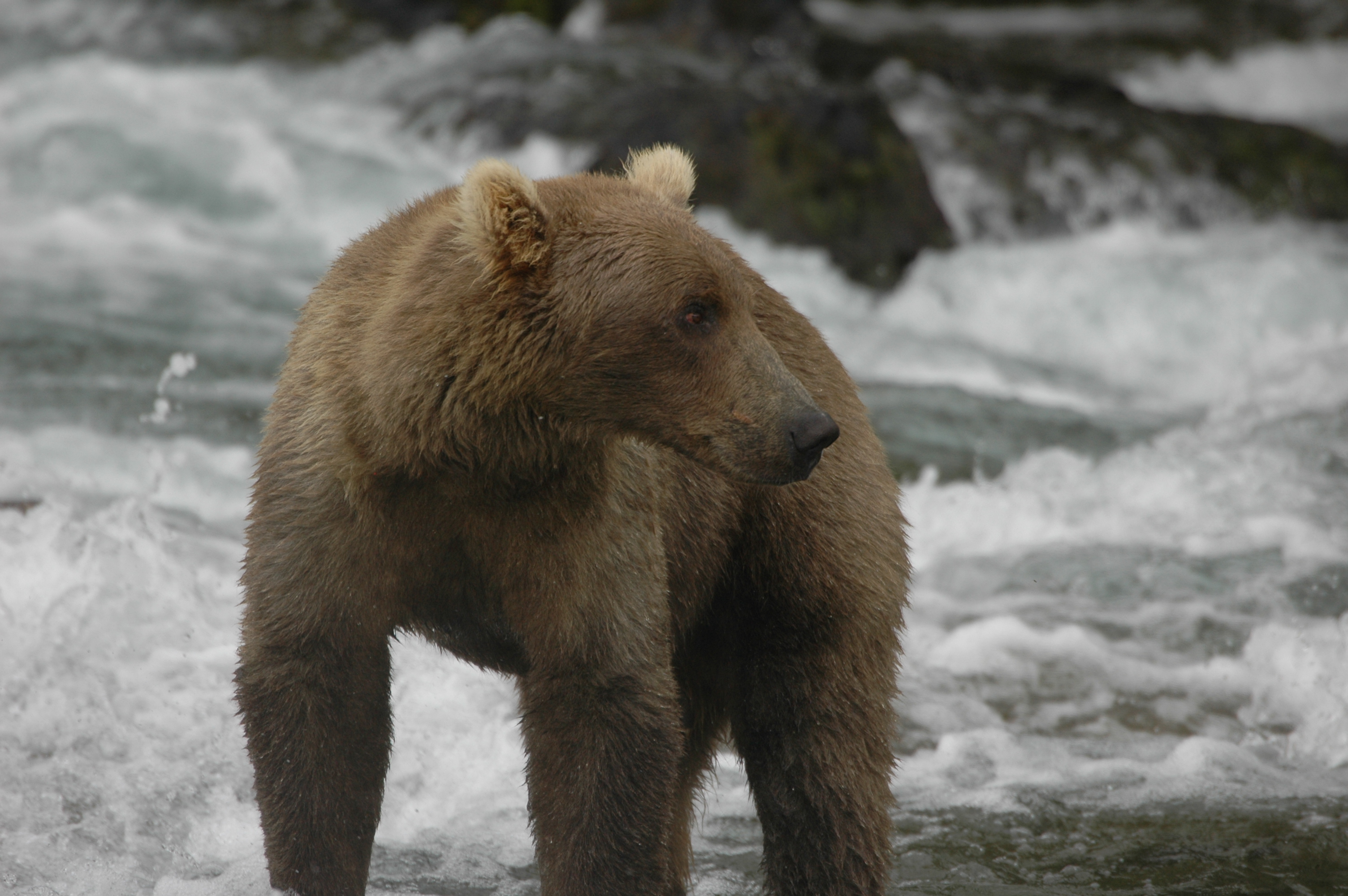
Grizzly photo Copyright Jim Robertson

Grizzly photo Copyright Jim Robertson

Animal rights activists want Metallica booted from the Glastonbury music festival because frontman James Hetfield is an enthusiastic hunter, the Telegraph reports.

A Facebook page calling for their removal, launched shortly after the History Channel announced that Hetfield will narrate its new series about bear hunting, already has over 27 thousand likes.

The page says that Hetfield’s “support of big game hunting…is incompatible with the spirit of Glastonbury and brings its good name into disrepute.”

Hetfield, who once admitted that he missed his son’s birthday while hunting bears in Russia,  is a member of the NRA and has described himself as “pretty conservative on a lot of things.”

Read more: http://dailycaller.com/2014/06/07/metallica-might-be-booted-from-festival-for-bear-hunting/#ixzz344VHOQ00

Ignorance is never an excuse for hunting

Wildlife Photography ©Jim Robertson, 2014. All Rights Reserved

Wildlife Photography ©Jim Robertson, 2014. All Rights Reserved

Well, actually, this article was entitled, “Ignorance is never an excuse for hunting violations,” but I thought this shortened version was more fitting. By Dan Stefanich, it starts off:

“I’m not sure how anyone can accidentally slaughter 30 ducks after the waterfowl season, but these guys did it. And thankfully, got busted.

“Three men have been arrested in connection with a highly publicized killing of ducks after the season. The March duck poaching incident occurred at Carlyle Lake Wildlife Management Area near Vandalia, Illinois. Steven Dean of Granite City, along with Bradley Peters and Daniel Groves of Wood River, were arrested on April 25.  The three men face felony charges for their alleged involvement in the illegal killing of more than 30 ducks out of season, according to the DNR. Since ducks are migratory waterfowl, they fall under the jurisdiction of both state and federal authorities and violations can be charged as felonies. Charges include: 
• Felony resource theft of migratory waterfowl 
• Unlawful possession of freshly killed species during the closed season 
• Wanton waste of migratory waterfowl 
• Unlawful take over the limit of mallard ducks 
• Unlawful take over the limit of northern pintails

“I’m thinking the Judge may throw the book at these guys, and rightfully so. Such a blatant disregard for our natural resources and regulations should carry stiff penalties. Am I the only one tired of “sportsmen” that think the law doesn’t apply to them? These are the guys that give us all a bad name.”

The article goes on to talk about “real sportsmen” following the laws. I didn’t think you’d be interested in reading the rest, but if you’re inclined, here’s the link:

http://www.chicagonow.com/dan-stef-outdoors/2014/05/ignorance-is-never-an-excuse-for-hunting-violations/

Every Hunter and Trapper Will Die Someday

10342876_644838815599443_2466424090983508710_n

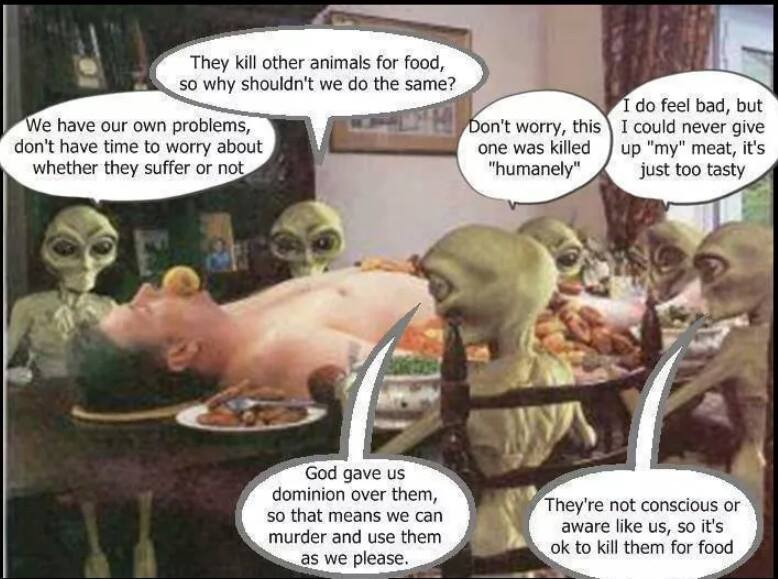
This photo (allegedly taken in late November, 1947, near Roswell, New Mexico) recalls some of the most common feeble rationalizations humans use to justify the killing and consumption of the other beings with whom we share this planet.

Another equally feeble rationalization just cropped up in a letter to the editor of the Las Vegas Sun, using the twisted logic that since all animals are going to die someday, we might as well kill and eat them.

The letter, entitled, “Hunting, trapping to manage wildlife,” by the president of the Southern Nevada Coalition “for Wildlife,” starts out attacking animal rights activists and defending trappers and hunters:

“The litany of attacks on trappers and hunters by animal rights activists lately are usually based on the claim that trapping and hunting are inhumane. One needs to ask the question: compared to what? Compared to the standards of Walt Disney productions where Bambi and his deer family think and talk things over and where Lion Kings rule? Perhaps so, but in the real world of nature and wildlife, it is a different story.

“Every wild animal will die someday. If animal rights activists think wild animals die comfortably in their beds surrounded by loving family members, they are sadly mistaken. Disease, starvation, dehydration and predation are the most probable causes, and in the absence of management tools like hunting and trapping, entire wildlife populations suffer horribly.

“That is the reason the entire wildlife management profession and every conservation association support regulated hunting and trapping.

“Professionals know that regulated hunting and trapping are far more humane than letting nature run its course unimpeded. The animal rights activists beg to differ, but how is it more humane to allow (or mandate) that wild animals must die by disease, starvation or predation, or, much worse, allow (or mandate) entire populations to suffer this way when there is a much better way?”

A better way? That’s assuming a lot, such as that an unaware animal is killed outright with one clean shot (which almost never happens). And how is trapping an animal and letting it struggle until a human returns to finish it off ever humane?!

Yes all animals are going to eventually die someday, but usually when that day happens, nature steps in and prepares the individual for it through a process that includes shock, withdrawal and the gradual shutting down of the senses. Hospice professionals know the process well; it’s outlined in handouts they share with anyone who is caregiving for the dying.

Ending a healthy life (human or otherwise), before he or she have had the chance to fulfill their life’s journey, is murder, no matter how you rationalize it.

The pro-human predation letter ends with the line: “Since 1937, it’s been proved that regulated hunting and trapping programs are the essential tools of modern wildlife management.” Humans can just thank their lucky stars that no bigger brained beings have rationalized away their existence…yet.

Petition: Stop any kind of Safari hunting in Africa

Sign the Petition: https://www.causes.com/actions/1742571-stop-any-kind-of-safari-hunting-in-south-africa

President of South Africa Mr. Jacob Zuma – President of Uganda Mr. Yoweri Museveni – President of Kenia Mr. Uhuru Kenyatta – President of Tanzania Mr. Jakaya Kikwete – President of Namibia Mr. Hifikepunye Pohamba – President of Botswana Mr. Ian Khama

All wild animals in Africa, elephants, giraffes, lions, rhinos, leopards, cape buffalos, zebras, etc. are a heritage of whole mankind, a heritage for our children and for those who will come after them. With this our public petition we ask strongly to stop all forms of safari in Africa, the only kind of Safari allowed must be photographic safari. We find shameful as may be granted hunting, with precision weapons, to these animals, which are themselves the symbol of whole African continent.

P.S. Please join too to our Facebook group: No Safari Facebook Group and to our FB official page giving us a like AnimalsTrust Facebook page to give us more strength and a greater International weight.

Please follow us on Twitter too: https://twitter.com/animalstrust

1979559_639720376107870_1515330944290250336_n