Republicans Push Lead Poisoning of Wildlife Disguised as “Sportsmen’s Heritage Act”

For Immediate Release, February 3, 2014

Contact: Bill Snape, (202) 536-9351 or bsnape@biologicaldiversity.orgRepublicans Push Lead Poisoning of Wildlife Disguised as “Sportsmen’s Heritage Act”

Legislation Would Also Roll Back Public-lands Protection, Promote Polar Bear Trophy Hunting

WASHINGTON— The U.S. House of Representatives will vote Tuesday on H.R.Fudd 3590, the misnamed “Sportsmen’s Heritage and Recreational Enhancement Act.” Under the guise of expanding hunting and fishing access on public lands, the Republican-supported bill aims to prevent the Environmental Protection Agency from protecting millions of birds and other animals from lead poisoning. The extremist legislation also contains provisions to undermine the Wilderness Act, dispense with environmental review for projects on national wildlife refuges, and promote polar bear hunting.

“Another cynical assault by House Republicans to roll back protections for public lands and wildlife,” said Bill Snape, senior counsel at the Center for Biological Diversity. “This supposed ‘sportsmen’s legislation’ would actually jeopardize the health of hunters, promote needless lead poisoning of our wildlife, and prevent hunters, anglers and other members of the public from weighing in on decisions about how to manage 150 million acres of federal land and water.”

H.R. 3590 seeks to exempt toxic lead in ammunition and fishing equipment from regulation under the Toxic Substances Control Act, the federal law that regulates toxic substances. The EPA is currently allowed to regulate or ban any chemical substance for a particular use, including the lead used in shot and bullets. Affordable, effective nontoxic alternatives exist for lead ammunition and lead sinkers for all hunting and fishing activities.

Spent lead from hunting is a widespread killer of more than 75 species of birds such as bald eagles, endangered condors, loons and swans, and nearly 50 mammals. More than 265 organizations in 40 states have been pressuring the EPA to enact federal rules requiring use of nontoxic bullets and shot for hunting and shooting sports.

“There are powerful reasons we banned toxic lead from gasoline, plumbing and paint — lead is a known neurotoxin that endangers the health of hunters and their families and painfully kills bald eagles and other wildlife,” said Snape.

H.R. 3590 would also exempt all national wildlife refuge management decisions from review and public disclosure under the National Environmental Policy Act and allow the import of polar bear “trophies” from Canada. The Republican-controlled House approved similar “Sportsmen’s Act” legislation in 2012 by a vote of 274-146, but the bill was stopped in the Senate.

Background
Despite being banned in 1992 for hunting waterfowl, spent lead shotgun pellets from other hunting uses continue to be frequently ingested by waterfowl. Many birds also consume lead-based fishing tackle lost in lakes and rivers, often with deadly consequences. Birds and animals are also poisoned when scavenging on carcasses containing lead-bullet fragments. More than 500 scientific papers have documented the dangers to wildlife from lead exposure. The U.S. Fish and Wildlife Service calculates that more than 14,000 tons of toxic lead shot is deposited in the environment each year in the United States by upland bird hunting alone.

Lead ammunition leaves fragments and numerous imperceptible, dust-sized particles that contaminate game meat far from a bullet track, causing significant health risks to people eating wild game. Recent scientific studies show that hunters have higher lead levels in their bloodstream, and more associated health problems, than the public at large. Some state health agencies have recalled venison donated to feed the hungry because of dangerous lead contamination from bullet fragments.

There are many alternatives to lead rifle bullets and shotgun pellets. More than a dozen manufacturers market hundreds of varieties and calibers of nonlead bullets and shot made of steel, copper and alloys of other metals, with satisfactory-to-superior ballistics. A recent study debunks claims that price and availability of nonlead ammunition could preclude switching to nontoxic rounds for hunting. Researchers found no major difference in the retail price of equivalent lead-free and lead-core ammunition for most popular calibers.

Hunters in areas with lead ammunition restrictions have transitioned to hunting with nontoxic bullets. There has been no decrease in game tags or hunting activity since state requirements for nonlead hunting went into effect in significant portions of Southern California in 2008 to protect condors from lead poisoning. California recently passed legislation to transition to lead-free hunting statewide by 2019.

Learn more about the Center’s Get the Lead Out campaign.
http://www.biologicaldiversity.org/news/press_releases/2014/lead-02-03-2014.html

Call OFF the “Wild”man

Drugs, Death, Neglect: Behind the Scenes at Animal Planet

Mother Jones’ exclusive investigation reveals how animals suffer on the network’s top reality show.

By the time three orphaned raccoons arrived for emergency care at the Kentucky Wildlife Center in April 2012, “they were emaciated,” says Karen Bailey, who runs the nonprofit rehab clinic set in the sunny thoroughbred country just outside of Georgetown, in central Kentucky. “They were almost dead.”

Read more: http://www.motherjones.com/environment/2014/01/animal-abuse-drugs-call-of-the-wildman-animal-planet

1488271_587846841303023_63989389_n

Wrong, New York Times. The Trophy Hunt Is Terrible For Rhinos

https://www.thedodo.com/community/MarcBekoff/is-killing-a-rhino-for-350k-re-396733510.html

Marc Bekoff
20 January 2014

Share on Facebook Share on Twitter

Who lives, who dies, and why?

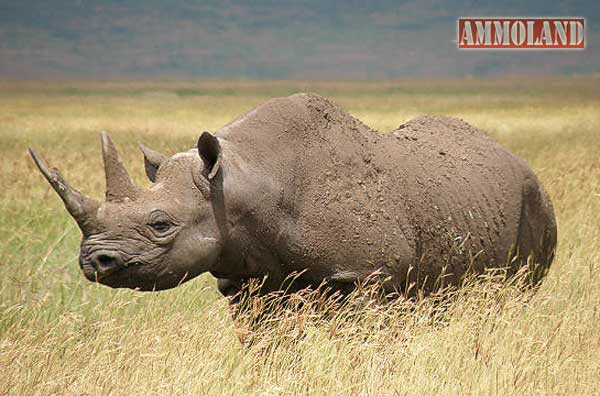
We live in a troubled and wounded world in which humans continue to dominate and relentlessly kill numerous nonhuman animals. A Texas hunting club recently auctioned off an endangered black rhino purportedly to save other black rhinos and their homes in Namibia. A representative of the Dallas Safari Club noted, “Namibian wildlife officials will accompany the auction winner through Mangetti National Park where the hunt will occur, ‘to ensure the correct type of animal is taken.'” This is not a very comforting thought. Nor is the idea that it’s OK to kill one rhino to save other rhinos.

Because of who we are we are always making decisions about who lives and who dies. The criterion used in these sorts of difficult decisions in the realm of conservation efforts centers on the debatable notion that we know what’s best for the good of a particular species. As a result of this often misplaced thinking, individual animals are devalued and treated as if they’re disposable objects and traded off for the good of their own (or other) species.

In today’s New York Times Richard Conniff published an essay called, “A Trophy Hunt That’s Good for Rhinos.” He writes, “auctioning the right to kill a black rhino in Namibia is an entirely sound idea, good for conservation and good for rhinos in particular.” This conclusion is too fast for me, and he does not present data that support this claim.

Conniff claims that Namibia, a small and sparsely populated country, is a conservation success story. Over the past 20 years its rhino population has increased as have the number of mountain zebras, elephants and lions. This is because around 44 percent of the country benefits from conservation protection due to the establishment of communal conservancies that own the wildlife. Nowhere does Mr. Conniff argue that these success stories rest on killing some of these animals for the good of other members of their species. That’s good, because we really don’t know this.

In Namibia and elsewhere black rhinos do indeed find themselves trying to avoid humans out to kill them, but in Namibia only 10 rhinos have been killed since 2006. Of course, this is 10 too many, but far fewer than have been killed in neighboring South Africa, where around 1,000 were killed in 2012 alone. For more on rhino slaughter in South Africa please read this.

Mr. Conniff also claims that the old post-reproductive and belligerent male who will be killed won’t be much of a loss because individuals such as these “have a tendency to kill females and calves.” Does having a tendency to do something warrant an individual’s unnecessary death? No it doesn’t. And, if these individuals were so harmful in any regular and significant way, one would think they would have been weeded out of the population over time due to natural selection or that they would be avoided and ostracized by other group members who fear them. This old male is merely a sacrificial rhino who’s killed for a lot of money that will supposedly go into conservation efforts.

We must revise some of the ways in which we attempt to coexist with other animals. Some of these methods center on heinous ways of killing them “in the name of conservation” or “to foster coexistence.” Compassionate conservation stresses that the life of every individual matters and trading off an individual for the good of their own or another species is not an acceptable way to save species. And, there doesn’t seem to be much evidence that it works in any significant way.

(For more on compassionate conservation please see “Ignoring Nature No More: Compassionate Conservation at Work”, Ignoring nature no more: The case for compassionate conservation, and a Forbes interview.)

The life of every individual matters. I agree with Conniff that “Protecting wildlife is a complicated, expensive and morally imperfect enterprise, often facing insuperable odds.” Where I and others disagree is his swift claim that killing a rhino male is a sound conservation strategy. When people say they kill animals because they love them this makes me feel very uneasy. I’m glad they don’t love me.

Cruelty can’t stand the spotlight and it is important that news about the sorts of activities discussed above be widely disseminated and openly discussed. That major media is covering them is a step in the right direction. Now it is essential that people who care about conserving without killing make their voices heard.

Marc Bekoff’s latest books are Jasper’s Story: Saving Moon Bears (with Jill Robinson; see also), Ignoring Nature No More: The Case for Compassionate Conservation (see also), and Why Dogs Hump and Bees Get Depressed

black-rhino

It’s Terrible About Those Death Threats

I don’t know who is sending would-be rhino Corey Knowlton all those death threats we keep hearing about, but I think it’s just terrible.

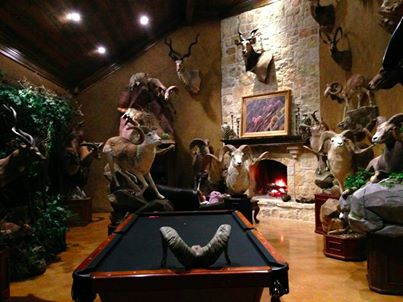
It’s terrible they waited until after he’d killed all those other 120 species—from every continent—that line the walls of his trophy1613918_577895065613412_412557772_n room. Too bad they held off until he had a chance to murder one of every species of wild sheep in existence, for instance. It’s a shame the 35 year old lived long enough to become the co-host of a hunting show on The Outdoor Channel which extols the virtues of snuffing out wildlife and encourages animal assassination in the name of sport.

It’s an absolute tragedy they waited until he won last week’s Dallas Safari Club auction to hunt a black rhino in Namibia. Now, unless the threats are in fact serious and carried out in the coming weeks, he will get the chance to destroy yet another undeserving sentient being in the name of ego, selfishness, arrogance and hedonism.
____________________________

For those not keen on lethal action, here are 3 things you can do to help:

1) PETITION: http://e-activist.com/ea-action/action?ea.client.id=104&ea.campaign.id=24844
2) PETITION: http://www.ifaw.org/united-states/get-involved/protect-black-rhinos-trophy-hunters
3) FB page with USFWS contact info and sample letter for writing to ask them to deny permit: https://www.facebook.com/events/242483775925213/

1017393_10202261526713538_1876940690_n

Mom Left Kids In Frigid Car To Go Hog Hunting: Cops

http://www.huffingtonpost.com/2014/01/17/kayla-shavers-kids-car-hog-hunting_n_4617334.html

A Florida mom was arrested after police say she left her two young children inside her car in near-freezing temperatures so that she could go hog hunting.

Kayla Shavers, of New Port Richey, was charged with child neglect on Thursday, WTSP reports.

The 31-year-old who said she went after the hogs because they had been tearing up her property, allegedly left her 9-year-old and 8-month-old alone in the car, which was not running, around 7 a.m. on Thursday. The temperature was 38 degrees, according to WPTV. The 9-year-old did not have a coat.

The 9-year-old called 911, saying he was cold and “a police car would be warmer,” according to Bay News 9. Police say they aren’t sure how long the children were alone in the car, but after arriving at the scene it was about 40 minutes before Shavers emerged from the woods, clad in camo.

“Kudos to that little 9-year-old boy,” Sheriff Chris Nocco told WTSP. Nocco says the boy may have saved the baby’s life.

Authorities say Shavers claimed she was close enough to the car to respond if her children needed help. She also allegedly said she left the keys in the car for the 9-year-old to turn it on if needed, but he apparently wasn’t able to do so.

1493185_206170882901726_158839565_n

Corey Knowlton? Yup, I Hate Him Too

Corey Knowlton is the hunter who won the right to kill an endangered rhino in the Safari Club auction. This is part of trophy room (Big Horn Sheep section – Knowlton claims that he has hunted “over 120 species on every continent” – obviously many animals per species)…

1613918_577895065613412_412557772_n

…and this is what Grumpy Cat has to say about him:

1017393_10202261526713538_1876940690_n

Sport Hunter Who Murdered Mother Cougar Lauded by Press

Hunter kills cougar, rescues newborn kittens

Posted 5:26 p.m. yesterday

More on this
Baker City Herald

By JAYSON JACOBY, Baker City Herald

BAKER CITY, Ore. — The mistake was unavoidable, but Todd Callaway didn’t stop to worry about his reputation as a hunter whose integrity is beyond reproach.

He just wanted to save the three cougar kittens.

And he did.

Callaway, 64, is both a hunter and a retired wildlife biologist for the Oregon Department of Fish and Wildlife’s (ODFW) Baker City office.

When he realized that the cougar he shot and killed on Thursday was a lactating female, he immediately started following the animal’s tracks in the snow, hoping to find its den and, possibly, kittens.

He found the den.

His flashlight beam showed three tiny kittens, each weighing about two pounds.

Callaway, who was hunting in the Lookout Mountain unit east of Baker City, called his former employer, ODFW.

The three kittens were taken to Baker City, where first a local veterinarian, and then Justin Primus, ODFW’s assistant district wildlife biologist, cared for them.

“(Primus) fed them every four hours,” said Brian Ratliff, the district wildlife biologist.

Ratliff estimates the kittens (also known as cubs) — two females and one male — are about two weeks old. Although their eyes were open, they were still covered with a film and the kittens were in effect blind, he said.

The kittens almost certainly would not have survived even one day without their mother, Ratliff said.

Cougars can have litters at any time of the year. Bearing young during winter can actually be advantageous for the cats, Ratliff said, because their main food source — deer — tend to be concentrated during winter, making it easier for the mother to find her own meals while nursing her kittens.

On Friday, Primus drove the three kittens to The Dalles, where he met another ODFW employee who transported the trio to the Oregon Zoo.

The kittens’ final home, though, will be the North Carolina Zoo in Asheboro, N.C., said Michelle Schireman, who has worked at the Oregon Zoo for 18 years and who also serves as the species coordinator for cougars for the Association of Zoos and Aquariums.

Schireman said she works closely with ODFW veterinarian Colin Gillin in cases when animals are orphaned.

Gillin called her on Thursday after learning that the kittens had been rescued in Baker City.

Schireman, through her work with the Association of Zoos and Aquariums, said she’s also in touch with zoos across the country and knows which facilities are looking for particular species.

In the case of the North Carolina Zoo, it had two male cougars in its exhibit, both about 18 years old.

One of the cougars died recently, and the other is in poor health, Schireman said.

“I had been in touch with the zoo and they were willing to take as many as three cubs,” Schireman said.

“Whenever possible I try to keep siblings together.”

She said the three kittens are in good health, and she expects they will be flown to North Carolina within a month or so.

“We’ve been feeding them every four hours, and when I came in for the early morning feeding today they looked really good,” Schireman said Monday.

Callaway was not allowed to keep the adult cougar because state law prohibits hunters from killing a female cougar that is accompanied by kittens that still have spots.

An Oregon State Police officer warned Callaway but did not issue a citation.

Ratliff said that’s not surprising because Callaway’s mistake was not only inadvertent, but also basically impossible to avoid.

The reason, Ratliff said, is that because the kittens are so young they had never left the den, which means there were no small cat tracks in the snow to alert hunters to the presence of kittens.

As for the adult female, it’s impossible at a distance to distinguish between a male and a female cougar, much less to determine that a female is lactating, Ratliff said.

Callaway said the cougar was running when he shot it.

After shooting the adult cougar, Callaway “did everything perfectly,” Ratliff said. “He did more than a lot of hunters would have done.”

Schireman said that during her 18-year tenure at the Oregon Zoo she has helped place 105 orphaned cougar cubs, counting the three from Baker County.

A majority of those animals were rescued in a state other than Oregon, she said.
http://www.wral.com/hunter-kills-cougar-rescues-newborn-kittens/13299097/

Bob Barker Says Dallas Safari Club’s Black Rhino Auction Is A ‘Cheap Thrill’

http://keranews.org/post/bob-barker-says-dallas-safari-club-s-black-rhino-auction-cheap-thrill

By

Credit The Price Is Right/Facebook
Bob Barker recently returned to “The Price Is Right” to celebrate his 90th birthday.

Bob Barker, the legendary game show host, has chimed in on the Dallas Safari Club’s black rhino auction that’s taking place this weekend. He wants the club to call off the event.

The club hopes to raise as much as $1 million to protect the rare black rhino by auctioning off the right to hunt one. But the auction has kicked up international controversy. Club members have been receiving death threats, and the FBI is investigating. (Update: On Saturday, the rhino hunt permit was sold for $350,000, the Associated Press reported.)

Friday afternoon, PETA released a letter from Barker, who hosted “The Price is Right” for 35 years. He’s also an animal rights advocate. (You remember his classic sign-off, right?: “Help control the pet population. Have your pets spayed or neutered.”)

The rhino to be hunted is an old bull that’s past the point of helping sustain the herd. This is the sixth such auction in Namibia, but the first to be held outside the country. The Dallas Safari Club says 100 percent of the money raised will go toward conservation efforts.

But in his letter, Barker says it is “presumptuous to assume that this rhino’s life is no longer of any value.”

“The rhino that your organization reportedly has in its crosshairs is an older ‘non-breeding’ male who has apparently been deemed expendable,” Barker wrote. “As an older male myself, I must say that this seems like a rather harsh way of dealing with senior citizens.”

Barker continues:

“Just because you’re ‘retired’ doesn’t mean you don’t have anything more to offer. In fact, I personally feel that I’ve accomplished a great deal since I quit my day job. Surely, it is presumptuous to assume that this rhino’s life is no longer of any value. What of the wisdom that he has acquired over the course of a long life? What’s the world coming to when a lifetime’s experience is considered a liability instead of an asset?

The Safari Club’s executive director, Ben Carter, recently spoke with KERA about his group’s efforts. Listen to that conversation here.

Here’s Barker’s full letter, provided by PETA:

I am writing to ask you to call off your planned auction of a chance to kill an endangered black rhino in Namibia. The rhino that your organization reportedly has in its crosshairs is an older “non-breeding” male who has apparently been deemed expendable. As an older male myself, I must say that this seems like a rather harsh way of dealing with senior citizens.

I can certainly sympathize with this animal’s plight (and I would think that many of your older members could as well). How many seniors have been written off simply because they have a certain number of birthdays under their belts? But just because you’re “retired” doesn’t mean you don’t have anything more to offer. In fact, I personally feel that I’ve accomplished a great deal since I quit my day job. Surely, it is presumptuous to assume that this rhino’s life is no longer of any value. What of the wisdom that he has acquired over the course of a long life? What’s the world coming to when a lifetime’s experience is considered a liability instead of an asset?

There are only about 5,000 black rhinos still alive in Africa. What kind of message does it send when we put a $1 million bounty on one of their heads? These animals are endangered for that very reason: money. What makes you any better than the poachers who kill rhinos to feed their families? At least, they are honest about their less noble motives. You try to dress up greed under the guise of “conservation.”

True conservationists are those who pay money to keep rhinos alive—in the form of highly lucrative eco-tourism—as opposed to those who pay money for the cheap thrill of taking this magnificent animal’s life and putting his head on a wall.

If you want someone’s head to go on a wall, pick mine. I will happily send you an autographed photo to auction off instead. My mug may not fetch as much money as that of a dead rhino, but at least we’ll all live to enjoy another sunrise in our sunset years.

Sincerely,

Bob Barker

Don’t Miss the Premier Episode of Black Sheep Robertson: “Revenge of the Ducks”

Tune into NDC’s newest reality series starring Exposing the Big Game’s Jim Robertson, the black sheep of the duck dynasty. You’ll learn true respect for wild ducks and geese, who are featured living as they naturally do along with their wetland brethren on Black Sheep Robertson’s sprawling sanctuary, in peace and harmony as God intended.

No animals are harmed during the filming of this program, unlike on Duck Dynasty, which is all about hurting and killing. And rest assured, although Jim is a compassionate man who would no sooner blast a duck than he would members of the camo-clad clan, he is an atheist so you won’t have to endure any cheesy, half-assed references to salvation and all that stuff.

On the premier episode, you’ll get a behind-the-scenes look at the special breeding facility where giant, mutant man-eating mallards are being fitted with armor outerwear and readied for their release into nearby hunter recreation areas and “sportsmen’s” playgrounds.

(If this sounds shocking, consider that as I write this I’m hearing the recurrent noise of shotgun blasts, resulting in the wounding and deaths of untold numbers of ducks and geese.)
______________________
(This has been another installment in EtBG’s “Headlines We’d Like to See.”)

Also See: I’m Not One of those Duck Dynasty Douchebags             

And: Expressing My Freedom of Speech 

Text and Wildlife Photography ©Jim Robertson, 2014. All Rights Reserved

Text and Wildlife Photography ©Jim Robertson, 2014. All Rights Reserved