American dentist says he regrets killing Cecil the lion, but believed hunt was legal

For Cecil isn’t just any old lion. He’s one of Africa most famous and beloved lions, the star attraction at the Hwange national park, and a YouTube sensation for tourists.

He’s renowned as a gentle giant.

Such popularity cut no ice with Dr Palmer.

He and his fellow hunters tied a dead animal to their vehicle to lure Cecil out of the park, scenting an area half a kilometre away.

Cecil took the bait and strayed outside.

Dr Palmer pounced, firing his bow-and-arrow and striking Cecil.

He’s a great shot. 

A New York Times profile of him in 2009 said he was ‘capable of skewering a playing card from 100 yards with his compound bow.’

But Cecil didn’t die.

Instead, he stumbled off, wounded and bloodied, for 40 hours before Dr Palmer and his hunters finally caught up with him and shot him dead.

They then beheaded Cecil, and skinned him, before leaving his rotting carcass lying outside the park.

There was no report on whether Cecil died with a ‘dazzling smile’ on his face, but it’s probably safe to assume he didn’t.

As a result of his death though, conservation experts say it is now highly likely that all Cecil’s recently born cubs will now be killed by the next lion in the hierarchy, Jericho – so that he can insert his own bloodline into the females.

Within hours of his name being revealed today, photos of Dr Palmer with his ‘trophies’ began popping up all over the internet

Within hours of his name being revealed today, photos of Dr Palmer with his ‘trophies’ began popping up all over the internet

Cecil, Zimbabwe’s famous lion, crosses open plains of Hwange

The cosmetic dentist gleefully cuddling myriad fabulous animals he’s just killed and mutilated. His trusty bow-and-arrows nestled against their still twitching bodies. 

The cosmetic dentist gleefully cuddling myriad fabulous animals he’s just killed and mutilated. His trusty bow-and-arrows nestled against their still twitching bodies.

Dr Palmer is wanted for questioning on suspicion of breaking two laws – deliberately luring an animal from the park to kill it, and removing the lion’s identifying collar (which should have protected Cecil from being hunted), also a breach of the rules.

He and members of his team have been charged and will appear in court next week.

Within hours of his name being revealed today, photos of Dr Palmer with his ‘trophies’ began popping up all over the internet.

The cosmetic dentist gleefully cuddling myriad fabulous animals he’s just killed and mutilated.

He’s just a smirking, vile, callous assassin with no heart, whose shameless boasting of his disgusting exploits is almost as repellent as his exploits

His trusty bow-and-arrows nestled against their still twitching bodies.

Dr Palmer’s beatific smile ever present, those twinkling kindly eyes shining through the camera lens.

The pictures make me puke.

Dr Palmer makes me puke.

He’s just a smirking, vile, callous assassin with no heart, whose shameless boasting of his disgusting exploits is almost as repellent as the exploits themselves.

What he does isn’t ‘hunting’. It’s not a fair fight.

It’s a rich, well-armed man paying a fortune to hire a team of people to lure unsuspecting animals to their certain death. Then ripping them to pieces so their heads and horns can be retained as sickening trophies.

If convicted, Dr Palmer now faces a prison sentence, but captivity seems way too good for him.

Instead, I’d like to introduce a new sport – Big Human Hunting.

I will sell tickets for $50,000 to anyone who wants to come with me and track down fat, greedy, selfish, murderous businessmen like Dr Palmer in their natural habit.

We’d lure him out with bait – in his case I suggest the fresh blood of one of his victims would be very effective as it seems to turn him on so much – and once lured, we would all take a bow and fire a few arrows into his limbs to render him incapable of movement.

Then we’d calmly walk over, skin him alive, cut his head from his neck, and took a bunch of photos of us all grinning inanely at his quivering flesh.

This may sound harsh, but if you ask Dr Palmer, it’s really not.

Imagine we could take Dr Palmer’s head and skin and have them framed for our office walls. I’d even keep his teeth, so we could forever see his ‘dazzling smile’

Read more: http://www.dailymail.co.uk/news/article-3177611/PIERS-MORGAN-d-love-hunting-one-day-Dr-Walter-Palmer-killer-dentist-stuff-mount-office.html#ixzz3hDYOPPug
Follow us: @MailOnline on Twitter | DailyMail on Facebook
Bubbas Gone Wild: Alligator hunting permits sell out within minutes

http://www.wapt.com/news/central-mississippi/jackson/alligator-hunting-season-permits-go-on-sale/34155224

Alligator hunting permits sell out within minutes

JACKSON, Miss. —Within 20 minutes of going on sale Tuesday, the 920 alligator hunting permits offered by the state were sold out.

Alligator hunting season does not begin until the end of August, but the process to get a permit began at 9 a.m. Tuesday.

The Emergence of Human Evil: the Prequel

There’s a scene from the movie, Dominion: Prequel to the Exorcist, wherein the local African cattle kill and eat several wild hyenas. Almost immediately after ingesting the animal flesh the cows begin to stumble and drop dead. As gruesome as the whole scenario was, it seems symbolic of the first day, one million years ago (or so), also in Africa, when pre-human primates came across or killed another animal and decided to eat its dead flesh. As with the scene from the installment of the Exorcist, the event represented an innocent plant-eater’s first brush with evil.

Unfortunately for all other life to follow, humans did not have an immediate sickened reaction and drop dead like the cattle in the film. Nothing stopped the greedy proto-humans from continuing with their aberrational carnivorous crimes against nature. Instead, the killing and consumption of their fellow animals, bolstered by the lust for power and control, became routine, tradition, and finally enshrined. Now, here we are today (both the unthinking omnivore and the ethical vegetarian alike) paying the penance for our ancestors’ acts.

Yes, there was an original sin, but it had nothing to do with eating apples or any other fruit, nor anything that grew on trees or in the ground for that matter. It had to do with trying to mimic natural predators who’ve had millennia over us primates to adapt physically and psychologically into the role of carrion scavenger or killer. Not that nature’s carnivores were ever evil, but why would we want to emulate such undesirable and offensive behavior?

That first bloody bite of carrion, the first mouth-watering morsel of tender flesh was all it took; all she wrote. Fast-forward a million years—game over.

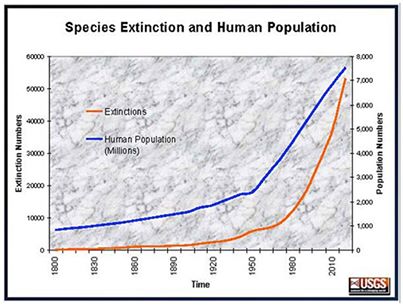
The proud human followed a path from hand-to-mouth, from feed lot to oil field, changing everything from Earth’s biodiversity to its very climate.

A lot has been made about humans being the only species to cause a mass extinction. But when all is said and done, some may say that we’re not the first species to have a role in a mass extinction; that the over-population of methane producing microbes, methanogens, might have factored in to the third mass extinction event, the Permian extinction. Still the fact remains that humans have the dubious distinction of being the one species to knowingly bring en entire era (in our case, the Age of Mammals—the most diverse in Earth’s history) to a close. Despite ample warning and time to modify our behavior, our species seems bent on making the same mistakes right up to the living end. Not only did the freeways and highways not miraculously clear at the first sign that our carbon over-output was changing the planet’s atmosphere, but relatively few people (relative to the over-all burgeoning human population, anyway) are swearing off carrion after learning that meat production is responsible for an even greater carbon (and methane) footprint.

And it all leads back to that first fateful bloody bite. Mother Nature was too nice to us. If she had made that early proto-human urp it all back up again, projectile-vomit at the very thought of it, or experience some repellant natural reaction, we could all have been spared a lot of misery at the hands of Homo Horribilus Rex, the two-legged mutant, meat-eating monster.

264431_455824994498980_1177070538_n

Iowa grants gun permits to the blind

http://www.usatoday.com/story/news/nation/2013/09/08/iowa-grants-gun-permits-to-the-blind/2780303/

Jason Clayworth, The Des Moines Register 1 a.m. EDT September 8, 2013

No one questions the legality of the permits, but some officials worry about public safety.

229773 4729 56 LINKEDIN 552 COMMENTMORE

DES MOINES, Iowa — Here’s some news that has law enforcement officials and lawmakers scratching their heads:

Iowa is granting permits to acquire or carry guns in public to people who are legally or completely blind.

No one questions the legality of the permits. State law does not allow sheriffs to deny an Iowan the right to carry a weapon based on physical ability.

The quandary centers squarely on public safety. Advocates for the disabled and Iowa law enforcement officers disagree over whether it’s a good idea for visually disabled Iowans to have weapons.

On one side: People such as Cedar County Sheriff Warren Wethington, who demonstrated for The Des Moines Register how blind people can be taught to shoot guns. And Jane Hudson, executive director of Disability Rights Iowa, who says blocking visually impaired people from the right to obtain weapon permits would violate the Americans with Disabilities Act. That federal law generally prohibits different treatment based on disabilities

On the other side: People such as Dubuque County Sheriff Don Vrotsos, who said he wouldn’t issue a permit to someone who is blind. And Patrick Clancy, superintendent of the Iowa Braille and Sight Saving School, who says guns may be a rare exception to his philosophy that blind people can participate fully in life.

Private gun ownership — even hunting — by visually impaired Iowans is nothing new. But the practice of visually impaired residents legally carrying firearms in public became widely possible thanks to gun permit changes that took effect in Iowa in 2011.

“It seems a little strange, but the way the law reads we can’t deny them (a permit) just based on that one thing,” said Sgt. Jana Abens, a spokeswoman for the Polk County Sheriff’s Department, referring to a visual disability.

Polk County officials say they’ve issued weapons permits to at least three people who can’t legally drive and were unable to read the application forms or had difficulty doing so because of visual impairments.

And sheriffs in three other counties — Jasper, Kossuth and Delaware — say they have granted permits to residents who they believe have severe visual impairments.

“I’m not an expert in vision,” Delaware County Sheriff John LeClere said. “At what point do vision problems have a detrimental effect to fire a firearm? If you see nothing but a blurry mass in front of you, then I would say you probably shouldn’t be shooting something.”

Training the visually impaired

In one Iowa county, blind residents who want weapons would likely receive special training.

Wethington, the Cedar County sheriff, has a legally blind daughter who plans to obtain a permit to carry when she turns 21 in about two years. He demonstrated for the Register how he would train blind people who want to carry a gun.

“If sheriffs spent more time trying to keep guns out of criminals’ hands and not people with disabilities, their time would be more productive,” Wethington said as he and his daughter took turns practice shooting with a semi-automatic handgun on private property in rural Cedar County.

The number of visually impaired or blind Iowans who can legally carry weapons in public is unknown because that information is not collected by the state or county sheriffs who issue the permits.

Clancy, superintendent of the Iowa Braille and Sight Saving School, said the range of sight among people who are classified as legally blind varies greatly. He believes there are situations where such applicants can safely handle a gun.

13 animals hunted to extinction

Fri, May 06, 2011 at 12:45 PM
Whether it is for the lust of exotic skins, mere sport or — as is often the case — pure fear, numerous species have been wiped out primarily by human hunters in the last couple hundred years alone.

Read more: http://www.mnn.com/earth-matters/animals/photos/13-animals-hunted-to-extinction#ixzz3cxooknVq

Control Cruel Special Interest Groups, Not the Wild Animals.

Letter from Rosemary Lowe to the Albuquerque Journal:
NM Game Dept. Killing Machine
“Mexican Wolves belong on New Mexico lands, but there are special interests within the hunting & livestock industries which have a long history of prejudice about this (& other) wonderful native species. It is time to bring back the Lobo, and give it the priority & protection it needs. These cruel special interest groups need controlling, not the wild291789_400428663360054_2105335387_n animals.
The livestock industry grazes on public lands, at taxpayer expense, denuding & damaging water resources, native grasses, while demanding that the government slaughter native wild animals including wolves, bears, coyotes, mountain lions, & other innocent wildlife: a mindless hatred of so-called “predators.” Many of these species are in decline, despite the “pseudo-science” misinformation from the Game Dept.& other anti-wildlife interests.
Native wild animals are facing further declines as Climate Change worsens, affecting the health of remaining ecosystems, but the Game Dept. continues its antiquated “management” schemes to appease their special interest buddies.
Based upon the anti-wildlife mentality of the Game Dept. it does not belong in the 21st century. It must be abolished, if wildlife is to survive at all.

With Friends Like the Obama Administration, Endangered Species Don’t Need Enemies

11259525_555836894555749_4295500415848445220_n

http://www.huffingtonpost.com/noah-greenwald/with-friends-like-the-oba_b_7339268.html

by

Endangered species program director, Center for Biological Diversity

From gray wolves to Cheat Mountain salamanders, the more than 1,500 endangered species in the U.S. face threats like never before. In addition to the ever-present threat of habitat loss caused by our growing footprint on the planet, species now face growing threats from climate change, invasive species, over-exploitation and pollution.

Given the growing magnitude of threat to endangered species, one would think the Obama administration would pull out all the stops to save our precious wildlife heritage. Instead, the administration and its U.S. Fish and Wildlife Service have quietly been rolling out a series of regulatory changes that threaten to cripple the Endangered Species Act, dramatic changes that would never have flown under the Bush administration.

Here’s a breakdown of those policies and why they matter:

In July 2014, the administration finalized a policy first conceived under the Bush administration that severely limits when species qualify for endangered species protection. Under the Act, a species qualifies as endangered if it is “in danger of extinction in all or a significant of portion of its range,” meaning that a species need not be at risk everywhere it occurs to receive protection.

The new policy, however, sets a much higher bar by requiring not only that a species be endangered in a portion of its range, but also that the loss of that one portion threatens the survival of the species as a whole. The policy also specifies that historic portions of a species’ range can never be considered significant.

If this policy had been in place when the Act was first passed, the bald eagle would never have been protected because although it had been wiped out across much of the lower 48 states, the Pacific Northwest and Alaska had strong populations that were not at risk of extinction.

Many other species that have similarly been wiped out or are at risk across large parts of the U.S. are sure to be denied protection because of this disastrous policy. Indeed, several already have, including the cactus ferruginous pygmy-owl and American wolverine.

The second regulatory change forwarded by the administration severely undermines protections for endangered species’ critical habitat. The Endangered Species Act requires protection of critical habitat for all endangered species. The designation of “critical habitat” has proven to be an essential tool with species that have designated habitat being twice as likely to be recovering as those without it.

Critical habitat protects species by prohibiting federal agencies from “adversely modifying” — that is, hurting — critical habitat for endangered species in actions they fund, permit or carry out. The Obama administration’s policy could enable more habitat destruction by redefining “adverse modification” as only those actions considered to potentially harm the entirety of a species’ designated critical habitat, a change that will give a green light to the many federal actions that destroy small portions of critical habitat. If enacted, the new proposal could allow the proliferation of projects that harm a species’ habitat without assurance that the cumulative effects will be taken into account — a particularly problematic development because the Fish and Wildlife Service already has a dismal record of tracking and limiting cumulative impacts on wildlife.

The third regulatory change proposed by the administration earlier this month lets federal agencies, such as the U.S. Forest Service or Bureau of Land Management, off the hook from quantifying or limiting the amount of harm to endangered species allowed under overarching management plans, including regional forest plans, plans for individual national forests, plans for BLM resource areas and many others.

This will all but ensure that cumulative impacts from individual timber sales, development projects, oil and gas drilling operations or other projects will never be considered or curbed, increasing the risk that species will be driven to extinction from a death by a thousand cuts.

The most recent proposal by the Obama administration limiting the scope of the Endangered Species Act was issued just this week. It would place crippling burdens on citizens filing petitions to protect species as threatened or endangered under the Endangered Species Act, ultimately making it more difficult for imperiled species to get lifesaving protections.

The proposed regulations bar petitions seeking protection for more than one species and require petitioners to provide advance notice of the petition to all states in the range of the species; to append any information from states to the petition itself; and to certify that all relevant information has been provided in the petition.

This disastrous proposal will not only make it less likely species will get the life-saving protections they need, but it’s fundamentally undemocratic, cutting the public out of endangered species management. Many environmental and other statutes allow citizens to petition the federal government for action. This proposal marks the first time that an administration has placed obstacles to citizens filing petitions for federal intervention and thus has the potential to set a very concerning precedent.

The Endangered Species Act was passed precisely because states were not doing enough to protect wildlife. In many cases, states remain opposed to protection of species. Forcing citizens to go through these very same states in seeking protection of species runs directly counter to the purpose of the Act.

In combination, these policies represent a rollback of endangered species protections that Tea Party Republicans in Congress couldn’t hope for in their wildest dreams, yet they’re being forwarded by the Obama administration perhaps as an attempt to appease critics of the Act.

If this is indeed the intent, it will fail because criticisms from states, industry and others do not come from a desire to see the Act work better but rather from a desire to see protections for endangered species watered down.

And if these changes are implemented, they’ll get their wish, effectively undermining the conservation law that has saved not only bald eagles and brown pelicans, but gray wolves, grizzly bears, humpback whales and many more.

Sadistic hunters vie to be Extreme Huntress champ

EXCLUSIVE: The next Rebecca Francis? ‘Sadistic’ hunters vie to be Extreme Huntress champ

THESE are the women animal rights campaigners have branded “sadistic” and “unhinged”.

PUBLISHED: 19:30, Mon, May 18, 2015 | UPDATED: 08:14, Tue, May 19, 2015

Jodi Schmideder, Rebecca Francis and Jen The Archer CordaroIG

Rebecca Francis, centre, has received death threats since the show

They are in the running to be finalists in the American television female hunting competition Extreme Huntress, which has seen previous winners receive death threats and worldwide hate.

This year’s fearless competitors have admitted they are anxious about public perception, but remain defiant in their “right” to kill animals which includes zebras, lionesses, antelopes and bears.

**WARNING: GRAPHIC CONTENT PICTURES TO FOLLOW**

Rebecca Francis, the competition winner in 2010, has been repeatedly slammed by comedian and animal lover Ricky Gervais in recent months after a photograph emerged of her lying with a giraffe she had killed, beaming with happiness.

After angry animal rights activists called for her head, she refused to accept she had done anything wrong.

This year’s competitors are equally as unabashed as they fight for votes to be selected into the finals of what is regarded one of the most prestigious titles a huntress can achieve.

Jen “The Archer” Cordaro is no stranger to hate after receiving death threats for teaching children to hunt with the campaign #Bringakidhunting.

Activists even turned up at her house and threatened to murder her first born when she starts a family.

Lorraine LawrenceIG

One of the finalists Lorraine Lawrence with a lioness

Charisa ArgysIG

Contestant Charisa Argys says she believes in living with integrity and morals

I know putting myself out there could potentially attract abuse yes, but that’s the risk I am willing to take

Jodi Schmideder

Thousands of people have signed a petition to “stop” the PhD student, following graphic images of her slicing sows and posing with dead boars.

She told Express.co.uk: “Threats on someone’s life is never acceptable.”

But nothing will stop the city-born bow hunter who started shooting 18 months ago with an aim to be self-sufficient and live “off-grid” within ten years.

She added: “If anything, it makes me want to keep fighting the good fight.”

She sympathised with the abuse Ms Francis is attracting, adding she too would kill endangered and wild animals including zebras, lions or giraffes.

She said: “If the need was there for culling or management, absolutely.

Tanya Chegwidden with a zebraIG

South African contestant Tanya Chegwidden has killed game from zebra, impala, and waterbuck

Jodi SchmidederIG

Jodi Schmideder said some contestants were trophy hunters

“There are management reasons to hunt all types of animals, including endangered animals or animals that humans put at the top of their cute and fuzzy hierarchy.”

But charity People for the Ethical Treatment of Animals (PETA) accused the Extreme Huntress semi-finalists of “perpetuating violence”.

Associate director Elisa Allen said: “It has been a long time since humans truly needed to hunt in order to survive – today, people who get their kicks from hunting and killing defenceless animals are either sadists or suffering from a psychological break.

“Common decency says that we should protect the most vulnerable and helpless in society, not destroy them – much less derive “pleasure” from doing so.

“When cruelty is glorified and portrayed as a ‘hobby’, it debases society and perpetuates violence.

“Hunting of any kind has no place in modern society, and it should have ended years ago, along with cockfighting, bear-baiting and dogfighting.”

Tanya Chegwidden, top left, Jessica Amoss, right, and Taylor ReisbeckIG

Tanya Chegwidden, top left, Jessica Amoss, right, and Taylor Reisbeck

Miss Cordaro is joined by 19 other female hunters in the competition, including mother-of-one Michelle Slyder, 41, from Montana in America.

The engineer told Express.co.uk: “Nothing that happens to me personally could make me waiver in my passion for hunting. It’s not about what others think, it’s just who I am, how I was raised, and a part of me.

“I can’t and won’t ever change that. Every person has a right to their opinion and I can handle what comes my way. I also will protect my right, which is why I would never back down from someone engaging in that manner.”

Meanwhile Jodi Schmideder, 24, who started hunting before she could walk, aged two, admitted some contestants are trophy hunters.

“For some, that is what hunting is to them. I on the other hand, would love to luck out sometimes and bag a big game animal, however, it is not what hunting is to me.

Jen The Archer CordaroIG

Hunter Jen The Archer Cordaro said no one deserves death threats

Michelle Slyder with a dead wild goatIG

Michelle Slyder hunts for meat and wouldn’t kill endangered animals

“When you do shoot an animal, and you decide to post pictures for the general public to view, you should know not everyone will be ok with it. I don’t wish upon anyone to receive death threats towards them, it is extreme and yes, scary. However, every picture or post you are debating to show could potentially put you in a bad position, and precaution should be taken.

“I know putting myself out there could potentially attract abuse yes, but that’s the risk I am willing to take.”

Votes are being cast across the world to decide who is the Extreme Huntress of 2016.

The 20 semi-finalists will be reduced to six for the television finals. There they will go to a Texan ranch to compete head-to-head in outdoor skills and fitness challenges to decide who is the Extreme Huntress 2016.

Angry animal lovers claim Extreme Huntress has “nothing to do with conservation”, with one calling the television programme “a stain on the world”.

But producers are brazen in their fight back, claiming on social media “ignorance is bliss”.

Why SC’s Animal Cruelty Laws Rank 45th

http://www.wltx.com/story/news/2015/05/18/why-scs-animal-cruelty-laws-rank-45th/27550493/

Columbia, SC (WLTX) South Carolina’s laws against animal cruelty rank 45th in the nation, according to the Humane Society of the United States, and state lawmakers who’ve tried to toughen those laws say there’s one main reason for that.

“We have people that are avid hunters and fishermen and they believe that anything to do with animal concerns, animal abuse, is going to take away, infringe on their rights, take away their guns, not let them hunt and that kind of thing. So anytime you bring something up about animals you’re hitting a brick wall,” says Rep. Deborah Long, R-Indian Land, who sponsored a bill two years ago to create an animal abuse registry, similar to the sex offender registry. Now, someone can be convicted of animal abuse in one county and, even if a judge prohibits them from having any more animals, if they move to another county enforcement of that ban is difficult. The bill never made it out of committee.

One of the main opponents of tougher animal cruelty laws has been Rep. Mike Pitts, R-Laurens, who is an avid hunter and fisherman. “I am not against toughening animal cruelty laws,” he says. “What I am against is an intrusion that most people don’t see, don’t understand, that uses animal cruelty laws as a façade for a much bigger agenda.”

He says local Humane Societies are fine and do good work. His concern is with the Humane Society of the United States, or HSUS, and People for the Ethical Treatment of Animals, PETA. “My absolute opposition to animal rights bills is not based on trying to stop something in good direction to protect pets and service animals. It is to keep HSUS and PETA at bay in my state,” he says.

He says HSUS president and CEO Wayne Pacelle wants to ban all sport hunting, so Pitts is worried that any bill that HSUS supports is a foot in the door to move in that direction. Officially, HSUS is working to ban some forms of hunting, like hunting animals that are kept in enclosed areas.

One example he says of a bill that seems good but can go too far is a tethering law. The state has no law against keeping a dog chained to a tree, post, or stake in the ground, but Pitts and others fought against a tethering bill. “In that tethering bill, it also included that I couldn’t put my bird dog or rabbit dog in a box in the back of my truck, a box that’s made for them. I couldn’t put, tie my horse while I was saddling my horse. That would be illegal tethering, because a rope’s not over six foot. So the devil is in the details of what they’re trying to do,” he says.

Wayne Brennessel, executive director of the Humane Society of South Carolina, says there are a couple of laws the state needs, one of them being a tethering law. “We need some laws about puppy mills, about these people who breed and breed and breed animals until, basically, the female animal is just falling apart because she’s been so overbred,” he says.

But Pitts counters with a question. How do you prevent puppy mills without unfairly restricting legitimate dog breeders? A bill just introduced on May 5th tries to answer that. It would put standards in place that would allow commercial dog breeders to operate without overbreeding their dogs.

Lawmakers did pass a tougher law last year that increases penalties for repeat offenders. Sen. Paul Campbell, R-Goose Creek, chaired a subcommittee that traveled around the state and listened to residents’ concerns about animal cruelty and laws to prevent it.

“It’ll be interesting to see how they rate South Carolina after we tightened those, the law up last year on the penalty and made it much more severe on a repeat offense,” he says.