Climate tipping points could topple like dominoes, warn scientists

https://www.theguardian.com/environment/2021/jun/03/climate-tipping-points-could-topple-like-dominoes-warn-scientists

Analysis shows significant risk of cascading events even at 2C of heating, with severe long-term effects
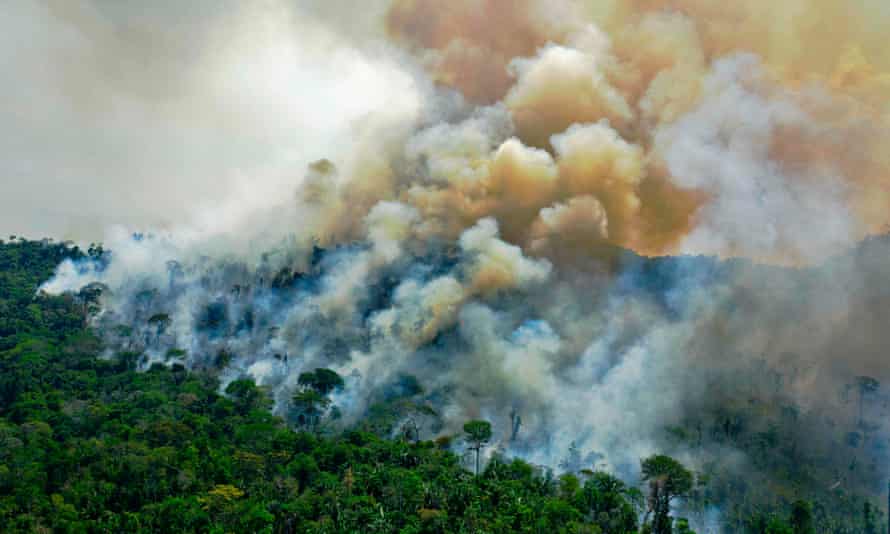
Smoke rises from the Amazon rainforest in Brazil
A burning area of rainforest reserve in Pará state, Brazil. Much of the Amazon is close to a tipping point at which it becomes savannah, researchers have warned. Photograph: Carl de Souza/AFP/Getty Images

Damian Carrington Environment editor@dpcarringtonThu 3 Jun 2021 12.34 EDT

Ice sheets and ocean currents at risk of climate tipping points can destabilise each other as the world heats up, leading to a domino effect with severe consequences for humanity, according to a risk analysis.

Tipping points occur when global heating pushes temperatures beyond a critical threshold, leading to accelerated and irreversible impacts. Some large ice sheets in Antarctica are thought to already have passed their tipping points, meaning large sea-level rises in coming centuries.

The new research examined the interactions between ice sheets in West Antarctica, Greenland, the warm Atlantic Gulf Stream and the Amazon rainforest. The scientists carried out 3m computer simulations and found domino effects in a third of them, even when temperature rises were below 2C, the upper limit of the Paris agreement.AdvertisementBiden provides details on plan to share 80m Covid vaccine doses globally – liveNetanyahu attacks ‘dangerous’ coalition seeking to topple himUnited Airlines aims to revive Concorde spirit with supersonic planesUS DoJ investigating postmaster general over political fundraising‘Mind-blowing’: tenth of world’s giant sequoias may have been destroyed by a single fireUS DoJ investigating postmaster general overpolitical fundraisinghttps://imasdk.googleapis.com/js/core/bridge3.462.0_en.html#goog_1133111315https://imasdk.googleapis.com/js/core/bridge3.462.0_en.html#goog_693384201https://imasdk.googleapis.com/js/core/bridge3.462.0_en.html#goog_475190248

The study showed that the interactions between these climate systems can lower the critical temperature thresholds at which each tipping point is passed. It found that ice sheets are potential starting points for tipping cascades, with the Atlantic currents acting as a transmitter and eventually affecting the Amazon.

“We provide a risk analysis, not a prediction, but our findings still raise concern,” said Prof Ricarda Winkelmann, at the Potsdam Institute for Climate Impact Research (PIK) in Germany. “[Our findings] might mean we have less time to reduce greenhouse gas emissions and still prevent tipping processes.”

The level of CO2 in the atmosphere required to push temperatures beyond the thresholds could be reached in the very near future, she said. “In the next years or decades, we might be committing future generations to really severe consequences.” These could include many metres of sea-level rise from ice melting, affecting scores of coastal cities.

“We’re shifting the odds, and not in our favour – the risk clearly is increasing the more we heat our planet,” said Jonathan Donges, also at PIK and part of the research team.

In May, scientists reported that a significant part of the Greenland ice sheet was on the brink of a tipping point. A 2019 analysis led by Prof Tim Lenton at the University of Exeter suggested the world may already have crossed a series of climate tipping points, resulting in what the researchers called “an existential threat to civilisation”.

The climate crisis may also mean much of the Amazon is close to a tipping point, at which carbon-storing forest is replaced by savannah, researchers have warned. The ocean currents of the Atlantic Meridional Overturning Circulation (AMOC), of which the Gulf Stream is an important part and keeps western Europe mild, are at their weakest in more than a millennium.

The research, published in the journal Earth System Dynamics, used a new type of climate model because existing models are very complex and require huge computing power, making them expensive to run many times. Instead, the researchers used an approach that focused specifically on how the temperature thresholds for the tipping points changed as the systems interacted, allowing them to run the 3m simulations.

An example of the complex chain of interactions the researchers tracked is the melting of the Greenland ice sheet. This releases fresh water into the ocean and slows down the AMOC, which is driven partly by dense, salty water being pulled down towards the ocean floor. A weaker AMOC means less heat is transported from the tropics towards the north pole, which in turn leads to warmer waters in the Southern Ocean. This can then destabilise ice sheets in Antarctica, which pushes up global sea level and causes more melting at the edges of the Greenland ice sheet.

“The study suggests that below 2C of global warming – ie in the Paris agreement target range – there could still be a significant risk of triggering cascading climate tipping points,” said Lenton. “What the new study doesn’t do is unpack the timescale over which tipping points changes and cascades could unfold – instead it focuses on the eventual consequences. The results should be viewed as ‘commitments’ that we may be making soon to potentially irreversible changes and cascades, leaving as a grim legacy to future generations.”

However, the chance of a cascade of tipping points leading to a runaway greenhouse effect, where the planet gets ever hotter even if humanity stops carbon emissions, is extremely unlikely, according to Prof Anders Levermann, also at PIK but not involved in the new work. “The Earth will get as warm as we make it, which means we’re the ones [that must] stop it,” he said.
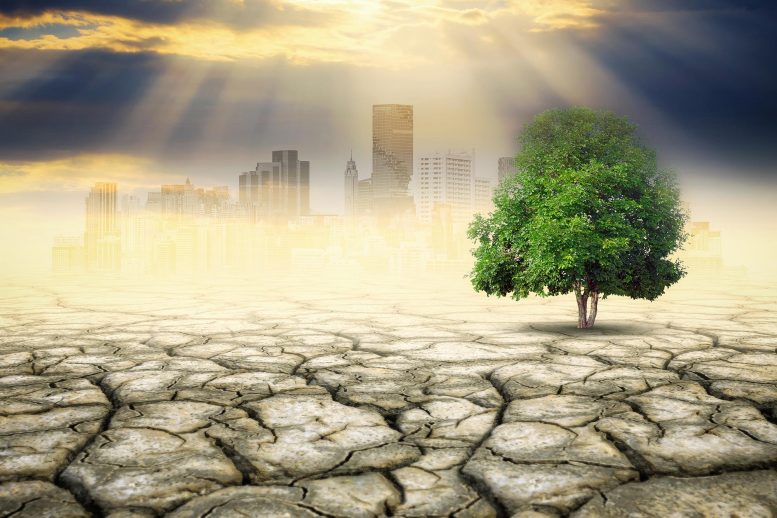
Scientists Warn: Nine Climate Tipping Points Now ‘Active’ – Could Threaten the Existence of Human Civilization

Global Warming Threatens Human Civilization

More than half of the climate tipping points identified a decade ago are now “active,” a group of leading scientists have warned.

This threatens the loss of the Amazon rainforest and the great ice sheets of Antarctica and Greenland, which are currently undergoing measurable and unprecedented changes much earlier than expected.

“We must admit that we have underestimated the risks of unleashing irreversible changes, where the planet self-amplifies global warming.” — Johan Rockström, Potsdam Institute for Climate Impact Research

This “cascade” of changes sparked by global warming could threaten the existence of human civilizations.

Evidence is mounting that these events are more likely and more interconnected than was previously thought, leading to a possible domino effect.

In an article published in the journal Nature on November 27, 2019, the scientists call for urgent action to reduce greenhouse gas emissions to prevent key tipping points, warning of a worst-case scenario of a “hothouse,” less habitable planet.

“A decade ago we identified a suite of potential tipping points in the Earth system, now we see evidence that over half of them have been activated,” said lead author Professor Tim Lenton, director of the Global Systems Institute at the University of Exeter.

“The growing threat of rapid, irreversible changes means it is no longer responsible to wait and see. The situation is urgent and we need an emergency response.”

Co-author Johan Rockström, director of the Potsdam Institute for Climate Impact Research, said: “It is not only human pressures on Earth that continue rising to unprecedented levels.

“It is also that as science advances, we must admit that we have underestimated the risks of unleashing irreversible changes, where the planet self-amplifies global warming.

“This is what we now start seeing, already at 1°C global warming.

“Scientifically, this provides strong evidence for declaring a state of planetary emergency, to unleash world action that accelerates the path towards a world that can continue evolving on a stable planet.”

In the commentary, the authors propose a formal way to calculate a planetary emergency as risk multiplied by urgency.

Tipping point risks are now much higher than earlier estimates, while urgency relates to how fast it takes to act to reduce risk.

Exiting the fossil fuel economy is unlikely before 2050, but with temperature already at 1.1°C above pre-industrial temperature, it is likely Earth will cross the 1.5°C guardrail by 2040. The authors conclude this alone defines an emergency.

Nine active tipping points:

  1. Arctic sea ice
  2. Greenland ice sheet
  3. Boreal forests
  4. Permafrost
  5. Atlantic Meridional Overturning Circulation
  6. Amazon rainforest
  7. Warm-water corals
  8. West Antarctic Ice Sheet
  9. Parts of East Antarctica

The collapse of major ice sheets on Greenland, West Antarctica and part of East Antarctica would commit the world to around 10 meters of irreversible sea-level rise.

Reducing emissions could slow this process, allowing more time for low-lying populations to move.

The rainforests, permafrost, and boreal forests are examples of biosphere tipping points that if crossed result in the release of additional greenhouse gases amplifying warming.

“Scientifically, this provides strong evidence for declaring a state of planetary emergency.” — Johan Rockström

Despite most countries having signed the Paris Agreement, pledging to keep global warming well below 2°C, current national emissions pledges — even if they are met — would lead to 3°C of warming.

Although future tipping points and the interplay between them is difficult to predict, the scientists argue: “If damaging tipping cascades can occur and a global tipping cannot be ruled out, then this is an existential threat to civilization.

“No amount of economic cost-benefit analysis is going to help us. We need to change our approach to the climate problem.”

Professor Lenton added: “We might already have crossed the threshold for a cascade of inter-related tipping points.

“However, the rate at which they progress, and therefore the risk they pose, can be reduced by cutting our emissions.”

Though global temperatures have fluctuated over millions of years, the authors say humans are now “forcing the system,” with atmospheric carbon dioxide concentration and global temperature increasing at rates that are an order of magnitude higher than at the end of the last ice age.

###

Reference: “Climate tipping points — too risky to bet against: The growing threat of abrupt and irreversible climate changes must compel political and economic action on emissions.” by Timothy M. Lenton, Johan Rockström, Owen Gaffney, Stefan Rahmstorf, Katherine Richardson, Will Steffen and Hans Joachim Schellnhuber, 27 November 2019, Nature.
DOI: 10.1038/d41586-019-03595-0

The latest UN Climate Change Conference will take place in Madrid from December 2-13.

‘Tipping point’ risk for Arctic hotspot

News.

‘Tipping point’ risk for Arctic hotspot

A rapid shift under way in the Barents Sea could spread to other Arctic regions, scientists attending a conference in Norway have warned. The Barents Sea is said to be at a “tipping point”, BBC News explains, changing from an Arctic climate to an Atlantic climate as the water warms. The Arctic Ocean has a surface layer of freshwater “which acts as a cap” on a layer of warmer, saltier water below. “But now in the Barents Sea there’s not enough freshwater-rich sea ice flowing from the high Arctic to maintain the freshwater cap,” BBC News reports.

BBC News Read Article
Scientists warn climate change could reach a ‘tipping point’ sooner than predicted as global emissions outpace Earth’s ability to soak up carbon

A new study warns that if greenhouse gas emissions continue at current rates, Earth’s vegetation may not be able to keep up. “Once plants and soil hit the maximum carbon uptake they can handle, warming could rapidly accelerate”, MailOnline writes. The study from Columbia University’s School of Engineering and Applied Science investigates how changes in soil moisture affect its capability to act as a “carbon sink”. Currently, “plants and soil around the world absorb roughly a quarter of the greenhouse gases that humans release”, the New York Times explains. But “when the soil is dry, plants are stressed and can’t absorb as much CO2 to perform photosynthesis”. And with warmer conditions microorganisms in the soil become more productive and “release more CO2”. The researchers found that although “plants and soil could absorb more CO2 during the wetter years, it did not make up for their reduced ability to absorb CO2 in the years when soil was dry”. Carbon Brief has also covered the study.

MailOnline Read Article
UK team drills record West Antarctic hole

Scientists have succeeded in cutting a 2km hole through the West Antarctic Ice Sheet to its base using a hot-water drill, BBC News reports. The team then collected sediment from the bottom of the hole and “deployed a series of instruments”. The researchers from the British Antarctic Survey hope that the data collected can help them determine how fast Antarctica might lose its ice in a warming world. Dr Andy Smith, who led the team, commented: “There are gaps in our knowledge of what’s happening in West Antarctica and by studying the area where the ice sits on soft sediment, we can understand better how this region may change in the future and contribute to global sea-level rise.”

BBC News Read Article
US coal retirements in 2019 to hit at least 6GW

2019 will see the retirement of nearly 6GW of coal power in the US, while 49GW of new power generation capacity will be added to the grid, according to the latest figures from S&P Global Market Intelligence, which is highlighted by CleanTechnica. In a related story, E&E News reports that a group of US utilities and other power producers say they may have to shut down their coal-fired power plants if a court rolls back a Trump administration extension to the deadline for closing some coal ash dumps. Their filing to the US Court of Appeals follows a legal challenge brought by environmental groups to the administration’s changes last July to the Obama-era regulations governing coal ash disposal, the article explains.

In other coal news, the Australian Financial Review reports that Jeremy Grantham, the “legendary British hedge fund manager” who founded GMO, has said that thermal coal is “dead meat”. Bloomberg investigates how a “loophole” lets Norway’s $1 trillion sovereign wealth fund boost its coal exposure. Meanwhile, Forbes says that China’s “coal reliance is not falling nearly as fast as some like to claim”. Chinese coal demand “hasn’t been falling in the absolute sense”, the piece argues, continuing: “China approved nearly $6.7bn worth of new coal mining projects in 2018, and production increased 5.2% to 3.55bn tonnes”.

CleanTechnica Read Article