The National Rifle Association and a sport hunting group want to ensure their members can hunt grizzly bears in the three-state region around Yellowstone National Park after the animals lost U.S. protections.
Idaho, Montana and Wyoming are considering limited trophy hunts for grizzlies outside the park in future years after the U.S. Fish and Wildlife Service revoked the species’ threatened status in July.
Conservation groups have sued to restore protections, and now the NRA and Safari Club International have asked U.S. District Judge Dana Christensen to let them intervene in the case.
Several of the groups’ members said in affidavits submitted by their attorneys that hunting would help the region’s economy, allow states to better manage the animals and improve public safety.
“Having the ability to hunt grizzlies would be great for business. I would also personally hunt a grizzly if given an opportunity to do so,” said Edwin Johnson, a 70-year-old hunting outfitter who lives in Gardiner, Montana. “They need to be hunted so that they fear the scent of humans, rather than following it as they do now.”
An estimated 700 bears live in and around Yellowstone National Park. Attacks on humans have increased since the animals rebounded from widespread extermination in the last century.
At least six lawsuits to restore protections for grizzlies are pending in Montana and Illinois, although most are expected to be consolidated into a single case in coming months.
An attorney for environmentalists in one of the Montana cases said no decision has been made on whether to fight the attempt by the NRA and Safari Club to intervene.
“We are committed to doing everything we can to stop trophy hunting of grizzly bears leaving Yellowstone National Park,” said Matthew Bishop with the Western Environmental Law Center, who is representing WildEarth Guardians.
If you were an elephant, you might be puzzling over human behavior this week. On Monday, the animal-rights attorney Steven Wise filed a writ of habeas corpus on behalf of three privately owned Asian elephants, arguing that the animals are “legal persons” who have a right to bodily liberty and should be free to live in a sanctuary. Then, on Thursday, the U.S. Fish and Wildlife Service announced that the remains of elephants legally hunted in Zimbabwe and Zambia could now be legally imported to the United States as trophies.
This new policy overturned a ban put in place by the Obama administration in 2014. African elephants are considered “threatened” under the U.S. Endangered Species Act, a step below being endangered. The animals’ numbers have plunged from around 10 million 100 years ago to around 400,000 today, largely because of poaching and habitat loss. The Fish and Wildlife Service has not changed the elephants’ status; instead, it now argues that supporting “legal, well-managed hunting programs” will help provide “much-needed conservation dollars to preserve habitats and protect wild herds” in Zimbabwe and Zambia, the agency’s principal deputy director, Greg Sheehan, said in a news release.
But then, to further complicate matters, President Donald Trump tweeted Friday evening that nothing would actually change until he “reviews all conservation facts.”
The idea that killing more elephants will help save the species is counterintuitive, and its line of reasoning is difficult for many conservation organizations to support: Let rich hunters pay hefty sums to shoot elephants, and use the money to help conservation efforts and local communities. Supposedly, the villagers won’t then need to poach elephants to feed their families and pay their kids’ school fees. Still, the International Union for Conservation of Nature, or IUCN, a respected organization that sets the conservation status for all species, supportsthe notion.
But the evidence that “hunting elephants saves them” is thin. The hunting-safari business employs few people, and the money from fees that trickles down to the villagers is insignificant. A 2009 report from the IUCN revealed that sport hunting in West Africa does not provide significant benefits to the surrounding communities. A more recent report by an Australian economic-analysis firm for Humane Society International found that trophy hunting amounts to less than 2 percent of tourism revenue in eight African countries that permit it.*
And then, there is a larger moral question: How does hunting affect male elephants, especially the “big tuskers” that hunters want, and the overall population?
If elephants are recognized as legal persons, a term the U.S. courts have granted corporations and a New Zealand court gave to a river (elsewhere the term has been extended to chimpanzees, a bear, and the environment), it would be more difficult to hunt them at all—let alone import their body parts. Wise’s lawsuit cites extensive scientific studies that have established elephants’ cognitive abilities, emotional and empathetic natures, complex social lives, lifelong learning, and memory skills. “Taken together, the research makes it clear elephants are autonomous beings who have the capacity to choose how to live their lives as elephants,” he tells me.
One thing elephants would not choose, Wise and elephant researchers agree, is to be hunted. “It doesn’t matter to elephants if they are killed by poachers or trophy hunters,” says Joyce Poole, who has studied African elephants in the wild in Kenya and Mozambique for more than 40 years and is the codirector of ElephantVoices, a conservation organization. “Either way, you’re a killer. And if elephants understand that about you, they change their behavior.”
Elephants aren’t considered game animals in most African countries with substantial populations of these animals. But trophy hunters after large male elephants can seek their prey in South Africa, Namibia, Cameroon, Zambia, Zimbabwe, Tanzania, Gabon, and Mozambique. Kenya banned the sport in 1973, while Tanzania continued to permit legal hunting. That caused problems for the elephants of Kenya’s Amboseli National Park, says Poole, who was studying the large males in the park at the time. The park borders Tanzania, and after the Tanzanian government opened a hunting block on the opposite side, the Amboseli male elephants who wandered across became prized targets.
“It was an awful time,” Poole recalled, “because on one side, the elephants learned to trust tourists—generally white people—in cars. From our studies, we know they can smell the difference between whites and local people. They also distinguish us by our languages. They know people who speak Maa, the language of the local Maasai people, may throw spears at them; those who speak English don’t.” However, the tables were turned on the Tanzanian side of the border. There, white people in cars who drove up close to see an elephant might lean out with a camera—or a rifle.
“The elephants didn’t run because they didn’t expect to be shot,” Poole said. Two of the large males she was studying were lost this way to trophy hunters. She and others protested to the Tanzanian government, and these particular hunting blocks were eventually closed.
Poole does not know how the loss of these big males, who’d fathered many calves, affected the other elephants. Female elephants, though, do mourn family members who die, and are especially troubled when the matriarch, their leader, passes. In 2003, for instance, researchers in Kenya’s Samburu National Reserve watched as Eleanor, an elephant family’s matriarch, died from natural causes. When Eleanor fell heavily to the ground, Grace, a matriarch from another family, used her tusks to lift her friend and helped her to her feet. Despite Grace’s efforts, Eleanor died that night. She had a tiny, six-month-old calf who never left her side. In a photograph, the calf stands like a small sentinel beside her mother’s body, while the rest of the family bunches together, grieving.
Researchers have rarely seen similar moments among male elephants, who as adults, live away from the female herds they grew up in, and return only to mate. That behavior led to a “myth that males are far less social than females,” said George Wittemyer, a conservation biologist at Colorado State University in Fort Collins who has studied elephants in Kenya for more than 20 years. His new research contradicts this notion. “Actually, the males are always in groups and have preferences for certain companions. They’re not the loners they’ve been made out to be,” he said.
“The death of a bull will cause less disruption than the death of a family member,” said Iain Douglas-Hamilton, a zoologist who founded the organization Save the Elephants. “If a bull is shot while associating with a family the others will normally run away.” But he noted: “Bulls will defend or help each other sometimes, when one is down.”
From a population standpoint, “older male elephants are very important to the health and genetic vitality of a population,” said Cynthia Moss, who has led the Amboseli Elephant Research Project in Kenya since 1972. While hunters in the past have used the belief that older males are reproductively senile as an argument for killing them for their ivory, research has revealed that they are in fact an elephant population’s primary breeders. “By living to an older age, [older males show that] they have the traits for longevity and good health to pass on to their offspring,” Moss said. “Killing these males compromises the next generation of the population.”
It’s not clear if the Fish and Wildlife Service will consider how trophy hunting affects individual elephants or their families. The agency didn’t comment on Trump’s tweet when contacted, but later issued a public statement confirming that permits would be put on hold. “President Trump and I have talked and both believe that conservation and healthy herds are critical,” Interior Secretary Ryan Zinke said in the statement.
Wise believes that the emotional and psychological suffering the elephants endure from this sport is obvious. “One day it will be seen for the moral outrage that it is,” he said.
Before Trump’s tweet, the Fish and Wildlife Service had intended to begin issuing permits for importing elephant trophies on Friday. The new policy would apply to elephants hunted in Zimbabwe between January 21, 2016, and December 31, 2018, as well as elephants hunted in Zambia from 2016 to 2018. Regardless of how hunting affects elephants, if the policy goes through, some hunters will have trophies waiting for them in those countries.
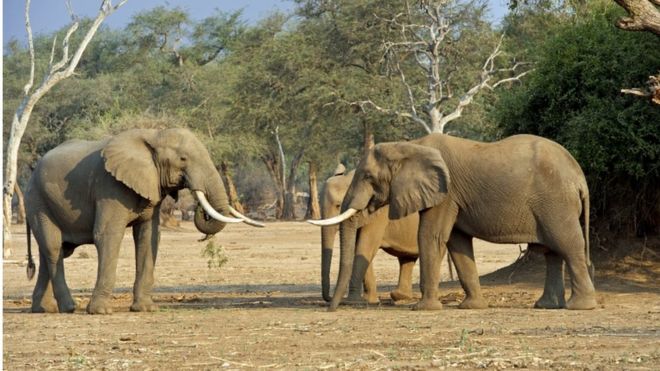
Image copyrightSPLImage captionThe US Fish and Wildlife Service argues hunting “will enhance the survival of the African elephant”
President Donald Trump has suspended the import of elephant hunting trophies, only a day after a ban was relaxed by his administration.
Imports of trophies from elephants legally hunted in Zambia and Zimbabwe had been set to resume, reversing a 2014 Obama-era ban.
But late on Friday, President Trump tweeted the change was on hold until he could “review all conservation facts”.
The move to relax the ban had sparked immediate anger from animal activists.
“Your shameful actions confirm the rumours that you are unfit for office,” said French actress and animal-rights activist Brigitte Bardot in a letter to President Trump.
Put big game trophy decision on hold until such time as I review all conservation facts. Under study for years. Will update soon with Secretary Zinke. Thank you!
The non-profit group’s report found a population drop of 6% in Zimbabwe alone.
Despite their listing under the Endangered Species Act, there is a provision in US law that allows permits to import animal parts if there is sufficient evidence that the fees generated will actually benefit species conservation.
French actress and animal rights activist Brigitte Bardot had previously criticized US President Donald Trump over his administration’s move to loosen restrictions on hunting bears and wolves on federally protected land in Alaska. By ERIC FEFERBERG (AFP/File)
French screen legend and animal rights activist Brigitte Bardot on Friday slammed US President Donald Trump as “unfit for office” after his administration’s “shameful actions” in authorizing the import of Zimbabwean elephant hunting trophies.
The move Thursday reverses a prohibition imposed under former president Barack Obama, permitting the import of “sport-hunted trophies from elephants hunted in Zimbabwe” between January 21, 2016 and December 31, 2018. Zambia will also be covered under the revised rule.
“No despot in the world can take responsibility for killing off an age-old species that is part of the world heritage of humanity,” Bardot said in a letter to Trump, released through Fondation Brigitte Bardot.
The move is “a cruel decision backed by Zimbabwe’s crazy dictator and it confirms the sick and deadly power you assert over the entire plant and animal kingdom.”
“Your shameful actions confirm the rumors that you are unfit for office,” the 83-year-old added.
According to the Great Elephant Census project, African savannah elephant populations fell by 30 percent between 2007 and 2014, while Zimbabwe saw a drop of six percent.
The most popular of all the Okla. hunting seasons in the state, the 16-day
Deer gun season, opens Saturday statewide.
A state big game biologist states “It is like Thanksgiving and football. That
Is what part of fall is, getting out there for a deer hunt with a rifle.”
If past history is any indication, more than 150,000 hunters will be
In the woods Saturday for the deer gun season opener.
Not only is deer hunting an annual tradition for many Okla. Families,
It is also significant to the Okla. economy as gas stations, convenience
Stores, sporting goods outlets and meat processors rely on the money
Spent by deer hunters per year.
One economic study indicates that Okla. deer hunters spend $130
Million annually.
Based on the number of deer taken by hunters during the archery
And muzzleloader seasons, Okla.’s deer harvest is on pace to reach around
100,000 again.
Okla. hunters killed more than 100,000 deer for the first time in 2000
And since then, hunters have reached near that mark or exceeded it
11 times in the past 17 years.
Last year’s grand total was 99,023 and the 13-year average is 103,000.
The Okla. Dept. of Wildlife Conservation has been pushing the importance
Of letting young bucks walk to increase the opportunities for a trophy
Deer in the future.
More Oklahoma hunters are now willing to practice what deer biologists
Have been saying.
A/w the Wildlife Dept.’s research, 65% of the deer killed by Okla. hunters
In 1985 were yearlings and over the years that no. has dramatically
Decreased.
Yearlings represented 46% of the deer harvest in 2000 and just 23% in
2010. Last year, only 17% of the deer killed were yearlings and last season
The majority of bucks harvested were 2.5 and 3.5 years old.
10 percent of bucks harvested last season were 6.5 years old and in 2010
Bucks that old only represented 3% of the harvest. In 2000, 6.5 year old
Bucks represented just 1% of the harvest.
A spokesman for the Wildlife Dept. states that “It is really a testament
To our hunters. They are actually the deer managers. They are the
Boots on the ground and making a decision every single time they pull
That trigger or choose not to pull that trigger.”
PERRY, Mo. — As professional artist Craig Norton of Perry was doing research for an adult coloring book focusing on endangered animals, something kept gnawing at him.
Norton said he would frequently encounter disturbing photographs of big-game hunters posing with the carcasses of endangered animals they had just killed.
He said he saw one hunter standing victoriously atop a dead elephant while flexing his muscles and giving a thumbs-up sign.
He saw a hunter swaying with a dead cheetah in his arms as if dancing with the animal on prom night.
He saw a couple kissing and holding a “Just Married” sign while standing next to a dead grey zebra one of them had killed.
He saw hunters sitting on a dead giraffe while smoking cigars and toasting each other with champagne glasses.
He saw a photo of a boy — about 10 or 12 years old — relaxing alongside a lion he had shot.
“He was literally cozied up next to the dead lion, and he’s playing on his iPad,” Norton said.
All of these images — and many others — bothered Norton and stayed with him while he was producing the 45 pen-and-ink drawings that were eventually featured in his coloring book, “Endangered: Animals to Color,” which was published in 2016.
Since then, Norton decided to express his feelings about “the negative effects of trophy hunting” by producing a series of paintings that focus on the killing of endangered animals.
The result is “Trophies,” an art exhibit that opens Monday in the Hannibal-LaGrange University’s Arts Department gallery. The exhibit will remain on display through Nov. 10. A reception with the artist — open to the public — is scheduled for 6 p.m. Friday.
Norton, a father of six who makes a living as a professional artist, said he felt compelled to create the series of artworks as a way to make a statement about his concern for the loss of endangered animals.
“These beautiful animals stand no chance when facing a hunter with a gun,” he said.
Norton is quick to point out that he is not opposed to legal hunting in general. He is specifically opposed to killing endangered animals.
“This exhibit has nothing to do with deer, turkey or duck hunters,” he said.
Norton is worried that the continued hunting of endangered animals will lead to the extinction of more species.
“For every species that is wiped out, it affects so much more than people realize because the extinction of one species affects other species,” he said.
Norton likens the extinction possibilities to a jigsaw puzzle.
“When one piece of that puzzle is suddenly missing, it affects the balance of things and is not complete,” he said.
“There’s not enough protection for these animals. Their numbers are dropping considerably. So I’m trying to get the debate going on whether this is the right thing or the wrong thing.”
Norton said all of the paintings he produced for the exhibit were based on real photographs he encountered while doing research over the last couple of years.
“These are not fictional,” he said. “They are based on real photographs, then I make it my own painting by adding things and subtracting things.”
Norton even added editorial text to some of the paintings to help illustrate his points about “the complete and utter disrespect and disregard for the animals’ life.”
Norton, 43, is known for making statements about social issues when producing his work.
Over the years he developed gallery shows in New York, Chicago, St. Louis and Baltimore featuring paintings, drawings and mixed-media work on such diverse subjects as the Holocaust, racial lynchings, gun violence and the travails that have faced Native Americans and the elderly.
He feels endangered animals deserve some attention as well.
“There are thousands of species at risk,” he said.
More information and examples about Norton’s artwork can be found on his website, craignortonart.com, and at craignortonart@facebook.com.
Nine-in-ten welcome the provincial government’s decision to ban trophy hunting of grizzlies in the province.
Vancouver, BC – Three-in-four British Columbians believe no grizzly bears should be hunted in the province, a new poll by Insights West conducted in partnership with Lush Cosmetics and the Commercial Bear Viewing Association has found.
In the online survey of a representative provincial sample, 74% of British Columbians are in favour of banning all grizzly bear hunting in the province, while 19% are opposed.
The highest level of support for banning all hunting of grizzly bears in British Columbia is observed among women (78%), residents aged 35-to-54 (79%), Vancouver Islanders (81%), BC New Democratic Party (NDP) and BC Green Party voters in the 2017 provincial election (81% for each) and non-hunters (75%).
In addition, almost three-in-five self-described hunters (58%) are in favour of banning all grizzly bear hunting in British Columbia.
The Government of British Columbia recently banned trophy hunting of grizzly bears in the province. This decision is backed by almost nine-in-ten British Columbians (88%), including 69% who “strongly” support it.
The survey was conducted at the end of August, two weeks after the government’s announcement. The decision allows a residential hunt to continue.
“Our polling has shown that British Columbians have consistently been opposed to trophy hunting, so the level of support for the government’s decision is not surprising,” says Mario Canseco, Vice President, Public Affairs, at Insights West. “Still, with so many residents who believe grizzlies should not be hunted at all, there is definitely appetite for more action.”
“With such strong results from British Columbians, we believe that the government can go further and ban all hunting of grizzly bears across the province,” says Tricia Stevens, Charitable Giving Manager at Lush Cosmetics. “Scientists, bear viewing operators, conservationists and now even hunters are agreeing it’s time to protect this iconic species for once and for all.”
“The government has taken a good first step, but this poll reiterates the fact that the vast majority of British Columbians want to see an end to all hunting of grizzly bears, whether for trophies or meat,” says Julius Strauss of the Commercial Bear Viewing Association’s Political Committee and owner of Grizzly Bear Ranch. “It’s time to respect that wish. Some worry that such a ban will cost BC money, but the reality is that bear-viewing is worth far more to the province than grizzly hunting.”
Across the province, 11% of residents describe themselves as hunters. The animals that have been hunted the most are deer (65%), moose (51%) and elk (30%).
About Insights West:
Insights West is a progressive, Western-based, full-service marketing research company. It exists to serve the market with insights-driven research solutions and interpretive analysis through leading-edge tools, normative databases, and senior-level expertise across a broad range of public and private sector organizations. Insights West is based in Vancouver and Calgary.
About this Release:
Results are based on an online study conducted from August 27 to August 30, 2017, among 817 adult residents of British Columbia. The data has been statistically weighted according to Canadian census figures for age, gender and region in British Columbia. The margin of error—which measures sample variability—is +/- 3.5 percentage points, nineteen times out of twenty. View the detailed data tabulations.
‘The grizzly bear in Alberta is a threatened species,’ says group that had hoped for higher fine
The Canadian PressPosted: Sep 22, 2017 7:54 AM MT Last Updated: Sep 22, 2017 10:20 AM MT
A collared grizzly bear that was being tracked for research by officials in Jasper National Park was killed by a hunter. (Government of Yukon)
An Alberta man charged with killing a collared grizzly bear that was being tracked for research will pay nearly $13,000 in fines, but some say that’s not enough to protect the threatened species.
Ronald Raymond Motkoski pleaded guilty earlier this month in an Edson, Alta., courtroom to possession of wildlife and was fined $2,500. He’s also required to pay $5,000 to Alberta’s BearSmart program and $5,202.76 for the cost of the tracking collar.
Neither he nor his lawyer could be reached for comment this week.
Motkoski was charged in June 2016 after Fish and Wildlife officers were notified by fRI Research that a collar put on grizzly bear No. 141 in Jasper National Park had stopped working near Edson, about 200 kilometres west of Edmonton.
It was determined the three-year-old male grizzly had been shot and killed.
The Crown prosecutor withdrew a charge of hunting wildlife in a closed season and providing a false or misleading statement. A spokesperson for the province said the charges were withdrawn because some of the evidence did not suggest a reasonable likelihood of conviction.
Another man, John Peter Grant of Fort McMurray, Alta., pleaded guilty on Feb. 2 to unlawful possession of wildlife related to the death of the same bear and was fined a total of $6,000.
Critics say the fines are too low.
“It’s absolutely scandalous,” said Jill Seaton, chair of the Jasper Environmental Association. “The grizzly bear in Alberta is a threatened species.”
Gordon Stenhouse, a scientist with the fRI Research grizzly bear program, said he also had higher expectations.
“I thought there would be a different outcome,” he said, noting the maximum fine is $100,000.
A threatened species
Grizzly bears were listed as threatened in Alberta in 2010 when it was determined there were only about 700 left. A recovery strategy was introduced aimed at reducing conflicts between bears and people.
Poaching remains a problem in Alberta, with statistics showing at least 39 grizzly bears have been killed illegally since a legal hunt ended in 2005.
Bear No. 141 was considered important because he was fitted with a GPS collar in Jasper and left the park within a few weeks.
“It’s quite rare that a bear in Jasper takes off,” said Stenhouse.
Officials with Jasper National Park declined to comment.
Stenhouse said that valuable research was lost with the death of the bear.
No. 141 “was one of a very few bears that we have seen make long-distance movements from Jasper National Park over the past 18 years of research in this area,” he said in an impact statement prepared for court.
“The movements and habitat use of this bear were of significant interest to us in learning more about home range establishment and response to human activities.”
‘An unfortunate loss’
Despite getting about $5,000 to replace the bear’s tracking collar, he said it’s also a financial hit for the program.
“This is an unfortunate loss and does not address any of our time, effort or cost that our research team invested in the successful capture of this bear,” he said.
Losing even one bear hurts the province’s recovery plan, he said.
“From a broader perspective, the key issue is on the common and ongoing problem of the illegal killing of bears,” said Stenhouse. “Some members of the public appear to remain unwilling to share a common landscape and co-exist with this species.”
Should those attitudes continue, he said it’s unlikely that future generations will see grizzly bears anywhere other than the most remote areas of the national parks.
It is hard to picture yourself on the fence when it comes to issues of wildlife conservation and hunting for sport. The two seem mutually exclusive, and advocates for each could hardly be blamed for believing they could never see the other side’s point of view.
Which makes the heart-churning new documentary “Trophy” eye-opening, depressing and enlightening all at once. It shows how these issues are inextricably intertwined, because of both the costs of preserving species that face extinction, and the profit motives of the multi-billion-dollar global hunting industry whose clients will pay big bucks to bag a prized specimen of lion, elephant, rhino or other magnificent creature.
And yes, it forces the viewer to reflect on the desires of both sides: those for whom hunting is a God-given right and all God’s creatures under Man’s dominion to do with as we please; and those for whom the death of an animal is intolerable, and who will take to the streets or to social media to target hunters. (Walter Palmer, the Minnesota dentist who hunted and killed Cecil the lion in Zimbabwe in 2015, became an international pariah who received death threats.)
But there are people in the middle, trying to find a way to protect species in an imperfect, capitalist world where, for example, bans on the sale of rhino horn (enacted to protect rhinos from poachers) have actually increased poaching, decimating the species in just a few years.
A hunter poses with the elephant he killed in Namibia in the documentary “Trophy.”
THE ORCHARD
“Trophy” (which had its world premiere earlier this year at the Sundance Film Festival) follows several figures pursuing their personal goals involving animals, including: Philip Glass, a Texas rancher who is closing in on fulfilling a hunter’s “Big Five,” if the lion’s recent addition to the endangered species list doesn’t trip him up first; John Hume, a former property developer who has invested millions to raise rhinos and harvest their horns, to keep the animals from being slaughtered by poachers; Christo Gomes, who breeds exotic animals on his South African ranch, appealing to the tastes of his wealthy hunter clients; and Chris Moore, a Zimbabwean wildlife officer who must act like King Solomon among the local community whose livestock and family members are preyed upon by wild animals.
If you think you know these people by these brief descriptions, you are wrong. Moore uses harsh “scared straight” tactics against the children of suspected poachers in the dead of night; Gomes cries when thinking about the animals he raises, only to be killed by the clients who pay his bills; Hume goes to court, fighting to repeal South Africa’s ban on rhino horn sales and avoid financial ruin; and Glass visibly mourns the passing of an elephant, which takes a long, long time to expire from the bullets he has fired into its body.
Director Shaul Schwarz and co-director Christina Clusiau do not pull their punches when showing the glee with which a beer-swigging hunter slaughters an alligator dragged out of its pond. “It’s party time!” he says after firing his rifle at point-blank range. Nor with the Youtube commenter upset over Cecil’s death, who happens to be wearing a leopard print scarf.
A taxidermist puts the finishing touches on a stuffed lion in “Trophy.”
THE ORCHARD
As each person rationalizes their thinking and behavior for the camera, we are left questioning our own moral compass, and where animals fall within it.
One of the most moving sentiments is from a taxidermist, Travis Courtney, who rues that the destruction of habitat forces animals into contact with people. “They always come second,” he says, putting the finishing touches on a stuffed lion.
“This might do justice to them,” he says of his handiwork. “At least that is what I aim for. So if they do become extinct one day, it’s something to show the world what they look like.”
Exceptionally well-photographed, “Trophy” captures the haunting beauty of these threatened animals, whether roaming free in a park beset by poachers or behind chain-link fences, oblivious to the safari that awaits.
The film, strangely, inspires something close to hope — despite the poaching statistics and depressing bloodlust — because, as evoked by the film’s participants in so many different ways, the value of these animals is calculated far beyond mere currency, despite the monetary impulses on view. As anti-poaching activist John Hume observes about harvesting rhino horns rather than slaughtering the animals outright, “Who would kill the hen that lays the golden egg?”
“Trophy” (distributed by The Orchard) opens in New York City and Santa Monica, Calif., on Friday, September 8, and in cities nationwide beginning September 20. (Get tickets.) The film will be broadcast on CNN in 2018. 109 mins. This film is not rated.
To watch a trailer for “Trophy” click on the video player below.
Unexpected move reverses a trend that has seen increasing numbers of large carnivores shot by hunters each year since Romania’s accession to the European Union
In 2016, the largest hunting quotas yet gave hunters the mandate to shoot 550 bears, 600 wolves and 500 big cats over 12 months. Photograph: Radu Sigheti/Reuters
Wednesday 5 October 2016 11.08 EDTLast modified on Thursday 6 October 2016 05.14 EDT
Romania has banned all trophy hunting of brown bears, wolves, lynx and wild cats in a surprise decision that gives Europe’s largest population of large carnivores a reprieve from its most severe and immediate threat.
The move on Tuesday reverses a trend which has seen the number of large carnivores being shot by hunters grow year on year since Romania’s accession into the European Union in 2007. In 2016, the largest hunting quotas yet gave hunters the mandate to shoot 550 bears, 600 wolves and 500 big cats over 12 months.
Over the last decade, hunting has grown into a multimillion-euro industry in Romania, with hunters from all over the world paying up to €10,000 (£8,800) to claim a ‘trophy’ – hunting parlance for the carcass of a hunted animal – from the Carpathian mountains.
The government has claimed that in order to exist, the industry relies on a loophole in European law which allows for the culling of wild animals that have been proven to be a danger to humans. Under the habitats directive, all large carnivores are protected in European Union member states, yet the state can order the killing of specific animals if shown to have attacked a person or damaged private property.
“Hunting for money was already illegal, but it was given a green light anyway,” environment minster, Cristiana Pasca-Palmer, told the Guardian. ‘The damages [clause in the habitats directive] acted as a cover for trophy hunting.”
Each year, hundreds of hunting associations across the country would submit two numbers; the total population of each large carnivore species, and the total number which they believed to be likely to cause damages. The second number would then act as a basis for a government-issued hunting quota for each species. These quotas were then carved up between hunting companies and sold as hunting rights to the public.
“This method raised some questions,” says Pasca-Palmer. “How can hunting associations count how many animals are causing damages a priori – before the damages have happened? By introducing the ban, what we are doing is simply putting things back on the right track, as the habitats directive originally intended.”
Wildlife NGOs claim that the methodology also tended to dramatically overestimate the populations of large carnivores. The official figure for the number of bears in Romania is over 6,000, and for wolves is 4,000. Yet with hundreds of hunting associations each responsible for monitoring a small area of land, and animals prone to wandering, it is understood that individual animals were often counted multiple times, potentially pushing the total population statistics up by thousands.
Announced late on Tuesday evening, the ban is expected to divide Romania’s population, pitching rural and urban dwellers against each other. The government’s decision has strong support in the larger cities, which have seen a growing movement against hunting in recent months. But in much of Romania’s remote countryside large carnivores are a daily threat to villagers and a persistent nuisance to livestock farmers, and many see hunting as the only solution.
Csaba Domokos, a bear specialist with wildlife protection NGO Milvus group, is convinced that the success or failure of the hunting ban rides on the government’s ability to address the rural population’s fears.
“Damages caused by large carnivores are a very real concern in the countryside,” he said. “The system up until now did not work; hunting does not reduce conflicts between carnivores and humans; in fact many studies show that with wolves and large cats, it can actually increase the problem.
“But the rural population believe that hunting is the answer, and unless they can be convinced otherwise, people may well start to take the problem into their own hands. The ban is a great step, but we don’t want hunting to be replaced by poaching.”
Domokos points out that hunters also have a vested interested in the protection of their quarry. “To some extent, hunting acts as a financial incentive for wildlife management, from preventing poaching to conserving habitats. There is some concern that once you take that away, the government will not invest enough to replace it.”
Hunters pay up to €10,000 to trophy hunt in the Carpathian mountains. Photograph: Nick Turner/Alamy
The government’s response is to take management into its own hands. A special unit is to be set up within the paramilitary police force that will assess any reports of damages by large carnivores and deal with the culprit animal directly. The ministry of environment have discussed the possibility of relocating the target animals abroad to countries interested in ‘rewilding’.
The ban comes amid a growing push for the protection of Romania’s wild mountains that has seen anti-corruption officers convict dozens of foresters, hunters and local officials in recent years.
Gabriel Paun, an activist and conservationist behind a petition that collected 11,000 signatures in the weeks before the hunting ban, sees the government’s decision as a step towards a safer future for Europe’s wild spaces: “The Carpathian mountains are home to more biodiversity than anywhere else in Europe, but for too long they have been ruthlessly exploited for forestry and hunting. Let’s hope the government’s decision is a sign of things to come.”

 National Park Service via AP, FILE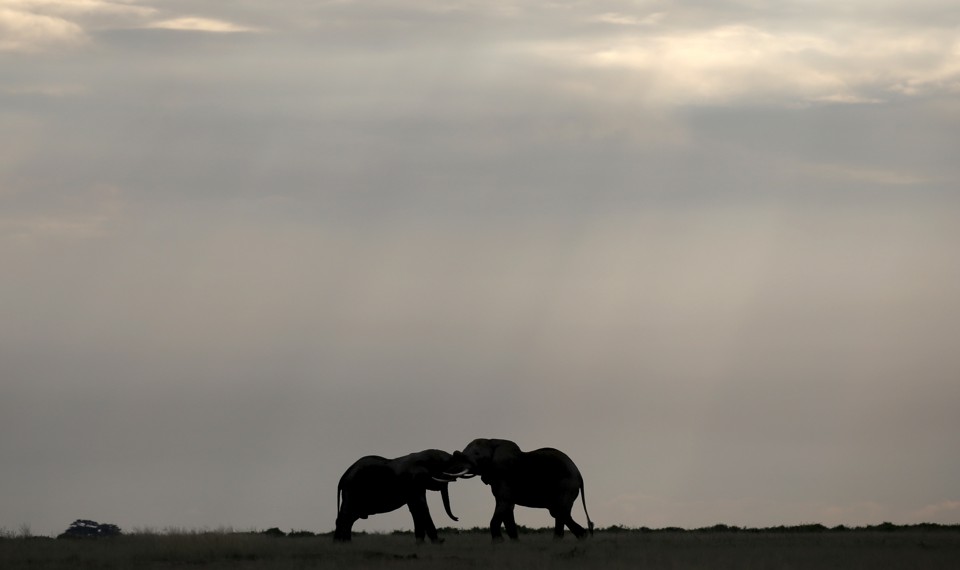





 Exposing the Big Game