Exposing the Big Game

Forget Hunters' Feeble Rationalizations and Trust Your Gut Feelings: Making Sport of Killing Is Not Healthy Human Behavior

Exposing the Big Game

Cecil the lion ‘died in agony’ 10 hours after being shot by hunter, says zoologist

While the world didn’t learn about Cecil the lion until after his death, Andrew Loveridge knew the animal for years. The zoologist had been studying lions around Hwange National Park since 1999. (A. J. Loveridge)

Listen24:59

Read Story Transcript

Cecil the lion died “in agony” 10 hours after he was first shot, says a zoologist who had fitted him with a tracking collar.

The animal’s death made headlines around the world in 2015, after U.S. dentist Walter Palmer shot and killed him, with the help of a local hunting guide.

“We know that Cecil then probably ran away — about 20, 30, 40 metres away — into some bush and survived for the next 10 hours with a devastating arrow wound,” says Andrew Loveridge, who has spent his career studying Cecil and the other lions in the Zimbabwe’s Hwange National Park.

They didn’t bother to go and kill it, to put it out of its misery.– Andrew  Loveridge

Loveridge was able to piece together the lion’s final hours through data from the satellite collar, and testimony from staff at the local hunting camp.

“When we spoke to the hunting tracker, he said that he could hear the animal struggling to breathe,” Loveridge tells The Current’s guest host Liz Hoath.

“So it was obviously close by, and they didn’t bother to go and kill it, to put it out of its misery.”

Loveridge thinks Palmer wanted to claim the kill as a bowhunting trophy. But in order to do that, he says that “he would have to kill it with a bow and arrow, he can’t go and shoot it.”

“I guess they wanted to wait for the animal to die of its initial wound.”

The new claims about the manner in which he died are made in Loveridge’s book Lion Hearted: The Life and Death of Cecil and the Future of Africa’s Iconic Cats, set to be published next week.
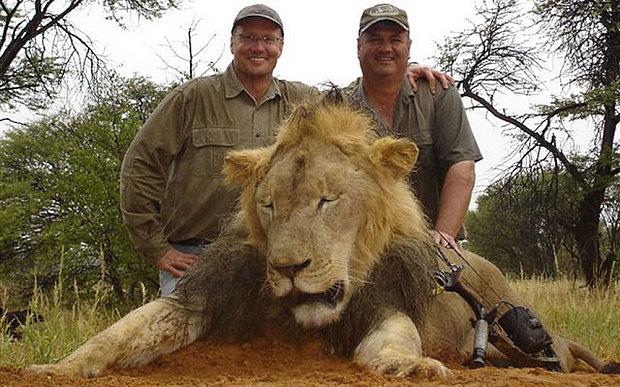
For his part, Palmer issued a statement after the outcry over Cecil’s death, which said, in part: “I had no idea that the lion I took was a known, local favourite, was collared and part of a study until the end of the hunt. I relied on the expertise of my local professional guides to ensure a legal hunt.”

Palmer never faced charges in the incident, and the charges against his local hunting guide, Theo Bronkhorst, were thrown out by a Zimbabwean court.

Andrew Loveridge argues that conservation efforts have to become a global responsibility, not just paid for by African governments. (Simon & Schuster Canada; Regan Arts)

A species under threat

Loveridge says he was accustomed to seeing the lions he studied be killed in trophy hunts. In fact, Cecil was the 42nd male lion in his study group to be killed by hunters.

According to figures from the International Union for Conservation of Nature (IUCN), African lion populations declined by about 43 per cent between 1999 and 2014.

And yet, Loveridge says trophy hunting is not the only, or even the most significant threat to Africa’s lion populations.

The lions live in almost constant tension with local people, who see them a danger to their agricultural livestock, and an impediment to economic development.

Andrew Loveridge says hunting is only part of the reason that lions are endangered. They are losing their habitats, and natural prey, as farms increase in size and number. (A. J. Loveridge)

“We can’t talk about conserving lions, without understanding that African perspective of lions,” says Loveridge.

“Lions are dangerous animals, they kill people’s domestic stock, they sometimes kill people, they kill people’s kids. And people are frightened of them.”

“They have a lot of respect for them — they don’t necessarily want to live with them.”

With the human population in Africa expected to double in the century from 2000 to 2100, according to United Nations estimates, there’s pressure to make sure that the economy can grow, in order to support the people who live there.

But that means the lions’ habitat would invariably shrink.

Habitats will shrink as the human population in Africa grows, bringing lions into greater conflict with farmers. (Jane Hunt)

Global responsibility

Loveridge says much more will need to be done to ensure that wildlife and people can continue to live side-by-side, and that lion populations are preserved.

He says conservation has to become a global responsibility, not just paid for by African governments, which are the least able to devote money to it.

“Western governments could fund conservation in a heartbeat if they wanted to.” says Loveridge.

“It’s a fraction of the defense and development spending that governments spend all the time.”

Listen to the full conversation at the top of this page, where you can also share this article across email, Facebook, Twitter and other platforms.


This segment was produced by The Current’s Alison Masemann.

Big Game Hunter Gets Shot Dead While In Africa Hunting Lions

 http://www.ladbible.com/news/animals-big-game-hunter-gets-shot-dead-while-in-africa-hunting-lions-20180129

A Croatian trophy hunter who’d hunted ‘everything that could be hunted in Europe’ has been shot dead in a freak accident while taking part in a South African hunting expedition.

Pero Jelinic, a 75-year-old hotelier from the Croatian island of Pag, had already killed one lion and was about to shoot another when he was struck and killed by a stray bullet on a remote farm this past Saturday.

Jelinic’s friend Slavko Pernar said Jelinic was a ‘passionate’ hunter who travelled to Africa to land a lion trophy after he found himself seeking a new challenge, the Daily Mail reported.

Credit: Facebook/Pero Jelinic

It is not yet clear who was responsible for firing the shot that killed Jelinic, police said.

Jelinic was shot while he was in the North West province of South Africa, having travelled there with two friends to hunt big cats ‘to complete his extensive trophy collection’.

According to Pernar, a close friend of Jelinic’s and a fellow hunter, Jelinic was particularly keen on claiming the head of a lion ‘to crown his rich hunting career’. For the past year he had even leased his hotel out so he could commit fully to his ambition and enjoy his retirement.

“Pero was a passionate hunter of big and small game, and in search of that he travelled most of the world,” Pernar told Croatia’s Jutarnji List newspaper.

“For the past year he had leased his hotel to dedicated himself to the things he planned to accomplish and enjoyed a deserved retirement.

“He, unfortunately, received the ugliest end – he died in South Africa doing what he loved. His office, a hunting hall, was full of trophies, deer and bear specimens and everything that could be hunted in Croatia and Europe.”

Jelinic was killed at Leeubosch Lodge, a property a four-hour drive from Johannesburg and 40 miles from the border with neighbouring country Botswana.

The property is known for keeping lions in captivity for the sole purpose of their being hunted – a controversial industry known as ‘canned’ lion-hunting.

The owner of Leeubosch Lodge, Dr Gideon Engelbrecht, told News24 that he was not at the farm when Jelinic was shot dead.

‘I was at my surgery when I received the call. I arranged for a helicopter to take the man to hospital, but that’s all I am going to give you at this stage, because the case is still under investigation,’ he said.

South Africa’s ‘canned’ lion-hunting industry, which legally breeds lions in captivity to be killed by hunters, is known for being a lucrative business which is also highly controversial among animal lovers and hunters alike.

Lions at Lion Park in Johannesburg, South Africa. Credit: PA

Hunts in this industry keep lions in a confined space using fences, giving them a zero chance of escape and giving the hunter the best possible chance of claiming his trophy.

In November 2015, the Professional Hunters’ Association of South Africa (PHASA) voted to disassociate itself from canned lion hunting in the country and banned its members from taking part in such expeditions, calling them ‘vanity hunting’.

However, PHASA reversed the ruling last year, a decision which received severe criticism from animal rights groups across the globe.

Police have confirmed that they have opened a case of culpable homicide into Jelinic’s death. They are also investigating charges of illegal possession of a firearm and ammunition.

However, they ‘do not suspect any foul play’ in the shooting and investigations into the death are ongoing.

Featured Image Credit: PA

Ass-backwards Defined: Make good shot with your weapon, then with your camera  

Spend some quality time behind the camera and make the buck of a lifetime into a lifetime memory with a top-drawer photo.

Hunters in the Carolinas who take trophy bucks rarely turn down a trip to the taxidermist, even though a quality mount may cost hundreds of dollars. But few spend time taking capture quality photos of their kills. A shoulder mount over the fireplace will showcase a quality animal, but photographs from the day and place of the kill will better capture the event.

To make a great photographic memory, hunters need to be prepared and have a good digital camera ready in case a lifetime buck ventures into range. While a professional-level camera will take photos of the best quality, the technology available in most consumer-grade digital cameras is more than adequate.

Today’s cell phones do much more than just make and receive calls, and if their cameras shoot more than 5 megapixels, they are a valid option after a trophy buck hits the dirt. The key is to keep the phone/camera perfectly still to take the best shot.

Settings are important, and while hunters can fine-tun the white balance, focus, aperture and shutter speed, the auto functions on cameras and smart phones in most conditions.

If you have a digital camera, a small tripod can be helpful and can be purchased for as little as $20. Also, almost all cameras have a timer feature that can be used in concert with a tripod to take photos of the hunter with his trophy when no help is available.

 The only manual setting that should be adjusted is the flash. Even when sunlight is plentiful and the auto flash indicator didn’t turn on, adding flash can make a good shot fabulous. Adding flash is especially good when the sun is high because shadows can ruin a great shot, and hunters are likely to be wearing a hat or cap ­that will cover his or her face with shadows. A flash eliminates shadows, and during low-light conditions, it provide the light necessary to bring out colors and the fine detail in a crisp, quality photo. 

Beyond equipment, the biggest part of taking a good photo is the setup. The best photos are taken from the woods or in a natural setting where the deer was killed. Too many times, cameras aren’t pulled out until the deer is on the driveway, in the skinning shed or at the gas station where the background is ruined by an assortment of unwanted objects. Don’t let anything in the background take away from the photo.

The person holding the camera should set up several shots of the deer and hunter from different angles while always keeping the sun at the camera’s back. Any time the sun is off to one side or the other, it will cast shadows and can create glare that will ruin a photo. On extremely bright, sunny days, a few shots should be taken in a shaded area with the flash activated. While good sunlight is a positive, too much sun can cause the hunter to squint, and unwanted glare is a risk.

The best photos include the entire hunter and deer with just a little extra space all around. Fill up the frame with the subject; you need to be relatively close to the subject for the camera’s flash and focusing capacities to take effect. You can always crop the photo later.

A lifetime buck doesn’t come into range every day. Hunters should take precautions to take the best possible photos to preserve these special events for a lifetime of memories.

Hunters are livid over Trump’s elephant trophy decision

 https://www.washingtonpost.com/news/animalia/wp/2017/11/20/hunters-are-livid-over-trumps-elephant-trophy-decision/?utm_term=.b95131272568
 November 20 at 5:24 PM

A herd of elephants stands near a water hole in Zimbabwe’s Hwange National Park, east of Harare, in September 2013. Zimbabwean ivory poachers killed more than 80 elephants by poisoning water holes with cyanide that year, endangering one of the world’s biggest herds. (Philimon Bulawayo/Reuters)

President Trump’s announcement that he is delaying a decision on allowing elephant hunting trophies from Zimbabwe drew angry reactions from hunting groups and reignited a heated debate over whether killing iconic animals is the best way to manage their shrinking populations.

Last week, the Trump administration announced it would reverse a ban on trophy imports from Zimbabwe that had been imposed by the Obama administration. Two days later, however, Trump tweeted that elephant hunting is a “horror show” and suggested he would maintain the ban.

Hunters have criticized the decision to delay ending the ban. In voicing their indignation, hunters were careful not to blame the president. Instead, one of the largest and more recognized groups, Safari Club International, issued a call to arms against “hysterical anti-hunters and news media outlets” that “went into overdrive, attacking everyone in sight, including the Trump administration, SCI and even the National Rifle Association of America” after the decision was announced by the U.S. Fish and Wildlife Service last Wednesday.

The Safari Club said the hold is the result of “shrill, negative reactions.” It asked supporters to use its “action center” to call in and tell Trump how much they appreciate the finding that Zimbabwe had enhanced its program to protect elephants, paving the way for allowing trophies of legally hunted elephants to be imported. SCI did not respond to requests for comment.

Mmmm…OK I’ll take it (let’s just shut up and not ask questions on this one guys, ‘K?) https://twitter.com/realdonaldtrump/status/931685146415255552 

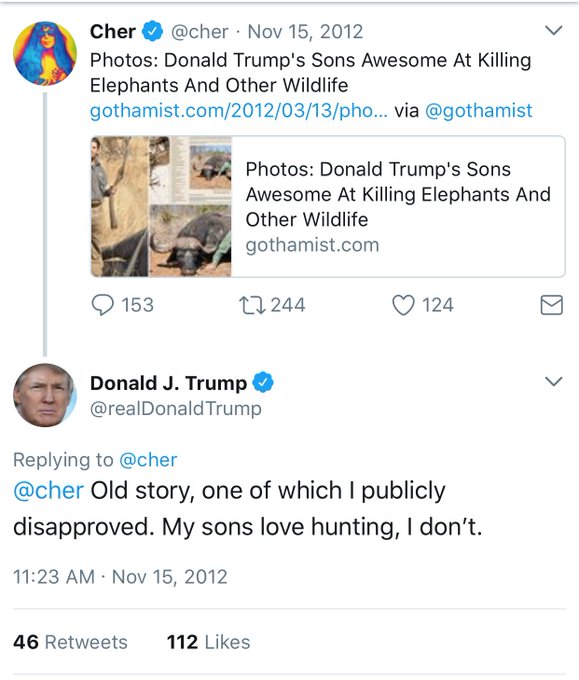
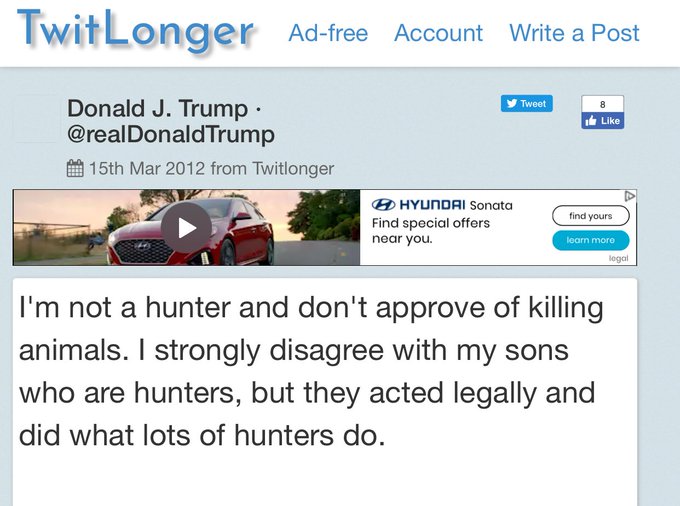
Little known fact about Trump — he actually opposes hunting! Here are his tweets criticizing his kids for big-game hunting in 2012. pic.twitter.com/vdM2X8YrIX

View image on TwitterView image on Twitter

Seventy percent of hunters who pay up to $20,000 for permits to legally harvest elephants are American, according to Campfire, a group in Zimbabwe that manages its elephant hunting program. The program’s revenue dropped from an average of $2 million per year before the ban in 2014 to $1.73 million last year, Charles Jonga, Campfire’s director, said in an email.

Jonga joined hunters in blaming Trump’s decision on others. “This is certainly not about President Trump’s reaction,” he said, “but about animal welfare lobbyists who have nothing to show for their misplaced belief that they can dictate to African rural communities how they should share their living space with wildlife.”

Trump tweeted Friday that he would put off a decision until he could meet with Interior Department Secretary Ryan Zinke. Zinke, an avid hunter and trophy collector, later issued a statement on Interior’s website and tweeted that he agreed with the president.

Put big game trophy decision on hold until such time as I review all conservation facts. Under study for years. Will update soon with Secretary Zinke. Thank you!

During the Obama administration, Fish and Wildlife had questioned Campfire’s management and how much revenue was devoted to the conservation of elephants. Animal rights groups such as the Humane Society International said much of the funding was lost to corruption. The arrest of Zimbabwe’s president, Robert Mugabe, within days of the Trump administration’s favorable finding raised concerns.

Elephant hunting trophies are allowed to be imported to the United States from two other African countries, South Africa and Namibia. Another country, Zambia, was given the green light by the Fish and Wildlife Service last week. The current controversy focuses on the import of trophies from Zimbabwe.

On Monday, two environmental groups sued the Trump administration over the move to end the ban, which they called contrary to the slow and deliberate process called for under the Endangered Species Act, which lists African elephants as threatened.

“Trump’s abrupt backpedaling after public outcry, while appreciated, shows how arbitrary this deplorable decision was,” Tanya Sanerib, a senior attorney with the Center for Biological Diversity, said in a statement. “These incredibly imperiled creatures need a lot more than vague promises.”

The Center for Biological Diversity and Natural Resources Defense Council drew on Zimbabwe’s troubles in the announcement of their lawsuit, filed at the U.S. District Court for the District of Columbia. To arrive at an enhanced finding that elephant herds are well managed, Fish and Wildlife must rely on “Zimbabwe having the plans, resources, funds, and staff to conserve elephant and lion populations.”

“But . . . corruption is already a huge concern” due to the ouster of Mugabe. Also, the groups noted, “Zimbabwe scored an abysmal 22 out of 100 on Transparency International’s 2016 Corruption Perception Index.

“Poaching elephants for their ivory remains a significant threat in Zimbabwe. According to aerial surveys — known as the Great Elephant Census — Zimbabwe’s elephant population decreased 6 percent between 2001 and 2013, when the aerial surveys were performed.” They went on to point out that controversies over animal killing often arise in Zimbabwe, where Cecil the Lion was illegally tracked, shot with an arrow and killed by an American hunter.

Elly Pepper, deputy director of a wildlife trade initiative and program at NRDC, called Trump’s announcement a pleasant surprise but said he needs to do more. “These tweets are still really ambiguous,” she said. “And tweets don’t have any legal authority. We want to make sure that the administration doesn’t have its cake and eat too. We want to ensure they aren’t going to quietly start issuing trophy permits and enjoy public support because their tweets indicated they oppose trophy hunting.”

Wayne Pacelle, president and chief executive of the Humane Society of the United States, said his organization plans to work with Trump without taking legal action. But Pacelle questioned the idea of killing elephants to conserve them.

“Botswana disallowed all trophy hunting, and Botswana has more elephants by a long shot than every other country,” Pacelle said. “It’s recognized that this would damage the brand of the nation. Trophy hunting subtracts animals from nature. It diminishes the value of animal populations.”

During the controversy in 2015 over allowing a rhinoceros hunter to import the trophy head of a rhinoceros he planned to kill in Namibia, the International Union for the Conservation of Nature said concern over the act confused illegal poaching with well-managed hunting tourism.

“Well-managed trophy hunting has little to do with poaching, and indeed can be a key tool to help combat it,” the union said in a statement. Without it, African conservationists “would not be able to employ the upwards of 3,000 field rangers employed to protect wildlife and enforce regulations.” Namibia’s conservation is viewed by Fish and Wildlife as one of most responsible such programs in Africa.

Pacelle dismissed this type of argument. Hunters never say “we want to trophy hunt because we want to mount the head,” Pacelle said. “They always apply something to it. They could just give the money for conservation. But they want something out of it.”

In a year that saw the Ringling Bros. Circus fold after a century and a half following an outcry over its treatment of animals, the nation is experiencing a major shift in tolerance, according to Pacelle.

“That was a marker of how our attitudes have evolved toward elephants. We don’t want to see anyone chain them and have them perform silly stunts,” he said. “It’s worse to shoot them in the head.”

Read More

Animal activists finally have something to applaud at Ringling Bros.: Its closure

Before elephants, Trump loosened limits on lion trophies

Lions are raised to be shot in South Africa. American hunters love it.

Hunting is down in the US. The Trump administration wants to change that

http://www.cnn.com/2017/09/22/politics/hunters-ryan-zinke-interior/index.html

STORY HIGHLIGHTS

  • There are 2.2 million fewer hunters in America now than in 2011
  • Zinke was recommended by Donald Trump Jr., an avid hunter
  • Last week Zinke issued a new secretarial order designed to increase access to various public lands for hunters and fishers

Washington (CNN)Toy gun grasped firmly in his hand and a grin plastered wide across his face while he played “Big Buck Hunter Pro,” Ryan Zinke could have been a kid at an arcade. But the Interior secretary and former congressman was actually in the department cafeteria showing off the arcade game installed to commemorate hunting season.

“To highlight #sportsmen contributions 2 conservation I installed Big Buck Hunter in the employee cafeteria. Get excited for #hunting season!” Zinke tweeted from his personal account Tuesday.
But Zinke is not toying around when it comes to his support of hunters and fishers.
Hunting in the United States is down. A US Fish and Wildlife Service survey released last week found that there are 2.2 million fewer hunters in America now than in 2011. And the new administration is poised to change that.
On his first day in office back in March, Zinke issued two orders, one which overturned a recent ban of lead ammunition and fish tackle on Fish and Wildlife Service lands and waters. Last week Zinke issued another secretarial order designed to increase access to various public lands for hunters and fishers.
Zinke’s passion for expanding hunting rights on public lands is both personal and political. A Montanan, the secretary has been known to hunt in his spare time. During his short stint in Congress, he was a member of the Congressional Sportsmen’s Foundation. He was spotted attending their annual dinner last Wednesday, a source told CNN, just two days before he issued the most recent secretarial order.
“What really kind of expedited this whole thing, was last week the US Fish and Wildlife put out a survey saying that hundreds of Americans were enjoying the outdoors, but within that survey they found that hunting was down,” Heather Swift, Interior spokesperson said when asked about last week’s secretarial order. “And the big thing that the secretary hears over and over again is that people just don’t have access to land.”
Politically Zinke also owes a lot to hunting, angler and conservation lobbyists who were largely responsible for supporting him for the position of Interior Secretary earlier this year. The issue was especially important to Donald Trump’s son Don Jr., an avid hunter and active member of the Boone and Crocket Club, who helped with the search for Interior secretary.
“Mr. Zinke was the pick of the litter, not the best litter ever, but he was definitely the pick and that’s why we advocated for him and that’s why Jr. advocated for him as well,” said Land Tawney, the president of the Montana-based Backcountry Hunters & Anglers, a non-profit sportsmen’s organization.
Zinke and the Interior have recently made a big show of their support of hunting groups. In addition to the “Buck Hunter” game he gifted Interior employees, the department declared Thursday that October would be National Hunting and Fishing Month.
The declaration also generated the support of the National Rifle Association.
“Hunters, anglers, and target shooters are the best conservationists who contribute so much through the Pittman-Robertson and Dingell-Johnson Acts,” said Richard Childress, NRA vice president. “Last year, they contributed $1.2 billion toward conservation and protecting our natural resources. We need more mentors taking young people out and teaching them to hunt and fish, so I’m glad Secretary Zinke is promoting hunting and fishing at the federal level.”
But despite Zinke’s clear efforts to woo hunters and anglers, not all of his decisions have gone over well with the conservationist-minded group. For example, Zinke’s leaked recommendationsto the White House to shrink the boundaries of national monuments and open up some of the land to the fossil fuel industry and loggers — first reported Sunday by the Wall Street Journal — were met with opposition and confusion.
“With what’s leaked it’s super troubling. Any reduction on these monuments is an attack on the Antiquities Act,” said Tawney. “All monuments are at risk now. They can become political footballs in our eyes.”
Conservationists who want to expand their access to hunting on public park lands and at monuments are as weary of opening up national park land to fossil fuel industries as environmentalists are, since both value sustaining the land as is.
“We can have all the access we want to a concrete parking lot, but that access doesn’t mean anything if that fish and wildlife habitat isn’t there,” said Tawney.
Another pro-hunting group says what they are seeing within Interior is a fight between access and conservation.
“On the access front the department has been good. Access to our own public lands is a lot harder today than it ever has been, and that is in part introduced with the decline in hunting numbers we’ve seen,” said Whit Fosburgh, president and CEO of the Theodore Roosevelt Conservation Partnership, a non-profit coalition of conservation organizations and outdoor related businesses.
“On the conservation side however, I think it’s a much less rosy picture,” Fosburgh said. “It’s been a lot more about expanding development, opening up to oil and gas. There has been no proactive conservation vision espoused for our public lands.”
Fosburgh said that the hunting community started getting “a little bit critical” of Zinke after he first announced the National Monument Review earlier this year. And he’s skeptical of just how far the secretarial order will go.
“They use hunting and fishing for an excuse for our changes in monuments,” he said. “All of the ones under review already allow hunting and fishing very clearly.”
Fosberg’s criticism is similar to what environmental groups said following the secretarial order last week.
“Don’t be fooled: the Trump Administration is pretending to be granting hunting and fishing rights that are already guaranteed by law and policy,” said a statement from the Center for American Progress, a left-leaning thing tank. “The real story is that, with this announcement, the Trump administration is trying to create a distraction from their plans to dramatically reduce the size of America’s national monuments, which would be the largest elimination of protections on wildlife habitat in US history.”
Nevertheless, Fosburgh said most pro-hunting and conservation minded groups are still hoping for the best with the Trump administration.
“We’re very prepared, and we have been from day one. We supported his nomination and we are prepared to work with Secretary Zinke,” he said. “We’re not going to just say it’s a lost cause in September of the first year of the administration.”

BC Govt Plans a New Independent Wildlife Agency Managed by Guide Outfitters, Trophy Hunters, Trappers

Valhalla Wilderness Society

Box 329, New Denver, British Columbia, Canada V0G 1S0
Phone: (250) 358-2333, Fax: (250) 358-2748, E-mail: vws@vws.org, Web: http://www.vws.org

18 May 2017
Call for action

BC Government wants to establish a new independent wildlife agency managed by hunters, trappers and guide outfitters Valhalla Wilderness Society was appalled when the BC government announced in late March that it intends to establish a new independent wildlife agency (https://news.gov.bc.ca/releases/2017FLNR0037-000783 ) “as part of its long-standing commitment to healthy wildlife populations.” The proposed “independent” agency is a thinly disguised attempt by the BC government to privatize wildlife management. Equally concerning and outrageous is that this agency was cooked up with at least the following 5 organizations, the BC Wildlife Federation, the BC Guide Outfitters Association, the BC Trappers Association, the Wild Sheep Society of BC and the Wildlife Stewardship Council with whom the BC government has signed a memorandum of understanding (MOU). These organizations whose members include hunters, trappers and guide outfitters who guide (trophy) hunters fully support the proposed agency whose mandate appears ironically to be “the growth of wildlife in British Columbia.”

At the announcement, Bill Bennett, then MLA East Kootenay and Minister of Mines and Energy,
explained the need for a new agency as follows: “Government is afraid to manage wolves, for example,are afraid to manage grizzly bears in some cases because of the politics of that. Hopefully, an agency that is separate from government can make decisions that are in the best long-term interest of wildlife and just forget about the politics and do what is best for the animals.”

http://www.summit107.com/news/east-kootenay-news/new-independent-wildlife-group-to-takeover-

bc-government-operations/. Bill Bennett has left BC enough of a devastating legacy with the
Mount Polley mine tailing pond failure which continues to pollute Quesnel Lake.
2
The past president of the BC Wildlife Federation welcomed the announcement of the proposed agency by stating: “I think it’ll put more positive aspect into managing wildlife and getting away from the precautionary principles and get back to real numbers and managing wildlife the way it should be.” The government press release reports that the proposed agency will be funded with start-up funds of $5 million but “subsequently would be supported by hunting licence revenues of $9 million to $10 million each year.”
Valhalla Wilderness Society calls on all members to express their opposition to this outrageous scheme to not only privatize wildlife management in BC but to place it in the hands of hunters, trappers and guide outfitters. Notwithstanding the poor job the BC government has been doing in terms of “growing wildlife”, wildlife should be managed by government. The above-mentioned special interest groups lack the technical expertise to make wildlife decisions based on scientific evidence and are even unwilling to apply the precautionary principle, which- in the face of climate change -, is needed more than ever. The proposed agency can not be held accountable to the public like an elected government, especially as agency members will no doubt be gagged by mandatory confidentiality agreements. Nor can it be bound by the domestic and international legal obligations, such as the Canada-BC Species at Risk Agreement, that bind the Province directly or indirectly through the federal government`s signing of international legal treaties.
The proposed agency does not represent the majority of British Columbians and the fake “public
consultation” process that the BC government has set aside $200,000 for when the mandate,
stakeholders and funding have already been decided is an utter waste of tax payers’ money. Wild
management should not be reduced to the management of species which hunters, trappers and guide outfitters’ clients like to kill: a broad ecosystem approach is needed to ensure that BC’s “wildlife grows” and their habitat is protected. Last but not least, funding for wildlife management should not be contingent on hunting license revenue or on other funding from special interest groups. Please take the time to email John Horgan, leader of the NDP, Andrew Weaver, leader of the BC Green Party, and Christy Clark, leader of the BC Liberals, demanding that:
 this proposed agency be shelved and the MOU terminated with immediate effect. Wildlife
management must remain the responsibility of the BC government;
 all wildlife management decisions by government must be made on the basis of scientific evidence guided by the precautionary principle and on a broad ecosystem level, which would automatically remove politics from the decision-making process the $200,000 set aside for so-called “public” consultation on this proposed agency whose establishment has been set in motion by special interest groups be used for restoration of mountain caribou habitat;
documents and meeting minutes with the above-mentioned organizations and others involved in
the establishment of this proposed agency be immediately released to the public.

Contact details:
John Horgan, NDP Party leader
Room 201, Parliament Buildings
Victoria, BC, V8V 1X4
Tel: 250 387-3655
Email: oppositionleader@leg.bc.ca
Andrew Weaver, Green Party leader and MLA
Room 027C, Parliament Buildings
Victoria, BC, V8V 1X4
Tel: 250-387-8347
Email: andrew.weaver.mla@leg.bc.ca
Christy Clark, BC Liberal leader
Parliament Buildings
Victoria, BC, V8V 1X4
Tel: 250-387-1715
Email: Christy.clark.mla@leg.bc.ca

Donald Trump Jr. taps hunting pal for Interior liaison


President Donald Trump’s eldest son is an avid hunter and played a key role in picking Interior Secretary Ryan Zinke, who is also a hunter and fisherman. And now Donald Trump Jr. has asked Jason Hairston, a former San Francisco 49ers linebacker and founder of hunting gear company Kuiu, to serve as a liaison among himself, Zinke, sportsmen’s groups and the White House on conservation and public lands issues, Hairston said on Thursday.

“I’m absolutely going to take the position,” Hairston told POLITICO, but the job won’t come with a salary, and he plans on staying in California where he lives and managing his business.

But an official with the Interior Department said there had “been no discussion of creating of a new role like this” and White House deputy press secretary Stephanie Grisham said in an email there were no new personnel announcements.

Hairston said Donald Trump Jr. had hoped to play the liaison role between Interior and the White House himself, but his decision to stick with running his father’s business empire with his brother, Eric Trump, put a kink in that plan.

“It’s really a role he was hoping to fill, but he can’t because of conflict of interest,” Hairston said.

Hairston and Donald Trump Jr. have been hunting buddies for at least two years — and Donald Trump Jr. tweeted out his congratulations last year after Hairston’s company was featured in a Bloomberg news article. The two have tracked game together in mountain ranges in the West and Canada, and Hairston helped to organize meetings between sportsman groups and Donald Trump during his campaign, including a February 2016 gathering in Las Vegas, Hairston said.

The president “knows that it’s not just a sport, that it really is something that’s more meaningful to hunters and how important wildlife and conservation are because of everything Don and Eric have experienced and shared with him,” Hairston said. “So he’s not just pacifying his kids over this. He understands it and gets it.”

Outdoor recreation groups have recently stepped up their fight against efforts by some Western Republican lawmakers to force the Interior Department to transfer more of the vast amounts of public lands it controls in the West to states — a move the groups say would cut them off from prime hunting and fishing ground. And having Hairston as their advocate would give them a direct line to the White House.

While he said his position hasn’t been given a formal starting day, Hairston said he has “already started with the work on it,” including “meeting with different organizations to determine what challenges and issues we’re facing and really just what we should be working on — what’s important.”

Hairston has met with Zinke twice: once before Zinke was confirmed as secretary and again on March 7 when Hairston traveled to Washington and talked with the heads of conservation and hunting organizations. Those included the National Rifle Association, Theodore Roosevelt Conservation Partnership, National Shooting Sports Foundation and Safari Club International.

Guide outfitter says he paid heavy financial and personal price for wildlife charges in B.C. and Yukon

http://vancouversun.com/news/local-news/guide-outfitter-says-he-paid-heavy
financial-and-personal-price-for-wildlife-charges-in-b-c-and-yukon

A big-game guide outfitter and trophy hunter who faced a litany of charges
in B.C. and Yukon says he paid a high financial and personal price over the
years.

“The biggest impact for me is what you guys wrote, “Abe Dougan of Big Boar
Outfitters said of the media. “Obviously, when I’m trying to get business,
it’s pretty hard not to find that on the Internet.

“I just want it to be done. I’ve got kids, right, and a wife and stuff.
People can say what they want about me, but it’s not fair to them.”

He added of game officers: “It’s personal with some of these guys against
me, in case you haven’t gathered that already. I don’t know why because I
don’t know any of them and haven’t done anything to them. Whatever, it is
what it is.”

Dougan pleaded guilty to wildlife offences in Yukon, had more Yukon charges
dropped due to the Crown taking too long to bring the case to trial and,
more recently, received a stay of proceedings on Wildlife Act charges in
Williams Lake.

He lives in Kamloops, but has guided in the Lower Mainland in the Pitt
and Stave lake areas. He caters to out-of-province trophy hunters wanting to
kill large black bears.

In the latest development, the Crown stayed three Wildlife Act charges
against Dougan last October in Williams Lake provincial court, a decision
that went unreported until now.

The charges related to a December 2013 guided cougar hunt that occurred
between 100 Mile House and Williams Lake, and included:

. hunting game within six hours after being airborne in an aircraft that is
not a regularly scheduled commercial aircraft
. unlawful possession of dead wildlife
. failure to accompany the person they were guiding

“They dropped them because there was never really any case,” Dougan said.
“It was total bull-t, to be honest with you. They drug it out as long as
they could, so you guys could write as much as you could about it.”

Dan McLaughlin, counsel with the Criminal Justice Branch, said the decision
to stay the charges against Dougan was made after “further information was
received by the prosecutor with conduct of the file. After reviewing this
information and the rest of the file materials the prosecutor concluded the
charge approval standard could no longer be met.”

Dougan also faced four counts in connection with the illegal shooting of a
Dall mountain sheep in Yukon in August 1999. The charges were laid in
September 2012 and the trial started in December 2013, consuming a total of
17 days of court time. A provincial court judge entered a stay of
proceedings in October 2015 because the case had taken too long. Dougan had
a permit to kill the sheep in northern B.C., but the judge concluded he shot
it just across the border in Yukon, a straight-line distance of 18
kilometres from the B.C. border.

As a hunting guide, Dougan was fined $15,000 and banned from hunting and
guiding in Yukon for 20 years after pleading guilty in August 2014 to
wasting meat and hunting too soon after exiting a plane in 2011. Convictions
in another jurisdiction do not cause outfitters to automatically lose their
licences in B.C.

Dougan suggests he plead guilty out of practicality. “Some things are for
financial reasons, whether they’re right or wrong. I’m not a rich man.”

The Ministry of Forests, Lands, and Natural Resource Operations, said in a
written statement that Dougan had a territory in the South Coast region, but
sold three quarters of it “a few years ago and has not guided in the area
since then.”
431125_10150547334526188_1114807436_n

Donald Trump Jr. visits Turkey in hunting trip, kills goats

http://www.dailysabah.com/nation/2016/11/30/donald-trump-jr-visits-turkey-in-hunting-trip-kills-goats

While his father is engaged in headhunting for his cabinet, Donald Trump Jr. tackled some real trophies in a surprise and secretive hunting trip in Turkey.

The 38-year-old Donald John Trump Jr., son of real estate tycoon turned president-elect of the United States, Donald Trump, was in the southern Turkish resort of Antalya to hunt wild goats, the Doğan News Agency reported.

The younger Trump hunted two goats in the Oluklu plateau of Antalya on Sunday. Trump Jr. arrived in Antalya with five bodyguards after securing a hunting permit from Turkish authorities.

He spent two nights camped out in the mountainous area before leaving on Tuesday back to Germany, where he was staying before the trip.

Donald Trump Jr. is known for his penchant for hunting, drawing the criticism of animal rights activists in the past, especially for his involvement in big-game hunting.

In 2012, younger Trump was slammed by critics when photos showing him with a knife in one hand and holding the tail of a dead elephant surfaced online.

In another photo dating back to 2012, Donald Trump Jr. was seen with his brother Eric beside a dead crocodile hanging from a noose off a tree.

A photo of the duo holding a dead leopard added to the furor of activists although Donald Trump Jr. has never been shy of his enthusiasm for hunting.

In an interview with a website on hunting, he has said he learned hunting from his maternal grandfather in Czechoslovakia and preferred bow hunting.

Previous reports by Turkish media outlets stated that it was Eric Trump who visited Turkey for ann hunting trip, and killed two wild deers.

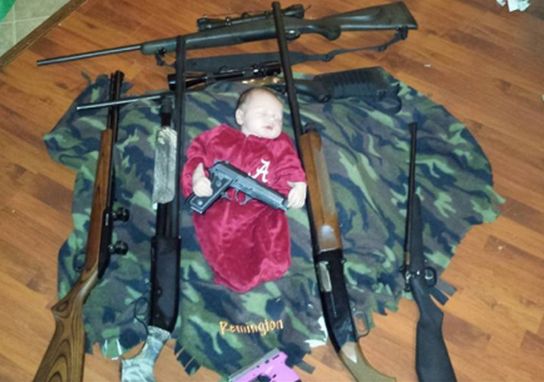
baby-guns-1