Safari Club International has some 50,000 members, 150 chapters and collects $3.17 million in membership dues each year. It raises another 7 million from their annual convention. But what is truly despicable about this organization is that it encourages slaughter through awards.
SCI’s record book system ranks the biggest tusks, horns, antlers, skulls and bodies of hunted animals. Hunter…s are rewarded with trophies for completing a “Grand Slam”. There are 15 “Grand Slams”. The ones that cover Africa are:
1. “The African Big Five Club” African lion, African leopard, African elephant, African buffalo and an African rhinoceros.
2. “Dangerous Game of Africa” requires a minimum of five from the African lion, African leopard, African elephant, African rhinoceros, African buffalo, hippopotamus and Nile crocodile.
3. “African 29” African lion, leopard, elephant, rhinoceros, buffalo, and a small cat, eland, bongo,kudu, nyala, sitatunga, bushbuck, sable antelope, roan antelope, oryx/gemsbok, waterbuck,lechwe, kob or puku, reedbuck or rhebok, wildebeest, hartebeest, mamalisc, impala, gazelle, pygmy antelope, springbok, dik-dik, bush duiker, forest duiker, nubian ibex, aoudad, hippopotamus, and wild pig.
4. “Cats of the World” minimum of four of: lion, leopard, cheetah, jaguar, cougar, lynx, cougar or puma, serval, carcal, African golden cat or bobcat.
There are dozens of other reward categories where members can buy special gold and bejewelled pins for the number of kills they rack up.
There is also the “Global Hunting Award” that requires the killer to have hunted 6 continents to receive a diamond award, a minimum of 17 native in Africa, 13 native or introduced in North America, 4 native or introduced in South America, 6 native or introduced in Europe, 6 native to Asia and 4 introduced in the South Pacific, for a total of 50 animals.
There is the “Hunting Achievement Award” that requires a minimum of 125 animals, or 60 if hunting with a bow.
And for women they have the “Diana Award”, given to women who “have excelled in international big game hunting”.
And finally there is the obscenely named “World Conservation & Hunting Award” given to hunters who have killed on six continents and have killed more than 300 species. This “esteemed” award goes to the killer who has taken all 14 “Grand Slams”, the 23 “Inner Circles”, “Pinnacle of Achievement” (fourth) and the “Crowning Achievement Award”.
It is this award system that is driving thousands of wealthy primarily white men and a few women to spend millions of dollars stalking animals around the world for the sole purpose of killing the in the name of vanity and self-glorification.
Spokesperson Jeff Ramsay reported, “It is our stern belief that safari hunting of threatened species such as lions has the potential to undermine our regional anti-poaching efforts as it encourages illegal trade which in turn promotes poaching. To this end, individuals partaking in such sport hunting expeditions will not be welcome in Botswana.”
Just last week, Zimbabwe officials released a statement calling for Palmer’s extradition back to the southern African nation to answer for his crime. There has been much discussion on how nations which are home to these hunted species are cracking down on what is called “canned hunting,” or exporting wild animals to other countries to be hunted down for sport, and Botswana is proud to stand against such activities. Let’s count this as a win for endangered animals’ rights and conservation of our precious wildlife parks.
My faith in humanity is refreshed; my hope has been rekindled.
As a wildlife photographer I know where my tourist dollars are going someday. (There’s nothing worse than spending time getting figuratively close to an animal only to learn that they ended up on some psycho dentist’s or gynecologist’s office or trophy room wall.)
It’s refreshing to be among a majority who care and feel that the laws are on the side of goodness again.
My hope for humanity has been rekindled; my faith in the future has been refreshed…
“Hunting of lions, leopards and elephants in areas outside of Hwange National Park has been suspended with immediate effect” [That protect 3 species in some areas, but falls short of an outright ban on trophy hunting.]
“He added big game hunters would only be allowed if “authorised in writing by the Director-General of the Zimbabwe Parks and Wildlife Management Authority”. [Again, this leaves the door open for interpretation and corruption…]
It’s definitely better than nothing, but to see what an all out ban looks like, Zimbabwe would have only to look the example set by their neighbor, Botswana:
Botswana confirms ban on trophy hunting in wake of Cecil the Lion’s death
In this 2008 file photo, a lion’s head and skin from an African safari expedition are seen in the Explorers Club’s trophy room. The head and skin were donated to the New York club by former president Theodore Roosevelt. (Kathy Willens/AP)
Hunters and others looking to ship lion, leopard, elephant, rhinoceros and buffalo heads and other big-game trophies across the world still have options available, even as Delta Air Lines, American Airlines and Air Canada announced this week that they will no longer allow such cargo on their planes.
Shipments of hunting trophies are still allowed by United Parcel Service, a UPS spokeswoman told The Washington Post on Tuesday, noting that the global shipping giant follows U.S. and international laws, not public opinion, in determining what it will and won’t ship.
“There are many items shipped in international commerce that may spark controversy,” UPS public relations director Susan Rosenberg wrote in an e-mail. “The views on what is appropriate for shipment are as varied as the audiences that hold these views.
“UPS takes many factors under consideration in establishing its shipping policies, including the legality of the contents and additional procedures required to ensure compliance. We avoid making judgments on the appropriateness of the contents. All shipments must comply with all laws, including any relevant documentation from the shipper required in the origin and destination location of the shipments.”
Although FedEx doesn’t ship animal carcasses, the company “may accept legitimate shipments of parts for taxidermy purposes if they meet our shipping guidelines,” a spokesman said in an e-mail to The Post.
“These are legitimate shipments, not shipments that are illegally obtained,” spokesman Jim McCluskey wrote Tuesday. “Our priority is to ensure we abide by laws and regulations for all shipments.”
The policies of airlines and shipping companies are drawing extra attention and scrutiny following the death of one of Africa’s most iconic lions, which was killed in a hunt this summer.
That lion, known as Cecil, was killed in Zimbabwe by an American big-game hunter, an act that has sparked international outrage. Walter Palmer, a Minnesota dentist, has said he had “no idea that the lion I took was a known, local favorite.”
Lay Cecil the Lion to Rest on the White House Lawn
By Marc Ash, Reader Supported News
02 August 15
Blame for the death of Cecil the Lion lies squarely with the U.S.
government. For decades, the White House and its conservation agencies have
turned a blind eye to the well-being of wildlife in North America and
around the world. Even in the face of overwhelming evidence that inaction
would lead to their endangerment and often extinction.
*The Fish and Wildlife Service Is Investigating*
From Laury Parramore, damage control specialist, U.S. Fish and Wildlife
Service: “The U.S. Fish and Wildlife Service is investigating the
circumstances surrounding the killing of Cecil the Lion.”
In searching for the truth, the Fish and Wildlife Service might well
investigate itself. As recently as October 2014, the FWS *rejected
< https://firstforhunters.wordpress.com/2014/10/27/fws-rejects-attempts-to-stop-lion-hunting/>*
Endangered
Species status for African lions, saying that sport-hunting was “not found
to be a threat to the species at this time.” The Safari Club International
(SCI) was ecstatic. Their headline called the ruling a “Major Setback for
Anti-Hunting Efforts!”
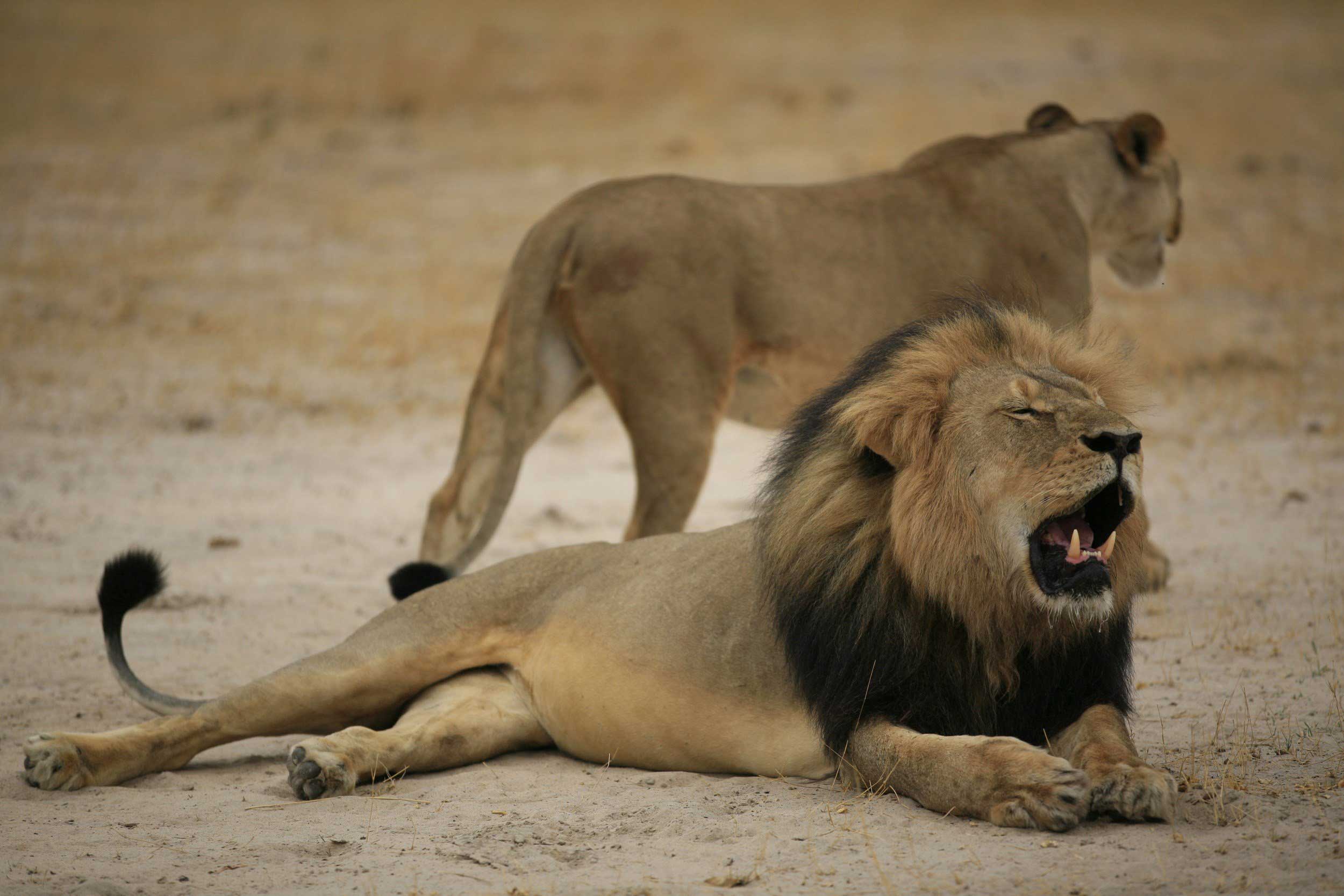
Cecil the lion is shown in a handout photo taken Oct. 21, 2012, and released
on July 28, 2015, by the Zimbabwe National Parks agency. (AFP/GETTY IMAGES)
Ronald Orenstein is a Canadian zoologist, author, lawyer and wildlife
conservationist. He is the author of Ivory, Horn and Blood: Behind the
Elephant and Rhinoceros Poaching Crisis.
The death of Cecil the lion has shocked and angered people around the world.
It should. But perhaps the most shocking thing about his killing at the
hands of a selfish American hunter and his guides is that there may have
been nothing unusual about it. Zimbabwe’s government may have created the
situation that led to Cecil’s death.
Hwange National Park is ringed with private landholdings where hunting is
legal, though the land where Cecil was killed did not have an assigned quota
for lions. Luring Cecil out of Hwange has been called “unethical” by the
Safari Operators Association of Zimbabwe, and the Zimbabwe Parks and
Wildlife Act makes it illegal to “entice” an animal out of a national park
without a permit. However, a 2007 study found that 24 lions radio-collared
in Hwange were shot by sport hunters between 1999 and 2004. Further
killings have been alleged since. The difference this time is that Cecil was
famous.
Zimbabwe has been treating its wildlife as a commodity for years. Though the
kills have decreased recently, its hunting quotas for lions, among the
highest in Africa, have been called unsustainable by lion biologists. Lions
as young as two years old have been shot for trophies, despite
recommendations that only animals at least five years old should be hunted
to give young males a chance to reproduce.
In early July, despite protests from around the world (and arguably
violating its own laws against animal cruelty), Zimbabwe exported 24 baby
elephants from Hwange to a dubious safari park in China, claiming that the
move relieved elephant overpopulation. Zimbabwe’s Environment Minister at
the time, Saviour Kasukuwere, said that “it made commercial sense” to send
the country’s wildlife to China. The Zimbabwe Independent cited claims that
the money went to pay a shoe manufacturer for boots for the military.
Hunters argue that the fees they pay for the right to shoot a lion can
benefit conservation and alleviate rural poverty. Conservation is certainly
expensive, and money helps – though tourism revenue exceeds hunting revenue
in many African countries, and a 2010 study, published by the pro-hunting
International Council for Game and Wildlife Conservation and the United
Nations Food and Agriculture Organization, found that hunting companies in
Tanzania contributed only about 3 per cent of their revenues to local
communities.
When a hunter is willing to pay tens of thousands of dollars into a corrupt
system, the benefits can be hard to find. Zimbabwean blogger Alex Magaisa
claims that there is “a huge amount of corruption and skullduggery” in
Zimbabwe’s hunting industry, and warns that there will be “more Cecils in
future.” The enormous prices hunters pay tempt operators to give clients
what they want, and fund the bribes needed to get it. When hunting quotas
are based on the industry’s bottom line, and the rules that exist are
ignored, trophy hunting becomes little more than organized, legalized
poaching, and the hunters’ targets little more than contraband.
African lions have been in serious decline for years. Numbering an estimated
75,800 in 1980, a combination of human population growth, habitat loss,
disease and hunting pressure has reduced their number to no more than 32,000
today (and possibly a good deal less). It is a decline that has gone largely
unrecognized. A 2011 petition to list the African lion under the U.S.
Endangered Species Act – a listing that would require the United States to
prohibit trophy imports unless they can be shown to benefit conservation –
still awaits action.
The revulsion at Cecil’s death may have been, in part, because he was an
animal with a name. I hope, nonetheless, that it leads countries like the
United States, the biggest importer of lion trophies, to take a closer, and
tougher, look at “sustainable” wildlife management, and to clamp down on
trophy imports that threaten the survival of Cecil’s nameless kin. If they
do, perhaps Cecil will not have died entirely in vain.
By SCOTT MAYEROWITZ, AP Airlines WriterPublished: Aug 4, 2015
NEW YORK (AP) – The big three U.S. airlines have all this week banned the shipment of hunting trophies, although it is unclear how many – if any – they have been carrying in recent years.
Delta Air Lines was the first to announce the change Monday, saying that it would no longer accept lion, leopard, elephant, rhinoceros and buffalo trophies. American Airlines and United Airlines soon followed.
American spokesman Ross Feinstein said it’s largely symbolic because his airline does not serve Africa. United, which only has one flight to Africa, also announced Monday afternoon its own restriction. United said its records indicate no shipments of these types of trophies in the past.
The moves come after an American dentist killed a well-known lion named Cecil in Zimbabwe last month in an allegedly illegal hunt, setting off a worldwide uproar. The dentist, Walter James Palmer, lives in Minnesota, which is a major hub for Delta.
As recently as May, Atlanta-based Delta had said that it would continue to allow such shipments – as long as they were legal. At the time, some international carriers prohibited such cargo.
Delta has the most flights of any U.S. airline to Africa. Several foreign airlines announced similar bans last week.
Delta would not answer questions from The Associated Press about why the decision was made now and how many hunting trophies it has shipped in recent years. The company only issued a 58-word statement noting that prior to Monday’s ban, “Delta’s strict acceptance policy called for absolute compliance with all government regulations regarding protected species.”
Henry Harteveldt, a travel industry consultant, noted that the airline was probably responding to pressure following the news of Cecil’s killing. The airline was the subject of a petition on change.org to ban such shipments.
“I don’t think there was much of this shipment taking place, so there is minimal revenue loss and big PR gain for them,” he said.
Breaking News: Today, both Delta and United – the biggest U.S. based carriers to Africa – announced new policies that ban transport of trophies from lions, elephants, rhinos, leopards, and buffalo – the “Africa Big Five.” These announcements come in response to the global furor of the illegal killing of Cecil, and will put pressure on foreign-based carriers that serve major African cities to stop their carrying of trophies from these species.
Dr. Walter Palmer’s behavior in killing and mutilating Cecil the lion is disgraceful. But he’s not a one-off character. He’s a very enthusiastic participant in the larger enterprise of globe-trotting international trophy hunting, where rich trophy hunters seek out and kill some of the largest animals in the world to fill their dens or private museums, get their names in the record books of Safari Club International, and brag to their buddies that they’ve killed the biggest and the grandest of creatures on earth.
Now, sure as shooting, a second low-life character has come to light – Jan C. Seski, a gynecologist from Pittsburgh – for a possible illegal lion killing under similar circumstances in April. In addition to the lion he killed, Dr. Seski also shot his sixth elephant on that trip. (He apparently threatened to shoot his neighbor’s dogs too – as if any of us needed more evidence that this guy, too, is a heartless thug.)
Seriously, what is wrong with these people? Why are they obsessed with killing the world’s biggest, most magnificent animals, and denying the rest of us the pleasure of sharing the earth with these creatures? What is it about the serial killing of animals that titillates them so much?
Cecil the lion with his cubs. Photo by Brent Stapelkamp
It’s been reported that after Cecil’s death, Palmer requested help in finding an elephant with tusks above a certain weight. He only left the country after he was informed by his guide they could not help him with that.
The trophy hunters like to excuse their passion for killing by saying that their spending promotes conservation. That’s nonsense, and more of a self-serving diversion.
A 2013 economic report demonstrated what anybody with their wits about them knows: These animals are worth more alive than dead. Kenya, which banned trophy hunting in the 1970s, has an eco-tourism economy that brings in far more than trophy hunting brings in to South Africa as a whole.
The fact is, trophy hunting of lions, elephants, and rhinos is a net revenue loser for African economies. Trophy hunters may throw around some money, but they rob parks, reserves, and other natural areas of the wonderful animals that are the real draw – the animals that attract countless people willing to spend money to see them and to be close to them. In that respect, trophy hunters are like bank robbers who leave a little cash behind.
South African Airways suspended the transport of big game trophies from Africa several months ago, including the heads of lions killed on canned hunting operations in the country. But recently, under pressure from Safari Club International and other groups aligned with the trophy hunting industry, they resumed transports. Emirates Airlines, on the other hand, has remained steadfast in not accepting hunting trophies of lions, elephants, and rhinos. So has Lufthansa. With the announcements from Delta and United, the momentum is clearly on our side.
Let’s let all the major airlines know it’s time to cut off the shipments for good of African lions, elephants, rhinos, leopards, and Cape buffalo – the so-called Africa Big Five. This “hunting achievement” award leads to disgraceful behavior, and the airlines should not provide a getaway vehicle for trophy hunters’ larceny.
Using wealth to kill the magnificent animals of the world is a misuse of the gifts these people have been given. If trophy hunters are serious about conservation they should do some real good with their wealth – and stop spreading destruction, pain, and death.
There is hypocrisy all around this brutal hunting industry. The US government purports to be horrified at Palmer’s illegal activity, and there is talk of extradition.
What a farce!
Wikileaks documents show that the US government has been well aware all along of the illegal and unethical practices of US hunters in Zimbabwe (and elsewhere in Africa) – and deliberately chose not to act on this knowledge, hoping it would never become public.




 Exposing the Big Game