Check out this great U-Tube:
A Response To Kendall Jones – The Truth About Hunting


http://www.huffingtonpost.ca/chris-genovali/bc-bear-hunt-trophy_b_6913970.html
Executive Director, Raincoast Conservation Foundation
Good intentions aside, Oak Bay-Gordon Head MLA Andrew Weaver has introduced a poorly thought-out private member’s bill requiring trophy hunters to pack out the “edible meat” from any grizzly bear they kill in British Columbia. In an interview with the Vancouver Observer, Weaver triumphantly claimed, “If this bill were to pass, it puts an end to [the] trophy killing of grizzly bears.”
But as Shannon McPhail, executive director of the Skeena Watershed Conservation Coalition, aptly summed up, Weaver’s bill would not impact the B.C. grizzly hunt “one bit.” Not only would the bill do nothing to stop, or even reduce, the recreational killing of grizzlies, it would end up providing cover for grizzly killers who would like nothing more than to be able to mischaracterize their trophy hunting of bears as a food hunt.
Doug Neasloss, elected councillor and stewardship director for the Kitasoo/Xai’xais First Nation, states: “Weaver’s bill is not in alignment with the position of Coastal First Nations who have unanimously banned the trophy hunting of bears in our traditional territories under tribal law. It does not matter what the end use of the bear is, killing them is prohibited in our territories. The Kitasoo/Xai’xais have made a significant investment in tourism centred around bear viewing and it is the second largest employer in our community; we need these bears alive.”
Weaver seems not to recognize that the motivation and desire of trophy hunters to bag a grizzly bear will certainly prevail over the relatively minor expense and annoyance of having to “pack the meat out.”
A renowned large carnivore expert and former member of the B.C. government’s grizzly bear scientific advisory committee, Raincoast Conservation Foundation senior scientist Dr. Paul Paquet states, “I have struggled to understand the logic underlying the unequivocal and resolute claims that, if enacted, this proposed legislation would end the hunting of grizzlies for trophies. Simply, Weaver’s assertions and declared facts sound authoritative but are dead wrong. The supposed effectiveness of this proposed legislation is scientifically naïve and irrelevant to the facts.”
Not surprisingly, the two most prominent trophy hunting lobby groups in the province, the Guide Outfitting Association of B.C. and the B.C. Wildlife Federation, enthusiastically support the “pack the meat out” concept.
Despite decades of strong opposition to this very policy, the GOABC and the BCWF now clearly see the benefit of camouflaging their recreational killing of grizzlies as something other than the gratuitous slaying of a trophy animal.
In fact, the GOABC, preceding Weaver’s bill, introduced the concept months ago during a radio debate with Raincoast on CFAX 1070, stating they would be petitioning the province to enact similar “pack the meat out” regulations. In what can only be described as a macabre act of charity, the GOABC had the gall to further state they intend to donate the grizzly remains to food banks, never mind the potential for contracting trichinosis and other pathogens, thank you.
Unfortunately, this is not Weaver’s first misstep with regard to the grizzly hunt and large carnivores of late. During the recent debate over Minister Steve Thomson’s decision on wildlife allocation, he echoed the BCWF’s talking points that gave the impression the policy gives more wildlife to foreign hunters than resident hunters.
The reality is that resident hunters have always, and will continue, to receive the great majority of allocated wildlife in the province. Parenthetically, Weaver has also endorsed the unscientific and unethical B.C. wolf cull, mirroring the BCWF once again.
Complaining about not getting enough wildlife to kill, as compared to non-resident hunters, was prominent in the BCWF’s calculated messaging. In contrast, provincial mortality statistics show that from 1978 through 2011, resident hunters killed 5,900 grizzlies while non-resident hunters killed 4,100. To those 10,000 bears it was no consolation whether the bullets ripping through their bodies, causing immeasurable pain and suffering, were fired from the guns of resident or non-resident hunters.
Why Weaver would choose to hitch his wagon to the BCWF’s misleading wildlife allocation campaign, and subsequently introduce a bill that would enable grizzly killers to adopt the façade of a food hunt, remains confounding, especially given the B.C. Green Party’s official policy goal to “eliminate sport and trophy hunting of grizzly bears.”
April’s arrival will see resident and non-resident trophy hunters fan out across the B.C. landscape in search of grizzlies to kill, while the bears in their sights are preoccupied with the greenery that will sustain them until the salmon and berries they seek are ready in the fall.
In the fall, these hunters will repeat the process, this time focusing on the salmon streams and berry patches where the bears must be in order to secure the nutrition they need. By the end of November, 300 to 350 grizzlies will be dead. More than 100 of them will be females.
If Weaver’s bill is somehow approved, most of the muscles of the bears will be transported out of the bush and dumped into landfills in B.C. and beyond, while their hides and heads will continue to be transformed into rugs for living rooms and prizes for trophy rooms. In other words, the killing will continue and the trophies will still be mounted, despite misguided attempts to proclaim the end of the grizzly trophy hunt by doing nothing more than renaming it.
This article was co-authored by Raincoast Conservation Foundation guide outfitter coordinator Brian Falconer.
A version of this article previously ran in the Victoria Times Colonist.
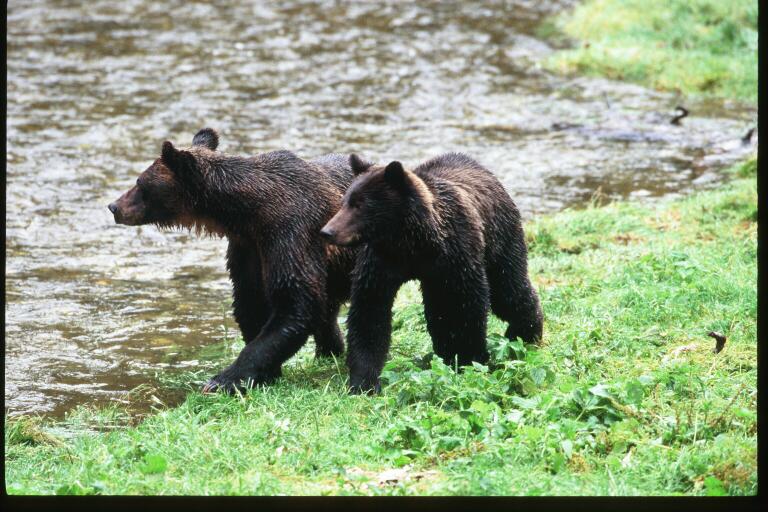
—Wildlife Photography©Jim Robertson
DALLAS (AP) — The US government will allow a Texas man to import the trophy of an endangered black rhinoceros should he kill one in Africa as part of a conservation fundraiser.
The US Fish and Wildlife Service said Thursday that importing a carcass from Namibia meets criteria under the Endangered Species Act of benefiting conservation.…
Corey Knowlton bid $350,000 last year in a Dallas Safari Club auction billed as a fundraising effort to save the black rhino.
In a letter to the agency in December, the club’s executive director, Ben Carter, said the money raised from such auctions is “critical to supporting the Namibian government in their efforts to stem the tide of commercial killing of these animals.”
Since publishing the initial request in November, the US Fish and Wildlife Service received more than 15,000 comments, as well as petitions with about 152,000 signatures demanding that it be denied. PETA said Thursday that it will file a lawsuit.
The hunt was postponed and Knowlton’s money kept in escrow while the agency deliberated over the permit application.
Dallas Safari Club spokeswoman Jay Ann Cox could not immediately confirm Thursday whether a date has been set for the hunt.
The agency also is allowing Michael Luzich, a Las Vegas investment manager, to import his black rhino trophy. Namibia directly sold him a hunting permit.
Luzich has received far less scrutiny than Knowlton, who said last year he hired full-time security because he’d received death threats once his name became public knowledge.
Full story at http://fwbusinesspress.com/fwbp/article/1/9432/Breaking-News/US-government-approves-Dallas-clubs-rhino-import-permit-.aspx
http://www.thepetitionsite.com/takeaction/804/950/521/?cid=FB_TAF
The federal government in the US has confirmed that permission has been granted to Trophy hunter Corey Knowlton
Once again we are shown proof that money is power in the United States of America, with permission being granted to Trophy hunter Corey Knowlton to import the trophy of critically endangered black Rhino from Namibia for which he paid 350,000 dollars. This must be stopped before precedent is made and all wealthy people become entitled to be above international law.
http://www.thepetitionsite.com/takeaction/804/950/521/?cid=FB_TAF
Elk still range across parts of North America, but every hunting season brings a greater challenge to find the sought-after bull with a towering spread of antlers. Africa and Asia still have elephants, but Roosevelt would have regarded most of them as freaks, because they don’t have tusks. Researchers describe what’s happening as none other than the selection process that Darwin made famous: the fittest of a species survive to reproduce and pass along their traits to succeeding generations, while the traits of the unfit gradually disappear. Selective hunting—picking out individuals with the best horns or antlers, or the largest piece of hide—works in reverse: the evolutionary loser is not the small and defenseless, but the biggest and best-equipped to win mates or fend off attackers.
When hunting is severe enough to outstrip other threats to survival, the unsought, middling individuals make out better than the alpha animals, and the species changes. “Survival of the fittest” is still the rule, but the “fit” begin to look unlike what you might expect. And looks aren’t the only things changing: behavior adapts too, from how hunted animals act to how they reproduce. There’s nothing wrong with a species getting molded over time by new kinds of risk. But some experts believe problems arise when these changes make no evolutionary sense.
More: http://www.newsweek.com/how-hunting-driving-evolution-reverse-78295
It’s easy to spot Columbus. He’s not only the biggest and strongest gnu among the dozens grazing on a South African plain, he also sports a golden-hued coat, a stunning contrast to the gray and black gnus around him.
Finding Columbus in the wild would be a stroke of amazing luck. More than 99.9 percent of all wild gnus, also called wildebeest, from the Afrikaans for “wild beast,” have dark coats. But this three-year-old golden bull and his many offspring are not an accident. They have been bred specially for their unusual coloring, which is coveted by big game hunters.
These flaxen creatures are the latest craze in South Africa’s $1 billion ultra-high-end big-game hunting industry. Well-heeled marksmen pay nearly $50,000 to take a shot at a golden gnu — more than 100 times what they pay to shoot a common gnu. Breeders are also engineering white lions with pale blue eyes, black impalas, white kudus, and coffee-colored springboks, all of which are exceedingly rare in the wild.
“We breed them because they’re different,” says Barry York, who owns a 2,500-acre ranch about 135 miles east of Johannesburg. There, he expertly mates big game for optimal — read: unusual — results. “There’ll always be a premium paid for highly-adapted, unique, rare animals.”


Left: A standard lion. Photographer: Getty Images
Right: Letsatsi, the white lion. Photographer: Arno Meintjes/Getty Images
This kind of selective breeding to create exotic animals has raised howls from conservationists and more traditional hunters, who dismiss the practice as little more than creating mutants for profit. “These animals are Frankenstein freaks of nature,” says Peter Flack, a hunter and conservationist and former chairman of gold mining company Randgold Resources. “This has nothing to do with conservation and everything to do with profit.”
No one disputes that there’s money to be made in rare big game. Africa Hunt Lodge, a U.S.-based tour operator, advertises “hunt packages” to international clients traveling to South Africa that include killing a golden gnu for $49,500, a black impala for $45,000, and a white lion for $30,000. For the money, hunting tourists typically get a seven- to 14-night stay in a luxury lodge, gourmet food with an emphasis on meat dishes, and hunting permits. (Taxidermy costs extra.)
Operators don’t guarantee kills, yet to leave hunters disappointed is generally seen as bad business, says Peet van der Merwe, a professor of tourism and leisure studies at South Africa’s North-West University. Killing lions was the biggest revenue generator for the country’s hunting industry in 2013, followed by buffalo, kudu, and white rhinos.
As the hunting industry has grown, so have the numbers of large game animals that populate South Africa’s grasslands. In other parts of Africa, including Kenya and Tanzania, the opposite has been true: Large mammal populations have been decimated as farms and other human activities encroached on wild areas. But South Africa is one of only two countries on the continent to allow ownership of wild animals, giving farmers such as York an incentive to switch from raising cattle to breeding big game. ‘‘My first priority is to generate an income from the animals on my land, but conservation is a by-product of what I do,” York says.


Left: A standard golden impala Photographer: Villy Yovcheva/Getty Images
Right: A White Flanked Impala at Phala Phala Wildlife in Bela Bela Source: Phala Phala Wildlife
At 66, York has been involved in breeding and hunting for decades. After he emigrated from his native Zimbabwe in 1980, he bred prize cattle for beef in South Africa’s northern grasslands. He also organized hunts, which gave him the occasion to see his first golden gnu in 1986, when a client killed one. “It was the most beautiful animal I had ever seen,” he says.
In 2007, York bought a farm in Limpopo Province that had previously been used for crops. His plan was to raise beef cattle. That turned out to be a costly mistake. The cows languished, unable to gain weight and poorly adapted to the ticks and other pests prevalent on the hot plains. York found himself shelling out a steady stream of cash for expensive vaccines and veterinary fees. At that rate, “I’d be broke in a year or two,” he says.
York recalled the beautiful golden gnu he had seen more than 20 years earlier and hatched a plan. He figured that, as a native species, gnus were better adapted to the South African grassland than cattle. He would be able to sell them for both hunting and meat, and if he could breed some with exotic coloring, they would command a premium.
His timing was good. The switch coincided with a rise in popularity of big game hunting, and prices for rare variants were soaring. Since 2005, the average price at auction for a golden gnu has more than quadrupled to 404,000 South African rand ($33,000).


Barry York Photographer: Dean Hutton/Bloomberg
Today, York has roughly 600 gnus. He keeps the best — the most fertile and beautiful, with the biggest horns — for breeding. The next tier goes to auction, mostly for sale to other breeders. Animals that don’t make the grade for breeding are sold to hunting ranches, which are typically bigger and more scenic than York’s, giving hunters the feel of the wild African bush.
More: http://www.bloomberg.com/graphics/2015-hunting-mutant-big-game-in-south-africa/
https://secure.humanesociety.org/site/Advocacy
A terrible bill has been introduced that will allow for the expanded hound hunting of cougars. This cruel and unsporting practice was rightfully outlawed by voters in 1996.
Under this proposal, counties can authorize a hound hunt based on public safety complaints of cougar sightings. The existing law already allows for citizens to protect themselves if they feel threatened by a cougar. Despite the fact that seeing a cougar does not constitute a threat and cougar kittens are extremely vulnerable to attacks by packs of dogs, proponents of the bill want to bring back the trophy hunting of cougars with hounds. This program was in place from 2004 until 2011, and resulted in widespread, guided recreational hound hunts offered by hunting clubs throughout eastern Washington.
TAKE ACTION
Please call your state senator today to stop this dangerous proposal. Look up your legislator’s phone number. You can say: “I am a constituent, and I am calling to ask you to please oppose SB 5940.”
After making your call (please do not skip that crucial step!), fill in and submit the form below to send a follow-up message. Legislators receive a lot of email; be sure to edit your message so it stands out.


Cut the crap about a harmless little F-word, there’s animals fucking dying out there.
Yesterday I posted a picture someone put together of multiple murderers and their “trophy” giraffe kills. I’d thought about titling the post, “Who the Hell Hunts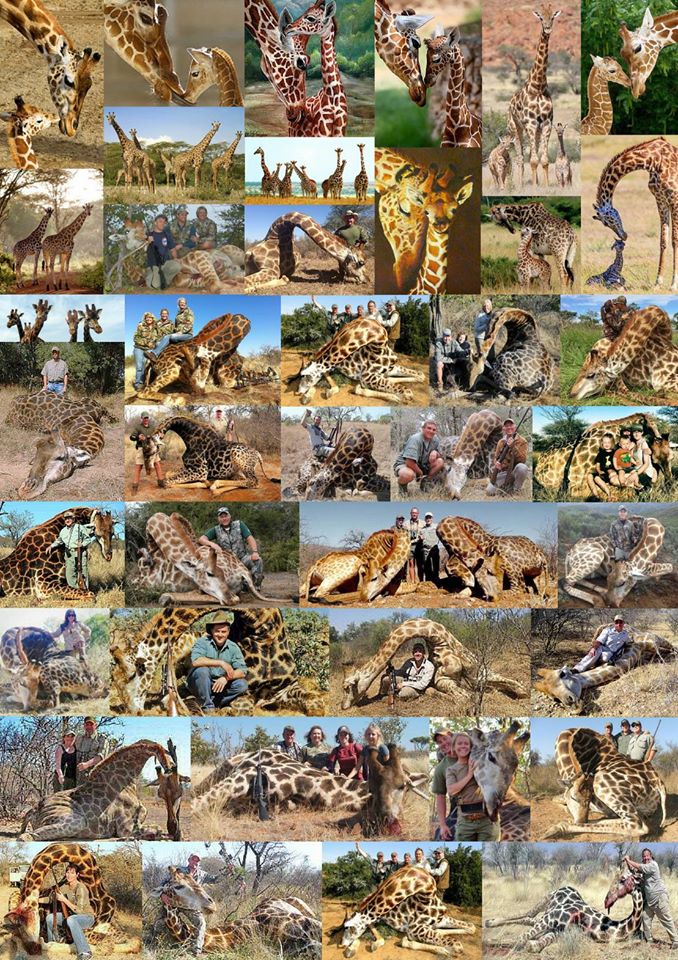 Giraffes for Sport and How You Can Stop Them?” But the issue made me so angry that I went with my gut reaction and titled it, “Who the Fuck Hunts Giraffes for Sport and How You Can Stop Them?” But, for that I’ve been chastised across the social media by certain readers.
Apologies to anyone reading this that’s a young kid or in some other way sheltered enough to think a word is somehow more offensive than a photo of dozens of dead giraffes and the fuckers who shot them down. Don’t get me wrong, I don’t normally go around spewing obscenities, but when some asshole is out murdering animals as harmless and miraculous as a giraffe I start to get a bit pissed off. You could say my tact goes out the fuckin’ window.
Forgive me if I can’t stay civil when addressing some shithead serial-killer-sport-hunter who wants to add a lion, rhino or giraffe to his trophy collection.
Instead of being so sensitive to swear words, perhaps some of you should save your comments for the real criminals—the murdering mother-fuckers who kill sentient beings for sport.
___________________________________________________
Please sign and share these petitions.
Rhinoceros in SA need your help before their extinction
http://www.change.org/petitions/rhinoceros-in-south-africa-need-your-help-before-their-extinction#shar


 Exposing the Big Game