Yellowstone Bison Back Under the Gun

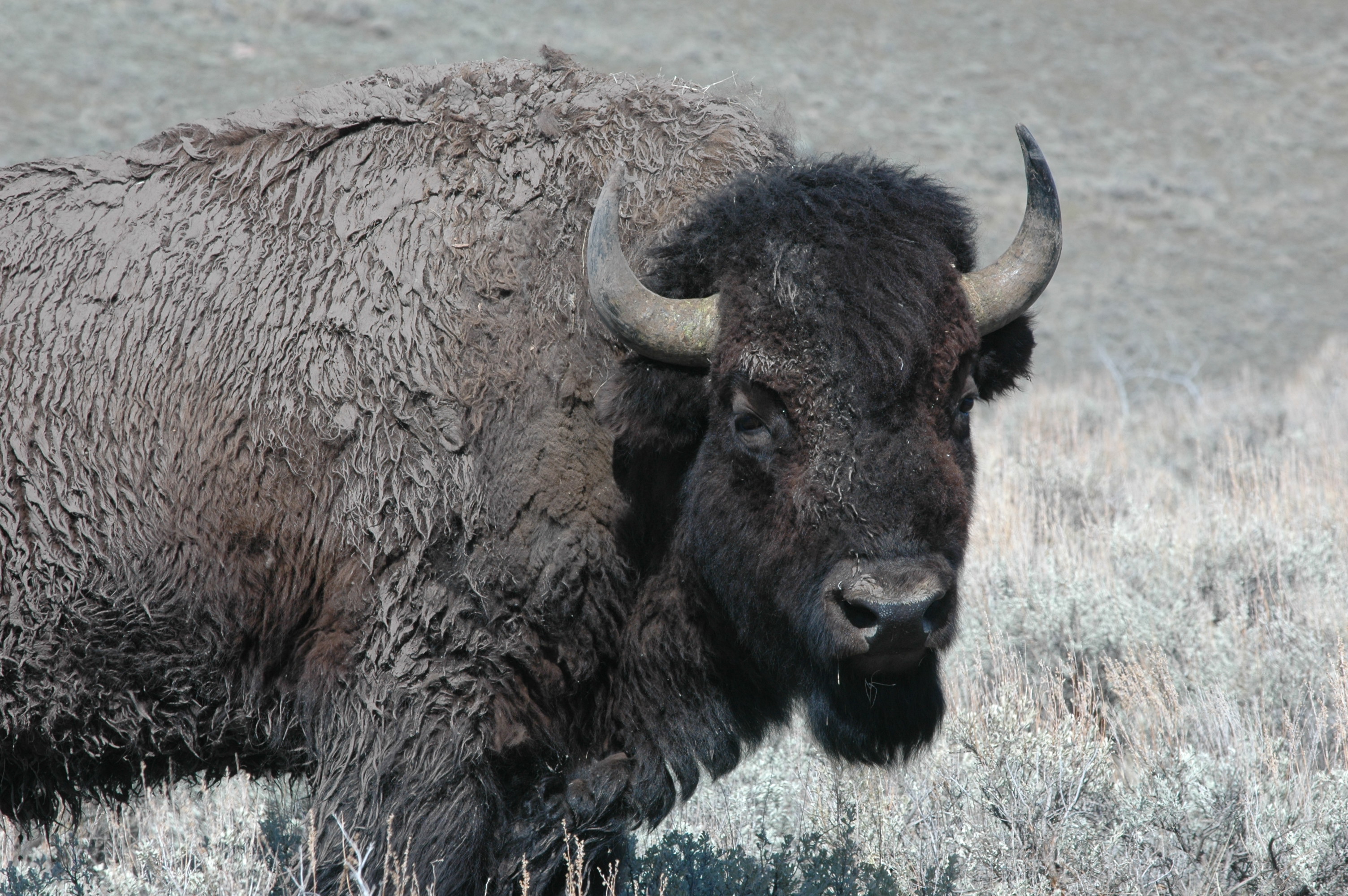
Wolves aren’t the only once endangered species being targeted right outside of Yellowstone National Park. Bison, the symbol of our National Park system, have been killed by the thousands in recently imposed state and tribal hunting seasons and by the Montana Department of Livestock, who, with the full blessing of the National Park Service, have rounded up over 5000 migratory park bison since 2008 and shipped them to slaughterhouses (those nightmarish death camps where so many forcibly domesticated bovines meet their ends).

In a ruthless act of rabid backstabbing, 1600 bison—who had never known confinement or any reason to fear people—were slain to appease Montana ranchers during the winter of ‘08. More than half of Yellowstone’s bison were killed in what was the highest body count since the nineteenth century.

Instead of making amends for the historic mistreatment of these sociable, benevolent souls, twenty-first-century Montanans are still laying waste to them. Spurred on by industry-driven greed for grazing land (veiled under the guise of concern about brucellosis, a disease with a negligible risk of transmission that has never actually been passed from wild bison to cattle), the state of Montana sued to seize control of bison ranging outside Yellowstone. Now their department of livestock has implemented a lethal policy and the US National Park Service is facilitating it. Since the dawn of the new millennium, over 5000 Yellowstone bison have been put to death.

The following action alert from the Buffalo Field Campaign includes contact info…

Before wild bison have even begun their annual migration to their winter habitat in Montana, State, federal, and tribal governments — including Yellowstone National Park –are aiming to kill hundreds of wild buffalo this winter through hunting, slaughter, or both. The agencies state that they want to “even the sex ratio” and have placed a heavy target on female buffalo, wanting to kill at least 400 female buffalo that migrate north of the Park into the Gardiner Basin. The herds that migrate north include buffalo from both the Northern and Central herds, which also means that the Central herds (which also migrate west) will be doubly impacted by hunting and slaughter.

Yellowstone National Park states that a “skewed sex ratio” has resulted from years of capture and slaughter operations, which have removed more bulls than cows from the population. In other words the government is saying they will slaughter more buffalo to mitigate the impact of slaughtering so many buffalo. Talk about playing God in Yellowstone.

With these plans aimed to placate Montana’s livestock interests, Yellowstone National Park threatens the buffalo’s immediate survival and evolutionary potential.  Yellowstone’s plans to capture and slaughter wild bison are absolutely contrary to their mission to preserve and protect plant and animal species unimpaired for present and future generations.  The wild bison of the Yellowstone ecosystem make up America’s last continuously wild population. Wild bison are ecologically extinct throughout their native, historic range, and currently number fewer than 4,300 individuals.  Wild bison once teemed across the North American continent in the tens of millions, but today the last remnant herds only exist in and around Yellowstone and are in dire need of protection.

TAKE ACTION!  Tell Yellowstone Superintendent Dan Wenk that you absolutely oppose any capture or slaughter of wild buffalo.  Yellowstone is mandated by law to protect wild bison, not cater to Montana’s cattle politics.  Tell Superintendent Wenk to stop being a puppet for Montana livestock interests, pull out of the draconian Interagency Bison Management Plan, and to stand up for the wildlife that the American people have placed in his care.  Wild bison are a natural, national treasure, the prehistoric and rightful roamers of North America, and we will not stand by and allow Yellowstone or Montana’s cattle industry to jeopardize their future for any reason.

Daniel Wenk, Superintendent

Yellowstone National Park

P.O. Box 168

Yellowstone National Park, WY 82190-0168

(307) 344-2002 phone

(307) 344-2014 fax

Dan_Wenk@nps.gov

DSC_0146


The Infertile Union

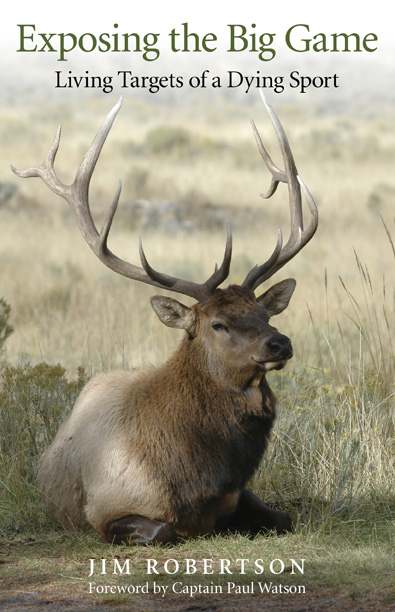
So you don’t get the idea I go around unfairly picking on small grassroots groups, here’s an excerpt from my book, Exposing the Big Game: Living Targets of a Dying Sport, wherein I take on the Goliath of all national green groups for siding with hunting…

Sport hunters have enjoyed so much laudation of late they’re beginning to cast themselves as conservation heroes. What’s worse is that many modern, influential green groups are swallowing that blather, hook, line and sinker. Maybe they ought to reread the words of Sierra Club founder, John Muir:

“Surely a better time must be drawing nigh when godlike human beings will become truly humane, and learn to put their animal fellow mortals in their hearts instead of on their backs or in their dinners. In the meantime we may just as well as not learn to live clean, innocent lives instead of slimy, bloody ones. All hale, red-blooded boys are savage, fond of hunting and fishing. But when thoughtless childhood is past, the best rise the highest above all the bloody flesh and sport business…”

Henry David Thoreau, another nineteenth-century nature-lover whose forward-thinking writings were an inspiration to Muir, cautions, “No humane being, past the thoughtless age of boyhood, will wantonly murder any creature which holds its life by the same tenure he does. The hare in its extremity cries like a child. I warn you, mothers, that my sympathies do not make the usual philanthropic distinctions.”

If those dated messages and mockery are lost on twenty-first-century Sierra-clubbers, Edward Abbey’s sentiment should be obvious enough for anyone, “To speak of harvesting other living creatures, whether deer or elk or birds or cottontail rabbits, as if they were no more than a crop, exposes the meanest, cruelest, most narrow and homocentric of possible human attitudes towards the life that surrounds us.”

Early vanguards of ecological ideology recognized Homo sapiens as just one among thousands of animal species on the planet, no more important than any other in the intricate web of life. They also abhorred sport hunting.

But a shocking turn-around is taking place in the current bastardization of the environmental movement. The Sierra Club and other large, corporate green groups are embracing (read: sleeping with) powerful hunting groups like the Safari Club International and the National Rifle Association (NRA). In a transparent effort to appear down-home and therefore more in touch with nature, they’re making the fatal mistake of joining frces with sportsmen whose conservation “ethic” exists only so their preferred prey species can be slain again and again.

The infertile union between super-sized modern green groups and mega-bucks hunting clubs must have been sired by their shared conviction that humans are the most crucial cogs in the wheel of life (or at least the squeakiest wheels in the dough machine). As the only animal capable of coughing up cash when the collection plate comes around, human beings (every last gourmandizing, carnivorous one of them) are the primary concern; their wants must be given priority over those of all other species. Contemporary environmental organizations, seduced by a desire to engage as many paying members as they can get their hands on (regardless of their attitudes towards animal life), must believe blood-soaked money is as green underneath as any.

Forever stagnating in “thoughtless childhood,” members of hunting groups like the NRA live for the day they can register a record-breaking trophy with the Boone and Crocket Club—formed by Roosevelt “to promote manly sport with rifles.” Fund for Animals creator, Cleveland Amory, took issue with the sporty statesman in his anti-hunting epic, Man Kind? Our Incredible War on Wildlife. A benevolent humanitarian for humans and nonhumans alike, Mr Amory wrote, “Theodore Roosevelt…cannot be faulted for at least some efforts in the field of conservation. But here the praise must end. When it came to killing animals, he was close to psychopathic. Dangerously close indeed (think: Ted Bundy). In his two-volume African Game Trails, Roosevelt lovingly muses over shooting elephants, hippos, buffaloes, lions, cheetahs, leopards, giraffes, zebras, hartebeest, impalas, pigs, the not-so-formidable 30-pound steenbok and even (in what must have seemed the pinnacle of manly sport with rifles) a mother ostrich on her nest.

But don’t let on to a hunter your informed opinion of their esteemed idol, because, as Mr Amory points out, “…the least implication anywhere that hunters are not the worthiest souls since the apostles drives them into virtual paroxysms of self-pity.” Amory goes on to say:

The hunter, seeing there would soon be nothing left to kill, seized upon the new-fangled idea of “conservation” with a vengeance. Soon they had such a stranglehold [think: Ted Nugent] on so much of the movement that the word itself was turned from the idea of protecting and saving the animals to the idea of raising and using them—for killing. The idea of wildlife “management”—for man, of course—was born. Animals were to be “harvested.” They were to be a “crop”—like corn.

Fortunately, a faithful few are seeing through the murky sludge spread where green fields once thrived. Sea Shepherd Conservation Society’s Captain Paul Watson (founder and president of about the only group still using the word conservation to mean protecting and saving animals) recently took another in a lifetime of steadfast stands by resigning from his position on the Board of Directors of the Sierra Club. He refused to be a part of their whorish sleeping with the enemy—their pandering to sportsmen by holding a “Why I Hunt” essay contest, complete with a grand prize trophy hunt to Alaska. To think of how many trees were needlessly reduced to pulp for this profane effort when the answer to why hunters hunt was so succinctly summed up in just one sentence by Paul Watson, “Behind all the chit-chat of conservation and tradition is the plain simple fact that trophy hunters like to kill living things.”

Just as the naïve young girl who falls for the charms and promises of a sunny sociopath learns, the hard way, about his hidden penchant for abuse and violence, the Sierra Club and other middle-ground eco-friendly groups may soon learn the dangers of looking for Mr. Goodbar in all the wrong places. How will they divorce themselves from this unholy alliance when the affair goes sour and sportsmen reveal their malicious, hidden agenda by calling for another contest hunt on coyotes or cull on cougars, wolves or grizzly bears to do away with the competition for “their” deer, elk, moose or caribou?

front-cover-low-res6

Wolves Are the Only Management “Tool” Necessary

I didn’t mean to set off a pissing match in my last blog post by quoting a group’s recent statement to the Missoulian, “We at Wolves of the Rockies understand and acknowledge the importance of hunting as a tool for managing wolves, and we stand beside the ethical hunter in doing so.” I’m sorry if I misinterpreted that statement, but I thought it made their position on wolf hunting pretty clear: they support it.

And I think it’s obvious what they’re saying with the lines, “We are not advocating the end of wolf hunting. We have only asked for a slight modification to the state wolf management plan to accommodate other legitimate values in this specific locale. Remember, Montana’s wildlife is owned by ALL the people, not just hunters.”

It sounds to me like they feel that wolf “management” through hunting and trapping is acceptable, as long as it doesn’t conflict with another “legitimate value” some other human being has placed on the canines. I would argue that wolves themselves have intrinsic value, as individuals and as a species.

While I whole-heartedly applaud this group’s part in getting a buffer zone closed to hunting and trapping implemented around Yellowstone National Park in Montana (“only for this year,” according to the Montana Wildlife Commission chair Bob Ream), I have to question whether anything is worth legitimizing wolf hunting and trapping as “management tools” like they did in their articles to the press. When the back-patting and back-pedaling are over, it’s time to bring the focus back on the real problem—the fact that wildlife are considered “property” of the states, to be “managed” as they see fit.

Commissioner Ream said they made the closure because of the “particular and unique situation” of collared Yellowstone wolves being shot. He assured hunters and ranchers that the closure will not affect the goals of the commission for the overall Montana wolf hunt and trapping season in any significant way because this is such a small area, and one with almost no winter livestock.

Still, it could have a big effect conserving Yellowstone’s small and shrinking wolf population, now down to only about 80 wolves. The park’s wolf population of 170 wolves three or four years ago began to drop when inter-pack rivalry and low surviving pup numbers took their toll. Clearly, wolves have self-regulating population control systems which kick into play before their numbers get too far out of hand (which is more than can be said for hunters and trappers).

Wolves play an important part in nature’s narrative, a role that has served both predator and prey for eons. Rightful kings returning from exile, wolves are far from new to the Yellowstone ecosystem. Their 71-year absence was the result of a heartless bounty set by the real newcomers to the fine-tuned system of checks and balances that has regulated itself since life began.

New to the scene are cowboys on four-wheelers with their monoculture crop of cows and ubiquitous barbed-wire fences. New are pack trains of hunters resentful of any competition from lowly canines, yet eager to take trophies of wolf pelts, leaving the unpalatable meat to rot. And new is the notion that humankind can replace nature’s time-tested order with so-called wildlife “management,” a regime that has never managed to prove itself worthy.

Unmatched manipulators, modern humans with their pharmacies, hospitals, churches, strip malls, sporting goods stores, burger joints and fried chicken franchises have moved so far beyond the natural order that population constraints, such as disease or starvation, are no longer a threat to the species’ survival (as long as society continues to function). Hunting is no longer motivated by hunger. Twenty-first century sport hunters are never without a full belly, even after investing tens of thousands of dollars on brand-new 4X4 pickups, motorboats, RVs and of course the latest high-tech weaponry.

But wolves can’t afford to be acquisitive; if they run low on resources, they must move on or perish. Theirs is a precarious struggle, without creature comforts or false hopes of life everlasting.

~ From the book, Exposing the Big Game: Living Targets of a Dying Sport

Text and Wildlife Photography ©Jim Robertson, 2012. All Rights Reserved

Text and Wildlife Photography ©Jim Robertson, 2012. All Rights Reserved

Hunting Humans

After my post, Killing Wolves Provides “a Level of Tolerance”?, the director of a Canadian animal rights group, Lifeforce, sent me this press release, which, like my post, is a semi-satirical statement about turning the tables on trophy hunters…

Animal Rights Group To Booth: Let Us Hunt You

An animal rights group is challenging Vancouver Canucks forward David Booth to see what it feels like to be hunted in the wilderness. Peter Hamilton, director of the B.C.-based advocacy group Lifeforce, took umbrage with a picture Booth tweeted last week of the left winger posing next to a freshly-killed mountain goat.

He responded with a dare. “We’re challenging David Booth to put himself in the position of a hunted wildlife,” Hamilton told CTV News. “He would be subjected to the same plight that wildlife are, in hopes that he will reflect upon the suffering and pain of innocent animals.”

A draft version of the “Booth Hunt” plan indicates the Canuck would be sent into the wild unarmed, alone and without rations. A team of hunters with dogs and high-tech equipment would then attempt to track and capture him within an agreed-upon time limit. Naturally, Booth would not be harmed by his chasers.

“He would rely on any of his woodsman skills, as do the wildlife who are forced to rely on their abilities while being ruthlessly pursued,” the draft plan reads. Hamilton described trophy hunting as “barbaric,” and said it’s a practice that must be stopped.BOOTHHUNT

“A trophy is an inanimate object. These are sentient beings,” he said. “One has to question anyone’s motive in getting any kind of pleasure out of killing an animal in this manner.” …

I certainly have to agree with Peter Hamilton on that last point—their motive mirrors that of a serial killer—but as I told him, the fact that he’d know he wouldn’t be harmed by his pursuers would make Booth’s experience only a watered-down version of what a hunted animal fearing for its life goes through. Mr. Hamilton concurred; of course his proposition had to sound non-lethal in order to get the barbaric Booth to even consider going along with it.
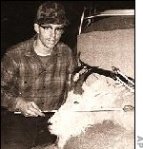
6-4Hansens-trophy-goatIronically, another infamous celebrity who posed with murdered mountain goats is Anchorage, Alaska baker, serial killer and renowned trophy hunter, Robert Hansen (now serving a 461 year prison sentence for the murder of at least 17 women, ranging in age from 16 to 41.) Well-liked by his neighbors and famed as a local hunting champion, Hansen even broke several records for trophy (nonhuman) kills, documented in the Pope & Young’s book of world hunting records.

Another bit of irony: like the Connecticut school shooter, Adam Lanza, and the D.C. Beltway snipers, John Allen Mohammed and John Lee Malvo, he used a .223-caliber semi-automatic hunting rifle to make his kills (both human and non-human).

Whenever Hansen got a victim under his control, he would fly her in his private plane to his remote cabin where they would be subjected to torture and then set free in the woods, naked and sometimes blindfolded. Hansen would give his victims a brief head start and then hunt them down with a hunting knife or a high-powered rifle. In5-2Robert-Hansens-trophy-room describing his hunts to investigators, Hansen said that it was like “going after a trophy Dall sheep or a grizzly bear.”

As world renowned FBI profilers, John Douglas and Roy Hazelwood correctly surmised, Hansen was compelled to keep trophies of his murders, such as a victim’s jewelry. According to Douglas, the abuse of prostitutes is a way for perpetrators to get back at women. Hansen was probably using his victims as a way to get revenge (much like the motive of good ol’ boys who kill wolves).

Several investigators who were familiar with Hansen said that he was known around the area as a proficient hunter. He earned this reputation after taking down a wild Dall sheep with a crossbow. Douglas concluded that Robert Hansen must have tired of elk, bear and Dall sheep, and instead turned his attention to more interesting prey.

When investigators first heard Hansen’s confession, they couldn’t help but think of the popular fictional story “The Most Dangerous Game” by writer Richard Connell. In the story, a shipwrecked trio find themselves stranded on an uncharted island, where they meet a Russian Count, known only as General Zaroff. The group’s initial delight turns to terror when they realize that the shipwreck was no accident and the good general had lured them there so he could hunt them down.

According to the Huffington Post, Anchorage police and FBI investigators just released information about another Alaskan serial killer, Israel Keyes, who authorities said never showed any remorse but said he got a rush out of hunting for victims and killing them. He also tortured animals as a child, investigators said.

Again, the serial killer’s motive and behavior closely parallels a trophy hunter’s:

“Israel Keyes didn’t kidnap and kill people because he was crazy. He didn’t kidnap and kill people because his deity told him to or because he had a bad childhood,” Anchorage homicide Detective Monique Doll said. “Israel Keyes did this because he got an immense amount of enjoyment out of it; much like an addict gets an immense amount of enjoyment out of drugs. In a way, he was an addict, and he was addicted to the feeling that he got when he was doing this.”

While researching for this blog post, I dug up an article by lion conservationist, Gareth Patterson, entitled “The Killing Fields.” In it, Patterson compares the uncanny similarities between trophy hunters and serial killers.

Here are some excerpts…

Certainly one could state that, like the serial killer, the trophy hunter plans his killing with considerable care and deliberation. Like the serial killer, he decides well in advance the type of victim–that is, which species he intends to target. Also like the serial killer, the trophy hunter plans with great care where and how the killing will take place–in what area, with what weapon. What the serial killer and trophy hunter also share is a compulsion to collect trophies or souvenirs of their killings. The serial killer retains certain body parts and/or other trophies for much the same reason as the big game hunter mounts the head and antlers taken from his prey…as trophies of the chase.

Hunting magazines contain page after page of (a) pictures of hunters, weapon in hand, posing in dominating positions over their lifeless victims, (b) advertisements offering a huge range of trophy hunts, and (c) stories of hunters’ “exciting” experience of “near misses” and danger. These pages no doubt titillate the hunter, fueling his own fantasies and encouraging him to plan more and more trophy hunts.

Trophy hunters often hire a camera person to film their entire hunts in the bush, including the actual moments when animals are shot and when they die. These films are made to be viewed later at will, presumably for self-gratification purposes and to show to other people–again the longing “to be important” factor?…

And finally, while on the subject, here’s an excerpt from the chapter, “Inside the Hunter’s Mind,” in my book, Exposing the Big Game: Living Targets of a Dying Sport:

A hunter’s true impetus is to serve the evil master in custody of his soul: his ravening ego. His self-interests are consistently placed far above those of his animal victims, whom he depersonalizes and views as objects rather than individuals. Reducing living entities to lifeless possessions and taking trophies of their body parts—without the slightest hint of guilt, remorse or other higher sentiment—is standard practice for the sport hunter…and the serial killer.

The sportsman keeps his malignant, murderous obsession concealed within the hollow confines of his psyche…until the next hunting season. Beneath a façade of virtuosity he’s driven by an urge to obtain surrogate victims, or stand-ins, representative of some perceived injustice he imagines he underwent at the hands of someone who didn’t let him have his way at some time in his life.

Maybe as a young child he felt he was undeservedly reprimanded, and so he terrorized the family pet, threw rocks at pigeons or turned to some other form of animal abuse to lift his sense of worth and gain a feeling of control. Over the years, he may have found that same kind of ego boost in killing animals for sport, partially satiating his savagery until the next legal opportunity to kill again. Imagining he’s reaping the power of the bear or the stately bull elk temporarily boosts his floundering self-esteem or relieves his sense of inadequacy. But his pride is a shallow pool, constantly in need of refreshing…

Text and Wildlife Photography ©Jim Robertson, 2012. All Rights Reserved

Text and Wildlife Photography ©Jim Robertson, 2012. All Rights Reserved
Paul Ryan Is Out to Corrupt His Little Girl

The hunting industry’s motto must be: “Get ‘em while they’re young.”

Being the diehard “sportsman” that he is, Republican vice presidential candidate Paul Ryan is taking that maxim to heart. Yesterday he told ABC News his daughter has watched him hunt for years, and he’d already bought her a Remington 700 .243 junior model rifle last Christmas.

“She’s going to get to go hunting this year for the first time,” Ryan said. “She’s 10 years old, so she can hunt starting at 10. I just need to get her some clothes.”

What kind of clothes? Why camo, of course. No doubt sensing a photo op, Ryan stopped at the Forest Park, Ohio, Outdoor World and paid $101.14 in cash for camouflage gloves and a jacket.

Females are supposed to be the more caring and nurturing of our species. How is teaching them to murder animals at an early age a good thing? Unless we want a world full of conscienceless, compassionless killers, it isn’t.

A normal young girl’s natural reaction to seeing a beautiful creature killed is shock, sadness, revulsion or repugnance. But if her father praises her enough when she brings down her first victim, there’s a chance she’ll end up thinking that she somehow enjoys it. From then on, when she sees a deer or rabbit, she will think of the praise she received; she’ll see them simply as trophies to mount on the wall; or she’ll envision them butchered and reduced to bloody lumps of meat. She’ll always be a little twisted in her perception of our fellow beings.

Years later, after a string of failed marriages, alcoholism, suicide attempts or a criminal record for child abuse or other violent crimes, in addition to a lifetime of inner turmoil, she might eventually seek psychiatric counseling. Only then will she realize that her problems began on the day her father first praised her for killing an innocent, sentient animal—the kind that she used to think of as beautiful.

And this Ryan guy wants to be our vice president? Considering the way he plans to corrupt his little girl, I’d want him to stay the hell away from my daughter.

Text and Wildlife Photography ©Jim Robertson

For the Bragging Rights

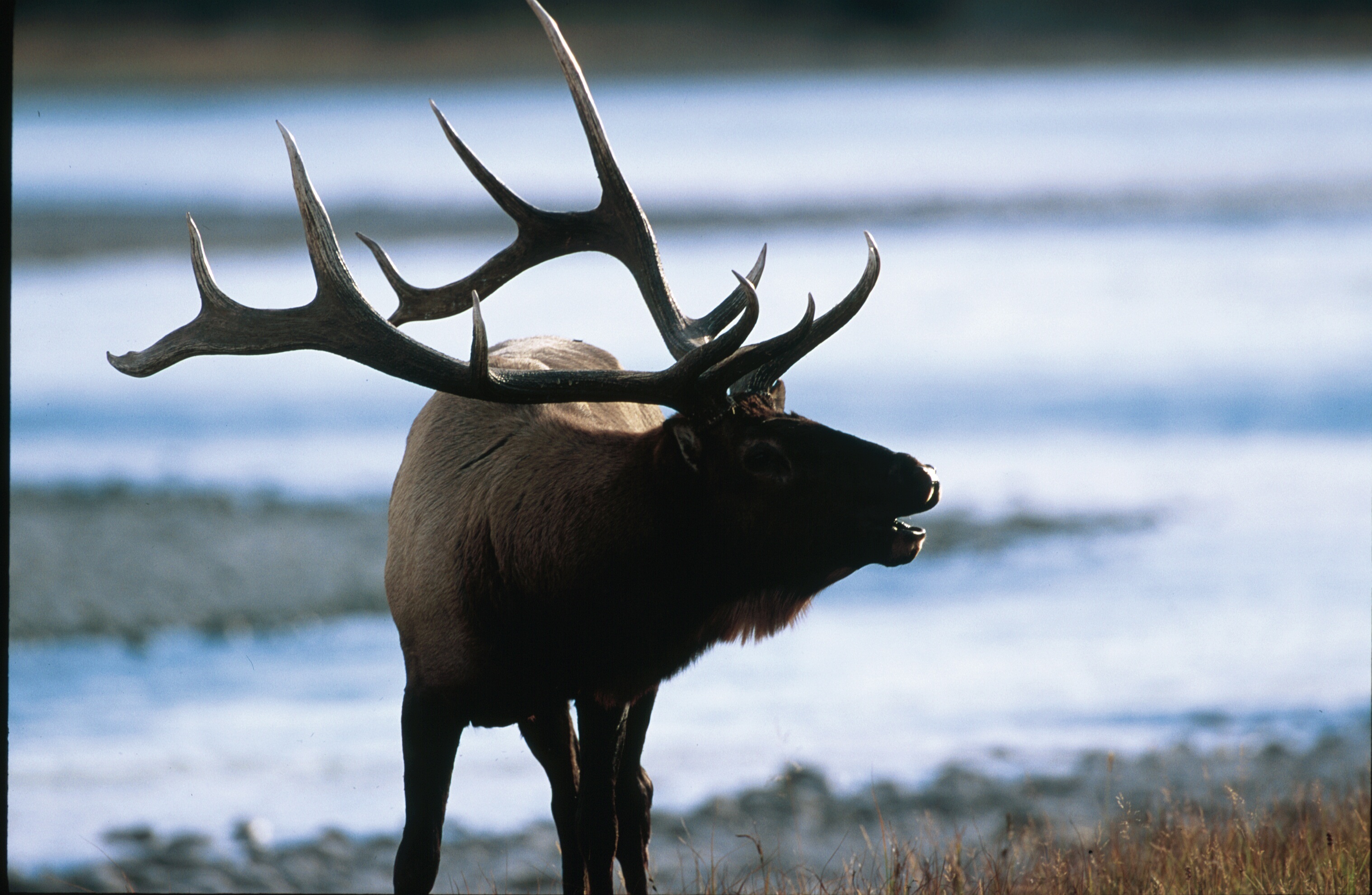
Autumn in elk country would not be complete without the stirring sound of solicitous bulls bugling-in the season of brightly colored leaves, shorter days and cooler nights. Nothing, save for the clamor of great flocks of Canada geese, trumpeter swans or sandhill cranes announcing their southward migration, is more symbolic of the time of year. And just as any pond or river along their flyway devoid of the distinctive din of wandering waterfowl seems exceedingly still and empty, any forest or field bereft of the bugling of bull elk feels sadly deserted and lifeless.

Yet there are broad expanses of the continent, once familiar with these essential sounds of autumn, where now only the blare of gunfire resounds. By the end of the nineteenth century, the great wave of humanity blowing westward with the force of a category five hurricane—leveling nearly everything in its destructive path—had cut down the vast elk herds, leaving only remnants of their population in its wake.

Nowadays, a different kind of rite rings-in the coming of autumn across much of the land. Following in the ignoble footsteps of their predecessors who hunted to extinction two subspecies, the Mirriam’s and the Eastern elk, nimrods by the thousands run rampant on the woodlands and inundate the countryside, hoping to relive the gory glory days of the 1800s.

On the way back from a trip early last evening I saw one such nimrod as I turned at the local mini-market on the final stretch home. I have no doubt in my mind that he was parked there just to show off his kill; the antlers of a once proud, now degraded and deceased bull elk were intentionally draped over the tailgate of the assassin’s truck—clearly on display.

I can’t say that I see just what the hunter was so proud of. It’s not like he personally brought down the mighty animal with his bare hands. Elk follow a pretty predictable path this time of year, and the bulls are distracted and preoccupied with escorting their harems around. Taking advantage of them during their mating season is about as loathsome as anything a human can come up with (and that’s saying a lot).

All a deceitful sportsman has to do is blow an imitation elk bugle to lure a competitive bull within range of their tree stand or wait in hiding above the herd’s traditional trail to the evening feeding grounds. When the procession passes by (right below the camouflaged killer’s perch), the most challenging thing for the sniper is deciding which individual animal to shoot or impale with an arrow.

The fact that they let groups of cows and young spike bulls pass by and wait for the largest, “trophy” bull is proof positive that they’re not hunting for food, but rather for sport—and for bragging rights.

____________________________

The first portion of this post was excerpted from the chapter, “The Fall of Autumn’s Envoy,” in the book, Exposing the Big Game: Living Targets of a Dying Sport

Text and Wildlife Photography ©Jim Robertson

Hold On to Your Sanity

Seeing the photo of a young Trump troll holding a severed elephant trunk makes me so enraged I could tear it out of his hands and beat him to a bloody pulp with it. There, I said it. Make no mistake, photos of sick, gloating psychos inspire as much murderous rage in me as they do in any other good person who cares for animals and who knows that the elephant was a far more worthy soul than the grinning, scum-bag sport hunter.

Does this bring me “down to his level?” No, that’s an overused cliché that I should have avoided in my last post, because it put some readers on the defensive and made them miss my whole point (which was simply:  even in our talk of retribution, we should strive to sound more humane than those who enjoy killing). Would I enjoy flogging someone to death with the trunk of an elephant (justified as it might well be)? If so, it may be time for some serious introspection; time to ask myself, “Have I crossed the line and temporarily lost my sanity?”

The tag line for my book and blog is “Forget hunters’ feeble rationalizations and trust your gut feelings; making sport of killing is not healthy human behavior.” The word “sport,” which hunters make no bones about using, suggests taking pleasure in the act of something—in the case of hunting that means offing a living being. Regardless of how you justify it, deriving pleasure from killing is not healthy behavior. No matter how tempting it is to go on the warpath on their behalf, the animals need us to stay sane. Any lethal action we take will be perceived as another sign that we “put animals above humans” (guilty as charged?) and justify further oppression of the animals. Thankfully, nobody here has been driven to cross that Rubicon yet.

I included only photos of live animals throughout my book, in part help people identify with the subjects, but also to avoid making the reader see red, drop the book, and go out and commit some act of homicide that could set back any progress made for the animals and inspire a fully armed retaliation against them. All laws are on the side of the exploiters, and they have all the weapons (well, at least most of them).

My advice to folks who find themselves at the end of their rope: whenever you feel you’ve viewed one too many snuff shots of evil, smug little men and women with their trophies, file that rage away for a minute and take some time to regain your composure. Maybe pet your cat or dog, gaze out the window at the sunset or appreciate a photo of a live, free-roaming animal. But if you keep staring at a computer screen full of morbid, infuriating images of animal murderers, it might make you sink to their level…of sanity, anyway.

The fight for the animals is a war of attrition; a war of hearts and minds. Everything we do or say can have a bearing in the case against animal cruelty.

No matter how enjoyable the thought of beating a hunter or trapper with their victim’s severed body part might seem be, for the sake of the animals we must try to hold on to our sanity.

Text and Wildlife Photography ©Jim Robertson

Where Your Sympathies Lie

Some people are animal people and some are people people, while others claim to love everyone equally. The fact is, whether consciously or not, at some point we all have to make a choice as to where our sympathies really lie.

It seems that all but the most saintly of us has a limited quantity of compassion. If it’s too focused, a lot of individuals can get left out, but spread too thin it’s not much good to anyone.

Animal advocates are often some of the most caring people around, yet  at times it appears as if they don’t have a whole lot of compassion for the people who abuse animals. Though nearly Christ-like in many ways, most animal rights supporters actually have a limited empathy allotment, so they tend to save theirs for the victims—not the perpetrators—of cruelty.

Although biologically there’s no real difference between us all (except that new studies have shown hunters suffer from DMGD, that emotionally crippling Diminutive Male Genitalia Disorder), the simple fact is that people are different from one another in the amount of empathy, guilt or remorse they are capable of experiencing.

When animal rights advocates look at their own culpabilities, they take responsibility and work to change their actions. This is something you cannot expect from willful animal exploiters. Those who knowingly mistreat can’t be made to feel shame for anything; they’ve built up a wall of rationalization eight feet thick. Nothing gets in. They can’t or won’t be changed, though they may profess a profound transformation to their parole board.

Such was surely the case with Ted Bundy, before he ultimately confessed to the brutal murders of thirty young women (many of whom he decapitated and—like a typical sport hunter—kept their heads as trophies to help him relive the kills).

When the day of Ted Bundy’s execution finally came, people in Florida were weighing in on all sides of the issue. On one extreme were folks chanting and carrying signs like, “Thank God it’s FRY-day,” “Bye-Bye Bundy, and more power to you” and “Hey Ted, don’t forget to file an appeal in Hell” expressing their displeasure with the serial killer’s horrendous acts. At the other end of the spectrum was a virtual fan club of Ted Bundy devotees and groupies, one of whom had married him surreptitiously during his sentencing hearing.

Most people’s reactions were somewhere in between the two, depending on their sympathies. As always, mine are with the victims.

Wildlife photography Copyright Jim Robertson

The Serial Killers Named Buffalo Bill

It puts the lotion on its skin, or else it gets the hose again.”

That haunting line was made famous by the serial killer, Buffalo Bill. Not the historic character credited with the serial murder of tens of thousands of gregarious and benign bison, including 4,120 in one eighteen month period alone. No, it was uttered by the other famous (though in this case, make believe) multiple murderer of the same name: the nemesis in the story, The Silence of the Lambs.

Like his namesake, the old west bison slayer (forever immortalized with towns named after him and museums devoted to his memory), the fictional “Buffalo Bill” made a habit of objectifying his victims, using the pronoun “it” to depersonalize them in order to avoid any stirrings of conscience that might drift by. Both Buffalo Bills thought those they killed were beneath them and therefore unworthy of their concern.

The fictitious “Bill” was modeled in part after the real-life serial killer, Ed Gein, who, like most sport hunters, made trophies and souvenirs from his victims’ bones and skin.

It seems whether their victims are human or non-human animals, objectification and depersonalization play major roles in the psyches of hunters and/or serial killers.