Zimbabwe will not charge U.S. dentist for killing Cecil the lion

http://www.msn.com/en-us/news/world/zimbabwe-will-not-charge-us-dentist-for-killing-cecil-the-lion/ar-AAfmVFd?ocid=ansmsnnews11

“We approached the police and then the prosecutor general, and it turned out that Palmer came to Zimbabwe because all the papers were in order,” Muchinguri-Kashiri told reporters.

Muchinguri-Kashiri said Palmer would be free to visit Zimbabwe as a tourist in the future but not as a hunter. The implication was that Palmer would not be issued the permits a hunter needs.

The environment minister’s comments immediately drew the ire of the animal conservation group Zimbabwe Conservation Task Force, which maintained that Palmer had committed a crime and said it planned to pursue legal action against him in the United States.

Palmer could not be reached for comment on the environment minister’s statement to reporters.

The 55-year-old dentist had closed his practice in late July after he was publicly identified as the hunter who killed Cecil, drawing widespread criticism on social media and a large demonstration by animal rights advocates at his office in Bloomington, Minnesota, a Minneapolis suburb.

The practice reopened in mid-August without him. Palmer returned to work in early September to a handful of protesters and some public support from patients.

“The fact is the law was broken,” said Johnny Rodrigues, the head of the Zimbabwe task force, which first reported news of Cecil’s killing. “We are going to get our advocates in America to actually see what they can do to bring justice to him.”

The U.S. Fish and Wildlife Service has said it was investigating the killing of the lion.

Two more people still face charges related to Cecil’s killing. Both allegedly were involved in using bait to lure the lion out of his habitat in Hwange National Park so he could be killed.

Theo Bronkhorst, a professional hunter in Zimbabwe, is charged with breaching hunting rules in connection with the hunt in which Cecil was killed. A game park owner is also charged with allowing an illegal hunt. Both have denied the charges.

Bronkhorst is expected to appear on Thursday in a Hwange court where a magistrate will rule on a request by his lawyers that his indictment be quashed.

Parks officials said prosecutors would bring Cecil’s head, which the hunters took as a trophy, to court as an exhibit if the trial goes ahead.

Palmer has previously said that the hunt was legal and no one in the hunting party realized the targeted lion was Cecil, a well-known tourist attraction in the park.

Wildlife hunting, which earned $45 million last year, is an important source of money for Zimbabwe, which is still recovering from a catastrophic recession between 1999-2008.

Zimbabwe will not charge American dentist Walter Palmer for killing its most prized lion in July because he had obtained legal authority to conduct the hunt, a cabinet minister said on Monday.

Palmer, a lifelong big-game hunter from Minnesota, stoked a global controversy when he killed Cecil, a rare black-maned lion, with a bow and arrow outside Hwange National Park in Western Zimbabwe.

But Palmer’s hunting papers were in order, Environment Minister Oppah Muchinguri-Kashiri said on Monday. Consequently, he could not be charged.

“We approached the police and then the Prosecutor General, and it turned out that Palmer came to Zimbabwe because all the papers were in order,” Muchinguri-Kashiri told reporters.

Dentist Walter Palmer, who returned to his practice, Tuesday, Sept. 8, 2015, in Bloomington, Minn., arrives back to his office following a lunch break.© AP Photo/Jim Mone Dentist Walter Palmer, who returned to his practice, Tuesday, Sept. 8, 2015, in Bloomington, Minn., arrives back to his office following a lunch break. Muchinguri Kashiri said Palmer was free to visit Zimbabwe as a tourist but not as a hunter. The implication was he would not be issued the permits a hunter needs.

Two more people still face charges related to Cecil’s killing. Both allegedly were involved in using bait to lure Cecil out of his habitat in Hwange National Park so he could be killed.

Theo Bronkhorst, a professional hunter in Zimbabwe, is charged with breaching hunting rules in connection with the hunt in which Cecil was killed. A game park owner is also charged with allowing an illegal hunt. Both have denied the charges.

Bronkhorst is expected to appear in a Hwange court on Thursday where a magistrate will rule on a request by his lawyers that his indictment be quashed.

Palmer, 55, has previously said that the hunt was legal and no one in the hunting party realized the targeted lion was Cecil, a well-known tourist attraction in the park.

Palmer could not be reached immediately for comment on the environment minister’s statement to reporters. (Reporting by MacDonald Dzirutwe, additional reporting by David Bailey in Minneapolis; Editing by James Macharia)

Letter in Response to Oct. 9th Gray Wolf Article

by Rosemary Lowe

It’s about time that the U.S. Fish & Wildlife Service stopped genuflecting to the NM Game & Fish Dept. & Commission, which is entrenched in an antiquated, anti-wildlife mentality with trophy hunting, trapping & ranching interests in control. Two of the Game Commissioners are members of the infamous Safari Club International, which continues to promote shameless trophy hunting around the world, including endangered species. The Mountain Lion ( a New Mexico wild cat) is on their “Grand Slam Cats of the World”  Trophy hunting list. It  was apparent to those of us attending these meetings, that this department has no interest in wild life protection/ preservation, nor in any democratic process. Most people do not hunt, trap or ranch. Yet their voices are never heard.
If we want to save wolves, mountains lions, & other native animals, , we must  take on those special interests who are the impetus behind this despicable  state agency:  Tell these public lands rancher-moochers who graze everywhere on our National Forests, wilderness areas, BLM and state lands,  we want them off ! Wildlife need these lands to survive.
Now it is up to the US Fish and Wildlife Service (USFWS) to take full control of the Mexican Wolf Recovery program. The failure of the federal government to protect public land in Nevada from rancher Cliven Bundy set a dangerous precedent for New Mexico. Also, Catron County ranchers have resisted the Federal Mexican Wolf Reintroduction Program from the beginning. In May last year the Otero County Cattle Growers Association and their parent organization New Mexico Cattle Growers Association held a rally to “protect our land from federal designation.” The federal government must be prepared to protect federal wildlife habitat in the face of armed resistance.
Rosemary Lowe

Jimmy John Liautaud: Listen to Your Customers and Stop Your Trophy Hunting

Petitioning Jimmy John Liautaud

Listen to Your Customers and Stop Your Trophy Hunting

Petition by Mindy Everett
Oak Park, Illinois
3,568
Supporters
The illegal killing of Cecil, a beloved African lion, put a spotlight on the horrors of trophy hunting. My family recently learned that Jimmy John’s restaurant’s founder and CEO, Jimmy John Liautaud, is a trophy hunter. We were outraged, and decided to stop eating at Jimmy John’s. But my seven-year-old daughter, Grace, wants us to do more. Grace wants to take action and get Jimmy John to end his trophy hunting.

Jimmy John’s is getting ready to take its company public — a huge moment for any business. It is being reported that the company will be valued at more than $2 billion. This is a great opportunity to let potential investors know what people think of Jimmy John’s trophy hunting. There may be some money in this investment, but is it worth supporting a man who kills endangered animals for sport?

Join Grace in calling on the founder and CEO of Jimmy John’s, Jimmy John Liautaud, to publicly commit to no longer participate in trophy hunting.  

This controversy surrounding Jimmy John is nothing new. Reports of Jimmy John Liautaud hunting big game came out in 2011. Now, with the issue resurfacing after the senseless killing of Cecil in July, we have an opportunity to put pressure on Mr. Liautaud.

Trophy hunting is defined as “a specific and selective legal form of wildlife use that involves payment for a hunting experience and the acquisition of a trophy by the hunter”. In simpler terms, big game hunting consists of wealthy people paying big bucks to slaughter animals for “fun”. Join me in showing my daughter that her voice can be heard. Please sign this petition and help put an end to Jimmy John Liautaud’s trophy hunting.

B.C. man persuaded to give up coveted licence to hunt grizzly bears

Screen Shot 2015-09-28 at 3.17.28 PM

http://www.theglobeandmail.com/news/british-columbia/bc-man-persuaded-to-give-up-coveted-licence-to-hunt-grizzly-bears/article26646576/

Brent Sheppe grew up in a family of hunters, and for almost as long as he can remember he wanted to kill what some people regard as the biggest trophy of all.

“It’s been a dream of mine to get a grizzly bear. You know, to be able to hunt something that could hunt you back is pretty intimidating, is pretty awesome,” Mr. Sheppe said in a recent interview as he sat at home watching a hunting show on television.

This fall, after 10 years of trying, Mr. Sheppe got lucky, and for the first time his name was drawn for a grizzly bear licence in a limited entry hunt (LEH) in the Knight/Kingcome Inlet area on British Columbia’s central coast.

Getting your name drawn for an LEH is like winning the lottery, because it allows you access to an area from which the vast majority of hunters are excluded. LEHs are a way for the government to restrict the number of animals killed by limiting the number of hunters allowed in a prescribed zone. This year, 9,614 hunters applied for LEH licences for grizzly bears in British Columbia, and 3,469 tags were issued. In the Knight/Kingcome zone, 324 applied and 59 were selected.

(A government spokesman said many more tags are issued than bears are harvested. In 2014, for example, 3,067 LEH hunters province-wide killed 267 grizzlies.)

When Mr. Sheppe got his licence after so many years of trying, he was ecstatic.

But in a remarkable story of conversion that shows the dramatic way attitudes are shifting against grizzly hunting in B.C., Mr. Sheppe is going to forfeit his LEH.

Instead of shooting a trophy bear, he is going to look at one through binoculars.

The 31-year-old welding contractor grew up in Port McNeill on the north end of Vancouver Island, where people go into the forest to get meat the way urbanites visit the butcher.

“The way I was raised, we’d go out and shoot some animals and we’d bring the animals home and clean them, process them, smoke them and put them in the freezer. That was what we’d eat growing up. So hunting has been a big part of my life,” he said.

But his views on hunting grizzly bears changed recently when he talked with Mike Willie, an old friend and a hereditary chief of the Musgamakw Dzawada’enuxw First Nation.

Mr. Willie runs Sea Wolf Adventures, which offers cultural and wildlife tours on the coast, and Mr. Sheppe was hoping to get a boat ride into the remote Knight/Kingcome area, at the southern edge of the Great Bear Rainforest.

“I gave him a call, and was like, ‘You know, you’re the guy to take me out and help find some animals.’ And he said, ‘Well, there’s a bit of a problem because I’m completely against hunting these animals; they are majestic and spiritual,’” Mr. Sheppe said.

They talked about the importance of bears to First Nations.

“Bears are like family. If you have a bear lost, it’s a family member down,” Mr. Willie said.

“It really hit me,” Mr. Sheppe said. “I never had the opportunity to go hunt one before, so I was pretty excited about this [hunt], but my views have changed. Something in my spirit has switched and I’m ready to start a new chapter and try and help promote saving these bears.”

Mr. Willie said as an incentive to help Mr. Sheppe abandon his hunt, Sea Wolf Adventures and Nimmo Bay Resort, a luxury wilderness lodge, have offered to host him and his family for a bear-viewing trip.

It is an offer he hopes to make to other hunters prepared to give up their LEH licences.

Fraser Murray of Nimmo Bay Resort said when Mr. Sheppe sees a trophy grizzly, they will identify it as the bear that would have been shot had the hunt proceeded. A snare will be used to get DNA from a hair sample, and the bear will become part of a science project tracking the movement of coastal grizzlies.

“We’ll learn more about that bear and get a sense of the value of that bear to tourism as opposed to hunting,” he said.

A study last year found that tourists spent $15-million on bear viewing in the Great Bear Rainforest in 2012, while hunters spent $1.2-million.

Judging by that, the bear being spared by Mr. Sheppe is worth a lot more alive than dead.

Increasingly, British Columbians seem to be realizing that. A survey released on Friday found that more than 90 per cent now oppose the grizzly hunt. Included in that number are probably a lot of hunters like Mr. Sheppe, who have turned away from killing bears.

Bear Hunt Trial Triggers Protest In B.C.

http://www.huffingtonpost.ca/2015/10/09/clayton-stoner-bear-trial_n_8271206.html?utm_hp_ref=green&ir=Green

clayton stoner bear protest

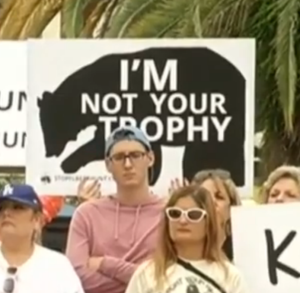
VANCOUVER — The case of an NHL player charged in the death of a grizzly bear has become a rallying cry for a British Columbia group against trophy hunting.

About a dozen members of Bears Matter gathered outside provincial court in Vancouver on Friday before a court date for Anaheim Ducks defenceman Clayton Stoner.

Stoner is charged with five counts under the provincial Wildlife Act, including two counts of knowingly making a false statement to obtain a hunting licence, hunting out of season, hunting without a licence and unlawfully possessing dead wildlife.

The bear, which local residents had named Cheeky, was killed in the Great Bear Rainforest on B.C.’s central coast in 2013.

clayton stoner bear

Bear Matters member Barb Murray said a growing number of people are against trophy hunting and that Stoner’s case should draw attention to the practice.

“We really need to make this case stand out above the others so that Premier (Christy) Clark cannot ignore our petitions, cannot ignore our letters and cannot ignore our voices,” she said.

Records from the Environment Ministry show dozens of charges in 2014 related to hunting without a licence and unlawfully possessing dead wildlife.

However, few other cases have been in the spotlight.

“Clayton Stoner, he’s recognized internationally, he’s an NHL hockey player, he makes millions of dollars,” Murray said. “He’s supposed to be an example of what a sportsman (embodies). And he’s not.”

Stoner has never denied the hunt, which sparked debate two years ago when pictures published in a Vancouver newspaper showed him holding a grizzly’s severed head.

Stoner, who is from Port McNeill on Vancouver Island, defended his hunting trip with his father, an uncle and a friend after the photos were publicized.

“I grew up hunting and fishing in British Columbia and continue to enjoy spending time with my family outdoors,” he said in a September 2013 written statement, adding he would continue those activities in the province.

Stoner should apologize for hunting bears, said Murray, her voice choked with emotion.

“I’m hoping they slap a very big fine, and he could also contribute to conservation in this province, big time.”

Stoner was not in court Friday. Ricky Bal, a lawyer who appeared on his behalf, said he does not know how the hockey player intends to plead.

The case was put over until Nov. 13.

Program offers bear hunt to sick kids

They’re going to die, but why not kill a bear before it’s over? A “sick” kid in more ways than one…

http://wiat.com/2015/09/17/program-offers-bear-hunt-to-sick-kids/

(WBAY) — A program in Oconto County is assisting children with life-threatening illnesses by giving them a chance to hunt bears and spend more time outdoors.

“It’s very special, they get to bond,” said Bruce Watruba, Secretary of Oconto River Kids, “most people never expect to be able to bear hunt with their child.”

Bruce “Bearman” Watruba is part of Oconto River Kids, a program that brings kids with life-threatening illnesses into the woods, and gives them a chance to bear hunt.

“Most of these kids haven’t hunted before,” said Watruba, “and when they come up hunting, when they do tip a bear over, they are so excited.”

Kids like 16-year-old Lexie Joly, who has brain cancer.

“At first it [cancer] was scary,” said Lexie, “but now I just, go through every day and I fight. I’m all good.”

While she’s never been hunting until now, she’s glad she decided to head into the blind with her mom, and a guide.

“I came here first to bait, then we can here again to practice shooting the gun I’d be using,” said Lexie. “Now I’m here again for the bear hunt.”

Oconto River Kids is run completely on donations, and the generosity of local businesses.

“We’ve got area taxidermists that help us out,” said Watruba, “they give us discounts on the mounts, and we have a pretty good reputation in the area, with all the area businesses.”

This program wouldn’t be able to keep running if it weren’t for the 80-some volunteers and all the donations. Every bear tag used by one of the kids, has been donated by a hunter.

“In Zone B, it takes 10 years to get a tag,” said Watruba, “and yet, we’ve got these people that are giving us their tags to use to hunt.”

“They’re selfless, they don’t ask for anything,” said Robyn Joly, Lexie’s mom, “they just do it because they want to, and that’s the biggest thing.”

Lexie didn’t see a bear on her first day, but hopes to get one when she heads out with a guide later this week. She says, she’s grateful for the opportunity.

“It’s really cool that people just donate the bear tag, and all this, sponsors,” said Lexie, “I really thank them for this opportunity, I’ll probably never get this again.”

If you’d like to be part of Oconto River Kids, you can request information by sending a letter to:

Oconto River Kids
P.O. Box 288
Mountain, WI 54149

You can also visit their website at www.ocontoriverkids.org

 Wildlife Photography© Jim Robertson

Wildlife Photography© Jim Robertson

Guide: Walter Palmer knew Wis. black bear ‘was illegally shot and killed’

KMSP) – Before Cecil the lion, there was this unnamed Wisconsin black bear. Minnesota dentist Walter Palmer let his guides know he wasn’t interested in any bear, but the largest they could find. He paid his guides more than $2,500, but was allegedly willing to pay so much more if they would lie about where the kill went down.

http://www.fox9.com/news/19925713-story

Zimbabwe man who helped U.S. dentist kill Cecil the Lion arrested on new wildlife smuggling charges

http://www.nydailynews.com/news/world/african-hunter-helped-kill-cecil-lion-arrested-article-1.2361421

Professional hunter Theodore Bronkhorst, who helped in the killing of Cecil the lion, has been arrested by Zimbabwean authorities for allegedly smuggling antelopes.

A professional hunter in Zimbabwe who helped an American dentist kill a well-known lion named Cecil has now been arrested for allegedly trying to smuggle sable antelopes into South Africa, Zimbabwean police said Tuesday.

Theo Bronkhorst, a Zimbabwean, is in police custody in the southern city of Bulawayo following his arrest a day earlier and will appear Wednesday in a court in Beitbridge, a town on the border with South Africa, police spokeswoman Charity Charamba said.

Police and Zimbabwe National Parks officials also caught three South African men after the vehicles carrying the sables got stuck along the Limpopo River which marks Zimbabwe’s border with South Africa, the Zimbabwe National Parks and Wildlife Management Authority said in a statement.

“Bronkhorst will be charged for trying to move wild animals without a permit. He faces an additional charge of being an accomplice in a smuggling racket involving the sables,” Charamba told The Associated Press in a telephone interview.

The scheme involved trying to smuggle 29 sables worth $384,000 into South Africa, according to the parks authority.

NORTH AMERICA OUT; AP PROVIDES ACCESS TO THIS HANDOUT PHOTO TO BE USED SOLELY TO ILLUSTRATE NEWS REPORTING OR COMMENTARY ON THE FACTS OR EVENTS DEPICTED IN THIS IMAGE. THIS IMAGE MAY BE USED ONLY FOR 14 DAYS FROM THE TIME OF TRANSMISSION; NO ARCHIVING; NOPaula French/AP

Cecil the Lion was killed in July.

The South Africans had no capture and translocation permits authorizing them to move the sables — seven males, 16 females and six calves — from a private sanctuary in Zimbabwe to a private conservancy in South Africa, the parks authority said.

Bronkhorst had been out on bail after being charged for the allegedly illegal hunt of Cecil by dentist James Walter in July.

He is due to go on trial in that case on Sept. 28. Authorities say Cecil was lured out of a national park with an animal carcass before he was shot.

The lion’s death sparked an international outcry, prompting some airlines to ban the transport of parts of lions and other animals killed by hunters.

Cecil The Lion’s Killer Says Animal Activists Have Made His Life A Misery

Walter Palmer caused outrage after he killed the famous beast during a poaching expedition in Zimbabwe in July.

cecil

Speaking for the first time since the incident, the US dentist showed little remorse for his actions and hit out at critics who forced him into hiding.

Palmer, 55, was adamant he followed “the proper procedures” and claimed the hunting party had no idea the lion was so special. He said: “If I had known this lion had a name and was important to the country or a study, obviously I wouldn’t have taken it.

“Nobody in our hunting party knew before or after the name of this lion.

“This has been especially hard on my wife and my daughter.

“They’ve been threatened in the social media. I don’t understand that level of humanity to come from people not involved at all.”

But Palmer, from Minnesota, did not rule out returning to Africa to add to his trophy collection. There was worldwide fury after pictures emerged of him with the skinned lion he shot with a crossbow arrow. Animal rights groups called for his extradition to Zimbabwe to face charges. Others sent death threats and protesters spent days gathered outside his dental practice.

But on Tuesday he said he would be returning to work the following day.

“I’m a health professional,” he said.

“I need to get back to my staff and my patients. I’m a little heartbroken at the disruption in their lives.

http://vbetweenthelines.com/index.php/2015/09/11/cecil-the-lions-killer-says-animal-activists-have-made-his-life-a-misery/

Hundreds of wild animals to be slaughtered in Limpopo, South Africa

http://www.telegraph.co.uk/news/worldnews/africaandindianocean/southafrica/11848103/Hundreds-of-wild-animals-to-be-slaughtered-in-Limpopo-South-Africa.html


New hunting controversy – two months after Cecil the lion was shot – which will see animals shot from specially erected platforms rekindles debate on big game hunting

In what is known as a “driven hunt”, the animals will be corralled into a two kilometre (1.2 mile) stretch of land close to the town of Alldays

In what is known as a “driven hunt”, the animals will be corralled into a two kilometre (1.2 mile) stretch of land close to the town of Alldays Photo: Alamy

Animal welfare groups in South Africa on Monday failed to prevent the opening of a week-long “driven hunt”, in which foreign hunters pay to shoot wildlife that is herded past them for easy dispatch.

More than 20 Belgian and Dutch hunters took part in the hunt on a farm near the town of Alldays, in the northern province of Limpopo.

Taking aim from purpose-built platforms overlooking a bush strip, hunters are able to shoot at hundreds of wild animals including baboons, warthogs and antelope as they pass.

Just two months after the global furore surrounding the slaughter of Cecil the lion in Zimbabwe, the hunt has rekindled controversy over the killing of wildlife for sport.

Cecil greets one of the lionesses in the Linkwasha Camp, within the Hwange National Park Cecil greets one of the lionesses in the Linkwasha Camp, within the Hwange National Park   Photo: Brent Staplecamp

Such was the anger over the death of Cecil, who was being tracked by Oxford University as part of a research project, that the hunter – Walter Palmer, a dentist from Bloomington, Minnesota – was forced into hiding, emerging only this week to make a public statement.

The National Council of SPCAs, the South African animal welfare group, appealed for the driven hunt to be stopped.

Ainsley Hay, the group’s manager of wildlife protection, said that it was trying to obtain a warrant to prevent the hunt from the magistrates court in the town of Louis Trichardt.

“Our team is trying to get the warrant, but the hunters are there already and the shooting is about to start,” she said.

Later reports said 18 animals were killed on Monday.

She said an indigenous community in the area had claimed the land and was renting it out to “individuals” who were hosting the hunt as a way of earning income.

“They have built platforms that line the bush for the hunters to stand on and have employed locals to walk in a straight line beating metal drums to chase the animals into the slaughter strip.

“The hunters then take pot shots at the animals. The animals have no chance of evading the onslaught and the hunters have no way of ensuring a clean shot or a humane death.

“From past hunts like these we have seen that much of the kill can’t be eaten or used as trophies because the dead animals are so full of bullets.”

The hunt, at Braam Farm outside Alldays, is due to last for one week. Hundreds of animals could be killed each day.

Hermann Meyeridricks, president of the Professional Hunters’ Association of South Africa, said he did not have enough information about the hunt to comment.

“There is a media frenzy around hunting at present and we don’t know enough about this this kind of hunting, which has been going on for centuries in Europe.

“I have no mandate to investigate activities of citizens of this country.”

More: http://www.telegraph.co.uk/news/worldnews/africaandindianocean/southafrica/11848103/Hundreds-of-wild-animals-to-be-slaughtered-in-Limpopo-South-Africa.html