Exposing the Big Game

Forget Hunters' Feeble Rationalizations and Trust Your Gut Feelings: Making Sport of Killing Is Not Healthy Human Behavior

Exposing the Big Game

Airlines Take Flight From Trophy Hunting — When Will Congress Get on Board?

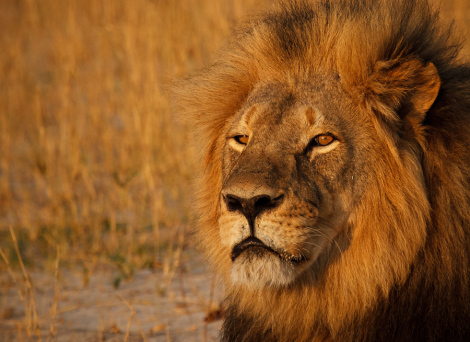
Portrait of Cecil by Ed Hetherington

http://www.huffingtonpost.com/michael-markarian/airlines-take-flight-from-trophy-hunting_b_7966170.html

by

Chief Program & Policy Officer, The Humane Society of the United States

The tragic death of Cecil the Lion — senselessly shot by an American dentist with a bow and arrow and left to suffer for hours before being shot again — has exposed the pay-to-slay subculture of wealthy people who spend a fortune to kill the grandest, most majestic animals in the world. The public outrage shows no signs of slowing down.

Virtually overnight, a cascade of major airlines has banned the transportation of spoils from the trophy killing industry — principally elephants, rhinoceros, lions, leopards, and buffalo, or the “Africa Big Five” sought for self-aggrandizement in the Safari Club International record books. Delta, United, American and others are all in flight from the destruction and death meted out by trophy hunters on the African continent.

But when will Congress get on board? Even now, there are lawmakers working quietly to appease the bullies and fat-cats of the trophy hunting corps. While most of the world is convulsed over Cecil, some members of Congress are springing into action to grant special favors for one of the smallest and most elite groups of trophy hunters in the world.

Walter Palmer is now a household name. What isn’t so widely known is that there are thousands of ultra-wealthy trophy hunters just like him, and that 41 of them are lobbying Congress for a wholly unprincipled bail-out that would blow a hole in the heart of the Endangered Species Act.

Bills in the House and Senate — the “Bipartisan Sportsmen’s Act” sponsored by Sens. Lisa Murkowski, R-Alaska, and Martin Heinrich, D-N.M., and the “SHARE Act” sponsored by Reps. Rob Wittman, R-Va., Tim Walz, D-Minn., Jeff Duncan, R-S.C., and Gene Green, D-Tex. — both provide a sweetheart deal to help 41 big-bucks, trophy-mad hunters import the heads of rare polar bears they shot in Canada. None of these millionaire trophy hunters, who paid as much as $50,000 each to shoot a polar bear, ate the meat. They just went on a head-hunting exercise in the Arctic, and paid a fortune to do so — all for the head and the hide and the bragging rights that go along with it.

U.S. law bars import of these trophies because polar bears are in terrible trouble with their very survival at stake, thanks to climate change, commercial trade, and over-hunting. These animals were killed during expensive trophy safaris in Canada at a time when the Bush Administration had proposed listing the polar bear as a threatened species — the U.S.’s contribution to conservation. These fat-cat hunters proceeded knowing that the door would be closed to polar bear trophy imports, but confident that they could always call upon friends in Congress to do their bidding and get them an exemption.

Indeed, Congress has several times granted similar import allowances — a de facto repeal of the import ban — sending a message to trophy hunters that they can continue killing imperiled species and eventually exert their influence to get approval to bring home their trophies. The cumulative impact of this corrosive pandering encourages more reckless killing of these animals around the globe.

The whole sordid business is fueled by competitive killing programs that give “hunting achievement” awards and “grand slams” for kills in specific categories. For example, hunters at the Safari Club International compete for the “North American 29” award, which requires killing a minimum of 29 species and subspecies of animals, including the polar bear, in North American habitat. They also strive to earn the “Bears of the World” award, which requires killing five bears, such the polar bear and Eurasian and Siberian brown bears, on a number of continents.

The U.S. Fish and Wildlife Service is now considering a rule to list the African lion as threatened under the Endangered Species Act. Should all the Walter Palmers of the world seeking the “Africa Big Five” award now rush to be among the last hunters to bag the king of the jungle? That acceleration of killing inverts the very purpose of the law.

These trophy hunters don’t care that African lion populations and polar bear populations are declining fast. They don’t care that time is running out to slow the mortality of these majestic creatures. But Congress should.

Trump Defends His Sons’ Sick Hobby Of Killing Innocent Animals

https://www.thedodo.com/trump-speaks-on-sons-hunting-1275724124.html

By Stephen Messenger

Unfortunately for one Republican presidential hopeful, the answer is: his sons.

Donald Trump was forced to weigh in on the issue this week after a gory photo of his trophy hunting sons resurfaced online, tying his family to the very practice that has sparked fierce backlash in recent days. When asked for his response at a press conference in Scotland this week, Trump was reportedly far from condemning of the fact that his sons had a hobby of killing innocent animals, too.

“My sons love to hunt,” The Telegraph and The Daily Mail report Trump said, though he reportedly refused to directly address shooting endangered animals. “They are members of the NRA, very proudly. I am a big believer in the Second Amendment. But my sons are hunters, Eric is a hunter and I would say he puts it on a par with golf, if not ahead of golf. My other son, Don, is a hunter. They’re great marksman, great shots, they love it. I em, like golf. I don’t do that.”

As benign as he makes it sound, Trump’s sons are hardly run-of-the-mill hunters. The family’s fortune has apparently been used to fund safaris to Africa, targeting beloved animals like elephants and leopards — hunting trips that can range in the tens of thousands of dollars.

While the senior Trump has stated before that he’s not a believer in hunting, his unwillingness to discourage the practice outright given the chance stands in contrast to the reaction of other public figures.

See below for more of The Dodo’s coverage on Cecil:

Lion Killer Dentist Writes Letter To Patients About His Passion For Hunting

Jimmy Kimmel Tears Into ‘A-hole’ Dentist Who Killed Cecil The Lion

Lion Killer Dentist Is Having The Worst Day Ever

Cecil’s Death Just Got More Depressing: His 12 Cubs Will Probably Die Now

We Can Do A Lot More To Save Lions Than Sign Petitions For Cecil

Trophy Hunting Deserves the Attention it Does Not Want

11825758_10153384818490861_9149004585855556291_n

http://www.bornfreeusa.org/weblog_canada.php> Born Free USA Canadian Blog by Barry Kent MacKay 07 Aug 2015

As most folks now know, after suffering for 40 hours, wounded by an arrow, an African lion given the name “Cecil” was shot again—this time fatally—with a rifle.

His tormentor was a dentist named Walter Palmer, from Minnesota, who had paid tens of thousands of dollars, travelling to distant Zimbabwe to kill animals: something he admits he loves to do. Cecil had been lured from a national park, which is illegal to do in Zimbabwe.

And, the world took note. Cecil was wearing a radio tracking collar. His body was skinned, the head removed.

Palmer’s guide was charged with poaching and so was the owner of the ranch where this outrage occurred.

Now, Zimbabwe wants to extradite Palmer from the U.S. to face similar charges. Palmer has been the subject of outrage, all the more so for having poached before, when he lied about where he had shot a black bear in the U.S. His life has been threatened, his property vandalized, his business closed for now, and he has fled into hiding, hounded by relentless vitriol and images of him posted on social media posing with various beautiful animals he has killed. He looks so pleased; the animals look so dead.

If there is a positive outcome to this situation, it may be to the degree that trophy hunting has received attention it would rather avoid.

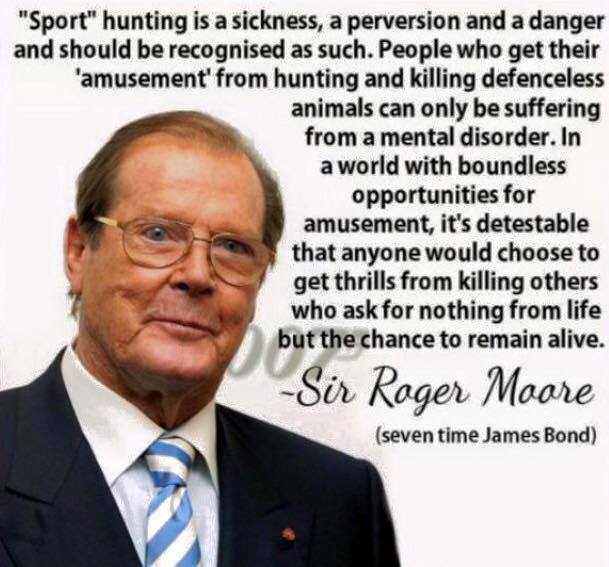
I am personally inclined to agree with British actor Sir Roger Moore, who said, “‘Sport’ hunting is a sickness, a perversion, and a danger and should be recognized as such… We know that we should protect the most vulnerable and helpless in society, not destroy them—much less derive pleasure from doing so.

Thankfully, those of us with a conscience are appalled by the idea of gunning down animals for the sake of a thrill or a photo. Interest in hunting in Great Britain and elsewhere is steadily declining, since decent people prefer to hike, take photographs, kayak, and generally enjoy the outdoors without killing other beings.”

Palmer had already scored the “super grand slam” of North American trophy hunting by killing all of the “top 29” North American species and subspecies.

And then, there is Sabrina Corgatelli, an American accountant who defended her own love of killing animals on a national TV show, saying, “There is a connection to the animal, and just because we hunt them doesn’t mean we don’t have a respect for them. Giraffes are very dangerous animals. They could hurt you seriously, very quickly.” This last comment was likely in reference to disgusting images of her posing triumphantly with a giraffe she had just killed. In her Facebook account of this event, she wrote, “I got an amazing old giraffe. Such an amazing animal!!!! I couldn’t be happier.”

There are hunters I’ve met who have no respect for the category of hunting known as “trophy” hunting, or even of baiting animals to lure them into range. Cecil was lured from the park refuge by the smell of a dead animal tied to a vehicle, at night, and shot when caught in the glare of a spotlight. We would never know but for the radio collar, put there by scientists from Oxford University studying lions in the nearby park. We have learned of other such lions being shot for the same reason. Indeed, lions are in serious decline, heading toward extinction.

Killing animals for trophies continues day after day around the world. It seems even reminiscent of those serial killers who take some trophy of their victims—some hair or a piece of clothing, perhaps—as if wanting to have a souvenir to aid memory of the event. Except, trophy hunting for animals is, too often, quite legal.

And, while they may not be able to admit it to themselves, I think that, at some rudimentary level, trophy hunters realize that their love of killing is an aberration to other people. Thus, they may try to excuse it with rationales that, thanks to Cecil’s sad plight, are now being held up to scrutiny. No giraffe threatens you, me, or Corgatelli. Even Cecil never bothered or threatened humans.

The more sophisticated defense is that trophy hunting brings essential revenue to places like Africa, to be used for conservation. But, it does no such thing. We have found that <http://www.bornfree.org.uk/animals/lions/projects/trophy-import-ban/> revenue from trophy hunting is a fraction of what tourism brings to Africa, and people travel to such places mostly to see (not kill) live (not dead) animals.

It is almost as if the trophy hunter somehow thinks that, with access to the art of taxidermy, the grace, beauty, power, and elegance of beautiful creatures can be possessed and owned as a reflection of their own competency. They don’t “get” how pathetic they are in the eyes of other people.

Some argue that trophy hunting removes geriatric animals who are past being able to contribute to the survival of the species. However, that was not true of Cecil, nor Corgatelli’s “old giraffe,” nor most other animals: often prime individuals. (That’s the whole idea.). And, at any rate, the slaughter still begs the question of “Why?” Why do you want to kill anything?

To shoot a warthog? A walrus? A giraffe? How can a person kill something so wonderfully alive and so evocative of the high plains and big skies as a pronghorn—for fun? No. I just don’t want to do that. Most people don’t. Those who do are the aberrant ones: the misfits, the insecure, the outright strange.

They are a minority… but not enough of a minority. They are killers in a world that’s in desperate need of protectors.

And, at Born Free, and in our offices everywhere—including mine up in Canada—that’s why we’re here.

Economics of Trophy Hunting in Africa Are Overrated and Overstated

http://www.ifaw.org/united-states/news/new-report-economics-trophy-hunting-africa-are-overrated-and-overstated

New Report: Economics of Trophy Hunting in Africa Are Overrated and Overstated
Tuesday, June 18, 2013
Washington, DC

A new report released today analyzes literature on the economics of trophy hunting and reveals that African countries and rural communities derive very little benefit from trophy hunting revenue. The study, authored by Economists at Large—commissioned by the International Fund for Animal Welfare (IFAW www.ifaw.org), The Humane Society of the United States, Humane Society International and Born Free USA/Born Free Foundation—comes amid consideration to grant the African lion protection under the U.S. Endangered Species Act (ESA).

“The suggestion that trophy hunting plays a significant role in African economic development is misguided,” said economist Rod Campbell, lead author of the study.  “Revenues constitute only a fraction of a percent of GDP and almost none of that ever reaches rural communities.”

As a portion of any national economy, trophy hunting revenue never accounts for more than 0.27 percent of the GDP. Additionally, trophy hunting revenues account for only 1.8 percent of overall tourism in nine investigated countries that allow trophy hunting, and even pro-hunting sources find that only 3 percent of the money actually reaches the rural communities where hunting occurs. While trophy hunting supporters routinely claim that hunting generates $200 million annually in remote areas of Africa, the industry is actually economically insignificant and makes a minimal contribution to national income.

“Local African communities are key stakeholders for conservation, and they need real incentives for conservation,” said Jeff Flocken, North American regional director, International Fund for Animal Welfare. “Non-consumptive nature tourism–like wildlife viewing and photo safaris–is a much greater contributor than trophy hunting to both conservation and the economy in Africa. If trophy hunting and other threats continue depleting Africa’s wildlife, then Africa’s wildlife tourism will disappear. That is the real economic threat to the countries of Africa.”

Many species suffer at the hands of trophy hunters including the African lion. The number of African lions has declined by more than 50 percent in the past three decades, with as 32,000 or fewer believed remaining today. The steepest declines in lion population numbers occur in African countries with the highest hunting intensity, illustrating the unsustainability of the practice.

“Trophy hunting is driving the African lion closer to extinction,” said Teresa Telecky, director, wildlife department, Humane Society International. “More than 560 wild lions are killed every year in Africa by international trophy hunters. An overwhelming 62 percent of trophies from these kills are imported into the United States. We must do all we can to put an end to this threat to the king of beasts.”

Listing the African lion as endangered under the ESA would generally prohibit the import of and commercial trade in lion parts, and thus would likely considerably reduce the number of lions taken by Americans each year.

“The U.S. government has a serious responsibility to act promptly and try to prevent American hunters from killing wild lions, especially when the latest evidence shows that hunting is not economically beneficial.  Listing the African lion under the Endangered Species Act will help lions at almost no cost to African communities. Government inaction could doom an already imperilled species to extinction through much of its range,” said Adam Roberts, executive vice president, Born Free USA.

A copy of the economic study is available for download.

###

About the International Fund for Animal Welfare (IFAW)
Founded in 1969, IFAW (the International Fund for Animal Welfare) saves animals in crisis around the world. With projects in more than 40 countries, IFAW rescues individual animals, works to prevent cruelty to animals, and advocates for the protection of wildlife and habitats. For more information, visit www.ifaw.org. Follow us on Facebook and Twitter.  Photos and video available at www.ifawimages.com.

About Born Free USA
Born Free USA is a recognized leader in animal welfare and wildlife conservation. Through litigation, legislation, and education, Born Free USA leads campaigns against animals in entertainment, exotic “pets,” trapping and fur, and the international wildlife trade.  Born Free USA brings to America the mission of the U.K.-based Born Free Foundation, established in 1984 by Bill Travers and Virginia McKenna, stars of the iconic film Born Free:  to end suffering of wild animals in captivity, conserve threatened and endangered species, and encourage compassionate conservation. (bornfreeusa.org; twitter.com/bornfreeusa; facebook.com/bornfreeusa.)

About Born Free Foundation
Born Free Foundation, based in England, is an international organization devoted to compassionate conservation and animal welfare.  Born Free Foundation takes action worldwide to protect threatened species, stop individual animal suffering, and keep wildlife in the wild. Born Free helps hundreds of thousands of animals worldwide each year.  (bornfree.org/uk)

About The Humane Society of the United States
The Humane Society of the United States is the nation’s largest animal protection organization, rated the most effective by its peers. Since 1954, The HSUS has been fighting for the protection of all animals through advocacy, education and hands-on programs. We rescue and care for tens of thousands of animals each year, but our primary mission is to prevent cruelty before it occurs. We’re there for all animals, across America and around the world. Celebrating animals and confronting cruelty – on the Web at humanesociety.org. Subscribe to Wayne Pacelle’s blog, A Humane Nation. Follow The HSUS on Twitter. See our work for animals on your Apple or Android device by searching for our “Humane TV” app.

About Humane Society International
Humane Society International and its partner organizations together constitute one of the world’s largest animal protection organizations. For nearly 20 years, HSI has been working for the protection of all animals through the use of science, advocacy, education and hands-on programs. Celebrating animals and confronting cruelty worldwide — on the Web at hsi.org.

Alaska big-game hunting “safe” from airline trophy bans

http://juneauempire.com/local/2015-08-06/alaska-big-game-hunting-safe-airline-trophy-bans

August 6, 2015 – 12:06am

The amount of revenue generated by resident and non-resident hunting activities and their support systems means big game is a big deal for Alaska.  James Brooks | The Juneau Empire

James Brooks | The Juneau Empire
The amount of revenue generated by resident and non-resident hunting activities and their support systems means big game is a big deal for Alaska.


It has been more than a month since an American Dentist killed Cecil the lion, Zimbabwe’s most famous feline, but public uproar regarding the lion’s death is certainly still alive.

On Monday, three major U.S. airlines added their names to a growing list of carriers limiting, and in some cases eliminating altogether, the transport of hunting trophies.

“Effective immediately, Delta will officially ban shipment of all lion, leopard, elephant, rhinoceros and buffalo trophies worldwide as freight,” Delta announced in a press release Monday. United Airlines and American Airlines released similar statements the same day, joining several other international carriers — some of whom started banning hunting trophies as early as April.

Alaska Airlines has no intention to implement any such ban. The Seattle-based company has made clear that it will continue allowing the transport of hunting trophies as long as they meet the airline’s existing guidelines.

“Our existing policy works well for the people in the Lower 48 and in Alaska, and we’re not making any policy changes,” said Bobbie Egan, a spokesperson for Alaska Airlines.

Though most carriers’ hunting-trophy bans primarily target trophies taken in Africa, Delta went on to say that it “will also review acceptance policies of other hunting trophies,” potentially impacting trophy hunting in Alaska. Delta is engaged in tight competition with Alaska Airlines for service to and from the 49th state, having added year-round service to Fairbanks, Juneau and several other communities in recent years.

Nonetheless, many of Alaska’s top sport-hunting officials are not worried that these bans will hurt the state’s robust big-game hunting industry, which drew in $3.9 million from hunting-tag fees in 2014.

Since the 1960s, the Alaska Department of Fish and Game has awarded and sold thousands of hunting tags annually to Outside visitors seeking to hunt the biggest state’s biggest game. Caribou, moose, black bears and grizzly bears are the animals most sought after by out-of-state sport hunters.

None of the major U.S. airlines banning hunting trophies have added these animals to their no-fly lists and bison, available in Alaska, are hunted in extremely small numbers. However, even if the airlines banned all shipments, the Alaskan big-game hunting industry likely wouldn’t be impacted, said Kelly Vrem, chair of the Alaska Big Game Commercial Services Board.

Vrem has been a guiding big-game hunts for more than four decades and hunting even longer. The way he sees it, the bans are hardly more than a publicity stunt by airlines.

“This is kind of grandstanding on the airlines’ part,” Vrem said. “It’s is nothing but an opportunity to get some free advertising.”

Most out-of-state hunters who are coming to Alaska and taking trophies home are not transporting them on commercial airlines, he said. Instead, these hunters use regular freight companies or specialty expeditors to ship their trophies home, and that has been the case here for more than 20 years.

“For a fair amount of time now, it has really been impractical to ship trophies by air,” Vrem said. “It was a hassle for them, and it was a hassle for us, too. It was just a nuisance for everyone.”

Such a nuisance, in fact, that Vrem’s business, Kelly Vrem’s Rough and Ready Guide Service, officially changed its policy regarding shipment of trophies in 1993 to recommend against using commercial airlines for shipping.

The airlines didn’t like dealing with trophies because they are typically large and heavy, he said. They take up a lot of space, and can be damaging to other luggage. If packaged improperly, for example, caribou horns are sharp enough to puncture soft luggage stacked on top of them, he said.

Back then, Vrem never had a problem with the airlines. It was simply easier for both parties if hunters shipped their trophies using freight services. However, now Vrem said he plans to avoid flying with any airlines imposing hunting-trophy bans, which he sees as useless if not insulting. He’s not the only one.

Thor Stacey, a hunting guide and member of the Alaska Professional Hunters Association, said the hunting trophy bans are useless in protecting animals and offensive to hunters.

“We feel, in a way, very picked on,” Stacey said. “It’s akin to the person who doesn’t want to make wedding cakes for same-sex couples who are getting married.”

Stacey said animals would be better protected if these airlines would impose a tariff on the transport of trophies rather than a ban. The extra money raised by the tariff could then be put toward habitat protection and conservation, he said. “Now that would be something we could understand.”

Delta and United did not respond to the Empire by press time. American issued the following statement, “Even though we do not serve the continent of Africa, we will no longer transport buffalo, elephant, leopard, lion or rhinoceros trophies.”

• Contact reporter Sam DeGrave at sam.degrave@juneauempire.com or at 523-2279.

Similar stories from JuneauEmpire.com

Let’s Ground Trophy Hunting

Featured Image -- 10026
From HSUS.org

In the days since the circumstances surrounding the death of Cecil the lion came to light, at least 20 airlines have shown their commitment to protecting wildlife by implementing or clarifying existing bans on the transport of hunting trophies.

While companies like Delta, Virgin Airways, United Airlines and KLM are moving in the right direction, one airline has taken a detour. Despite instituting a ban in late April, South African Airways recently resumed the transport of hunting trophies because of pressure from commercial trophy hunting interests

With Cecil’s death, the world has come to realize the truly horrific nature of trophy hunting. Africa’s wild animals are part of our global heritage and must be protected from needless slaughter for the sake of a head-hunting exercise. By giving trophy hunters — and poachers — a way to transport pieces of these majestic creatures, South African Airways is providing a getaway vehicle for the theft of Africa’s wildlife.

Urge South African Airways to honor Cecil by joining the growing list of airlines that will no longer participate in the depletion of Africa’s wildlife — write today and tell the company #DontFlyWild.

Cecil the lion’s death highlights the work to be done to protect wildlife

August 5 at 7:31 PM

IN THE wake of the international outcry over the death of Zimbabwe’s most famous lion, the country’s wildlife authority has suspended the hunting of lions, leopards and elephants in the areas outside the park that the black-maned Cecil made his home before he was lured to his death. Conservationists hailed the move as a good first step. But more than a temporary stop in hunting in one African country will be needed if threatened and endangered species are to be saved.

Circumstances of the death of Cecil, a 13-year-old lion popular with tourists at Hwange National Park and being studied by scientists, are well known. Shot with an arrow after a dead animal was allegedly used to draw him out of his sanctuary, Cecil was tracked for 40 hours before being shot with a gun, skinned and beheaded. Walter Palmer, the American dentist who admitted killing Cecil, expressed regret, saying he relied on local guides and thought the hunt was legal. Officials in Zimbabwe and the United States are investigating.

What must not get lost in the hunt for justice for one celebrity lion is that Cecil’s death is part of a larger problem. The decline in population of African lions has been dramatic, from 500,000 to 600,000 at the turn of the 20th century to about 30,000 today. Other animals — elephants, rhinoceros, apes — are in equal, sometimes greater, danger. The Post’s Kevin Sieff pointed up the contrast in attention between Cecil’s killing and that of five nameless elephants slaughtered in Kenya by poachers marketing in ivory.

Hunting, legal and illegal, has not been the main cause of the decline in animal populations; that honor goes to the encroachment of civilization on natural habitats. Indeed, some hunting enthusiasts even argue that trophy hunting can be a boon to conservation by generating big fees to support sanctuaries, attract tourists and discourage local residents from killing animals or taking over their habitats.

Whether trophy hunting is beneficial to wildlife is a matter of some dispute. A 2009 report from the International Union for the Conservation of Nature said it had produced “mixed results.” Countries (Namibia is an example) that tightly regulate trophy hunting (paying close attention to the population of species), are vigilant about enforcement and are transparent about where the monies go can claim some overall benefits in helping wildlife. Too many countries, though, sell permits with lax regulations, no enforcement and no idea of the impact on animal populations.

 Portrait of Cecil by Ed Hetherington

The African Wildlife Foundation is asking all African governments to consider placing a moratorium on the trophy hunting of lions. Delta has joined other airlines in banning the shipment of big-game trophies on its flights. The United Nations has called on member states to increase efforts to fight poaching of endangered species, and the U.S. Fish & Wildlife Service has proposed listing lions as threatened under the Endangered Species Act. All are prudent moves that we hope will prove to be more than a sop to those mourning Cecil.

Wednesday Cecil News Roundup

Naples taxidermist reacts to ban on shipment of trophy animals
http://www.nbc-2.com/story/29710960/naples-taxidermist-reacts-to-ban-on-shipment-of-trophy-animals#.VcJBBBNViko
“He’s not happy about the new ban, but he said even though Delta,
United and American airlines aren’t allowing trophy animal remains to
be shipped into the U.S., it won’t kill his business.”

Cecil the lion killer Walter Palmer’s Florida vacation home vandalized
http://www.dailymail.co.uk/news/article-3185082/Cecil-lion-killer-s-1million-Florida-vacation-home-vandalized-graffiti-pigs-feet.html?ito=social-twitter_dailymailus

‘LION Killer!’ sprayed on Florida home of Twin Cities hunter
http://www.startribune.com/vandals-tag-lion-killer-on-fla-home-of-twin-cities-hunter/320741711/?stfeature=S
“Pigs feet made to look bloody also left in the driveway of the Marco
Island residence.”

Trial due to open in Zimbabwe over Cecil the lion’s death
http://news.yahoo.com/trial-due-open-zimbabwe-over-cecil-lions-death-035034280.html

Zimbabwe has suspended the hunting of wildlife following the death of
Cecil the lion
http://qz.com/471639/zimbabwe-has-suspended-the-hunting-of-wildlife-following-the-death-of-cecil-the-lion/

Dubai expat’s billboard campaign to raise awareness of animal rights
http://www.thenational.ae/uae/dubai-expats-billboard-campaign-to-raise-awareness-of-animal-rights

Animal rights organisation against proposal to export dog meat
http://www.niticentral.com/2015/08/05/animal-rights-organisation-against-proposal-to-export-dog-meat-327231.html
“Kochi, Aug 4 (PTI) An animal rights organisation today termed as
“illegal” a controversial resolution adopted by gram panchayats in a
Kerala district proposing export of dog meat to China to counter stray
dog population, saying the state government was bound to follow rules
established by the Centre in this regard.”

Air Canada bans shipments of hunting trophies after killing of Cecil the lion
http://www.startribune.com/air-canada-bans-shipments-of-big-game-hunting-trophies/320681132/?stfeature=S

Major U.S. airlines halt carrying African hunting trophies after Cecil
the Lion killing
http://www.marketwatch.com/story/delta-air-lines-bans-animal-hunting-trophies-after-cecil-the-lion-shooting-2015-08-03
“American Airlines AAL, says it’s joining U.S. carriers Delta Air
Lines DAL, and United Airlines UAL, in banning hunting trophies from
baggage if they are from endangered species. This comes as worldwide
outrage over the killing of Cecil the Lion, Zimbabwe’s most famous big
cat, by a Minneapolis dentist last month shows no sign of abating.”

‘Canned hunting’ of lions in South Africa raises concern, debate
http://www.chicagotribune.com/news/nationworld/ct-south-africa-lion-hunting-20150804-story.html

How Vegans Should Be Responding to Cecil the Lion
http://www.care2.com/greenliving/how-vegans-should-be-responding-to-cecil-the-lion.html

Guide who led Twin Cities dentist to Cecil defends his actions
http://www.startribune.com/bc-zimbabwe-lion-killing-nyt-0548-n-guide-who-led-hunt-that-killed-cecil-the-lion-defends-his-actions/320699191/?stfeature=S
“The guide who led a Minnesota dentist on the hunt that killed Cecil
the lion defended his actions Tuesday, a day before he was scheduled
to stand trial in Zimbabwe.”

http://www.washingtonpost.com/news/morning-mix/wp/2015/08/03/delta-air-lines-bans-freight-shipments-of-lion-hunting-trophies/