Thu 22 Oct 2020 04.58 EDTLast modified on Thu 22 Oct 2020 04.59 EDT
Shares37
Joe Biden is leading Donald Trump in the national polls for the presidential election.
But that doesn’t guarantee the Democratic candidate victory. Hillary Clinton also had a clear lead over Trump in the polls for almost the entire 2016 campaign. She ended up losing in the electoral college.
Each day, the Guardian’s poll tracker takes a rolling 14-day average of the polls in eight swing states.
In order to track how the race is developing in the areas that could decide the election, six of the eight states we focused on were those that flipped to Trump in 2016 after backing Barack Obama in 2012. Arizona and North Carolina were also added due to what they might tell us about a shifting electoral landscape – they could emerge as vital new swing states this year.
We must caution that the polls – particularly some swing state polls – severely undercounted Trump supporters in 2016. We are not certain, despite assurances, that they they have corrected this. Additionally, they may be over-counting Democratic support (more people may say they will vote for Biden than actually turn out).
We present the latest polls with those caveats to be borne in mind.
The national polls
Advertisement
The latest polling average puts Biden ahead of Trump nationally.
While the national poll tracker is a poor indicator of how the crucial swing states will sway the election, a strong polling lead across the country can point to how the race will develop.
Each day, the Guardian’s national poll tracker takes a 14-day average of national voting intention polls.
On Tuesday 3 November 2020, Americans will vote for their next president, with a choice between Donald Trump, the Republican incumbent, or his Democratic challenger, Joe Biden.
Methodology
The Guardian poll tracker tracks the latest polls in eight crucial swing states. For Biden to win, he needs to reclaim some of these swing states.
The Guardian is collating polls in each of these states, as well as another set of national polls. Any polls deemed unreliable – for example, because they have small sample sizes – are excluded.
Our polling average is a 14-day rolling average: on any day, we collate any polls published in the last 14 days and take a mean average of their results.
If any company has conducted multiple polls in the last 14 days, we average out their polling results in order to give them just one entry. After this standardization process, we take a mean average of these daily entries to present the polling average.
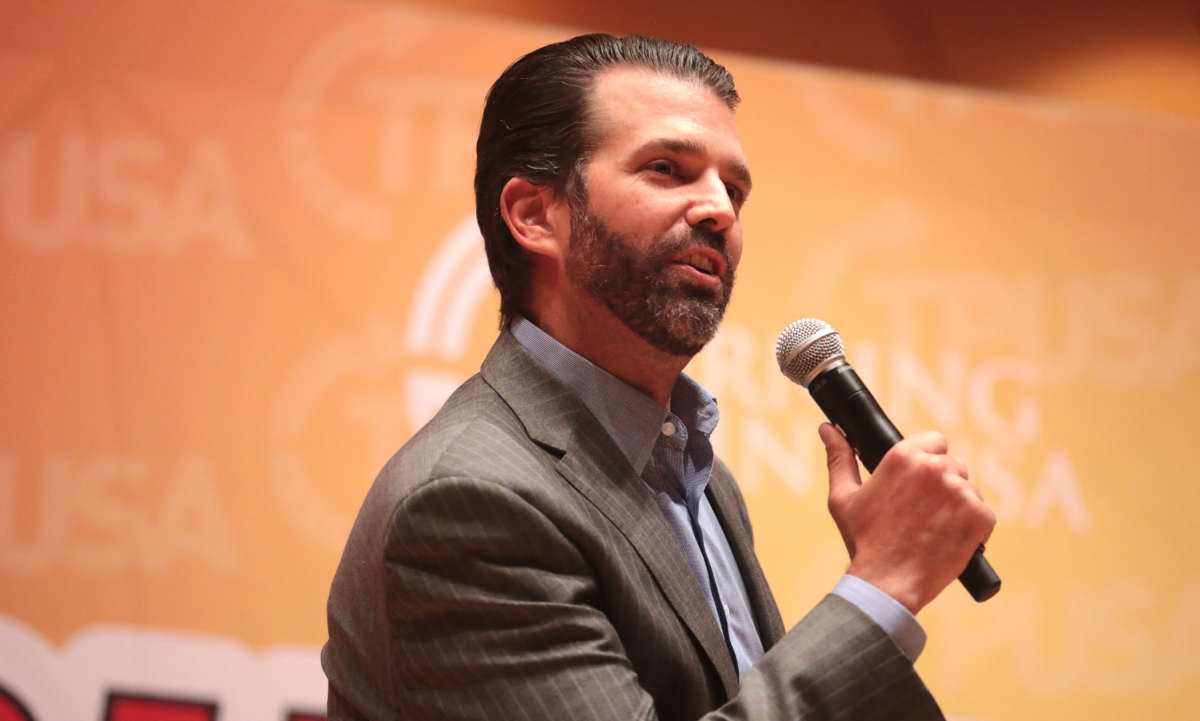
Donald Trump Jr., the eldest child of President Donald Trump, has received a suspension from the social media site Twitter for sharing potentially harmful information related to coronavirus.
“The Tweet is in violation of our COVID-19 misinformation policy,” a spokesperson for Twitter said. “The account will be locked until the account owner removes the Tweet.”
Twitter announced in March that it would regulate and remove content “when it has a clear call to action that could directly pose a risk to people’s health or well-being.” That includes content with descriptions “of alleged cures for COVID-19,” as well as the promotion of “harmful treatments or protection measures which are known to be ineffective.”
The post in question that Don Jr. had shared seems to fit those descriptors.
The president’s son retweeted a post that falsely promoted hydroxychloroquine as a cure for coronavirus. The video also showed individuals, claiming to be doctors, telling viewers “you don’t need masks” to protect themselves from the disease, contradicting recommendations from the Centers for Disease Control and Prevention (CDC).
In spite of the fact that President Trump has himself come around on the issue of masks, he, too, shared the dubious and misinformative video on his Twitter account on Tuesday, which also took aim at Anthony Fauci, the director of the National Institute of Allergy and Infectious Diseases. Twitter removed the original post, but took no action against the president’s account, as the company has a separate policy around world leaders’ accounts, stating that they will be allowed to remain in place because of their “public interest value.” However, Twitter appears not to have followed through on its policy of placing such tweets “behind a notice that provides context about the violation” in this case, though it has done so to the president’s tweets in the past.
Other social media sites, including Facebook and YouTube, have also taken actions against users who have shared the same video.
Twitter’s actions come after President Trump petitioned the Federal Communications Commission (FCC) to take more regulatory steps toward social media sites earlier this week. Trump is seeking to require such companies to “publicly disclose accurate information regarding its content-management mechanisms” in order to allow “users to make more informed choices about competitive alternatives.”
Trump also complained on Monday about Twitter’s trending topics feature, arguing that it was promoting content that portrayed him in a negative way.
“They look for anything they can find, make it as bad as possible, and blow it up, trying to make it trend,” he said.
Moves to change how the FCC treats social media are being opposed by the two Democratic appointees on the commission, who view the attempts to do so as a means for Trump to politically pressure the site.
“While social media can be frustrating, turning this agency into the President’s speech police is not the answer,” FCC Commissioner Jessica Rosenworcel said in response to Trump’s request.
BY RICHARD RICHELS, HENRY D. JACOBY, GARY YOHE AND BEN SANTER, OPINION CONTRIBUTORS — 07/18/20 09:00 AM EDT 885THE VIEWS EXPRESSED BY CONTRIBUTORS ARE THEIR OWN AND NOT THE VIEW OF THE HILL147
In its campaign against action on greenhouse gas emissions, one of the more subtle moves by the Trump administration is its manipulation of the Social Cost of Carbon (SCC). This number is used to represent the damage resulting from emitting an additional ton of carbon. Climate economists sometimes refer to it as the most important number you’ve never heard of. Undermine the SCC and you can discredit action to fight climate change, boost support for the fossil fuel industry, tip the scales away from renewable energy and counter other important policy initiatives. Fortunately, in a detailed report on the estimation of the SCC, the congressional watchdog General Accounting Office has called out this latest affront to reliable assessment of the science and risks of climate change.
The SCC is a key input to the benefit-cost analyses required of all federal regulatory actions, and thus is an important factor in their justification. The federal SCC estimate has also been adopted by several states. Examples of the SCC’s use are abundant, including the setting of reasonable federal standards for the performance of private automobiles and appliances.
Estimating the SCC requires joint consideration of natural and social science aspects of the climate change problem. A federal working group spent nearly a decade on this process. Recognizing that the underlying methodology needed rigorous and impartial review, the interagency group commissioned a comprehensive update by the U.S. National Academy of Sciences (NAS). The 2017 NAS report supported the previous approach to valuing the SCC, recommending a program of research and analysis to improve the estimate.
The Trump administration did not follow this recommendation. Instead, it imposed measures to hobble reliable estimation of the SCC. The earlier working group was disbanded, associated documents were withdrawn and the NAS study was ignored. Instead, changes were made to limit the SCC’s scope and the weight it gave to future generations. These changes cannot be justified by either the science or the standards deemed acceptable for benefit-cost studies.
As a result of the administration’s changes, the previous central value for the SCC – roughly $50 per ton of CO2 – was reduced by nearly 90 percent.
These changes are misguided and pernicious. They limit damages to those occurring within U.S. borders, and thus reflect a tragic misunderstanding about climate change and the U.S. national interest. CO2 emissions, primarily from the burning of fossil fuels, impact every person on the planet, regardless of the geographical location of the source. To limit current and future climate change damages, it is in the U.S. national interest not only to reduce its own emissions, but also to encourage other countries to do the same. The administration’s near-zero SCC does just the opposite, offering other countries a pretense for adopting positions that mimic those of the world’s second-largest emitter.
There are many other causes for concern. The impacts of our emissions will be felt most cruelly by the most vulnerable Americans, and by those countries least able to cope with the ensuing damages. Ignoring the needs of these individuals and countries threatens to exacerbate societal inequities at home and to create millions of environmental refugees abroad. Humanitarian crises that would burden rich and poor nations alike are the obvious consequences. Preventing these crises is both the right thing to do and in our own self-interest.
Another critical aspect of the SCC calculation is the value placed on future generations. Intergenerational equity is a contentious topic. There are reasonable debates among social scientists about what constitutes fairness in the treatment of unborn generations. Despite these disagreements, there is convergence among scholars as to what represents a plausible range of discount factors. The administration, ignoring the prudent advice of the NAS authors and other knowledgeable experts, provides no analysis of its own. It simply mandates a set of discount rates at the higher end of the spectrum, to the disadvantage of future generations.
In its assessment of the administration’s SCC procedure, the GAO uses careful diplomatic language. It writes that, “. . . the federal government may not be well positioned to ensure agencies’ future regulatory analyses are using the best available science.” Our interpretation is more direct: Ignoring the science to cook the numbers discredits the federal process for public decision-making.
The GAO recommends that a federal agency should be made responsible for addressing the NAS report, and for ensuring that the best-available science is used in calculating the SCC. Sadly, there is little expectation that this recommendation will be heeded by an administration that denies the reality and seriousness of the climate threat.
Richard Richels directed climate change research at the Electric Power Research Institute (EPRI). He served on the National Assessment Synthesis Team for the first U.S. National Climate Assessment.
Henry D. Jacoby is the William F. Pounds Professor of Management, Emeritus in the M.I.T. Sloan School of Management and former co-director of the M.I.T. Joint Program on the Science and Policy of Global Change.
Gary Yohe is the Huffington Foundation Professor of Economics and Environmental Studies, Emeritus, at Wesleyan University in Connecticut. He served as convening lead author for multiple chapters and the Synthesis Report for the IPCC from 1990 through 2014 and was vice-chair of the Third US National Climate Assessment.
Ben Santer is a climate scientist and member of the U.S. National Academy of Sciences. He served as convening lead author of the climate change detection and attribution chapter of the IPCC’s Second Assessment Report and has contributed to all five IPCC assessments.
Just in the past three years, the Trump administration has attempted to roll back at least 95 environmental rules and regulations to the detriment of the environment and Americans’ public health. Moreover, the administration refuses to act to mitigate the effects of climate change—instead loosening requirements for polluters emitting the greenhouse gases that fuel the climate crisis. This dangerous agenda is affecting the lives of Americans across all 50 states.
Between 2017 and 2019, North Dakota experienced one severe flood and one intense drought. The damages of these events led to losses of at least $1 billion.
In North Dakota, more than 50,000 people live in areas with an elevated risk of inland flooding. This is concerning because precipitation is projected to increase in North Dakota during the colder part of the year.
North Dakota currently averages 10 heat wave days per year, but projections indicate that number will increase fivefold to nearly 50 days per year by 2050. This endangers the lives of the approximately 20,000 people living in North Dakota who are especially vulnerable to extreme heat.
Impacts of the Trump administration’s anti-environmental policies
Climate
In March 2020, the Trump administration announced its final rule to overturn Obama-era fuel efficiency standards for cars. These weakened fuel standards will lead to higher greenhouse gas and particulate matter emissions and will cost North Dakota residents $74.8 million
In August 2019, the Trump administration proposed eliminating federal requirements for oil and gas companies to control leaks of methane from new wells, storage facilities, and pipelines. In 2016, researchers found that the Bakken region in Montana and North Dakota, a significant oil and gas producing area, emits 275,000 tons of methane per year. Methane, a potent greenhouse gas, is responsible for one-quarter of greenhouse gas-driven global warming.
The Trump administration is attempting to gut climate considerations from major infrastructure projects by eliminating the “cumulative impact” requirement of the National Environmental Policy Act. This is concerning because North Dakota’s economy relies heavily on its agriculture, tourism, and outdoor recreation industries—all of which are highly dependent on climate and weather conditions.
Tourism: The tourism industry in North Dakota generates an economic impact of $3 billion and supports 43,000 workers annually, making tourism the state’s third-largest
Outdoor recreation: The outdoor recreation industry in North Dakota generates 30,000 direct jobs and $3.1 billion in consumer spending.
Air quality
Mercury emissions in North Dakota decreased by nearly 55 percent from 2011 to 2017, yet the Trump administration just undermined limits on the amount of mercury and other toxic emissions that are allowed from power plants.
Water quality
On the fourth day of Trump’s presidency, the administration issued an executive order advancing the construction of the Keystone XL and Dakota Access pipelines. In June 2017, the pipelines were fully functional and over the next year saw more than one dozen small spills. In March 2019, more than 9,000 barrels of crude oil had spilled in North Dakota alone, which caused immediate impacts on nearby wetlands.
William Perry Pendley, Trump’s nominee to lead the Bureau of Land Management, has ties to anti-environment and anti-government forces
‘Although Pendley has been acting director of the Bureau of Land Management since last July, his official nomination will give him troubling new authority and political clout.’ Photograph: georgesanker.com/Alamy Stock PhotoPublished onMon 6 Jul 2020 04.30 EDT
890
On 26 June, Donald Trump announced that he plans to nominate William Perry Pendley to lead the Bureau of Land Management. That may not sound like big news, but it is. First of all, the office manages one-tenth of the United States’ land mass and, therefore, massive amounts of fossil fuels. Second, Pendley is linked to two little-known but very dangerous political movements: the so-called Wise Use movement and the anti-government extremists sometimes called constitutionalists or sovereign citizens.
The appointment should not come as a total surprise. Wise Use advocates, who are fiercely opposed to almost any environmental protection laws, have long had exceptional access to the Trump administration. In 2017, Lars Larson, a “journalist” from the alternative rightwing media sphere, crystallized the attitude of the Wise Use movement with a comment he made to then press secretary Sean Spicer:
The federal government is the biggest landlord in America. It owns two-thirds of a billion acres of America. I don’t think the Founders ever envisioned it that way. Does President Trump want to start returning the people’s land to the people? And in the meantime … can he tell the forest service to start logging our forests aggressively again to provide jobs for Americans, wealth for the treasury, and not spend $3.5bn a year fighting forest fires?
Larson was expressing a key demand of the Wise Use movement. The movement wants to privatize basically all public land, so that it can be used “wisely” by big business – especially the agricultural, fossil fuel and logging industries, which are also the movement’s biggest donors. The movement has been responsible for significant harassment and threats of political violence, particularly against environmentalists and employees of government agencies in the Pacific north-west. Between 2013 and 2018 alone, federal employees overseeing public lands were assaulted or threatened at least 360 times. In roughly the same period, the FBI initiated under 100 related domestic terrorism investigations, most concerning individuals motivated by anti-government ideologies.
The anti-environmentalists overlap with sections of the broader US far right, notably so-called constitutionalists and sovereign citizens, who hold a variety of different beliefs, all essentially denying the legitimacy of the federal government. This very loosely organized subculture has been responsible for some of the most notorious anti-government actions, including the 2014 Bundy Standoff in Nevada and the 2016 Oregon Standoff. The Oregon standoff, in which members of rightwing militia groups occupied the Malheur national wildlife refuge for 41 days to protest the sentencing of two ranchers for burning federal lands, became a cause celebre for many far-right activists.
Trump has long been sympathetic to these movements. In 2018 he pardoned Dwight Hammond Jr and his son, Steven Hammond, the two farmers whose case sparked the Oregon Standoff. But so far Trump’s support has been mainly symbolic and verbal. Like Jair Bolsonaro in Brazil, Trump has questioned federal ownership of public land on many occasions. In November 2018, as California was battling massive forest fires, he tweeted:
There is no reason for these massive, deadly and costly forest fires in California except that forest management is so poor. Billions of dollars are given each year, with so many lives lost, all because of gross mismanagement of the forests. Remedy now, or no more Fed payments!
Note the similarity to Larson’s demand a year earlier.
Although Pendley has been acting director of the Bureau of Land Management since last July, his official nomination will give him troubling new authority and political clout. In addition to undermining his own agency, he will also probably push to privatize more public land and provide even more access to exploitation by agricultural, fossil fuel and logging companies. Just last week, the Bureau of Land Management proposed opening millions of acres in rural Alaska for oil and gas leasing.
Just as troubling: Pendley’s new role will probably further embolden far-right anti-environment and anti-government forces, some of which already consider themselves above the law. In an op-ed last year in the Las Vegas Review-Journal, Pendley defended the role of Bureau of Land Management law enforcement officers, but did so in rhetoric carefully calculated to appease the anti-government far right, which believes local authorities are more legitimate than the federal government: “[Bureau of Land Management] rangers,” he wrote, “partner with local law enforcement, while recognizing that counties are a governmental-arm of sovereign states. Maintaining that deference is essential to making BLM a truly productive and valued partner to western communities.”
In articles for the conservative magazine National Review, Pendley has argued that the federal government should “sell its western lands” because “westerners are tired of having Uncle Sam for a landlord”, and expressed thinly-veiled support for anti-government extremists involved in armed stand-offs with federal agents.
The Pendley case is an important reminder that the ultimate far-right threat to American democracy does not come from the Klansmen or neo-Nazis shouting “Jews won’t replace us” in the streets of Charlottesville. It comes from broad but loosely organized anti-federal government subcultures, aided by men in suits fronting for multi-billion industries.
It is this coalition of disaffected, illiberal and self-interested forces that holds Trump and the Republican leadership together and which is slowly but steadily dismantling the federal government from within. It will not stop until every acre of public land is exploited by big business and federal oversight only exists on paper. It operates in broad daylight, aided by federal, state and local Republicans and ignored or underestimated by most Democrats.
Cas Mudde is the Stanley Wade Shelton UGAF professor of international affairs at the University of Georgia, the author of The Far Right Today (2019), and host of the new podcast Radikaal
(CNN)Kimberly Guilfoyle — the girlfriend of Donald Trump Jr. and a top fundraiser for the Trump campaign — has tested positive for coronavirus, according to a top official for the committee she leads.”After testing positive, Kimberly was immediately isolated to limit any exposure,” said Sergio Gor, chief of staff for the Trump Victory Finance Committee. “She’s doing well, and will be retested to ensure the diagnosis is correct since she’s asymptomatic but as a precaution will cancel all upcoming events. Donald Trump Jr was tested negative, but as a precaution is also self isolating and is canceling all public events.”Guilfoyle tested positive in South Dakota before she was set to attend the President’s event at Mount Rushmore, a person familiar with the matter and a campaign source familiar with the matter said.Guilfoyle was not with the President and Donald Trump Jr. has so far tested negative, the person familiar with the matter said. That source said Guilfoyle had not had recent contact with the President, but she was in Tulsa, Oklahoma, and was backstage for his rally there and, was also at his event in Phoenix.Guilfoyle’s positive test was first reported by The New York Times.A former Fox News personality, Guilfoyle assumed the role earlier this year of national chairwoman of the Trump Victory Finance Committee, where she is credited with expanding its ranks of fundraisers.Guilfoyle and Trump Jr. had been in the upper Plains region hosting high-dollar fundraisers for several days, people familiar with the matter said.Guilfoyle has “been with a lot of the campaign donors” in recent days, one source familiar with the matter said.Billed as a “Mountain West Ranch Retreat,” one event occurred in Gallatin Gateway, Montana, from Tuesday until Thursday, according to one of the people.Another event was billed as the “Rapid City Roundup Retreat” in Rapid City, South Dakota, from Thursday to Friday.The people said Guilfoyle was not seen wearing a mask during the events.She is not the first person close to the President to test positive for the virus. A member of the Navy who serves as one of Trump’s personal valets tested positive in May. Additionally, eight Trump advance team staffers who were in Tulsa tested positive for coronavirus.All of Trump’s campaign staffers who worked on the rally in Tulsa were quarantining last week after interacting with several colleagues who later tested positive for coronavirus, CNN reported at the time. Campaign aides are tested before events, per the Trump campaign’s safety protocols.The news of Guilfoyle’s test comes not long after Trump Jr. posted images that falsely suggested that masks and face coverings don’t help prevent the spread of the highly contagious virus.Experts say wearing a mask or other face covering could reduce the transmission of Covid-19 by as much as 50%.Earlier this week, Trump Jr. posted an image on Facebook of a lab where scientists were working in certain hazmat suits known as positive pressure suits. Text on the image says, “This is what virologist wear to protect themselves from a virus. Don’t worry, though. Your bandana probably works too.”The image is from 2017 and was taken at the Wuhan Institute of Virology in Wuhan in central China’s Hubei province.In posting the image, Trump Jr. wrote, “Solid point.” The post has received more than 40,000 shares and over 69,000 reactions on Facebook.This story has been updated with additional details.
CNN’s Fredreka Schouten, Maeve Reston, Ryan Nobles, Donald Judd and Kate Sullivan contributed to this report.
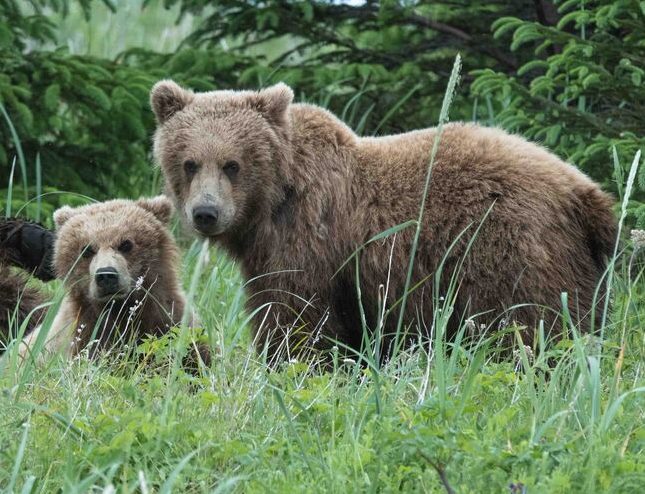
Just today, the Department of the Interior proposed another rule, again to overturn the prior administration’s rule that barred baiting of brown bears on two million acres of public lands in the state’s Kenai National Wildlife Refuge. Photo by Dacia Doroff/iStock.com
The Trump administration has given trophy hunters the green light to commit some of the worst sort of carnage on 20 million acres of Alaska’s pristinely beautiful national preserves.
Under a new rule finalized this week, trophy hunters can, starting next month, kill hibernating mother black bears and their cubs in their dens with the aid of artificial lights, shoot wolf and coyote pups and mothers at their dens, use bait like donuts and meat scraps to attract brown and black bears, shoot vulnerable caribou while they are swimming (including with the aid of motorboats), and use dogs to hunt black bears.
This is yet another dastardly move from an administration that, from the start, has carried out a no-holds-barred assault on America’s—and the world’s—most precious wildlife. From weakening protections for native American wildlife covered by the Endangered Species Act to allowing trophy hunters to import the trophies of endangered animals likerhinos and lions, the Department of the Interior, under Trump, has consistently played into the hands of trophy hunters and other corporate interests to dismantle the progress we’ve made for wildlife over decades.
A lot of this, including the National Park Service rule finalized this week, has involved reversing protections for wildlife put in place by the Obama administration.
And they’re not done. Just today, the Department of the Interior proposed another rule, again to overturn the prior administration’s rule that barred baiting of brown bears on two million acres of public lands in the state’s Kenai National Wildlife Refuge. Hunting of brown bears over bait is an extreme practice and biologists have been raising alarms about the loss of brown bear populations in Alaska.
We already know what the carnage sanctioned by these rule changes will look like. Before the 2015 rule, thousands of bears and wolves were shot from the air, killed over bait barrels, clubbed or shot in their dens and hunted down with lights at night. Many of these cruel practices professed to reduce numbers of iconic predators in order to boost prey species for hunters, but science has shown that nature cannot be manipulated this way without terrible results.
We have seen brown bear numbers across Alaska dwindle because of intensive management. State lands, where the egregious practices now permitted by the NPS rule are already allowed by the Alaska Board of Game, have seen sharp drops in wildlife populations. Alaska state officials should prefer their wildlife alive rather than dead because the tens of thousands of wildlife watchers who trek into the state each year put far more money into the state’s coffers than a handful of trophy hunters seeking to kill the animals do.
The Humane Society of the United States, along with a coalition of organizations, is currently in federal court defending the Obama-era NPS and Kenai rules. These changes are unlawful because Congress requires that the Department of the Interior conserve and protect wildlife in national preserves and national wildlife refuges. By opening season on the animals it’s supposed to protect just to appease a few trophy hunters, the agency—and this administration—have not only shown themselves to be extremely poor stewards of our public lands, they have let down a majority of Americans who would never sanction such cruelty against our native wildlife.
Sara Amundson is president of the Humane Society Legislative Fund.
An environmental group on Tuesday said it will sue the White House if President Trump doesn’t walk back an executive order that waives endangered species protections along with a host of other environmental laws.
The Thursday order from Trump relies on emergency authority to waive the requirements of a number of environmental laws, arguing the U.S. needs to fast-track construction projects to fight the economic fallout tied to the coronavirus pandemic.
The order could be a boon to controversial projects that have lingered while agencies undertake environmental reviews, ranging from pipelines to oil and gas drilling to highway construction.
Weighing how those projects might impact imperiled plant and animal life is just one of the considerations.
But the suit from the Center for Biological Diversity argues the Trump administration is violating laws that allow for sidestepping environmental review only in fast-moving emergencies like an environmental disaster.
“Congress made the deliberate decision not to elevate general economic activity and ordinary infrastructure projects above the interests of imperiled species but, rather, to ‘afford’ listed species ‘the highest of priorities’ even above the ‘primary missions’ of federal agencies,” the Center wrote in its letter of intent to sue.
The letter follows guidelines requiring a 60 day notice before filing a suit.
“President Trump has used his lawful executive authority to expedite infrastructure projects and the economic recovery while protecting the environment, and CBD is misreading the plain text of the order to push a radical, Green New Deal-like agenda,” White House spokesman Judd Deere said in an email, using an abbreviation for the Center.
The Trump administration has taken a number of steps to weaken the Endangered Species Act.
A rule finalized by the administration in August dramatically scales back America’s landmark conservation law, limiting protections for threatened species and how factors like climate change can be considered in listing decisions. It also curbs the review process used before projects are approved on their habitat.
The Thursday order also lifts environmental review required under the National Environmental Policy Act and the Clean Water Act — all of which Trump argued was necessary.
“From the beginning of my Administration, I have focused on reforming and streamlining an outdated regulatory system that has held back our economy with needless paperwork and costly delays,” Trump wrote in the order. “The need for continued progress in this streamlining effort is all the more acute now, due to the ongoing economic crisis.”
However, numerous legal experts have expressed concern over the use of emergency authority by the White House, and additional lawsuits are likely.
“Trump’s authoritarianism seems to reach deranged new levels every week,” Kierán Suckling, the Center for Biological Diversity’s executive director, said in a release.
“The president’s not above the law. Inciting federal agencies to violate the Endangered Species Act is part of a pattern he’s displayed throughout his presidency. He’s encouraging officials to ignore the rules and obey his whims,” he added.
Trump Jr. did not even have a permit from Mongolian officials when he shot an argali sheep. The permit was offered to him afterwards, raising questions about whether he received special treatment from the Mongolian authorities. Photo by Conrad Savy/Creative Commons License
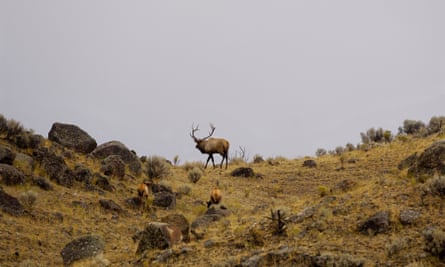
We’ve just learned that Donald Trump Jr.’s trophy hunting trip to Mongolia, where he hunted an argali sheep—an animal listed as “threatened” under the U.S. Endangered Species Act—cost American taxpayers a whopping $77,000.
The revelation comes from the watchdog group Citizens for Responsibility and Ethics in Washington (CREW), which dug into expenses Trump Jr. incurred for this controversial trip made last year. Following an initial Freedom of Information Act request, the group was provided with Secret Service protection costs alone—around $17,000 for the trip. It was only after an appeal that CREW received information of other expenses, including flight costs and a stop Trump Jr. made in the capital city of Ulaanbaatar, where he met with the Mongolian president, putting total expenses for that trip at the much higher figure of $76,859.36.
Trump Jr. is an avid trophy hunter and his exploits targeting at-risk animals, including leopards and elephants, are well documented. While all trophy hunting—done purely for fun and the thrill of killing a majestic animal—is unethical and disturbing, what is more outrageous about the president’s son’s pursuit of his deadly pastime is that Americans now have to pay for it.
The trip to Mongolia last August was an ethical minefield from start to finish. ProPublica, which originally broke the story of that trip, reported Trump, Jr. did not even have a permit from Mongolian officials when he shot the animal – it was offered to him afterwards, raising questions about whether he received special treatment from the Mongolian authorities. Argali are prized as a national treasure in Mongolia, and the permitting system for hunting one, according to ProPublica, is based on money, connections and politics.
The hunt itself was conducted at night, with a laser-guided rifle.
Back home, Trump Jr. has established himself as a champion of trophy hunting interests, peddling his famous last name for more privileges and perks, always at taxpayer expense because he receives Secret Service protection on all his trips. In February, he was the guest of honor at the Safari Club International’s annual convention, where the lives of 860 animals, including lions, polar bears, zebras and buffalo, were auctioned off. This included winning bids totaling $340,000 by two hunters for an opportunity to stay on a yacht with and join Trump Jr. in hunting black-tailed deer and sea ducks in Alaska.
Trophy hunters are usually a privileged lot with pockets deep enough to influence policies that favor their bloodlust. But Trump Jr. is not just any trophy hunter. As the president’s son he has an unparalleled ability to potentially influence our government’s policies on the world’s most endangered animals. But just like the Trump administration—which has launched repeated attacks against the most at-risk wildlife in the world, including hacking at the Endangered Species Act to benefit trophy hunters and mining and oil-drilling interests—Trump Jr. has failed to use his power to do good.
We are not staying silent. We’re challenging the administration’s changes to the ESA in court, and we are in good company, with many animal protection and environmental organizations joining us. We have also petitioned the U.S. Fish and Wildlife Service to refuse a permit for Trump Jr. to import the trophy of that sheep. Argali from Kyrgyzstan, Mongolia and Tajikistan are listed as threatened in the ESA, and import of a hunting trophy of an ESA-listed species can be authorized only if it furthers conservation. There is no evidence that this was the case here, or that recreational killing for trophies ever promotes conservation.
Being the president’s son may come with perks, like a retroactive permit from Mongolia to slay an argali and a red-carpet welcome from the world’s largest trophy hunting group; but it also comes with the scrutiny of his questionable spending of taxpayer resources by organizations like ProPublica and CREW, and opposition to his wildlife-killing activities from animal protection groups like ours. Americans do not want their money misused in a manner that will do permanent damage to the world’s most at-risk animals, and we will hold those who do so accountable, no matter how powerful and influential they are.
Sara Amundson is president of the Humane Society Legislative Fund.







 Exposing the Big Game